Things I Learned on the Way to Looking up other Things—Women’s Baseball Edition

2 Apr

A Riot in Cuba

In early 1893 a team known as the “American Female Baseball Club” traveled to Cuba to play a series of games against male teams.  The Associated Press said the team was “going about playing against Cuban clubs and otherwise exhibiting themselves with more or less success,” until they arrived in the Almendares district of Havana for a game on March 5:

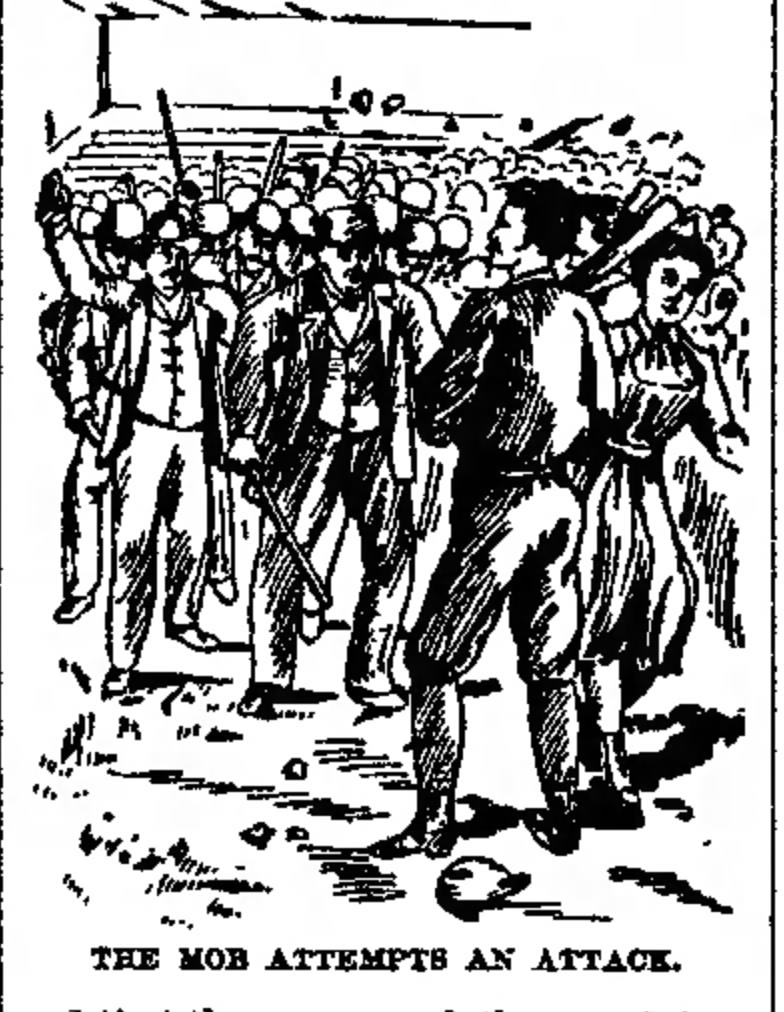
“The attendance included a share of the lowest dregs of society.  These became irritated at the playing of the American visitors and some of them declared that it was simply farcical and…claimed the young women were, in fact, not players at all.  They clamored for the restitution of their money, and at length broke seats and set fire to the fence around the play-grounds.

“This caused a general consternation among the female players, who were gallantly defended by the young men of the opposing Cuban club and by the respectable majority of the spectators.  Confusion ensued, and the shrieks of the frightened young women could be heard mingled with the execrations of the mob.  All the players, male and female, took refuge in a house.  The mob pursued them and succeeded in obtaining entrance.  Then the rioters pillaged the house.  The Cuban players fought bravely to save the young women; otherwise more of them would have been hurt.”
1893havana

Illustration that appeared with the story in several newspapers

Most of the nine players were injured in the melee, and when the team returned to New York on March 14 The associated Press said the team “brought suit for damages against the Spanish Government.  The manager of the team, a man named Joseph Bruckner, said not only were the players assaulted but the rioters “dragged down the American flag which the club carried, and destroyed it.”

The resolution of the suit, if there was any, was never reported.  And there is no record of the “American Female Baseball Club” playing again.

“Deserting Home for the Diamond Field”

The acting chief of the New Orleans police department received a telegram from Cincinnati in May of 1886:

“Arrest two runaway girls.  They will arrive on train No. 1 of the North-eastern [sic] Railroad.”

The Cincinnati Enquirer said two New Orleans officers were detailed, and:

“(U)pon the arrival of the train placed the two runaway girls under arrest and brought them to the chief’s office.  At the time of their arrest they were in the company of H. Freeman, the manager of the Female Base-Ball Club.  Arrived at the station they gave their names as Fannie Crambert and Ella Burke.  They stated that they got acquainted with the members of the club in Cincinnati, and that, believing it a pleasant life, they resolved to lead it.”

The paper noted that both “were over eighteen years of age,” and were “dressed in flashy sailor suits,” when they arrived in New Orleans.

The Chief “gave them sound advice, and stated that the ways of the female baseballists were too rough and dangerous for young and virtuous girls.”

The two were returned to their families in Cincinnati.

The manager of the team, Harry Freeman (The New Orleans Times-Picayune said his real name was Sylvester Wilson), was arrested  and “charged with being a dangerous and suspicious character…for inducing young girls to leave their homes and parents and join his troupe of baseball players.”

Freeman/Sylvester was given the choice of a $25 fine or thirty days in jail; he chose to pay the fine.

The Times-Picayune said:

“Female base ball playing in New Orleans has doubtless had its day, and there will be no more of it—this season at least.”

Bloomer Girls

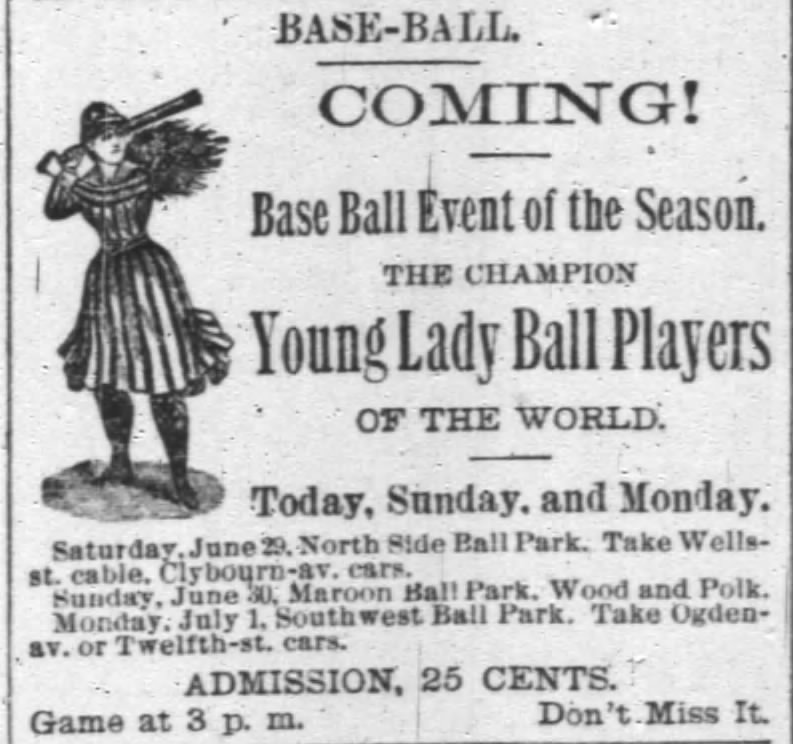
Below is an advertisement for the Chicago dates for a 1889 Barnstorming Tour of “Young Lady Ball Players of the World,” one of many teams generically called “Bloomer Girls,”  that played across the country in the late 19th Century.  This club played against male competition, and, like most women’s teams had between one and four male team members who would usually dress in drag.
womenjune1889chicago

“It is Claimed by these Citizens that the Pictures are Indecent”

In 1886, The Atlanta Constitution reported that a “cigarette picture sensation is agitating certain good people” in the city.

Cards inserted in packages of cigarettes were not new in Atlanta, or anywhere else; the practice was, at least, a decade old.  But these cards were different:

“They represent nine handsome female baseball players in attitudes common in that popular game.”

The cards were “displayed in a window” at the tobacco shop in Atlanta’s Kimball House Hotel.

“Since two weeks ago, it has been a daily occurrence for crowds to gather around the window and gaze admiringly upon the graceful forms depicted in the photographer’s art.  All sorts of people have been there, from the ragged boot black to the merchant prince.”

The cards quickly became controversial:

“A number of staid citizens have expressed themselves as being opposed to the exhibition of the pictures, and have declared their intention to request Mayor (George) Hillyer to interfere.  It is claimed by these citizens that the pictures are indecent.”

Atlanta was not the only city where the cards were a sensation, and controversial.

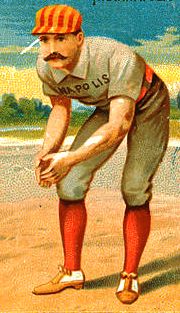
One of the cards that caused the sensation

One of the cards that caused the sensation–Pacholder Tobacco Company created the series to promote brands including Sub Rosa and Dixie–many extant examples of the set are part of New York’s Metropolitan Museum of Art collection

The New York Journal railed against the “objectionable pictorial advertisements in tobacco shop windows.”  Anthony Comstock’s Society for the Suppression of Vice contacted cigarette manufacturers and retailers ordering them to “cease these immodest displays, or prepare to face legal prosecution.”

The Journal said:

“Business men complain that some of the picture exhibited in the retail cigar stores…are of such a character that their wives and daughters hesitate to pass them, because of the open comments of boys and men who hang about the windows.”

While the displays were removed from many windows throughout the country, there is no record of any prosecutions of those who refused to remove the “offensive” cards.
“There is a Constant fear that Someday the Men will Decline to go on the field.”

31 Mar

The St. Louis Maroons were a big league franchise for just three seasons.  After winning the inaugural (and only) Union Association championship in 1884, the team was absorbed into the National League and was a dismal 36-72 in 1885, and 43-79 in 1886.

The club disbanded after the ’86 season and throughout the winter there was speculation about whether the franchise would end up in Kansas City (where local businessmen were looking to replace the Cowboys, who also went broke after the ’86 season) and Indianapolis.

The deal was finalized on March 8 when the franchise and nine players were sold to Indianapolis.  The Indianapolis News announced on the front page:

The Base Ball Deal

It Is Finally Completed

The story said:

“There is general rejoicing about the city over the certainty of having a league baseball club here.”

The team would be called the Hoosiers, and play at the Seventh Street Grounds, a ballpark owned by local businessman John Tomlinson Brush.

John T. Brush

John T. Brush

Brush was the driving financial force behind the deal and had been involved in local baseball in Indianapolis for several years, first having financed and organized a local amateur league in the city in order to promote his business—the When Store, and later the When Clothing Company—he was also an investor in the short-lived 1884 incarnation of the Hoosiers who struggled through one twelfth-place (29-78) season in the American Association.

The Hoosiers first year was unsuccessful and chaotic.

The first manager was George Walter “Watch” Burnham, who had been a National League umpire for 41 games in 1883 and one in 1886.  His role in the effort to acquire the franchise, his selection as manager, and the manner in which he acquired his nickname, gave some pause about the seriousness of the Indianapolis operation.

"Watch" Burnham

“Watch” Burnham

The Chicago Tribune said:

“The promoter of the Indianapolis movement is George W. Burnham, known as “Watch” Burnham.  At Cleveland, in 1883, while acting as a league umpire, he endeavored to establish himself in the public esteem by buying a watch, having ‘Presented to George W. Burnham by his friend and admirers’ inscribed on it, then having it sent out to him on the field during the progress of the game.  It is not surprising that some of the league people are suspicious of the Hoosier effort.”

Brush was not the team’s original president, that duty fell to a local attorney named Louis Newberger who spent his entire two-month tenure in the position complaining that he had no time to run the team; Brush took over as president in late May.

The Hoosiers limped to a 6-22 start—no doubt aided by 22 straight road games from May 5 through May 30.  Burnham resigned once, just five games into the season, but returned a few days later.  By mid May, as the team struggled through their endless road trip, The Chicago Tribune said a mutiny was expected:

“The dissatisfaction on the part of the players with Burnham, the manager, amounts almost to insubordination and there is a constant fear that someday the men will decline to go on the field.”

The Tribune said Burnham had fined “the entire team,” and Captain Jack Glasscock “said he would be black-listed before he would play again under the management of Burnham, but was finally prevailed upon to do so.”

Jack Glasscock

Jack Glasscock

Upon the team’s return to Indianapolis Burnham was replaced with team secretary Fred Thomas.  Thomas, like Burnham, had no professional experience as a player or manager, and his tenure was not much more successful.  The club lost 18 of 29 games with him at the helm.

The team’s third manager also had no previous professional experience.  Horace Fogel was a sportswriter for The Philadelphia Press when he was tapped to be the third manager.  The Indianapolis News said hopefully:

“Mr. Horace Fogel, the new manager, is a good-looking young man, and makes a favorable impression on a stranger.  He is evidently very anxious to make the club a winner.”

The same July day The News opined on Fogel the paper also noted that maintenance of the ballpark had also angered some fans:

“Very unwisely the management had the chairs in the gallery varnished recently and yesterday several ladies had their dresses ruined.”

Things were no better under Fogel.  The Hoosiers went 20-49 under their third manager, and finished their inaugural season in eighth place with a 37-89 record.

The News said:

“Staring out under unfavorable circumstances…with inefficient management throughout the season, and many more defeats than victories, the club nevertheless, was accorded a generous support.”

The 1888 season became a matter of civic pride for the team’s ownership, local businesses and the newspaper.

In January it was announced that the Hoosiers would have a manager with at least some experience.  Harrison “Harry” Spence had played and managed in, among others, the Eastern, Northwestern and New England Leagues.  The News said of the new manager:

“A number of ball players of various clubs, who know Harry Spence…speak very highly of him.  Sam Thompson says he is a thorough gentleman, well liked by the players, and a fine manager.”

The News said the success of the Hoosiers was necessary for the future Indianapolis:

“Business and professional men are all interested in it, for, aside from the pleasure they derive from witnessing the games, they recognize the fact that the club is of great benefit in advertising the enterprise and prosperity of the city.”

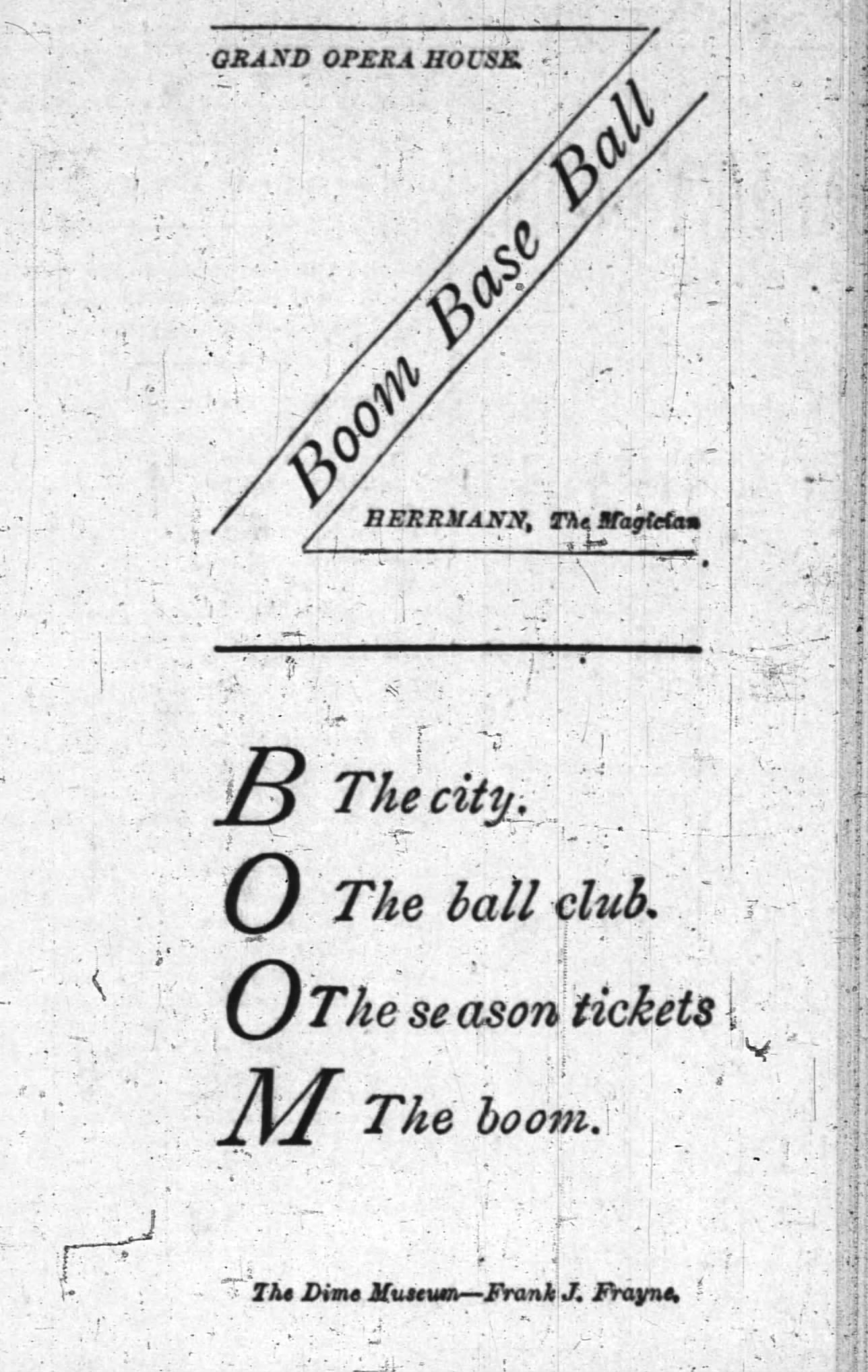
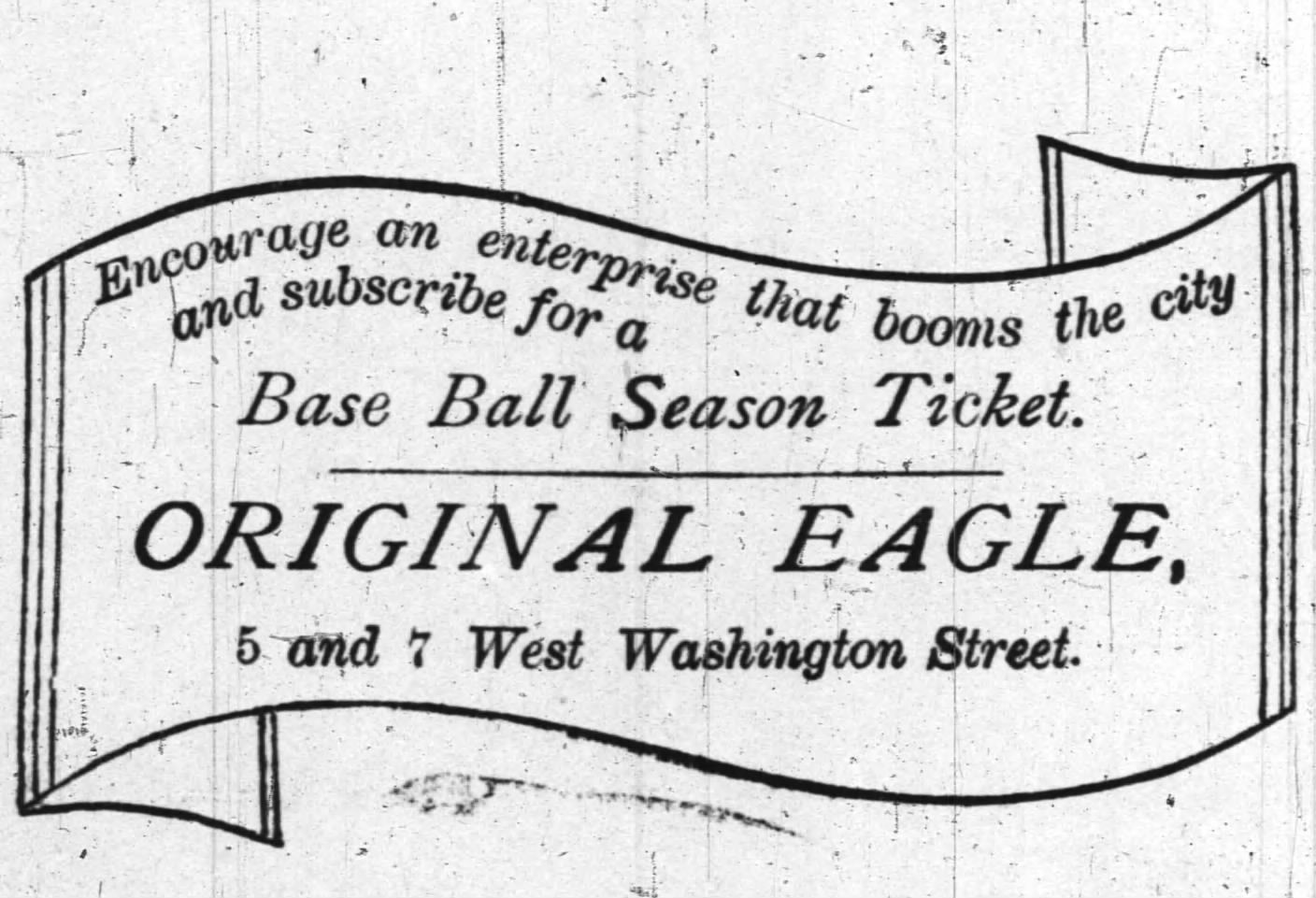
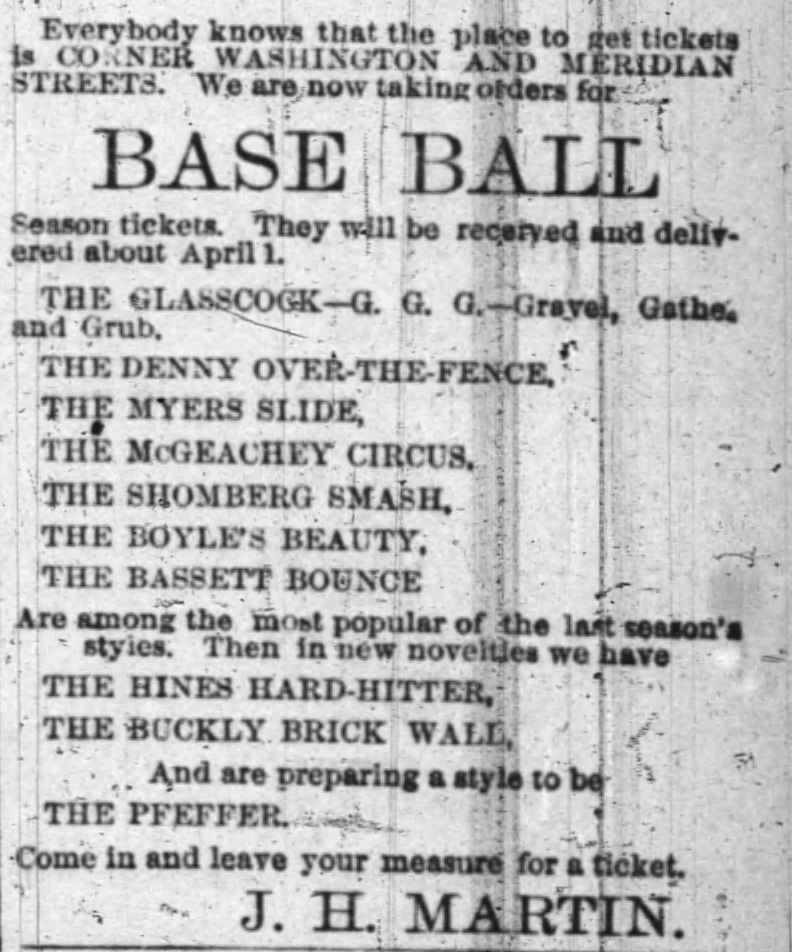
The paper organized a campaign called “Boom for Baseball.”  Sixty-eight local businessmen “representing the leading establishments in the city,” donated their advertising space back to the newspaper “for the purpose of setting forth the advantages that will accrue to the city, from the maintenance of a National League Baseball Club here.”

Brush told the paper:

“We want at least five hundred subscribers for season tickets, and with this as a guarantee, we can get the money we want.  If any such player as (Fred) Pfeffer or (Larry) Twitchell can be bought we can and will buy him, and we can get the club in first-class shape for opening the season.”

Season tickets were sold for $25 each, and Brush said “We will have a grandstand that will be a beauty, with all the latest improvements, so that there will not be one uncomfortable seat in it.  Then we will have a space set aside for carriages and a special department for ladies and their escorts.”

88indy4 88indy2

Some of the advertisements from Indianapolis' "Baseball Boom"  campaign

Some of the advertisements from The Indianapolis’ News’ “Baseball Boom” campaign

Most importantly, Brush assured the people of Indianapolis that they “would have a ballclub here that nobody would be ashamed of.”

He was wrong.

While not as bad as 1887, the Hoosiers got off to a 2-11 start, and struggled to a 50-85 seventh place finish, 36 games behind the champion New York Giants.

By 1889 Indianapolis had all but given up.  The team nearly went under before the season started.  In January a headline in The News said:

The Ball Club Gone

With debts of more than $5,000, the paper said Brush would “surrender the franchise” to the league.  Brush was able to raise enough capital to keep the club operating for one more sub .500 season (59-75), and another seventh place finish.  The only highlights for Indianapolis in 1889 was the arrival of 18-year-old Indiana native Amos Rusie, who posted a 12-10 record, and Jack Glasscock who hit .352, for the Hoosiers.

The team was dropped after the 1889 season, but not because of money.  The National League bought out Brush’s Hoosiers and the Washington Nationals.  Brush received a reported $67,000 for the team, he also received stock in the New York Giants as payment for former Hoosier players.  One year earlier when The News reported that Brush was on the verge of losing the team, the paper claimed “the franchise is now worth $15,500 cash.”  While that figure might have been low there was no doubt that Brush did well on the deal.  A year later he was president and majority stock holder of the Cincinnati Reds.

Indianapolis would only be a major league city one more time; in 1914 the Hoosiers were champions of the Federal League, but were relocated the following season, becoming the Newark Peppers.

Lost Advertisements–Opening Day, 1911

28 Mar

1911openingday

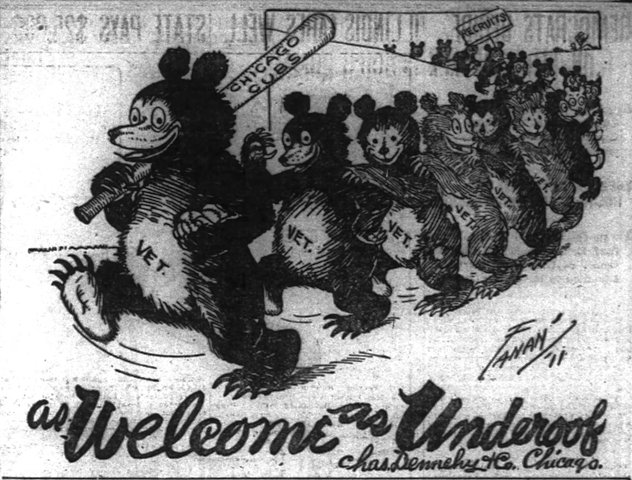
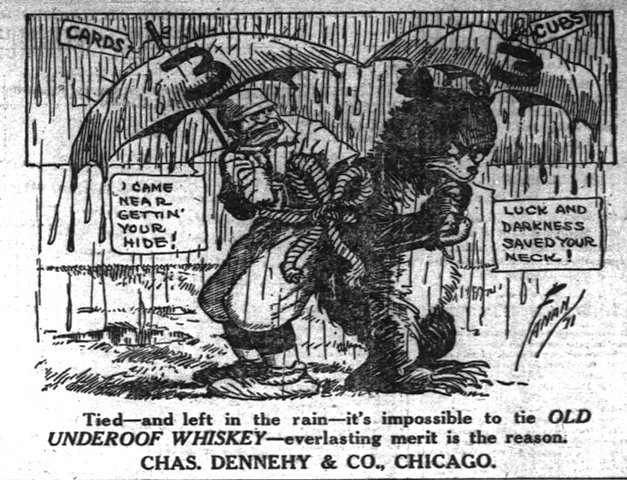
The above advertisement for Charles Dennehy Company, distributor of Old Underoof Whiskey,  appeared in The Chicago Inter Ocean on Opening Day, April 12, 1911.  The defending National League Champion Cubs met the St. Louis Cardinals at Chicago’s West Side Grounds.

The Chicago Tribune said:

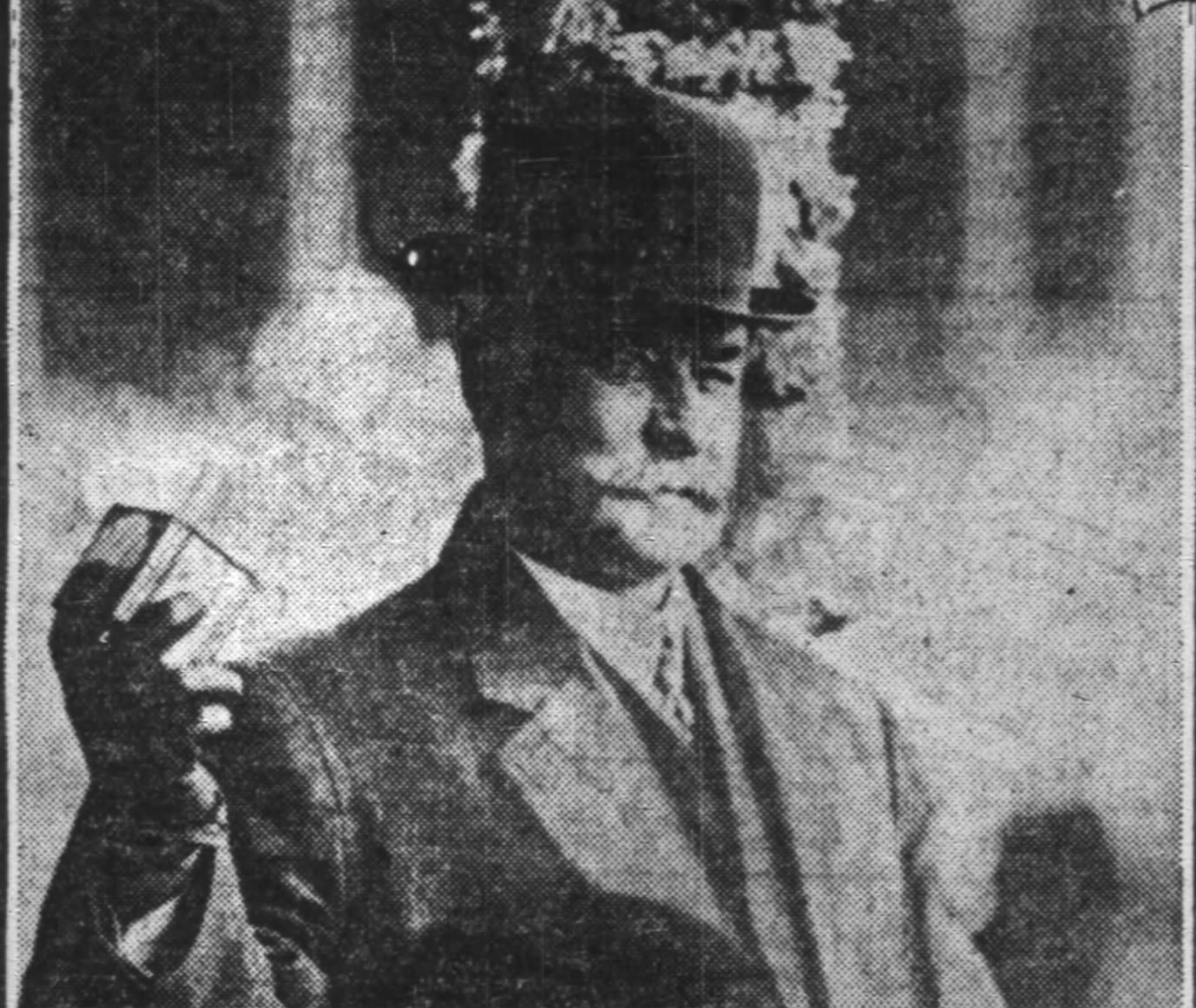
“Threatening clouds and misty atmosphere did not prevent the baseball public from of Chicago turning out for the opening.  There was almost a parkful [sic] of people there before the teams had begun their preliminary practice.  A brass band livened things up before the game started, and between innings a novelty in opening features was the presence of a woman who stood on the roof of the players’ bench and sang popular songs.  Mayor Elect Carter H. Harrison Jr.  from an upper box tossed out the ball that started the contest.  The entire park was draped with American flags.”

Carter Harrison at 1911 Cubs opener

Carter Harrison at 1911 Cubs opener

The game was called after 11 innings.  The Inter Ocean said:

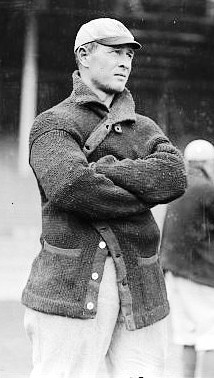
“Sometime, somewhere there may be such an opening game as was played at the West Side grounds yesterday when the thirty-sixth season of the National League was introduced with a 3 to 3 tie by the Chicago Cubs and the St. Louis Cardinals, but never again will a seventh position club of the season before hang the hoodoo on the league champions as Roger Bresnahan‘s crew did the trick on the Peerless Leader’s squad…It was a sin and a shame.”

Frank Chance, "The Peerless Leader"

Frank Chance, “The Peerless Leader”

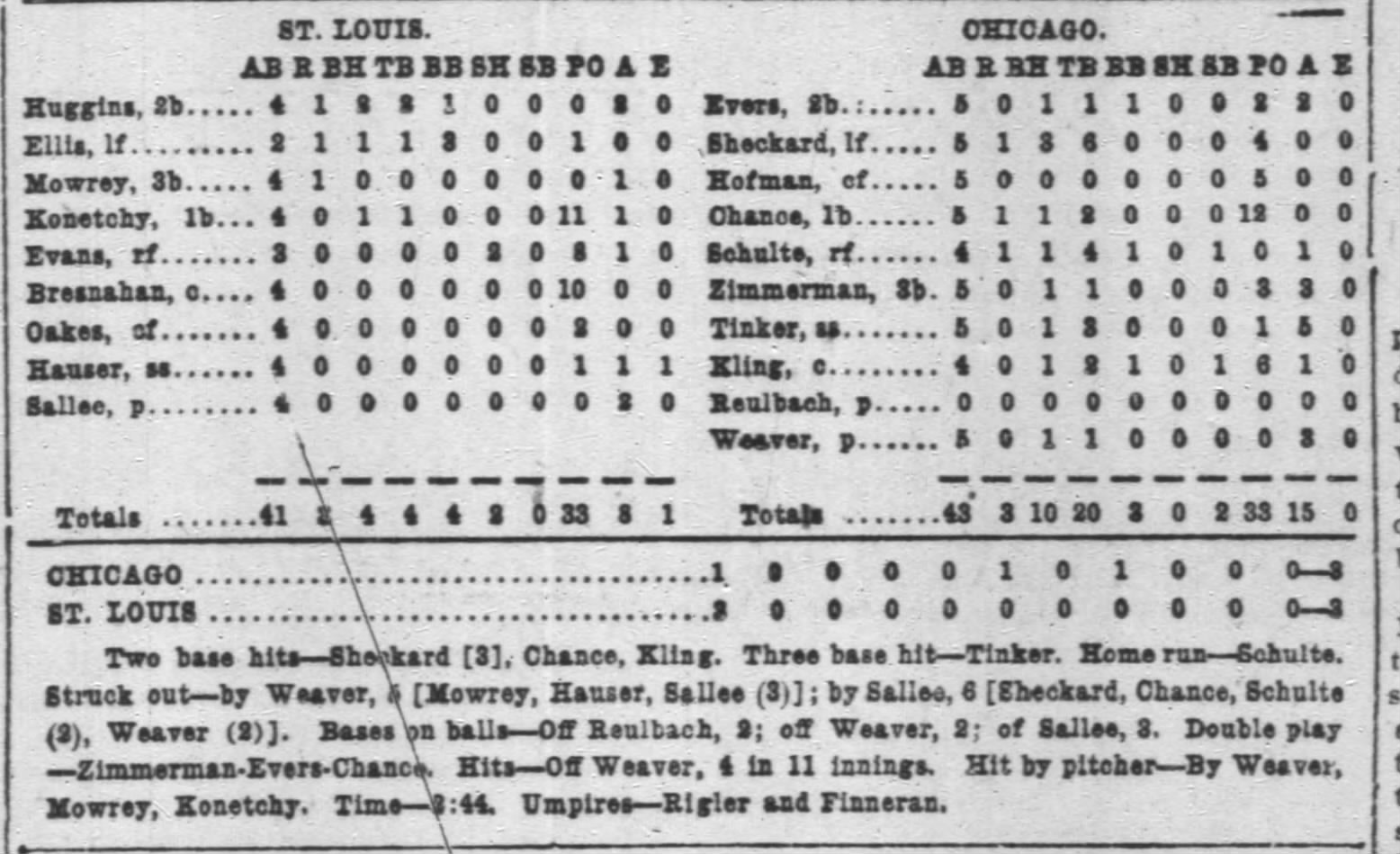
The Cardinals scored three runs in the first; starter Ed Reulbach–The Inter Ocean said he “was one wild critter–was pulled by Manager Frank Chance after throwing 10 straight balls to open the game, and was replaced by Orlie Weaver who finished the game.

The Tribune said the tie was the result of two “grievous errors of the mind.”

The first happened when Cubs third baseman Heinie Zimmerman fielded Bresnahan’s first-inning ground ball with runners on second and third:  “All Heine needed to do was toss the ball to the plate and one runner would have been caught, but he heaved to first base instead and the man coming from third (Mike Mowrey) scored, after he had actually stopped running.”

The other “grievous error” was made by second baseman Johnny Evers “incredible as it may seem, for Johnny is often talked of as the brainiest man on the team.”  Evers tried to score from first on Jimmy Sheckard‘s double in the first inning.  Cardinals first baseman Ed Konetchy took the relay throw and “there are none in the National League who can throw harder and  with greater accuracy”  Evers was thrown out by “ten feet” at the plate.

The Tribune said Chance “knows now that he acted against his better judgment in putting Ed Reulbach in to pitch the first game of the season.”  Reulbach had only appeared in 24 games in 1910 and was recovering from diphtheria (some recent references say Reulbach missed part of 1910 because his son had diphtheria–but several contemporaneous accounts say he suffered from the bacterial infection as well).

The box score

The box score


The Cubs went on to win 92 games in 1911, but finished in second place, seven and a half games behind the New York Giants.  The Cardinals finished fifth at 75-74.

Reulbach was 16-9 with a 2.96 ERA, but continued to struggle with control all season, walking 103 batters in 221 and 2/3 innings.

Below is another Old Underoof advertisement that appeared in The Chicago Examiner:

1911openingday2

Opening Day—1901

26 Mar

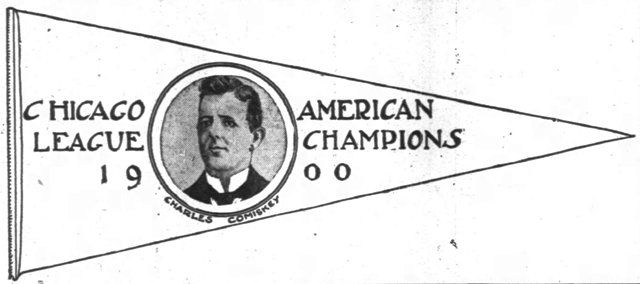
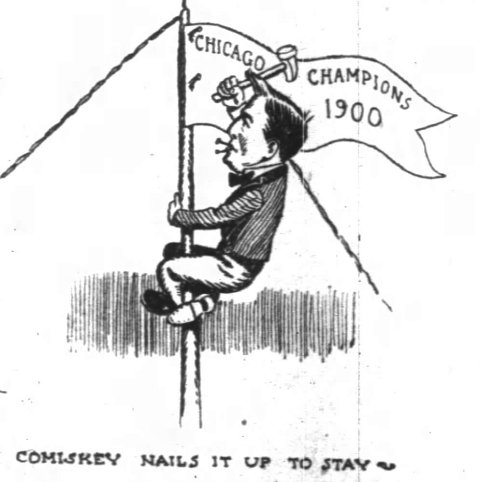
The Chicago White Sox opened the American League’s inaugural season as a major league on April 24, 1901, against the Cleveland Blues.  The three additional league games scheduled for the 24th were postponed on account of rain.

The Sox won the then-minor league American League championship the season before.

1900alchamps


Comiskey relinquished managerial duties in 1901 to Clark Griffith, the pitcher jumped from the cross-town National League Orphans for a reported $4,000; a $1,500 salary increase.

Clark Griffith

Clark Griffith

The opener at Thirty-Ninth and Wentworth included a parade, several bands, and speeches from many dignitaries—The Chicago Tribune said every member of Chicago’s City Council was on hand, but Mayor Carter Harrison, who had promised Comiskey he would appear to speak and throw out the first ball, “was kidnapped by William J. Bryan, who slipped into town unperceived. ‘Commy’s’ plans for having the Chief Executive start the opening game were shattered.”

The Tribune said American League President Ban Johnson also missed the game; he had traveled from league headquarters to attend the opener in Philadelphia “and it’s a 1,000 to 1 shot he was sorry when he found Comiskey was the only magnate who had squared himself with the weather man.”

Other than the absence of the mayor and the league president, the paper said the first game of the upstart league was a success:

 “Under the fairest skies the weather clerk could select from his varied stock of April goods; with a championship pennant floating high above them from the proudest pine of all Michigan forests; with 9,000 fans to cheer them from a pent-up enthusiasm that burst forth at every possible opportunity, the White Stockings open the American League baseball season on the South Side Grounds yesterday with a clean-cut victory over the aggregation from Cleveland.”

The Chicago Inter Ocean, which reported the attendance at 10,073 said:

“As a grand opening it was an unqualified success, something which Charles Comiskey can look back upon in after years with all the serene satisfaction of a baby who has just swallowed a tin Indian.  As a ball game it was a hideous nightmare, a cold and icy vision of the darksome night, a living horror, let loose to stalk adown a diamond field, hooting hoarsely…With pomp and ceremonial, with braying of bands and braying of fans, with an enormous audience gathered in the frapped stands, the American League season of 1901 was duly opened in Chicago, and the real champions, Comiskey’s White Stockings, began their campaign by giving the Clevelands all that was coming to them.  The afternoon was cold; the stands were Greenland, and the bleachers bore nets of icicles.  Yet 10,000 cranks and crankesses, keen devotees of the game.”

The Chicago Daily News said more than 14,000 fans were at the game:

“Promptly at 3:30 the two clubs lined up at the plate and, preceded by a “Rough Rider” band, marched to the flagpole at the south end of the field, where the championship banner was unfurled to the strains of ‘The Star Spangled Banner.’”

Cartoon of "pennant" being hoisted from The Chicago Tribune.

Cartoon of “pennant” being hoisted from The Chicago Tribune.

The Associated Press said the attendance was 8,000.

The Tribune said the crowd was enthusiastic despite the weather:

“There were cheers for everybody, from (William Ellsworth “Dummy’) Hoy, who couldn’t hear them, to (starting pitcher Roy) Patterson, the hero of many a hard-earned victory last year…there were flowers for (Dave) Brain, the youngest of the White Soxs [sic]…And at the end there was so much surplus exuberance that the bleacherites indulged in a merry cushion fight all through the concluding inning by way of celebration.”

Chicago scored two in the first and five in the second off Cleveland starter Bill Hoffer and cruised to an 8 to 2 victory behind Patterson.

The Inter Ocean said the most “ludicrous” play of the otherwise “uneventful” game took place in the sixth inning when Hoy attempted to steal third:

“(Catcher Bob) Wood threw wild, and (Bill) Bradley scooped up the ball way off from the cushion.  As Bradley, with no thought of the runner, turned to return the ball to the pitcher, Hoy, losing his balance as he ran, slid clear over third , out into the field and right into Bradley, his knee striking the ball clasped in Bradley’s hand.  It was possibly the first case on record of a man’s forcing a put-out on himself, and the crowd marveled greatly, perceiving that the science of the game had much advanced, and that there were new freckles every day.”

While the Chicago Orphans were losing their opening game in Cincinnati, The Tribune said the team’s president, James A. Hart, “was present and witnessed the game from a box at the south end of the grandstand.  He chatted with President Comiskey for some time and seemed to like the work of the players, but he did not voice his sentiments.”

Behind Griffith and his 24-7 record, the Sox won the league’s first pennant with an 83-53 record. Opening Day pitcher Roy Patterson was 20-15.  Cleveland finished seventh with a 54-82 record; Hoffer was 3-8 in 16 games when he was released in July, ending his major league career.

1901 Chicago White Sox

1901 Chicago White Sox

Comiskey and Hart were both members of their respective league’s “peace committee” at the January 1903 meeting in Cincinnati that led to the forging of the first National Agreement.


Opening Day—1890

24 Mar

The New York Sun said the Players League had won the battle:

“The local Brotherhood team have scored first blood, first knockdown, and have in general the best of the initial clash between the Players’ and the National League in this city.  While the latter were prepared for defeat, they had not anticipated such an overwhelming victory for the seceders as at least 3 to 1 in attendance.  They did not believe the Brotherhood would get 2 to 1, and so the result was rather staggering.  The admirers of the players are jubilant over the good attendance, and one of the partisans tersely said: ‘The League? Why they’re not in it and might as well give it up.  Let’s have another drink on the boys.’”

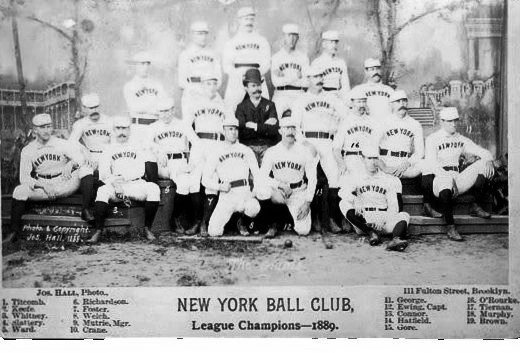
Fans streamed into the “grounds on Eighth Avenue” (the Brotherhood Ballpark was built next door to the Polo Grounds) and by the time the first Players’ League pitch was thrown in New York, 12,013 were on hand, while only 4,644 paid to see the National League.  The Players League team was composed mostly of players who had been with the National League Champion Giants in 1889–both teams were called the New York Giants in 1890.

Many of the members of the 1889 Giants jumped to the Players League in 1890

Many of the members of the 1889 Giants jumped to the Players League in 1890

The Sun said it would be “invidious to draw comparisons between the class that attended the League game and that which patronized the Brotherhood;” then went on to draw comparisons.

“But after a few moments’ study of the crowd surging down the elevated railway stairs an acute observer could quite easily have foretold which grounds each spectator or party was bound for.  Not but what there were plenty of well-dressed men and women in the immense crowd that wended their way toward Brotherhood Park, but rather in the excited holiday air the Players; sympathizers were.”

The Brotherhood crowd consisted of “urchins and young men,” while the National League crowd included “exquisitely dressed representatives of the fair sex.”

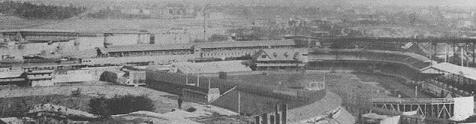
The two ballparks

The two ballparks

Although the field had been completed for weeks and was “in beautiful condition,” the Brotherhood Ballpark (what would become the final incarnation of the Polo Grounds) was “in an unfinished state,” and carpenters continued to work on the grand stand and lower tier seats as fans entered the park:

“The clubhouse was also only half built, and a huge banner with the words “World’s Champions” was spread across the front of it, as if to hide the unfinished part.  Flags and gay bunting were lavishly spread over the stand, but as one crushed spectator aptly put it: ‘They’d done a good sight better to build seats.’”

Despite the unfinished ballpark, the Brotherhood game was met with much fanfare:

“A cause of great enthusiasm and cheering in Brotherhood Park was the frequent arrival of tally-ho coaches, some of which were gaily decorated and bore appropriate inscriptions…Precisely at 3 o’clock the Players’ Philadelphia Club marched from the club house , preceded by the sixty-ninth Regiment Band.  They received a royal welcome to which the courteously doffed their caps.”

The New York team and Manager Buck Ewing then took the field:

“Such cheering, such yelling, as they neared the stand!  People threw up their hats and went crazy…as they broke ranks the dog on the club house porch broke into a prolonged howl.”

The crowd for the National League was more subdued, but The Sun quoted “one stalwart young man, whose face has been a familiar sight for years at the ball games,” who said the Brotherhood would “have the best of it for the first two weeks.  But wait.”

Both New York Giants teams lost their first game of the 1890 season, each to the Philadelphia franchise in their respective leagues.

The Players League lost the war.

The League outdrew the National League and American Association (PL-980,877, AA-803,200 and NL-776,042—the numbers are estimates and there is ample evidence that everyone lied about attendance figures during the year), but the Brotherhood lost an estimated $125,000 on top of more than $200,000 of debt incurred in building new ballparks.

The National League lost even more—some estimates as high as $500,000.

Although no contemporaneous details survive, the accepted story is that Albert Spalding was able to convince the Players League investors that their financial situation was worse than the National League’s.  Rather than a compromise, Spalding was able to negotiate an unconditional surrender.

The Players League would not have a second Opening Day.

“The Game was not Exactly ‘On the Square’”

21 Mar

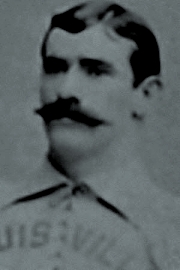
After the 1886 season, Jim Hart brought a team composed of members of his Louisville Colonels and other American Association players west.  The team played their way out towards California, winning twenty games against minor league, semi-pro and “picked nines.”

Jim Hart

Jim Hart

They finally lost their first game of the tour in San Francisco on December 26 to the Haverlys of the California League.  Dave Foutz, who had won 41 games for the champion St. Louis Browns pitched for Hart’s club.  Foutz allowed three runs on four hits in the first inning then shut out San Francisco on one hit the rest of the way, but Pete Meegan of the Haverlys held the American Association players to just two runs.

Pete Meegan

Pete Meegan

The San Francisco Morning Call said that Foutz who was “rather superstitious” and tried to “have a lemon in his possession whenever he steps on the diamond,” attributed the loss to the fact that the he had purchased a lemon “but was careless and did not put it in the pocket of his uniform.”

After the loss, Hart’s team defeated every California League team, including a Foutz one-hitter against the San Francisco Pioneers.

Dave Foutz

Dave Foutz

On January 23, with some of his players injured, Hart added three local players to his roster for a game with a “picked nine’ of local players in Alameda.  The game was tied 4 to 4 after seven innings, but Foutz gave up two in the seventh and four in the eighth and lost 10 to 4. The San Francisco Chronicle said:

“A large crowd was in attendance at the Alameda Baseball Grounds yesterday to witness the game between the Louisvilles and a picked nine of California players… the impression of many of the spectators was that the game was not exactly ‘on the square’…The cause of suspicion was as to the fairness of the game was caused by the appearance among the spectators of men well known at baseball games offering large odds against the Louisvilles.  At about the seventh inning these men were offering odds of twenty to one against a team that has hitherto been almost invincible.”

The Morning Call headline said simply:

“Hippodrome!”

There was no doubt, said the paper, that the game had been “pre-arranged” and “made up for the picked nine to win.”

In St. Louis there was more concern that Foutz had “broken down,” having given up fourteen hits rather than speculation that he might have thrown a game.  The Globe-Democrat said:

“Regarding the reported break down of Foutz in California… (Manager Charles) Comiskey received a letter from Foutz in which he denied that he had broken down, and said he was as good as ever.”

No one reported whether the pitcher had carried a lemon into the contest.

The evidence of a fix consisted of the activity of the gamblers, Foutz’ performance in the seventh nd eight innings, and an alleged conversation between Louisville’s second baseman Joseph “Reddy” Mack and Ed Morris the pitcher for the “picked nine.” Discussing how the result of the lightly attended game would improve attendance at the next game Louisville was scheduled to play in Alameda two days later.

reddymack

Reddy Mack

Jim Hart was indignant and wrote letters to West Coast papers denying that anyone on his team could have been involved:

“I wish to say that I have made the fullest and most searching investigation and can find no foundation for the charges.  Not one of my men wagered a dime.”

Hart blamed the loss on the “weakened condition” of his team and noted that three local players filled in with his squad for the game.  The players he “brought out here all enjoy national reputations, and they could not afford to hazard their good names for the small amount of gain there would be for them.”

In another letter, written to The Sporting Life, Hart attacked the credibility of the unnamed writer of the article in The Morning Call:

“(I)t was not much of a surprise to in the issue of a sensational morning journal last Monday the flaming headline ‘Hippodrome!’  The journal referred to, I understand, instructs its reporters and correspondents in the following language—‘Make your articles sensational even at the expense of the truth,’ and the young man who wrote the article under the above referred-to head line was evidently closely following instructions…What the young man who wrote the article don’t [sic] know about baseball would make a very large book.”

Hart went on to detail his additional complaints with “the young man” from The Morning Call, but as with his letters to West Coast newspapers, he never addressed the allegations regarding the abrupt changes in the odds offered on the game, and instead of asserting that “Not one of my men wagered a dime,” as he said in the earlier letters, the letter in The Sporting Life said:

“I have investigated the whole matter religiously, and if any of the boys were implicated in any way, they are too smart for me to find out.”

The California League conducted the only official” investigation into the allegations; that inquiry was limited to determining if any of their players were involved in any wrongdoing and according to The Chronicle, simply determined that no California League players “had anything to do with it or were cognizant of it,” and made no statement regarding whether there was evidence of a fixed game.

The Chronicle evidently didn’t think the case was closed and said:

“If Foutz, Mack or (Hubert) Hub Collins expect to come out here again, they must arise and explain to the entire satisfaction” of the league president.

The Louisville team wrapped up the tour in early February; Hart resigned his position and relinquished his interest in the team in order to take over the operation of the Milwaukee Cream Citys in the Northwestern League.  Mack and Collins returned to Louisville, Foutz headed to St. Louis and another 19th Century allegation of dishonest play disappeared into the ether.

“You are mostly Fakes, and yet I love you all!”

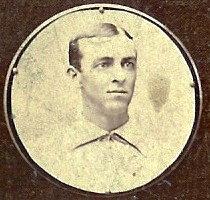
19 Mar

Elmer Foster became better known after his career had ended than he ever had been as a player because of sportswriter Hugh Fullerton who included stories he said were about Foster in his columns for more than twenty years.

Elmer Foster

Elmer Foster

The first story appeared in 1897, shortly after Fullerton arrived at The Chicago Tribune:

“The long-lost is found.  A few days ago a traveling man who is a baseball fan climbed on the train with the Colts and engaged Jimmy Ryan in Conversation.

“’Who do you think I saw the other day?’ he queried…I was up in Minnehaha, the village at the falls of St. Paul.  About 10 o’clock at night I was preparing to go to bed, when suddenly there came a series of war whoops up the street.  A man came tearing down on horseback, whipping the animal to dead run and whooping like a Comanche Just as he got to where we were standing he pulled two revolvers and, still whooping, emptied them into the air.  I was scared to death, but no one else paid any attention.  When the danger was over I crawled out from under a cellar door and said ‘Who is that?  ‘Oh, that’s nothing,’ said one of the gang.  ‘It’s only Elmer Foster going home.’”

The 1897 article also told a more accurate version of the incident in Pittsburgh that led to Foster’s release than Fullerton told in later years–it mentioned that he was with Pat Luby (incorrectly identified as “Harry” Luby), and Fullerton, in this version, did not claim to be present.

With that the legend was born.

Hugh Fullerton

Hugh Fullerton

By the turn of the century the legend grew.  Fullerton said:

“Foster was a great baserunner…He ran regardless of consequences, and perhaps no man that ever played in fast company ever took an extra base on a hit oftener than did Elmer.  He simply refused to stop at his legitimate destination, and kept right on.  When he got caught he always said: ‘Why, I wasn’t a bit tired.  Why should I have stopped running?’”

By 1903 Fullerton said of Foster:

“No man who was interested in baseball during the early ‘90s can certainly have forgotten the name of the man who was perhaps the best center fielder who ever wore a Chicago uniform.”

Like Bill Lange, another player he helped make famous long after his career was over, Fullerton’s most often repeated story about Foster was a dubious one involving a catch—a story that was repeated over the years as having happened three years after Foster’s big league career was over:

“Back in ’94 one of the Eastern teams was playing Chicago on the West Side, with Foster in center field.  The man at bat made a terrific swipe at the ball and hit it.  The shadow was deep over the infield and Foster could not see the ball.  He started to run out into far center, so as to be prepared.

“As a matter of fact the ball was only a bunt.  The shortstop caught it and threw the batter out at first.  But Foster kept on running—running like mad….Foster ran at the top of his speed almost to the center field fence.  Then he jumped high up into the air, threw up his left hand, and came down to the ground with—an English sparrow tightly clenched in his fist.”

In addition to Fullerton repeating the story over the years,  “Gentleman” Jim Corbett retold it in his syndicated sports column in 1919 and Al Spink, writing for The Chicago Evening Post in 1920 quoted former Chicago White Sox Manager Jimmy “Nixey” Callahan telling the story in 1920—like the original, both Corbett’s version and Spink’s via Callahan say the “catch’ happened three years after Foster left Chicago.  The story survived until at least 1925 when it appeared in several paper as park of a King Features syndicated column of short baseball stories.

Fullerton’s Foster stories—including several regarding drunken pranks Foster was alleged to have played on Cap Anson—became so ubiquitous that William A. Phelon of The Cincinnati Times-Star  said in 1912:

“It is now an accepted tradition that Elmer Foster, the famous fielder, led the Chicago team on a glorious, care-free, drunk through a whole wild merry season in 1891.  That is believed by everybody—yet the records show that Foster played just a few games with Chicago in 1890, and was released in April [sic] of 1891, before the season was even one week old!  Oh, you legends!  Oh, you deceiving old stories!  You are mostly fakes, and yet I love you all!”

“Foster you are Released”

17 Mar

Elmer Ellsworth Foster’s career as a pitcher ended on August 26, 1884.  He had been out for three weeks with “an injury to the tendon in his right arm,” when he took the mound for the St. Paul Apostles in a Northwestern League game against the Milwaukee Brewers.  The 22-year-old was 17-19 with 1.18 ERA when he took the mound at St. Paul’s West Seventh Street Grounds.

The St. Paul Daily Globe said:

“When the popular favorite took his position in the box in the last half of the first inning the audience received him with an ovation of cheers, to which he responded by raising his cap.  A moment later he pitched the first ball, a sharp crack was heard distinctly all over the ground and the sphere went spinning ten feet to the right of the batter.  Foster turned pale, but stood in his position until the players in the vicinity reached him.”

He had “snapped the bone of the right arm just above the elbow,” and after Foster left the field a collection was taken up among the fans “A few minutes later it was announced that $172 had been collected.”

He made it to the major leagues two years later as an outfielder with the New York Metropolitans in the American Association, and played parts of five seasons in the American Association and National League.  A consistent .300 hitter in the minors, Foster hit just .187 in 386 big league at bats.

According to The Sporting Life, his manager with the New York Giants in 1888 and ‘89, Jim Mutrie considered him “one of the best fielders in the country, and the only reason New York ever let him go was because he didn’t show up well with the stick in fast company.”

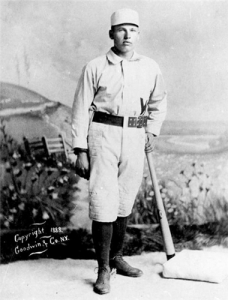
Elmer Foster

Elmer Foster

Sportswriter Hugh Fullerton said he excelled at other things as well:

“The rowdy of the rowdies was Elmer Foster.  Handsome, well bred, clean cut and with it all, well educated and something of an actor.  Foster was in baseball for the fun of it.”

From the time Fullerton joined The Chicago Tribune in 1897 until he left Chicago for New York in 1919 Bill Lange was probably the only 19th Century player he wrote about more often Foster.

Foster’s  best season was 1890 (.248 in 105 at bats and 5 home runs) with Cap Anson’s second place Chicago Colts after being acquired in late August.

Foster started the season with his hometown Minneapolis Millers in the Western Association (he hit .388 in his first twelve games), but fell out of favor with Manager Sam Morton after he and a teammate named Henry O’Day were arrested and fined in Milwaukee for public intoxication in May.

Foster was benched, but the team refused to release him, and by mid-July he was ready to take the Millers to court.  The St. Paul Daily Globe said:

“(Foster) threatens to bring suit against the management to compel its members to give him his release.  His claim will be that they are unjustly preventing him from earning a livelihood.  There is a possibility that the threat may be only a bluff, but should such a trial be put on, it will be of much interest in Western baseball circles, as it will be the first of its kind in this section.”

The Millers finally chose to release Foster rather than fight a lawsuit.  Foster was rumored to be headed to several different teams, but finally signed with the Colts on August 27.

After his strong September in 1890 Foster began the ’91 season as the Colts center fielder, but it didn’t last.

Fullerton said Foster sealed his fate with Anson during the opening series:

“We were going to Pittsburgh, and just before we arrived in town on the unearthly jump from Chicago to Pittsburgh, via Cleveland, Anson came along and sat facing us.

“’Foster,’ He said ‘The next time you take a drink, or anyone on the club takes a drink with you, I’ll release you.’

“’All right, Cap,’ said Foster, cheerfully.

“We arrived in Pittsburgh, and while Anson was registering the club at the desk Foster said: ‘Let’s go have a cocktail.’

“’Better be careful, Elmer, the old man is sore,’ I remarked.

“But we went.  The mixologist had just strained the cocktails into the glasses when Foster, looking into the mirror, spied Anson in the doorway.  He turned and, bowing low, said sweetly “Captain anson, will you join us for a drink?’

“’No,’ thundered Anson.  “Foster you are released.

“And now that I am released, Captain Anson,’ said Foster, ‘will you join us in a drink?”

Unlike many of Fullerton’s story, the basic facts (if not the part where he included himself in the story) are confirmed by contemporaneous accounts.  The Chicago Tribune said on April 26 after the Colts four-game series with the Pirates:

“Elmer Foster is not with the club and he has probably played his last game with it.  He and (Pat) Luby last night at Pittsburgh were drinking and Anson fined each $25 and ordered them to go to bed.  They paid no attention to the order and the fine was increased to $50.  This morning when the team was ready to go to Cincinnati Anson gave foster a ticket to Chicago and sent him home.”

Luby was not sent home and lost to the Reds 1 to 0 the following day.  He was fined several times for drinking during the 1891 season, and after a promising 20-9 rookie season in 1890 he slipped to 8-11, and followed it up with an 11-16 season in 1892 before Chicago let him go.

Foster was suspended without pay and finally released on May 11.  He was immediately signed by the Kansas City Blues.

Foster played well in Kansas City, hitting .300 in 70 games for the second place Blues, but was released in August.  The Kansas City Star said:

“One of the sensations of today is the unconditional release of Elmer Foster whose behavior on the present trip has been disgraceful”

The paper said Manager Jim Manning was forced to make the move, not just because of Foster’s drinking, but because he “has been largely instrumental in leading other members of the team astray.”

His replacement, Joseph Katz, acquired from the Grand Rapids Shamrocks in the Northwestern league hit just .225 in the final 25 games.

In December of 1891 The Minneapolis Times said:

“Elmer Foster, the ballplayer, yesterday secured $25,000 through the will of his dead mother, and today announced his permanent retirement from the diamond. “

With the exception of one game in 1895 (he went 1 for 2) with the Millers, Foster was true to his word and quit baseball at the age of 29.

Foster retired to Minneapolis where he operated a piano and organ store with his brother, did some acting and occasionally said he was considering running for the Minneapolis City Council or the Minnesota State Legislature, although there is no record of his ever officially filing to run for office.  He also worked as a scout for the Pittsburgh, and signed Ralph Capron out of the University of Minnesota for the Pirates.

After Fullerton moved to New York and stopped writing about Foster the “The rowdy of the rowdies” faded into comfortable obscurity in Minnesota.  He died in 1946 at age 84.

Some of Fullerton’s less reliable stories about Foster on Wednesday.

“This whole Trouble, Disgraceful to be sure, may be Blamed directly on Jack Sheridan”

14 Mar

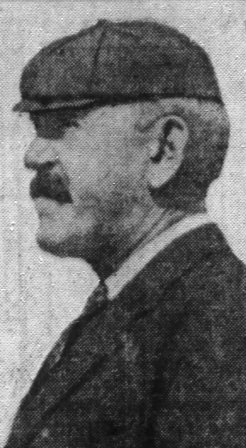
On April 7, 1901, The San Francisco Call reported that John F. “Jack” Sheridan had accepted an offer from President Ban Johnson to continue working as an umpire in the American League—which operated as a minor league the previous season.  The paper said “The National League also made a bid for his services.  He will receive $400 a month and expenses.”  It was said to be “the largest salary ever paid to an umpire.”

Sheridan was a former player, a second baseman and outfielder, who played for several San Francisco teams in the California League, including stints with the Haverlys from 1883-85.  He went East in 1885 and appeared in six games for the Chattanooga Lookouts in the Southern league, and that same season began working as an umpire.

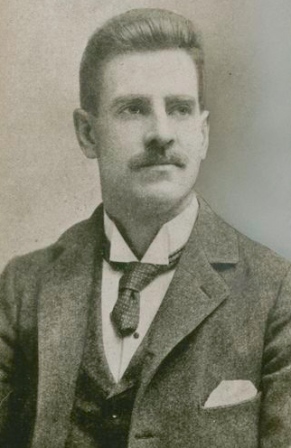
sheridanpix

Jack Sheridan

Years later, Mique Fisher, long-time California and Pacific Coast League manager and executive told The (Spokane) Spokesman-Review that Sheridan was signed by the Lookouts after he “sold himself to Chattanooga through a glowing personal description of his own ability,” but Fisher said:

 “Sheridan couldn’t field a ball with a fish net or hit one with a tennis racket.  When the Chattanooga manager saw Sheridan in action, he swore out a warrant charging him with obtaining money fraudulently.  Sheridan had to work out the expense advance in a cigarette factory.”

He worked as an umpire in the Southern League (1885, ‘93), the California League (1886-89, ’91), the Players League (1890), the National League (1892, ’96-97), and the Western/American League (1894-95, 1898-1900).

The best-paid umpire in the game, who was also a San Jose undertaker during the off-season, traveled from his California home to Chicago in early April of 1901, but a detour in Missouri nearly cost him his job.

The Chicago Tribune said Sheridan left the train “and was taken into custody on account of his strange actions.”  The Fort Wayne Sentinel said among the “strange actions” Sheridan “donned his uniform and started to umpire an imaginary game in the middle of the street.”

Johnson sent fellow American League Umpire “Pongo” Joe Cantillon to Missouri to get Sheridan released and accompany him to Chicago.  Sheridan was admitted to St. Elizabeth Hospital.  The Tribune said he was suffering from “nervous prostration,’ while The Cincinnati Enquirer said the league president said Sheridan was “on a protracted drunk.”

The day after he was admitted to the hospital two friends were given permission to take Sheridan out for a walk, The Chicago Inter Ocean said:

“As they reached Milwaukee Avenue and Division Street, a (street) car whirled by, and Sheridan swung himself on the rear coach.  His friends yelled in vain to the conductor to stop the train, and lost sight of Sheridan.

“They at once notified the police department to look out for Sheridan…Detective Fitzgerald found Sheridan wandering aimlessly on Jackson Boulevard near Wabash…Sheridan did not know where he was, nor could he tell where he had been since escaping from his friends.”

As Sheridan waited to appear in court to determine whether he was insane, newspapers speculated that Johnson would replace the umpire with either former player Warren “Hick” Carpenter or former Western and National League umpire Al Manassau—Manassau was appointed to the American League staff two days before the season began.

Before he could be adjudicated insane Sheridan made a miraculous recovery just one week into the season.  The San Jose Evening News said:

“Mrs. Sheridan, the mother of Jack Sheridan, the noted baseball umpire, has received a telegram from her son, who is in Chicago, stating that he has fully recovered from his derangement and that he could now continue with his contract.”

Sheridan was back on the field before the month of April of over.  He was competent, served as the American League umpires “chief of staff,”  and umpired in four World Series (1905, 07, 08 and 10); he was also selected, along with National League umpire Bill Klem, to join the Chicago White Sox and New York Giants on their world tour after the 1913 season.

But he also demonstrated erratic behavior for the rest of his career.

Just a month after returning to the field The Sporting Life said “Sheridan became frantic and ran up and down the field like a crazy man,” after a disputed call at home plate in the bottom of the ninth of a May 31 game in Detroit between the Tigers and Baltimore Orioles, which led to Sheridan awarding the game to the Tigers by forfeit.

The Sporting Life’s Baltimore correspondent said Sheridan was “held by President Johnson as a competent man,” despite his “habits.”

He resigned on at least three occasions.  After the 1905 and 07 seasons he said he was retiring to return to San Jose and become a full-time undertaker, only to return the following spring and in June of 1910, he abruptly quit minutes before a game in Washington, but returned within several weeks.

When Sheridan again took the field The Washington Post said he would “establish a precedent, as he will be the only major league umpire wearing glasses.”

Sheridan was also arrested in October of 1907 after a barroom brawl that began over a dispute over $120.  The Associated Press said when police searched Sheridan he was carrying $2700.  He was released from jail the following day after being fined $10.

On July 30, 1914, Sheridan called Ray Morgan of the Washington Senators out on a close play at first base in Detroit.  The Washington Post said Morgan, who had slid, “came up with a handful of dirt and threw it on the ground at Sheridan’s feet…Sheridan evidently thought that Morgan intended to hit him, and did not even give the National’s second sacker time to put up his guard, but whaled away at his smaller opponent.”

Ray Morgan

Ray Morgan

Morgan punched Sheridan, and after both dugouts emptied, Sheridan was also punched by Washington’s Eddie Ainsmith.  The disturbance spilled over to the stands with a few Washington players, including Morgan and Ainsmith, taking on Detroit fans before police restored order.

The Post said:

“This whole trouble, disgraceful to be sure, may be blamed directly on Jack Sheridan, the umpire, who has been at fault so many times this year.  In the first place Sheridan has threatened to beat up several of the Washington players.  Sheridan told (David “Mutt”) Williams and (Joe) Engel that he would punch them in the nose, the same as he had Morgan, if they did not do as he told them.”

Ban Johnson never took action against Sheridan for the incident in Detroit, but Morgan and Ainsmith drew suspensions from the league.

On August 1, 1914, The Associated Press reported that “The baseball players fraternity intends to take steps to have Umpire Jack Sheridan retired from service on grounds of incompetence.”

The incident, and dust up on August 12 with Jack Fournier of the White Sox inspired a poem from The Chicago Tribune’s Ring Lardner:

Making Night Hideous

Oft in the stilly night,

Ere slumber’s chain has bound me

Fond memory brings the sight

Of athletes crowding round me;

The scowls, the sneers

Of Jack Fourniers

And Morgans strike my vision;

I hear the barks

And rude remarks

That greet each close decision.

Thus in the stilly night,

Ere slumber’s chain has bound me,

I sometimes get tight up and fight

The chairs and tables round me.

At the end of the 1914 season, Sheridan returned to California.  On October 31 The Associated Press reported that Sheridan would not be returning as an umpire:

“Sheridan will probably be retained as a sort of supervisor of umpires, spending his time roaming around the circuit.”

Just three days later Sheridan died of heart failure in San Jose at age 62—he was said to have suffered sunstroke during an August game and never fully recovered.  Ban Johnson supported him to the end; just weeks before the umpire died the American League president told a reporter:

“I sincerely doubt if the baseball game will ever know another Jack Sheridan.  He had all of the virtues of other arbiters, and none of their mistakes.”

Things I Learned on the Way to Looking up other Things #6

12 Mar

Umpiring “Revolutionized”

The Chicago Inter Ocean reported that an “innovation in baseball” would be introduced during the second game of a September 9 double header at Chicago’s South Side Park between the White Sox and the Boston Americans.

“The astonishing feat, an apparent impossibility, will be accomplished by the use of colors, and the inventor, George W. Hancock, expects the umpiring business to be almost revolutionized.”

hancock

George W. Hancock

Hancock was the inventor of indoor baseball in 1887; the game that evolved into softball.

“(Umpire) Jack Sheridan will wear a red sleeve on his right arm and a white one on his left claw.  For a strike he will wave the right arm, and for a ball the left one and the flash of the colors can be seen by people seated so far away that the voice even of Sheridan, the human bullfrog, would be inaudible.”

The “innovation” would likely have benefited one player, the popular center fielder of the White Sox, William Ellsworth “Dummy” Hoy, who was deaf.  But no mention was made of Hoy in the description of Hancock’s plan.

Hoy

Hoy

The “astonishing feat” turned out to be so insignificant that The Inter Ocean failed to even mention it in the summary of the double-header which the Sox swept.  Hoy did not appear in either game.  George W. Hancock’s plan was never mentioned again.

Luminous Ball

Another innovation that promised to revolutionize the game that never came to be was the luminous ball.  The Reading Times reported on the process in 1885:

“Charles Shelton, the leading druggist of Bridgeport, has discovered a compound which, when applied to a baseball, renders that object luminous.  One of the drawbacks of playing baseball at night under the electric light is the inability to see the ball when thrown or batted into the air with the black night background of sky behind it.  By saturating it with Mr. Shelton’s compound the ball while in motion is luminous.  At rest it does not retain any light.  The illuminating ball retains its meteoric irritation for 45 minutes.”

There is no record of Mr. Shelton’s invention ever being used in a professional game.

What’s a Dog Worth?

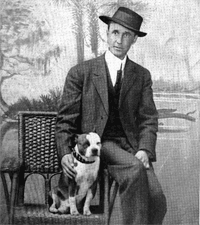
As part of the Federal League’s antitrust lawsuit against the American and National League’s affidavits were submitted from players detailing how organized baseball controlled the destiny and salary of player.  Mordecai “Three Finger” Brown, who jumped from the Cincinnati Reds to sign with the Federal League’s St. Louis Terriers, swore in his filing that players, on at least two occasions, had been traded for dogs.

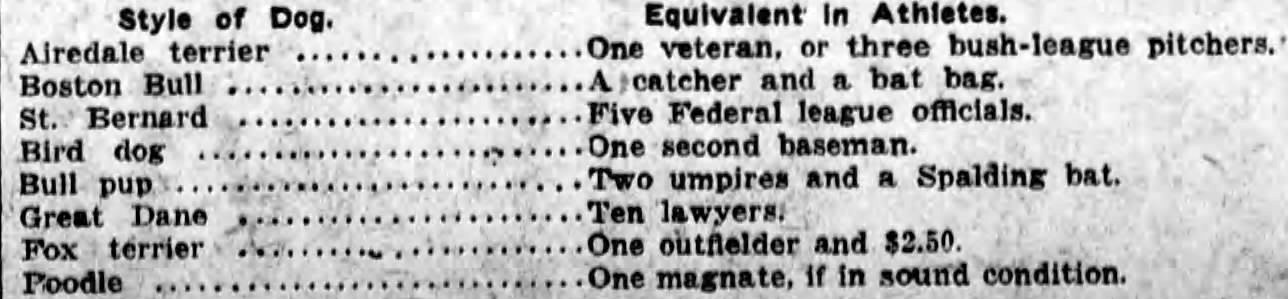
William A. Phelon, of The Cincinnati Times-Star and “Baseball Magazine,” said:

“This thing of trading dogs for ball players—as outlined in the Federal affidavits—should be put upon a sane and sensible basis.”

Phelon provided a “definite standard and a set of unit values” for baseball to follow:

phelondogs

McMullin’s Long Route to the Plate

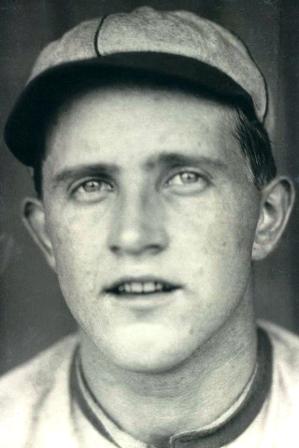
Before Fred McMullin became the least famous of the eight members of 1919 Chicago White Sox who were banned from organized ball for life, he was a popular player on the West Coast.

Fred McMullin

Fred McMullin

The (Portland) Oregonian told a story that was purported to have taken place when McMullin was a member of the Tacoma Tigers in the Northwestern League in a game with the Seattle Giants:

“He came in from third on a dead run and made a slide for the plate.  McMullin knew he didn’t touch it, but he was afraid to slide back, as the catcher had the ball in his hand.  The umpire also knew he didn’t score, but he said nothing, for that was none of his business.

“Fred dusted off his uniform and stalked nonchalantly to the bench.  A couple of Seattle players yelled for a decision.

“‘He wasn’t safe, was he?’ demanded (Walt) Cadman, who was catching for Seattle.

“The umpire shook his head no.  At that Cadman, holding the ball in his hand, dashed over to the Tacoma bench to tag McMullin.  Fred waited until he almost reached him and then slid to the other end of the bench.

“Cadman followed him, and as he did s slipped in some mud and fell to his knees.  McMullin leaped up from the bench, dashed for the plate and touched it.  The umpire called him safe.”