Tag Archives: A. G. Spalding

“Random Notes on the Leading Members of the Brotherhood.”

29 Sep

Ernest Justin Jarrold wrote for The New York Sun in the 1880s and 90s and was best known as the author of the “Mickey Finn” stories which were serialized in The Sun—Jarrold also wrote for the paper under the pseudonym “Mickey Finn,” about his travels through Ireland.
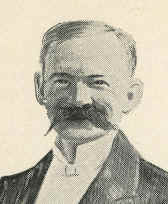
Ernest Jarrold

Ernest Jarrold

In 1889 Jarrold was at New York’s Fifth Avenue Hotel for “the meeting of the Ball Players Brotherhood for the purpose of forming the Players’ League.”  He provided readers with his “random notes on the leading members of the Brotherhood.”

Jarrold said:

“I met all the leaders.  The man who attracted the most attention was John Montgomery Ward, the celebrated shortstop.  This little man—for he is a pygmy compared with some of his associates—is generally admitted to have the largest business faculty of any baseball man in the country.  He originated the scheme of the new league while on the trip around the world last year, and, with the help of Fred Pfeffer, of Chicago, and Edward Hanlon, of Pittsburgh, formulated the plans while on the steamer going from Australia to Europe.  This conspiracy was carried out under the very nose of Al Spalding, and many secret conferences were interrupted by the entrance of Mr. Spalding.  Ward has a winning personality.  He dresses modestly but neatly.  He is the husband of the celebrated actress Helen  Dauvray, and has saved money from his earnings as a ballplayer.  This he has invested mostly in western real estate.  He is variously estimated to be worth from $50,000 to $75,000.

“Perhaps the next man in popular interest seen in the corridors was Michael Kelly.  In addition to being one of the handsomest men in the new league, Kelly is probably the wittiest.  He has created more original coaching expressions than any of his contemporaries.  He dresses well and wears diamonds.  Kelly is credited with executive ability on the ball field of a high order.  Most of the tricks in ball playing are the tricks of his prolific Irish brain. “

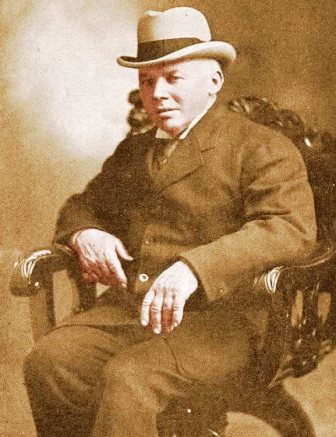
Jarrold said “one of the most striking figures” present at the meeting was the six-foot-four 200 pound Jay Faatz:
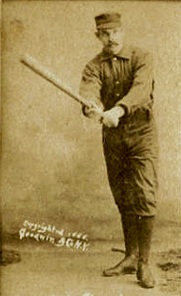
Jay Faatz

Jay Faatz

Faatz is the most expert poker player in the United States.  He has a passionate love for diamonds and always carries in his shirt bosom and cuffs $1,500 worth of these gems…He also has a snug sum in the bank.  Faatz always takes in the prize fights and the dog disputes which occur in his vicinity.  He is a level-headed, clear thinker, and the orator o the Brotherhood.

Fred Pfeffer, of Chicago, is one of the few players who has put money into the new league.  He has invested $3,000.  He is said to be the best fielder in the West.  Pfeffer is remarkable for his neat appearance when playing ball.  He is quiet and reserved.  He wears a brown mustache, a silk hat and a pleasant smile.  The New York reporters couldn’t elicit any information from him even when they used a corkscrew.

William Ewing, the greatest ball player in the world, is a bachelor. He is a very ordinary looking citizen in street attire.  He earned $6,500 last season (The New York Times said he earned $5,500, the “Spalding Guide” said $5,000).  Ewing was the first man to sign the agreement which bound the players to the new scheme.  He said he had no grievance, as the league had always used him well, but he wanted to cast his lot with ‘the boys.’  For a long time he was distrusted by the players on account o his intimacy with Mr. Day (Giants owner John B. Day).  Ewing will be captain of the New York team.

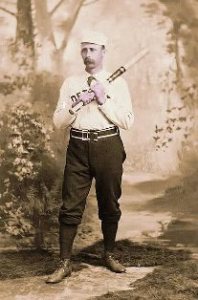
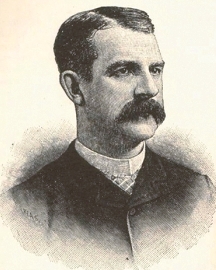
Lawrence G. Twitchell, five years ago, was a carpenter, working for $2 per day.  Today he is a capable left fielder, and earns $2,500 for working about six months in the year.  Tony, as he is familiarly known, is remarkable for his fine physique.  No more perfect man physically ever set foot on a diamond.  The trip east from his house in Ohio to attend the convention cost him $500.  He married a wealthy young woman, who became enamored of him while playing ball at Zanesville, Ohio…Tony says he is not obliged to play ball for a livelihood.  He does it for love of the game.  He is young, beardless and handsome;  also enthusiastic as to the ultimate success of the new league.

Larry Twitchell

Larry Twitchell

Edward Hanlon, who will fill the onerous position of captain of the new Pittsburgh club, will also act as manager and centerfielder of the team.  He has been frugal and has saved money during his long and illustrious baseball career.  Hanlon is one of the progenitors of the new league.”
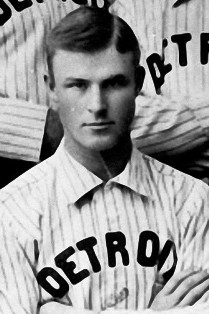
Hanlon had been responsible for making the initial contact with street car magnate Albert Loftin Johnson, who would become one of the league’s principal financial backers, and according to Jarrold “the missionary of the new baseball venture.”  Jarrold said:

“(Johnson is) an ardent admirer of the game…All preliminary meetings in the formation of the Players’ League were held in his rooms in Cleveland.  A policeman was stationed at the door to keep out reporters.  It was mainly through his efforts that the seal of secrecy was kept over the organization for so long a time.  He can talk longer and state less facts for reportorial use than any man connected with the baseball fraternity.  It can be stated truthfully that no organization of such interest to the public as the Players’ League was ever handled so secretly as has this one.  This was mainly due to Johnson’s perspicuity.  He is a heavy backer of the new enterprise, and is known as the Moses of the new baseball dispensation.  Johnson doesn’t pay much attention to clothes or diamonds.”

Among those present at the meeting, Jarrold seemed to think most highly of outfielder George Gore “One of the most dashing, devil-may-care men in the new league.”  Jarrold said:
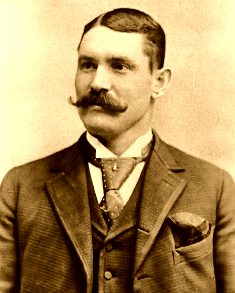
George Gore

George Gore

“Gore has the happy faculty of laying aside his profession when off the diamond, which faculty is shared by but few ball players.  As a rule these men are very sensitive, and when a game is lost it is not uncommon for them to be so depressed in spirits that they cannot eat or sleep.  Gore, however is not that kind.  As John Ward says:  ‘Gore lets care get behind the wood pile when his work is over.’  He used to run a paper machine in Saccarappa, Maine in 1878.  Gore lives up to his income and has saved no money.”

Within a year, the Players League was finished and “Mickey Finn” had moved on to writing about his travels in Ireland.

The Wealthiest Ballplayers, 1894

19 Sep

In 1894, major leaguer turned sportswriter, Sam Crane wrote about the wealthiest players in baseball in The New York Press:

(Cap) Anson is probably the wealthiest ball-player on the diamond today.  His wealth has been estimated anywhere from $50,000 to $100,000.  It is, without doubt, nearer the latter sum than the former.”

"Cap" Anson

“Cap” Anson

Anson’s fortune would be long gone, due to a series of poor investments and other financial setbacks, by the time he died in 1922.

“From the time he joined the Chicago club he has enjoyed a big salary.  In his nearly 20 years’ connection with the club he has acted as manager and captain since the retirement as a player of A.G. Spalding in 1877.  Anson, of course received extra salary as manager, and has also been a stockholder in the club…He has been fortunate, too, in real estate transactions in the “Windy City,” under the tutelage of Mr. Spalding, and could retire from active participation in the game without worrying as to where his next meal was coming from.”

The men who Crane said were the second and third wealthiest players managed to keep their fortunes.

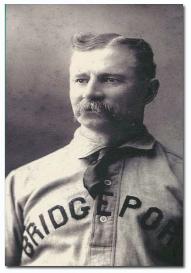
Jim O’Rourke is thought to come next to Anson in point of wealth.  Jim came out as a professional player about the same time as Anson.  He did not get a large salary at first with the Bostons, which club he joined in 1873.  He remained with the team until 1878, when he went to Providence.  Jim was young and giddy when he came from Bridgeport to Boston, in 1873, and did not settle down into the staid, saving player he now is…He was a ‘sporty’ boy then, and liked to associate with lovers of the manly art.  Patsy Sheppard was his particular friend in the ‘Hub,’ and James made the boxer’s hotel his home for some time.  When he went to Providence in 1879 Jim began to think of saving his money, and from that time on his ‘roll’ began to increase.

Jim O'Rourke

Jim O’Rourke

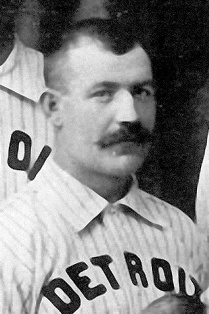
Dan Brouthers has received big salaries only since 1886, when he, as one of the famous ‘big four,’ was bought by Detroit from Buffalo.  But since then he has pulled the magnates’ legs and socked away the ‘stuff.’  He has been situated so that he has been able to make the magnates ‘pony up’ to the limit, and Dan had no mercy.  He said he was out for the ‘long green,’ and he got it.  When the Boston club bought Brouthers, (Abram “Hardy”) Richardson, (Charlie) Bennett, (Charles “Pretzels”) Getzein and (Charlie) Ganzell, Dan grasped the opportunity and got a big bonus and also a big salary.  He made the Detroit club give up a big slice of the purchase money before he would agree to be sold.

Dan Brouthers

Dan Brouthers

“The Brotherhood war, when Dan jumped to the Boston Players league was another favorable opportunity for him, and he grasped it and the boodle with his accustomed avidity.  Dan has planted his wealth in brick houses in Wappingers Falls (NY), and can lie back at his ease with his 30,000 ‘plunks’ and laugh at the magnates.  It is this feeling of contentment that has made Dan almost too independent and has affected his playing lately (Brouthers appeared in just 77 games in 1893, but hit .337, and hit .347 in 123 games in 1894).  Dan is what ballplayers call ‘hard paper,’ which was a most distinguishing characteristic of every one of the ‘big four.’”

Detroit’s “Big Four” consisted of Brouthers, “Hardy” Richardson, James “Deacon” White and Jack Rowe.

“Hardy Richardson was not so awful bad, but Jim White and Jack Rowe took the whole bake shop for being ‘hard papes.’  They have both been known to start on a three weeks’ trip with 80 cents each, and on their return Jim would ask Jack, ‘How much have you spent?’  Jack would reply:  “I haven’t kept run of every little thing, but I’ve got 67 cents left.’   Jim would remark gleefully: ‘Why, I’m three cents ahead of you; I’ve got 70 cents.’  And Pullman car porters are blamed for kicking when a ball club boards their car!  Jack and Jim would sleep in their shoes for fear they would have to pay for a shine.  The only money they spent was for stamps in sending home papers, which they borrowed from the other players.  They are both well off now, however, and can afford to laugh at the players who used to guy them.”

Deacon White

Deacon White

(Charles) Comiskey has been fortunate in getting big money since 1883.  (Chris) Von der Ahe appreciated the great Captain’s worth and paid him more and more every year.  The Brotherhood business enabled him to make a most advantageous contract, and as manager and Captain of the Chicagos he received $7,000 salary besides a big bonus.  His contract with Mr. (John T.) Brush to play and manage in Cincinnati called for $23,000 for three years and $3,000 in cash.  This was made in 1891 and runs this year (1894).  Comiskey has his money invested in Chicago real estate, which is paying him a good income at the present time.

(John “Bid”) McPhee, (William “Buck”) Ewing, (Harry) Stovey, (Paul) Radford, (Ned) Hanlon, (Jack) Glasscock, (Tim)Keefe, (Charles “Chief”) Zimmer, (Charlie) Buffington, (Charlie) Bennett, and (Fred) Pfeffer are players who are worth from $10,000 to $15,000, which has all been made by playing ball.  There are only a few more players who have much in the ‘stocking.’”

“It may well be Doubted whether Beals should be Permitted to play Second Base again”

23 Jul

Thomas Lamb “Tommy” Beals had a complicated relationship with Harry and George Wright.

George named his son, the Hall of Fame tennis player, Beals Wright after his friend and former teammate.  But, The Chicago Tribune said when the two played together, “George Wright and Tommy Beals went many a day without a friendly word,” a charge Wright denied.

After signing a contract to play second base for Harry Wright’s Red Stockings for 1876—the first season of the National League—Beals decided instead to jump the contact and go to Colorado where he worked as a miner.

Tommy Beals

Tommy Beals

He eventually left Colorado and went to the West Coast where he played a handful of games in 1879 for the San Francisco Mutuals and Oakland Pioneers in the California League.  In the spring of 1880 he signed a contract with the Chicago White Stockings.

Harry Wright protested the signing of his former player, or as The Tribune said:

“Some parties in Boston have been making a wholly unnecessary fuss over the engagement of Beals by the Chicago Club, claiming that after engaging to play with the Bostons in 1876 he refused to report for duty.”

The Tribune noted that the contract was actually signed before the league was officially founded on February 2, 1876, but:

“The Boston people argue that, although the League was not in existence at the time Beals retired from baseball, it was agreed, upon its formation, that that all contracts existing between clubs and players should be recognized.”

The newspapers in Wright’s former hometown of Cincinnati weighed in.  The Commercial Gazette encouraged the Boston protest and said Wright should make it “a test case (and) prevent the Chicago Club from playing him during the coming season.”  The Cincinnati Enquirer took the opportunity to accuse Wright of protesting activities he was himself regularly guilty of engaging in:

“The disposition shown by the Boston Club management to create an unpleasantness in the matter of the engagement of Tommy Beals by the Chicago Club, upon the ground that Beals was under some sort of engagement with Boston four or five years ago, has had the effect of recalling some reminiscences calculated to show that the pharisaical kickers of the Hub are in no position to give us the ‘holier than thou’ racket.  In the first place Boston has slept upon its rights, if it ever had any, in the Beals case so long that the matter is outlawed long since, and ought never be raked up at this late day, especially in view of the fact that Chicago acted in good faith and without any suspicion of a cloud upon its title to the services of Beals.

“In the next place Boston had better be repenting for some of its own sins before assuming the role of exhorter towards other folks.  That club has now under contract three players whose engagements will not bear the closest kind of scrutiny.  In 1877 the Boston Club, in the middle of the season, committed an act of piracy on the Lowell Club of which it ought to be ashamed, by jerking (John) Morrill and (Lew) Brown out of the Lowell nine in regular highwayman fashion, both these players being then under contract for the entire season in Lowell…we (also) find that (Jack) Burdock was under contract to Chicago in 1875 and never showed up.  He might have been expelled by Chicago, but was not, and continues an honored and valued member of the Boston outfit.  In 1876, again Thomas Bond was suspended from play and pay by the Hartford Club, of which he was then a member, and in spite of this cloud upon his name and fame, was engaged the following year by Boston, and has been there ever since.”

Morrill, Burdock and Bond were all still members of the Red Stockings, comprising three-fourths of the team’s infield.

The Enquirer also criticized Boston because the team acted to “choke off” an attempt by Hartford Manager Bob Ferguson to bring the allegations which led to Bond’s suspension to light during a league meeting—Bond, during a season-long feud with Ferguson had accused his manager, among other things, of “selling” games.  Bond was suspended by Ferguson on August 21 of 1876 despite posting a 31-13 record for the second place Dark Blues—Bond’s replacement as Hartford’s primary pitcher was Candy Cummings.

Tommy Bond

Tommy Bond

The Enquirer took a final shot at Wright noting that when the league instituted the new rule for 1879 which barred non-playing managers from the bench “Boston squealed because Harry Wright couldn’t enjoy privileges  denied to everybody else, and this year they are playing baby about Beals on grounds equally absurd.”

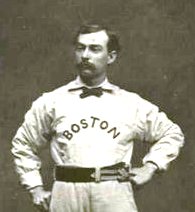
The Tribune laid out Chicago’s long list of grievances for “plenty of ‘queer’ work in which Boston has been engaged.”  In addition to the incidents mentioned by The Enquirer, The Tribune said in 1877 after Albert Spalding had secured infielder Ezra Sutton for Chicago, “Sutton was worked upon by Boston and went there to play.”

So, according to Boston’s critics the club’s entire 1880 infield had come to the team via questionable circumstances.

The Boston Herald responded:

“It is not to be expected that the Chicago Club will recognize the position of the Boston Club in this matter, and release Beals.  That organization has on more than one occasion, shown its utter contempt for League rules, or in fact, for anything that interferes with its own particular self, and, to expect justice in this case, is not to be thought of.  In the meanwhile, the Boston Club will probably not take any official action in the premises, but let the Chicago Club enjoy all the honor (?) there is in playing such a man.”

After the weeks of allegations, posturing and name-calling in the press, the season began on May 1; Boston never lodged a formal complaint about the signing of Beals.

Chicago cruised to the National League title, spending only one day (after the season’s second game) out of first place.  Beals, rusty from his layoff made little impact for the champions, hitting just .152 in 13 games at second base and in the outfield.  By August, with the fight to defend his signing long forgotten, The Tribune said after a rare Beals start in a 7 to 4 loss to the Worcester Ruby Legs:

“Beals played as though he had never seen a ball-field before…It may well be doubted whether Beals should be permitted to play second base again…any amateur who could be picked at random would be likely to do better both in fielding and batting.  Worcester would have made two or three less runs yesterday if second base had been left vacant altogether, as what time Beals didn’t muff grounders he threw wild and advanced men to bases they would not otherwise have reached.”

Beals was 0 for 3 with three errors that afternoon—for the season he committed 4 errors in thirteen total chances at second for a fielding percentage of .692.

Let go by Chicago at the end of the season, Beals’ professional baseball career was over and he returned to the west.  In 1894 he was elected to one two-year term in the Nevada State Legislature as a Republican representing a district that included the town of Virginia City.  By 1900 he was back in Northern, California, where little is known about his activities.  He died in Colma, California in 1915

“I Believe that a Pitcher of a Slow Ball could make Monkeys out of Opposing Batsmen”

21 May

After the success of William Arthur “Candy” Cummings’ decades-long campaign to be recognized as the inventor of the curveball—his claim was supported by influential voices like A.G. Spalding, Cap Anson,  and Tim Murnane—culminated with his 1908 “Baseball Magazine” article “How I Pitched the First Curve,” Cummings was often sought out by the press for his opinions on pitching.

Candy Cummings

Candy Cummings

In 1910, an article “By Arthur Cummings, Discoverer of the Curve,” appeared in several newspapers, including The Boston Post.  Cummings took current pitchers to task for throwing too hard:

“Speed, speed, speed seems to be the cry of the pitcher today.  The more steam a fellow has, the more valuable he appears in the eyes of the managers.  It’s only once or twice in a game that a twirler will let loose his slow ball, and then he doesn’t put a whole lot of faith in it.  Of course there are some exceptions, like Mathewson, but I am talking about the general run.  To my mind, the speed craze is an obsession and many a pitcher would meet with greater success if he’d only revert to the old style of pitching and try slow ones oftener.  Players and managers of today think that the only way to win a ballgame is to have a pitcher who can throw a ball with such force that it will go through a six-inch plank, and if the fellow hasn’t got that amount of speed he is no good.

“If some managers would go back to the old-time style of pitching and send men in the box who would serve up slow balls there wouldn’t be as much base running as there is now, but the ball would be batted more and there would be better exhibitions of fielding.  Players of today can’t hit a slow ball with any degree of safety, they having become used to the swift article.  That’s why I believe that a pitcher of a slow ball could make monkeys out of opposing batsmen.

“Of course, there is a difference in the national sport, as now exemplified, when you compare it with the game when I was in it some thirty years ago.  The pitcher’s box now is further away from the home plate than it was when I used to pitch.  At that time it was forty-five feet from the home plate; now it is more than sixty, and it takes some speed to get over the plate.  I don’t know as I could go in a pitcher’s box, such as it is used today, and get a ball over the home plate, but if they moved it up to forty-five feet I could get my slow overshoots over the pan and I’ll bet a cigar the batsman wouldn’t hit it; he’d hit at it, though, and swing for all he’s worth.

“But even though the plate is further back, the pitchers have the curve worked down to such a science that they can make their ‘floaters’ break more sharply than we old timers could, and consequently they would much more easily fool the hitters.  Once in a while a genuine slow ball pitcher pops up and gets along but little confidence is placed in him; his victories are attributed to luck, and he is not used very regularly.

“Fans laugh these days when a pitcher takes it into his head to serve up a slow ball, which scorers call a change of pace, and see a heavy hitter almost break his back trying to kill the ball.  When he misses, it pleases the bugs immensely, but let me tell you, that the slower a ball is the harder it is for the batsman to connect with.  The hitting column wouldn’t have as big averages as it does now, and a man who could bat for .300 would be a wonder indeed, if slow balls were used by pitchers.

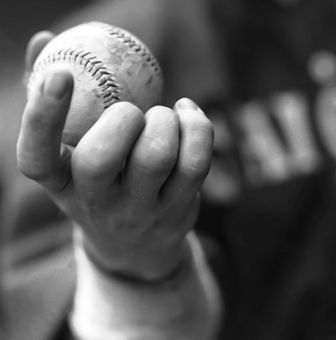
“But it seems as if the day of the slow ball has gone by.  A scout will not sign a pitcher unless he has got something good in the way of speed or a peculiarly curving swift ball, like Harry Howell’s or Eddie Cicotte’s knuckle ball.  It seems as if when we old timers dropped out of the game and the present generations took it up where we left off, they thought they would introduce new features to the game, and selected speed as the proper thing.  Of course, the invention of the mask, protector and heavy mitts had something to do with slow pitching passing out of existence, but it was the ideas of the young pitchers more than anything else that developed the desire of captains and managers for pitchers with great speed.

Ed Cicotte's knuckleball grip

Eddie  Cicotte’s knuckleball grip

“Perhaps you notice that these pitchers of today who have such great speed and assortment of curves do not work very regularly.  Well, when I played ball I was in the box one day and in the field the next and in that way I kept my arm in good shape and my batting eye keen, just because I was at the game all the time.  I never used much speed; therefore my arm was in condition to work.  Perhaps some manager will come along yet and decide that there was better pitching in the old days and give a slabbist with a slow curve ball a chance to work in the box.

“When that day arrives the fans will see some fun, for the long-distance hitters will find it hard to connect with the ball very often.”

In 1921 Cummings, then 72-years-old was sitting in the press box of Ebbetts Field, a guest of The Brooklyn Eagle, for a game between the Dodgers and Philadelphia Phillies.  Cummings told The Eagle’s Sports Editor Abe Yager:

“I think I could out-guess   Babe Ruth if I were pitching right now.  I had to pitch against Dan Brouthers, Cap Anson and other sluggers of bygone fame and believe me it was some feat to fool them.  We did it often, but of course, they hit ‘em out just as often.  Ruth can be fooled by an outcurve, a high one in close or a drop the same as the sluggers of old, but of course, he will connect once in every three times by the law of averages.”

“Somebody has got to Write a real Baseball History”

18 Apr

Detroit Tigers Manager Hughie Jennings had an idea to improve American education.  He told The Detroit Times in 1911:

“I think it pretty near time that our advanced public school educators began to think of teaching baseball history in their schools.  Seriously I do.

“Baseball is America’s chief recreation, and has been for two generations.  Indications are that it will live many generations more.  The stars of the game are important personages to the boys and the men of today as are the big men in affairs of state and business.  The boy is constantly clamoring for news of his baseball heroes, and because we have decided baseball is a clean, good sport, we encourage his interest.

“It is only lately that I have been interested in the history of the game, although it has been my means of support for years.  I don’t know what it was that impelled me last winter to go digging into newspaper files for data on the antecedents of the game, but I do know this:  I’m mighty sorry I didn’t get the idea before.  For nothing was more interesting.”

Tiger Manager Hughie Jennings

Tiger Manager Hughie Jennings

Jennings’ conclusions would likely have disappointed Albert Spalding and the members of the Mills Commission, which advanced the Doubleday myth:

“Of course I had always known in a superficial way something about the origin of baseball and about the men who figured prominently in it during its infancy; and the men who have brought it up to the standards of today are men of my day and age, but I had never before made a consistent effort  to learn just what was what in baseball history.  I was pained and surprised , when I started at it, to find that there does not exist a history of the game which is so thoroughly prepared that it might be put into schools as a text book.  Before this idea of mine can be put into effect, somebody has got to write a real baseball history.

“In my research last winter, for instance, I I confirmed my old understanding that baseball as we know it today is sort of a sublimated ‘one-old-cat’ or ‘rounders’ as they used to call it.  The first game of baseball, with nine men on a side, was played in Hoboken, NJ in 1845.”

Jennings quoted Alexander Cartwright’s 1845 rules and made no mention of Cooperstown or a Civil War general, putting squarely in the camp of “The Father of Baseball” on the game’s origins.

The Tigers’ manager also said, according to his research “The first ball was made from sections of an old arctic shoe wound with woolen string and covered with coarse cowhide.”

Origin Stories

9 Apr

Timothy Paul “Ted” Sullivan was a player, manager, executive, and the lifelong friend and confidant of Charles Comiskey.

Al Spink, in his 1911 book “The National Game,” said Sullivan was “the best judge of a ball player in America, the man of widest vision in the baseball world, who predicted much for the National game years ago, and whose predictions have all come true.”

Comiskey said of his friend:

“Ted Sullivan’s standing in the profession of baseball cannot be measured by modern standards.   He is in a class all by himself.  He is ever and always ahead of his time, with a knowledge of the game and a versatility that no other baseball man of my acquaintance has ever possessed.”

Ted Sullivan

Ted Sullivan

Sullivan, given his reputation, was a favorite among reporters who sought his opinion about everything related to baseball.

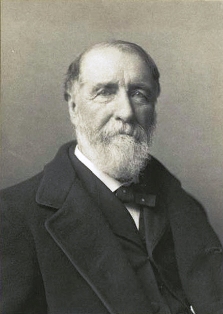
In December of 1904, months before the Mills Commission was organized to determine baseball’s origin, Sullivan was asked by The Cincinnati Enquirer to weigh-in on the subject.  A month earlier Albert Spalding had given a speech at the YMCA training school in Springfield, Massachusetts claiming that baseball “is distinctively an American sport.”  The commission was formed in reaction to Henry Chadwick’s 1903 essay which said baseball was derived from British game rounders—after Spalding’s response, the two agreed to appoint the commission to settle the question.

Henry Chadwick

Henry Chadwick

The Enquirer said;

 “Of all the old-timers in harness Ted Sullivan is as good as the best, or a trifle better, when it comes to reviewing the history of diamond doings of the hoary past.  His memory goes back to year one of baseball and his story of the origin of the game makes a good bit of fan literature for the off season.

“’The origin of baseball may be the evolution of townball, barnball, two-old-cat or yet it may be the suggestion of the three named,’ says Ted.  ‘At any rate, the game is the product of American genius and temperament, and not an offshoot of English rounders, as our English cousins would have us believe.  Of the many times I have been in England and the subject of baseball came up, one Englishman would say to the other: ‘Why, that blooming American game of baseball is nothing but our old game of rounders, you know.’ I have nothing but the highest regard for an Englishman’s love of sport—for it is inherent in a Briton from the present King down, and should an Englishman have only his last sixpence, and should the alternative arise whether he should eat or see a field sport—he would undoubtedly decide in favor of the latter.  I must totally disagree, however, with my British cousins that their primitive and plebian game of rounders is the mother of our national game.  Oh, no dear cousins; chase that idea out of your heads.

“’To say rounders is baseball would be the same as claiming that a palace was a hut because it had a door, or a wheelbarrow a carriage because it had a wheel…From the time that the game was regularly played by the knickerbockers of New York until it became a profession, change after change has been made in the rules, to make the game as perfect as possible in its machinery.  The game is about fifty-five years of age, that is to say, before it became national, as it was played in New York and New England up to 1861, but did not reach the limits of our country until 1865 and 1866.  The most important changes in the rules after the structure of the game was put up was first eliminating a put out on the first bound by an outfielder.”

Like Spalding, Sullivan didn’t provide any specific evidence, and instead made a case that baseball must be an American invention because of “the originality of the American in the line of invention,” and by his logic, baseball was just one in a great line of American innovations:

“America to-day is the inventive torch of the world, and has been for the last fifty years.  The first seed of America’s inventive genius took root in Robert Fulton’s brain when he advocated steam as a motive power.  The next in line was Prof. Morse’s advocacy of the use of telegraph wire as a transmitter of sound.  This invention was followed by the sewing machine that relieved the weary housemaid of her burden.  On its heels came Cyrus McCormick with his farming implements that taught the world how to reap their harvest in one-tenth the time and with a fraction of the labor of former days.  The last of the greatest of America’s inventive thinkers is Tom Edison, the Wizard of Electricity, who has electrified ad illuminated the world by his inventions.”

Sullivan said this demonstrated “the originality of the American in the line of invention—whether it be a pastime or a beneficiary to the commercial world.”

There was no doubt Sullivan was influenced by Spalding’s speech.  Both claimed the game was “natural evolution” of earlier American games, and Sullivan refers to baseball as “the product of American genius and temperament; Spalding said baseball was “peculiarly adapted to the temperament and character of the American people.”

A.G. Spalding

Albert Spalding

Spalding’s speech was reprinted in many newspapers as well as the 1905 edition of “Spalding’s Official Baseball Guide.”

When the formation of the Mills Commission was announced in the spring of 1905 The Washington Post said:

“Inquiries are to be made throughout the United States, Great Britain, Canada, Australia and other English-speaking communities, with a view of ascertaining whether baseball is an evolution of the old English game of rounders, or of the classic American game of one-old-cat.”

The Post ridiculed the effort:

“Those ‘youngsters,’ Father Chadwick and A.G. Spalding, are playing extra innings to decide the origin of baseball.  The general public doesn’t seem to care when or how the game originated.”

The seven-member commission was composed of members sympathetic to the American origin version of Spalding and Sullivan.  Commission members Abraham Mills, Morgan Bulkeley, Arthur Gorman, Nick Young, Al Reach, George Wright and John Edward Sullivan accepted the story of a mining engineer from Denver named Abner Graves, and thus was born the Doubleday myth.  Spalding and Sullivan started with a conclusion and Spalding put together a commission that made it so.

The full text of the Graves’ first  letter to the commission as reprinted in The Sporting Life in august of 1905:

“The American game of base ball was invented by Abner Doubleday, of Cooperstown, N. Y., either the spring prior or following the ‘Log Cabin and Hard Cider’ campaign of General William H. Harrison for the presidency.  Doubleday was then a boy pupil of Green’s Select School in Cooperstown, and the same, who as General Doubleday, won honor at the battle of Gettysburg in the Civil War: The pupils of Otsego Academy and of Green’s Select School were then playing the old game of Town Ball in the following manner:

“A tosser stood close to the home goal and tossed the ball straight upward about six feet for the batsman to strike at on its fall, the latter using a four-inch flat-board bat. All others wanting to play were scattered about the Held, far and near, to catch the ball when hit. The lucky catcher took his innings at the bat. When a batsman struck the ball he ran for a goal fifty feet distant and returned.   If the ball was not caught or if he was not plunked by a thrown ball, while running, he retained his innings, as in Old Cat.

“Doubleday then improved Town Ball, to limit the number of players, as many were hurt in collisions. From twenty to fifty boys took part in the game I have described. He also designed the game to be played by definite teams or sides. Doubleday called the game Base Ball, for there were four bases in it.  Three were places where the runner could rest free from being put out, provided he kept his feet on the 1 flat stone base. The pitcher stood in a six-foot ring. There were eleven players on a side. The ball had a rubber center overwound with yarn to a size somewhat larger than the present day sphere and was covered with leather or buckskin. Anyone getting the ball was entitled to throw it at a runner between the bases and put him out by hitting him with it.

“I well remember some of the best players of sixty years ago. They were Abner Doubleday, Elilin Phinney, Nels C. Brewer. John. C. Graves. Joseph Chaffee. John Starkweather, John Doubleday, Tom Bingham and others who played on the Otsego Academy campus; although a favorite place was o the Phinney farm, on the west shore of Otsego Lake.”

Graves’ recollection would place the first game in 1839 when he was five, and “boy pupil” Doubleday was 20.


Opening Day—1890

24 Mar

The New York Sun said the Players League had won the battle:

“The local Brotherhood team have scored first blood, first knockdown, and have in general the best of the initial clash between the Players’ and the National League in this city.  While the latter were prepared for defeat, they had not anticipated such an overwhelming victory for the seceders as at least 3 to 1 in attendance.  They did not believe the Brotherhood would get 2 to 1, and so the result was rather staggering.  The admirers of the players are jubilant over the good attendance, and one of the partisans tersely said: ‘The League? Why they’re not in it and might as well give it up.  Let’s have another drink on the boys.’”

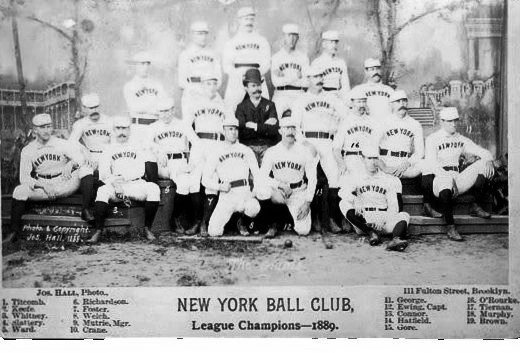
Fans streamed into the “grounds on Eighth Avenue” (the Brotherhood Ballpark was built next door to the Polo Grounds) and by the time the first Players’ League pitch was thrown in New York, 12,013 were on hand, while only 4,644 paid to see the National League.  The Players League team was composed mostly of players who had been with the National League Champion Giants in 1889–both teams were called the New York Giants in 1890.

Many of the members of the 1889 Giants jumped to the Players League in 1890

Many of the members of the 1889 Giants jumped to the Players League in 1890

The Sun said it would be “invidious to draw comparisons between the class that attended the League game and that which patronized the Brotherhood;” then went on to draw comparisons.

“But after a few moments’ study of the crowd surging down the elevated railway stairs an acute observer could quite easily have foretold which grounds each spectator or party was bound for.  Not but what there were plenty of well-dressed men and women in the immense crowd that wended their way toward Brotherhood Park, but rather in the excited holiday air the Players; sympathizers were.”

The Brotherhood crowd consisted of “urchins and young men,” while the National League crowd included “exquisitely dressed representatives of the fair sex.”

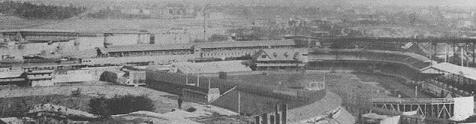
The two ballparks

The two ballparks

Although the field had been completed for weeks and was “in beautiful condition,” the Brotherhood Ballpark (what would become the final incarnation of the Polo Grounds) was “in an unfinished state,” and carpenters continued to work on the grand stand and lower tier seats as fans entered the park:

“The clubhouse was also only half built, and a huge banner with the words “World’s Champions” was spread across the front of it, as if to hide the unfinished part.  Flags and gay bunting were lavishly spread over the stand, but as one crushed spectator aptly put it: ‘They’d done a good sight better to build seats.’”

Despite the unfinished ballpark, the Brotherhood game was met with much fanfare:

“A cause of great enthusiasm and cheering in Brotherhood Park was the frequent arrival of tally-ho coaches, some of which were gaily decorated and bore appropriate inscriptions…Precisely at 3 o’clock the Players’ Philadelphia Club marched from the club house , preceded by the sixty-ninth Regiment Band.  They received a royal welcome to which the courteously doffed their caps.”

The New York team and Manager Buck Ewing then took the field:

“Such cheering, such yelling, as they neared the stand!  People threw up their hats and went crazy…as they broke ranks the dog on the club house porch broke into a prolonged howl.”

The crowd for the National League was more subdued, but The Sun quoted “one stalwart young man, whose face has been a familiar sight for years at the ball games,” who said the Brotherhood would “have the best of it for the first two weeks.  But wait.”

Both New York Giants teams lost their first game of the 1890 season, each to the Philadelphia franchise in their respective leagues.

The Players League lost the war.

The League outdrew the National League and American Association (PL-980,877, AA-803,200 and NL-776,042—the numbers are estimates and there is ample evidence that everyone lied about attendance figures during the year), but the Brotherhood lost an estimated $125,000 on top of more than $200,000 of debt incurred in building new ballparks.

The National League lost even more—some estimates as high as $500,000.

Although no contemporaneous details survive, the accepted story is that Albert Spalding was able to convince the Players League investors that their financial situation was worse than the National League’s.  Rather than a compromise, Spalding was able to negotiate an unconditional surrender.

The Players League would not have a second Opening Day.

Alternate Uniforms, Circa 1879

14 Feb

On the eve of the 1879 season The Chicago Times endorsed an innovation about to be introduced by the Chicago White Stockings:

“The management of the Chicago Club has very wisely decided that the skinny white uniform with tips of blue, in which it has dressed its men from time immemorial, is not the best of its kind; that good taste dictates higher colors for the field, something that will bring out, instead of dwarfing the muscular development of its wearer.  The result of the consultations over the matter has been the adoption of something which has merit of novelty about it, at least, and, at the first blush, there seems to be no reason why it should not produce a pretty effect on the field.”

The Times noted that three years earlier, the White Stockings had worn individually colored caps in order to make it either for fans to identify the players.  The move “for some unknown reason was discarded” at the end of the 1876 season.

“The present change is in the same line, except that it goes further and applies the principle to the entire uniform.  The customary white flannel will be used for the body of the dress.  In this respect they will all be alike; but each man will be furnished with an individual color to finish it with, including cap, neck-tie, belt and a band some three inches wide around the thickest part of the calf.  The colors have been selected, and Spalding Bros. are now at work upon the uniforms.”

The 1879 Chicago roster by color:

Silver Flint:  Blue

Terry Larkin: Brown

“Cap” Anson: Grey

Joe Quest: Black and yellow

John Peters: Green

Frank Hankinson: Scarlet

Abner Dalrymple: White

George “Orator” Shafer: Red and black

George Gore: Blue and white

Bill Harbridge: Red and white

Frank Hankinson--wore scarlet in 1879

Frank Hankinson–wore scarlet in 1879

The move was taunted in at least one National League city–The Syracuse Courier derisively referred to the team as the “Chicago Rainbows.”

The Times said “Cap” Anson was in favor of the new uniforms and “says there’s luck in it.”

The paper agreed with Anson’s assessment:

“The individual caps won in 1876.  Since then they have been discarded, and Chicago hasn’t been able to win anything.”

Anson’s “luck” didn’t hold in 1879.  The White Stockings were in first place from Opening Day until August 1, then Anson became ill in July and eventually left the team which went 5-12  the rest of the season under Silver Flint, and finished in fourth place.

The uniforms disappeared and Anson returned for the 1880 season. When the team took the field for the opener The Chicago Tribune said:

“The Chicagos appeared for the first time in their regular League uniform for this year, with all-white stockings that are a marked improvement over the many-colored rings of last year.”

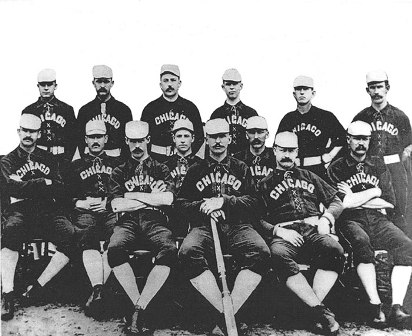
The 1880 White Stockings

The 1880 White Stockings “with all-white stockings”

The Adventures of George Borchers

7 Feb

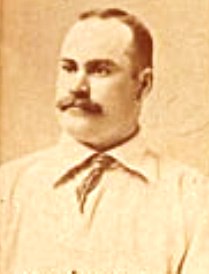
George Bernard “Chief” Borchers was a West Coast phenom.  The Sacramento native was so good as a 16-year-old in 1885 that the town’s two professional teams battled for his services.  After pitching half the season for one club, The Sacramento Record-Union said:

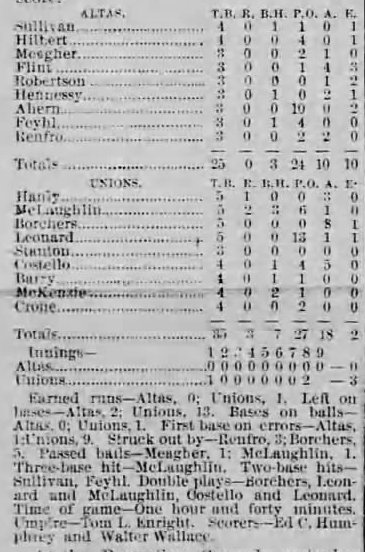
“George Borchers, heretofore pitcher for the Alta Baseball Club, has resigned his position in that club and will hereafter pitch for the Unions.”

Box score for Borchers' first start for the Sacramento Unions (July 26, 1885) after jumping the Sacramento Altas.  Borchers beat his former team 3 to 0.

Box score for Borchers’ first start for the Sacramento Unions (July 26, 1885) after jumping the Sacramento Altas. Borchers beat his former team 3 to 0.

He played for the California League’s Sacramento Altas in 1886 and the Oakland Greenhood & Morans in the same league in 1887. The Sporting Life said of him:

“Borchers is possessed of Herculean strength, great endurance, and is a heavy batsman.”

The Sacramento Bee said Borchers “would soon rank as one of best pitchers on the coast,” if he got “command of the ball and his temper.”

Before the 1888 season the 19-year-old became the subject of a bidding war.  He pitched several games against the New York Giants during John Montgomery Ward’s barnstorming/honeymoon tour of the West Coast in the winter of 1887.

Ward told New York reporters that Borchers was the best pitcher in the California League.  The Sporting Life called him “Ward’s especial favorite,” and “Ward’s find.”  By January The Boston Post said he turned down an offer from the Beaneaters, The San Francisco Chronicle said he rejected the Detroit Wolverines, and The Philadelphia Times said “(Athletics Manager Bill) Sharsig is hopeful to sign Borchers.”  The Times also said Ward’s Giants had made an offer but:

“The young man wanted a mortgage on Central Park and a large chunk of Coney Island.”

The San Francisco Chronicle said Borchers came from a wealthy family (his father owned a brewery) and were “opposed to his playing ball.”

Whatever the reason, Borchers opened the 1888 season with the Greenhood & Morans.  He pitched at least four games for Oakland before it was announced on May 2 that the 19-year-old had signed a major league contract.  The  Chronicle said:

“The baseball world was thrown into a state of excitement yesterday when the press dispatches made the unexpected announcement that George Borchers prize pitcher of the Greenhood & Moran club, had been signed to pitch for the Chicagos.”

The paper said when White Stockings President Al Spalding sent a telegram to Borchers asking his terms, the pitcher, “treated the telegram as more of a joke than anything else, and in the spirit of fun telegraphed back” asking for $3000, with a $500 advance.

“He never dreamed of receiving a favorable answer, and his surprise can well be imagined when a few hours later the answer came accepting his terms.”

Despite being what The Chronicle claimed was the “largest salary ever paid to a California player in the East,” Borchers immediately regretted the agreement:

“He says he does not feel much like leaving here and would like to back out if he could, but, knowing that he is legally bound by his act, he will of course stand by it.”

The pitcher arrived in Chicago on May 13 to great fanfare.  The Chicago Tribune said “if he equals the reports of his ability that precede him, the team will be as nearly invincible as it is possible for a baseball organization to be.”

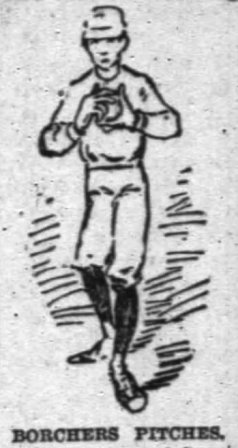
Caricature of Borchers from The Chicago Tribune--1888

Caricature of Borchers from The Chicago Tribune–1888

White Stockings shortstop Ned Williamson, who batted against Borchers on a West Coast trip, compared him to another California pitcher who made his big league debut at age 19:

“He pitched more like Charley Sweeney than any other man I ever saw, and Sweeney was as good as any that ever stepped in the box.”

Borchers made his debut on May 18.  The Chicago Inter Ocean said:

“Another wonder has been discovered and the Chicago Ball Club has it.  The wonder is George Borchers, the California pitcher.  He was put in the box to pitch for the Chicagos yesterday against the Bostons in the closing game of the series.  The result is manifest in the score—13 to 0…Borchers was made the hero of the hour.  He has come to stay, and his work yesterday is a guarantee of his ability to keep his place.”

The Chicago Tribune was more subdued than The Inter Ocean:

“(Borchers) has an easy delivery. Good curves and great speed, but his command of the ball remains to be determined.  Yesterday he was wild.  Three wild pitches were charged to him, and with a less active and reliable man than (Tom) Daly behind the bat more would have been recorded.  Those that got by Daly were extremely wild.  Still he was effective.”

The game, played in the rain at West Side Park, in what The Chicago Daily News called “practically a swamp,” was called after five innings.

The papers couldn’t agree on the attendance either–The Inter Ocean said it was 3000, The Tribune, 1500 and The Daily News 2000.

Borchers allowed just three hits and beat Charles “Old Hoss” Radbourn in his first major league game.

Things went downhill from there; the rest of Borchers’ story on Monday.

Spalding Bats

24 Dec

In 1883 “Northwestern Lumberman” magazine wrote about Albert Spalding’s bat manufacturing operation in Hastings, Michigan:

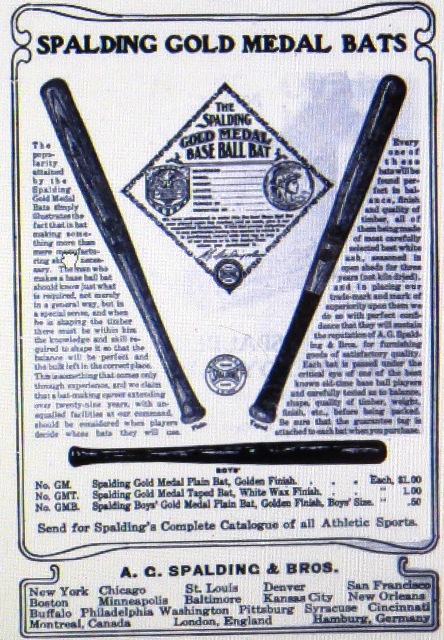
“Ash is the staple bat wood.  The ash bat is universally preferred and used by professional players, and given the best satisfaction.  In the matter of weight, strength and durability, bats of that wood seem best adapted to the wants of the batter.  A proportion of fancy, and necessarily higher-priced, bats are made of cherry.  Including the different woods and various sizes, there are twenty-two styles of bats made for the trade, ranging in price at retail from ten cents for a juvenile article up to $1.50 for an aesthetic cherry bat.”

A.G. Spalding

Albert Spalding

The article said Spalding’s Hastings plant would use roughly 350,000 feet of ash, 250,000 feet of basswood and 50,000 feet of cherry, resulting in an output of “25,000 dozen,” or 300,000 baseball bats.

“The best kind of lumber is required in making good bats, and the stocks of the raw material are kept two years in advance, in order to have them thoroughly dried.  Kiln drying is avoided, principally on account of the waste entailed by the method.”

The magazine said the “casual observer” might believe “there was considerable money in making bats,’ but:

“A man might find there was less profit than seemed to be the case.  The lumber must be good, and must be carried for considerable time, while it requires good machinery and careful workmanship on as nice a job as turning out a first-class bat.”

The bat business (and sporting goods in general) was very profitable for Spalding; he  left an estate of more than $2 million dollars when he died in 1915.

Spalding bat advertisement circa 1905

Spalding bat advertisement circa 1905