Tag Archives: A. G. Spalding

1876 Salaries

14 May

In July of 1876, The Brooklyn Argus published the salaries of the two highest paid teams in the newly formed National League; many of these have never appeared in any of the collections of early baseball salaries.

According to the article, the highest paid player was Chicago White Stockings pitcher Albert Goodwill Spalding who “as pitcher and manager, receives $3,000 for the year, with $1,000 bonus for producing the secession from the Hub (Boston) to Chicago.”  (The 1950 book “100 Years of Baseball,” by Lee Allen said Spalding earned $3,500 and a $500 bonus for the season).

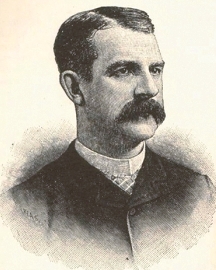
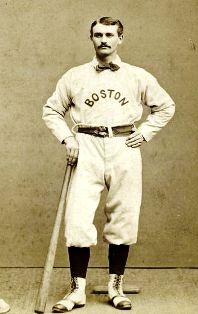
A.G. Spalding, highest paid in National League

A.G. Spalding, highest paid in National League

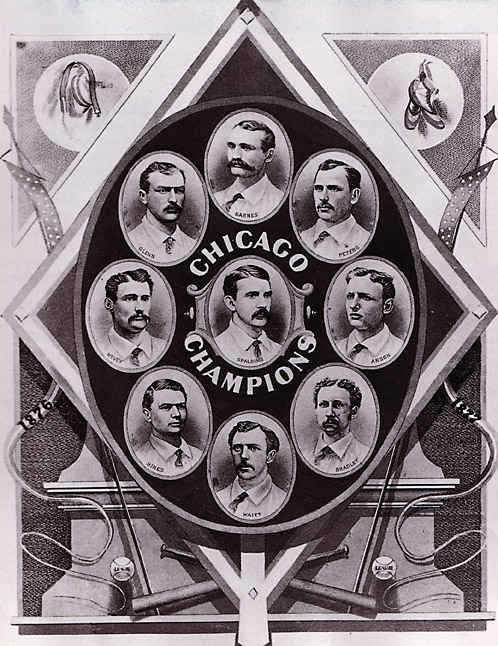
The three players Spalding brought with him from the Boston Red Stockings in the National Association, Catcher James “Deacon” White, first baseman Cal McVey and second baseman Ross Barnes were all paid $2,500.  The two players signed away from the Philadelphia Athletics, third baseman Adrian “Cap” Anson and outfielder Bob Addy received $2,200 and $1,500 respectively.

Outfielder Paul Hines earned 1.800, utility player Fred Andrus was paid 1,000, and the remaining members of the first National League Champions, shortstop John Peters and outfielders John Glenn and Oscar Bielaski were made $1500 each.

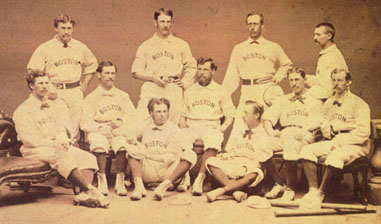
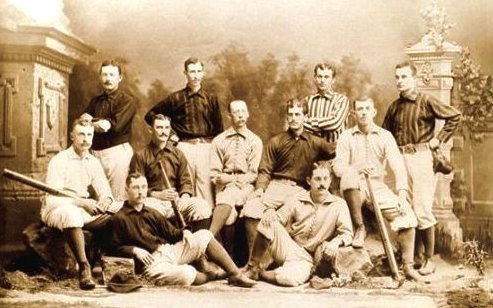
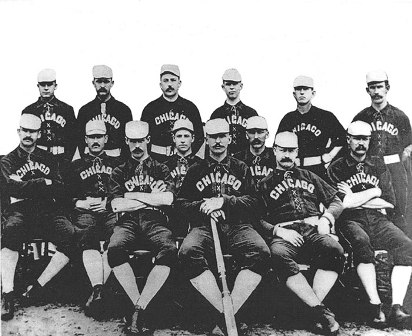
Chicago White Stockings, 1876 National League Champions--and highest salaried team.

Chicago White Stockings, 1876 National League Champions–and highest salaried team.

Harry Wright’s Boston Red Stockings filled the vacancies of White and Barnes with 18-year-old Lew Brown and 21-year-old John Morrill who The Argus said received “between 800 to 1000 dollars each.”

Manager Wright, who only appeared in one game, and his brother George were the highest paid members of the Boston club at $2,500 each.  Andy Leonard, who played second and outfield was paid $2,000.  Two other notable players on the Red Stockings, Hall of Famer “Orator Jim” O’Rourke and Tim Murnane received “between fifteen hundred and eighteen hundred dollars.”

According to The Argus, the White Stockings payroll of $21,500 topped the league, with Boston’s total of 18,000.

“Mique” Fisher 2

7 May

On October 12, 1906, with the World Series between the Chicago White Sox and Chicago Cubs deadlocked at two games apiece, August “Garry” Herrmann, President of the National Commission, received a telegram from Fresno, California:

“Fresno will give $25,000 guarantee; guarantee 40,000 fans and sunshine for deciding game of World Series.

–Mike Fisher”

Fisher said the offer to bring the series and Fresno native Frank Chance to town was backed by “the businessmen here.”

It is doubtful Herrmann took the offer seriously, and it’s probably just as doubtful that Fisher took it seriously, but it was picked up by newspapers across the country, and Fisher enjoyed the publicity.

It was a last bit of publicity before his career in organized baseball ended.  Later in the month he was dismissed as manager of the Fresno Raisin Eaters, and the team was dropped from the Pacific Coast League (PCL) the following spring.

Within weeks Fisher had moved on to a new project; he announced that he was in the process of forming a team to travel to Hawaii.  The San Francisco Call said “It will be the first American ball team to make the trip across the Pacific in a little over nineteen years,” since Spalding’s world tour.

In conjunction with Jesse Woods, a Honolulu promoter, Fisher organized a tour of the Hawaiian Islands with a team of PCL stars.

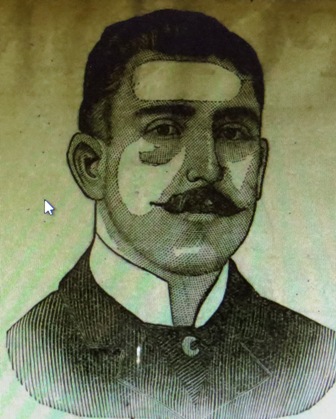
Mike Fisher

Mike Fisher

Upon his return, Fisher got more ink on the West Coast, when he headed to Nevada with Charlie Irwin of the San Francisco Seals; the two met with businessmen in the mining towns of Goldfield and Tonopah to discuss forming a professional league—Fisher told The San Jose Mercury News that he was now “against organized baseball,” and if he got involved in the league “it will be an outlaw organization.”

Fisher chose not to get involved in the new league, but immediately went to work on an even more ambitious tour than the 1907 Honolulu trip.

With the sponsorship of the Reach Sporting Goods Company, Fisher would accompany a group of stars to China, Japan and the Philippines.  Early publicity promised the travelers would include Ty Cobb, Hal Chase, and Frank Chance.

When the ship set sail in November of 1908 those three stars were not on board, but “several hundred fans and friends” were present when the steamer China left the port in San Francisco to see the group off.  The team was substantially the same as the one that toured Hawaii the previous year—an aggregation of PCL stars and a few National and American League players– and consisted of: Jim Delahanty, George Hildebrand, Bill Burns, Pat Flaherty, Jack Bliss, Babe Danzig, Harry McArdle, Nick Williams, Joe Curtis, Heine Heitmuller, Jack Graney and Bill “Brick” Devereaux.

Despite the failure to land Cobb, Chase or Chance for the tour, the West Coast press applauded Fisher for even attempting the trip, The Call said:

“The undertaking which he has fathered and which is so successfully underway at the present time is a big proposition.  With the single exception of the around-the-world trip of the A.G. Spaldings years ago, nothing on as big a scale as this has ever been attempted.  To take a team of American baseball players over a journey that will total 10,000 miles before they return, to play games in China, Japan, Manila and Honolulu is something that two or three years ago would have been laughed at as an impossibility.”

The tour lasted more than three months, with the team barnstorming through Japan, China, the Philippines and Hawaii, playing local and US Service member teams.  Though reports varied, the team played between twenty and thirty games, and lost no more than four.

While they drew large crowds throughout the trip, the newspapers back home reported that the tour was a financial disaster; when the players arrived back in San Francisco on February 15, 1909 aboard the Tenyo Maru, Fisher responded to the reports:

“I hear that it has been said that the trip was a financial frost.  Well, anybody who says that is a liar.  We broke even in Japan and made money in Manila and Honolulu.  I am satisfied with the trip.”

Fisher didn’t mention the financial results in China; likely because that leg of the tour was a disaster financially.  Years later he would tell a story about the team’s experience there, complete with his usual exaggerations:

“In one game we played in Canton we had 150,000 people inside, and as the gatemen had been instructed to accept Chinese money it required the combined efforts of the entire team to tote the money up to the hotel.  A special staff of accountants was busy all night totaling it up and in the morning we discovered we had $46.15.”

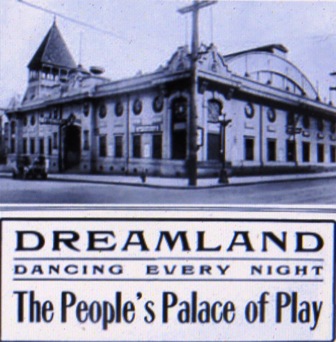
Fisher promised to take a team to Australia the following year.  The trip never took place; instead Fisher purchased a Seattle dance hall called the Dreamland, and quickly became the target of the pious women of the city.  Early in 1910 Fisher was indicted by “The King County grand jury, as a direct result of the activity of the Women’s Clubs,” for violating liquor laws, allowing “unescorted women” into his dance hall, and other assorted charges.  A special prosecutor, Justice William Henry White, one of the most respected jurists in Washington State, was appointed to prosecute Fisher and other club owners targeted by the women.

Ever the promoter, Fisher used the indictment to promote his dance hall and rally public support.  After the indictment was handed down Fisher sponsored a “Sermon in the Dreamland rink.”  According to The Seattle Times, Fisher engaged Reverend Frank Herthum, who “has liberal ideas about amusements.”

Mike Fisher's Dreamland Dancehall, Seattle

Mike Fisher’s Dreamland Dance Hall, Seattle

Herthum preached, and Fisher presented a free vaudeville show.  The paper said Fisher had stirred up a “protest against the effort to close the dance hall without having provided a substitute where clerks, servant girls and employees in the shops may pass an evening to their liking.”  At the same time The Times noted that the prosecutor was becoming impatient with the women who brought the charges because they continually promised to provide evidence that “has not yet come to light.”  The charges were quietly dismissed within weeks.

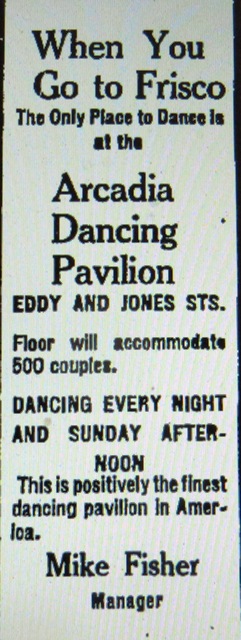
Fisher left Seattle sometime in 1911 and began operating the Arcadia Dance Hall in San Francisco.

Advertisement for Fisher's Arcadia Dancing Pavilion.

Advertisement for Fisher’s Arcadia Dancing Pavilion.

In January of 1917 Fisher made headlines in California when he announced that he was directing an effort to restart the California State League, which had folded after the 1915 season.  He said he would have clubs in Sacramento, Fresno, Stockton and San Jose.  Within two weeks Fisher abandoned the plan.  The San Jose Mercury News was not surprised:

“Mr. Fisher, the wonderful getter of publicity, has his publicity and is through.  Probably he has done wonders for his dance emporium or whatever it is he runs.”

The following year the San Francisco Seals of the Pacific Coast League came on the market; the first name reported as a potential buyer was Mike Fisher.  Fisher again got his headlines, but it was his old friend Charlie Graham who got the team.  Graham, and a group of investors purchased the Seals and the former catcher was installed as manager.
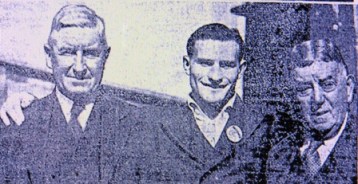
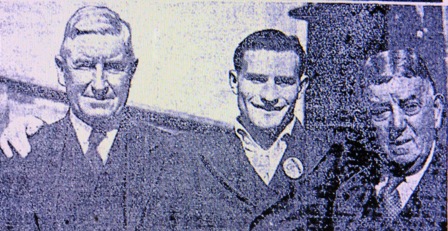
Charlie Graham, left, Mique Fisher, right, with World Middleweight Champion and actor Freddie Steele.

Charlie Graham, left, Mique Fisher, right, with World Middleweight Champion and actor Freddie Steele.

With his friend in charge The Mercury News said Fisher became a fixture “around the San Francisco ballpark ever since Graham bought in on the Seals in 1918,” he would remain a fixture at Recreation Park, and later at Seals Stadium for more than 20 years , and continued to provide copy for West Coast s sports writer

As a result of his friendship with Graham, who recommended he get the honor, 77-year-old Fisher was selected to travel to Cooperstown to represent the PCL at baseball’s centennial celebration in 1939.  The man who so loved seeing his name in the paper  received headlines one more time, when he died in San Francisco on June 6, 1943.

The Ross Barnes Case

2 May

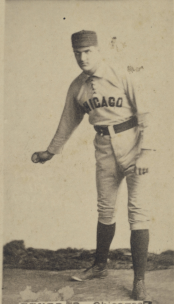
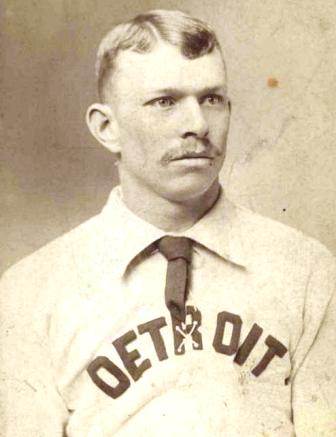
Charles Roscoe “Ross” Barnes was one of the greatest players of his era, and largely forgotten today.

Barnes was a member Harry Wright’s Boston Red Stocking teams in the National Association from 1871-1875 and won the National League’s first batting title hitting .429 in 1876 as a member the Chicago White Stockings.

Ross Barnes

Ross Barnes

Teammates and contemporaries had no doubt about how good he was.

“Orator Jim” O’Rourke called Barnes “the greatest second baseman the game ever saw.”  In 1896, A.G. Spalding “declared Ross Barnes to have been the greatest ballplayer in America,” and Tim Murnane said of Barnes:

“His left-handed stops of hard-hit balls to right field were the prettiest stops ever made on the Boston grounds. As a base-runner no man of the present day is his equal, and as a batsman he must be reckoned very high.”

1871 Red Stockings. Spalding, standing second from left, Barnes, standing far right, O'Rourke, seated far left.

1871 Red Stockings. Spalding, standing second from left, Barnes, standing far right, O’Rourke, seated far left.

Some of Barnes’ success was due to the rule at the time regarding  balls that rolled foul in the infield, The Sporting Life said:

“It was Barnes who was the first to master the fair-foul hit. He was able to drive the ball so that it would land fair and then swing in foul just outside of the reach of the third baseman.”

Barnes became ill in 1877, although he started the season with the White Stockings, The Chicago Inter Ocean said in early May “he is now, and has been all spring, very sick with few signs of improvement.”  After a slow start, Barnes was out for more than three months before returning in late August.

The Chicago Tribune said:

“Barnes made his reappearance with the Whites, and played his old position at second base,  but he showed evidence of physical weakness and lack of practice,”

Barnes appeared in only 22 games, hitting .272.

The second baseman,  who was earning $2500 for the season, and as was often the case in 19th Century baseball,  was not paid for the time he missed.  Early in 1878 Barnes filed a lawsuit against the White Stockings to collect more than $1,000 the team did not pay him while he was ill.

Cook County Judge Mason B. Loomis heard the case, which The Inter Ocean said:

“(I)s a new one in the experience of ball clubs, and the result is looked forward to with some interest  in sporting circles.”

The result was not favorable for ballplayers.  Judge Loomis ruled against Barnes, The Tribune said:

“This makes clear the point that players are not legally entitled to wages when laid off by sickness.”

While some owners did pay players during time missed due to illness and injury, teams had the right, after 15 days, to suspend any player without pay; and the legal precedent established in Barnes’ case remained until 1916 when the “injury clause” was rescinded.

Barnes attempted to return to the White Stockings in 1878, but The Tribune said he “has never fully recovered,” from the illness, and was released.

He played with and managed the London Tecumsehs in the International Association in 1878, then made two comeback attempts with the Cincinnati Reds in 1879, and the Boston Red Stockings in 1881, his career was over at age 31.

Barnes retired to Chicago and was working for Peoples Gas, Light and Coke Co. when he died in 1915 at age 65.

Profiles of Members of Spalding’s World Tour, “The Stonewall Infield”

23 Apr

While with the players who took part in the world tour between the 1888 and ’89 seasons, Si Goodfriend observed:

 “My experience in traveling with baseball clubs, the circumstances of which necessarily brings about a close association, has impressed me with the fact that most of them are, as a rule, men of far more intelligence and better manners than they are generally given credit for.”

Among those players were all four members of the Chicago White Stockings “Stonewall Infield:” Adrian Constantine “Cap” Anson, Nathaniel Frederick “Fred” Pfeffer, Edward Nagle “Ned” Williamson, and Thomas Everett “Tom” Burns.

Goodfriend said of Anson:

“Decidedly the most unique and interesting figure of all is that of Captain Anson.  He shows the same peculiarities of temperament off as on the ball field.  He takes advantage of every point he sees and, and holds it…He may not admire a fellow baseball player personally, but this will not induce him to detract from his skill or standing as a player.

“’Old Anse’ has genuine sporting blood in him, and will bet on anything that turns up…There isn’t anything (aboard)the ship he won’t bet on if he has a fair chance of winning.  Anson’s nature is not nearly as harsh as some people imagine.  The rippling water in the moonlight or the graceful soaring of a bird will draw out the greatest sentiments from him.”

Like John Tener, Anson would enter politics, but was less successful.  After being elected Chicago’s city clerk in 1905, he was defeated in the Democratic primary for Cook County (IL) Sheriff in 1907

"Cap" Anson

“Cap” Anson

Of Pfeffer he observed:

“(He) is handsome and has no striking mental characteristics.  He has a long, flowing, brown mustache and soft brown eyes, both of which would readily come under the head of a womanly ‘lovely.’  To show the nature of the man I need only mention a little incident that is causing him much worry at the present time.  His only relative is his mother who lives in Louisville.  Before leaving on the trip he promised to write to her regularly and while on the ocean he promised to cable home from every point possible.  He did not know there was no cable from Honolulu, and now he is worrying himself that his old mother will be anxious about him until he can cable from Auckland.  It will seem an age to him until that city is reached.”

Pfeffer, along with “Monte” Ward was a leader in baseball’s nascent labor movement, Pfeffer was frequently at odds with Anson, and led the exodus of most of the White Stockings’ starters to the Players League.  Despite that, in 1918 Anson called Pfeffer the game’s all-time greatest second baseman after sportswriter Grantland Rice said Eddie Collins of the White Sox was the best ever.

Fred Pfeffer

Fred Pfeffer

Williamson, he said, was “unassuming” and:

“(A) big tender-hearted fellow, whom everybody likes.  He writes in an exceedingly clever and interesting style, and can ‘fake’ a good story like a veteran journalist.”

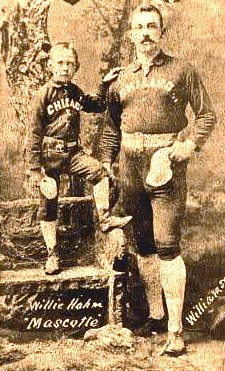
Ned Williamson with White stockings mascot

Ned Williamson with White stockings mascot

Williamson wrote his own dispatches from the tour which became popular features in Chicago papers.  He injured his knee on the tour and A.G. Spalding refused to help him with medical expenses; the 36-year-old Williamson jumped to the Players League in 1890, but his health began to deteriorate that year while playing for the Chicago Pirates.  He died of tuberculosis in 1894.

Goodfriend on third baseman Burns:

“(He) is a bright, intelligent man, who spends most of his time in reading; works of a standard heavy and weighty character being favorites.  He has the reputation of being a great dresser, and is said to have as many trunks with him as a New York belle would carry to Saratoga.”

Tom Burns

Tom Burns

Nearly a decade after the tour, Burns would be the man who replaced Anson as manager of the Chicago National League ballclub.  Burns took the reins of the “Orphans” in 1898, ending Anson’s 19-year run as manager.

Burns was named manager of the Jersey City Skeeters in the Eastern League in 1902, but died just weeks before the beginning of the season.

Profiles of Members of Spalding’s World Tour

22 Apr

Among those who joined A.G. Spalding’s world tour between the 1888 and 1889 seasons, was Simon “Si” Goodfriend, a sports writer for The New York World who later became a theatrical agent.  In 1935 The New York Times said of Goodfriend “has watched baseball as a fan and a sportswriter since the days of the Civil War.”

Simon "Si" Goodfriend

Simon “Si” Goodfriend

Throughout the trip Goodfriend wrote brief profiles of some of the players:

On Hall of Famer John Montgomery “Monte” Ward:

“Ward is a credit to the professional brotherhood of ballplayers.  He is not only ambitious to elevate the standing of the profession but he is equally ambitious personally.  He is exceedingly studious and never visits a strange city (without visiting) the art galleries, museums and libraries and takes copious notes of what he sees.  He presents the same disposition on the sea voyage.  He is a busy person both with his pencil and at his ball practice.”

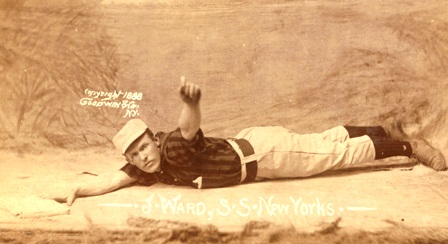
Ward, who had spearheaded the effort to create the first player’s union in 1885 and the creation of the Players League in 1890.

John Montgomery Ward

John Montgomery Ward

Of John Kinley Tener, White Stockings pitcher and future United States Congressman and Pennsylvania Governor:

“I was going to allude to John K. Tener as a typical handsome American gentleman, but unfortunately I learned, but a day or two ago, that he was born in Ireland and came to America with his parents when he was 9-years-old…His features are clear cut, regular and refined.  His manners are gentle and cultured. Baseball players secured a worthy brother professional when he joined their forces, and there is a to be regretted possibility that he may retire again next season…Anson can be relied on to make a great effort to hold him back.  On the trip Mr. Tener acts as a secretary and treasurer to Mr. Spalding.”

John Tener

John Tener

Tener jumped the Cubs to join the Pittsburgh Burghers in Players League in 1890; after posted a 3-11 record with an ERA of 7.31 Tener left baseball for the banking business, and ultimately politics.

Jimmy Manning, who would quite possibly save an umpire’s life in Kansas City in 1890, was also on the tour:

“(He) is another modest young man with a blond mustache, of which he is proud.   He recently graduated from the Boston college of Pharmacy.”

Jimmy Manning

Jimmy Manning

Philadelphia Quakers outfielder Jim Fogarty:

(Monte Ward) mentions in his book on baseball (that Fogarty was) probably the best right fielder in the country, is a bright looking young fellow with an exuberance of spirits, unquestionably inherited from the land of Erin, and that apparently has no limit.  It is said that he is writing for a Philadelphia paper.  If his letters are half as bubbling and genial as he is at sea they will make interesting reading.  With the exception of (Charlie) Bennett of the Detroits, Fogarty probably has as bad a pair of hands from hard knocks in baseball games as any player in the country.”

Fogarty also jumped to the Players League, joining the brotherhood team in Philadelphia; however he became ill during the season would die of tuberculosis in May of 1891.

Jim Fogarty

Jim Fogarty

Of Billy Earle, “The Little Globetrotter,” McClure said:

“Little William Earle…has already proven himself a first-class backstop (and) is still quite a lad, being only 21 years old.  He is heavy-set has a jolly round face, an habitual smile and tightly curled hair.  He rarely smokes, doesn’t drink and would almost sooner play ball than eat.

Billy Earle

Billy Earle

Some of Goodfriend’s observations about Earle would prove to be wrong, as discussed in an earlier post.

Goodfriend’s profiles of the White Stockings’ “stone wall infield” tomorrow.

“Leather-Fisted Phil”

12 Apr

“Leather –Fisted Phil” is what Phillip J. Powers was called in his 1914 Associated Press obituary which said:

“(Powers) was famous for his ability to stop the swiftest throws of the league’s star pitchers.”

He most likely earned the nickname in 1877 when, like many other catchers of the era, he began using a small, leather pad on his hand while with the London Tecumsehs of the International Association.

After the London team disbanded in August of 1878 Powers joined the Chicago White Stockings.  According to The Chicago Inter Ocean:

“He is a tall young fellow…He is described as a good catcher, but liable to get hurt, fair at the bat, and a genial man on the grounds.”

Powers would spend parts of seven seasons and 155 games in the National League and American Association with the Boston Red Stockings, Cleveland Blues, Cincinnati Red Stockings and Baltimore Orioles, hitting .180.  In between his engagements as a player Powers was an umpire.

It was as an umpire that he made a name for himself, but it probably wasn’t what he had in mind.  Few umpires, even in an era when members of the “profession” were poorly trained and underpaid, were the target of as much criticism as Powers.

In 1881 he began the season as a National League umpire.  By July he had become a target in several cities,

The Detroit News said:

“Phil Powers has acquired reputation enough in the last two weeks to last him a lifetime.  The erroneous umpiring he did here, people were inclined to regard as errors of judgment, but to say the least his ‘mistakes’ have become so numerous that his utter unfitness for the position he holds is unquestioned.”

The Cleveland Plain Dealer took the criticism even further:

“Powers is said to have been offered $150 to play ball (for the Detroit Wolverines) for one month, but refused it.  As an umpire he cannot, if square, earn more than $15 or $20 a week and expenses; and must take the chance at that of being chosen an umpire.  He preferred to be an umpire.  Several of his decisions on Saturday were grossly unfair, and, what is worse, they bore heavily on Cleveland.  They were so one-sided that many of the spectators believed he deliberately purposed to give the game to Troy.”

Despite the ill feelings in Cleveland, Powers joined the Blues in August and caught five games for the team after Michael “Doc” Kennedy was injured and John Clapp was “called away by an illness in his family.”   He finished the season with the New York Metropolitans in the Eastern Championship Association.

Powers again became a full-time player from 1882-1885, and was part of the Red Stockings American Association championship team in 1882.  He was released by Cincinnati in July of 1885, signed with the Baltimore Orioles and was again released the following month.

1882reds

1882 Cincinnati Red Stockings, Phil Powers standing 2nd from left

Powers was signed by the St. Louis Browns in the spring of 1886, but released before the beginning of the season, and was added to the National League umpiring staff in August.  He again worked as an umpire through the 1887 season, left to return to London, Ontario to manage the Tecumsehs in the International Association, but again returned to the National League as an umpire in August of 1888.   He came back just in time to find himself in the middle of a controversy involving two Hall of Famers.

New York Giants catcher/captain William “Buck” Ewing was hit on the wrist by a ball during a game with the White Stockings in Chicago.  In 1888 the opposing team’s captain had to agree that an injury was serious to necessitate a substitution; Chicago’s “Cap” Anson said he did not agree to a substitution when backup catcher “Big Bill” Brown entered the game in the 6th inning.  Anson appealed to the umpire, and according to The Chicago Inter Ocean, “(Powers) said that Captain Ewing was not so badly hurt that he could not play.”

After a heated argument, during which The Inter Ocean said Ewing acted “in a childish and fatuous manner,” Powers declared the game “forfeited to Chicago by a score of 9 to 0.”

Buck Ewing acted “in a childish and fatuous manner”

Buck Ewing acted “in a childish and fatuous manner”

Powers had been involved in a similar situation in 1886, refusing to allow Philadelphia Quakers catcher “Deacon” McGuire to leave a game after an injury.  The Chicago Tribune said Quakers captain Arthur Irwin “told McGuire to catch ‘away back’ (from the plate).” The Tribune said Irwin’s actions created a “scene” and “pandemonium reigned,” until Anson agreed to allow Philadelphia to replace McGuire.  White Stockings President A.G. Spalding “preferred charges against umpire Powers” for losing control of the game.

The substitution rule was changed in 1891, putting an end to controversies regarding the replacement of injured players.

But controversies involving Powers continued.  More on Monday.

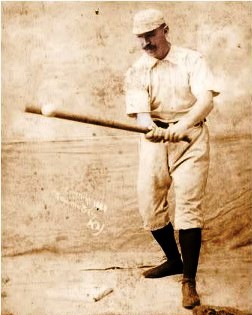
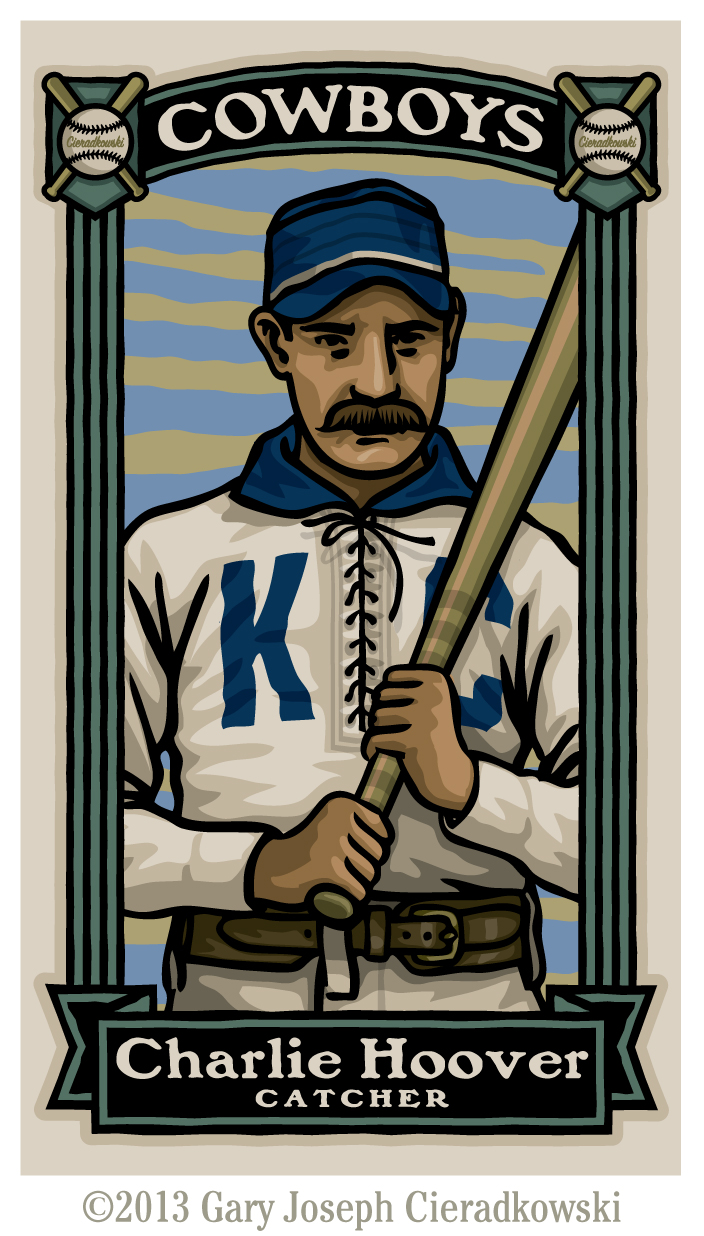
Charlie Hoover–Infinite Baseball Card Set

21 Mar

Gary Cieradkowski is an exceptionally talented artist from Covington, Kentucky.  Since 2010 he has produced the great Infinite Baseball Card Set Blog–with excellent stories and his incredible art work.  Gary contacted me recently about collaborating on a piece.  I chose Charlie Hoover.  Hoover was a talented, troubled 19th Century catcher who faded into obscurity and remains one of a handful of Major League players for which there is no information on the place or date of his death.  Read the piece here on Gary’s blog.

This is the card Gary created:

HOOVER_LG

“The most Extraordinary of the Championship Contests so far”

8 Feb

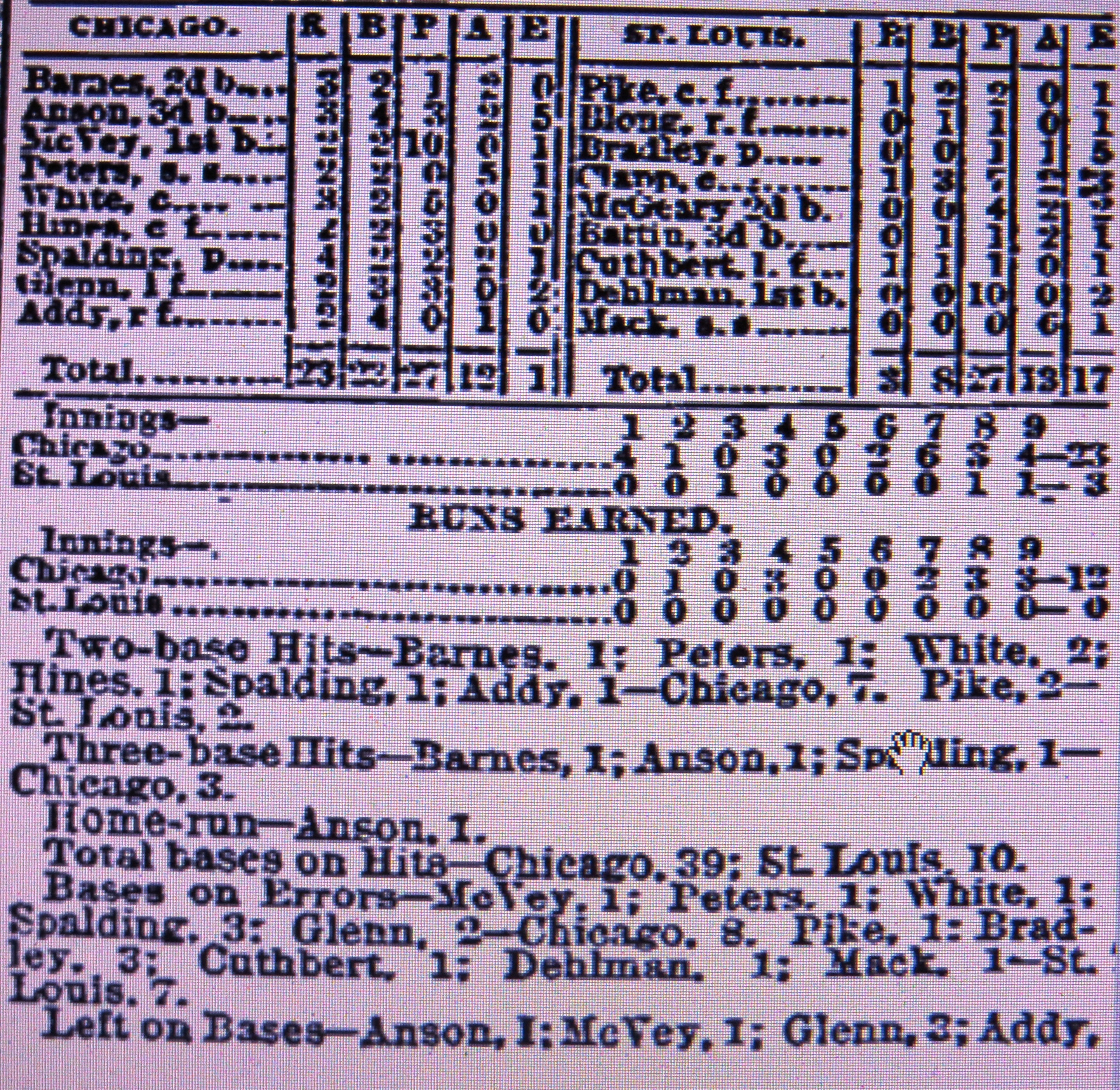
A game recap and box score from the National League’s inaugural season.  On August 26, 1876, the Chicago White Stockings defeated the St. Louis Brown Stockings 23-3 in Chicago.

Cap Anson, 50 errors in 1876

Cap Anson, 50 errors in 1876

Among the game highlights, White Stockings 3rd baseman Cap Anson made five errors, on his way to 50 for the season, Brown Stockings pitcher George Bradley also committed five (he only had 12 for the season) and the two teams combined for 28 errors.

The Chicago Inter-Ocean said the game was the turning point of the season in the White Stockings drive for the first league championship in a breathless, meandering report:

“The closing game of the Chicago-St. Louis series which was played Saturday at the Twenty-Third Street grounds, proved to be by all odds the most extraordinary of the championship contests so far.  As if determined to wipe out every record of the St. Louis having ever won a game from them, the Chicagos turned themselves loose and broke Bradley’s heart…Nearly 5,000 witnessed the game, and the enthusiasm rose at times to fever-heat.”

The story said Anson redeemed himself for his errors “two or three” of which were “comparatively easy balls,” by hitting a triple and a home run:

“Obtained on a terrible drive to right field which went clear to the fence…The Chicago batting was tremendous, and the visitors were kept on a continual hunt for the ball.”

The box score:

???????????????????????????????

Albert Spalding, Chicago’s manager, and pitcher, who batted 7th started all but six of the White Stockings 66 games in 1876. Bradley, who batted third, started all 64 of the Brown Stockings games and pitched 573 of the 577 innings played by St. Louis—outfielder Joe Blong pitched 4 innings in one game.  Bradley also pitched the National League’s first no-hitter against the Hartford Dark Blues on July 15.  As expected with the number of errors, Bradley gave up 151 unearned runs for the season.

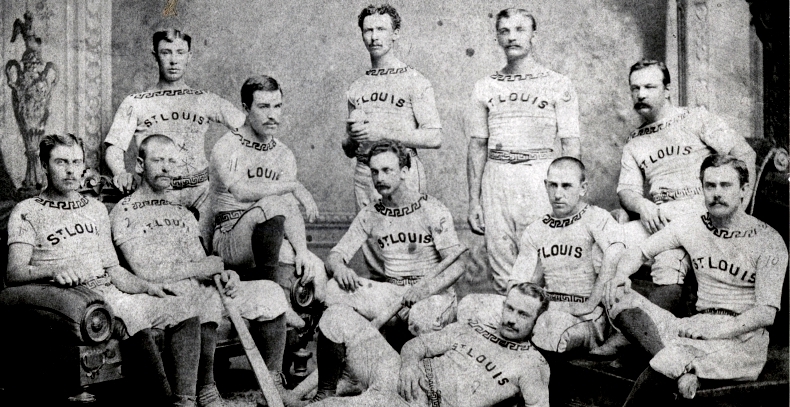
1876 St. Louis Brown Stockings, George Bradley

1876 St. Louis Brown Stockings, George Bradley, standing center, Joe Blong, standing left

After his 45-19 season for the third-place Brown Stockings, Bradley was acquired by the White Stockings in 1877, with Spalding moving to 1st base.  The White Stockings finished 5th with a 26-33 record, Bradley was 18-23.

St. Louis finished fourth, Blong split time between the outfield and the mound and went 10-9 for the Brown Stockings.


Actually, it Probably Wasn’t the Superstition

5 Dec

As with George Treadway, a story can get repeated throughout the decades while a large, key portion is lost in the process; such is the case with Billy Earle.

His career ended because of the superstitions of other players who thought he was “creepy,” as David Nemec described him in his excellent book “The Beer and Whiskey League.” In “The New Bill James Historical Abstract,” James credulously quotes the assertion from sportscaster Bill Stern‘s 1949 book “Favorite Baseball Stories” that Earle was:

“(F)orced out of baseball, because of nothing more than superstition, the belief that he was a hypnotist with the power of ‘the evil eye.’”

For awhile even Earle tried to use it as an excuse.

But actually, it was probably the morphine.

William Moffat Earle was at times a great player, but more often impetuous and prone to jumping contracts.

He earned his nickname “The Little Globetrotter” after being part of the 1888 world tour organized by Albert Spalding. Earle said of the trip:

“We played everywhere from the catacombs of Rome to Cheops of Egypt, under the shadow of the pyramids and out through India and the Islands of Ceylon.”

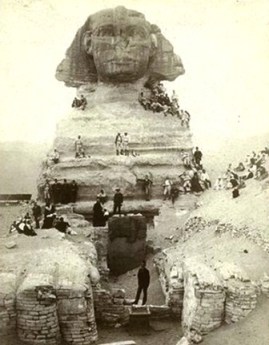
Billy Earle and the other members of the world tour

Billy Earle and the other members of the world tour at the Great Sphinx of Giza

After returning from the tour Earle joined the Cincinnati Red Stockings in the American Association. He bounced back and forth from Major League to minor league teams for the next six years. During that time, there were a number of humorous references to Earle’s interest in hypnotism, but none claimed it was an impediment to his career; however, in 1897, upon being released after one game with the Columbus Senators of the Western League the legend began.

In September of 1897, an article appeared in The Baltimore Sun under the headline, “A Haunted Ballplayer:”

“(Earle) cannot get a position on any ball team in the country, not even the small minor league teams.”

Earle told a sad story of teammates avoiding him and fearing the “hoodoo.” He even blamed his being released by Pittsburgh after the 1893 season on it, ignoring the fact that he was only signed because of injuries to the three other Pirate catchers, Connie Mack, Joe Sugden and Doggie Miller—and emergency catcher Jake Stenzel.

That 1897 story became the story of Billy Earle.

It also said:

“He is, moreover, a pleasant, intelligent, strictly temperate man.”

The first two might very well have been true. The last was not.

The rest of the story about Billy Earle has been lost, forgotten, or just ignored.

In August of 1898, The Cincinnati Enquirer told the real story of why Billy Earle had been out of baseball. The “strictly temperate” Earle was addicted to morphine.

His friend John McGraw helped get him treatment in a Baltimore hospital; his former Cincinnati teammates took up a collection to buy Earle a ticket to Philadelphia to stay with his parents after treatment.

He kicked the habit, and then for three seasons managed and played for an independent team in Richmond, Indiana; he also coached teams in Havana, Cuba during the winters of 1900 and 1902-1904. And he returned to professional baseball; hardly the profile of a blacklisted man.

Earle signed as a player/manager with the 1903 Vicksburg Hill Billies in the Cotton States League. He continued his playing career through 1906, and either managed or worked as an umpire in Midwest-based leagues through 1911.

Billy Earle, player/manager Columbia Gamecocks 1905.

Billy Earle, player/manager Columbia Gamecocks 1905.

Billy Earle died in Omaha, Nebraska in 1946.

Were there some players in the superstitious world of 19th Century baseball who were uncomfortable playing with or against Earle? Probably. If he had hit .320 and not had a drug problem would he have had a 10-year or more major league career regardless of superstitions? Probably.

A Really Complete Chronology, and Quite a Reason to End up on the Disabled List

10 Oct

The Reach Guide, founded by Major Leaguer turned sporting goods magnet Alfred Reach in 1883, along with the Spalding Guide, founded by Major Leaguer turned sporting good magnet Albert Spalding in 1878, were the annual bibles of baseball.

Both publications prided themselves on providing the most complete chronology of the previous season.

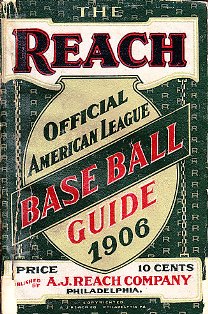
An example of just how complete the Reach Guide could be is found in the 1906 edition.

The entry is about a young pitcher named Gus Bonno.

Bonno was born November 27, 1882 (Baseball reference incorrectly lists his birth year as 1881) in Ohio.  Records for his career are spotty.  After playing for a semi-pro team in Urbana Ohio in 1901 and part of ’02, late that season Bonno appeared in two games with the Toledo Mud Hens in the American Association.  Bonno returned to semi-pro the following season and played for the Paducah Indians in the Kitty League in 1904.

Bonno pitched for the Newark Sailors in the Eastern League and Norwich Reds in the Connecticut State League in 1905.

The Kentucky New Era referred to the Bonno as: “The handsome black haired, black-eyed debonair Italian twirler.”  In fact, nearly every contemporaneous newspaper article about Bonno referred to his ethnicity, which underscores the domination of players of Irish and German heritage in 19th and early 20th Century baseball.

Back to the Reach Guide.

On page 160, for the date September 23, 1905:

“Pitcher Gus Bonno at Cincinnati broke his ankle jumping from a second story window of a young woman’s home to avoid being shot by a jealous rival suitor.”

1906 Reach Guide

Bonno recovered enough to join the Augusta Tourists in the South Atlantic in the spring of 1906, but was sold to the Norfolk Tars of the Virginia League at the beginning of season.  He continued to pitch until 1911 with stops in the Western League and Bluegrass League.

He passed away in Cincinnati in 1964.