Tag Archives: American Association

“The Money in Baseball” 1884

14 Mar

In 1884, under the headline “The Money in Baseball,” The Boston Globe expressed their antipathy about the “enormous salaries which the ‘kings of the profession’ demand.”

The Globe observed that “The best pitchers get as much money for working a few hours each day during seven months as many college professors receive for the entire year’s service.”

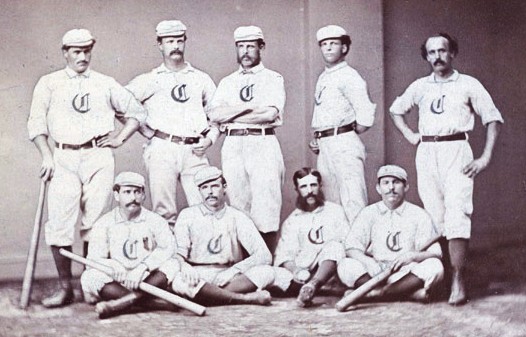
George Wright, Hall of Famer, and brother and teammate of Harry Wright with the 1869 Cincinnati Red Stockings, told the paper

“The money paid the entire team would put a poor team on the field today.  My brother Harry was the most expensive man on the team, and he got $2000 for being captain and playing center field.  I was in my regular position at short and drew $1800.”

Wright said several players on the Red Stockings were paid less than $1000.

1869 Red Stockings, Harry Wright, standing third from left, George Wright standing to the right of him.

1869 Red Stockings, Harry Wright, standing third from left, George Wright standing to the right of him.

By comparison The Globe said:

“The salary list of the Boston League club amounts to $25,000 in round numbers…It is impossible to estimate how much has been paid in salaries to ballplayers throughout the country.  The eight League clubs will certainly average as much as Boston’s total…In the Union Association are eight more clubs…there is not much doubt that the eight clubs pay at least $125,000 in salaries.  The American Association has twelve clubs…the salary list of these three largest baseball associations in the country aggregate between $500,000 and $600,000.”

McCloskey, Mays and Hair Color

12 Mar

Carl Mays is best known for being the pitcher who hit Cleveland Indians shortstop Ray Chapman with a pitch, resulting in the only hit by pitch death of a Major League player. In fifteen seasons he posted a 208-126 record with a 2.92 ERA.

Five years before he became infamous for Chapman’s death, Mays became embroiled in a strange feud with former National League manager John James McCloskey; the dispute was over hair color.

Carl Mays

Carl Mays

In December of 1914, McCloskey was a well-respected figure in baseball, credited with being the “father” of the original Texas League in 1888, he had spent five seasons as manager of the Louisville Colonels and St. Louis Cardinals in the National League, and another 23 as a minor league manager and owner.

Mays was coming off a 24-8 season for the Providence Grays in the international League, and while called up to the Red Sox in the closing weeks of the season had not yet appeared in a big league game.

The controversy originated when Charles “Toby” Fullerton, a pitcher for the Seattle Giants in the Northwestern League was quoted in an article that appeared in The Pittsburgh Press and several other papers about pitcher “Seattle Bill” James, who had just led the Boston Braves to a World Championship. Fullerton said when he and James were teammates in Seattle in 1912, manager Shad Barry had, “condemned the youngster for being a blond,” he then was quoted saying McCloskey also, “has no use in the world for blonde ball players.”

“Seattle Bill” James

The strange, silly, throwaway quote should have been the end of it, but it was apparently serious enough for McCloskey to issue a long denial from his home in Louisville, Kentucky. The full-page letter McCloskey wrote appeared in more newspapers than the original story, and read in part:

“Let me say, I have been accused of every crime in the calendar, but this is too much.”

McCloskey claimed the “rumor” originated when he was managing the Milwaukee Brewers in the American Association in 1910. Outfielder Rube DeGroff played for McCloskey (incidentally, Shad Barry was also a member of the team), and according to McCloskey:

“We were playing in Kansas City, we were behind…and made a big rally that came near giving us the game. The bases were full in the last inning, with two men out, when the big, blonde and good-natured Rube DeGroff, who was a splendid all-around player and life of the club, came to bat with the bases full and struck out. I was sore over losing the game and made the remark that I never saw a cotton-top who ever made good in a pinch.”

McCloskey said he also believed anything Barry might have said to or about James was certainly a joke, and closed with a final defense:

“In fact, in my humble opinion, I think the blonde has a shade over the brunette. But why the color of a man’s hair should have anything to do with his ability as a ball player is a mystery to me, and I hope this explanation will put an end to these silly rumors.”

It didn’t.

Within days Carl Mays weighed in, claiming that he had twice been rejected for an opportunity to pitch for McCloskey’s Ogden Canners in the Union Association because he was blond.

Mays said:

“McCloskey is a liar pure and simple…In 1912, when I was on my way to Boise to try out for the Boise team; I stopped off at Ogden, thinking possibly owner McCloskey might give me a trial. I met him downtown in a billiard parlor and went up and introduced myself.

“McCloskey looked me over carefully, like a horse-trader examining a piece of horseflesh, and then suddenly espied my blond hair. ‘No,’ said he coolly, ‘I don’t want you. In fact I wouldn’t have you around the ranch. I don’t want any blonds in my camp.’”

Mays also claimed that later in 1912 while compiling a 22-9 record for the Boise Irrigators in the Western Tri-State League; he was nearly sold to McCloskey’s pitching-strapped Ogden Canners until:

“One of the Ogden players happened to mention the fact that he was the same blond-haired fellow who had asked for a job earlier.”

According to Mays, McCloskey said:

“’Deal is off. Send that white-haired guy over here and I’ll kill him.’”

The story stuck with McCloskey for more than 20 years. A 1916 story in The Providence Tribune said:

“Scouts all over the country know McCloskey and never did one in his employ recommend a light-haired ballplayer…His peculiarity was well-known, and he knew that no one would have the temerity to recommend to him a blond or light-haired ballplayer. “

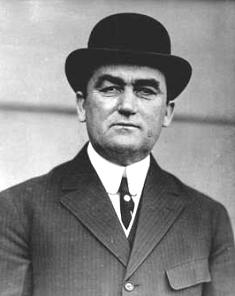
The black-haired John McCloskey

The black-haired John McCloskey

In 1934, The Milwaukee Journal called McCloskey, “one grizzled veteran who frowned on blond athletes.”

The article quoted E. Lee Keyser, a long-time minor league executive, who said when McCloskey managed Butte, “One of (McCloskey’s) players was an Indian outfielder whose hair was black,” the player struck out in a critical situation. According to Keyser, when the unnamed player returned to the clubhouse later, McCloskey grabbed his hair and said: “I just want to know if you’re wearing a wig. You hit like a blond.”

McCloskey managed in the minor leagues until he was 70-years-old, he died eight years later in 1940.

Another “Rube”

4 Mar

Hall of Famer “Lefty” Grove and Jack Ogden were the best known pitchers of the great Baltimore Orioles teams that won seven straight International League Pennants from 1919-1925, but in 1923 both were out-pitched by James Arthur “Rube” Parnham.

Parnham began his professional career in 1914 with the Huntington Blue Sox in the Ohio State League.  In 1915 he joined the Raleigh Capitals in the North Carolina State League, managed by Connie Mack’s son Earle.  The 21-year-old was an unspectacular 9-15 for Raleigh, but caught the eye of the elder Mack and spent the spring of 1916 with Jacksonville with the Philadelphia Athletics.
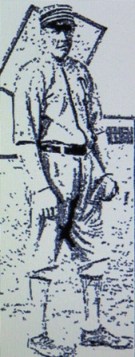
Rube Parnham, 1917

Rube Parnham, 1917

Parnham returned to the North Carolina State League for the 1916 season, splitting time between Raleigh and the Durham Bulls, posting a 17-19; his contract was purchased by the Athletics in late August.  Nearly a month later Parnham made his Major League debut; he appeared in four games for Mack’s last place (36-117) ballclub, he was 2-1 with a 4.01 ERA.

Parnham was with the Athletics in Jacksonville again in 1917, but was sent to Baltimore before the beginning of the season.  He won 16 games for the Orioles and earned one more shot with Mack in Philadelphia; Parnham was 0-1 with a 4.09 ERA in two September appearances.

As Parnham started winning games for Baltimore he developed a reputation as a work horse; in 1917 he won both ends of a double-header against the Rochester Hustlers, pitching a total of 24 innings in two 3-2 victories; in 1919 he won both games of a twin bill twice.   At the same time he began to earn a reputation as “eccentric’ and “erratic,” the inevitable comparisons to Rube Waddell and his small time roots earned Parnham the nickname “Rube,” he was also known as “Uncle.”

Baltimore sold Parnham to the Louisville Colonels in the American Association in March of 1918, but within two months was sold back to Baltimore, where he rejoined manager Jack Dunn, with who he had, and would continue to have, a contentious relationship.  He won 22 games in 1918 and followed with 28 in 1919, leading the Orioles to their first championship since 1908.

As the Orioles jumped out to a quick lead in 1920 (Parnham was 5-0, and was joined on the pitching staff by Ogden and Grove) the erratic Rube Parnham surfaced again. He was prone to disappearing for days at a time and also appears to have been hurt.  By mid-season he was gone.

More recent accounts have said Parnham jumped the Orioles to play semi-pro ball in Pennsylvania; just as likely, Parnham, who was suspended in June by Dunn for being out of shape, and who was clearly overshadowed by Grove (12-2) and Ogden (27-9); as well as Jack Bentley (16-3) and Harry Frank (25-12), was let go.

Lending credence to Parnham not having jumped is a January 1922 Associated Press item that said the pitcher “whose arm went on him” would rejoin “the Baltimores for the 1922 season.  Parnham wrote Dunn that he believed he could come back next season and pitch successfully.”  He won 16 games for the Orioles in 1922.

The following season would be Parnham’s best; the 29-year-old pitcher led the Orioles with a 33-7 record, Grove was 27-10, Ogden 17-12.   In addition to out-pitching his two teammates, Parnham set an international League record by winning 20 consecutive games.

Parnham’s old ways returned before the 1924 season when he failed to report to Florida for spring training.  The Associated Press said:

“Rube never reported at the Oriole training camp in the south and never even deigned to notify Jack Dunn whether he was going to play ball this year.”

Parnham eventually reported, but had another stormy, abbreviated season.  With a 6-5 record and a 4.84 ERA, Dunn suspended the pitcher in June, and he appears to have not pitched for the Orioles again that season.

The only reference to Parnham in 1925 was a May game he pitched for a semi-pro team in Duquesne, Pennsylvania and was beaten 8-0 by the Homestead Grays.

His career appeared to be over, but Dunn, it seems was willing to give his pitcher one more chance.

The Baltimore Sun said shortly before the 1926 season:

“Uncle Rube Parnham, the most colorful figure in the International League, will be back on the mound for the Orioles next season.”

Parnham was 13-9 with a 5.05 ERA, and spent the entire season feuding with Dunn; It was the end of the Orioles dynasty, the Toronto Maple Leafs won the championship in 1926 and Baltimore would not finish first again until 1944.

The Orioles were finally through with Parnham, The Baltimore Sun said:

“There was so much trouble between Parnham and Dunn last year that it was apparent Rube had spent his last season with the Orioles.” “

The 32-year-old was still considered valuable enough that the Milwaukee Brewers in the American Association purchased the pitcher from Baltimore.

The Brewers expected big things from their new pitcher, The Milwaukee Journal said:

“At times his playfulness leads him away from the straight and narrow, and he nearly drove Jack Dunn nutty last season…But Parnham is a great pitcher, despite his eccentricities, and if (Brewers owner) Otto Borchert can hire a good keeper for him is certain to be a winner with the Brewers.”

By March Parnham had worn out his welcome with another manager when he didn’t bother to report to Hot Springs, Arkansas for spring training.  The Journal said:

“Disgusted with the dilatory tactics of Rube Parnham, Jack Lelivelt, boss of the Brewers, hinted Saturday night that unless the eccentric righthander reports at once that he would probably be turned back to Baltimore.  Former International Leaguers …have told the Milwaukee leader about some of Reuben’s idiosyncrasies  and Lelivelt is beginning to feel that he will become a stepsister to Kid trouble if he had the former Oriole on his club.”

Parnham never played for the Brewers, and was returned to Baltimore, but Dunn was finished with him as well and he was shipped off to the Reading Keystones.  After a 2-8 season split between Reading and the Newark Bears, Parnham’s career was over.
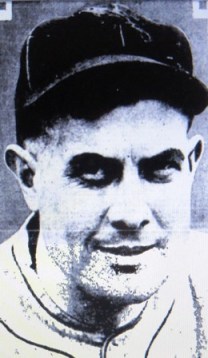
rube

Rube Parnham, 1923

Parnham retired to McKeesport, Pennsylvania, where the troubles that followed him throughout his career seem to have continued.  James Bready, an editor for The Baltimore Sun went to Pennsylvania to interview the former Oriole hero in 1961:

“The story was that he had gone downhill. Falling asleep in the snow, recently, he had lost several toes. On the phone, the director of a home for indigents said he would notify Parnham of the interview project. He gave me the street address — and a caution: ‘Try to get here before noon.’

“Paper, pen — I knocked and Rube beckoned me inside what today would be called a shelter. He was wearing an overcoat (I understand that better, now) and had not shaved recently. We sat down, facing, on two of half a dozen cot beds.  I tried a question. ”Gbbmhdahlr,” he replied. I stared at him; slowly, the meaning penetrated. I reached in my pocket and handed him a dollar.”

Parnham died two years later in McKeesport.

Kauff and Perritt

29 Jan

Benny Kauff and Pol Perritt were two of the reasons why the New York giants won the National League Pennant in 1917.  Kauff led the team with a .308 average and Perritt was 17-7 with a 1.88 ERA.  Both came to the Giants by way of the Federal League, and with the help of “Sinister Dick” Kinsella, John McGraw’s right-hand man.

"Sinister Dick" Kinsella

“Sinister Dick” Kinsella

Kinsella was the former baseball magnate of Springfield, Illinois who went east to serve as McGraw’s chief scout.  He was a key player in the incident that led to Giants’ catcher Larry McLean’s banishment from organized baseball.

After the 1914 season, McGraw set his sights on the Indianapolis Hoosiers’ Kauff, who was being called the “Ty Cobb of the Federal League.”  Kauff led the league with a .370 average, 120 runs, 211 hits and 75 stolen bases.

When the debt-ridden Hoosiers were transferred to Newark for the 1915 season Kauff’s contract was sold to the Brooklyn Tip-Tops, and he joined the team in Browns Wells, Mississippi.

At the same time, Perritt coming off a 16-13 season was prepared to jump the St. Louis Cardinals and join the Pittsburgh Rebels in the Federal League.

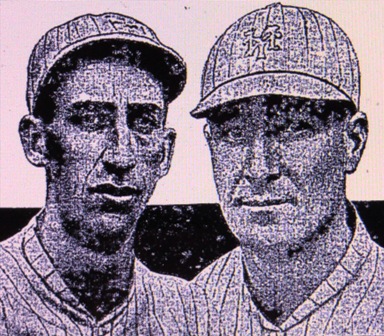
Pol Perritt and Benny Kauff, 1917

Pol Perritt and Benny Kauff, 1917

Sportswriter Frank G. Menke of Hearst’s International News Service picks up the story:

“Dick Kinsella, scout for the Giants, according to the story we get, hustled to Browns Wells and got a job on a plantation…Kinsella didn’t dare to put up at the same hotel because he was known by Manager Lee Magee, Business Manager Dick Carroll and others of the Brookfeds.”

Kinsella, according to Menke, was pretending to be a farm hand and also observing Kauff’s workouts and reporting back to McGraw who, along with Jack Hendricks of the Indianapolis Indians in the American Association (who held Kauff’s rights) was sending coded telegrams to Kauff signed “Father.”  Kauff received telegrams saying, “Mother wishes to see her boy,” and “All is forgiven.”

According to Menke, the telegrams were intended to inform Kauff that McGraw wanted him with the Giants and:

“The “everything forgiven” telegram was to tip Kauff off that if he jumped the National Commission probably would let him play.”

While Kauff was in Mississippi, Pol Perritt was in the process of  jumping to the Federal League.

According to Menke, Kinsella left Mississippi in the middle of the operation to secure Kauff in order to talk to Perritt.  What Kinsella said to Perritt is unknown, but Perritt’s meeting with Pittsburgh manager Rebel Oakes pretty much put an end to any chance of joining the Federal League.  The Associated Press said:

“Pitcher ‘Pol’ Perritt who jumped to the Pittsburgh Federal recently had a fist fight with Manager ‘Rebel’ Oakes…Those who saw the fight say that the pitcher delivered one blow that knocked Oakes over a chair…Friends and acquaintances interceded and hushed up the whole affair before police arrived on the scene.”

The story said Perritt was meeting with Cardinals’ management to “flop back to organized ball,” within weeks the Cardinals sold Perritt’s contract to the Giants, The AP said:

“Carefully guarded by “Sinister Dick” Kinsella…Perritt was delivered to John J. McGraw this noon…Kinsella brought his man in from Shreveport without struggle, and states that he did not even sight a Federal submarine during the entire journey.”

An alternate version of the story, published in The New York Times said it was McGraw who met with Perritt rather than Kinsella and highlighted the manager’s journey to meet the pitcher:

“McGraw had to travel forty miles on one railroad, nine miles on another, and then drive nine miles through the mud to get to Perritt’s home in Louisiana.”

Perritt was in the fold.  After a 12-18 season in 1915, he would win 18, 17 and 18 from 1916-18.

Kauff would be a bit more complicated.

While Kinsella was gone from Mississippi securing Perritt, Kauff signed a $6000 contract with Brooklyn, which he immediately regretted and contacted McGraw.

kinsellamcgraw

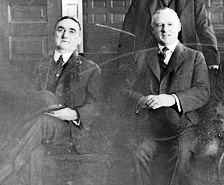
Dick Kinsella and John McGraw, 1920

According to Menke, Kauff:

“Related the difficulty he had with Robert B. Ward, president of the Brookfeds, over the contract.  The Giants people thought that owing to Kauff’s trouble—or alleged trouble—over the Brookfed contract that he was not legally under contract.”

Menke said the Giants signed Kauff for $7000 a year for three years with a $7000 bonus.

National League President John Tener voided the contract and Kauff was forced to return to the Tip Tops; he again led the league with a .342 average.

McGraw finally got his second man at the close of the 1915 season.  After the Federal League folded and Kauff was reinstated to organized baseball he signed a two-year contract for $6500 a season and a $5000 bonus with the Giants.

New York had finished in eighth place in 1915. They improved to fourth in 1916 and won the pennant by 10 games in 1917. McGraw’s Giants lost the to the Chicago White Sox four games to two in the World Series.  Perritt appeared in three games in relief, and Kauff hit a disappointing .160, despite two home runs in the Giants’ game four victory.

After the 1917 World Series Perritt and Kauff faded fast.

Perritt was 18-13 in 1918, but would only win four more games over the following three seasons with the Giants and Detroit Tigers; he was out of professional baseball before his 30th birthday.

Kauff’s demise is better known; his professional career came to an end at age thirty, the result of allegations of his involvement with gamblers, in general, and 1919 World series fixer Arthur Rothstein in particular.  Kauff, who owned an automobile accessory business with his half-brother and Giant teammate Jesse Barnes, was charged with stealing and reselling an automobile.  Although he was acquitted at trial, Kenesaw Mountain Landis banned Kauff for life.  Kauff’s oft-told story is told best in two excellent books by David Pietrusza:  Rothstein: The Life, Times, and Murder of the Criminal Genius Who Fixed the 1919 World Series and Judge and Jury: The Life and Times of Judge Kenesaw Mountain Landis.

Perritt died in Shreveport, Louisiana in 1947; Kauff died in Columbus, Ohio in 1961.

“King of the Natural Hitters”

25 Jan

Percival Wheritt “Perry” “Moose” Werden began his baseball career as a pitcher for the semi-professional team of his employer; the Ira Perry Pie Company in Saint Louis.  He was discovered by the St. Louis Browns who offered him a contract but ultimately signed with the Saint Louis Maroons in the Union Association.

(An oft-repeated story that Werden’s discovery involved him leaving a pie wagon unattended to join a game, resulting in the wagon being destroyed is almost certainly apocryphal, although it has been repeated as fact with little or no support by several writers)

In 1884 the 22-year-old was 12-1 with a 1.97 for the Maroons who at 94-19 won the Union Association pennant by 21 games; despite the strong start, Werden would never pitch in the Major Leagues again.

The Maroons joined the National League the following season and Werden ended up with the Memphis Reds in the Southern League.  He was primarily a catcher a first baseman, and his career as a pitcher pretty much ended; he appeared on the mound in only three games that season and had only 14 more minor league appearances over the next 10 years because of arm trouble.

Perry Werden, 1908

Perry Werden, 1908

From 1886-88, Werden played with five minor league teams and played three games in the National League with Washington in 1888.  In 1889, Werden joined the Toledo Black Pirates in the International League, where he became a great hitter.

Werden hit .394 for Toledo; in 424 at-bats, he had 167 hits, which was the hit record for the franchise for nearly 100 years, finally broken by Greg “Boomer” Wells in 1982 (Wells had 182 hits in 541 at-bats).

Toledo became a Major League franchise the following season, joining the American Association as the Maumees, Werden was the their starting first baseman, hit .295 and led the team in hits, runs, triples, and RBIs.  The Maumees finished 68-64 in their only season.

Werden was sold by Toledo to the Baltimore Orioles in 1891 and had another solid season, leading the team in hits, triples and RBI’s.  The following season he was signed by the Saint Louis Browns to replace Charles Comiskey at first base; Comiskey had jumped the Browns to join the Cincinnati Reds.

Werden hit .256 and .290 in two seasons with the Browns.  In 1894, he returned to the minor leagues with the Minneapolis Minnies in the Western League.  That’s where he became a legend.

In 1894, Werden exploded.  He hit .417 with 43 home runs.  In 1895, he improved to .428 with 45 home runs.

The Western League was no doubt a hitter’s league; eight players with at least 100 at-bats hit .400 or better in 1894 and 11 did so in 1895.  And the Minnies home field, Athletic Park, where Werden hit most of his home runs, was by all estimates a hitter’s paradise with a short (some sources say 250 feet) fence.

Regardless, 45 home runs would remain a professional baseball record until 1920. The Duluth News-Tribune said several years later that Werden hit seven home runs in a double-header in 1895; under the headline “Perry Werden was King of the Natural Hitters:”

“It was one of the greatest batting feats ever seen on a baseball lot anywhere.”

Werden had one last season in the Major Leagues.  At 35-years-old in 1897, he hit .301 for the Louisville Colonels, then returned to the minor leagues where he continued to hit well; .330 for his minor league career.

Werden became an umpire in the American Association in 1907, and became a baseball pioneer in 1908 when he joined the Indianapolis Indians in the same league; he was one of the first full-time coaches in professional baseball.  The Associated Press said:

“Perry Werden will go to Indianapolis to act as assistant manager, coach and advisor in general of the Indianapolis baseball club this year.”

In October The Indianapolis News declared Werden a success in the new role:

“Werden was one of the biggest factors in bringing Indianapolis her first pennant since 1902.  Without his services it’s highly probable the flag would have flown elsewhere”

The Indianapolis Star predicted that Werden’s “novel position,” would become the norm with the Indians, and throughout baseball.

Werden eventually returned to umpiring, working in the western, Dakota, South Dakota and Northern leagues.

His 43 home run season became news again in 1920 as Babe Ruth was closing in on Werden’s professional record.  Werden said there was one player in his era who was Ruth’s equal as a hitter.  Who was it?

Read about it on Monday.

John Bradley

18 Jan

Two members of the 1888 Dallas Hams were shot and killed in Texas.

One, George Kittle, I wrote about in September.

John Bradley was the other one.

Charles M. “John” “Brad” Bradley (wrongly listed with the middle initial “H” on Baseball Reference) left Oil City, Pennsylvania where he was born in June of 1864, to go west and play baseball.  An article in The Louisville Courier Journal said he was born to wealth and left Pennsylvania because of his father’s disapproval of baseball:

“(Bradley) was surrounded with every luxury.  He acquired a collegiate education and all the ornamental accomplishments of modern times.  He was possessed of a charming tenor voice; was a brilliant pianist and an expert linguist.  He was passionately fond of the national game…An early disagreement with his father, the result of his penchant for baseball, led to an estrangement, and, troubles never coming singly, he was rejected by a young lady of Oil City, PA, to whom he was devoted.”

After playing in Corning, New York in 1885 Bradley went to Kansas.  Various sources place him with the Topeka Capitals in the Western League and/or a team in Abilene in 1886 though neither can be verified.  Bradley then played with the Emporia Reds in the Western League in 1887.

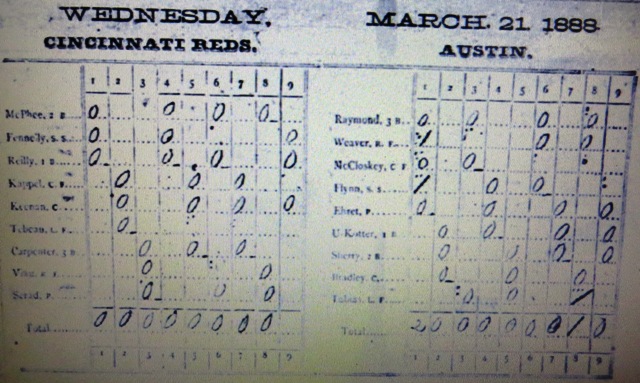
He signed with the Austin Senators in the newly formed Texas League in 1888.  In March, Bradley caught for Austin in two exhibition games with the Cincinnati Red Stockings of the American Association—the Statesmen lost the first game 2-0, but won the second 3-0.

Box score of 1888 Austin -Cincinnati game won by Austin 3-0.

Box score of 1888 Austin-Cincinnati game won by Austin 3-0.

Bradley was Austin’s starting catcher until the dissolution of the Texas League in July.  When the reformed Texas Southern League commenced play later that month, Bradley was with Dallas where he shared catching duties with Kittle.

Bradley hit .158 as Dallas coasted to a championship.

The 1888 off season was an eventful one.

Bradley was offered a contract for 1889 with the St. Joseph Clay Eaters in the Western Association.

He also started seeing Dolly Love, “A woman of bad repute,” as The Dallas Morning News said; problem was Love was also involved with a livery driver named Tom Angus.

At the same time Bradley got in trouble with the law in December of 1888.  The Austin Weekly Statesman said:

“(Bradley) shot a man named Billups in a (Dallas) bar room, because Billups attacked him with an empty beer keg because he refused to pay for drinks.”

Bradley was charged with “assault with intent to kill” and was scheduled to appear in front of a Dallas Judge at the end of January.  He was also arrested twice in early January for altercations with Love at the brothel she operated.

Throughout the chaos Angus and Bradley were trading threats over Dolly Love.

The rivalry came to a head on January 16.  Shortly after 10:30 a.m., Bradley and a friend exited Swope & Mangold’s Saloon at the corner of Main and Austin to return to his room at the Grand Windsor Hotel across the street.  The Austin Weekly Statesman said Bradley was:

“Shot down like a dog by Tom Angus, a hack driver, who followed him and fired in his back.”

The Headline in The Dallas Morning News said:

“The Killing of Charles Bradley the Baseball Catcher, all about a Fallen Woman.”

Bradley was shot through the back and began to run as Angus fired two additional shots; after running about 120 feet, Bradley fell dead in the street.  Angus was immediately arrested and ordered held for trial.

A letter from five representatives of the Texas/Texas Southern League and addressed “To the Baseball Profession of the Union” was published in newspapers around the country soliciting funds “In order that able counsel may be obtained to conduct the prosecution,” the letter concluded:

“John Bradley played with Austin and Dallas in 1888, and had recently signed with St. Joe for the season of 1889. He was a gentleman, an excellent ballplayer and altogether an honor to our profession.  To ball players this case suggests not only a duty but a privilege, and we trust that a suitable response will be made.  Yours fraternally,

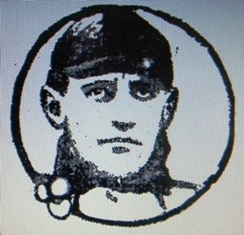
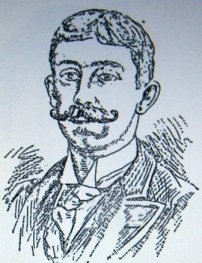
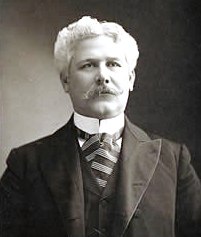
J. J. McCloskey, manager Austin team, I888.

Charles Levis, manager Dallas team 1888

Doug Crothers, manager Dallas team, 1889.

Kid Peeples, short stop Dallas team 1888.

Billy Joyce, third base Ft. Worth and New Orleans, 1888.”

It is unknown how much money was raised.

Dolly Love left Dallas for Fort Worth to escape the publicity.  Tom Angus spent more than a year in jail awaiting trial during which time he got married.  Dick Johnson, a friend of Angus’, who was at the scene of the shooting, was charged as an accessory, but was acquitted in a separate trial.

When the trial began in April of 1890 The Dallas Weekly Times-Herald headline called it:

“The Most Sensational Case that Has Been up for Years.”

Several witnesses, including a Dallas police officer testified that Bradley had also made threats against Angus in the weeks leading up to the killing, and that he often carried a gun.  Although Bradley wasn’t carrying a gun on the morning he was shot, and was shot in the back, the defense claimed that Angus had acted in self-defense.  Angus was found guilty, but sentenced to only five years in prison.

The sentence was upheld on appeal, the decision said:

“The accused should congratulate himself upon the mildness of the sentence.”

Angus was released from prison in the spring of 1895; in December he was arrested for shooting a man over a dispute about a horse.

Bradley was buried in Dallas.

The 1888 Texas Southern League

17 Jan

The Texas Southern League was in existence for half of one season; the reason for its creation was that the Dallas Hams were just too good a team in 1888.

In the winter of 1887 the Texas League was formed with six teams: the Dallas Hams, Austin Senators, Fort Worth Panthers, Galveston Giants, Houston Babies and San Antonio Missionaries.  Representatives from the Memphis Grays and New Orleans Pelicans in the Southern League, which was struggling to replace teams that had folded, also attended the meeting and lobbied for the league to be expanded to eight teams, but the six Texas-based teams voted not to include them;   New Orleans and Memphis joined the 4-team (down from 7) incarnation of the Southern League, which also included the Birmingham Maroons and Charleston Sea Gulls.

Charlie Levis, who had played Major League ball in The Union Association and American Association in 1884 and ’85 was named manager and played 1st base for Dallas.  Levis, a St. Louis native, brought in several Missourians including some who had spent time in the Major Leagues and built a strong team.

The Sporting News said Levis:

“Signed a team of professionals for Dallas that would do credit to almost any league in the country…They are all splendid fielders and batsmen and fair base runners.”

The team was so strong according to The Dallas Morning News that:

“So good was the Dallas team that club after club dropped out after repeated drubbings at its hands.  Dallas won so many consecutive victories that the other cities lost their appetite for baseball and withdrew.”

By late June, Dallas led the league with a winning percentage above .800; Austin and Fort Worth had dropped out and all the remaining teams were losing money with players often going several weeks between paydays.  At the same time, the Southern League was collapsing.  In early July, a deal was struck to create the five-team Texas Southern League with New Orleans joining Dallas, Galveston, Houston and San Antonio.

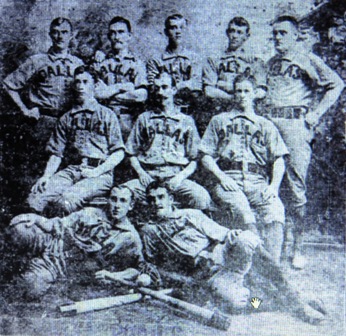
The 1888 Dallas Hams--Identifiable players: Front right Bill Goodenough, front left, Pat Whitaker, seated left, Ducky Hemp, standing left Charlie Levis, standing right John Fogerty,

The 1888 Dallas Hams–Identifiable players:
Front right Bill Goodenough, front left Ducky Hemp, seated left Pat Whitaker, standing left Charlie Levis, standing right John Fogarty,

While New Orleans provided some much-needed competition for Dallas the Texas Southern League half-season was not much different from the Texas League half-season.  Dallas finished with a winning percentage of .826, New Orleans finished second followed by San Antonio, Galveston and Houston.  The Morning News said on the final day of the season:

“The league is dead, and the Dallas club carries off the glory, waves high the pennant, and stands the champion club not only of the league but of all the South.”

The following season Austin and Fort Worth rejoined and the Waco Babies replaced the San Antonio Missionaries to again form a six-team Texas league; New Orleans returned to the Southern League, and the Texas Southern League was finished.

The story of one member of the 1888 Dallas Hams tomorrow.

Fighting Jimmy Burke

2 Jan

James Timothy Burke had a stormy tenure with the Saint Louis Cardinals from 1903-1905, including a disastrous 35-56 record as player-manager in 1905, replacing Kid Nichols (who remained on the pitching staff)—Burke resigned in August, and the Cardinals were in such disarray that owner Stan Robison eventually took over the team for the remainder of the season.

Burke had been with five teams from 1898 through 1902 before being traded to the Cardinals.

Jimmy Burke

Jimmy Burke

During his time with the Cardinals Burke had various fights and feuds, it was said he was the ringleader in a group of players trying to undermine manager Patsy Donovan in 1903; he had a long-standing feud with shortstop Dave Brain and the two seldom spoke, and he feuded with Robison throughout his short tenure as manager.  After his resignation he said:

“When I took charge of the team it was with the understanding that I was to be manager or nothing.  I have suffered as Donovan and Nichols with too much interference.”

Burke also had trouble with a Saint Louis sportswriter named Joe Finnegan.  Their contentious relationship came to a head at the Victoria Hotel in Chicago in September of 1904 after Finnegan had written an article in which he called Burke “a cow’s foot,” (apparently those were fighting words circa 1904).

The Pittsburgh Press provided the colorful blow-by-blow of the fight:

“First round–Burke hit Finnegan in the lobby, and followed the blow with a left hook on the back of the neck, breaking the scribe’s collar.  Burke pressed the advantage and struck Finnegan near the cigar stand.  Finnegan blocked cleverly, uppercut with the left and caught Burke in the snout.  Finnegan crossed his right and landed on Jimmy’s potato-trap.  Burke jolted Finnegan in the rotunda and followed with a short swing near the Turkish parlor.  Finnegan shot the right to the ear, and the left to the lamp.  They clinched.  Terrific short-arm fighting, completely wrecking Finnegan’s collar and cuff.  Johnny Farrell separated the men. Time.

“Second round—The house detective threw both fighters out in the alley.  Time.  Decision to Finnegan.”

Burke’s Major League career ended after the 1905 season.  New Cardinal manager John McCloskey said he wanted to retain Burke as his third baseman, but Robison, against his manager’s wishes (and continuing the pattern which led papers to call Cardinals managers “figureheads”) waived Burke.

Burke became a successful minor league manager and returned to the Major Leagues as a coach with the Detroit Tigers in 1914.  He also served as a coach with the St. Louis Browns and managed the team for three seasons.

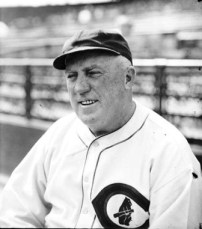
Jimmy Burke, Cubs coach

Jimmy Burke, Cubs coach

Burke served as Joe McCarty’s right hand from 1926-1930 with the Chicago Cubs and followed him to the New York Yankees where they continued together until a stroke necessitated Burke’s retirement after the 1933 season.  McCarthy had played for Burke with the Indianapolis Indians in the American Association in 1911.

Burke died in St. Louis in 1942.

Anger Management

27 Dec

Thomas Timothy “Tim” Flood just couldn’t control himself.

Flood was a solid infielder and somewhat erratic hitter.  As a 17-year-old he hit .364 with the New Orleans Pelicans in the Southern Association in 1894 but hit .266 in his minor league career and .233 as a Major Leaguer.

He had a late season 10-game trial with his hometown St. Louis Perfectos in the National League in 1899.  He was given his next shot in the National league in 1902 when he was signed by Ned Hanlon’s Brooklyn Superbas to fill the void left at second when veteran Tom Daly jumped his contract to join the Chicago White Sox.

Flood was an upgrade in the field, and while a weaker hitter than Daly, he quickly became a favorite of Hanlon who named him Brooklyn’s captain for the 1903 season.

Tim Flood

Tim Flood

1903 was not a good season for the new captain; he continued to struggle at the plate and dealt with a knee injury that limited him to 84 games.  He was also suspended for two games in July for a physical altercation in Cincinnati with umpire James “Bug” Holiday.  Holiday, a former Major Leaguer had a stormy half season as a National league umpire and resigned several days after tangling with Flood.

Flood was released by Brooklyn in March of 1904 and joined the Los Angeles Angels in the Pacific Coast League.

He was a very popular player in Los Angeles and captained the Angeles in 1904 and part of 1905 until he assaulted Ira “Slats” Davis, another former Major Leaguer turned umpire during a game in June of 1905. Eugene Bart, president of the league suspended flood indefinitely.

Newspapers reported that Flood said he would “never fight another arbitrator whether he is in the right or wrong.”

In 1906, he signed with the Altoona Mountaineers in the “outlaw” Tri-State League, where he appears to have kept his pledge and had an incident-free season.

In 1907, he joined  the Toronto Maple Leafs in the Eastern League and managed to play 29 games before he was in trouble again.  Flood assaulted an umpire named John Conway during a game in Toronto; the attack included a kick to the umpire’s chest.
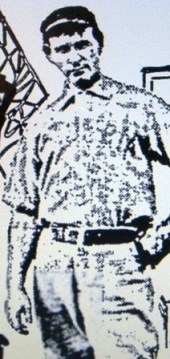
Flood was arrested.

He was charged with assault and ordered to appear in front of a magistrate. Friends told Flood the hearing would be a formality and that he should plead guilty and receive a small fine.

No one told Magistrate George Taylor Denison who said, “This sort of thing must be discouraged,” and sentenced Flood to “Fifteen days in jail with hard labor.” At the same time Patrick Powers, president of the Eastern League, banished Flood from the league.

Toronto fans were outraged and immediately began circulating petitions which “included the names of several clergymen” and were presented by team officials to Minister of Justice Allen Bristol Aylesworth in hopes of getting Flood pardoned.

Opinions of the punishment varied.  Several newspapers carried the following poem which lamented Flood’s fate for “Sassing” an umpire:

“’Holy Moses!’  In Toronto

There is news to make you pale

Sass the umpire if you want to—

That is, want to go to jail!

There is woe among the batters,

As around the field they scud;

And their pride is torn to tatters

By the fate of poor Tim Flood

Fifteen days in jail for Timmy

Soon the parks will close so tight

That you couldn’t with a jimmy

Let in one small streak of light.”

Others, including two former players, said Flood got what he deserved and implied that his behavior was not limited to the three well-publicized incidents.

Charles “Count” Campau, a former Major Leaguer and umpire, who had been a teammate of Flood’s in New Orleans said:

“I am sorry to see anyone go to jail, but, for the good of baseball. I am glad to see Tim Flood out of it for good. Rowdies of the Flood type are a disgrace to any sport or business, and especially baseball. He was always mixed up in just this way and was chased out of California, where b« was playing, for the same kind of tricks. Umpire baiting was always his long suit, and, from what I can understand, his attack on Umpire Owens [sic] was a most cowardly one: Flood is a good ballplayer, but his hasty temper, his meanness has put him out of the game forever, and incidentally Into Jail.”

Charles "Count" Campau

Charles “Count” Campau

Tim Murnane, Major Leaguer turned baseball writer said:

“Tim Flood has a new record, and will now be in a position to go back to his trade and give up the game he was unfitted for.  The courts all over the country should follow the example of the Canadian judge, who sent a ballplayer to lock-up for assaulting an umpire.  It wouldn’t take many decisions of this kind to drive the bad men out of the sport.  Imagine a player taking a running jump at a man and hitting him in the breast with his spiked shoes!”

Tim Murnane

Tim Murnane

After serving 10 days, Minister of Justice Aylesworth ordered Flood released.  The player, in various reports, claimed he lost between 10 and 16 pounds during his incarceration, citing the poor quality of the food.

President Powers rejected pleas from the Toronto management to reinstate Flood and permanently banned him from the Eastern League; however, contrary to Campau’s and Murnane’s wishes, Flood was out of baseball for less than a month.

Flood was signed before the end of July by the Saint Paul Saints in the American Association and vowed, as he had before, that he was a changed man.

It appears 10 days in jail might have made a difference.  Flood was named manager of the Saints in 1908 and continued to play and manage in the minor leagues for five more seasons, apparently without incident.

In 1914, The Sporting Life reported, with no irony, that Flood was hired as an umpire in the Northern League.

Flood died in St’ Louis in 1929.

Actually, it Probably Wasn’t the Superstition

5 Dec

As with George Treadway, a story can get repeated throughout the decades while a large, key portion is lost in the process; such is the case with Billy Earle.

His career ended because of the superstitions of other players who thought he was “creepy,” as David Nemec described him in his excellent book “The Beer and Whiskey League.” In “The New Bill James Historical Abstract,” James credulously quotes the assertion from sportscaster Bill Stern‘s 1949 book “Favorite Baseball Stories” that Earle was:

“(F)orced out of baseball, because of nothing more than superstition, the belief that he was a hypnotist with the power of ‘the evil eye.’”

For awhile even Earle tried to use it as an excuse.

But actually, it was probably the morphine.

William Moffat Earle was at times a great player, but more often impetuous and prone to jumping contracts.

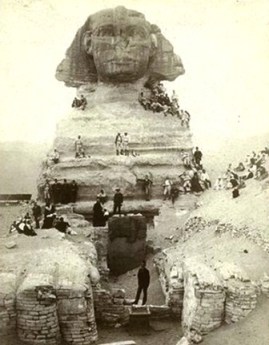
He earned his nickname “The Little Globetrotter” after being part of the 1888 world tour organized by Albert Spalding. Earle said of the trip:

“We played everywhere from the catacombs of Rome to Cheops of Egypt, under the shadow of the pyramids and out through India and the Islands of Ceylon.”

Billy Earle and the other members of the world tour

Billy Earle and the other members of the world tour at the Great Sphinx of Giza

After returning from the tour Earle joined the Cincinnati Red Stockings in the American Association. He bounced back and forth from Major League to minor league teams for the next six years. During that time, there were a number of humorous references to Earle’s interest in hypnotism, but none claimed it was an impediment to his career; however, in 1897, upon being released after one game with the Columbus Senators of the Western League the legend began.

In September of 1897, an article appeared in The Baltimore Sun under the headline, “A Haunted Ballplayer:”

“(Earle) cannot get a position on any ball team in the country, not even the small minor league teams.”

Earle told a sad story of teammates avoiding him and fearing the “hoodoo.” He even blamed his being released by Pittsburgh after the 1893 season on it, ignoring the fact that he was only signed because of injuries to the three other Pirate catchers, Connie Mack, Joe Sugden and Doggie Miller—and emergency catcher Jake Stenzel.

That 1897 story became the story of Billy Earle.

It also said:

“He is, moreover, a pleasant, intelligent, strictly temperate man.”

The first two might very well have been true. The last was not.

The rest of the story about Billy Earle has been lost, forgotten, or just ignored.

In August of 1898, The Cincinnati Enquirer told the real story of why Billy Earle had been out of baseball. The “strictly temperate” Earle was addicted to morphine.

His friend John McGraw helped get him treatment in a Baltimore hospital; his former Cincinnati teammates took up a collection to buy Earle a ticket to Philadelphia to stay with his parents after treatment.

He kicked the habit, and then for three seasons managed and played for an independent team in Richmond, Indiana; he also coached teams in Havana, Cuba during the winters of 1900 and 1902-1904. And he returned to professional baseball; hardly the profile of a blacklisted man.

Earle signed as a player/manager with the 1903 Vicksburg Hill Billies in the Cotton States League. He continued his playing career through 1906, and either managed or worked as an umpire in Midwest-based leagues through 1911.

Billy Earle, player/manager Columbia Gamecocks 1905.

Billy Earle, player/manager Columbia Gamecocks 1905.

Billy Earle died in Omaha, Nebraska in 1946.

Were there some players in the superstitious world of 19th Century baseball who were uncomfortable playing with or against Earle? Probably. If he had hit .320 and not had a drug problem would he have had a 10-year or more major league career regardless of superstitions? Probably.