Tag Archives: American Association

“Dunnie’s” Narrow Escape

28 Jul

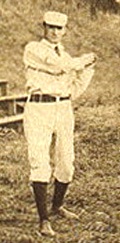
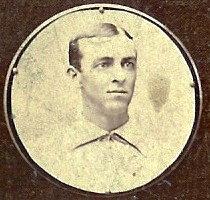
Samuel Morrison “Dunnie” Dungan returned home to Southern California in 1889 after graduating from Eastern Michigan University– the Michigan State Normal School– and joined the F.N. Hamilton’s a powerful San Diego-based semi-pro team that included 39-year-old Cal McVey, a member of Harry Wright’s Cincinnati and Boston Red Stockings teams from  1869 through 1875 (with a detour to Baltimore in 1873).

In the spring of 1890 the Oakland Colonels, champions of the California League in 1889 recruited Dungan to catch for them during a series of exhibition games in Los Angeles.  The Oakland squad did not impress Southern California critics.  The San Diego Union said:

“It is drawing it mild to say that it was the rottenest game that been played on the ground.  If it was not a fake, than the Oaklands cannot play ball.  Do they suppose up about San Francisco and Oakland that they can bring down to Southern California a lot of boys and show the Southerners how to play ball?”

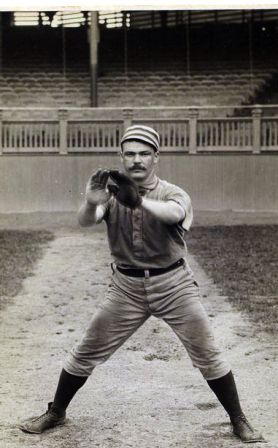
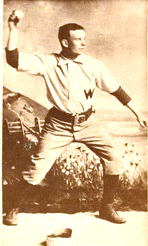
Samuel Dungan
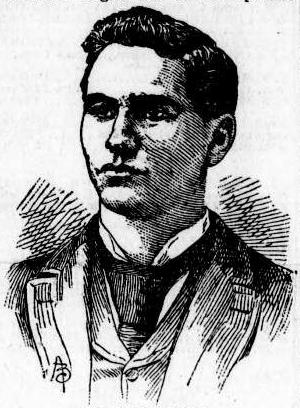
Samuel Dungan

The Union said the Hamiltons, as well as two other San Diego teams, the Schiller & Murthas and the Llewellyns “can beat the Oakland team out of sight.”

The paper said only one player stood out:

“Dungan, the San Diego catcher, who caught for the Oaklands both days, was about the only redeeming feature of that club…And he does not pretend to be a professional.”

As a result of his play during the exhibitions, Dungan was signed by the Colonels;  he still caught occasionally but was now primarily an outfielder.  Team owner Colonel Thomas P. Robinson was unable to restrain his enthusiasm when Dungan was signed, telling The Oakland Tribune:

“I believe Dungan is the greatest batter we’ve ever had here—better than (Lou) Hardie or (Vince) Dailey, the latter of whom I rank as the best of the old men.”

Fred Carroll, a California native who played with the Pittsburgh Burghers in the Players League in 1890, called Dungan “the only scientific batter on this coast.”

Statistics are incomplete for the 1890 California League season, but both The Tribune and The San Francisco Chronicle reported that Dungan was the league’s batting champion.  The Los Angeles Herald said he hit .332.  The Colonels finished third in the four-team league.  The Tribune said it was “probable that Dungan will go East.”

He was first rumored to be heading to be heading to the Washington Statesmen in the American Association but ended up signing with the Western Association’s Milwaukee Brewers.

It was Dungan’s departure from the West Coast in the spring of 1891 that led to the biggest headlines of his career.

The San Francisco Chronicle told the story:

“Sam Dungan, the ballplayer who was with Oakland last season and who led the California League in batting, is being pursued by an irate wife who says she will follow him to the end of the earth if necessary to again clasp him in her arms.  It seems that last year among the many conquests Dungan made in Oakland was Miss Mamie Bodgard.  She became wild over him, and at last was introduced to him.  After the season Dungan came south to his home in Santa Ana, but communication between himself and Miss Bodgard kept up.  She sent him many dainty perfumed notes.  Finally the marriage of the couple was announced and it created no great surprise.

“Now comes the thrilling part of this story.  Two hours after the marriage had taken place (in Los Angeles) Dungan left his bride and journeyed to Santa Ana, where he had an interview with his parents, who are well and favorably known and rank among the leading families.  Sam is a college graduate and was the idol of his parents.  Mrs. Dungan also journeyed to Santa Ana.  She did not go to the home of the Dungan’s, but went to the Richelieu Hotel.  She is a most pronounced brunette, rather petite, and is reported to have a temper.  The couple had parted, and the news of the separation soon became noised around.  Mrs. Dungan consulted a lawyer to have her ‘hubby’ restrained from leaving Santa Ana, but the heavy hitter eluded his young wife and started for Milwaukee, giving his bride the slip at Orange, she being on the same train with him that far.”

The jilted bride told a reporter for The Los Angeles Herald that she was “a grass widow,” but vowed to pursue Dungan to Milwaukee.  Mrs. Dungan’s trip to Milwaukee was unsuccessful.

A year later The Herald reported that a court in Santa Ana had awarded Mrs. Dungan $25 a month  “and she is very elated in consequence.”  She was said to have gone to Milwaukee twice the previous year and had taken to reading “Sammy’s love letters on the street corners,” of Santa Ana:

“Mrs. Dungan is an excellent dresser and is an exceptionally handsome woman.  She doubtless could be induced to kiss and make up, but the parents of her husband stand in the way of a reconciliation.  The Dungan’s are anxious to have Sam get a divorce, but he  can’t very well, and Mrs. Dungan says: ‘Never in a thousand years.'”

A divorce was finally granted in 1893.  Sam Dungan remarried in 1900.

Dungan went on to play parts of five seasons in the major leagues, mostly with the Chicago Colts and had a .301 career batting average.  He was an excellent minor league hitter, putting up several excellent seasons—including averages of .447, .424 and .372 in 1894, ’95, ’97 with the Detroit Creams and Detroit Tigers in the Western League. He also hit a league-leading .337 in 1900 for the Kansas City Blues in the inaugural season of the American League.

Dungan returned home to Santa Ana after retiring at the close of the 1905 season and participated in many old-timers games in Southern California.  The Santa Ana Register reported on his heroics during a 1924 fundraising game for former player Ed Householder who was dying of stomach cancer—Dungan joined Sam Crawford, Gavvy Cravath, Fred Snodgrass and other West Coast baseball legends for the game in Los Angeles:

“Yesterday, Dungan, now a prosperous Santa Ana resident and rancher, proved that years have not dimmed the remarkable eye nor time deprived the power from his arms and shoulders that enabled him, year after year, to outhit the other big league players of his day.

“Dungan rapped out a two-bagger with two men on the cushions in the tenth inning.  This blow broke up the game.  Previously Dungan had smashed out three other bingles.  Thus, Dungan of Santa Ana, the oldest man on the field in point of years, was the heaviest hitter just as he used to be years ago.”

Dungan died in Santa Ana in 1939.
Things I Learned on the Way to Looking up other Things #10

21 Jul

Trash Talk, 1886

The Philadelphia Times reported in July of 1886 about a feud between two American Association pitchers; Brooklyn Grays rookie Steve Toole and St. Louis Browns star Dave Foutz:

“Steve Toole says Foutz is the ugliest player in the Association.  Foutz returns the compliment by saying that Toole is no pitcher, but his face paralyzes the batsmen.”

Dave Foutz

Dave Foutz

Steve Toole

Steve Toole

The National Convention—1867

The Nashville Union and Dispatch’s take on a decision which would reverberate for the next 80 years:

“Still Against The Negro—The National Convention of base-ball players in session at Philadelphia last week resolved that no club composed of persons of color, or having in its membership persons of color, should be admitted into the National Association.

“To show the significance of this action we may state that there were four hundred and eighty-one clubs represented in this convention including clubs from the following states:  Massachusetts, Connecticut, New York, New Jersey, Pennsylvania, Delaware, Maryland, District of Columbia, Ohio, Indiana, Illinois, Wisconsin, Minnesota, Missouri, Oregon and Nebraska.  From which it is evident that the Northern base-ballists are opposed to Negro equality.”

Boss Schmidt—Throwing and Fighting

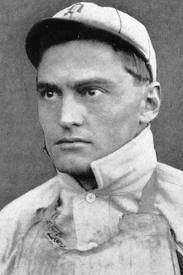
Charles “Boss” Schmidt is best known for leaving Ty Cobb with two black eyes and a broken nose in 1907 after Cobb slapped a black groundskeeper and choked the man’s wife when she attempted to intervene;  he also was a member of three pennant-winning Detroit Tigers teams (1907-1909).

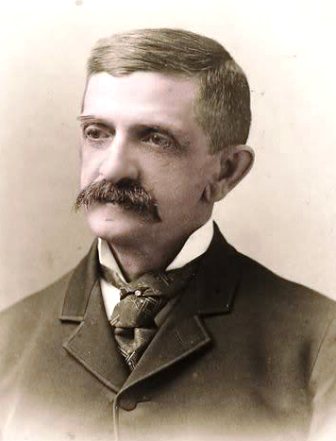
Charles "Boss" Schmidt

Charles “Boss” Schmidt

During the era when several players received tremendous publicity for catching balls dropped from great heights. Schmidt received only minimal attention for an impressive throwing feat in 1909.

The Tigers were staying at Washington’s Arlington Hotel during an August series with the Washington Senators when Schmidt, according to The Associated Press:

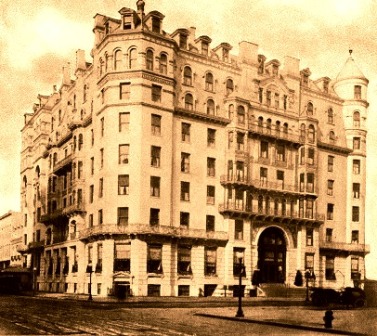
“Charles Schmidt of the Detroit baseball team threw a 10-cent baseball from Vermont Avenue in front of the Arlington over the eight-story Shoreham Hotel (the one torn down in 1929, not the Omni Shoreham which was built in 1930 and is still standing), which faces on fifteenth Street.  He took a run, and the ball went up until it disappeared over the roof line of the hotel.  It was later found in Fifteenth Street.  Whether it cleared the building entirely or bounced from the roof is not known, but it was a splendid throw, for the distance from where Schmidt stood to Fifteenth Street is nearly 400 feet.”

shoreham

The Shoreham Hotel, Washington D.C., the eight story hotel Schmidt cleared with “a 10-cent baseball.”

Schmidt participated in two professional bouts in Fort Smith, Arkansas after the 1911 season—he won a six-round decision and participated in one four-round no decision.  While some thought Schmidt could potentially fight champion Jack Johnson (who some sources say he spared against during this period), it’s clear Schmidt never took seriously the idea of fighting Johnson.

In a letter later printed in The Detroit Times Schmidt told a friend:

“This white man’s hope bunk is the biggest joke ever put over on the public.  I admit I like the boxing game, but I have never even considered gathering a living from the roped arena.  I like to do just four things.  Play ball, fight, hunt and eat.  Boxing is all right for a little amusement when it’s too cold to play ball…As for this dope on my being the white man’s hope, somebody is loon, it sounds like a squirrel talking to a nut.

“I have joined the Tigers again, and mean to show by my playing that I am with the team heart and soul.  Whatever my personal opinions have been, whatever my playing is, whatever critics have said about me, no one can say that I have not given the Detroit team the best I have…I don’t know who this guy is who has been sending fight dope from Fort Smith about my challenging Jack Johnson, but whoever he is, he ought to get a job in New York.  He could sell J. Pierpont Morgan a nicely enameled brick without difficulty.

“Yours is peace, prosperity and pennants, Charlie.”

Despite being released by the Tigers before the beginning of the 1912 season, Schmidt remained true to his word that baseball, not boxing, was his sport of choice.  His big league was over, but he continued as a player and manager in the minor leagues until 1927.  He never fought again.

“No Exhibition was ever Received in this City with more Enthusiasm”

2 Jul

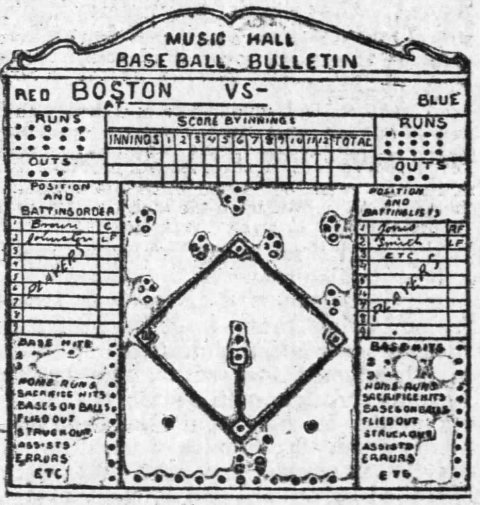
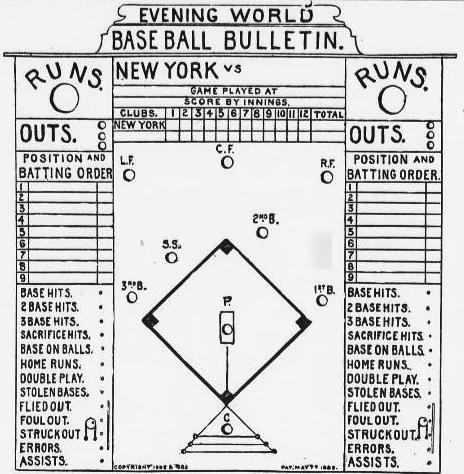
The New York World unveiled a newly updated attraction for baseball fans on August 6, 1889; the “Baseball Bulletin,” a version of which had also been introduced at the Boston Music Hall earlier that summer.

The Boston Music Hall "Bulletin Board."

The Boston Music Hall “Bulletin Board.”

The Associated Press said some fans thought the board was “an advantage over the actual game, in that it not only reproduces the plays graphically and simultaneously, but it keeps at the same time a simple and conspicuous record of the contest.”

The New York World's "Bulletin Board."

The New York World’s “Bulletin Board.”

The Boston Herald said their board measured “fifteen feet square.”  New York’s board was an improved version of one that had been used the previous October for the Giants six game to four World Series victory over the American Association’s St. Louis Browns.

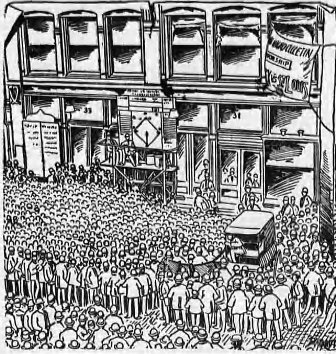
The crowd on Park Row for the 1888 World Series

The crowd on Park Row for the 1888 World Series

The board was the creation of  reporter Edward Van Zile of The World; Van Zile received a patent for the invention, although it was another member of the paper’s staff, Publisher Joseph Pulitzer’s secretary Edwin A Grozier, who turned it into a profitable enterprise. After purchasing the original rights from Van Zile, Grozier improved the design and received his own patent.

The World said the new version was a bigger sensation than the one introduced the previous October:

“’Perfection’ is the word which expressed the verdict of the baseball public who had the good fortune to witness the game between the New York Giants and Baby Anson’s team on The  World’s Baseball Bulletin Board yesterday afternoon…it is safe to say that no exhibition was ever received in this city with more enthusiasm than was the baseball bulletin.

“And the crowd too!  What a vast number!  There must have been fully 10,000 people in the audience, and the way they cheered when the Giants made a run was a sound that would have made Baby Anson sick.”

The presentation of the game took place on New York’s “Newspaper Row” (Park Row), with a crowd on the east side of the street

“(E)xtending from above The World Building to far below it (and) on the west side of the street the crowd was much larger.  There was a long line of people from Mail Street almost down to the other end of the big Federal Building.

“No point from which the game could be witnessed was left vacant.  The boys climbed up and lodged themselves in among the pillars of the Post Office…Even the lamp post was monopolized by the urchins, and when our boys made a good play they generally led the cheering.”

The “expert board operator placed the Chicago men in the field,” for the first inning, and leadoff hitter George Gore at the plate:

“When (Gore) slid down to first base the crowd were just ready to cheer, but they saw him put out and they reserved their applause for another occasion.

“They did not have long to wait, however, for (Mike) Tiernan and (Buck) Ewing  each succeeded in gaining bases, and then big Roger Connor was placed over home plate

“The crowd held its breath in anticipation of what was to come.  Their enthusiasm was drawn up to a high pitch, and was just waiting for a chance to break its bonds.  And they got it!  The little red disk representing Connor slid up to first and Tiernan slid across home plate.  Then there was a volley of cheers.  It broke forth clear and strong, and the sound could be heard blocks away.

“Up on the tops of the tall buildings in the neighborhood the cheers of the crowd could be heard resounding forth as a victorious army returning from battle.

“And it was all the same through the game. A great many people were attracted to the spot by the cries of the crowd, and when they saw the baseball bulletin they all united in declaring it to be the greatest thing they had ever seen.”

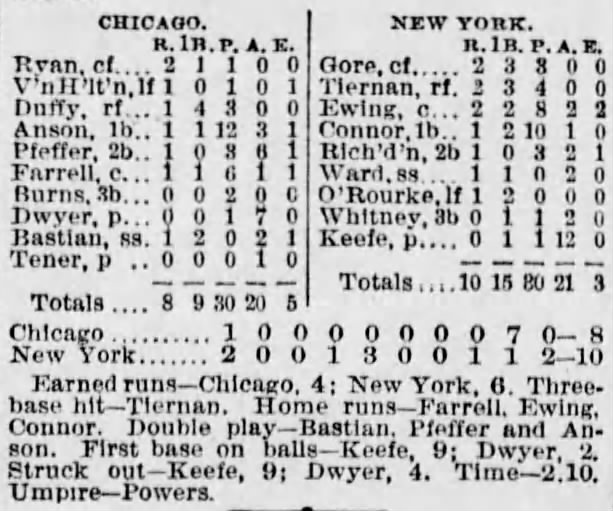
Chicago scored seven runs off Tim Keefe in the ninth to tie the score at 8.  The crowd’s “disapproval resolved itself into a continued groan.”

The Giants scored two runs in the tenth, and when the white Stockings came to bat in the last half of the inning:

“(T)he crowd watched more intently than at any time before.As each Chicago man went out there was a yell, and when they all went out without having made a run it was impossible to say a word that could be heard.”

The Box Score

The Box Score

The paper commemorated their innovation with a poem:

A boy was passing down the street,

Another lad he chanced to meet;

‘I’ll bet,’ he said, ‘we’re licked once more.

What is the score?’

A merchant coming down that way,

Lifted his bearded head so gray;

And ceased o’er book and cash to pore—

‘What is the score?’

A preacher wrestled with his text,

And wondered what he’d best say next;

Then called out through his study door;

What is the score?’

The Mayor in his office sat

And pondered over this and that,

The said: ‘I’m sure the game is o’er.

What is the score?’

If they had only chanced to go

Into the middle of Park Row,

And see the bulletin of The World,

And the glorious pennant there unfurled,

They’d never ask the question more

‘What is the score?’

The  World predicted the initial crowd was just the beginning:

“Today’s game between the Chicagos and the New Yorks will be duly recorded on the board.  There is room for everybody to see, and it is expected that the crowd will be twice as large as yesterday.”

The following day the paper did not say the crowd had doubled—to 20,000—but claimed it was “The largest crowd that had ever been on Park Row,” for the Giants 4 to 2 victory over the White Stockings.

Crowds continued to come to Park Row as the Giants battled the Boston Beaneaters and won the pennant on the final day of the season.

Baseball Bulletin Boards, and other versions of the concept, remained a popular feature well into the 20th Century. More often than not they were sponsored and presented by local newspapers.

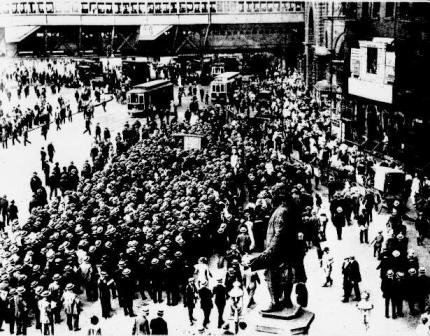
The New York Sun presented their own "Baseball Bulletin Board"  on New York's Park Row in 1914

The New York Sun presented their own “Baseball Bulletin Board” on New York’s Park Row in 1914


Things I Learned on the Way to Looking up other Things #9

18 Jun

The Business of Bats–1896

The Louisville Courier-Journal said in the spring of 1896 that their city “is now conceded to be the bat market of the world.”

That year, J. F. Hillerich & Son, a company that “was in practical obscurity three years ago,” had already “received orders to manufacture 75,000 bats this season.”

(Many sources, including the Louisville Slugger Museum, say the name change from Hillerich Job Turning to Hillerich and Son took place in 1897, but the names “& Son” and “& Son’s” were used in advertisements as early as 1895)

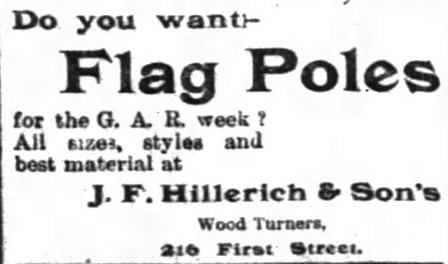
An advertisement for flag poles which appeared in Louisville papers on the eve of the 29th Encampment of the Grand Army of the Republic in September of 1895 shows the company name as J.F. Hillerich & Son's.

An advertisement for flag poles which appeared in Louisville papers on the eve of the 29th Encampment of the Grand Army of the Republic in September of 1895 shows the company name as J.F. Hillerich & Son’s.

“(Hillerich) is known to every ball player of any note in the United States.  A Courier-Journal reporter yesterday afternoon found orders from (Ed) Delehanty of the Philadelphias; (Hugh) Duffy of the Bostons, (Jesse) Burkett of the Clevelands and many other noted batsmen in the little factory at 216 First Street. Eight years ago (James Frederick) Jim Hillerich did not have money enough to buy a wagon load of ash, from which bats are made.  This season his business amounts to more than $50,000 which is done in ball bats alone.

“When a team arrives in the city the first thing the members do is to have a race for this bat factory to select some new ‘sticks.’”

The paper said the company’s output in 1895 had been twice that of 1894 and “The business this year amounts to four times as much as it did last year.”

The ash for Hillerich’s bats was grown in Indiana and Kentucky “and is felled and split by fifty men.  All the bats are hand-turned”

Washington’s Brief Craps Scandal–1891

In June of of 1891 The Washington Herald reported trouble in the ranks of the American Association’s ninth place Washington Statesmen.

The team was playing for their second manager (there would be a total of four that year), the first, Sam Trott had been let go after just 11 games.  The Herald said when Charles “Pop” Snyder was installed in place of Trott “the directors thought they had at last secured a pilot who would successfully carry them through the breakers.”

The team lost 16 of their first 19 games under Snyder and the paper said “steps are being taken to secure a new man to fill Snyder’s place.”

Chief among Snyder’s failing was:

“(W)hen a discovery was made at the grounds by some interested parties.  It was in the morning, and the men should have been practicing in order to better their playing, but instead were found, it is said, engaged in the seductive pursuit of playing ‘crap.'”

The only player the paper named was catcher James “Deacon” McGuire who, at one point during the game was ahead $56.  The Herald quoted an unnamed team official:

“‘We pay them good salaries, from $250 to $350 per month, and they ought to give us good ball.’ observed one director, after exhausting himself in giving expression to some very emphatic language regarding the crap incident.”

Deacon McGuire

Deacon McGuire

One week later the paper said:

The Herald cheerfully publishes this denial:  Manager Snyder makes a plain statement of the case, to the effect that one morning, the day of the extreme heat, while the men were in the shade, umpire (John) Kerins pulled out the ivories and the men in the spirit of fun went at the game.  It did not last ten minutes and it was the only time it occurred during the season.”

Snyder was replaced as manager a month later by Dan Shannon who fared no better (15-34); he was replaced by Tobias “Sandy” Griffin in October.

 The Reason for Baseball’s “Mania”–1869

The Milwaukee Semi-Weekly Wisconsin editorialized on the growing popularity of baseball in July of 1869:

“A few years ago the game of baseball which every male in the land, perhaps, had played from his youth up, was dignified by being elevated into a ‘national game,’ and set off with printed rules and regulations.  Forthwith the sport became the rage of young and middle-aged, and clubs were formed all over the land.  It was suddenly found that the game was just the thing to develop muscle and invigorate the frames of school boys and men of business, clerks and mechanics, sedentary men and farmers.”

The Associated Press gives with the utmost minuteness the score of every match game–no matter though it may have taken place in the obscurest village of the far east.  Across and up and down the continent these reports go side by side with the most important matters of state, of commerce, of international policy, often times taking up more space than news of the greatest moment.”

The paper asked “What has given this sudden impetus to the ‘national game?’ Is it the result of an increased desire for physical culture?  Is it because men feel more than ever the importance of exercise?  Not at all…There is another reason for the mania.”

That reason was gambling:

“We have nothing to say against baseball or any other sport when carried on simply as a recreation; we approve of them and think they ought to be encouraged; but the trouble is they degenerate into a machine for betting , and thus they become the means of corrupting the morals of the youth.  Americans seem to be rapidly acquiring an appetite for betting…This passion for outside  betting is increasing, and this is the reason why these match games are telegraphed over the country with such minuteness…Men bet on an election or a  baseball match who would not go into a gambling saloon for any consideration.”

The conclusion of the editorial was a foreshadowing of the role of gambling during baseball’s next five decades”

“It may be a comparatively small evil to make or lose five dollars upon some kind of match game, but this is only the beginning of an evil which too frequently grows into a magnitude which cannot always be computed.”


“The Contest is going to be the Hottest in the History of Baseball”

6 Jun

Just weeks into the 1892 season, National League president Nick Young declared the newly expanded league, which absorbed four franchises from the defunct American Association and included the only scheduled split-season in major league history, an unqualified success.

Nick Young

Nick Young

The schedule, which called for the first half to end on July 15, and the second in later October, necessitated starting league play two weeks earlier than 1891 resulting in a large number of early season games being played in inclement weather.

Young spoke to a reporter named Max Ihmsen, who usually covered politics for The Pittsburgh Dispatch, about the state of game

“(T)here is no doubt of the overwhelming success of the new deal.  Considering the wretched weather that prevailed everywhere during April the showing, both financially and as to skill displayed, has been remarkable.  Everyone is making money, and I look for the most successful season ever known in the history of the game.  The reconciliation of the clashing interests, a reconciliation effected during the past winter, has been the salvation of the sport…This year there is every prospect of each club quitting a big winner.  Never before have such games, as are now being put up, been seen.”

Young said an April 19 doubleheader in Chicago, which brought in $4,000 accounted for the league’s highest single-day gate receipts of the season so far.

As for the pennant race Young said:

“The contest is going to be the hottest in the history of baseball.  Everybody is ‘out for blood,’ and at the close of the season I anticipate seeing a tie for every place up to fourth or fifth.  A difference of 10 or 15 games between the highest and lowest clubs will reflect no discredit on the lowest club…All the clubs are in good shape and I expect quite a number of absolutely errorless games will be recorded before the season closes.”

Young got nearly everything wrong.

At the close of the season, Ernest J. “Ernie” Lanigan said in The Philadelphia Record that only two teams (Cleveland and Pittsburgh) operated in the black.  He said their profits were less than $20,000 combined while “ten clubs have lost in the neighborhood of $150,000.”

O.P. Caylor said in The New York Herald the league’s financial state was a “disaster more astonishing than any which have preceded it and knocks the hot air out of President Nick Young’s prosperity balloon, which went sailing up so grandly.”

At a June meeting in New York team owners agreed to cut rosters from 15 to 13, and the salaries for the remaining thirteen players were cut (as much as 40 percent).  At the same time, they increased to 12 ½ percent the 10 percent of gate receipts each club was assessed to pay off the debt incurred to buy out the American association franchises that were not absorbed into the league.

Caylor said salaries would continue to fall and “This is the year when the owners of huge blocks of baseball stock are not classed with the Vanderbilts, Goulds, Astors, and Rockefellers.  Every one of the holders has been ‘touched’ heavily, more or less, by the financial disappointments of the year.”

The Baltimore Sun put it more succinctly:

“The season has been a failure financially.”

The Boston Beaneaters won the first half (52-22) over the Brooklyn Grooms (51-26), after the June roster and salary reductions, the Cleveland Spiders (fifth place with a 40-33 record in the first half) won the second half (53-23) over the Beaneaters (50-26).

Initially, Boston owner Arthur Soden said his team would not meet Cleveland in a post-season series as a result of charges in Boston that his team tanked the second half.  He told Caylor:

“You cannot make a large number of our patrons believe that the Boston club has not purposely lost the last championship for the sake of making money out of a series of finals.  That belief has hurt us to the extent of thousands of dollars during the last half of the season, and unless it be removed will hurt us equally as much next season.  The only way we can remove the wrong impression is by refusing to play.”

Caylor said at the October owners meeting “the rest of the league took up the case and literally forced the Boston club to play…Boston’s refusal to play would do more harm to the interests of the League at large than the Bostons could possibly suffer by the playing of the games.”

The nine-game championship series began with an 11-inning pitching duel between Boston’s Jack Stivetts and Cleveland’s Cy Young that ended in a 0-0 tie.  Boston swept the next five games.

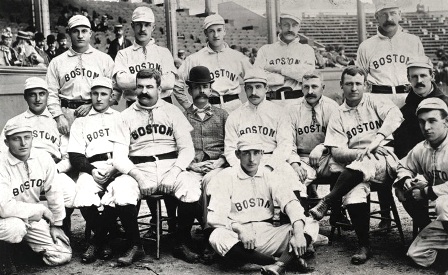
The Boston Beaneaters

The Boston Beaneaters

The split schedule and the resulting longer season were dropped for 1893.

Max Ihmsen, the reporter Nick Young spoke with, became city editor of The New York Journal, a William Randolph Hearst paper, in 1895.  Ihmsen went on to manage Hearst’s unsuccessful campaigns for mayor of New York City and governor of New York; he was also the Hearst-backed candidate for Sheriff  of New York County in 1907, a race he lost to the Tammany Hall-backed candidate.

Ihmsen later became the managing editor of another Hearst paper, The Los Angeles Examiner.  He died in 1921.

“I am thoroughly Disgusted with the Business”

12 May

Robert Vavasour “Bob” Ferguson shares claim, with Brooklyn Atlantics teammate Jack Chapman, to the nickname “Death to Flying Things,” although it will likely never be resolved which had the name attached to him first.

Bob Ferguson

Bob Ferguson

What is clear is that Ferguson was an important figure in 19th Century baseball –a player, manager, umpire and executive, and the game’s first switch hitter.

Ferguson was, given the reputation’s of 19th Century  umpires, uniquely popular.

The St. Louis Republican said he was “about the most brilliant of any…He never allowed his word to be questioned and was the most successful umpire in that regard ever in the profession”

The Louisville Post said “Ferguson plays no favorite from the time he calls play.  He sees all men alike and tries to do justice to them.”

The Sporting Life said he was “The only umpire who can satisfy New York audiences.”

In May of 1886 Ferguson resigned from the American Association’s umpire staff to manage the New York Metropolitans, until May of 1887, when he was let go by New York and returned to the association staff.  The Philadelphia Times said his services were so sought after that he was offered “$1200 for the remainder of the season.  This is much in excess of the regular umpire’s salary, but (the Cleveland Blues, Brooklyn Grays and St. Louis Browns) have agreed to stand the additional expense if Ferguson will accept the position.”

Even when criticizing Ferguson for possessing “a whole barrel full of that commodity known as mulishnessThe Cincinnati Enquirer said, “There is no disputing his honesty.”

Intractability was the one major criticism of his work, but Ferguson thought it an asset.  Shortly after returning as an umpire in 1887 The Washington Evening Star said during a game between New York and Philadelphia, a runner starting from second base, noticing Ferguson’s back turned after a passed ball cut third base and scored easily.  Ferguson was alleged to have said:

“I felt morally certain that he did not go to third base, as he scored almost as soon as the base runner who was on third at the time.  But before I could do anything in the matter the crowd began to hoot and I declined to change my decision.  Let an umpire be overcome just once by the players or the crowd and he never will be acknowledged afterward.”

But, despite the respect he sought and received, on and off the field, in 1888 Ferguson told  a reporter for The New York Mail and Express—which said Ferguson was noted for his “bluntness and firmness” as a player– how he really felt about being an umpire:

 “I did not choose it; that is to say, I did not seek it very earnestly.  I had been active on the ball field for so many years that I knew it would be only a question of a short time when my efficiency as a player would be impaired to the extent of my being forced to retire, and the position of umpire being possible for me to obtain and in fact offered to me, I accepted it that I might surely be able to continue upon the field, where I have spent most, and in a general way the happiest years of my life.

“How do I like it?  I do not like it at all.  An umpire, not withstanding newspaper talk regarding his being master of the field, is practically a slave to the whims of players.  He does not, as is generally supposed, go upon a field, and upon the slightest provocation fine a player to any amount simply because that man does not act in accordance with his ideas.  He is not there for that purpose.  He is simply the representative of the officers of the association in which he happens to be employed.

“I give all clubs, whether weak or strong, an equal chance.  The position of an umpire is one that no self respecting man can hold long without wondering whatever possessed him to accept it, and wishing to be free from it.

“But everyone has to earn a livelihood, and I am endeavoring to earn mine, but I will say I am thoroughly disgusted with the business and will welcome the day when I can say: ‘Robert, you are free; your slavery days are over; you can now enjoy the fruits of your labor.’  Don’t misquote me now and say that I am disgusted with the national game, for it would be utterly untrue.  I am fond of baseball, as my many years on the diamond will attest; but to be a player, which position I loved, is one thing; to be an umpire is another.”

Ferguson remained in the American Association through 1889, then joined the Players League as an umpire in 1890, and returned to the American Association for the 1891 season, his last; The Sporting Life said “the Association soured on him” because “his expense bill” was much larger than any other umpire.”

Ferguson tried to get a position with the National League in 1892, but according to The Chicago Tribune he “does not seem to be much sought after.”

Ferguson retired to Brooklyn where he died in 1894 at the age of 49.

Oliver Perry Caylor said in The New York Herald said he was “an umpire of recognized fairness and merit…His honesty was always above suspicion, and scandal never breathed a word against his upright life professionally.”

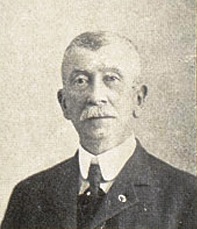
Miah Murray

7 May

Jeremiah “Miah” Murray appeared in only 34 major league games, with four teams between 1884 and 1891.  In 31 games a catcher, he made 29 errors and was charged with 28 passed balls.

During that short career, he also became the subject of two stories which highlighted his shortcomings behind the plate.  Both stories appeared after the fact, so are subject to the usual caveats of 19th-century baseball stories.

Jeremiah "Miah" Murray

Jeremiah “Miah” Murray

In 1894 The New York Sun wrote about the most embarrassing episode Murray’s career—said to have taken place during his rookie season, 1884:

“(Murray) tells about a game he once caught in at Buffalo when he was a member of the Providence team.  There were three men on bases and he threw to (Jerry) Denny to catch a man napping, but the ball never got there.  It hit Jim O’Rourke, who was the batsman, on the side of the head and bounded into the grandstand, three men scoring and winning the game for Buffalo.  Jim staggered and cried out with pain, but the crowd simply cried with glee, O’Rourke’s hurt being entirely lost sight of in the enthusiasm.”

Murray’s manager during that 1884 season was Frank Bancroft who led Providence to the National League championship and a three games to zero victory over the New York Metropolitans of the American Association earning for the first time the title “World Champions” from The Sporting Life.

Frank Bancroft

Frank Bancroft

Bancroft compiled a 375-333 record over parts of nine seasons as a big league manager, before becoming an executive with the Cincinnati Reds.

It was while serving as the Reds’ Business Manager that Bancroft related another story about Murray’s brief time with Bancroft’s championship team.  The story first appeared in The New York  American in 1915:

“’Take it from me,’ said Frank Bancroft, while some of the fans were discussing famous bonehead plays, ‘the old timers pulled some bones that had all you youngsters blocked off the map.  Best I recollect, right now, was sprung by Miah Murray when he was catching for me…With a runner on first Miah steamed back to the stand a made a magnificent catch of a foul fly.  The crowd broke into roars of applause; Murray, leaning against the stand, took off his cap and bowed right and left—and the runner, sizing up the situation, lit out from first, kept right on going, and came all the way around while Miah kept bowing and the rest of the team were screeching and raving, all in vain.”

Murray later became a National League and college umpire; he was also a prominent boxing promoter and matchmaker in Boston where he operated the Lincoln Athletic Club of Chelsea, and later the Armory Athletic Club.  He died in Boston in 1922 at age 57.

Bancroft retired as business manager of the Reds in January of 1921; he died two months later at age 74.

“King of the Bushes”

23 Apr

Edward Francis “Ned” Egan was called “The Connie Mack of the minors” and the “King of the Bushes” during his managerial career.

It is likely that most of the statistics listed under Egan’s name on Baseball Reference and other sources  are for another player or players with the same surname.  Egan’s grave, burial record, birth and death record confirm that he was born on January 13, 1878, in St. Paul, Minnesota–which would make him 10-years-old for the first playing records for the “Ned Egan” listing.  Contemporary references to Egan’s playing career are vague–most say he played semi-pro ball in Minnesota beginning in 1897, and some sources say he was with St. Paul Saints in the Western League in 1901; although his name does not appear on any roster for the team.

What is certain is that his managerial career began 1902 and that he won eight pennants in 16 seasons.

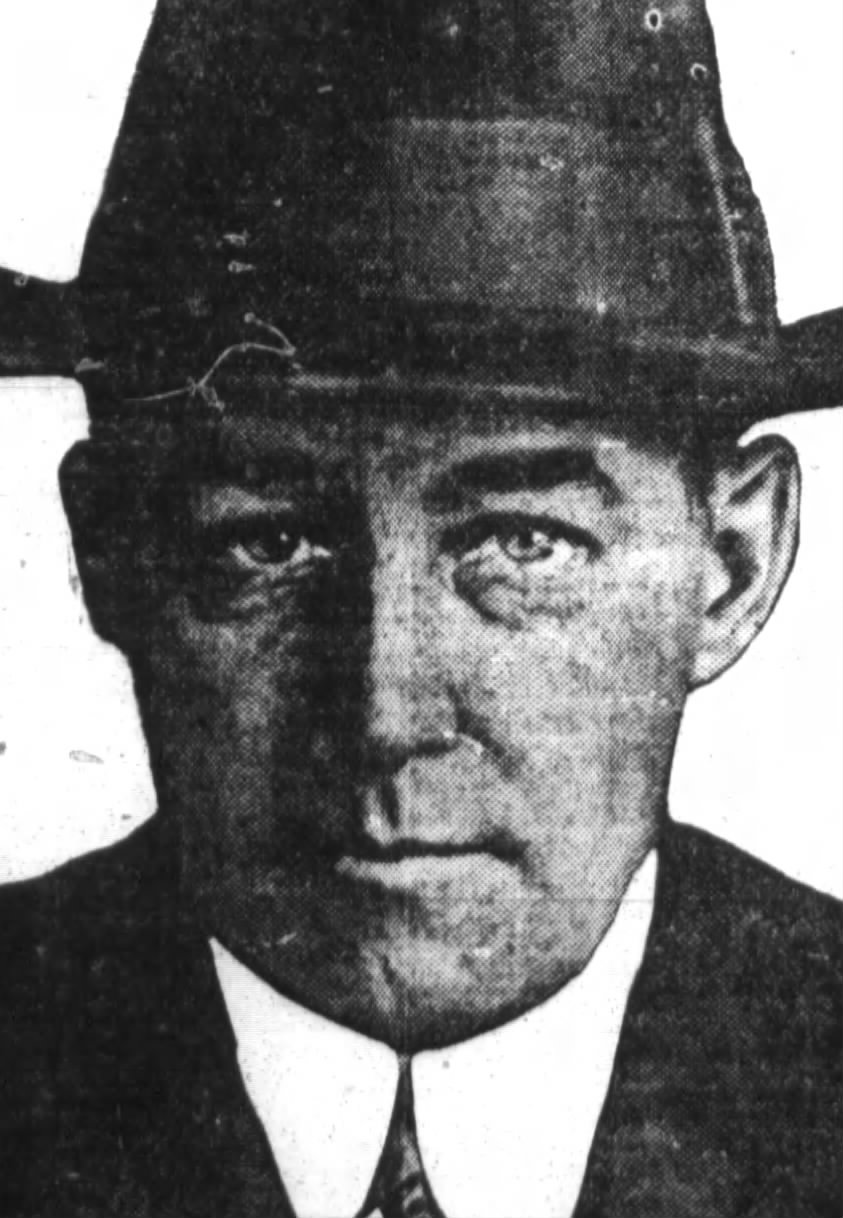
Ned Egan

Ned Egan

Egan won championships in 1902 and 1903 with the Winnipeg Maroons in the Northern League,  then won six more with the Burlington Pathfinders (1906 Iowa League of Professional Baseball Clubs, 1908 Central Association), the Ottumwa Speedboys-Packers (1911,12 and ’13 Central Association), and the Muscatine Muskies (1916 Central Association).  The Washington Post called him “The Central Association’s chronic pennant winner.”

Egan was credited with helping develop several major leaguers including Burleigh Grimes, Lee Magee, Cy Slapnicka, Hank Severeid, and Cliff Lee.

Egan finally got his chance in the high minors in January of 1918, but it happened as a result of a fluke.  Al Timme, owner of the Milwaukee Brewers of the American Association announced that Egan would be his new manager.  The Milwaukee Journal said:

 “A very peculiar circumstance brings ‘Ned’ Egan to the local club. When President Temme attended the meeting of the International League in New York some months ago the local prexy opened negotiations with Jack Egan, manager of the Providence club in 1917.  Jack Egan’s name was made public as the possible leader of the Brewers, but the press reports from the east said that ‘Ned’ Egan was being considered by Owner Temme [sic].

“The local baseball headquarters were immediately flooded with recommendations from major leaguers who unanimously stamped ‘Ned’ Egan as the logical man to lead the locals.  Subsequently, Temme [sic], who had not met the St. Paul man, realized that these endorsements of Ned Egan were worth taking stock of and finally he opened negotiations with him.”

Egan was signed to a “provisional contract for 1918, 1919 and 1920.”

Al Timme told reporters he had confidence in his new manager despite the mix-up, and despite the fact he had denied he had any interest in hiring him as recently as a week earlier:

“Ned Egan has devoted his entire life to baseball—is one of the best posted and able men in the game today.  No one has a wider or more favorable acquaintance, especially with major league club owners.  His development of players and many pennants prove conclusively Mr. Egan’s superior ability to build and handle a team.”

Egan returned home to Minnesota in late January, and while ice skating another skater ran into him, knocking him down.  Egan sustained what he thought was a minor back injury.

Ned Egan, 1918

Ned Egan, 1918

In February Egan contacted Timme and told the Brewer owner that the injury was more serious than originally thought; he had fractured two vertebrae and said that a doctor had recommended he resign.  The Journal said:

“Mr. Timme prompted Egan to reconsider.”

A month later after “his fighting spirit kept him on the job constantly,” Egan’s injury became so severe that he was no longer able to walk.  The Journal said:

“The St. Paul man is at present confined to the Sacred Heart sanatorium here, at the expense of the Milwaukee ball club.  He is a nervous wreck…Physicians cannot predict how long Egan will be incapacitated.”

The Brewers then hired Jack Egan, the manager Timme originally sought, to replace Ned Egan.

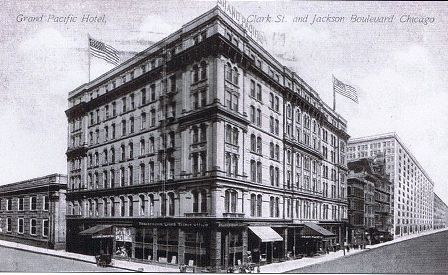
Egan was still in the sanatorium on May 4 when he was released for 3 days in order “to visit Chicago” and checked into the Grand Pacific Hotel.  On May 6 The Chicago Tribune said:

“Edward F. (Ned) Egan…was found dead with a revolver at his side in the Grand Pacific Hotel shortly after midnight this morning.  He had apparently been dead for hours.  Despondency, brought on by ill health, is believed to have led him to commit suicide.”

The Grand Pacific Hotel Chicago

The Grand Pacific Hotel Chicago

Timme told The Journal:

“So far as I have learned, his condition while at the sanatorium was improving.  I will have Mr. (Tom) Hickey (president of the American Association) obtain the facts from the police at Chicago.”

It was reported that Egan, who “owned considerable property in St. Paul,” was to be married in June.  His first wife had died in 1912, just more than a year after their marriage.  The day following his death, the Cook County Coroner confirmed the cause of death was suicide and said Egan was despondent over his injury.

The Milwaukee Sentinel published a eulogy for Egan written by long-time minor league umpire Oliver Otis “Ollie” Anderson:

“Umpires are supposed to have no feelings—to shed no tears, but they do bow their heads occasionally, and mine is bowed in thought, I have just read of the death of Ned Egan.

“As a baseball genius he was worthy of being compared to Comiskey, as a developer of players he was a Connie Mack, as a winner of pennants he was king of the bushers.  As a friend he was loyalty itself.

“What more can we say.”

Opening Day—1890

24 Mar

The New York Sun said the Players League had won the battle:

“The local Brotherhood team have scored first blood, first knockdown, and have in general the best of the initial clash between the Players’ and the National League in this city.  While the latter were prepared for defeat, they had not anticipated such an overwhelming victory for the seceders as at least 3 to 1 in attendance.  They did not believe the Brotherhood would get 2 to 1, and so the result was rather staggering.  The admirers of the players are jubilant over the good attendance, and one of the partisans tersely said: ‘The League? Why they’re not in it and might as well give it up.  Let’s have another drink on the boys.’”

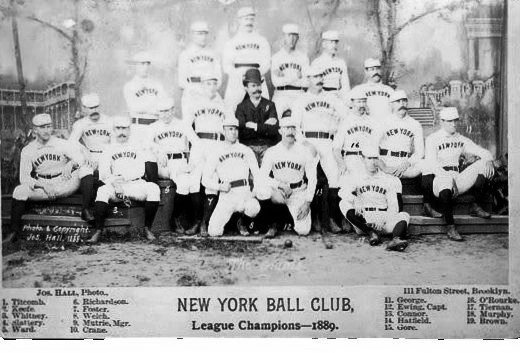
Fans streamed into the “grounds on Eighth Avenue” (the Brotherhood Ballpark was built next door to the Polo Grounds) and by the time the first Players’ League pitch was thrown in New York, 12,013 were on hand, while only 4,644 paid to see the National League.  The Players League team was composed mostly of players who had been with the National League Champion Giants in 1889–both teams were called the New York Giants in 1890.

Many of the members of the 1889 Giants jumped to the Players League in 1890

Many of the members of the 1889 Giants jumped to the Players League in 1890

The Sun said it would be “invidious to draw comparisons between the class that attended the League game and that which patronized the Brotherhood;” then went on to draw comparisons.

“But after a few moments’ study of the crowd surging down the elevated railway stairs an acute observer could quite easily have foretold which grounds each spectator or party was bound for.  Not but what there were plenty of well-dressed men and women in the immense crowd that wended their way toward Brotherhood Park, but rather in the excited holiday air the Players; sympathizers were.”

The Brotherhood crowd consisted of “urchins and young men,” while the National League crowd included “exquisitely dressed representatives of the fair sex.”

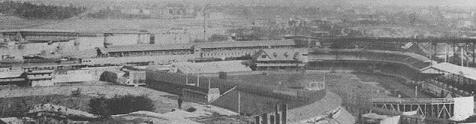
The two ballparks

The two ballparks

Although the field had been completed for weeks and was “in beautiful condition,” the Brotherhood Ballpark (what would become the final incarnation of the Polo Grounds) was “in an unfinished state,” and carpenters continued to work on the grand stand and lower tier seats as fans entered the park:

“The clubhouse was also only half built, and a huge banner with the words “World’s Champions” was spread across the front of it, as if to hide the unfinished part.  Flags and gay bunting were lavishly spread over the stand, but as one crushed spectator aptly put it: ‘They’d done a good sight better to build seats.’”

Despite the unfinished ballpark, the Brotherhood game was met with much fanfare:

“A cause of great enthusiasm and cheering in Brotherhood Park was the frequent arrival of tally-ho coaches, some of which were gaily decorated and bore appropriate inscriptions…Precisely at 3 o’clock the Players’ Philadelphia Club marched from the club house , preceded by the sixty-ninth Regiment Band.  They received a royal welcome to which the courteously doffed their caps.”

The New York team and Manager Buck Ewing then took the field:

“Such cheering, such yelling, as they neared the stand!  People threw up their hats and went crazy…as they broke ranks the dog on the club house porch broke into a prolonged howl.”

The crowd for the National League was more subdued, but The Sun quoted “one stalwart young man, whose face has been a familiar sight for years at the ball games,” who said the Brotherhood would “have the best of it for the first two weeks.  But wait.”

Both New York Giants teams lost their first game of the 1890 season, each to the Philadelphia franchise in their respective leagues.

The Players League lost the war.

The League outdrew the National League and American Association (PL-980,877, AA-803,200 and NL-776,042—the numbers are estimates and there is ample evidence that everyone lied about attendance figures during the year), but the Brotherhood lost an estimated $125,000 on top of more than $200,000 of debt incurred in building new ballparks.

The National League lost even more—some estimates as high as $500,000.

Although no contemporaneous details survive, the accepted story is that Albert Spalding was able to convince the Players League investors that their financial situation was worse than the National League’s.  Rather than a compromise, Spalding was able to negotiate an unconditional surrender.

The Players League would not have a second Opening Day.

“The Game was not Exactly ‘On the Square’”

21 Mar

After the 1886 season, Jim Hart brought a team composed of members of his Louisville Colonels and other American Association players west.  The team played their way out towards California, winning twenty games against minor league, semi-pro and “picked nines.”

Jim Hart

Jim Hart

They finally lost their first game of the tour in San Francisco on December 26 to the Haverlys of the California League.  Dave Foutz, who had won 41 games for the champion St. Louis Browns pitched for Hart’s club.  Foutz allowed three runs on four hits in the first inning then shut out San Francisco on one hit the rest of the way, but Pete Meegan of the Haverlys held the American Association players to just two runs.

Pete Meegan

Pete Meegan

The San Francisco Morning Call said that Foutz who was “rather superstitious” and tried to “have a lemon in his possession whenever he steps on the diamond,” attributed the loss to the fact that the he had purchased a lemon “but was careless and did not put it in the pocket of his uniform.”

After the loss, Hart’s team defeated every California League team, including a Foutz one-hitter against the San Francisco Pioneers.

Dave Foutz

Dave Foutz

On January 23, with some of his players injured, Hart added three local players to his roster for a game with a “picked nine’ of local players in Alameda.  The game was tied 4 to 4 after seven innings, but Foutz gave up two in the seventh and four in the eighth and lost 10 to 4. The San Francisco Chronicle said:

“A large crowd was in attendance at the Alameda Baseball Grounds yesterday to witness the game between the Louisvilles and a picked nine of California players… the impression of many of the spectators was that the game was not exactly ‘on the square’…The cause of suspicion was as to the fairness of the game was caused by the appearance among the spectators of men well known at baseball games offering large odds against the Louisvilles.  At about the seventh inning these men were offering odds of twenty to one against a team that has hitherto been almost invincible.”

The Morning Call headline said simply:

“Hippodrome!”

There was no doubt, said the paper, that the game had been “pre-arranged” and “made up for the picked nine to win.”

In St. Louis there was more concern that Foutz had “broken down,” having given up fourteen hits rather than speculation that he might have thrown a game.  The Globe-Democrat said:

“Regarding the reported break down of Foutz in California… (Manager Charles) Comiskey received a letter from Foutz in which he denied that he had broken down, and said he was as good as ever.”

No one reported whether the pitcher had carried a lemon into the contest.

The evidence of a fix consisted of the activity of the gamblers, Foutz’ performance in the seventh nd eight innings, and an alleged conversation between Louisville’s second baseman Joseph “Reddy” Mack and Ed Morris the pitcher for the “picked nine.” Discussing how the result of the lightly attended game would improve attendance at the next game Louisville was scheduled to play in Alameda two days later.

reddymack

Reddy Mack

Jim Hart was indignant and wrote letters to West Coast papers denying that anyone on his team could have been involved:

“I wish to say that I have made the fullest and most searching investigation and can find no foundation for the charges.  Not one of my men wagered a dime.”

Hart blamed the loss on the “weakened condition” of his team and noted that three local players filled in with his squad for the game.  The players he “brought out here all enjoy national reputations, and they could not afford to hazard their good names for the small amount of gain there would be for them.”

In another letter, written to The Sporting Life, Hart attacked the credibility of the unnamed writer of the article in The Morning Call:

“(I)t was not much of a surprise to in the issue of a sensational morning journal last Monday the flaming headline ‘Hippodrome!’  The journal referred to, I understand, instructs its reporters and correspondents in the following language—‘Make your articles sensational even at the expense of the truth,’ and the young man who wrote the article under the above referred-to head line was evidently closely following instructions…What the young man who wrote the article don’t [sic] know about baseball would make a very large book.”

Hart went on to detail his additional complaints with “the young man” from The Morning Call, but as with his letters to West Coast newspapers, he never addressed the allegations regarding the abrupt changes in the odds offered on the game, and instead of asserting that “Not one of my men wagered a dime,” as he said in the earlier letters, the letter in The Sporting Life said:

“I have investigated the whole matter religiously, and if any of the boys were implicated in any way, they are too smart for me to find out.”

The California League conducted the only official” investigation into the allegations; that inquiry was limited to determining if any of their players were involved in any wrongdoing and according to The Chronicle, simply determined that no California League players “had anything to do with it or were cognizant of it,” and made no statement regarding whether there was evidence of a fixed game.

The Chronicle evidently didn’t think the case was closed and said:

“If Foutz, Mack or (Hubert) Hub Collins expect to come out here again, they must arise and explain to the entire satisfaction” of the league president.

The Louisville team wrapped up the tour in early February; Hart resigned his position and relinquished his interest in the team in order to take over the operation of the Milwaukee Cream Citys in the Northwestern League.  Mack and Collins returned to Louisville, Foutz headed to St. Louis and another 19th Century allegation of dishonest play disappeared into the ether.