Tag Archives: American League

“Waddell got in his Deadly Work”

28 Sep

On July 12, 1902, Rube Waddell beat the Boston Americans 3-2, throwing a five-hitter.  The Philadelphia Times said:

“Waddell’s brilliant work enables Mack’s men to down Boston.”

The Philadelphia Inquirer said, “Waddell got in his deadly work at critical a stage…was by striking out the batsmen. He seduced nine on strikes.”

rube

Rube Waddell

The Inquirer also mentioned that before the game:

“Waddell and George (Candy) La Chance engaged in a friendly wrestling match, much to the amusement of the spectators.  It was finally won by Waddell, who came within an ace of putting both (of) LaChance’s ears to the ground.

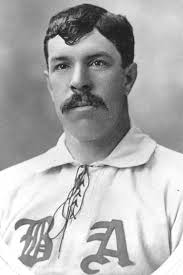
Candy LaChance

Candy LaChance

In later years, LaChance’s teammates said the wrestling match was an attempt to keep Waddell out of the game.  In 1905, Albert “Hobe” Ferris told The Chicago Inter Ocean:

“Waddell was going to pitch and big George said to (Boston Manager Jimmy) Collins:  I’m going to fix Rube so we will hit him all over the field.

“Now, as you know, Rube is willing to wrestle anyone, and George challenged him to a friendly bout.  Right on the grass they sailed in.  LaChance was trying hard to get a hammerlock on Rube’s left arm, so that he could put it out of business for the afternoon.  But after six or seven minutes’ fooling Rube got a fall, and then, much to the disgust of La Chance and Collins, he shut Boston out with four hits and fanned twelve of us, getting George three times.

“’I suppose,’ said Collins after the game, to LaChance, ‘that if you had wrestled ten minutes longer Rube would have shut us out without a hit and struck out twenty men.”

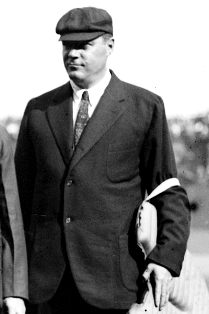
As with most stories about Waddell, later versions embellished some of the facts.  In 1918, Bill Dinneen, the losing pitcher in the game—and American League umpire from 1909-1937—told a version of the story to a reporter for The New York Sun.

Bill Dinneen

Bill Dinneen

In Dinneen’s version, “Waddell picked him off his feet as though he were a baby, held him high over his head and dashed him to the earth in a heap.”  Dinneen also claimed, “LaChance was barely able to play first base for us that day; he was so sore and bruised.”  His version also got the details of the game wrong:

“As for Rube, he shut us out with two hits.”

In 1922, Nick Altrock, who didn’t join Boston until September of 1902– two months after the game—retold the story one his syndicated articles for The Newspaper Enterprise Association (NEA).  Altrock got the date wrong (1903), claimed “the two wrestled for an hour,” and said Waddell “struck out 14 men and shut out Boston 1 to 0, allowing three hits.”

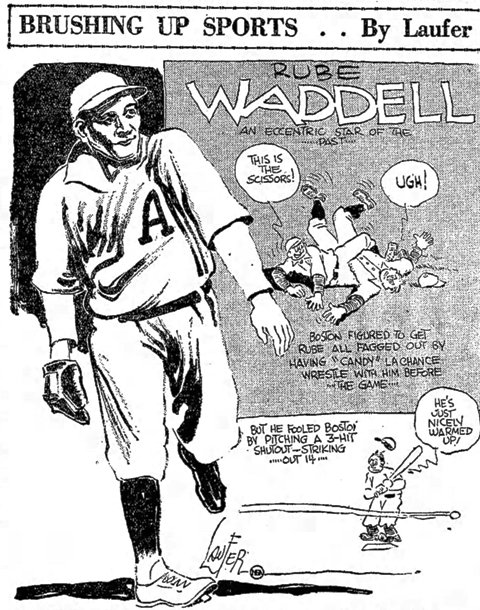
The version of the story with Altrock’s embellishments became the most often repeated and was still being told a decade later when Werner Laufer, The NEA’s sports cartoonist memorialized Waddell’s performance:

rubewernerlaufer1932

“Stars for A’s, Pep for Phils—In Negro Ranks”

13 Jul

The push to integrate baseball in the late 1930s and early 1940s came most frequently from the black press and American Socialists, but occasionally a white voice would call for the color line to be broken.

In May of 1940, with both Philadelphia teams struggling and headed towards last place finishes (Phillies 50-103, and Athletics 54-100), The Philadelphia Record made the case under the headline:

Stars for A’s, Pep for Phils—In Negro Ranks

“Experienced players are available who could strengthen the A’s shaky pitching staff and give the Phils the batting punch they need.  These players could make potential champions out of any of the other also-rans in either major league.”

[…]

“But they are Negroes, and organized baseball says they can’t come in.”

The previous season, Phillies Manager James Thompson “Doc” Prothro, a Memphis native, told The Pittsburgh Courier he would welcome players from the Negro Leagues on his club:

“I certainly would, if given the opportunity to sign up a good Negro ball player.  I need good players, and if I ran across a colored boy who could make the grade I wouldn’t hesitate signing him.”

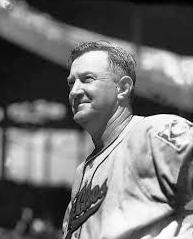
Doc Prothro

Doc Prothro

The Courier’s Wendell Smith said that when the Phillies manager made the statement:

“Prothro draped his right arm across our shoulders and we walked along, as though to assure us he realized the unfairness of the major league color line.  It seemed he wanted to convince us that he was against it as much as we were.”

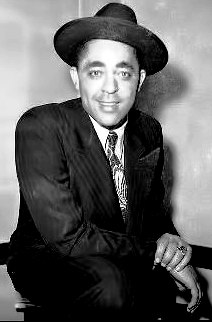
Wendell Smith

Wendell Smith

Now as Prothro and the Phillies headed towards their second straight 100 loss season, one of Philadelphia’s daily papers agreed that it was time:

“In all baseball law there is not a single line barring colored players from the game.  Several major league managers have said they would jump at the chance to sign the best of them.  Some owners have declared they would vote to admit them.

“But no vote ever is taken on the subject.  No manager or owner dares defy the Jim Crow tradition which in the past has been the most inflexible unwritten law in the game.”

Most importantly, the paper said, the “unwritten law” had left a key group out of the decision:

“No one seems to have consulted the fans…There is an even chance—and a whole lot more—that a few thousand fans who have been staying away from the A’s and the Phils might turn out to see what (Satchel) Paige and (Josh) Gibson and a few more like them, might do in the major leagues.”

The Record never followed up on their call to integrate.  The issue was forgotten in Philadelphia.  As both teams limped to their last place finishes the fans that were never consulted on the issue stayed away in droves. The Athletics drew 432,135—sixth out of eight American League teams.  The Phillies had the worst attendance in the major leagues, just 207,177.

“He is a $900 Man”

6 Jul

Frank Leonardo Hough had a major conflict of interest. While sports editor for The Philadelphia Inquirer, he also held a 12.5% interest in the Philadelphia Athletics from the club’s inaugural season until 1912—he also served as the team secretary for several seasons while working at the paper. Another Philadelphia sports writer, Sam Jones of The Associated Press also held a 12.5% interest in the team.

Frank L. Hough

Frank L. Hough

Perhaps it was Hough’s close association with an American League team that made him one of the most vocal advocates for the rights of current and former National League players while the leagues battled for stars.

In 1902, he told his readers the story of how William “Bill” Duggleby, who jumped from the Phillies to the Athletics after the 1901 season, was treated—Hough said he was, “Human Chattel”–while a member of the Phillies:

“These are the facts:

“William Duggleby, pitcher played with the Auburn Club, of the New York State League, during the season of 1897. In the fall of that year, he was drafted by the Philadelphia Ball Club.”

According to Hough, Duggleby was offered $900 for the season, a $25 raise from his salary in Auburn.

Hough pitched just nine games for the Phillies in 1898 and, “was farmed or rented,” to minor league clubs for the remainder of 1898 and in 1899 and 1900.

“Thus it will be seen that although he was under the absolute control of the Philadelphia Club from 1897, he played only a few games in the season of 1898 with that organization. He had no control over his own services. He could not even say where he would play, or where he would not play. That matter was determined by the treasurer of the Philadelphia Ball Club.”

William Duggleby

William Duggleby

Hough noted that while Duggleby, “developed considerable skill,” and had three good seasons in the Eastern League (12-11, 22-16, 17-10) drawing considerable interest from a “half dozen” major league teams, he only received $900 from the Phillies each season:

“The clubs that rented Duggleby did not know him in the financial end of the transaction at all.

“Had Duggleby the right to sign wherever he could have made the best bargain he would have undoubtedly received at least $1800 a season for his services—just twice as much as received under the White Slave system of the National League.”

Hough said Duggleby likely only had six to 10 years total earning power and “lost three years in which he should have received a salary somewhere commensurate to his ability.”

That, however, said Hough, was not the worst of it. In 1900, Duggleby was with the Toronto Canucks, who paid the Phillies, “$225 per month for his services,” while Duggleby was paid just $150 a month.

“No convict from a Texas or Georgia penitentiary was ever rented or leased to break stone on a quarry or repair roadways in colder blood than was Duggleby to the Toronto Club.

“If Duggleby was not a white slave in a free country, what in the name of all that is fair was he?…Of course, Duggleby did not have to wear ball and chain—that might have interfered with his playing ability. But he had no more control over his actions than would the most hardened criminal consigned to the quarries.”

Just days after Hough made the case for Duggleby’s victimhood—and after he appeared in just two games for the Athletics— the pitcher returned to the Phillies. Said to have been paid $3250 by the Athletics, Duggleby accepted a $2400 contract with the Phillies. He told Sporting Life:

“There was no great reason for my going with the American League in the first place, but after I had given my word to go with Connie Mack’s team I did not feel like breaking it. Then came the decision in the (Napoleon) Lajoie case, and a notice from Manager (Bill) Shettsline to report to him or meet with the same fate as Lajoie. I went to see Shetts at once and asked him if the club really intended to proceed against all players that were under reserve. He assured me that they would. Well, under the circumstances I saw nothing for me to do but go back to the National.”

Hough’s tone changed considerably after Duggleby left the Athletics; in addition to his paper referring to the pitcher in a headline as a “Vertebraeless Youth,” he said:

“Without awaiting the outcome of the efforts to be made today to secure an appeal (in the Lajoie case)… (Duggleby) runs to cover like a frightened hound…Evidently the treasurer of the Philadelphia Ball Club sized up Duggleby right in the first place. He is a $900 man.”

Duggleby, who posted a 20-12 record for the Phillies in 1901, only had one winning season after (18-17 in 1905). He pitched in the major leagues until 1907.

Duggleby had one other distinction: During his initial trial with the Phillies in 1898, he hit a grand slam in his first major league at-bat on April 21–for 70 years he remained the only player to hit a grand slam in his first game until Bobby Bonds hit one during his debut (his third at-bat) on June 25, 1968; Jeremy Hermida equaled the feat in his first major league at-bat in 2005.

Hough remained a stockholder and officer with the Athletics while simultaneously reporting on baseball for The Inquirer, until he sold his interest to Connie Mack in 1912. He was the paper’s sports editor until his death the following year. (While Hough’s middle name was said to be Leonardo throughout his life, his Pennsylvania death certificate lists it as Lewis)

“The Aristocrat of all Mascots”

1 Jul

Shortly after the 1920 World Series, The Associated Press (AP) claimed to have discovered why the Brooklyn Robins, after taking two out of three games from the Indians at home, dropped four straight in Cleveland:

“At last the secret…is out.  The Dodgers declined to take their mascot, Eddie Bennett, with them to the lair of the Indians, and without his lucky presence they were swamped.  And not only that.  Bennett, indignant over having been left at home, has quit the Brooklyns!  That’s revenge!”

The Brooklyn Daily Eagle said, Bennett, a Brooklyn native, came to the attention of baseball fans in 1919 when he served as bat boy and mascot for the American League Champion Chicago White Sox:

“(H)e used to hang around the players’ entrance to the ballparks on both sides of the bridge.  The Yankees were playing at the Polo Grounds then, and one day one of the White Sox noticed a wistful little fellow in the front row of hero worshippers.”

Eddie Bennett

Eddie Bennett

White Sox outfielder Oscar “Happy” Felsch, noticed Bennett suffered from kyphosis (the excessive curvature of the spine—in Bennett’s case it was said to have been caused by an injury when he fell out of his stroller as an infant) and asked “’Are you lucky?’ ‘Sure,’ cried Eddie Bennett eagerly.”  With Bennett serving as bat boy, the Sox defeated the Yankees.  With that:

“Felsch spoke to Eddie Cicotte about taking him back to Chicago. Cicotte spoke to Manager (William) Kid Gleason.  Eddie Bennett became the official White Sox mascot.”

Bennett spent the rest of the season with the Sox and roomed with pitcher Dickie Kerr on the road. After the Black Sox scandal broke—Bennett told reporters, “I was one of the honest ones”—the 16-year-old returned to New York and went to work for the Robins.

Dean Snyder, writing for Scripps’ Newspaper Enterprise Association, said of Bennett during Brooklyn’s pennant run:

“(The Robins) bought the kid a swell uniform and told him to hang around.

“From the day he started as the official mascot…things began to look up.”

But, Snyder noted, Bennett was strictly a mascot and not a bat boy in Brooklyn:

“Little Eddie is a hunchback. The players positively forbid him to touch their bats.  They just want him to stick around. They’re might superstitious about their war clubs.”

After being left home by the Robins for the club’s ill-fated trip to Cleveland, Bennett jumped to the Yankees; he told The AP:

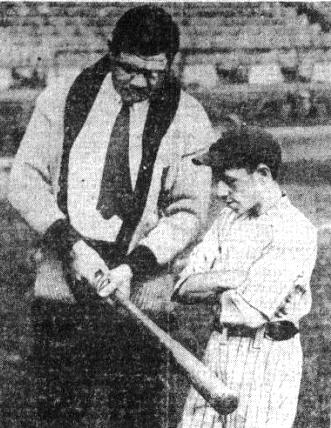
“I’m going to be with a real club this year.  Oh boy, to watch that (Babe) Ruth sock them every day.”

Bennett with Ruth

Bennett with Ruth

For the third straight season, Bennett was part of a pennant winner, and for the third straight year his team lost the World Series.  But this time he stayed put and remained a fixture with the Yankees for another decade.

American League Umpire Billy Evans, in one of his syndicated columns, said Bennett took his position very seriously and related a story about seeing him in a restaurant during a Yankee losing streak:

“Bennett was seated across from me at a table in the diner. We were served at about the same time, and I noticed he ate but little of the food he had ordered.

“’Something wrong with the food Eddie?’ I ventured.

“’The food is all right, I guess there is something wrong with me,’ replied Eddie.

“’Cheer up, Eddie.  The Yankees can’t lose all of them,’ I said with a laugh.

“’Babe hasn’t made a home run in a week.  The team never gets any runs for Bob Shawkey.  Every time Scotty (shortstop Everett Scott) makes an error it means a run.  Waite Hoyt has a bad inning every game,’ was Eddie’s come back.

“’Why worry about these things, Eddie?’ The Yankee mascot looked at me in a puzzled manner, as if I might be joshing him.

“’That’s my business, I’m a mascot,’ said Eddie in all seriousness.  ‘I am supposed to bring luck, to help Ruth make home runs, keep Scotty from making errors, have the team get runs for Shawkey, and no bad innings for Hoyt.’

“Eddie was disgusted at my failure to appreciate the importance of his position.”

In 1928, The Brooklyn Daily Eagle called Bennett “(T)he aristocrat of all mascots…eight flags in 10 years is the mark for other mascots, living and still to be born to try to equal.  It will probably never be beaten.”

Bennett’s career came to an end in May of 1932; according to The United Press (UP) he was riding in a cab which crashed and “was pinned to a pole,” Bennett suffered several broken bones, including a leg broken in several places, and spent months in the hospital. (The AP said he was hit by the cab while walking).

He made a brief, dramatic return to the Yankees a year later.

On May 23, 1933, Bennett entered the Yankees clubhouse on crutches in the midst of what The International News Service called “The great home run famine.”  Neither Babe Ruth nor Lou Gehrig had hit one since April 30:

“It was the longest home run slump for the twins since they started making life miserable for American League pitchers.  For weeks they rubbed their carcasses and bats with sundry kinds of magic oils and rabbit’s feet, consulted Yogi’s and employed every luck charm known to the superstitious in an effort to shake off the jinx.  It took Eddie Bennett, the little cripple who formerly was the club’s bat boy, to shatter the jinx.  Before yesterday’s game he solemnly tapped both sluggers with his magic crutch and that turned the trick.”

Eddie Bennett

Eddie Bennett

Both Ruth and Gehrig hit home runs off Oral Hildebrand (who came into the game with a 6-0 record) in an 8 to 6 victory over the Cleveland Indians.

It was a final happy moment for Bennett.

While he continued to be paid by Yankees owner Jacob Rupert, depression and alcoholism consumed the last years of his life.  The 31-year-old, “aristocrat of all mascots,” was found dead on January 17, 1935, according to The UP “cold and stiff in his drab rooming home…He lived out his days among his baseball trophies, drinking steadily”

Edit:  As noted in the comments, I say above that Bennett left the White Sox “when the scandal broke,”  which implies September of 1920 when the grand jury was impaneled. I should have said “when rumors of the scandal broke,” which began during the 1919 series and continued throughout the 1920 season.

“Probably the ‘Boniest’ Bonehead Play Ever”

22 Jun

While some of the details changed in subsequent tellings, this story stayed substantially the same from when it was first presented in a column by sports writer William A. in 1913, until the final published version in 1957 in The New Orleans Times-Picayune.  One version called it, “Probably the ‘boniest’ bonehead play ever”

The story was told by and told about lefty Evan “Rube” Evans.  Born on April 28, 1890, in Sebring, Ohio, Evans was a career minor league pitcher who, when the story first appeared, seemed to be headed to the big leagues. 
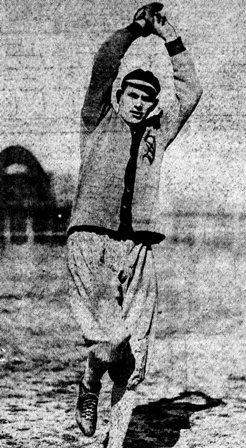
Rube Evans

Rube Evans

The tall–he was reported by various sources as anywhere from 6′ 2″ to 6′ 4″–began his professional career with the Dallas Giants in the Texas League in 1910; he was 15-12 for the pennant winners, but The Dallas Morning News said he didn’t “take baseball seriously” until the following year, when he was 18-16 for the Giants:

“Before that, it seemed, the big, husky flinger looked at playing baseball something in the light of a joke.  Last season, though he came back into the game with a different viewpoint. He seemed to realize that ball playing was a man-sized business.”

After his 1911 performance, Evans’ contract was purchased by the New York Giants, and he joined the team for spring training in Marlin, Texas in 1912.  The Morning News said if he maintained his new found focus “and works as hard as he knows how to work he ought to stick.”

Evans quickly impressed the Giants with a pitch “takes a most freakish break,” according to The Washington Times:

“Rube Evans, the Giants left-handed recruit pitcher from Dallas, surprised bot Manager (John) McGraw and Coach Robby (Wilbert Robinson) by showing them a curve that is entirely new to the big league…The ball is delivered in exactly the same manner as the spitball, but he does not moisten it.”

The paper did not elaborate on how Evans’ “dry spitter” was different from versions reported on during previous seasons–including the one thrown by Christy Mathewson of the Giants–but according to The New York World, “McGraw says he will try and teach it to Rube Marquard.”

Despite his “dry spitter,” Evans failed to make the team and was returned to Dallas where he posted a 22-12 record for the Giants.

In 1913, he joined the New Orleans Pelicans in the Southern Association but appeared to be headed to the Cleveland Naps before he threw a pitch in the regular season for the Pelicans.  In March, Evans shut down the Detroit Tigers 3 to 1 on five hits and followed that up with a four-hitter (and 3 to 1 victory) against the Naps.

The Cleveland Press said, “(Naps Manager Joe) Birmingham plans to cut down his squad considerably.  It is said recruits (Hugh) Peddy, (Pete) Shields and (Ward) McDowell will be left here in trade for one good pitcher, probably Southpaw Rube Evans.”

With Evans apparently on the verge of joining the Naps, the story of his “bonehead” play was told by Phelon, then repeated widely:

“(Evans) has one curious habit—a trait which has aroused much wonder on the part of every manager under whom the southpaw has been toiling.  When given an order by his manager or captain, Mr. Evans always stops, cocks his ears, and demands a repetition of the directions.  Naturally he is first taken for a simp, or bonehead, but when further acquaintance with him shows that he is a gentleman of intelligence and high mentality, the field leaders are muchly puzzled.

“’I always want my orders repeated,’ quoth Mr. Evans, ‘so that I will never again make such an error.”

(The 1913 version of the story, which quotes Evans,  places the incident in McKeesport, Pennsylvania, some later versions say it happened in 1913 with the Pelicans, still others say it was in Portland, Oregon; however, the original publication predates Evans’ time on the West Coast which did not begin until May of 1914).

Evans said he had pitched into the ninth inning when the opposing team put a runner on third with one out, when his manager told him if the other team attempted a squeeze play to “bean him.”  Evans said:

“’I knew no more what a squeeze play was than the man in the moon, but my orders rang in my ears as I started winding up.  Just as a swung up my arm, the fellow on third tore for the plate…I took careful aim at the oncoming runner, and pickled him with a fine shot to the back of the cranium.  Three seconds later the crowd was coming towards me with roars of fury, and I got over the back fence just in time.

“’Well how was I to know that I should have hit the batter and not the runner?  Ever since I have insisted on duplicate orders, so that I would know just what to do.’”

His acquisition by Cleveland never materialized and he had a disappointing 12-15 record in 1913, in a season split between New Orleans and the Birmingham Barons.

It is also in question whether Phelon’s characterization of Evans as a “gentleman of intelligence and high mentality,” was entirely accurate given his inability to stick with clubs who were impressed with physical abilities.  After his second chance to pitch in the majors didn’t materialize, the remainder his of career was marked by long stretches of mediocrity, charges of bad behavior and comparisons to another left-handed “Rube.”

In August of 1913, he was suspended for the remainder of the season by the Birmingham Barons for, according to The Birmingham Post-Herald, “Failure to keep in condition.”  The Sporting Life’s Chandler Richter called him “Erratic,” The Oakland Tribune said he was”Eccentric,” a wire service retelling of the “beanball” story from 1915 said he “earned a nationwide reputation as a ‘squirrel,” another called him “the real eccentric,” when compared to Rube Waddell.
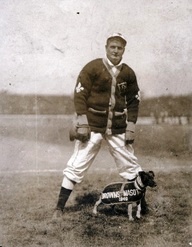
The other left-handed Rube

The other left-handed Rube

His two-year tenure with the Portland Beavers in the Pacific Coast League (PCL) began when he wore out his welcome in New Orleans in May of 1914 and was sold to the Beavers.  It was particularly rocky.  The Spokane Daily Chronicle said Evans and Beavers manager Walter “Judge” McCredie “got along like a pair of strange bulldogs.” He was suspended at least once, again for the euphemistic “failure to be in proper condition,” and gave up a game-winning home run to Jack Ness of the Oakland Oaks when he accidently threw a pitch over the plate while attempting to intentionally walk Ness.  At the close of the 1915 season, Portland let him go for what The Portland Oregonian called “His inability to take care of himself.” Of his 9-22 record the paper said:

“Rube ran into gobs of adversity.”

After leaving Portland, Evans played parts of three seasons for the Salt Lake City Bees in the PCL–in 1917 he was 21-9, but when McCredie was named manager of the Bees in 1918, Evans time with the team was nearly over.  Before the season, The Oregonian said, “Evans did not take kindly to the idea of having to take orders” from his former manager and was threatening to jump the club.  He finally did jump in June after appearing in 14 games and posting a 3-8 record.

Evans went to Portland and finished the 1918 season in the semi-pro Shipyards League, The Oregon Daily Journal said upon his arrival:

“Rube Evans was through at Salt Lake and McCredie was probably saved the trouble of wearying his hand by writing out Rube’s release, when Rube left.”

In 1919, he played for the Rupert franchise in the semi-pro Southern Idaho League; while successful, his reliance on the emery ball for his success didn’t make him friends.  The Twin Falls Times said:

“When Rube Evans lugged the emery ball into the S.I.L. he failed to do anything beneficial to the league.  Rube will win a few more games for the Rupert club, but he has lowered the standard of sport in the league.”

Evans had one more season in professional baseball, posting a 10-7 record with the Regina Senators in the Western Canada League in 1920.  In an August 15 doubleheader against the Edmonton Eskimos Evans was ejected for arguing with the umpire while facing the second batter of the first game; he came back to lead the Senators to 5 to 3 victory in the second game, giving up two runs in 7 2/3 innings, and hitting a three-run home run in the sixth.
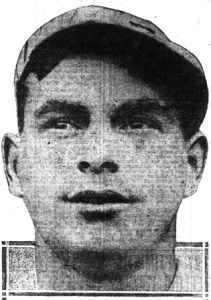
Rube Evans

Rube Evans

After the 1920 season, he returned to Ohio and spent the next decade playing semi-pro baseball there and in Western Pennsylvania.  His last headlines came in 1924 when he pitched six innings for the Sharon (PA) Elks team in an exhibition game against the New York Yankees.  The Elks lost 10-8, Babe Ruth went 2-4 with a double for the Yankees.

Evans’ playing days ended in Akron, Ohio.  He pitched for and managed the Goodyear Tire and Rubber Company team, and stayed on with the company as a rubber worker.  He died on January 30, 1950.

A clue to some of Evans’  erratic behavior is contained in his death certificate.  The pitcher spent the last three and a half years of his life in Ohio’s Cambridge State Hospital; his cause of death was listed as “General Paresis,’ brought on by syphilis.

A shorter version of this post appeared on June 3, 2013

“Their Joy was Unrestricted”

10 Jun

After Charles “Cy” Swain lost his leg in an accident after the 1914 season, he attempted to stay active in baseball by forming a team called the Independents with another former player, Tommy Sheehan.

Cy Swain

Cy Swain

Swain managed the team which was comprised of minor and major leaguers who spent the off-season on the West Coast.

In the early spring of 1916, the team played their most unusual game.  The San Francisco Chronicle described the scene:

“For the first time in the history of the State Prison across the bay in Marin County, the convict baseballers were yesterday permitted to play against an outside team…The attendance? Good!  Something like 2300 men and women prisoners, even including the fellows from solitary confinement, took their seats to watch the game, and their joy was unrestricted.”

Swain’s Independents were playing the Midgets, the baseball team at San Quentin.

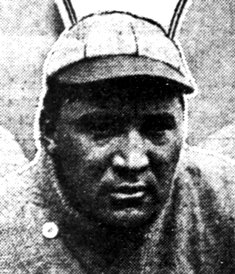
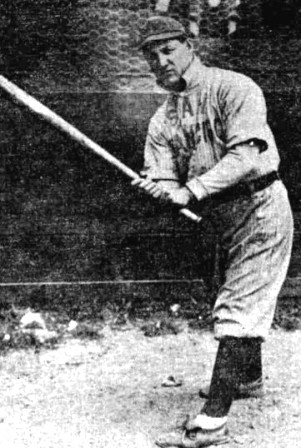
The paper said Swain received “an ovation that lasted for five minutes,” and that the prisoners cheered loudly for Ping Bodie, Spider Baum, and Biff Schaller.

Ping Bodie

Ping Bodie

“They know a good play or a bad one, just as you do from your comfy seat at Recreation Park, and they did their rooting accordingly.”

Because of prison rules, the game recap was slightly different than usual:

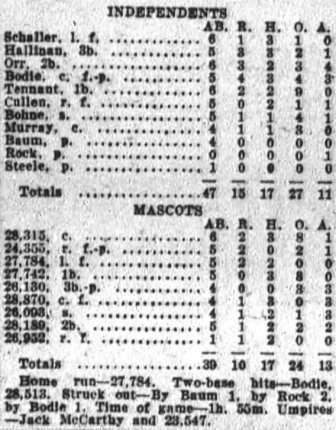
“Names are barred when it comes to San Quentin inmates, but it is worthy of note that No. 27784 came through with a home run, while third sacker 26130 pulled a fielding stunt that would land him with the Coasters if he were a free agent.

“Warden (James A.) Johnson, however, has his players fully signed, and he is protected with a reserve clause that is far more binding than the foundation of organized baseball. “

Jack McCarthy, a former American League and Pacific Coast League umpire, worked the game with “No. 23547,” and “to their credit be it said, the double system worked perfectly.”

The game was a slugfest, won the Independents 15 to 10—Bodie, Schaller and Ed Hallanan had three hits each.

The Box Score

The Box Score

Swain’s independents returned to the prison again the following year, beating the Mascots 9 to 6.  After the success of those games, baseball against outside teams became a regular feature at San Quentin.

“If Baseball is really the National Game let the Club Owners go out and prove it”

4 May

Haywood Broun, columnist for The New York World-Telegram, shook up the annual Baseball Writers Association dinner in February of 1933.  The Pittsburgh Courier said Broun “struck out boldly in advocacy of admitting Negroes to the charmed circle of big leagues.”

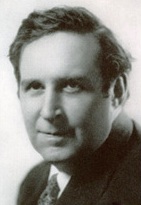
Heywood Campbell Broun

Heywood Broun

Broun said (and later wrote in The World-Telegram):

“I can see no reason why Negroes should not come into the National and American Leagues.

“Why in the name of fair play and gate receipts should professional baseball be so exclusive?”

[…]

“The introduction of a few star Negro ball players would do a great deal to revivify interest in the big leagues.  It would attract a number of colored rooters. And it would be a fair and square thing.  If baseball is really the national game let the club owners go out and prove it.”

Jimmy Powers of The New York Daily News said he polled the dinner guests after Broun’s remarks:

“I made an informal tour around the tables asking club owners and players their reactions to Broun’s little talk.  I was amazed at the sentiment in favor of the idea.”

Powers claimed that Yankees owner Jacob Rupert, St. Louis Cardinals General Manager Branch Rickey, and Babe Ruth were all in support of Broun’s statement.   John McGraw the dinner’s guest of honor—he had resigned as manager of the New Giants the previous summer due to his failing health—was, according to Powers, “The only prominent man present vetoing” the idea.

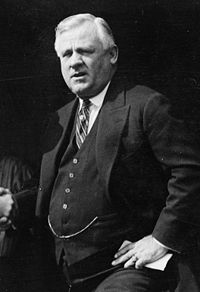
John McGraw

John McGraw vetoed the idea


Salem Tutt Whitney, a prominent star of the black vaudeville circuit, commented on McGraw in the pages of The Chicago Defender:

“John McGraw and his Giants have been the idols of the Colored baseball fans.  Whenever and wherever there had been talk about the color line in major league baseball, the Colored fans were a unit that declared that if John McGraw could have his way there would be no color line.  ‘Didn’t he play (Charlie) Grant at second base on the Giants!’  ‘Look how long he employed a Colored trainer (Ed Mackall)!’”

[…]

 “It is my opinion that if the Colored baseball fans of Harlem are not convinced that Mr. McGraw has nothing more to do with the Giants, there will be a lack of personal color in bleachers and stands at the Giants’ stadium this summer.”

Salem Tutt Whitney

Salem Tutt Whitney

Not content to simply report on Broun’s pitch for integration, Powers made his own:

“I would like to make a case for the colored baseball player.  In football, Duke Slater, Fritz Pollard and Paul Robeson and stars of similar complexion played with and against the cream of Nordic colleges.  Eddie Tolan, Ralph Metcalfe and Phil Edwards have conducted themselves in a gentlemanly—not to mention championship—fashion.  Boxing has known Joe Gans, Sam Langford, Joe Walcott and Tiger Flowers.  There are only three popular sports in which the dark-skinned athletes are snubbed—tennis, golf and baseball.”

The New York Age approved:

“Here’s hoping all the other big white sportswriters have the courage of Jimmy Powers.”

Chester Washington, a sports writer at The Pittsburgh Courier announced that the paper was launching “A symposium of opinion, coming from outstanding figures in baseball circles,” designed to demonstrate a broad coalition of support for integration.

The Courier reported “The first of these statements,” in response to Washington’s outreach the following week—and it was a rather incredible one from John Heydler, president of the National League, who said:

“Beyond the fundamental requirement that a major league player must have unique ability and good character and habits, I do not recall one instance where baseball has allowed either race, creed or color enter into the selection of its players.”

Gerald Nugent “aggressive young owner of the Phillies,” was next to respond to The Courier:

“Nugent calls attention to the fact that no ‘color line’ is drawn on the dollars which are spent by colored and white fans for admissions in the various big-league parks…He further declares that the average colored semi-pro league player is better than his white brother in the same category.”

Support continued to come.  Chicago White Sox President J. Louis Comiskey:

“You can bet your last dime that I’ll never refuse to hire a great athlete simply because he isn’t the same color of some other player on my team if the alleged bar is lifted.”

While Commissioner Kennesaw Mountain Landis did not respond to The Courier, his right-hand man, Leslie O’Connor said “(T)here isn’t any rule which keeps colored players out.”  But, like Heydler, he made the incredible claim that “the subject of Negro ball players had never been brought up,” among the Major League Advisory Council.

Based on the initial responses, William Goldwyn Nunn, The Courier’s managing editor, expressed great, if premature, optimism:

“And the color will be black!

“As sure as the Ides of March are approaching, there’s going to be some added color in the Major Leagues.  AND, THAT COLOR WILL BE BLACK!”

Meanwhile Jimmy Powers quoted Lou Gehrig and Herb Pennock of the Yankees and Frankie Frisch of the Cardinals in The Daily News, all said they were “open-minded,” about the possibility integration.

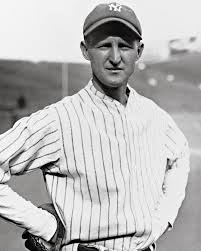
pennock

Pennock “Open-minded”


Two more prominent sportswriters came out in support:  Dan Parker of The New York Daily Mirror, and Gordon Mackay, who had been sports editor of three Philadelphia papers—The Enquirer, The Press and The Public Ledger.

And then, as abruptly as it began, the movement died.

Despite the brief groundswell of support, by the time the major league season opened Alvin J. Moses, another writer for The Courier admonished the papers readers:

“Aren’t you somewhat ashamed of yourselves that you haven’t seen fit to spare the time to flood (the paper) with letters that cry out against these NEGROPHOBES who for more than half a century have kept Negro ballplayers out of league competition?

“The cry of ‘Play Ball, Play Ball, Play Ball?’ is heard today in hundreds of parks the county over, and baseball statisticians have figured to show more than 40,000,000 fans walk past the turnstiles.  But what does that cry mean to you, and you, and you? Well, I’ll tell you—absolutely nothing.”


“Why not bring one of the Big League Teams to Phoenix for Spring Training?”

18 Feb

Grover Cleveland Land was a visionary.

In 1921 The Arizona Republican asked the question the former catcher had put to several major league clubs:

“Why not bring one of the big league teams to Phoenix for spring training?”

Land, a Kentucky native who spent the last 40 years of his life as a Phoenix resident,  was encouraged by a report that Connie Mack had announced that his Philadelphia Athletics would no longer train in Lake Charles, Louisiana;  according to The Associated Press Mack said “certain things happened at the Louisiana resort last March that handicapped” the team.

Grover Land

Grover Land

Land, the former catcher for the Cleveland Naps and the Brooklyn Tip-Tops, said:

“I have played ball in every section of the country, and I have yet to find a climate more suited for baseball training than I find right here in Phoenix…Major league managers have been sending their players to Texas and other southern states for many years and I can safely state that there is not one manager entirely satisfied with the present training camp sites.  Fully one-third of the training period is hampered by rain and storms and by the time the training season is ended the players are just beginning to round into shape.”

He said he understood that “local boosters” had made some effort to bring teams to Arizona in the past—the Chicago White Sox, Cubs, and Pittsburgh Pirates had played spring exhibition games in the state several times since 1909—but Land said he would “make an effort to induce one of my manager friends to come down here…I am certain that if one of the managers could be induced to come here for a few weeks Phoenix would have no difficulty getting on the sport pages.”

He said the local chamber of commerce was getting behind the push, and that he had “already written to one of the major league managers and I have been corresponding with several sports writers in the east,’ to make the case for Phoenix.

“If the local fans get behind the move and convince Connie Mack that they want his team here next spring I have every confidence that the Philadelphia Athletics will do their 1922 training in Phoenix.”

Land was a bit overconfident in regard to Philadelphia; Mack chose to take the Athletics to Eagle Pass, Texas in the spring of 1922.

No team would train in Arizona until 1929—the Detroit Tigers came to the state for one season—but chose California the following year.

The Detroit Tigers in Arizona, 1929

The Detroit Tigers in Arizona, 1929

But Land, who died in 1958, lived long enough to see his adopted home become the spring training location for four clubs.

Boston’s Horseshoe

9 Jan

Boston Beaneaters Manager John Morrill told The Washington Star in 1886:

“Yes, sir, it’s a fact, that professional ball-tossers are as a rule very superstitious.  It is nothing more than natural though, and is not as much due to the ignorance of the men as is sometimes supposed.  You see, so much chance enters into every game of ball that the boys who play game after game gradually become impressed with the belief that they can read in advance certain signs or omens which will have more or less effect upon their individual play, if not upon the result of the game.”

John Morrill

John Morrill

Morrill said that “on the whole” he thought his player’s superstitions were “a very good thing,” as long as “bad signs do not outnumber the good one.”  Morrill felt players were more inclined to look for good signs, which would encourage them to play “with more confidence.”

Morrill was also a supporter of mascots:

“Mascots are good things to encourage the boys.”

Morrill even attributed his greatest success as a manager to the power of superstition.  He took over the reins of the fourth place Beaneaters in July of 1883, and the team won 33 of their last 44 games and won the National league pennant.

“When we were way behind in the race for the championship, one of the members of our nine saw a horseshoe in front of the hotel in Detroit.  He stepped into the street and picked it up.  On it was the mark ‘O Winn.’  It was only the name of the Detroit blacksmith who had made the shoe, but as we won the game that day, the members of the nine began to regard the shoe as a good-luck sign, and the first thing we knew we were winning games right and left, and ended the season in the lead.  Our players attributed out success to the horseshoe, and so did Mr. O. Winn, who never fails to call upon us when we are in Detroit.”

More than 40 years later, William Braucher, columnist for the Newspaper Enterprise Association, resurrected the story of the horseshoe—although he embellished some of the details of Boston’s winning season.

He said the player who had found the horseshoe was outfielder Paul Radford. According to Braucher, “Radford’s father had it gilded and framed and it was presented to the Boston National League club.”

Paul Radford--found the horseshoe

Paul Radford–found the horseshoe

The horseshoe hung at the South End Grounds until the ballpark was destroyed by fire on May 15, 1894

Baucher said Red Sox owner James Aloysius Robert “Bob” Quinn, whose club had been a perennial doormat since he took ownership in 1923, was so desperate for a winner that he was trying to locate the missing horseshoe.

“Bob Quinn would like to know what happened to that horseshoe.  The president of the Red Sox even went so far as to put an ad in the Boston papers the other day offering a reward for the shoe stamped with the name of ‘O. Winn.’  Bob is trying every possible means to give Boston a winning ballclub.  And if a horseshoe will help he wants it.”

Bob Quinn

Bob Quinn

Quinn never found the horseshoe, and never had a  winning Red Sox team.

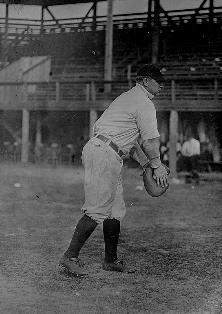
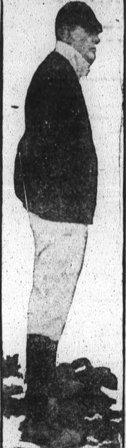
Harley Parker

20 Oct

Harley Park Parker was a renaissance man; a physician, an ambidextrous golfer, a billiard player who trained champions, in addition to being a major league pitcher—he was 5-8 with a 5.90 ERA in parts of four seasons with the Chicago Colts and Cincinnati Reds.

He is also responsible for what might be the worst single game pitching performance in professional baseball history.

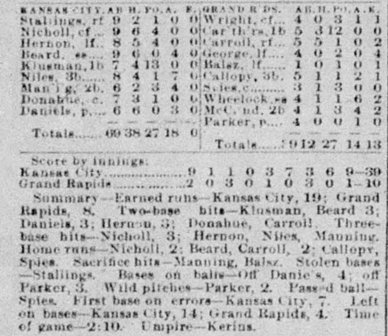
The 22-year-old Parker was pitching for the Grand Rapids Rippers (several newspapers in other in the other Western League cities called the team the Rustlers) against the Kansas City Blues (newspapers were split between referring to the club as the Blues or the Cowboys) on July 25, 1894.

Harley Parker circa 1895

Harley Parker circa 1895

The Kansas City Gazette said:

“The ball bats of the Kansas City Blues in the game against Grand Rapids collided with Pitcher Parker’s curves thirty-nine times yesterday, and yielded as many runs.”

The Blues actually had thirty-eight hits, to go along with 13 Grand Rapids errors.

The Kansas City Star said:

“(The Blues) hit him at will yesterday, for singles, doubles, triples and home runs.  It was a slugging match, the like of which had never before been seen in a professional game at Exposition Park, and while the Rustlers did some very sloppy fielding, there was world of free, sharp and hard hitting.”

Every member of the Kansas City line up had at least two hits, and three players, Sam Nicholl, Ollie Beard, and pitcher Pete Daniels, collected six each.

The final score was 39 to 10.

The Box Score Grand Rapids vs Kansas City

The Box Score Grand Rapids vs Kansas City

The game was indicative of Parker’s season; he finished with a 15-18 record with a 6.23 ERA—in addition to the 193 earned runs he gave up in 278.2 innings, his team gave him horrible support, and he allowed 194 unearned runs.

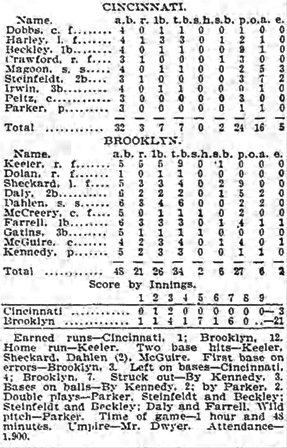
Parker had a similarly disastrous day as a major leaguer seven years later.  While pitching for the Reds against the Brooklyn Superbas on June 21, 1901 Parker allowed 21 runs on 26 hits in a complete game loss—“Wee Willie” Keeler was 5 for 5 with a rare home run (he hit just 33 during his 19-year career).

The Box Score Cincinnati vs Brooklyn

The Box Score Cincinnati vs Brooklyn

During his five minor league seasons Parker was only above.500 once; 5-4 in 1898 with the Minneapolis Millers; he was 5-8 as a major leaguer.

Parker briefly owned a Central League franchise in 1911, the club moved from Grand Rapids, Michigan to South Bend, Indiana, but even with the move he was forced to sell the team at mid-season because of financial difficulties.

That same year he also had a short stint as an umpire that ended with a trip to the United States Capitol.

In August, after one of Umpire Jack Sheridan’s frequent resignations—he returned to his position days later—American League President Ban Johnson hired Parker to the league staff.

Less than a month into his tenure Parker was on the field for one of William Herman “Germany” Schaefer’s stunts.  On August 4, Schaefer’s Washington Senators were playing the Chicago White Sox.  With the score tied in the ninth inning Schaefer stole second, hoping to draw a throw to allow Clyde Milan to score from third base; Sox catcher Fred Payne did not throw to second.  Schaefer then led off second base on the first-base side and returned to first on the next pitch.

The Washington Herald said:

“Umpire Harley Parker, who was officiating on the bases, was near first at the time.  When he saw Schaefer coming back to first Parker accosted the comedian ball player with the query: ‘What are you doing here?’

“’I have stolen second.  Now I am stealing first,’ said the Nationals’ troublemaker.

“’Well, if you stay down here I’ll call you out,’ said Parker.

“(White Sox) Manager (Hugh) Duffy in the meantime had ordered Doc White to throw the ball to John “Shano” Collins at first.  Germany thought discretion the better part of valor, and made a dive back toward second.  In the meantime Milan was tearing down toward home.  Collins wheeled and threw home, Milan being tagged out at the plate.”

Germany Schaefer

Germany Schaefer

Duffy was standing in the middle of the diamond arguing with Parker and home plate umpire Tommy Connolly as Milan was thrown out at home—Washington protested that “the play shouldn’t go because Chicago had ten men on the field.  Manager Duffy having stayed out to the middle of the diamond.”

Connolly and Parker finally ruled that Milan was out.  Washington went on to win the game 1 to 0 in 11 innings.

Harley Parker, 1910

Harley Parker, 1910

The following month Parker was again in Washington working a series between the Senators and the White Sox when, while sitting in the lobby of Washington’s Driscoll Hotel, according to The Washington Star he was approached by an “officer from the United States Senate,” who told Parker “I have a warrant for you.”

Parker was taken to the United States Capitol.

“The officer of Uncle Sam marched the arbitrator up to the desk of Vice President (James Schoolcraft) Sherman in the senate, the most august assemblage in the United States.

“’I guess I’ve got your man at last,’ said the officer as he introduced Parker to the vice president.

“’I sent for you to inquire about that play when Germany Schaefer went back to first after stealing second,’” said Sherman and Parker drew a sigh of relief.

“It was just like eating pie for Parker to explain the play and he did so to the satisfaction of all concerned.  Sherman admitted the play bothered him more than any problem that had come up in the extra session of congress and that was going some.”

Parker did not work as an umpire again after the 1911.  He returned to Chicago to practice medicine and teach billiard; contemporary newspaper accounts said he trained two champions—Calvin Demarest and Welker Cochran.

He died in Chicago in 1941.