Tag Archives: American League

An Umpire’s Revenge

5 Sep

In July of 1910 the Cotton States League released an umpire named Hunt (his first name has been lost to history).

A week after he was let go the first place Greenwood Chauffeurs were in Jackson, Mississippi to play the second place Tigers.  The Jackson Clarion-Ledger told the story:

“Ex-Umpire Hunt was in Jackson last night.

“If you don’t believe that statement ask some of the members of the Greenwood baseball team.

“They can testify to it.

“They can also show bodily evidence in support of the fact.

“He also had on his fighting clothes, and this is another fact they will swear to

“There are others who are willing to testify that he would have made a better show against Jack Johnson than did (Jim) Jeffries, among them Deputy Sheriff Sanders.

“Hunt was a short while back in the employ of the Cotton States League officiating in the capacity of umpire, but his performance last night demonstrated that he is better fitted for the prize ring.

“He was also fired, or at least relieved of his official duties on account of a howl made by certain players, the merits of which The Clarion-Ledger knows nothing.

“As before stated Hunt was in town and while standing at the corner of Mill and Capitol Streets, met Orth Collins of the Greenwood team, who accused him of umpiring games and betting on them at the same time.  This offended Hunt’s dignity, and on Collins reiterating the accusation, he was promptly knocked down…Hunt walked away, going to his supper in a nearby café.  Having satisfied his appetite, he proceeded to the Lemon Hotel, headquarters for all the baseballists, and where the Greenwood team had congregated preparatory to taking their game.  Entering Hunt espied his old friend Jack Law, catcher for the Greenwooders, and saluting him, asked that he use his good offices in patching up the differences between him and the mighty Orth.  But Jack, who reports say, was feeling his rye, was somewhat in belligerent humor himself, and he promptly pasted Hunt one in the face and received a knockdown in return.  Hunt then squared himself for action, but in doing so stumbled over a chair and fell to the floor and was immediately covered by second baseman (Ray) Rolling, who had gone to the assistance of Law.  In the meantime Law had recovered himself and kicked his ex-umpship in the eye, and to use Hunt’s expression ‘that kinder made him mad,’ and those who witnessed his subsequent performance, were perfectly willing to believe it.

Orth Collins--one of Hunt's victims

Orth Collins–Hunt’s first victim

“Shaking himself loose from Rolling, Hunt ‘riz’ to his feet and then the fireworks went off and the pyrotechnics shot out in every direction.  Four of the other players of the Greenwood bunch decided to take a hand against the athletic umpire, but very soon regretted their rashness in ‘rushing in where angels dare not tread,’ and were kept busy for a few minutes picking themselves up from the floor.

“Hunt backed himself up against the counter and his arms began working like piston-rods with battering ram attachments, and every time he stretched them out somebody went down.  (Clyde) Frakes, who officiates as catcher when Jack Law is occupying the bench, got into the scrap rather late, but he lost no time in getting out of it.  In fact, it is said that one lick delivered at the psychological moment started his feet to moving with such rapidity that he was unable to get any control over them until he found himself seated on in the A & V train (Alabama & Vicksburg Railroad) ready to pull out for Vicksburg.  Other players who showed an inclination to help their brothers in distress, hesitated and finally decided that discretion was the better part of valor and contented themselves with being ‘lookers on.’

“After the fight had gone some three or four round Hunt recognized that some of the men persisted in getting up after being knocked down by him, and not caring to continue the performance indefinitely, he gathered  two spittoons, one in each hand, and let one of them fly at a belligerent who was making for the stairway, and it is said that it hastened his speed to such an extent that his moving form became like Mark Twain’s coyote, ‘only a yaller streak,’ and that only lasted for a fraction of a second before he entirely disappeared from view.  The other cuspidor went in another direction, as also did most of the spectators.  Hunt was getting wild in his aim and not being able to distinguish friend from foe, and knocking down everybody and everything that came in reaching distance, the last being Jack Law, who had got back into the scrap, only to receive another swat, the like of which, spectators declared, was never before delivered to mortal man.

“Having put all his opponents hor de combat.  Hunt found himself in the arms of Deputy Sheriff Sanders, but not knowing him to be such, he was preparing himself for a last mighty effort when the deputy sheriff hastily volunteered the information that he was a peace officer intent on doing his duty, and the roaring lion subsided like an innocent lamb, and meekly announced that he didn’t ‘want to hurt any man attending to his own business.’”
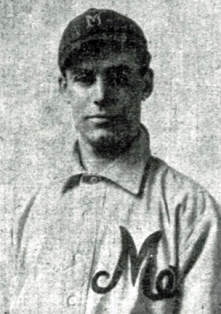
Hunt and six of the Greenwood players were arrested.  Four of the players were immediately released, but Law and Rolling, along with Hunt were held over for trial the following day.  All three were fined and released.

The Clarion-Ledger said although Hunt was “out of a a job at present…his friends will insist that he go into immediate training and challenge the holders of all the championship titles in the universe.”

Greenwood held on to beat Jackson by a half game for the pennant.

It’s unclear whether Hunt ever worked again as an umpire, but The Washington Times suggested that if Ban Johnson “wants a fighting umpire, one who can take the players and administer punishment on the ball field without fear of his blouse being torn to shreds or dirtied, here is the boy.”
Matty and the Federal League

3 Sep

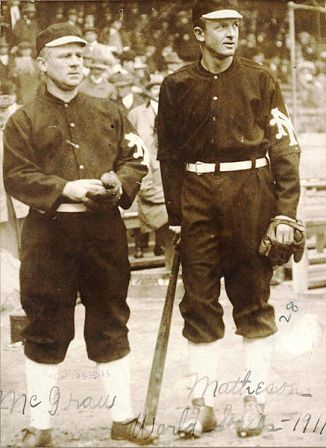
Despite the controversy during 1913 over ghost-written articles appearing under the bylines of major league players, Christy Mathewson continued to  “write” articles that were distributed to newspapers by the “Wheeler Syndicate.”  The Wheeler Syndicate was the creation of John Neville Wheeler, a reporter for The New York Herald, and widely known to be the writer of Mathewson’s articles.

Christy Mathewson with John McGraw

Christy Mathewson with John McGraw

Shortly before the beginning of the 1914 season, Mathewson “wrote’ a story about the outlaw Federal League, and the attempt the nascent league’s president made to secure his services:

“Until I had definitely signed with the Giants again, I made no comment on the Federal League or the offer of that organization to me.  In fact, there was nothing definite in the way of an offer until I received a telegram from President (James A.) Gilmore a few hours after putting my signature to a National league contract…The proposition came out of a clear sky and was unexpected.  I have learned since that the Federals believed I was signed up all winter and that it was not until a New York newspaperman happened to mention the fact to Gilmore.”

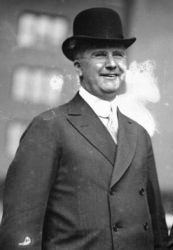
James A. Gilmore

James A. Gilmore

A New York reporter (likely Wheeler) told Mathewson how Gilmore came to find out he wasn’t yet signed:

“’We were sitting around the Waldorf late one night, fanning and discussing the Federal League, when one of the boys said to Gilmore: “’Why don’t you make Matty an offer and get some publicity out of it anyway?

“’He’s signed isn’t he?’ asked Mr. Gilmore.

“’No more than I am.  His contract expired last season, and he has not signed the new one yet.’

“’Gilmore at once left the party and sent a telegram to you.  Then he announced his action to us newspaper men, and the story appeared in the papers the next day.’”

At the time of the offer, Mathewson was asked by a reporter from The Los Angeles Examiner whether he would consider joining the Federal League, and said, “he would consider the offer.”  He now claimed, “all the time I knew I would not desert the New York club which had practically made me in baseball.”

Mathewson also took the opportunity to deny another rumor; that he was in California working on behalf of National and American League franchises to help them protect their players from the Federal League said:

“I saw several reports in the newspapers during the winter and early spring months that I was the agent of organized baseball on the Coast and that I had been busy counterbalancing the bids of the Federal League agents for the players spending the winter there.  As a matter of fact, I kept clear of both baseball on the diamond and the politics of baseball last winter because I did not care to have it on my mind.   Was having too much fun playing golf, and it is not in my province as merely a player to try to influence others to take certain steps which some day they might regret and then blame me for their mistakes”

Mathewson used his former teammate, catcher Art Wilson, as an example of how he had not given any players advice about accepting Federal League offers—Wilson had jumped from the Giants to the Chicago Feds during the winter:

“(Wilson) received a big offer to go with the Federals with the promise of a large piece of advance money.  Wilson has been pining for the chance to work regularly with a big league club for two or three years now and was weary of sitting on the bench, absorbing information in this position about how it is done in the majors.  As I said in a previous article, Wilson even asked (Manager John) McGraw to transfer him to a minor league team this season so that he could have an opportunity to work daily.  Now, if the Federal League turns out to be a big success, and if I had advised Wilson to refuse its offer and stick with the Giants, he might have said to me some day:

“’Well, I took your advice and am still sitting on the bench.  If I had gone with the Feds, I might have been a star now.’”

Art Wilson

Art Wilson

The move did result in additional playing time for Wilson.  From the time he joined the Giants in 1908 until he jumped to the Feds, he had appeared in just 231 games over six seasons.  In 1914 and ’15 he appeared in 233 Federal League games, hitting .291 and .305.

Mathewson, who had been paid $9,000 by the Giants in 1913, would not reveal how much he was paid by the Giants for 1914: “It is at the request of the New York club that I do not state the terms.”  He did, however, say exactly what he was offered by Gilmore to jump.  He said after not responding to the initial telegram from the Federal League president—a telegram that did not mention terms–he received a second:

“’Newspaper reports state you do not take Federal League offer seriously.  Get acquainted with the Federal League officials and be convinced we are not four flushing.  I will give you $65,000 for three years service as manager of a Federal League club–$15,000 advance money.  If satisfactory, meet me at the Waldorf Thursday, at my expense.  Wire answer Chicago.’”

Mathewson said he “was torn with regret” for refusing the offer that would have more than doubled his salary.

“It would be like leaving home if I were to pass up the Giants now.  I don’t think I would feel right in any other uniform.”

Mathewson said “the Federals have been spending money very liberally,” but placed the credit for the success the league had in inducing players to jump with Joe Tinker.  Tinker had jumped the Cincinnati Reds to join the Chicago Feds as player-manager.  Mathewson said:

“At first there was little confidence in the backers of the new organization until Joe Tinker jumped…The ball players had faith in Tinker because he is rated as one of the shrewdest in the business.  If the Federal League lives and goes through, Joe should get credit for it, because he is the man who has collected practically all the players for it.”

Joe Tinker

Joe Tinker

Both 33-years-old Mathewson (24-13 3.00 ERA) and Tinker (hit .256 in 126 games and led the Chi-Feds to a second place finish) had their last productive seasons in 1914.

Mathewson continued to “write” articles for the Wheeler Syndicate until 1916 when Wheeler sold the operation to the McClure newspapers.  Almost immediately after the sale, Wheeler formed the Bell Syndicate, and occasional articles under Mathewson’s byline were distributed by Bell through 1919.

“It is Feared that the Cares of his Office are making an old man out of Tim”

18 Aug

Timothy Carroll “Tim” Hurst had an eventful season in 1906.

He had been an umpire since 1891—with the exception of one awful season managing the St. Louis Browns to a 39-111 last place finish in 1898.  In 1904 Hurst retired from the National League, but months later joined the umpire staff of the Central League, and took a job in the American League in 1905.

Tim Hurst

Tim Hurst

The Kansas City Journal described the 5’ 5” umpire who was also a boxing referee::

“Hurst is a pudgy little fellow, below medium height, with sandy hair, twinkling blue eyes and a ruddy complexion.”

He was often called “pugnacious” for his on field, and off, altercations, and once told a reporter for The New York Herald how he dealt with argumentative catchers:

“Never put a catcher out of the game.  If the man back of the bat is sassy and objects to your calling of balls and strikes, keep close behind him while doing your work and kick him every time he reaches out a catch a ball.  After about the third kick he’ll shut up.”

The incident that earned him the most attention in 1906 happened during a May 7 game in New York between the Highlanders and the Washington Nationals.   The New York Times said during the fifth inning:

(Frank) LaPorte was declared out at first base on a close decision.  Manager (Clark) Griffith rushed over to the base line, and, throwing his cap in the air, protested against the decision.  He wildly gesticulated, and Hurst ordered him away.  Griffith, instead of following Hurst’s instructions, stepped up to the latter, protesting all the time.  In his excitement he stepped upon Hurst’s foot.”

Hurst “drew back” to punch Griffith but was held back by players from both teams.

“Hurst then took hold of the lapel of Griffith’s coat and started to lead the player-manager to the bench.  The latter angrily resented this action and pushed Hurst’s hand away.  Lave Cross and the Washingtons tried to pacify Griffith, and succeeded in getting him to the players’ bench.”

Hurst followed Griffith to the New York bench and again attempted to punch the manager, while Griffith “rushed at the umpire.”

Clark Griffith

Clark Griffith

According to The Associated Press Griffith claimed “’Hurst didn’t hit me.’ Then pointing to his swollen mouth he added, ‘I had this swollen lip before the game.’”

Hurst and Griffith were both suspended for five games.

The following year Henry Pierrepoint Edwards of The Cleveland Plain Dealer said Hurst had given him an explanation to “clear up the mystery” of why he reacted so violently:

“Now, it isn’t customary for Tim to wear baseball shoes on the diamond.  Usually Tim appears for the fray clad in the same suit he would wear at a pink tea.  His real uniform is just a cap.

“On the afternoon in question Tim purchased a new pair of patent leather shoes.  The shoes glistened in the sun like a diamond and gave Tim great pleasure.  Griffith forgot all about the shoes and in his rage over losing a close decision spiked and spoiled the new kicks.  Great was Tim’s rage.  Even greater was the clash.  That’s all.”

Two months after the incident with Griffith, Hurst made what might have been the worst call of his career.

On July 7 in Washington, he was working the game between the Nationals and the Detroit Tigers.  The score was tied 3 to 3 in the seventh inning, the Tigers had the bases loaded with two out and Sam “Wahoo” Crawford at the plate, facing Nationals pitcher Frank KitsonThe Washington Post said:

“’Wahoo’ lifted one a thousand miles directly over the pan.  Kitson came tearing in,  (Catcher Howard) Wakefield hesitated.  Manager (Jake) Stahl stood still at first base.  The pellet whirled in the air and finally dropped just inside the line and bounded back to the stands.  (Charley) O’Leary and (John) Eubank romped home.  Crawford went to second, carrying the funniest two-base hit on record.  Kitson and Wakefield stood admiring each other until Hurst again yelled ‘Fair ball!’ when the boy catcher went after the bulb.”

Sam Crawford

Sam Crawford

While the Nationals argued the call, and Hurst refused to reverse his decision, The Post said “The spectators were forced to listen to the dillydallying for fully fifteen minutes, then many of them got up and left the belligerents wrangling over the decision.”

Kitson threw a wild pitch to the next batter, Matty McIntyre scoring Herman “Germany” Schaefer and Crawford.  The Tigers went on to win 9 to 3.  Jake Stahl filed a protest with American league President Ban Johnson.

The Washington Evening Star said:

“The only excuse that Umpire Hurst can have is that the play was an unusual one.  Lave Cross admitting that he never saw its like in his experience on the diamond.  Hurst was palpably rattled, and the Tigers when taking their places on the field chaffed the locals with the remark that ‘Tim certainly handed us one that time.’”

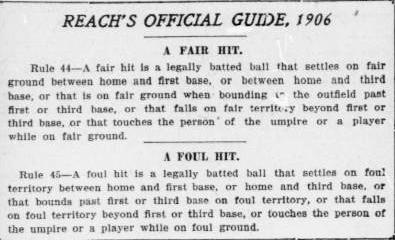
The Washington Times said it was “one of the most remarkable plays ever seen on a diamond,“ and printed for their readers rule number’s 44 and 45 from the 1906 “Reach Guide” Reach describing “A Fair Hit,” and “A Foul Hit.”

The Washington Times used "The Reach Guide" to illustrate how Hurst blew the call.

The Washington Times used “The Reach Guide” to illustrate how Hurst blew the call.

The Times said:

“(T)here seemed no possible way of calling it fair, but Hurst was obdurate, and the only explanation he would give was that the ball ‘was hit too high.”  What the heighth of the hit had to do with the fact that it eventually bounded foul is still another mystery.”

Hurst’s story evolved over the next several days.  The Post said his original explanation regarding the ball’s height was “to the effect that the ball was it so high it ‘settled’ inside, constituting the hit a fair one. “  This was quickly replaced by Hurst’s claim that the ball had touched Wakefield, the Washington catcher, before bounding into foul territory.

The Times’ baseball reporter Thomas Stevens Rice said of Hurst’s new story:

“This explanation is all right if it presents the facts in the case.  In the press box there was not a single man who thought the ball was touched by Wakefield or anybody else.”

The Post conceded that the protest would be rejected, saying “It is almost certain that Ban Johnson will sustain his scrappy umpire, no matter what interpretation he puts on the rules,” but the paper did not let up on Hurst.

The following week when Sam Crawford brought his average up to .300, The Post said:

“Hurst last week decided that Crawford’s high rap which hit inside the base line and bounded back to the stands was fair…am would have faced the pitcher 271 times and got away with 81 hits which would have made his average .299, as it was Sam got and extra hit which brought the total to .303.  He owes Tim a hat.”

Hurst was still young, just forty-one in 1906, but The Sporting Life said something had changed during that year, and by the end of the season that the umpire lacked the “Aggressiveness and enthusiasm” he had previously exhibited:

“It is feared that the cares of his office are making an old man out of Tim, who once was noted for having the finest brand of keen-cutting, kill-at-a-thousand-yards sarcasm of any umpire in captivity.  Sit Timothy is very tame, and the players, even the bush leaguers who have just broken in, can tell him what they think of him and his calling.”

Hurst’s old “aggressiveness” came out in 1909.  He was suspended in May for a fight with Norman “Kid” Elberfeld of the Highlanders, then on August 3 during a game between the Athletics and White Sox.  The Brooklyn Eagle said:

“At Philadelphia Tim Hurst came in for considerable trouble.  Hurst called Eddie Collins out at second and the Columbia youngster put up a kick.

“Whether it was with malice aforethought or quite an accident, it is a fact that the umpire distributed a mouthful of moistened union-made tobacco in the direction of the youthful Eddie, who immediately called Tim’s attention to the board of health ordinance which prohibited expectorating in public places.”

After the game Hurst had to be escorted from the field by Philadelphia police.  Ban Johnson suspended Hurst, beginning two weeks of rumor and speculation about the umpire’s fate.  Finally, on August 18 it was announced that Hurst had been let go by the American League.

Hurst, in poor health since 1912, died in 1915.  Hugh Fullerton of The Chicago Examiner said of his passing at age 49:

“The saddest part of it is that ‘Timothy’ did not die in the blue uniform, and that during the last few years of his life he was practically blacklisted in baseball for refusing to answer or deny charges made against him for his actions during a clash with Eddie Collins…President Johnson declared that if Hurst even had replied to his telegrams of inquiry he would have kept him—but Tim, knowing he had done wrong, refused, and went out of the game.”

Big Six versus The Hoosier Thunderbolt

6 Aug

Christy Mathewson had only pitched five full seasons when Sam Crane of The New York Journal said in January of 1906 “there is a great diversity of opinion” regarding whether Mathewson or Amos Rusie was the better pitcher.

Crane said “Old-time lovers of the game” said Rusie, “The Hoosier Thunderbolt”, whose career ended in 1901 after being traded to Cincinnati for “Big Six” Mathewson,  was the best ever, “and refuse to acknowledge that the young college man who won the world’s championship so easily last fall…is his superior.”   While, “the younger generation of enthusiasts say there was never but one Mathewson and point to his wonderful record to prove their point.”

Amos Rusie

Amos Rusie

Crane said two famous New York baseball figures—and future Hall of Famers– disagreed on the point:

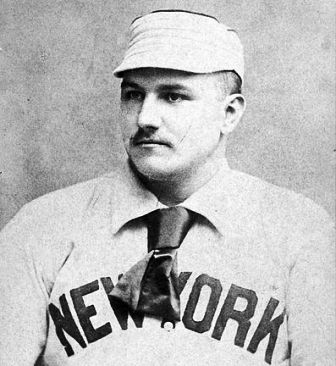
George Davis, the crack shortstop of the Chicago White Sox, and one of the best players who ever wore ‘New York’ across his shirt front, met Clark Griffith, manager of the Yankees (Crane was one of the earliest to call the then “Highlanders” the “Yankees”), yesterday at the headquarters of the New York American club, and argued over the much mooted questions of pitching superiority between the two crack box artists.  Both Davis and Griffith agreed that Mathewson and Rusie were two of the best, but differed as to which was entitles to the premier position.”

Davis thought Mathewson was better.

“Both have excelled all other Boxmen.  I have never batted against Matty in a game, but I have met his curves in practice and I want to say that he has just as good control of the ball as Rusie.  Matty’s most effective ball is a straight drop, but his speed is a great factor as well as a wonderfully controlled slow ball.  He uses his forearm and elbow and winds up in such a manner that a batsman is sure to be puzzled.  Rusie, on the other hand, depended on an out drop, which he controlled with remarkable skill, in addition to his fast ball; but he had very little preliminary motion and used his shoulder almost exclusively.  Rusie probably had the better physique, but in head work and vitality Mathewson outclasses the big Hoosier.”

Christy Mathewson with John McGraw

Christy Mathewson with John McGraw

Griffith disagreed:

“Rusie in his prime was the best twirler that ever stepped into the box.  His curves, speed and control were the best assortment I ever looked at, and no pitcher has ever approached him in class since he made his departure from baseball.”

Crane cast the deciding vote, declaring:

“Rusie never had a peep in with Mathewson as a box artist.  Rusie relied mostly on brute strength until his arm began to show symptoms of crystallizing, then he accumulated a good slow ball; but for head work, pure good judgment, with a delivery or series of deliveries to back up his well-balanced brain, Mathewson is superior to any pitcher who ever wore shoe plates.”

Crane’s analysis was prescient.

Rusie’s greatness is undisputed—his speed was primary reason for moving the pitching distance from 50‘ to 60’ 6”—but his best days were behind him before he turned 24-years-old.  His season-long holdout in 1896 and the arm injury that effectively ended his career at 27 after the 1898 season (except for three games he pitched for the Cincinnati Reds in 1901) make him one of baseball’s great “what ifs?”  He still finished his career 246-174, and was elected to the Hall of Fame in 1977.

Mathewson won twenty games for nine straight seasons after Crane declared him “superior to any pitcher.   He finished 373-188 and was part of the Hall of Fame’s first induction class.

“There are many Degrees of ‘Fan'”

1 Aug

It seemed that James Aristotle “Jim” Hart, president of the Chicago Orphans had a full plate in 1901.  His team got off to a 1-6 start and never recovered, finishing a disappointing 58-81, while the cross-town White Sox took over first place on July 10 and never looked back, winning the American League’s inaugural pennant.

Jim Hart

Jim Hart

Additionally, Hart was meeting frequently with American League President Bancroft “Ban” Johnson in an attempt to avert all-out war between the two leagues.  Rumors about the trouble ahead were so numerous that The Chicago Inter Ocean said one day during August:

“Ban Johnson went fishing yesterday, and Jim Hart busied himself making out checks for his players.  As a plain matter of fact, there wasn’t enough baseball excitement in town to scare a rabbit, but the fakebirds sang just the same.  By night, the National League had flopped over to the American and the American had joined the National; all the players on each side had been stolen, and there were forty-six more baseball wars in view.”

Despite his fading team, the looming battle, and the fact that the White Sox would out draw his club by nearly 150,000 over the course of the season, he still found time to make it clear what constituted “a genuine fan.”  Hart wrote an article for The Chicago Record-Herald:

“The genuine fan is a proper adjunct of the game of baseball and should be encouraged, for from him must come the enthusiasm which provides capital necessary  to operate the game, the encouragement which causes youths to become proficient players and the constant dropping of con for admission tickets to witness games which permits the sport to continue.

“There are many degrees of ‘fans,’ some agreeable and some disagreeable to an extent which is intolerable.  The ‘fan’ proper is perfectly harmless; he annoys nobody and loves the game for the amusement and benefit he derives from it.  He keeps the records of players of his favorite team and players of other teams.  He feels as if he had encountered personal loss when his team losses and is correspondingly jubilant when the team wins.  He does not roar or rant at the players, but feels grieved that any player on his pet team should ever make an error.

“The next degree of ‘fan’ is the one who becomes wildly demonstrative; he can ‘see things’ only one way, and that is the way he wants them to be; the umpire’s decisions are invariably wrong when they do not happen to be the way he wants them; the errors made by the players of his favorite team are made purposely and could just as well been avoided.  Consequently he at once joins the chorus of ‘take him out’ etc…

“The disagreeable ‘fan’ is strictly speaking not a ‘fan’ at all, but is a person who wishes notoriety and the ‘laugh’ which his sallies cause, for be it known that almost any remark made by a person among the spectators  causes more or less of a laugh.  This class of ‘fan’ does not always employ profane of vulgar language, but his remarks are usually coarse and are personal, directed usually to some spectator, or to a player or to the umpire, and, as stated above while the language is not always of a character that is vile, it encourages the next lower degree of ‘fan’ to use expressions which cannot be tolerated on any properly conducted baseball park.

“An honest management is under great strain during a game of baseball whenever the attendance runs up into the thousands, for it feels that every person there, especially the women, are under the protection of the management, and, when one reflects upon the enormous force for good or evil that is contained in an enclosure of less than a half dozen acres when from 15,000 to 20,000 persons are congregated to witness what may prove a wildly exciting contest upon which the championship of the world may depend, he will not by any act or word jeopardize the welfare and happiness of the people assembled.

“The mobs that attack umpires are not ‘fans.’  They are cowards and rowdies and the person who from the crowd insults a player is bound by the rules of his league and club to resent no insult of any description while in uniform;  consequently to hurl an insulting remark at a player or umpire while he is on the playing field is at par with striking a man who is bound hand and foot and tied to a post.”

Hart’s Orphans improved to 68-69 and finished fifth in 1902, but were again outplayed (74-60, fourth place) and out drawn by the Sox–Hart made no comment about the relative quality of either team’s fans.

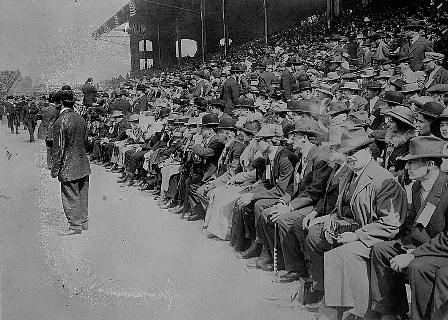
Fans at White Sox game circa 1910

Fans at White Sox game circa 1910

“Dunnie’s” Narrow Escape

28 Jul

Samuel Morrison “Dunnie” Dungan returned home to Southern California in 1889 after graduating from Eastern Michigan University– the Michigan State Normal School– and joined the F.N. Hamilton’s a powerful San Diego-based semi-pro team that included 39-year-old Cal McVey, a member of Harry Wright’s Cincinnati and Boston Red Stockings teams from  1869 through 1875 (with a detour to Baltimore in 1873).

In the spring of 1890 the Oakland Colonels, champions of the California League in 1889 recruited Dungan to catch for them during a series of exhibition games in Los Angeles.  The Oakland squad did not impress Southern California critics.  The San Diego Union said:

“It is drawing it mild to say that it was the rottenest game that been played on the ground.  If it was not a fake, than the Oaklands cannot play ball.  Do they suppose up about San Francisco and Oakland that they can bring down to Southern California a lot of boys and show the Southerners how to play ball?”

Samuel Dungan

Samuel Dungan

The Union said the Hamiltons, as well as two other San Diego teams, the Schiller & Murthas and the Llewellyns “can beat the Oakland team out of sight.”

The paper said only one player stood out:

“Dungan, the San Diego catcher, who caught for the Oaklands both days, was about the only redeeming feature of that club…And he does not pretend to be a professional.”

As a result of his play during the exhibitions, Dungan was signed by the Colonels;  he still caught occasionally but was now primarily an outfielder.  Team owner Colonel Thomas P. Robinson was unable to restrain his enthusiasm when Dungan was signed, telling The Oakland Tribune:

“I believe Dungan is the greatest batter we’ve ever had here—better than (Lou) Hardie or (Vince) Dailey, the latter of whom I rank as the best of the old men.”

Fred Carroll, a California native who played with the Pittsburgh Burghers in the Players League in 1890, called Dungan “the only scientific batter on this coast.”

Statistics are incomplete for the 1890 California League season, but both The Tribune and The San Francisco Chronicle reported that Dungan was the league’s batting champion.  The Los Angeles Herald said he hit .332.  The Colonels finished third in the four-team league.  The Tribune said it was “probable that Dungan will go East.”

He was first rumored to be heading to be heading to the Washington Statesmen in the American Association but ended up signing with the Western Association’s Milwaukee Brewers.

It was Dungan’s departure from the West Coast in the spring of 1891 that led to the biggest headlines of his career.

The San Francisco Chronicle told the story:

“Sam Dungan, the ballplayer who was with Oakland last season and who led the California League in batting, is being pursued by an irate wife who says she will follow him to the end of the earth if necessary to again clasp him in her arms.  It seems that last year among the many conquests Dungan made in Oakland was Miss Mamie Bodgard.  She became wild over him, and at last was introduced to him.  After the season Dungan came south to his home in Santa Ana, but communication between himself and Miss Bodgard kept up.  She sent him many dainty perfumed notes.  Finally the marriage of the couple was announced and it created no great surprise.

“Now comes the thrilling part of this story.  Two hours after the marriage had taken place (in Los Angeles) Dungan left his bride and journeyed to Santa Ana, where he had an interview with his parents, who are well and favorably known and rank among the leading families.  Sam is a college graduate and was the idol of his parents.  Mrs. Dungan also journeyed to Santa Ana.  She did not go to the home of the Dungan’s, but went to the Richelieu Hotel.  She is a most pronounced brunette, rather petite, and is reported to have a temper.  The couple had parted, and the news of the separation soon became noised around.  Mrs. Dungan consulted a lawyer to have her ‘hubby’ restrained from leaving Santa Ana, but the heavy hitter eluded his young wife and started for Milwaukee, giving his bride the slip at Orange, she being on the same train with him that far.”

The jilted bride told a reporter for The Los Angeles Herald that she was “a grass widow,” but vowed to pursue Dungan to Milwaukee.  Mrs. Dungan’s trip to Milwaukee was unsuccessful.

A year later The Herald reported that a court in Santa Ana had awarded Mrs. Dungan $25 a month  “and she is very elated in consequence.”  She was said to have gone to Milwaukee twice the previous year and had taken to reading “Sammy’s love letters on the street corners,” of Santa Ana:

“Mrs. Dungan is an excellent dresser and is an exceptionally handsome woman.  She doubtless could be induced to kiss and make up, but the parents of her husband stand in the way of a reconciliation.  The Dungan’s are anxious to have Sam get a divorce, but he  can’t very well, and Mrs. Dungan says: ‘Never in a thousand years.'”

A divorce was finally granted in 1893.  Sam Dungan remarried in 1900.

Dungan went on to play parts of five seasons in the major leagues, mostly with the Chicago Colts and had a .301 career batting average.  He was an excellent minor league hitter, putting up several excellent seasons—including averages of .447, .424 and .372 in 1894, ’95, ’97 with the Detroit Creams and Detroit Tigers in the Western League. He also hit a league-leading .337 in 1900 for the Kansas City Blues in the inaugural season of the American League.

Dungan returned home to Santa Ana after retiring at the close of the 1905 season and participated in many old-timers games in Southern California.  The Santa Ana Register reported on his heroics during a 1924 fundraising game for former player Ed Householder who was dying of stomach cancer—Dungan joined Sam Crawford, Gavvy Cravath, Fred Snodgrass and other West Coast baseball legends for the game in Los Angeles:

“Yesterday, Dungan, now a prosperous Santa Ana resident and rancher, proved that years have not dimmed the remarkable eye nor time deprived the power from his arms and shoulders that enabled him, year after year, to outhit the other big league players of his day.

“Dungan rapped out a two-bagger with two men on the cushions in the tenth inning.  This blow broke up the game.  Previously Dungan had smashed out three other bingles.  Thus, Dungan of Santa Ana, the oldest man on the field in point of years, was the heaviest hitter just as he used to be years ago.”

Dungan died in Santa Ana in 1939.

“What Right has Hanlon to Show me How to Hit?”

23 Jun

How are hitters created?  Bozeman Bulger of The New York Evening World attempted to answer the question, and described the hitting styles of some of the game’s biggest stars in 1906:

“Batting is a natural gift and to be a success the player must be allowed to swing the willow in his own sweet way.”

Bulger said John McGraw who “For nine years…had a batting average of .330” (actually .346 from 1893 to 1901) was asked his secret:

“Don’t know, I simply used my eye and my arms and figured it out.”

When McGraw played for the Baltimore Orioles, Manager Ned Hanlon tried to show him “how to hit (and) on one occasion he corrected him sharply.”  McGraw said:

“That set me to thinking, and I went to my room and dug up a lot of old records.  In these I saw that Hanlon had never hit as good as .300, that is for a period of two or three seasons (Hanlon hit .302 in 1885) while I had been hitting over .300 right along.  Therefore, I asked myself ‘what right has Hanlon to show me how to hit?’”

Ned Hanlon

Ned Hanlon

Bulger said

“In the past few years Yale and Harvard and Princeton and other colleges have employed coaches to teach them how to hit.  The experiment was futile, and no hitters were developed that did not already possess the gift.

“Take the great batters of to-day and you will find that no two of them stand at the plate alike.  Long since astute managers have found that it is a useless waste of time to attempt a correction of habits easily acquired.  To be successful a ball player must do everything in a perfectly natural manner.  This is paramount in batting.”

Bulger then wrote about the “peculiarities” of some contemporary hitters:

Sam Mertes of the Giants invariably pulls his left foot back as he swings at the ball.  Mertes also crouches with somewhat of a forward lean and keeps his feet wide apart.

Roger Bresnahan and Mike Donlin, two of the greatest hitters in the world, are what are called vicious swingers.  Bresnahan has absolutely no fear.  He never thinks of being hit, but runs squarely into the ball, and when he plants his bat squarely against it a scorching line drive follows.  Nobody hits a ball with more force than Bresnahan.

“Donlin stands with his feet about one foot apart and usually holds the bat perfectly rigid at his waist, slanting at an angle of about 45 degrees.  He can either ‘chop’ or swing hard with the same degree of accuracy.  Donlin is said to be the greatest natural hitter in the business.  He says he has no idea how he does it.

George Stone, one of the most remarkable batters of the age, has a (boxer Jim) Jeffries  crouch at bat which has caused experienced baseball managers to say George wouldn’t last as soon as the pitchers got next to him.  Stone puts a terrific amount of weight into one of his blows, swinging with his shoulders and smashing a line with fearful force.

George Stone

George Stone

“His position has been termed awkward, inelegant, and not conducive to good hitting, but Stone to-day leads the American League with a better average than the great (Napoleon) Lajoie.

“Larry is the personification of grace and elegance at bat.  He has that careless indifferent method which attracts, is devoid of nervousness but active and alert.  Infielders will tell you that there is a force in the balls smashed by Lajoie which makes them unpleasant to handle.  Lajoie is the finished artist.

“His great rival in the National League Honus Wagner is just the opposite.  Hans grabs his stick at the end, holds it high about his shoulders, and when he swings his legs are spread from one end of the batter’s box to the other.  Wagner is awkward standing almost straight and goes after outcurves and drops with equal avidity.  Hans often reaches to the far outside of the plate for a low outcurve and plants it into right center field.

Charlie Hickman stands at the outer edge of the box and swings with his body and shoulders His fondness for the balls on the outside of the pan are known to opposing pitchers.  Lave Cross puts his two feet into the angle of the batter’s box nearest the catcher, while (Dave) Altizer usually spreads out, varying this position with a crouching posture, from which he runs up on a ball.”

Lost Pictures–Walter Johnson Steamrolls the American League

20 Jun

walterjohnsonsteam

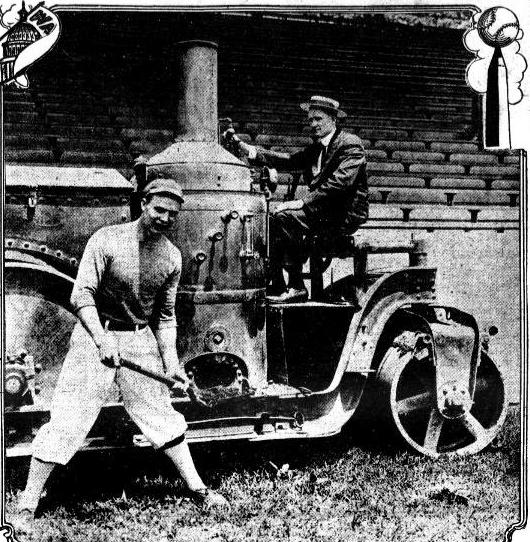
A 1912 publicity photo featuring Walter Johnson at the wheel of a steamroller, and Senators catcher Eddie Ainsmith with the shovel at Griffith Stadium in Washington.  The photo was taken on June 17; the Senators had just returned from Cleveland having won 16 straight games–all on the road.  During the streak, the Senators had gone from 17-21 in sixth place, to 33-21, just one and a half games behind the Boston Red Sox.

The Washington Times said “It was considered an omen of continued triumph” that the steamroller was “found on the grounds.”

The Senators won the following day and continued playing well the rest of the way, finishing 91-61, their first winning season in the team’s 12-year history.  But, it was not good enough to catch the Red Sox who finished 14 games in front.

Johnson had his first of two 30-win seasons, finishing 33-12 with a league-leading 1.39 ERA.

Ainsworth played in the major leagues for 15 years, the first nine with the Senators.  The Washington Post said before the season opener in 1915:

“For the seventh consecutive year Walter Johnson will work in the opening clash for the home folks, and in nearly as many seasons will Eddie Ainsworth be his battery mate.  This pair always work together and no pitcher and catcher in either league are better acquainted when it comes to baseball.”

Eddie Ainsmith

Eddie Ainsmith

Several weeks after Ainsmith was traded to Boston (then to Detroit on the same day) in January of 1919, Louis Dougher a writer for The Washington Times said:

“When Eddie Ainsmith was traded to Detroit via Boston, Clark Griffith shattered on of the crack batteries…it was Johnson and (Charles “Gabby”) Street.  Then when Gabby slowed up and gave way to a successor, it rapidly became Johnson and Ainsmith.”

Age, more than the departure of Ainsmith slowed Johnson down, but he still won 140 games and posted three 20-win seasons after his personal catcher was traded.

Birmingham Sam— The Last Great Star of the Indianapolis Clowns

9 May

Richard “King Tut” King’s illness, which led to his retirement in the spring of 1959, left a void with the Indianapolis Clowns— James “Nature Boy” Williams, was popular, but the barnstormers needed someone with Tut’s charisma. They finally found him in 1962; his name was Sam Brison

The St. Petersburg Times described one of his early appearances:

“A limber fellow raced across the diamond in an Indianapolis Clowns uniform and bowed in the direction of teammate first baseman extraordinary Nature boy Williams. Minutes later fans were acclaiming a new star…he shows signs of becoming one of the all-time greats”

Given his resemblance to King Tut; Clowns owner Syd Pollock originally billed Brison “King Tut Jr.” The excellent book “Barnstorming to Heaven: Syd Pollock and his Great Black Teams,” by Pollock’s son Allan and James Riley told the story of how he was renamed. Brison approached Pollock and said he had a problem with the name:

“Problem is, I didn’t even know the man. Seen his picture on the bus. He musta been popular as God. Fans keep asking me, ‘How your Daddy?’ and I got no answer. Ain’t gonna lie, ain’t gonna say, ‘My Daddy fine, I’ll tell him you be asking.’ These people feel strong about King Tut.”

When Pollock asked if he just wanted to be called by his name, Brison said:

“No, I figure Birmingham Sam be good. People ask me about how Birmingham is. I can answer that.”

“Birmingham Sam” would be the team’s biggest draw during his 16 years with the team. Following the example of many members of the clowns throughout the team’s history, Brison also spent his winters playing basketball, first with Goose Tatum’s Harlem Road Kings, then with the Harlem Globetrotters—on the basketball court he said he “had a lot of showmanship about me…I did a lot of hollering.”

Never one for understatement, some of Pollock’s press releases described Brison as “one of the best fielders in baseball and hailed as the greatest comedian in sports history. “ The six-foot-two-inch Brison would often begin performances by “unpacking” two-foot-seven-inch Dero Austin from a suitcase at home plate.

In 1969 The Associated Press reported that Brison had secured a spring training tryout with the Boston Red Sox’ Carolina League Winston-Salem franchise, Brison told the wire service:

“I just want to get to Florida and show my stuff.”

Brison said an injury earlier in the spring had led to the cancelation of a tryout with the Cincinnati Reds—there’s no record of the whether the Red Sox try out ever took place. The Associated Press story incorrectly said the 29-year-old Brison was only 23—his real age would have made it especially difficult for him to break into organized ball in 1969.

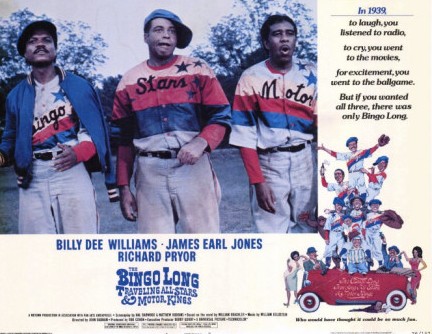
In the mid-1970s, during the beginning of the end for the Clowns as a viable business, Negro League Baseball was becoming the subject of renewed interest. In 1976, the barnstorming tradition of teams like the Clowns made the big screen with the release of “The Bingo Long Traveling All-Stars and Motor Kings.”

In order to add authenticity to the baseball scenes stars Billy Dee Williams, James Earl Jones and Richard Pryor were joined in the cast by Leon “Daddy Wags” Wagner (two-time American League all-star), Jophrey Brown (pitched in one game for the 1968 Chicago Cubs, then became a well-respected Hollywood stuntman), and “Birmingham” Sam Brison.

“Bingo Long” movie poster

Brison played shortstop Louis Keystone in the movie.

“Birmingham” Sam Brison is seventy-two-years-old and lives, appropriately enough, in Birmingham, Alabama.

Update: “Birmingham” Sam Brison passed away in April of 2014.

Opening Day—1901

26 Mar

The Chicago White Sox opened the American League’s inaugural season as a major league on April 24, 1901, against the Cleveland Blues.  The three additional league games scheduled for the 24th were postponed on account of rain.

The Sox won the then-minor league American League championship the season before.

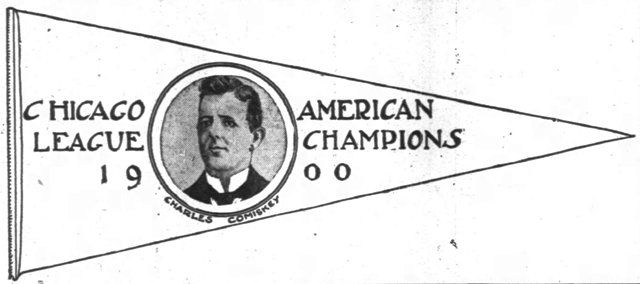
1900alchamps


Comiskey relinquished managerial duties in 1901 to Clark Griffith, the pitcher jumped from the cross-town National League Orphans for a reported $4,000; a $1,500 salary increase.

Clark Griffith

Clark Griffith

The opener at Thirty-Ninth and Wentworth included a parade, several bands, and speeches from many dignitaries—The Chicago Tribune said every member of Chicago’s City Council was on hand, but Mayor Carter Harrison, who had promised Comiskey he would appear to speak and throw out the first ball, “was kidnapped by William J. Bryan, who slipped into town unperceived. ‘Commy’s’ plans for having the Chief Executive start the opening game were shattered.”

The Tribune said American League President Ban Johnson also missed the game; he had traveled from league headquarters to attend the opener in Philadelphia “and it’s a 1,000 to 1 shot he was sorry when he found Comiskey was the only magnate who had squared himself with the weather man.”

Other than the absence of the mayor and the league president, the paper said the first game of the upstart league was a success:

 “Under the fairest skies the weather clerk could select from his varied stock of April goods; with a championship pennant floating high above them from the proudest pine of all Michigan forests; with 9,000 fans to cheer them from a pent-up enthusiasm that burst forth at every possible opportunity, the White Stockings open the American League baseball season on the South Side Grounds yesterday with a clean-cut victory over the aggregation from Cleveland.”

The Chicago Inter Ocean, which reported the attendance at 10,073 said:

“As a grand opening it was an unqualified success, something which Charles Comiskey can look back upon in after years with all the serene satisfaction of a baby who has just swallowed a tin Indian.  As a ball game it was a hideous nightmare, a cold and icy vision of the darksome night, a living horror, let loose to stalk adown a diamond field, hooting hoarsely…With pomp and ceremonial, with braying of bands and braying of fans, with an enormous audience gathered in the frapped stands, the American League season of 1901 was duly opened in Chicago, and the real champions, Comiskey’s White Stockings, began their campaign by giving the Clevelands all that was coming to them.  The afternoon was cold; the stands were Greenland, and the bleachers bore nets of icicles.  Yet 10,000 cranks and crankesses, keen devotees of the game.”

The Chicago Daily News said more than 14,000 fans were at the game:

“Promptly at 3:30 the two clubs lined up at the plate and, preceded by a “Rough Rider” band, marched to the flagpole at the south end of the field, where the championship banner was unfurled to the strains of ‘The Star Spangled Banner.’”

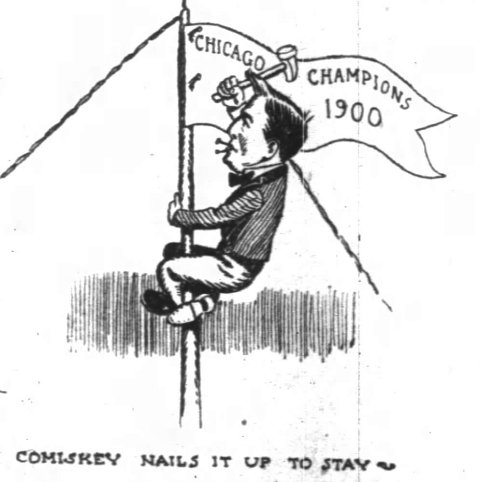
Cartoon of "pennant" being hoisted from The Chicago Tribune.

Cartoon of “pennant” being hoisted from The Chicago Tribune.

The Associated Press said the attendance was 8,000.

The Tribune said the crowd was enthusiastic despite the weather:

“There were cheers for everybody, from (William Ellsworth “Dummy’) Hoy, who couldn’t hear them, to (starting pitcher Roy) Patterson, the hero of many a hard-earned victory last year…there were flowers for (Dave) Brain, the youngest of the White Soxs [sic]…And at the end there was so much surplus exuberance that the bleacherites indulged in a merry cushion fight all through the concluding inning by way of celebration.”

Chicago scored two in the first and five in the second off Cleveland starter Bill Hoffer and cruised to an 8 to 2 victory behind Patterson.

The Inter Ocean said the most “ludicrous” play of the otherwise “uneventful” game took place in the sixth inning when Hoy attempted to steal third:

“(Catcher Bob) Wood threw wild, and (Bill) Bradley scooped up the ball way off from the cushion.  As Bradley, with no thought of the runner, turned to return the ball to the pitcher, Hoy, losing his balance as he ran, slid clear over third , out into the field and right into Bradley, his knee striking the ball clasped in Bradley’s hand.  It was possibly the first case on record of a man’s forcing a put-out on himself, and the crowd marveled greatly, perceiving that the science of the game had much advanced, and that there were new freckles every day.”

While the Chicago Orphans were losing their opening game in Cincinnati, The Tribune said the team’s president, James A. Hart, “was present and witnessed the game from a box at the south end of the grandstand.  He chatted with President Comiskey for some time and seemed to like the work of the players, but he did not voice his sentiments.”

Behind Griffith and his 24-7 record, the Sox won the league’s first pennant with an 83-53 record. Opening Day pitcher Roy Patterson was 20-15.  Cleveland finished seventh with a 54-82 record; Hoffer was 3-8 in 16 games when he was released in July, ending his major league career.

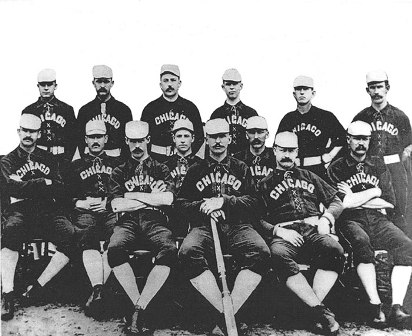
1901 Chicago White Sox

1901 Chicago White Sox

Comiskey and Hart were both members of their respective league’s “peace committee” at the January 1903 meeting in Cincinnati that led to the forging of the first National Agreement.