Tag Archives: Babe Ruth

Lost Pictures–An Off Day

10 Aug

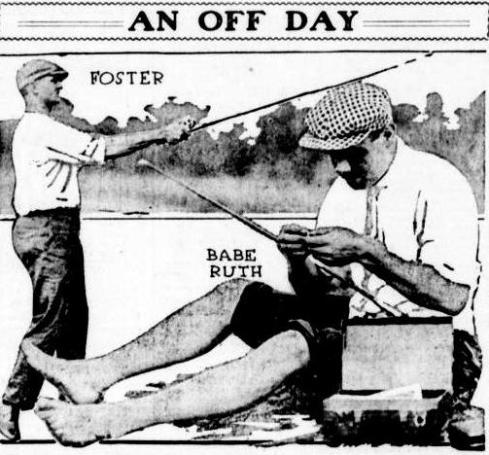
ruthfosterIn August of 1917, the Boston Red Sox were in the midst of a pennant race;  they battled the Chicago White Sox all season long and the race remained tight through August.  But there was always time for fishing, wrote Paul Purman, of The Newspaper Enterprise Association;

“An off day sounds just as good to a big league ballplayer as to anyone else, especially if the off day isn’t rainy, for on rainy days they generally have to hang around the hotel lobbies, which isn’t very good sport anytime.

“A number of the Red Sox are ardent fishermen and on off days you may usually find them at some lake pursuing the elusive bass.

“old clothes, and in some cases, almost no clothes are in order on those Izaak Walton excursionists, but the day is a big rest and the players are usually ready for a strenuous time on the ball field the next day.

“Babe Ruth is one of the club’s most enthusiastic sportsmen.  In the summer he fishes at every opportunity, although he doesn’t forget to report on the days he is to pitch as that other southpaw, Rube Waddell used to do.  Rube Foster and Harry Hooper are other members of the team who prefer fishing to other recreations.”

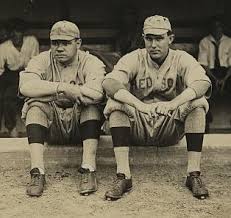
bosstaff

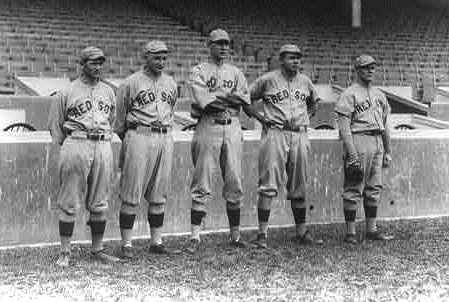
Foster, left, with Red Sox pitchers Carl Mays, Ernie Shore, Ruth, and Dutch Leonard.

The Red Sox finished in second place, nine games behind the White Sox.


Things I Learned on the Way to Looking Up Other Things: Predictions

18 May

Salaries

Ed Barrow, general manager of the New York Yankees, was sure of one thing in 1930, and according to Joe Williams of The New York Telegram, he was so sure of it his declaration “caused the window panes to shiver in the frenzy of a maddened Simoon.”

Joe Williams

Joe Williams

The Yankees had signed Babe Ruth to the largest contract ever, and Williams asked, “whether baseball would ever see another $80,000 hired hand.”

“’No, you will never hear of another ballplayer getting that kind of money,’ said the gentleman who functions as the watchdog of the treasury of the richest ballclub in the game.”

Ed Barrow

Ed Barrow

Ruth being Ruth, he said, would ensure that no player would ever be paid as much:

“’Even if another Ruth came along he wouldn’t be able to command it, because he would be just another Ruth, and that means he would not be a novelty.  He came along at a time when the receptivity of the fans welcomed a change from few-run games to batting orgies.  It was a situation into which he fitted perfectly.’

“’It isn’t possible for a similar situation to occur twice in the course of baseball.  All the great hitters in the future are going to suffer by comparison to Ruth, and this is going to operate against them as drawing cards.  Nobody prefers a copy of the original.’”

Babe Ruth

Babe Ruth

Barrow remained general manager of the Yankees until 1945, and baseball economics combined with the Depression and then a World War allowed his prediction to hold true throughout his career, but just four years later, his former club proved him wrong when Joe DiMaggio became baseball’s first $100,000 player.

Night Games

In August of 1930, Al Munro Elias, of the Elias Baseball Bureau, had some predictions about night baseball that he shared with The Brooklyn Eagle:

“’Night baseball (in the minor leagues) is succeeding now because it is a novelty.  It will prosper as long as the novelty lasts, that is if the novelty doesn’t last too long.  If it does, I fear there won’t be enough players to satisfy the customers’ desires.  Make no mistake about it, the night game is hard on the players.  The pitchers especially are going to feel the difference.  The old throwing arms need the hot sun.  Legs of all players’ need the sun…Night baseball isn’t real baseball.  Real baseball needs the sun and plenty of it.”

Al Munro Elias

Al Munro Elias

His brother, and partner, Walter B. Elias, who had yet to see a night game, had another concern:

“Now it’s a novelty and the fans flock to it…Night games can’t begin until 8 o’clock or so, and now while it is a novelty the men come to it, but wait until you hear the holler that the missus will put up when her husband stays out several nights to go to the ball game.”

Five years later the novelty expanded to the major leagues.

Things I Learned on the Way to Looking Up Other Things #17

10 Feb

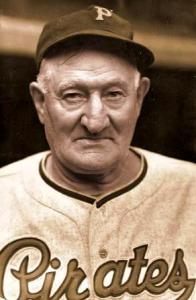
Honus Wagner on Integration, 1939

As part of a series of articles on the long overdue need to integrate major league baseball, Wendell Smith of The Pittsburgh Courier interviewed many of baseball’s biggest names.  One of the most vocal proponents was Honus Wagner.

Wagner

Wagner

The then 65-year-old Pittsburgh Pirates coach told Smith:

“Most of the great Negro players I played against have passed on, but I remember many of them well.

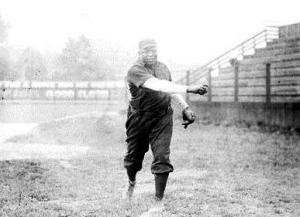
Rube Foster was one of the greatest pitchers of all time.  He was the smartest pitcher I have ever seen in all my years of baseball.

“Another great player was John Henry Lloyd.  They called him ‘The Black Wagner’ and I was always anxious to see him play.

“Well, one day I had an opportunity to go see him play.  After I saw him I felt honored that they should name such a great ballplayer after me, honored.”

Rube Foster

Rube Foster

Wagner said the “Homestead Grays had some of the best ballplayers I have ever seen.”

John Henry lloyd

John Henry lloyd

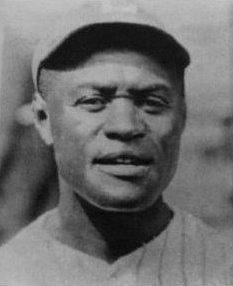
Although he misidentified one of them as “lefty,” Wagner also said of William Oscar Owens, a pitcher and outfielder for the Grays and several other clubs:

“He was a great pitcher and one of the best hitters I have ever seen.”

More recently, Wagner said Oscar CharlestonJasper “Jap” Washington, Satchel Paige and Josh Gibson “could have made the grade easily had they been accepted.”

Wagner concluded:

“Yes, down through the years, I have seen any number of Negro players who should have been in big league baseball.”


Uniform Criticism, 1923

The Decatur (IL) Herald found the state of baseball uniforms worthy of an editorial in March of 1923:

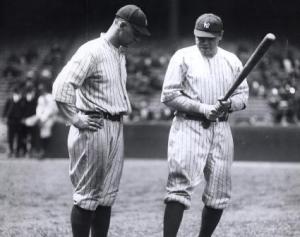
“Pictures of baseball players in training reveal that the season of 1923 has brought no marked change in the style of uniform.  It is quite as baggy and unbecoming as ever.

“Baseball players refer to their costumes as ‘monkey suits,’ a term that is supposed to establish some sort of connection with the cut of the affairs worn by the little animals that pick up the organ grinder’s pennies.  However, that may be, no sensible man imagines that his uniform accentuates his good looks.  It is purely a utility costume and smartness has no place in it.”

ruthandgehrig

Lou Gehrig and Babe Ruth in their “baggy and unbecoming” 1923 uniforms


The paper was most concerned about the uniform’s tendency to make players look foolish and appear to be out of shape:

“A collarless blouse with an awkward length sleeve bags at the belt in a way to emphasize abdominal prominence instead of athletic trimness about the loins.  Loose knickerbockers gathered at the knee resemble the khaki uniforms of the Spanish-American War period in their voluminousness and wrinkles…A cap fitting close about the head and bringing ears into striking relief is the climatic feature of this make-up.

“Underneath this covering of dirty gray or brown there are doubtless lithe limbs and well developed muscles, but the spectator doesn’t see them.  The baseball costume doubtless serves its purpose, it fails lamentably to make the wearer look like an athlete.”

No Women Allowed, 1912

Coming out of the 1912 winter meetings in Chicago, The New York Globe said:

“Nothing doing for suffragettes in the American League!  Not even if they march to the meeting.  They may be making great progress in their cause, but there will not be any Mrs. Brittons in the Ban Johnson organization.”

“Mrs. Britton” was Helene Hathaway Britton, who became owner of the St. Louis Cardinals after the death of her uncle Stanley Robison.

Helene Hathaway Britton with children Marie and Frank

Helene Hathaway Britton with children Marie and Frank

 “A decision was reached that no woman can own a club or even attend an American League meeting.  According to the owners it was a good decision, as they did not want to get into the same mess of trouble which the National League has encountered since one of its clubs fell into the hands of a woman.  Which shows the American League is constantly being benefitted by the experience of the National.”

The “trouble” referred to tension between Britton and Manager Roger Bresnahan, who she had given a five-year contract before the 1912 season.  The two feuded after the team struggled and Britton rejected numerous overtures from Bresnahan to buy the team.  She eventually fired the manager and a very public battle ensued.  Sinister “Dick” Kinsella, who along with Bill Armour comprised the Cardinals’ scouting staff, resigned claiming Bresnahan was “Not treated right.” Armour remained with the club and a settlement was finally reached when Bresnahan was named manager of the Chicago Cubs.

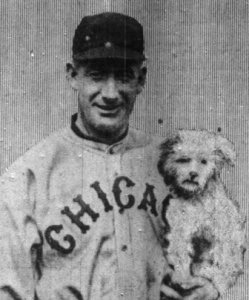
bresnahanandtoy

Bresnahan moved on to the Cubs

One American League owner told The Globe:

“I think it will benefit our league to keep the women out of baseball.  It is almost impossible to do so, but we must keep them out of baseball.  A woman owning a ballclub is about the limit, and the American League made a great move when they decided to bar female magnates.  Votes for the women may be alright, and we do not blame them for battling for them, but it would be a terrible thing to have them in baseball as owners.  It would mean the ruining of the game.”

Grace Comiskey, who became owner of the Chicago White Sox after the death of her husband John Louis Comiskey in 1939–she was forced to go to court to get control of the club from The First National Bank of Chicago; as trustees of the estate, the bank wanted to sell the team because there was no specific instruction in the will that his widow should take control.

She became the American League’s first woman owner.

The game appears not to have been “ruined” during her tenure.

Cicotte’s Knuckleball

8 Feb

With the Chicago White Sox holding onto a slim lead in the American league race, John Brinsley Sheridan of The St. Louis Globe-Democrat said they were in first place because of the pitch he called “(T)he hobo of balldom, it’s course, even when under control, being entirely beyond the influence of the pitcher, so far as the break at the plate is concerned…It is a hobo!”

The “hobo” was the knuckleball of White Sox pitcher Ed Cicotte—never mind Toad Ramsey’s claim to the pitch, Sheridan said it was all Cicotte’s:


Ed Cicotte

Ed Cicotte

“It is a freak delivery; this knuckleball, Cicotte invented it, and is its greatest exponent.  Many other pitchers have tried it, some with more or less success.  Earl Hamilton did wonderful work with it in 1912.  Then he lost control of it.  Many others tried it. They use it now and then to this day, but Cicotte is the only pitcher who admits that the knuckleball is responsible for a greater part of his success.”

Cicotte talked to Sheridan about the pitch after he threw a no-hitter against the St. Louis Browns earlier that season:

“I use it very frequently during a game, I vary pace on it, and very frequently I do not ask it to break at all.  I throw it with some rotation.  When I know a batter is going to hit—when I know and he knows that I must lay a strike over the plate—I pitch the ‘knuckle ball’ with as little rotation as possible, so that it may break as well as possible.  The different paces deceive the batter, and the break simply makes it impossible to hit safely save by the greatest fluke.

“The spitball has but one pace—fast.  The ‘fadeaway’ had but one pace—medium slow.  I can pitch the knuckleball at any pace from medium fast to dead slow.

Cicotte's grip

Cicotte’s grip

“I began using this ball when I was a kid.  It was always impossible to hit, but I found it very hard to obtain control of it. It was not until I joined Boston in 1908 that I began to get control of the ‘knuckle ball.’  Even then it evaded me for months at a time.  When I got it going right I was hard to beat.  Even now I often lose control of it.”

Cicotte, who would end 1917 with a league-leading 28 wins and 1.53 ERA, claimed his weight was a factor in his control of the pitch:

“I joined Chicago in 1912 and began to do better with the difficult delivery.  I had trouble, however, with my general control.  I had been a slim kid, but I was growing fat.  I weighed 135 when I had my first engagement with the Sault Ste. Marie team, way back in 1903.  I weighed 190 pounds in 1912.  Since that time I have tried to keep it down to 170 pounds, but I find it hard to do so.

“This year I made a special effort to reduce my weight.  I am down to 170 pounds, lighter than I have been in 10 seasons; I find that my control is better than it has ever been.  To this I attribute my early success this season.  You see, when I am fat I can’t get my arm to follow through with my pitch.  My upper arm hits my right breast and won’t go any farther.  Thus, I have been pitching with a short, jerky motion, which is not good for control.”

After an injury-plagued season and 12-19 record in 1918, Cicotte was 50-17 during the regular season in 1919-‘20 before his banishment.   Just two months before his final professional game he shut down Babe Ruth (0-3 with a walk) in front of an overflow crowd of 45,000 in Comiskey Park on August 1.  The crowd said Sy Sanborn of The Chicago Tribune “Left Comiskey Park disappointed because Babe Ruth did not get a home run.”

One of Cicotte’s last great moments with his famous pitch was captured by a Chicago photographer; Ruth looking back at the ball in the catcher Ray Schalk’s mitt, after striking out in the second inning of that game.

Cicotte strikes out Ruth

Cicotte strikes out Ruth

Lost Advertisements-1922 World Series, Lord and Taylor

13 Nov

1922ws

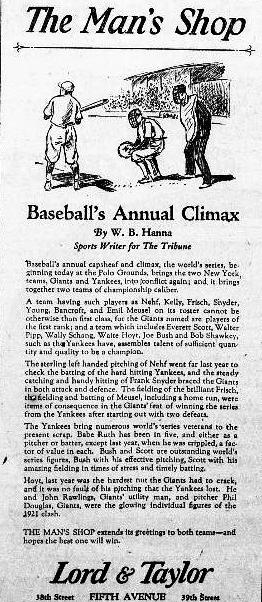
An October 1922 Advertisement for The Men’s Shop at Lord & Taylor.  The ad featured a preview of the World Series–a rematch of the 1921 series–written by William Blythe Hanna of The New York Tribune:

William Blythe Hanna

William Blythe Hanna

“Baseball’s annual capsheaf and climax, the world’s series, beginning today at the Polo Grounds, brings the two New York teams, Giants and Yankees, into conflict again; and it brings together two teams of championship caliber.

“A team having such players and (Art) Nehf, (George “High Pockets”) Kelly, (Frankie) Frisch, (Frank) Snyder, Young (Dave) Bancroft, and Emil (“Irish”) Meusel on its roster cannot be otherwise than first class, for the Giants named are players of the first rank; and a team which includes Everett Scott, Walter Pipp, Wally Schang, Waite Hoyt, Joe Bush and Bob Shawkey, such as the Yankees have, assembles talent of sufficient quantity and quality to be a champion.

“The sterling left-handed pitching of Nehf went far last year to check the hard-hitting Yankees, and the steady catching and handy hitting of Frank Snyder braced the Giants in both attack and defense.  The fielding of the brilliant Frisch, the fielding and batting of Meusel, including a home run, were items of consequence in the Giants’ feat of winning the series from the Yankees after starting out with two defeats.

“The Yankees bring numerous world’s series veterans to the present scrap.  Babe Ruth has been in five, and either as a pitcher or a batter, except last year when he was crippled, a factor of value in each.  Bush and Scott are outstanding world’s series figures, Bush with his effective pitching, Scott with his amazing fielding in times of stress and timely batting.

“Hoyt, last year was the hardest nut the Giants had to crack, and it was no fault of his pitching that the Yankees lost.  He and John Rawlings, Giants’ utility man, and pitcher Phil Douglas, Giants, were the glowing individual figures of the 1921 clash.

“The Man’s Shop extends its greetings to both teams–and hopes the best one will win.”

The Giants repeated, beating the Yankees four games to one–there was also a controversial tie in game 2.

22giants

The Giants

Lost Advertisements–PM Whiskey, “Rube Waddell, The One-Man Ball Team”

2 Oct

waddellad

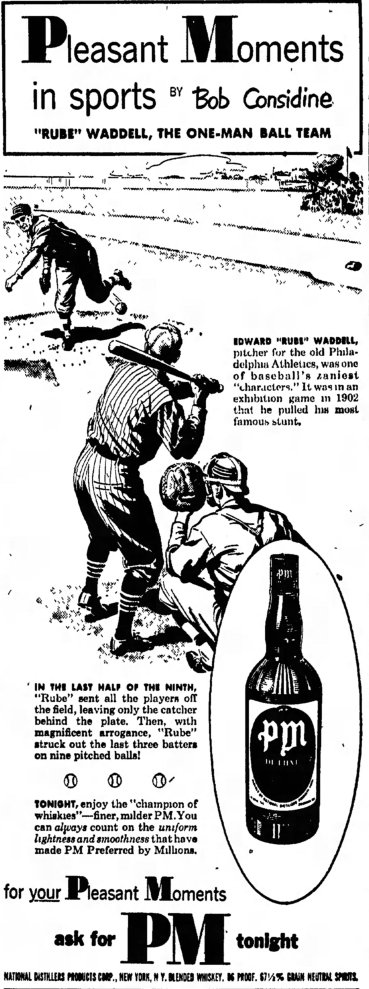
A 1951 advertisement for PM De Luxe Blended Whiskey–part of a series of ads featuring “Pleasant Moments in Sports,” stories from Bob Considine, co-author with Babe Ruth of the “The Babe Ruth Story.”

This one features an oft-told Rube Waddell legend:

“Edward ‘Rube’ Waddell, pitcher for the old Philadelphia Athletics, was one of baseball’s zaniest ‘characters.’  It was in an exhibition game in 1902 that he pulled his most famous stunt.

“In the last half of the ninth, ‘Rube’ sent all his players off the field, leaving only the catcher behind the plate. Then with magnificent arrogance, ‘Rube’ struck out the last three batters on  nine pitched balls.”

As with all Waddell stories, there was some truth and a good deal of embellishment in Considine’s account.  While the contemporary coverage of the game differs on some aspects of the performance, they all agree that Waddell pitched to just one batter after members of the team left the field in the ninth inning.

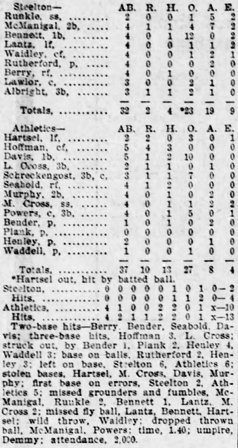
The game in question was played in 1903 at Steelton, Pennsylvania against that town’s YMCA team. The Athletics won easily, 10 to 2, and Waddell pitched the eighth and ninth innings for Philadelphia.

The Philadelphia Inquirer said:

“Waddell was the entertaining feature of the match, and in the last inning called in all the infielders after two men were out.”

The Harrisburg Daily Independent, which provided more in-depth coverage of the game, said:

“Rube Waddell was in all his glory at Steelton yesterday and his funny antics before and during the game were well worth the price of admission.”

The paper said before the game Waddell entertained the fans chasing “flies in the hills until he was perspiring,” and spent part of the early innings taking a “nap in his private carriage which carried him from (Harrisburg) to Steelton.”

rube

Waddell

As for his time on the mound, the paper said Waddell struck out the first two batters he faced in the eighth, then after getting two strikes on the third batter, named “Irish” McManigal:

“(W)hen he pitched the third ball (he) remarked, ‘Take your seat.’ ‘Irish,’ however, surprised the Rube and rapped out a pretty single to center field.”

Waddell gave up another hit in the eighth and the YMCA scored a run.

“The next inning Rutherford hit to Waddell and the Rube did a cake walk to first base to catch Rutherford.  Berry then hit to Monte Cross, but he threw wild to first and Berry reached third base.  Then the Reuben settled down and struck Lawlor out.”

The Daily Independent said Waddell did not call in the fielders, but instead, on their own:

“The Athletic players behind Waddell left the field and with a man on third base he and (Ossee) Schreck (Schrecongost) were left to put out the side.

“The Rube did not know his teammates had deserted him and when told to look around by Schreck he discovered the fact.  Then to make more complete the comedy Schreckengost [sic] sat down and the Rube struck out Albright while the crowd howled with merriment.”

The Harrisburg Telegraph provided a third set of contemporaneous “facts:”

“In the last inning when two men were out all the Athletics left the field except Waddell, Powers and L. Cross.”

The paper likely misidentified Schrecongost as Michael “Doc” Powers–Schrecongost had replaced him behind the plate in the eighth, and Lave Cross had already left the game–so the player who stayed on the field might have been shortstop Monte Cross.  The Telegraph also added another detail missing in the other reports:

“(Waddell) gave the batter three balls and the crowd was wild, but their last hope faded rapidly away as Rube put three fine ones over the plate and the striker was out.”

The Box Score

The Box Score

Considine likely cribbed his version from Harry Grayson, the sports editor of The Newspaper Enterprise Association syndicate.  Grayson told the three-batters-nine-pitches story several times throughout the forties, and that legend stuck.


Lost Advertisements–“162,859 Excited Fans”

7 Sep

mecca

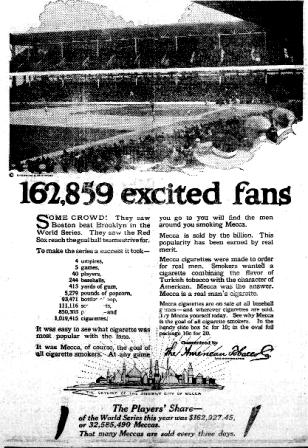
An advertisement for Mecca Cigarettes that appeared shortly after the 1916 World Series:

162,859 Excited Fans

“Some Crowd!  They saw Boston beat Brooklyn in the World Series.  They saw the Red Sox reach the goal ball teams strive for.”

The Red Sox won the series 4 games to 1–Babe Ruth won one, a 14-inning complete game, and Ernie Shore won two, the first and fifth games.

Babe Ruth and Ernie Shore

          Babe Ruth and Ernie Shore

“To make the series a success it took–

4 umpires,

5 games,

40 players

244 baseball,

413 yards of gum,

5,279 pounds of popcorn,

93,471 bottles of pop,

111,116 score cards,

850,303 peanuts–and

1,019,415 cigarettes…

The Players’ Share–of the World Series this year was $162,927.45, or 32,585,490 Meccas.

That many Meccas are sold every three days.”

Winners shares for the Red Sox were $3,910.26, the Robins losing shares were $2,834.82.

Lost Advertisements–“Babe Ruth Home Runs”

4 Sep

ruthbbs

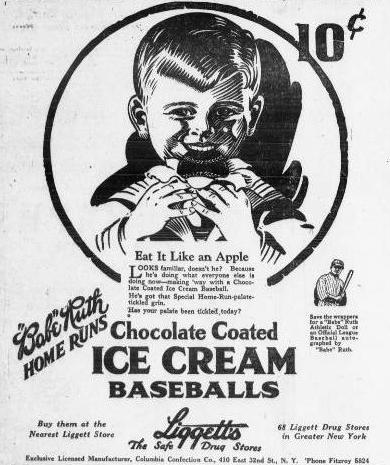
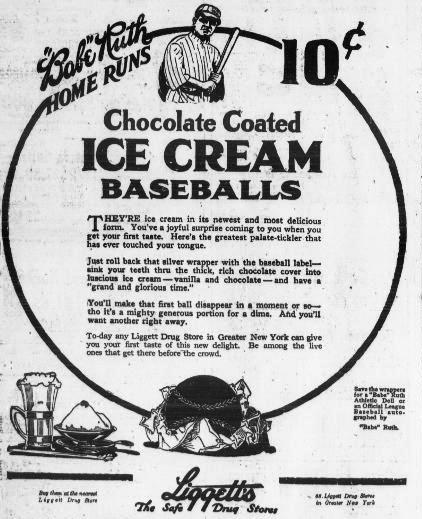
By 1922, Babe Ruth‘s name and image were used to sell dozens of products.  The above ad was for “Babe Ruth Home Runes Chocolate Covered Ice Baseballs.,” with the suggestion to “Eat it like an apple.”

“Save the wrappers for a ‘Babe’ Ruth Athletic Doll or an Official League Baseball autographed by ‘Babe’ Ruth.”

The ice cream was available at 68 New York area Liggett’s, “The Safe Drug Stores,” locations.

Below, is a second “Home Runs” ad featuring Ruth:

babeic


“Demmitt!!”

20 Jul

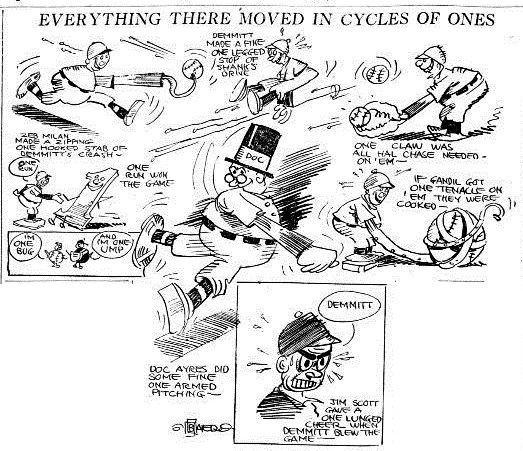
Arthur “Bugs” Baer was a humorist and sportswriter—widely credited with coining the nickname “Sultan of Swat” for Babe Ruth—who often included his own cartoons with his articles.

Baer worked for The Philadelphia Public Ledger, The Washington Times, and William Randolph Heart’s King Features Syndicate, before moving to Hollywood where he wrote several film scripts, including the titles for “Headin’ Home,” the first movie Babe Ruth appeared in.

An example of Baer’s newspaper work; after a May 1914, 1-0 Washington Senators victory over the Chicago White Sox in 10 innings–Sox pitcher Jim Scott took a no-hitter into the 10th before allowing a single to Chick Gandil:

“Demmitt!!

“That’s the word.

“Oh! No!  We don’t mean what you mean.  (Ray) Demmitt is the right fielder on the Chicago White Sox, although we admit that it sounds as if he wasn’t.  He is the lad who made a brilliant one-legged stop of (Howie) Shanks’ drive in the tenth yesterday, allowing the ball to bruise our perfectly good right field wall and Jim Scott’s heart at the same time.  He came racing to snag the ball just like one of these pictures you see in the “Police Gazette.”  Just like a regular ball player, same as they have in big cities.  You’ve heard about those kind.

Demmitt!!

Demmitt!!

[…]

“The old pill went through him just like the Congressional Limited goes through Elkton, Maryland.  And Chick Gandil flat wheeled around the bases same as the Fourteenth Street car does around Thomas Circle…What we wanted to ask is did you notice how everything moved in cycles of one?

“One run won the game.  Demmitt’s one-legged stop allowed that one run to score and win one ballgame.  (Clyde) Zeb Milan (who made a bare handed stab of Demmitt’s sixth-inning single, and caught threw him out attempting to stretch it to a double) one-hooked stab saved the bacon, and Gandil’s one tentacled clutches chopped off many an error.

Hal Chase’s one-clawed catches of wide throws kept the Sox in the running and (Yancey) Doc Ayers’ great one-armed pitching put them out of it.  In fact, everybody acted as if they only had one arm.

Tommy Connolly did some fine one-cylindered umpiring.

“And Jim Scott gave a one-lunged cheer when Demmitt—there goes that word again—blew the game.”

Baer's cartoon that accompanied the article

The Baer cartoon that accompanied the article

“The Aristocrat of all Mascots”

1 Jul

Shortly after the 1920 World Series, The Associated Press (AP) claimed to have discovered why the Brooklyn Robins, after taking two out of three games from the Indians at home, dropped four straight in Cleveland:

“At last the secret…is out.  The Dodgers declined to take their mascot, Eddie Bennett, with them to the lair of the Indians, and without his lucky presence they were swamped.  And not only that.  Bennett, indignant over having been left at home, has quit the Brooklyns!  That’s revenge!”

The Brooklyn Daily Eagle said, Bennett, a Brooklyn native, came to the attention of baseball fans in 1919 when he served as bat boy and mascot for the American League Champion Chicago White Sox:

“(H)e used to hang around the players’ entrance to the ballparks on both sides of the bridge.  The Yankees were playing at the Polo Grounds then, and one day one of the White Sox noticed a wistful little fellow in the front row of hero worshippers.”
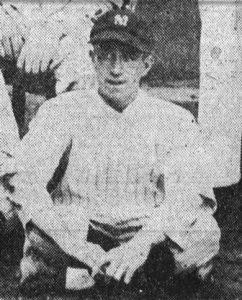
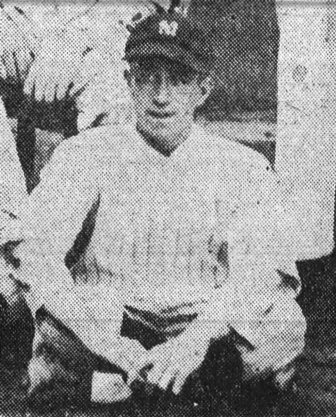
Eddie Bennett

Eddie Bennett

White Sox outfielder Oscar “Happy” Felsch, noticed Bennett suffered from kyphosis (the excessive curvature of the spine—in Bennett’s case it was said to have been caused by an injury when he fell out of his stroller as an infant) and asked “’Are you lucky?’ ‘Sure,’ cried Eddie Bennett eagerly.”  With Bennett serving as bat boy, the Sox defeated the Yankees.  With that:

“Felsch spoke to Eddie Cicotte about taking him back to Chicago. Cicotte spoke to Manager (William) Kid Gleason.  Eddie Bennett became the official White Sox mascot.”

Bennett spent the rest of the season with the Sox and roomed with pitcher Dickie Kerr on the road. After the Black Sox scandal broke—Bennett told reporters, “I was one of the honest ones”—the 16-year-old returned to New York and went to work for the Robins.

Dean Snyder, writing for Scripps’ Newspaper Enterprise Association, said of Bennett during Brooklyn’s pennant run:

“(The Robins) bought the kid a swell uniform and told him to hang around.

“From the day he started as the official mascot…things began to look up.”

But, Snyder noted, Bennett was strictly a mascot and not a bat boy in Brooklyn:

“Little Eddie is a hunchback. The players positively forbid him to touch their bats.  They just want him to stick around. They’re might superstitious about their war clubs.”

After being left home by the Robins for the club’s ill-fated trip to Cleveland, Bennett jumped to the Yankees; he told The AP:

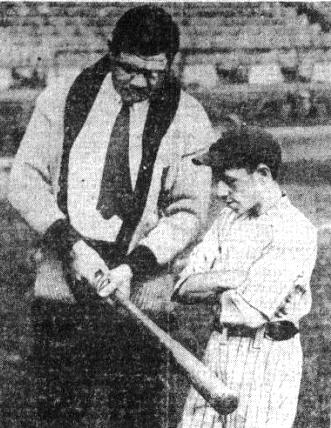
“I’m going to be with a real club this year.  Oh boy, to watch that (Babe) Ruth sock them every day.”
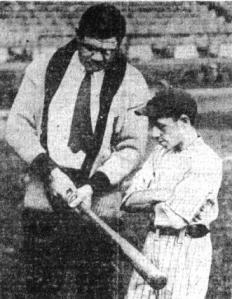
Bennett with Ruth

Bennett with Ruth

For the third straight season, Bennett was part of a pennant winner, and for the third straight year his team lost the World Series.  But this time he stayed put and remained a fixture with the Yankees for another decade.

American League Umpire Billy Evans, in one of his syndicated columns, said Bennett took his position very seriously and related a story about seeing him in a restaurant during a Yankee losing streak:

“Bennett was seated across from me at a table in the diner. We were served at about the same time, and I noticed he ate but little of the food he had ordered.

“’Something wrong with the food Eddie?’ I ventured.

“’The food is all right, I guess there is something wrong with me,’ replied Eddie.

“’Cheer up, Eddie.  The Yankees can’t lose all of them,’ I said with a laugh.

“’Babe hasn’t made a home run in a week.  The team never gets any runs for Bob Shawkey.  Every time Scotty (shortstop Everett Scott) makes an error it means a run.  Waite Hoyt has a bad inning every game,’ was Eddie’s come back.

“’Why worry about these things, Eddie?’ The Yankee mascot looked at me in a puzzled manner, as if I might be joshing him.

“’That’s my business, I’m a mascot,’ said Eddie in all seriousness.  ‘I am supposed to bring luck, to help Ruth make home runs, keep Scotty from making errors, have the team get runs for Shawkey, and no bad innings for Hoyt.’

“Eddie was disgusted at my failure to appreciate the importance of his position.”

In 1928, The Brooklyn Daily Eagle called Bennett “(T)he aristocrat of all mascots…eight flags in 10 years is the mark for other mascots, living and still to be born to try to equal.  It will probably never be beaten.”

Bennett’s career came to an end in May of 1932; according to The United Press (UP) he was riding in a cab which crashed and “was pinned to a pole,” Bennett suffered several broken bones, including a leg broken in several places, and spent months in the hospital. (The AP said he was hit by the cab while walking).

He made a brief, dramatic return to the Yankees a year later.

On May 23, 1933, Bennett entered the Yankees clubhouse on crutches in the midst of what The International News Service called “The great home run famine.”  Neither Babe Ruth nor Lou Gehrig had hit one since April 30:

“It was the longest home run slump for the twins since they started making life miserable for American League pitchers.  For weeks they rubbed their carcasses and bats with sundry kinds of magic oils and rabbit’s feet, consulted Yogi’s and employed every luck charm known to the superstitious in an effort to shake off the jinx.  It took Eddie Bennett, the little cripple who formerly was the club’s bat boy, to shatter the jinx.  Before yesterday’s game he solemnly tapped both sluggers with his magic crutch and that turned the trick.”
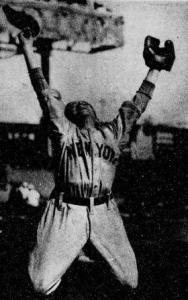
Eddie Bennett

Eddie Bennett

Both Ruth and Gehrig hit home runs off Oral Hildebrand (who came into the game with a 6-0 record) in an 8 to 6 victory over the Cleveland Indians.

It was a final happy moment for Bennett.

While he continued to be paid by Yankees owner Jacob Rupert, depression and alcoholism consumed the last years of his life.  The 31-year-old, “aristocrat of all mascots,” was found dead on January 17, 1935, according to The UP “cold and stiff in his drab rooming home…He lived out his days among his baseball trophies, drinking steadily”

Edit:  As noted in the comments, I say above that Bennett left the White Sox “when the scandal broke,”  which implies September of 1920 when the grand jury was impaneled. I should have said “when rumors of the scandal broke,” which began during the 1919 series and continued throughout the 1920 season.