Tag Archives: Baltimore Orioles

“The Best First Sacker in the Game”

27 Nov

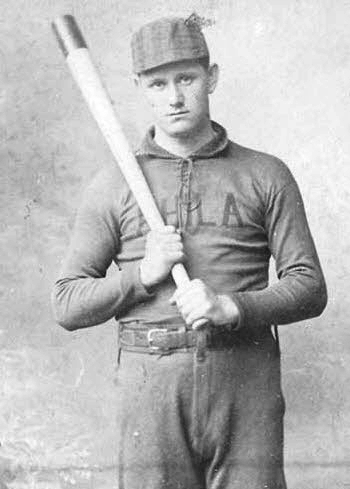
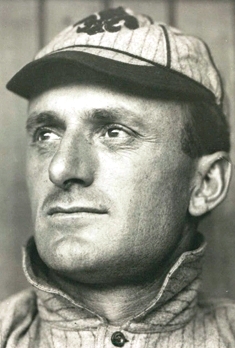
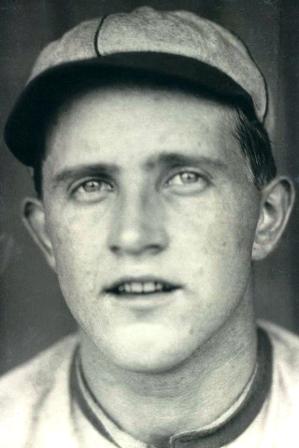
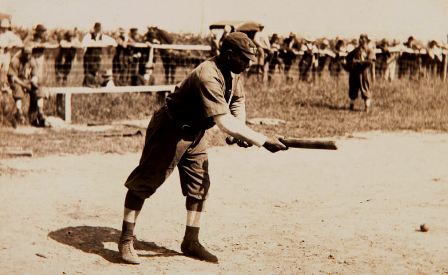
Raymond V. Wilson was one of the biggest stars of early black baseball. The Freeman said the captain and manager of the Philadelphia Giants was, at the plate, “styled the colored Hans Wagner,” and “in his heyday the best first sacker in the game.”  The paper also said he was one of the game’s best base runners:

“Ray Wilson gives no indication of speed or race, but he possesses these two qualities in a surprising degree, and his stealing is magnificent.  His strong point, however, is avoiding the man with the ball.  He has a slide which carries him outside the base and around, his spikes clinging to the base.”

Ray Wilson
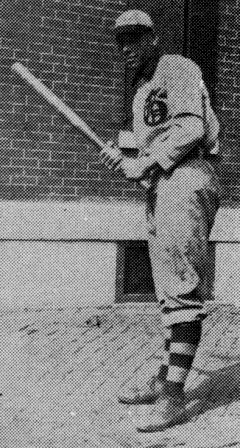
Ray Wilson

It is unclear where Wilson was born, but he lived for a time in Harrisburg, Pennsylvania before he became a member of the Cuban X-Giants in 1898.  The Harrisburg Telegraph said, the following season, in announcing that local catcher Clarence “Wax” Williams had joined the X-Giants “Ray Wilson, of this city, is playing first base on this crack team.”

The Telegraph said that Wilson played for several teams in Harrisburg, initially as a second baseman, “but his ability was soon learned and he was sent for.”

Wilson remained with the X-Giants through 1906, and then joined the Philadelphia Giants where he played for the remainder of his career.

It came to an end in the mid summer of 1910.

In a game at Bronx Oval, Wilson and the Giants were playing the Brooklyn Royal Giants.  The New York Age said Wilson was at bat, facing Brooklyn’s Harry Buckner and “was hit on the head near the temple and received a fracture which necessitated his retirement from baseball.”

By late July he began exhibiting strange behavior.

Other sources, including The Associated Press, said he received the injury earlier in his career, as a result of being “hit on the head by a swift line drive.”

The Freeman attributed some of the reason for Wilson’s becoming “somewhat demented” on his reaction to the death of his friend, Giants pitcher Sy “Bugs” Hayman, who was hit by a car on his way to a game, and died on July 4, 1910.
Bugs Hayman

Bugs Hayman

The injury, regardless of how it happened, as well as any other contributing factors, left Wilson nearly incapacitated, and he was sent to his mother’s home in Pittsburgh.

Just a week after arriving in Pittsburgh, The Associated Press reported that he had disappeared:

“(H)is relatives have asked the police to find him. Warning is given by the relatives that Wilson is insane and that he may not be captured without trouble.”

According to those relatives he was suffering from hallucinations:

“One of Wilson’s hallucinations was that someone batted a ball at him and that it broke through his hand and hit his head.  On such occasions he would lie down for hours, helpless from pain from the imaginary blow.”

On the day he disappeared, Wilson “picked up a newspaper to look at the ball scores.  He saw something which stirred him, and dashed from the house shouting that his head was hurting.”

Several days later he turned up in Tyrone, Pennsylvania, more than 100 miles from Pittsburgh.  The Tyrone Daily Herald said he had been arrested by railroad police “after insisting on going on to Harrisburg without paying his fare.”  Wilson was held in the Tyrone city jail until his identity was determined.  The paper said it was unlikely he would be prosecuted because he was “temporarily deranged, this accounting for his strange actions on the train.”

He was committed to the Pennsylvania State Hospital in Harrisburg where he died in September of 1912.  Most sources give Wilson’s year of birth as 1870, which would have made him 42 years-old at the time of his death, The Harrisburg Telegraph, in their brief death notice, listed his age as 35.

There was an intriguing claim made by Wilson’s hometown newspaper during his 1910 disappearance—although it was probably a conflation of the story of Charlie Grant.   The Telegraph said:

“While (John) McGraw was manager of the Baltimore team he endeavored to get Wilson into the major league by claiming the Negro was an Indian.  The subterfuge was discovered and Wilson was forced to remain in the Negro nines.”

With statistics being incredibly scarce, it is impossible to judge just how good Wilson was.  But, 15 years after his death, George “Chappie” Johnson—who had been in the game for more than 30 years was interviewed by W. Rollo Wilson of The Pittsburgh Courier:

“You want an all-time team you say?  I’ll pick you one and will challenge anyone to name a better outfit.  On this team of my choosing will be nothing but smart men. Every one will be able to hit, to bunt, to think…Here is your team, and note that old-timers are few and far between:

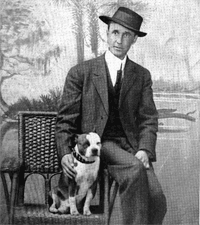
Chappie Johnson
Chappie Johnson

“Catchers (James “Biz”) Mackey, (Bruce) Petway, (George “Tubby”) Dixon; pitchers George Wilson of the Page Fence Giants, Nip Winters, Joe Williams, (Charles) Bullet Rogan;  first base, Ray Wilson of the Cuban X-Giants, second base John Henry Lloyd;  shortstop Dick Lundy;  third base Oliver Marcelle, utility, John Beckwith;  outfield Pete Hill, Oscar Charleston, Jess Barbour, (Cristobal) Torriente.”

Note:  While it seems unusual that John Henry Lloyd, almost unanimously considered the greatest shortstop in Negro League history, was placed at second, Johnson told The Courier:

“Among the men John Henry Lloyd stands out as the greatest second baseman of all time, and he is supreme at that bag yet.  Of course he made his greatest reputation as a shortstop, but I always thought second base was where he belonged.”

“I guess I am Rotten”

24 Nov

It was in doubt where Pete “The Gladiator” Browning would play in 1892.

There is no record of exactly how he parted ways with the Cincinnati Reds—Released by the Pittsburgh Pirates, Browning hit .343 for the Reds in 55 games in 1891 after signing with the club on June 29—but, by January of 1892 there were a steady stream of rumors about where he would sign.

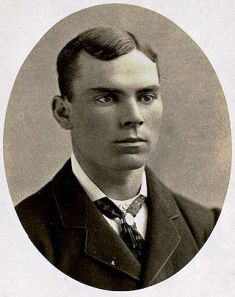
Pete Browning

Pete Browning

Speculation included the Baltimore Orioles and St. Louis Browns, but Browning opted to return home to Louisville, and signed with the Colonels—he was released again after an early spring salary dispute, but signed a new contract with the team a week into the season.

Browning returned Louisville with much fanfare.  The Courier-Journal said, after he contributed two singles and two sacrifice hits in a 7 to 2 victory over the Chicago Colts:

“Prodigal Pete…walked out—‘Prods’ do not return in carriages—to his old home in left field at Eclipse Park yesterday afternoon, where he had spent a happy, happy youth before the false adulation of the outer world called the Gladiator away.”

After am 11-3 start, the Colonels were returning to form, and were beginning to look like the ninth place team with a 63-89 record they would be at season’s end.

To make matters worse, “Prodigal Pete” struggled after his first game, hitting just .247—94 points less than his career average—in 21 games.

Browning explained his sump to Harry Weldon of The Cincinnati Enquirer:

“’I guess I am rotten. I guess I ought to be out of the business,’ said Pietro Gladiator Browning, as he walked on the field.  ‘Old Gladdy ain’t to his speed yet, but he’s hitting ‘em, and hitting ‘em good, but not as good as he will hit ‘em though, cause he’s got the catarrh, and is stopped up in the head.  When you’re stopped up your ‘lamps’ ain’t right.  Wait until the sun gets hot and the catarrh leaves the old hoss.  Then the pitchers will have to look out.  Will I lead the league in hitting?  Why not?  Look out for me.  None of ‘em are getting away from me in the outfield.  Did you read about me going up in the seats and pulling down a fly that saved the game?  I can do it right along.  None of them big stars, Jim) McAleer, Curt Welch or any of the rest of them fellows have the best of old Pete on fly balls.  The old boy is still ready money, and worth one hundred cents on the dollar.”

Within days the Colonels gave up on the Gladiator and handed him his release on May 18.

For a time Browning got his “lamps’ right again.  After signing with the Reds again, he hit .303 the rest of 1892.  He returned to Louisville in 1893 and hit .355 in part-time role.

11,297,424

12 Sep

The Chicago Tribune baseball writer Hugh Fullerton was fond of saying:

“Once upon a time there was a baseball bug down in Cincinnati who figured out there were 11,297,424 possible plays in baseball.  This, of course, was counting only straight and combination plays and taking no account of the different kinds of fly hits and grounders, which all are different.  He proved it conclusively and the next day the team made one that wasn’t on the list.

“Every play, every throw, every hit is different.  That is why baseball is the national game, and there are freaks in the game that make even the case hardened regular sit up and yelp with surprise and joy.”

Hugh Fullerton

Hugh Fullerton

Fullerton made a career of telling stories about those plays; some might have even been true.

A few more of them:

“Philadelphia lost a hard luck game to Cleveland in the old twelve club league.  The score was close, Philadelphia had two men on base, and Ed Delehanty was at bat.

“He cracked a long drive across the left field fence—a sure home run.  The ball was going over the fence high in the air, when suddenly it changed its course, dropped straight down, hit the top of the fence and bounded back into the lot.

Ed Delahanty

Ed Delahanty

“The crowd, which had given up in despair, was astonished.  The Cleveland left fielder got the ball and, by a quick throw, cut down the runner at the plate and Delehanty was held at second.  The next men went out and Philadelphia was beaten.

“Investigation after the game proved that the ball had struck a telephone wire reading to a factory just outside the grounds.”

Tom Corcoran had one of the oddest baseball experiences in the history of the National League at the old Eastern Park grounds in Brooklyn years ago, in a game against Boston.  The game was played on the morning of Labor Day, and there had been a hard rain the night before.  In the early part of the game Corcoran, going after a ground ball, felt his foot slip and his ankle turn, and, half falling, he stopped the ball and then fell.  He turned to pick up the ball to throw out his man, and saw no ball—although there was a hole six inches across, into which his foot had plunged.  The runner, reaching first, stopped and saw Corcoran with his arm plunged to the elbow in the ground, and after hesitating a moment, he ran on down to second.

Tom Corcoran

Tom Corcoran

“Corcoran, meantime, had been thinking.  His fingers were clutched around the ball, and yet he waited, pretending to be groping for the ball.  The runner started on, and as he passed, Corcoran dragged the ball out and touched him out.”

“One of the funniest plays I ever witnessed was pulled off on the old Baltimore grounds along in 1896, and it was good-natured, happy Wilbert Robinson who made the blunder that resulted in the defeat of the Orioles when they might have won the game.

Wilbert robinson

Wilbert Robinson

“The struggle was between Chicago and Baltimore and it went into extra innings.  In the eleventh, with a Chicagoan on second Doctor Jimmy McJames made a wild pitch, the ball shooting crooked and bounding around back of the visitors bench with Robby in close pursuit.  The ball rolled back of the water cask and disappeared.  Robby made one frantic grab back of the cask, and then, straightening up, hurled a sponge full of water at McJames, who was covering the plate.  The Doctor grabbed it, and as the water flew all over him he tagged Jimmy Ryan…In spite of the fact that the play beat Baltimore, the crowd yelled with delight over it, and Robby, who had made the sponge throw as a joke when he found he could not get the ball in time, appeared as much pleased as if he had won the game.”


“Go to Providence”

18 Jul

After Ned Hanlon guided the Brooklyn Superbas to horrible back-to-back seasons in 1904 and ’05 (56-97 sixth place, 48-104 eighth place) it was time for a parting of the ways between Hanlon and Brooklyn—it was announced that Hanlon had signed to manage the Cincinnati Reds in 1906.

Ned Hanlon

Ned Hanlon

During fifteen years with the franchise (eight in Baltimore, seven more in Brooklyn) Hanlon led them to five pennants and three second-place finishes, and according to The Brooklyn Eagle his departure “caused no end of regret among the wide circle of friends he had gained during his seven years stay here as head of the Superbas.”

But, the paper said, one man “learned of the change with greater dismay than anybody else.”  John Montgomery Ward, the former player, manager and leader of the Brotherhood was, by then, a successful Brooklyn attorney.

Ward and Hanlon were long-time friends and Hanlon had been an active member of the Brotherhood, but Ward said, more than that, he “owed my start as a successful ballplayer,” to Hanlon.

John Montgomery Ward

John Montgomery Ward

“I had begun my career as a professional that year with the Binghamtons, but along about June the club disbanded.  I received offers from Rochester and Providence to finish the season in the box. For I was pitching in those days, and went to Rochester to look over the field.  I was a boy of eighteen then, and inexperienced, and I was taken aback when the manager and players clamored for me to sign immediately.  Hanlon was captain of the team and he joined in the request for me to sign.  I asked them to give me a little time to think it over and went back to the hotel for that purpose.  Hanlon, and a well-known player of those days, Ed Caskin, followed me there, and continued their importunities.

“’I told them that it was my first year in the game, and then turning to Hanlon said ‘Mr. Hanlon, put yourself in my place and tell me what to do.  Advise me just as if you were speaking to a brother.’

“’Hanlon flushed up, looked at the floor, then at Caskin.  Then he turned to me.’

“’Go to Providence.’ He said.  Caskin coincided, and I took my bag and went to Cincinnati where the Grays were playing.  I made good with them (22-13 1.51 ERA) and gained fully five years of my career because of the sacrifice of Hanlon, who wanted me in Rochester.  We’ve been firm fiends ever since, the bonds being strengthened during his stay here.  I’m sorry he has gone, but I am confident he will have better success with the Reds.”

Despite Ward’s confidence, Hanlon was only slightly more successful with the Reds in 1906 and ’07 than he had been during his final two seasons in Brooklyn–64-87, 66-87, sixth place finishes.

“What Right has Hanlon to Show me How to Hit?”

23 Jun

How are hitters created?  Bozeman Bulger of The New York Evening World attempted to answer the question, and described the hitting styles of some of the game’s biggest stars in 1906:

“Batting is a natural gift and to be a success the player must be allowed to swing the willow in his own sweet way.”

Bulger said John McGraw who “For nine years…had a batting average of .330” (actually .346 from 1893 to 1901) was asked his secret:

“Don’t know, I simply used my eye and my arms and figured it out.”

When McGraw played for the Baltimore Orioles, Manager Ned Hanlon tried to show him “how to hit (and) on one occasion he corrected him sharply.”  McGraw said:

“That set me to thinking, and I went to my room and dug up a lot of old records.  In these I saw that Hanlon had never hit as good as .300, that is for a period of two or three seasons (Hanlon hit .302 in 1885) while I had been hitting over .300 right along.  Therefore, I asked myself ‘what right has Hanlon to show me how to hit?’”

Ned Hanlon

Ned Hanlon

Bulger said

“In the past few years Yale and Harvard and Princeton and other colleges have employed coaches to teach them how to hit.  The experiment was futile, and no hitters were developed that did not already possess the gift.

“Take the great batters of to-day and you will find that no two of them stand at the plate alike.  Long since astute managers have found that it is a useless waste of time to attempt a correction of habits easily acquired.  To be successful a ball player must do everything in a perfectly natural manner.  This is paramount in batting.”

Bulger then wrote about the “peculiarities” of some contemporary hitters:

Sam Mertes of the Giants invariably pulls his left foot back as he swings at the ball.  Mertes also crouches with somewhat of a forward lean and keeps his feet wide apart.

Roger Bresnahan and Mike Donlin, two of the greatest hitters in the world, are what are called vicious swingers.  Bresnahan has absolutely no fear.  He never thinks of being hit, but runs squarely into the ball, and when he plants his bat squarely against it a scorching line drive follows.  Nobody hits a ball with more force than Bresnahan.

“Donlin stands with his feet about one foot apart and usually holds the bat perfectly rigid at his waist, slanting at an angle of about 45 degrees.  He can either ‘chop’ or swing hard with the same degree of accuracy.  Donlin is said to be the greatest natural hitter in the business.  He says he has no idea how he does it.

George Stone, one of the most remarkable batters of the age, has a (boxer Jim) Jeffries  crouch at bat which has caused experienced baseball managers to say George wouldn’t last as soon as the pitchers got next to him.  Stone puts a terrific amount of weight into one of his blows, swinging with his shoulders and smashing a line with fearful force.

George Stone

George Stone

“His position has been termed awkward, inelegant, and not conducive to good hitting, but Stone to-day leads the American League with a better average than the great (Napoleon) Lajoie.

“Larry is the personification of grace and elegance at bat.  He has that careless indifferent method which attracts, is devoid of nervousness but active and alert.  Infielders will tell you that there is a force in the balls smashed by Lajoie which makes them unpleasant to handle.  Lajoie is the finished artist.

“His great rival in the National League Honus Wagner is just the opposite.  Hans grabs his stick at the end, holds it high about his shoulders, and when he swings his legs are spread from one end of the batter’s box to the other.  Wagner is awkward standing almost straight and goes after outcurves and drops with equal avidity.  Hans often reaches to the far outside of the plate for a low outcurve and plants it into right center field.

Charlie Hickman stands at the outer edge of the box and swings with his body and shoulders His fondness for the balls on the outside of the pan are known to opposing pitchers.  Lave Cross puts his two feet into the angle of the batter’s box nearest the catcher, while (Dave) Altizer usually spreads out, varying this position with a crouching posture, from which he runs up on a ball.”

Tragic Exits

28 Apr

George Frazee

George Donald Frazee, listed on Baseball Reference as “G. Frazee” with the Shreveport Sports in the Texas League in 1928, was a three-sport star at Texas Christian University.

Born November 21, 1904 in Fort Worth, Texas, Frazee played outfield for the baseball team, halfback and fullback with the football team, and was a guard on the basketball team from 1923-1925.  After graduation he played basketball with a team representing the Fort Worth, Texas YMCA which played throughout the Southwest and Mexico.

It’s unclear where Frazee played baseball in 1926 and ’27, but in 1928 he started the season with the San Angelo Red Snappers in the West Texas League, there are no surviving statistics for his time there, but after being transferred to Shreveport he hit .301 in 32 games. Frazee signed with Shreveport for the following season.

On January 24, 1929 Frazee was flying from Ft. Worth with World War I flyer Willoughby Alvous “Al” Henley and another Fort Worth man, to attend the opening celebration for San Angelo’s new airport.  The United Press wire story said:

 “Tragedy marred the formal opening of the municipal airport today, claiming the life of Al Henley…one of the nation’s most skilled pilots.  Henley, Donald Frazee, professional baseball player, and W.E. Shytles…were killed when their cabin monoplane crashed in an attempted landing.”

The Brownsville Herald said:

 “He was an outfielder, fast, big and aggressive.  Shreveport lost an outfielder who was certain to make good this year.”


Chief Wano

William “Chief” Wano was born on Oklahoma’s Pottawatomie reservation on May 12, 1896.  He played semi-pro ball in Oklahoma City and in the army while serving with the 79th Infantry, 15th Division at Camp Logan, Texas.  After his discharge in early 1919 the twenty-three-year-old began his professional career with the Tulsa Oilers in the Western League.

Wano struggled during his first season, hitting just .195, but joined the Little Rock Travelers in the Southern Association the following season—and along with fellow Oklahoman, and former classmate and teammate at the Chilocco Indian School– Moses “Chief” Yellow Horse; he helped lead Little Rock to the pennant.

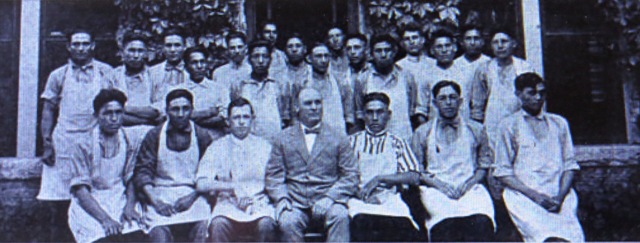
William Wano,

William Wano, back, fourth from right, at Chilocco Indian School

Wano was a consistent hitter throughout the 1920s (.317 in 11 seasons in class-A leagues), but was an erratic fielder and never made it to the major leagues.

After hitting .331 for the St. Joseph Saints in the Western League in 1930 Wano left organized baseball, first playing semi-pro then he accepted a position managing Ben Harjo’s All-Indian Baseball Club—Harjo was a millionaire and full-blooded Creek.   The team, based in Harjo’s hometown Holdenville, Oklahoma, barnstormed the Midwest and Southwest, and with Wano as player-manager won the Denver Post Tournament in July 1932.

Chief Wano

Chief Wano

Wano quit two months later after a dispute over two players Wano signed.  Harjo hired Jim Thorpe to manage the club the following season.

Wano moved to Dallas after his career.  According to The United Press he spent World War II working at the North American Aircraft plant in Dallas, and living at the home of Kal Hill Segrist Sr., his former Dallas Steers teammate (and father of Kal Segrist, who played with the New York Yankees in 1952 and the Baltimore Orioles in 1955).

On July 30, 1945 Wano was in the Dallas City Jail (reports varied on why he was there), when according to The Dallas Times-Herald another prisoner “slugged Wano on the chin, Wano fell, striking his head on the concrete floor.”  Other reports said Wano was trying to break up a fight when he was hit.

William “Chief” Wano died that night in Dallas’ Parkland Hospital.  A month later a grand jury chose not to indict the man who threw the punch.


Gene Gaffney

Eugene “Gene” Gaffney was one of the better hitters in the Florida State League during his brief career (1920-23), he was also a manager’s nightmare.

Gaffney hit .335 in 60 games for the league champion Orlando Tigers in 1921, but was suspended for several days in July by Manager Joe Tinker.

The following season he joined the Jacksonville Indians, managed by former major leaguer George Stovall.  The team struggled, and Gaffney, had his only sub .300 season, hitting just .277.  And, according to The St. Petersburg Evening Independent, a car caused a major riff between the outfielder and his manager:

“Has a baseball player a right to ride to and from the park in his own automobile?  George Stovall says no.  He suspended Gene Gaffney because Gaffney had bought an automobile and insisted on being his own bus.

“Stovall insisted he should parade to the park in the team bus.  Gaffney told Stovall to go jump; that if the team would win enough games so that he wouldn’t be ashamed to wear the uniform on parade it might be different.  At last accounts Gaffney was off the ballclub, but riding his automobile to his own intents and purposes, while Stovall still was trying to get the rest of the Jacksonville team somewhere on the field.”

Gaffney played just one more season; he hit .357 for the Daytona Beach Islanders in 1923.

After baseball, Gaffney tended bar in Orlando until August 12, 1937—The Associated Press said:

“Gene Gaffney, about 43, local bartender who once led the old Florida State League in batting, was believed today to have been the victim of foul play.

“His automobile, its windshield shattered and other windows broken, was found mired in mud on the shores of an almost inaccessible lake just across the Orange County line in Seminole County, with evidence of a struggle having taken place.

“His eye glasses were found in the mud about 20 feet from the car.”

Gaffney’s body was found the following day.  His death was ruled a homicide.

“This whole Trouble, Disgraceful to be sure, may be Blamed directly on Jack Sheridan”

14 Mar

On April 7, 1901, The San Francisco Call reported that John F. “Jack” Sheridan had accepted an offer from President Ban Johnson to continue working as an umpire in the American League—which operated as a minor league the previous season.  The paper said “The National League also made a bid for his services.  He will receive $400 a month and expenses.”  It was said to be “the largest salary ever paid to an umpire.”

Sheridan was a former player, a second baseman and outfielder, who played for several San Francisco teams in the California League, including stints with the Haverlys from 1883-85.  He went East in 1885 and appeared in six games for the Chattanooga Lookouts in the Southern league, and that same season began working as an umpire.

sheridanpix

Jack Sheridan

Years later, Mique Fisher, long-time California and Pacific Coast League manager and executive told The (Spokane) Spokesman-Review that Sheridan was signed by the Lookouts after he “sold himself to Chattanooga through a glowing personal description of his own ability,” but Fisher said:

 “Sheridan couldn’t field a ball with a fish net or hit one with a tennis racket.  When the Chattanooga manager saw Sheridan in action, he swore out a warrant charging him with obtaining money fraudulently.  Sheridan had to work out the expense advance in a cigarette factory.”

He worked as an umpire in the Southern League (1885, ‘93), the California League (1886-89, ’91), the Players League (1890), the National League (1892, ’96-97), and the Western/American League (1894-95, 1898-1900).

The best-paid umpire in the game, who was also a San Jose undertaker during the off-season, traveled from his California home to Chicago in early April of 1901, but a detour in Missouri nearly cost him his job.

The Chicago Tribune said Sheridan left the train “and was taken into custody on account of his strange actions.”  The Fort Wayne Sentinel said among the “strange actions” Sheridan “donned his uniform and started to umpire an imaginary game in the middle of the street.”

Johnson sent fellow American League Umpire “Pongo” Joe Cantillon to Missouri to get Sheridan released and accompany him to Chicago.  Sheridan was admitted to St. Elizabeth Hospital.  The Tribune said he was suffering from “nervous prostration,’ while The Cincinnati Enquirer said the league president said Sheridan was “on a protracted drunk.”

The day after he was admitted to the hospital two friends were given permission to take Sheridan out for a walk, The Chicago Inter Ocean said:

“As they reached Milwaukee Avenue and Division Street, a (street) car whirled by, and Sheridan swung himself on the rear coach.  His friends yelled in vain to the conductor to stop the train, and lost sight of Sheridan.

“They at once notified the police department to look out for Sheridan…Detective Fitzgerald found Sheridan wandering aimlessly on Jackson Boulevard near Wabash…Sheridan did not know where he was, nor could he tell where he had been since escaping from his friends.”

As Sheridan waited to appear in court to determine whether he was insane, newspapers speculated that Johnson would replace the umpire with either former player Warren “Hick” Carpenter or former Western and National League umpire Al Manassau—Manassau was appointed to the American League staff two days before the season began.

Before he could be adjudicated insane Sheridan made a miraculous recovery just one week into the season.  The San Jose Evening News said:

“Mrs. Sheridan, the mother of Jack Sheridan, the noted baseball umpire, has received a telegram from her son, who is in Chicago, stating that he has fully recovered from his derangement and that he could now continue with his contract.”

Sheridan was back on the field before the month of April of over.  He was competent, served as the American League umpires “chief of staff,”  and umpired in four World Series (1905, 07, 08 and 10); he was also selected, along with National League umpire Bill Klem, to join the Chicago White Sox and New York Giants on their world tour after the 1913 season.

But he also demonstrated erratic behavior for the rest of his career.

Just a month after returning to the field The Sporting Life said “Sheridan became frantic and ran up and down the field like a crazy man,” after a disputed call at home plate in the bottom of the ninth of a May 31 game in Detroit between the Tigers and Baltimore Orioles, which led to Sheridan awarding the game to the Tigers by forfeit.

The Sporting Life’s Baltimore correspondent said Sheridan was “held by President Johnson as a competent man,” despite his “habits.”

He resigned on at least three occasions.  After the 1905 and 07 seasons he said he was retiring to return to San Jose and become a full-time undertaker, only to return the following spring and in June of 1910, he abruptly quit minutes before a game in Washington, but returned within several weeks.

When Sheridan again took the field The Washington Post said he would “establish a precedent, as he will be the only major league umpire wearing glasses.”

Sheridan was also arrested in October of 1907 after a barroom brawl that began over a dispute over $120.  The Associated Press said when police searched Sheridan he was carrying $2700.  He was released from jail the following day after being fined $10.

On July 30, 1914, Sheridan called Ray Morgan of the Washington Senators out on a close play at first base in Detroit.  The Washington Post said Morgan, who had slid, “came up with a handful of dirt and threw it on the ground at Sheridan’s feet…Sheridan evidently thought that Morgan intended to hit him, and did not even give the National’s second sacker time to put up his guard, but whaled away at his smaller opponent.”

Ray Morgan

Ray Morgan

Morgan punched Sheridan, and after both dugouts emptied, Sheridan was also punched by Washington’s Eddie Ainsmith.  The disturbance spilled over to the stands with a few Washington players, including Morgan and Ainsmith, taking on Detroit fans before police restored order.

The Post said:

“This whole trouble, disgraceful to be sure, may be blamed directly on Jack Sheridan, the umpire, who has been at fault so many times this year.  In the first place Sheridan has threatened to beat up several of the Washington players.  Sheridan told (David “Mutt”) Williams and (Joe) Engel that he would punch them in the nose, the same as he had Morgan, if they did not do as he told them.”

Ban Johnson never took action against Sheridan for the incident in Detroit, but Morgan and Ainsmith drew suspensions from the league.

On August 1, 1914, The Associated Press reported that “The baseball players fraternity intends to take steps to have Umpire Jack Sheridan retired from service on grounds of incompetence.”

The incident, and dust up on August 12 with Jack Fournier of the White Sox inspired a poem from The Chicago Tribune’s Ring Lardner:

Making Night Hideous

Oft in the stilly night,

Ere slumber’s chain has bound me

Fond memory brings the sight

Of athletes crowding round me;

The scowls, the sneers

Of Jack Fourniers

And Morgans strike my vision;

I hear the barks

And rude remarks

That greet each close decision.

Thus in the stilly night,

Ere slumber’s chain has bound me,

I sometimes get tight up and fight

The chairs and tables round me.

At the end of the 1914 season, Sheridan returned to California.  On October 31 The Associated Press reported that Sheridan would not be returning as an umpire:

“Sheridan will probably be retained as a sort of supervisor of umpires, spending his time roaming around the circuit.”

Just three days later Sheridan died of heart failure in San Jose at age 62—he was said to have suffered sunstroke during an August game and never fully recovered.  Ban Johnson supported him to the end; just weeks before the umpire died the American League president told a reporter:

“I sincerely doubt if the baseball game will ever know another Jack Sheridan.  He had all of the virtues of other arbiters, and none of their mistakes.”

Lost Team Photos–1903 New York Highlanders

3 Jan

1903NY

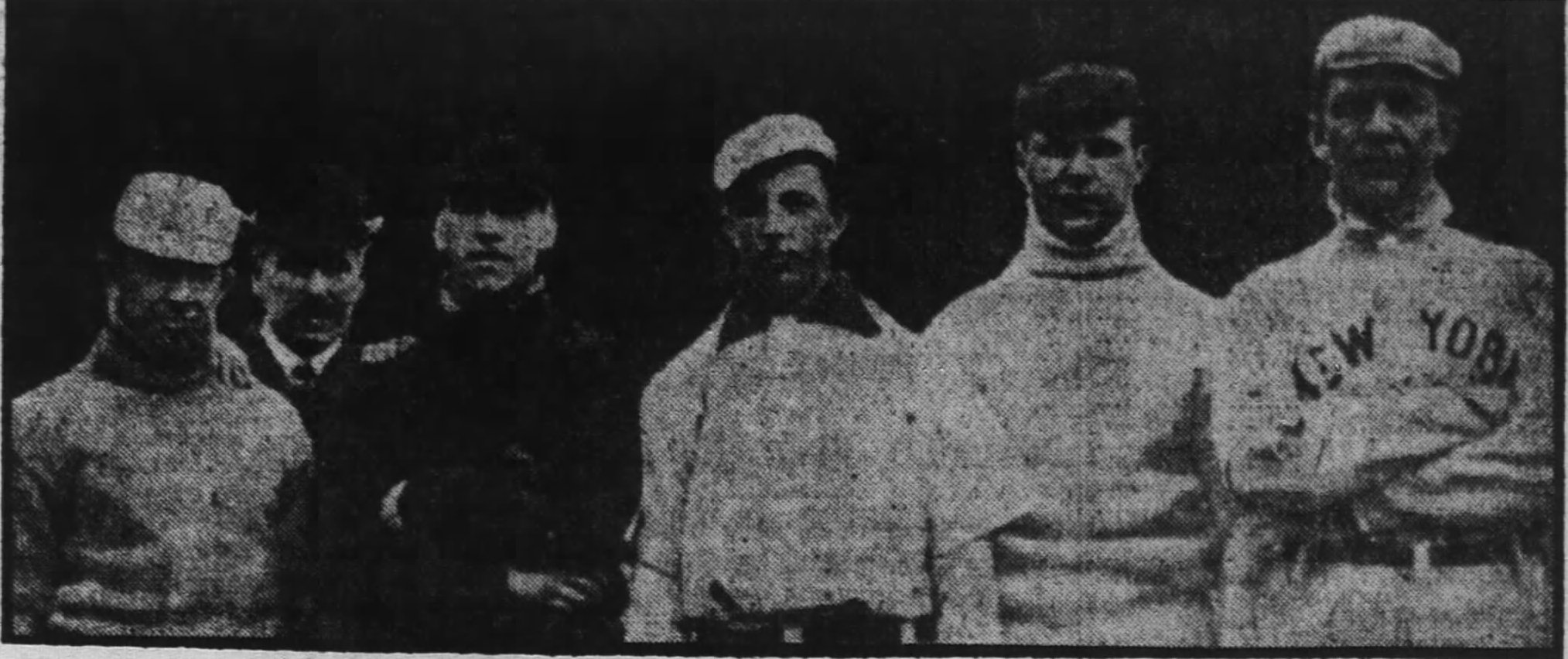
Five members of the first New York Highlanders team and a New York sportswriter photographed at Atlanta’s Piedmont Park in March of 1903. The financially failing Baltimore Orioles franchise was transferred to New York for the 1903 season.

From left: William “Wee Willie” Keeler (RF), James “Gym” Bagley of The New York Evening Mail, Harry Howell (P), William “Wid” Conroy (3B), Monte Beville (C), and John Ganzel (1B).

Atlanta Was thrilled to host the team.  The Atlanta Constitution said on the morning the team was due to arrive:

“The hearts of the local fans will be made glad today by the arrival of the New York American baseball team, for this afternoon on there will be something doing at the park.

“Manager Clark Griffith will have charge of the team, and will bring them in with him this afternoon on the Southern’s No. 27 from Washington, which is due in the city at 3:55 o’clock.

“The aggregation is nothing less than a bunch of stars.”

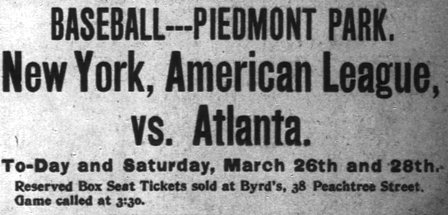
Large crowds came out to Piedmont Park for the team’s morning and afternoon practices and for the Highlanders first spring game on March 26 against the Atlanta Crackers.

advertisement for the 1903 New York Highlanders spring games with the Atlanta Crackers

Advertisement for the 1903 New York Highlanders spring games with the Atlanta Crackers


Griffith’s team finished fourth in the American League with a record of 72-62.

“The Experiment Was a Failure, But the Crowd Laughed”

27 Nov

In July of 1890 the Hartford franchise in the Atlantic Association–occasionally but not officially dubbed the “Nutmeggers” by the local press—were struggling financially.  So much so that the public was called upon to help raise enough money to meet payroll and get the team through the season.

The Sporting Life said a “meeting for the revivification” of the team was held on July 21, and a fundraising picnic was planned for August.  But the team’s best hope to raise enough money was  July 24: a game by electric light.

The first nighttime game was played a decade earlier, but the novelty of two professional teams playing under lights was enough that 4000 fans attended the exhibition game against the Baltimore Orioles at Ward Street Grounds.

The consensus opinion of the contest was summed up in The New York World headline:

The Experiment Was a Failure, But the Crowd Laughed

The paper said the game was lighted using “nine arc lamps in different sections of the field,” but the “light was dim and the players could hardly be distinguished…The game was a farce, but everybody was good-natured and the enterprise proved a first-class benefit for the home club.”

Only four innings were played.  The final score is in dispute.  Most recent accounts say Hartford won 20-19.  Most contemporary accounts, including The World and The Sporting Life said the score was 26-19.

The Baltimore Sun said Hartford’s net profit of $300 from the game enabled “management of the club to pay the players in full to July 15.” However, The Sun said there was a cost, Hartford catcher George Stallings was injured and “unable to play today as a result of last night’s so-called ballgame.”

George Stallings

George Stallings, injured in “so-called ballgame”

The proceeds from the night game and public contributions were not enough.

On August 14 Hartford was unable to come up with the $75 guarantee for the visiting Wilmington Blue Hens, and the game was cancelled.  Two days later, despite what The Sporting Life called “the club’s gallant fight,”  Hartford disbanded.

“The fans make us the ‘goat’ for Everything”

21 Nov

Chicago Orphans Manager Tom Burns suspended pitcher Bill Phyle without pay in August of 1899, even after Burns was replaced by Tom Loftus, Phyle remained in limbo.

Tom Loftus

Tom Loftus

In January Hugh Fullerton said in The Chicago Tribune that Loftus “probably will give him a chance.”  But in early February The Chicago Inter Ocean said even though Phyle had met with team President James Hart nothing had been resolved.  Phyle told the paper he was offered a contract but was “in no hurry to sign.”

Phyle finally signed at the end of the February, but The Tribune said Chicago would most likely trade him “although Loftus thinks highly of him.”

The team trained in West Baden Springs, Indiana, where according to The Tribune Phyle was “sarcastically called ‘Lucky,’ because of his proverbial hard luck, (he) rarely escapes a day without being hurt.”  He also managed to alienate his new manager.

After several days of poor weather in Indiana, Loftus decided to take the team further south, to Selma, Alabama on March 18.  According to The Tribune Phyle was not on the train:

“Phyle may not be with the team in Selma.  He left Friday (March 16), announcing he was going to see the fights in Chicago.  Manager Loftus hunted up the pitcher before he departed and told him it was a bad plan to start the year in such a manner.  Phyle then said he was ill and was making the journey in order to consult a physician in Chicago.”

Phyle did return from Chicago (where he claimed he had an unspecified operation), and joined the team on the trip south.  Upon his return he continued to suffer a series of illnesses and injuries, which included a bad reaction to a vaccination and a being hit in the knee with a thrown bat, both of which kept him inactive for several days.

Phyle was left in Chicago when the team opened the season in Cincinnati, and his imminent trade or release was speculated upon nearly daily in the Chicago press; he was finally traded to the Kansas City Blues in the American League with Sam Dungan and Bill Everitt for John Ganzel on May 18.  Phyle refused to report to Kansas City and spent the season playing for Chicago City League teams and a semi-pro team in DeKalb County, Illinois.  He was also a regular attendee at Chicago’s boxing venues and was said to own a piece of featherweight contender Eddie Santry.

Phyle returned to the National League in 1901 posting a 7-10 record for the New York Giants.  In 1902 he went to the California League as an infielder and never pitched again.  After his controversial exit from Memphis in 1903—and the aftermath—he continued to play until 1909.

Phyle worked as a boxing referee and as an umpire for more than 20 years in the Canadian, Eastern and Pacific Coast and International  Leagues, and was involved in two final controversies.

Bill Phyle, 1913

Bill Phyle, 1913

In 1920 a grand jury was impaneled in Los Angeles to investigate charges of game fixing in the Pacific Coast League.  Players Harl Maggert, William “Babe” Borton, Bill Rumler and Gene Dale were implicated.  While all criminal charges were eventually dismissed, the four were banned from baseball in 1921.

Phyle was called to testify in front of the grand jury, and said umpires were often blamed when players were crooked:

“The fans make us the ‘goat’ for everything that goes on during the ball game.  How many times we have suffered to suit the whims of a ballplayer who might have been working with the gamblers will never be known.  They just slough us around, call us whatever names they please and yell murder when we happen to fire them out of the game or have them suspended.

“An umpire should have the same authority as a referee has in the prize-ring.  If he believes a ballplayer isn’t giving his best toward the game, he ought to have the privilege of ousting him without taking the manager into confidence.”

In July of 1923 Phyle was working an International League game between the Baltimore Orioles and Rochester Tribe.  Phyle called a Rochester runner safe at first, then immediately reversed his decision.  He was dismissed the following day by league President John Conway Toole.

As a result of the dismissal, four other umpires resigned in sympathy.  Toole, who was attending the game, claimed he had not released him because of the blown call, but because Phyle had failed to work a double hitter he was assigned to earlier in the month.   The decision was upheld, and within three days the four other umpires withdrew their resignation.

Phyle ended his career back in the Pacific Coast League in 1926, and died in Los Angeles in 1953.