Tag Archives: Billy Evans

“Evans, who, at the Least, is Incompetent”

2 Dec

William George “Billy” Evans was nicknamed “The Boy Umpire” when he was hired by the American League at the age of 22.  After 21 seasons  he became a front office executive, working for the Cleveland Indians, Boston Red Sox and Detroit Tigers; he was also president of the Southern Association, authored two baseball books and in 1973, 17 years after his death, was elected to the Baseball Hall of Fame.

Billy Evans

Billy Evans

But during his first season as an umpire, 1906, he was not held in high esteem in Chicago.

On September 10 the White Sox were in second place, a game behind the New York Highlanders.  The Sox trailed the Tigers 2 to 1 in the 9th inning.  Chicago shortstop George Davis laid down a bunt and was called out at first by Evans.  Every Chicago paper said Evans beat the throw by “at least a step.”

The call precipitated a near riot.  The Chicago Tribune said:

“Instantly a shower of bottles from the first base bleachers drove the umpire, coacher, and players away from the vicinity of the base.”

After the next two batters were retired:

“Evans walked off the field amid another volley of bottle from the third base stand.”

The Tribune and The Chicago Inter Ocean said Evans and fellow umpire Tommy Connolly were mobbed by fans as they attempted to leave the ballpark with a police escort.  Both papers said “one or two blows” from fans connected with the umpire during his retreat.

The Inter Ocean said, “Evans has been the most heartily reviled arbiter that ever worked in any league.”

The Tribune said two weeks earlier Evans cost the Sox a game in Philadelphia.  After Chicago scored two runs in the top of the sixth inning to take a 5 to 4 lead, Evans “let the Athletics take advantage of his inexperience,” and stopped the game on account of rain with two men out in the bottom of the inning.  The Inter Ocean said, “(Sox Manager Fielder) Jones and (second baseman Frank) Isbell nearly came to blows with the umpire and members of the Athletic team.”

After a half hour, the game was called and the score reverted back to the end of the 5th inning, giving Philadelphia a 4 to 3 victory.

The next day, September 11, the Sox played the St. Louis Browns at South Side Park.  Evans worked the game along with Jack Sheridan.  The newspapers said Sox owner Charles Comiskey had discontinued the sale of “bottled goods” at the park that day.

The Browns won 7 to 3, and the Chicago press put much of the blame for the loss on the rookie umpire.

The Tribune said:

President (Ban) Johnson’s persistence in sending Evans, who, at the least, is incompetent, is giving baseball a black eye in Chicago.  Half the crowd believes the charges that Evans is working under instructions from Johnson to beat Chicago.  These charges undoubtedly are founded on mere prejudice, yet, had Evans been under instructions and trying to beat Chicago, he could not have done better than he did yesterday.”

The Inter Ocean said the Browns “were aided and abetted by Umpire Evans, the boy wonder…Why Ban Johnson insists upon sending the joke to officiate at important games is more than any sane man can see.”

But the Evans’ most ardent critic was William A. Phelon, sports editor of The Chicago Journal:

“Umpire Evans is the worst that ever yet came down this or any other pike in the history of the modern universe…And Ban says he is the best in the game.  We are not selfish and we are willing to let some other city endure him.  We can get over the shock of his removal.  If he doesn’t move he may have a statue down on the lake front, a statue 200 feet high made of bottles.  Give us liberty, give us death, give us any old thing, but, by the snakes of old Ireland, give us an umpire!”

Phelon also said Evans “seems to be a gentlemanly individual, whose place in life is evidently a long ways from the profession of umpiring.”
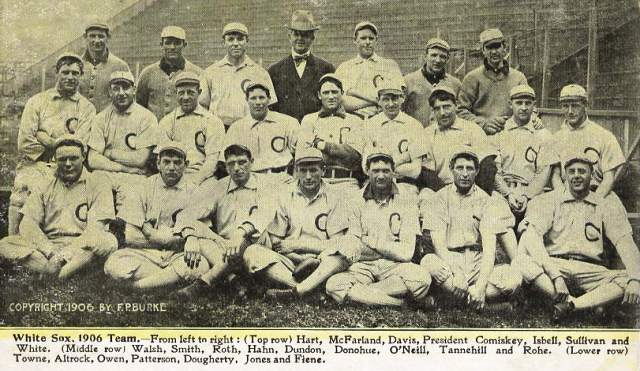
1906 White Sox

Despite the blame heaped on the young umpire in the press, the White Sox went 17-7 the rest of the season and won the pennant by three games.  They went on to beat the Chicago Cubs 4 games to 2 in the World Series.

Things got better for Evans as well.  He worked his first World Series in 1909—the youngest umpire to do so– and participated in five more from 1912 to 1923.  He was the third umpire to be elected to the Hall of Fame; Connolly and Bill Klem were the first two.

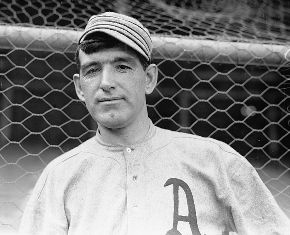
“Chief” Bender’s Catcher

3 Sep

Umpire Billy Evans, in one of his syndicated newspaper columns in the fall of 1910, said: “Most every ball player is more or less superstitious, but the pitchers, I believe, are more susceptible to beliefs uncanny than any of the other diamond athletes.”

Evans singled out Charles “Chief” Bender, who had just completed a 23-5 season with a 1.58 ERA for the World Champion Philadelphia Athletics, as one of the most “susceptible.”

Chief Bender

Chief Bender

According to Evans, Bender preferred throwing to catcher Ira Thomas over the team’s other two catchers Jack Lapp and Paddy Livingston:

“Bender has won lots of games with other catchers doing the receiving, but he never seems quite so steady as when Thomas is paired up with him.”

Evans said the preference extended to warming up as well:

“While there are scores and scores of pitchers who have their favorite catchers, still they are content to let one of the other receivers warm them up between innings, but not so with the Chief.  When Bender starts a game he absolutely refuses to throw to anyone other than Thomas.

“It is often the case that when the side is retired, the catcher happens to be a base runner.  Naturally much time is consumed by him in hurrying from the base he occupied to the bench to get his mask, glove and protector, and then back to the plate.  It is customary for most managers under such circumstances, to send one of the other catchers up to the plate to keep the pitcher warmed up.  I have seen Bender refuse at least a dozen times during the past summer to warm up with one of the Athletics other than Thomas.  He waits for Ira and takes a chance on getting cold in preference to putting the “jinx” on himself by tossing the ball to someone else.”

Bender's favorite catcher Ira Thomas

Bender’s favorite catcher Ira Thomas

The feeling was mutual.  In a 1911 article in The Pittsburgh Press, Thomas, who in addition to Bender also caught Jack Coombs (31-9, 1.30 ERA), Cy Morgan (18-12, 1.55 ERA), and Eddie Plank (16-10, 2.01 ERA) in 1910, said of Bender:

“I don’t take my hat off to…any other pitcher when Chief Bender is around.  He is a wonder of wonders.  No one can show me where there is a better pitcher in general.

“Bender has everything a pitcher needs and in a series of seven games he is almost invincible.”

Thomas remained with the Athletics organization for another 40 years as a coach, minor league manager and scout; he finished his scouting career with the Yankees, retiring in 1956.  He died in 1958.

Bender left Philadelphia in 1914 when he jump the Athletics for the Federal League; he returned to the Athletics organization in the 1930s.  He died in 1954.

Bender and Thomas shared a baseball card--the 1912 T202 Hassan Triple Folder

Bender and Thomas shared a baseball card–the 1912 T202 Hassan Triple Folder

The two remained close for the rest of their lives and often appeared together at baseball banquets.  One story Bender always told; the “greatest thrill” of his career, his May 12, 1910 no-hitter against the Cleveland Naps (this version was related in The Trenton Evening Times in 1936).  With two outs in the ninth Cleveland’s Elmer Flick hit a pop-up in front of home plate, the ball initially popped out of Thomas’ mitt before he secured it for the final out:

“Watching Ira juggle that ball and then hold it was my greatest thrill.”

More Superstitions

25 Apr

Billy Evans, “The Boy Umpire,” joined the American League staff at the age of 22.  Before becoming an umpire, Evans was a reporter for The Youngstown Vindicator and continued to write occasional, syndicated newspaper articles throughout his career.

Billy Evans

Billy Evans

In a 1907 article he wrote about superstitions:

“Baseball players are the most superstitious class of people in the world.  There are many superstitions in general in which all members of the profession have implicit confidence and nearly every player has some pet belief that is all his own.”

Evans mentioned one of the most superstitious players of all-time, Detroit Tigers pitcher “Wild Bill” Donovan, who as mentioned in an earlier post, believed that striking out the first batter he faced was bad luck.  According to Evans he also had a strange belief about the first game of the season:

“Donovan has a dread of working in shutout games on his first appearance.  He believes it a season hoodoo and would do almost anything to prevent it.”

Evans worked as an umpire in Donovan’s first start of the 1907 season, and the pitcher took a shutout into the ninth inning:

“I happened to be working back of Donovan that day and noticed that he seemed to let up in the ninth , also that he used nothing but a straight fast ball.  A pass, an error and a cracking hit by Charley Hickman sent a couple of tallies over the pan.”

Evans said he asked Donovan after the game if he “(lost his stuff,” in the ninth, Donovan said no:

“I have no desire to win a shutout game right off the reel…shutouts on your debut are not lucky.”

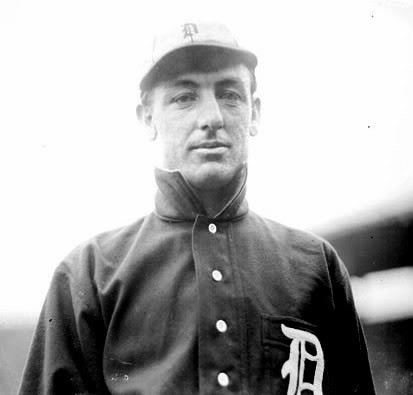
Bill Donovan

Bill Donovan

Evans said Fred “Lucky” Glade, a St. Louis Browns pitcher who had just been traded to the New York Highlanders, had a phobia of pitching if the sun wasn’t out:

 “According to Glade, he has never during his career won a game on a dark day.”

The pitcher also “started each inning…by tossing a ball to (Browns first baseman) Tom Jones.  Next year he will have to use (Highlanders first baseman) Hal Chase

Chase must not have been an adequate substitute; Glade struggled with arm and stomach problems, posted an 0-4 record in five starts for the Highlanders, before returning home to Nebraska in June.  He signed a contract for 1909, but never reported and never pitched again.

Fred Glade

Fred Glade

Ty Cobb had numerous superstitions; one had to do with the “position of the broom with which the umpires use to dust off the plate.”  Evans said:

“The umpires find it handy to keep the broom to the left of the plate, while Cobb, when at the bat, always desires it to the right.  Whenever he steps to the plate Cobb always picks up the broom and tosses it to the right side of the batter’s box.”

Additionally:

“When in a batting slump Cobb always makes three crosses as he takes his position at the plate.  When Cobb reaches first base on his journey from right field to the bench he always gives the bag a terrific kick in the direction of the plate…Cobb insists that the short distance he moves the bag toward the plate with his kick often is the means of winning a close decision at first for his team.’

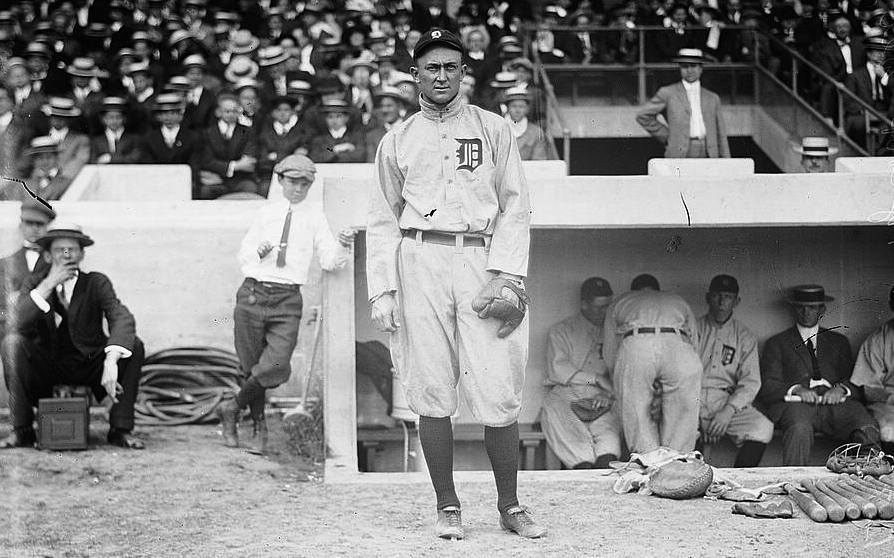
Ty Cobb

Ty Cobb

Evans said of superstitions in baseball:

“No doubt a close investigation would reveal that every player from the smallest bush league up has his pet theory.”

A Thousand Words

25 Oct

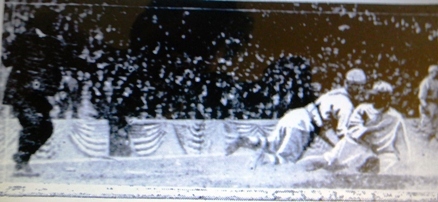
Occasionally you come across a photo that hasn’t been published anywhere in almost 100 years.  This one is from game 2 of the 1917 World Series.  New York Giant rightfielder Dave Robertson slides past Chicago White Sox Hall of Fame catcher Ray “Cracker”  Schalk, beating the throw home to score the first run of the game.  The umpire is Hall of Famer Billy Evans, “The Boy Umpire,” who at 22-years-old in 1906 became the youngest umpire in Major League history.

The White Sox went on to win the game 7-2 and won the series in 6 games.

What Happened to Trammell Scott?

2 Oct

Trammell Scott (Incorrectly listed as Trammel in multiple sources) was born in 1886 to a prominent Dalton, Georgia family.  After playing baseball at the University of Georgia, Scott played minor league ball in the south.  He spent time in the Georgia State League, South Atlantic League, and the Carolina Association—he was said to have also played with Houston in the Texas League but no statistics survive.

After his brief playing career Scott was the victim of a near fatal shooting in 1916.  The Atlanta Constitution covered the story closely and reported that Scott, while “In a dying condition,” told his mother “I told you they would get me.”  Trammell recovered, but never identified his assailant and no motive or suspects were ever identified–just 10 days after the shooting Atlanta Chief of Detectives Newport Langford said they were closing their investigation. and according to the Constitution “Leaving the mystery unsolved.”

Scott joined the army in World War I, was decorated for bravery in action and promoted to the rank of Major.

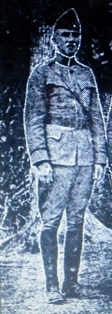
Trammell Scott 1919

Upon returning to Georgia Scott became a well known sportsman.  He was boxing referee and later served on the state boxing commission, owned a sporting goods store, was actively involved in local semi-pro baseball and basketball, and was prominent hunter and breeder of champion bird dogs.

In January of 1938 Scott was named interim President of the Southern Association in a contentious split vote.  At the end of the year he was named President.

In December of 1942 Scott boarded a train in Atlanta to attend the baseball winter meetings in Chicago.  Due to arrive for the league meeting at 4 pm, Scott’s train was delayed.

When the meeting convened without Scott, the owners who opposed his original appointment seized the opportunity.  Thomas Watkins from Memphis, Larry Gilbert of New Orleans, Roy Thompson of Little Rock and Bob Allen of Knoxville led a revolt which was soon joined by Paul Florence of Birmingham.

Within an hour Scott had been voted out and replaced by Billy Evans, a former American League umpire and one time general manager of the Cleveland Indians and Boston Red Sox.  Evans was at the meeting in hopes of landing a different position, but the Southern Association bosses settled on him as the new compromise candidate to run the league.

There was a problem.  No one attempted to reach Scott to inform him of the decision.

That evening, having finally arrived in Chicago, Scott hurried to the National Association dinner meeting of all the league presidents.  Taking his seat, the Associated Press noted “It was a tense moment as (National Association) President William G. Bramham informed Scott the Southern had named a new president.”

Scott said he never saw his dismissal coming and said league owners threw him “A low curve,” by replacing him in the manner they did.

Less than three weeks after his dismissal Scott was turkey hunting on friend’s farm near Newton, Georgia.  After returning for the day, Scott told his friends he was returning to the fields in search of a turkey he had wounded earlier in the day.  The following day Scott was found with a gunshot wound to the chest.

The medical examiner ruled that the wound was self-inflicted but the official ruling said it was “Undetermined whether the shooting was accidental or pre-meditated.”

Many of Scott’s friends said that in spite of being embarrassed by his dismissal he was far from distraught and noted that while being an experienced hunter, Scott was not always careful, “On occasion he was known to have leaned a loaded shotgun against his middle while lighting a cigaret (sic).” This, they speculated, could have caused the type of injury that killed Scott.

Scott was interred at Westview Cemetery in Atlanta—the whole story about two shootings 25 years apart, buried with him.