Tag Archives: Boston Red Sox

“Chief” Bender’s Catcher

3 Sep

Umpire Billy Evans, in one of his syndicated newspaper columns in the fall of 1910, said: “Most every ball player is more or less superstitious, but the pitchers, I believe, are more susceptible to beliefs uncanny than any of the other diamond athletes.”

Evans singled out Charles “Chief” Bender, who had just completed a 23-5 season with a 1.58 ERA for the World Champion Philadelphia Athletics, as one of the most “susceptible.”

Chief Bender

Chief Bender

According to Evans, Bender preferred throwing to catcher Ira Thomas over the team’s other two catchers Jack Lapp and Paddy Livingston:

“Bender has won lots of games with other catchers doing the receiving, but he never seems quite so steady as when Thomas is paired up with him.”

Evans said the preference extended to warming up as well:

“While there are scores and scores of pitchers who have their favorite catchers, still they are content to let one of the other receivers warm them up between innings, but not so with the Chief.  When Bender starts a game he absolutely refuses to throw to anyone other than Thomas.

“It is often the case that when the side is retired, the catcher happens to be a base runner.  Naturally much time is consumed by him in hurrying from the base he occupied to the bench to get his mask, glove and protector, and then back to the plate.  It is customary for most managers under such circumstances, to send one of the other catchers up to the plate to keep the pitcher warmed up.  I have seen Bender refuse at least a dozen times during the past summer to warm up with one of the Athletics other than Thomas.  He waits for Ira and takes a chance on getting cold in preference to putting the “jinx” on himself by tossing the ball to someone else.”

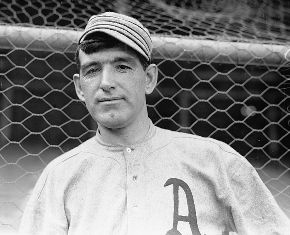
Bender's favorite catcher Ira Thomas

Bender’s favorite catcher Ira Thomas

The feeling was mutual.  In a 1911 article in The Pittsburgh Press, Thomas, who in addition to Bender also caught Jack Coombs (31-9, 1.30 ERA), Cy Morgan (18-12, 1.55 ERA), and Eddie Plank (16-10, 2.01 ERA) in 1910, said of Bender:

“I don’t take my hat off to…any other pitcher when Chief Bender is around.  He is a wonder of wonders.  No one can show me where there is a better pitcher in general.

“Bender has everything a pitcher needs and in a series of seven games he is almost invincible.”

Thomas remained with the Athletics organization for another 40 years as a coach, minor league manager and scout; he finished his scouting career with the Yankees, retiring in 1956.  He died in 1958.

Bender left Philadelphia in 1914 when he jump the Athletics for the Federal League; he returned to the Athletics organization in the 1930s.  He died in 1954.

Bender and Thomas shared a baseball card--the 1912 T202 Hassan Triple Folder

Bender and Thomas shared a baseball card–the 1912 T202 Hassan Triple Folder

The two remained close for the rest of their lives and often appeared together at baseball banquets.  One story Bender always told; the “greatest thrill” of his career, his May 12, 1910 no-hitter against the Cleveland Naps (this version was related in The Trenton Evening Times in 1936).  With two outs in the ninth Cleveland’s Elmer Flick hit a pop-up in front of home plate, the ball initially popped out of Thomas’ mitt before he secured it for the final out:

“Watching Ira juggle that ball and then hold it was my greatest thrill.”

“Another Phil Pitcher was Sacrificed on the altar of a Futile Attack”

6 Aug

When George Chalmers returned from Cuba with the Philadelphia Phillies in November of 1911 he wasn’t the same pitcher.

After pitching the first game of the series against Almendares and the great Cuban pitcher Jose Mendez, Chalmers saw little action in the final eight games.

While training in Hot Springs, Arkansas in the spring of 1912 it became clear that Chalmers’ shoulder was in bad shape.  The Philadelphia Inquirer said he was sent from Hot Springs to Youngstown, Ohio to “visit ‘Bonesetter’ Reese.” (John D. Reese was a Welsh-born “practitioner of alternative medicine.” The  “self trained”  Reese was, according to The Pittsburgh Press, visited by many of baseball’s biggest stars, including Frank Chance, Ty Cobb, Honus Wagner, and John McGraw.  At the same time he was condemned by Ohio physicians who said there was no evidence of Reese “curing a single case where there was actual fracture or displacement of bone.”)

The famous “Bonesetter” was unable to do anything for Chalmers.  The Wilkes-Barre Times-Leader said in April:

“It is reported on good authority that Chalmers, one of the Phillies star pitchers, will be unable to deliver the goods this season owing to the condition of his pitching arm.”

As a result of the injury Chalmers only appeared in 12 games in 1912, with a 3-4 record, and didn’t pitch at all from July 5 until September 4.   At the end of the season Phillies owner Horace Fogel, who would soon find himself chased out of the game, used Chalmers’ injury to suggest a change in how pitchers were paid.  According to The Philadelphia Bulletin:Ho

“Horace wants to employ pitchers on the percentage basis, paying them so much per game—no game, no pay.

“The Phillies President conceived the idea after he had figured that it had cost him an average of $800 per game for the few games pitched by George Chalmers during the present season.”
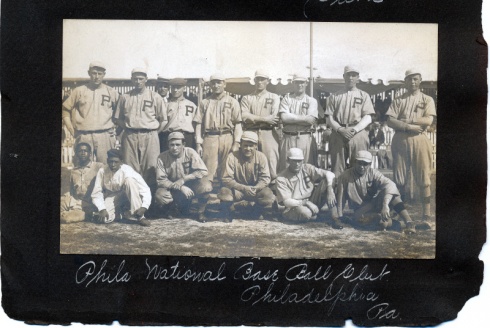
Phillies team photo from George Chalmers personal collection--appears to be the 1912 team.

Team photo from George Chalmers’ personal collection

The $800 per game figure was clearly wrong—Chalmers would have not earned anywhere near $9600 for the 1912 season (Christy Mathewson made between $8000 and $9000), Chalmers and “Pete” Alexander both probably made less than $3000.  It is doubtful Fogel’s plan would have gone anywhere had he remained president of the Phillies.

The following season was no better; with no improvement to the injured shoulder, Chalmers appeared in 26 games, 15 as a starter, and was 3-10 with 4.81 ERA.  It got so bad that after a loss near the end of the season The Wilkes-Barre Times-Leader said:

“Our old friend ‘Dut’ Chalmers got another trimming yesterday.  It has gotten to be such a regular thing for Chalmers to be beaten that he doesn’t mind it anymore.”

Two of the Phillies best pitchers in 1913, Tom Seaton (27-12), and Addison “Ad” Brennan (14-12) jumped to the Federal League, making Chalmers and his injured shoulder even more critical to the Phillies hopes for 1914.

In March The Philadelphia Inquirer said Chalmers had spent the winter in Hot Springs rehabilitating his shoulder and appeared “to be in splendid shape,” when he reported to spring training in Wilmington, North Carolina, and “(Charles “Red”) Dooin is thanking his lucky stars that Chalmers is in camp.”

The season turned out to be Chalmers’ worst.  He pitched in three games, losing all three with an ERA of 5.50, and he Phillies released him on June 22.  The Inquirer said his shoulder had never healed and attributed the injury to “rheumatism and a misplaced muscle.”

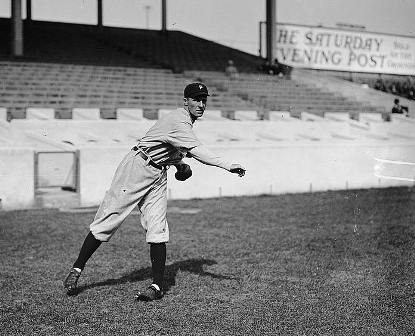
George "Dut" Chalmers

George “Dut” Chalmers

The Pittsburgh Press said:

“The frailty of baseball life and the quickness with which a career in the big show may be ruined are shown again in the case of George Chalmers…Chalmers may recover and come back some time, but it is doubtful, and his going marks the untimely end of a career that promised to be one of the most brilliant in baseball pitching history.”

According to The Inquirer, he was not yet ready for the end:

“Chalmers…had mighty little money, about $400 in all, and his best friends advised him to stick the little old four hundred into some good business and forget baseball…Good doctors had told George that his arm was gone.  Other pitchers, real friends of the Phillies star, had told him the same thing…Then he heard of a specialist in New York who had done a great job on another pitcher’s arm which had seemed to be gone (no articles mentioned the name of the specialist or the other pitcher).”

With his arm seemingly better, Chalmers was invited to spring training with John McGraw’s New York Giants in Marlin, Texas.  The New York Mail said “he looked good at Marlin,” but the Giants let him go before the season began.  On April 20 he was signed again by the Phillies, and sent out to pitch the next day.  The Inquirer said:

 “George Chalmers, once a Philly discard and lately spurned by the Giants, with whom he trained during the spring trip to the Southland, was the hero of today’s festive occasion for Philadelphia.  Chalmers had been without a big league contract and he was signed by (manager Pat) Moran only yesterday.  But he gave him a quick trial by shunting him at the Giants, and he showed his gratitude to the Quaker boss by pitching the best game of his career.”

Chalmers gave up only two hits and beat the Giants 6-1.

As the Phillies fifth starter in 1915 he was 8-9 with a 2.48 ERA, appearing in 26 games.  Jack Kofoed, a sportswriter for The Philadelphia Record said in “Baseball Magazine”that Chalmers’ record did not reflect how well he pitched:

“Throughout the season Chalmers twirled splendid ball, but played in tougher luck than any man on the Philly staff.  Had fate been as kind to him as to Al Demaree (14-11 3.05 ERA) , for instance, he would have won twice the number of games he did.  But the Phillies played more weird ball behind him than in back of any man on the staff.”

The Phillies won the National League pennant, and met the Boston Red Sox in the World Series.  With Philadelphia down two games to one, Chalmers was Moran’s choice to pitch game four in Boston.

Facing Ernie Shore, who won 19 games for the Red Sox, Chalmers pitched well, but lost 2-1 (the same score of Philadelphia’s losses Geo 2 and 3); The Inquirer said:

“Another Phil pitcher was sacrificed on the altar of a futile attack…through the futile efforts of his companions to obtain for him even the slender margin that was all he required.”

The Red Sox beat the Phillies four games to one.

In November of 1915 several Pennsylvania papers said Chalmers had used his “World Series coin as a matrimonial nest egg.”

The following season was his last.  The shoulder injury returned and the Phillies only used Chalmers in 12 games, he was 1-4 with a 3.19 ERA.  He did not appear in a game after August 7, and was released at the end of the season.  After an unsuccessful attempt to catch on with the Kansas City Blues in the American Association in 1917 Chalmers career was over before his 29th birthday.

In the waning days of his career, The Wilkes-Barre Times-Leader said:

“’Dut,’ as George is called by his playmates is a fine, upstanding, intelligent young fellow, with all the sturdy Scotch virtues as well as a Scotch burr in his speech, and whether or not he lasts in baseball he is very likely to be successful in life.”

Chalmers retired to New York and died in the Bronx in 1960.

Special thanks to Karen Weiss, George Chalmers’ great niece, for generously providing copies of photos from Mr. Chalmers’ scrapbook.

Hap Myers

29 Jul

When the 6’ 3” 175 pound Ralph Edward “Hap” Myers was let go by the Boston Braves after the 1913 season a reporter told Braves shortstop Rabbit Maranville he was sorry to see Myers go.  Maranville joked:

“Well, you might be, but I’m not.  Do you know that guy is so thin that every time I picked up a grounder I had to shade my eyes with my gloved hand to locate him before throwing the ball.”

Myers began his professional career after graduating from University of California, Berkeley in 1909, where he also played baseball.  The San Francisco native hit a combined .311 playing for the Sacramento Sacts in the Pacific Coast League, and the San Jose Prune Pickers and Santa Cruz Sand Crabs in the California League.

Myers went east in 1910 after being purchased by the Boston Red Sox, but became ill, with scarlet fever, and as a result appeared in only six games in Boston before being  sent first to the Toronto Maple leafs in the Eastern league, then the Louisville Colonels in the American Association.

Despite hitting just .240 with Louisville, Myers was selected by the St. Louis Browns in the Rule 5 draft.  The Red Sox claimed Myers still belonged to them and his contract was awarded to Boston, where he began the season, was sold to the St. Louis Browns, who quickly released him despite hitting .297 in 11 games, then back to the Red Sox where he hit .368 in twelve games before being sent to the Jersey City Skeeters in the Eastern League.

It was never clear why, in spite of hitting .333 in 81 at bats in 1910-1911, Myers couldn’t stick in the American League.

In 1912 he returned to the West Coast to play for the Spokane Indians in the Northwestern League where he led the league in hits, and runs, hit .328, and led all of professional baseball with 116 stolen bases.  The Portland Oregonian said:

“Myers base stealing smashes any previous performance in Northwestern League history.  You have to go back 20 years in official guide books to find any record to compare…and that includes every league in organized baseball.”

Spokane owner Joe Cohn went overboard in his praise of Myers in The Spokane Spokesman-Review:

“Best ballplayer in the Northwestern League by a long shot.  He is the greatest ballplayer I ever saw.  Boy I tell you this Myers is a wonder.  Ty Cobb, Hans Wagner, Tris Speaker and all of them have nothing on Myers…I think Myers has it on Cobb, Wagner, Lajoie, Jackson and the whole bunch.”

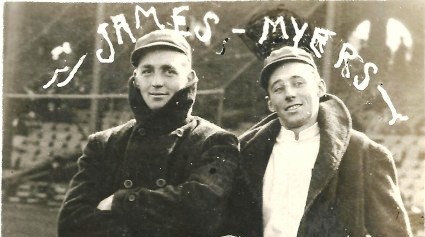
Myers, and Portland catcher Rex DeVogt were purchased by the Braves from Portland, Devogt would only last for three games, and six hitless at-bats in April of 1913.  Myers would become the Braves starting first baseman.  Another Pacific Coast League player, pitcher “Seattle Bill” James also joined the Braves.

hap3

“Seattle Bill” James and “Hap” Myers

Myers got off to a slow start; he was hitting just .224 in early July, but was leading the National League in steals.  An article in The Tacoma Times said:

“When Hap Myers, recruit first baseman of the Boston Braves is in full stride stealing bases, he covers nine feet…the average stride of a sprinter is six feet. “

The article said the average player took 13 steps, roughly seven feet per step, between bases but Myers took only ten steps:

“Myers is something of a baseball curiosity, and his work is watched with interest by the fans.  If the time comes that the big fellow climbs into the .300 class as a batter, he is apt to become a veritable terror of the paths.”

He was also said to use “a bat of unusual length,” but the size was never mentioned.

After the slow start, Myers hit well in the second half of the season, ending with a .273 average and 57 stolen bases (second to Max Carey of the Pittsburgh Pirates who stole 61).  Despite his strong finish, Myers was replaced at first base for 22 games in August and September by Butch Schmidt, who was purchased from the Rochester Hustlers in the International League.

"Hap" Myers

“Hap” Myers

At the end of the season Myers was sold to the Hustlers, the deal was, in effect, a trade for Schmidt.  The Boston press simply said Myers did not get along with manager George Stallings; Myers told a reporter in San Francisco that there was another reason; baseball’s labor unrest:

  “I was assigned by the fraternity to get as many Braves as possible into the fraternity, and succeeded in enrolling nearly the entire team.  The powers that be evidently didn’t relish my actions for soon my every move began to bring calldowns and I was not surprised to read in the newspapers a little later that I had been sent to Rochester.”

Myers jumped Rochester to join the Federal League; his signing was reported months before he actually signed.  The Associated Press said in March of 1914:

“Although it has been generally understood that Hap Myers, last season’s first baseman of the Boston National has been under a Federal League contract for some time, the elongated first sacker did not put his name to a contract until yesterday afternoon.  Myers originally expected to play with Larry Schlafly on the Buffalo Federals, but was transferred to Brooklyn, and seemed altogether pleased with the move.”

Myers got off to a strong start, and The Sporting Life said:

“Brooklyn fans cannot understand why Hap was passed out of the National League. They have had a chance already to give his successor at first base on the Boston team (Butch Schmidt) the once over, and the general opinion is that- Hap Myers “lays all over.”

His success in Brooklyn didn’t last; in 92 games Myers hit just .220.

Hap’s story continued tomorrow.

Lost Advertisements–“Our ‘Pennant’ Hat Looks well on ‘Dut’ Chalmers

26 Jul

chalmers

George “Dut” Chalmers, pitcher for the 1915 National League Champion Philadelphia Phillies in an advertisement for Geo. B. Wells Hats.

“Our ‘Pennant’ Hat Looks well on ‘Dut’ Chalmers

“As full of graceful curves as the shoots Chalmers puts across!

“You’ll find the right hat for your head in our very high-grade offerings at $2 and $3.”

Chalmers is one of only eight big leaguers to have been born in Scotland.  He was 8-9 with a 2.48 ERA in 26 games for the Phillies in 1915, and lost game 4 of the World Series 2-1 to the Boston Red Sox–Boston won the Series 4-1.

Chalmers was 29-41 in seven seasons, all with the Phillies.

George "Dut" Chalmers

George “Dut” Chalmers

Charles Murphy’s Last Stand

16 Jul

The National League had almost completely rid themselves of Charles Webb Murphy in 1914; the owner who had ongoing feuds with nearly every other league magnate, league officials, umpires, and many of his own players, had sold his interest in the Chicago Cubs to his financial benefactor Charles Phelps Taft.

Murphy returned to his home in Wilmington, Ohio; his only connection to the National League was his part ownership of the Baker Bowl, the home of the Philadelphia Phillies.  Murphy’s other ballpark ownership stake was in Chicago’s West Side Grounds, but that investment had lost most of its value after Taft sold the Cubs to Charles Weeghman, who moved the team to his ballpark on the North Side.  The Cubs former home field was used for amateur and semi-pro games, even  Buffalo Bill’s Wild West Show, but the park was not making Murphy money.

William Wrigley Jr., and his brothers were minority investors in the team in 1916, but Weeghman began struggling financially almost as soon as he bought the team, and the Wrigley brothers began buying Weeghman’s stock.

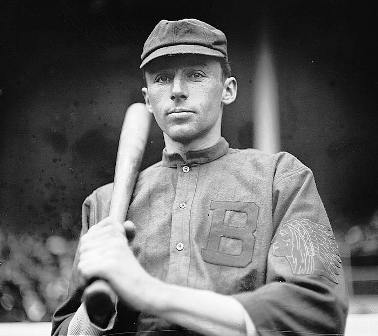
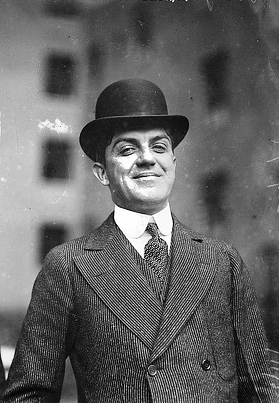
Charles Weeghman

Charles Weeghman

Between the 1918 and ’19 seasons the Wrigley’s acquired controlling interest in the Cubs.  (Some recent sources say Wrigley did not have controlling interest until 1921, but numerous contemporaneous sources said the Wrigley family had control of the team before the 1919 season began).

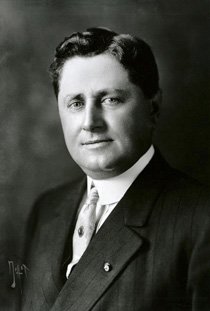
William Wrigley Jr.

William Wrigley Jr.

In February of 1919 Joe Vila, sports editor of The New York Sun wrote a story that said the Cubs were moving out of Weeghman Park and back to the West Side Grounds:

“National League men are gratified to learn that there will be a change of ball parks in Chicago, probably before the championship season opens on April 23.  The Cubs who have occupied the grounds of the defunct Chicago fed on the North Side since 1916, are preparing to return to their old home, West Side Park, which still is the property of Charles Webb Murphy and, presumably Charles P Taft.  The North Side plant never could accommodate more than 18,000 spectators, sitting and standing, whereas as many as 30,000 attended games at West Side Park in the days when Frank Chance had a world’s championship ball club.  Last fall the Cubs played their world’s title games with the Red Sox in Chicago at the home of the White Sox for the reason that the former Chifed arena was too small.”

Vila said Murphy saw an opportunity in the new ownership arrangement:

“Naturally, with an eye to business, Murphy promptly suggested to the Wrigley’s, who control the Cubs stock, the transfer of the Cubs…The Wrigley’s, who know little or nothing about practical baseball methods, regard Murphy as an oracle and there isn’t  a doubt that they will accept his suggestion.”

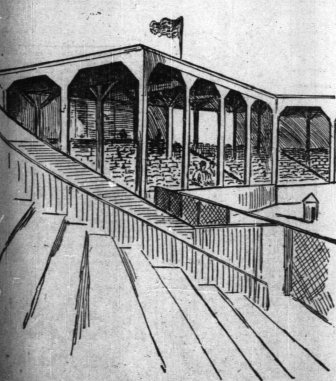
westsidegrounds

The Grandstand at West Side Grounds

It’s unclear whether the move, for which Vila said “there isn’t a doubt,” was ever even a possibility; it seems just as likely it was a story planted by Murphy.  Vila’s description of the ousted Cubs owner would suggest, at the very least, that Murphy had a sympathetic ear with The Sun sports editor:

“Murphy is one of the smartest men in baseball…When Murphy was president and of the Cubs the club didn’t have a losing year financially…In other words the Cubs under Murphy were tremendously successful.”

Vila also blames the Horace Fogel incident for all of “Murphy’s unpopularity that led to his retirement,” Not mentioning Murphy’s numerous feuds.

The Wrigley’s did not end up accepting Murphy’s suggestion, and the team remained at Weeghman Field, renamed Cubs Park before the 1920 season, and finally Wrigley Field before the 1926 season.

Murphy’s last stand having failed, he had his ballpark torn down in 1920.

It wasn’t until 1927 that the seating capacity at Wrigley Field finally surpassed that of the west Side Grounds.

“Calvo has been the Victim of a Cruel and Merciless Conspiracy”

4 Jun

When he signed 18-year-old Jacinto “Jack” Calvo Gonzalez, Washington Senators manager/owner Clark Griffith was no stranger to Cuban players, having managed Armando Marsáns and Rafael Almeida with the Cincinnati Reds, but Calvo’s signing was the beginning of Griffith’s 40-plus year commitment to signing players from Cuba.  During his tenure the Senators signed more than half of the 63 Cuban players in the major leagues.

Calvo was “discovered” while playing with Almendares in the Cuban National League, where he hit .342 in 19 games.  He made even more of an impression during a series Almendares played against the New Orleans Pelicans of the Southern Association, Calvo hit .400 and his older brother Tomas hit .385.

???????????????????????????????

He also hit .400 during a six-game series with the Philadelphia Athletics, The Associated Press said he didn’t compile those numbers facing minor league pitchers picked up for the series, but “against (Eddie) Plank, (Jack) Coombs, and (Charles “Chief”) Bender.”

When rumors circulated that Washington might have signed Calvo, Bender said:

“I never saw a faster youngster in my life; he can hit too, and looks for the entire world like a class ball player…If Griffith has signed him he will never regret it, for there is no chance for him to be a failure.”

By December of 1912 Griffith had Calvo under contract.  The Pittsburgh Press said:

“The young Cuban sent a letter to Griff, written in Spanish.  ‘They did not teach Spanish where I went to school,’ said The Old Fox, ‘so I can’t translate the missive.  However, as he signed his contract I guess everything is alright.’”

The Boston Red Sox signed Tomas Calvo later in December.

While Tomas never made it in Boston, Jacinto made his debut with the Senators on May 9; he hit only .242, but everyone noticed his arm.  After a June game with the St. Louis Browns, The Associated Press said:

“The youngster astonished the bugs yesterday with his remarkable throwing arm.  At one time he heaved the ball from the right field fence directly to (Germany) Schaefer’s hands at second.”

On August 13 Calvo was sent to the Atlanta Crackers in the Southern Association and made his first appearance with the team the following day, batting seventh, going 1 for 4.  The Atlanta Constitution said “He’s fast, fields pretty well, throws like a shot and meets the ball squarely.”

Calvo only lasted 10 days in Atlanta.  He was hit on the right arm with a pitch thrown by Charles “Curly” Brown of the Montgomery Rebels.  He was returned to the Senators and did not appear in another game that season.  (Some sources show Calvo with the Long Branch Cubans in the New York New Jersey League—it was most likely his brother Tomas, an infielder, rather than career outfielder Jacinto, who played shortstop for the team in 94 games).

Calvo started the 1914 season with the Los Angeles Angels in the Pacific Coast League.  After only 11 games (he was 4-8 with one double, one triple and a stolen base) he was sent to the Victoria Bees in the Northwestern League.  Later in the season a story came out explaining his abrupt departure from Los Angeles.

Calvo with the Washington Senators

Calvo with the Washington Senators

The Spokane Spokesman-Review said, “Calvo has been the victim of a cruel and merciless conspiracy,” despite the fact that “in the exhibition games last spring against the White Sox Calvo loomed up head and shoulders above the other Angel gardeners, out hitting them by a wide margin and displaying more speed on the bags than the whole Angel team combined.”

The paper claimed that a female reporter:

“(o)n one of the local papers…dragged out of him the fact that his father was a rich sugar planter in Havana, and that he played baseball for fun and not for money…That was the beginning of the end for little Calvo. “

The story said fans began harassing Calvo, and:

“Instead of coming to his rescue, the players on the Angel team ‘rode’ the boy unmercifully.  It was pathetic to see the friendless little Cuban trying to get into the good graces of his teammates.  One day, in the clubhouse the boy sat down on a bench and cried before them all.  His spirit was broken.”

Calvo hit .289 for Victoria in 1914, and spent the spring of 1915 with the Senators before being release before the beginning of the season.  After his release he played with his brother Tomas for the Long Branch Cubans, by then a member of the Independent Negro League; he also played for Havana in the Cuban-American Negro Clubs Series.

Calvo next played for the Vancouver Beavers in the Northwestern League and the San Francisco Seals in the Pacific Coast League, hitting .329 in 1916, and slipping to .263 in 1917. After the 1917 season, the outfielder returned, unsigned, the contract sent to him by Seals owner Charlie Graham.

Calvo had been very popular in San Francisco during his nearly two seasons with the Seals, but was criticised by fans and local press for his holdout, especially because he was holding out on the even more popular Graham.  The San Francisco Chronicle said:

“He sent his terms, and as they were exactly what he asked for before.  (Charlie) Graham is wondering why the Cuban went to the trouble to wire at all.”  The paper criticised Calvo for “asking for more money than he got last year,” while “better players than he have submitted to a salary slash on account of war conditions.”

San Francisco Seals owner Charlie Graham

San Francisco Seals owner Charlie Graham

The Chronicle lamented the fact that Seals outfielder Biff Schaller would miss the entire season with an injury, otherwise “Calvo could have stayed in Havana for all that anyone here cares.”

As it turned out, Calvo did stay in Havana.  For all of 1918 and ’19, not returning to the states until 1920.  Tomorrow–Jacinto Calvo’s return.

“I Have a Profound Contempt for the Game”

29 Apr

Samuel Porter Jones was one of the country’s most prominent Evangelists from the late 1870s until his death in 1906—the Ryman Auditorium in Nashville, home of The Grand Ole Opry, was originally called The Union Gospel Tabernacle and was built for Jones’ ministry.

Jones was not a baseball fan.

Speaking at a tent revival in his hometown of Cartersville, Georgia in 1885 Jones stirred up a crowd with his attack on the game.

Evangelist Samuel Porter Jones

Evangelist Samuel Porter Jones

According to The Atlanta Constitution, Jones read a note from one of the flock which said, “Our children have often gone off to the baseball grounds during this meeting and grieved our hearts,” and asked Jones for his opinion.  The preacher first said he’d hold his comments about the game for a later date, and then proceeded to give his views:

“In this town this year one poor wretch went into the baseball business regularly neglected his work and finally stopped doing anything whereby he could make a living.  His wife had to go to her father’s to get something to eat.  Yes, my views on the baseball question are very clear, and I intend to give those views with a vengeance at some future time.”

And then he continued again:

“I have a profound contempt for the game.  All that agree with me say ‘amen.’”

The Constitution said there were several ‘amen’s’ repeated in the tent:

“It is all very well for little boys under ten years of age to play baseball, but for men it is a crying shame and an abominable sin.  Why, I would not get mad with a man if he should kill my dog if he found him on a baseball ground.  My boy can play baseball until he is 10-years-old, but after that time I will give a hundred lashes every time he plays. ..If this meeting breaks up baseball in this town it will do well; if it does nothing else.  In three years no decent man will be found in the baseball business, if the game is carried on as it is now.”

The evangelist, and others who railed against the game in the late 19th Century did little to curb the growing popularity of the game..

Jones is buried in Cartersville.

Cartersville’s other connection to baseball is seven time American League all-star Rudy York, who played for the Detroit Tigers, Boston Red Sox, Chicago White Sox and Philadelphia Athletics.  York’s family moved there in his teens, and he played ball on a company team at the local textile mill and for the Atlantic Transportation Company team in nearby Atco, Georgia, before being signed for the Tigers by scout Eddie Goostree in 1933.

Rudy York, circa 1930, with local textile mill team.

Rudy York, circa 1930, with local textile mill team.

York died in 1970 and is buried four miles away from Jones in Cartersville.

Eddie Goostree, signed York for the Tigers

Eddie Goostree, signed York for the Tigers

“It is Not as Though they were Men of High Honor”

1 Apr

As the 1879 season drew to a close, The Chicago Inter Ocean lamented that the fourth place White Stockings, despite “the receipts of the year,” would only “have between $2,000 and $3,000 on the right side of the balance-sheet.”

According to the paper, the Cincinnati Reds would lose at least 8,000; the Boston Red Sox and Troy Trojans were both $4,000 in the red, the Cleveland Blues and Buffalo Bisons lost “a little,” while the National League Champion Providence Grays made “a little.”  The Syracuse Stars were “completely wiped out;” the franchise would be replaced by Worcester in 1880.

What was the reason for the lack of profits?  The Inter Ocean said it was those over paid players,:

“The folly of paying men from $1,000 to $1,800 for six months work.  It is not as though they were men of high order, who had spent large sums of money in training for a high profession…On the contrary, the best of them are nominally farmers or mechanics, who at their legitimate business are worth from $30 to $40 a month, and that is all they worth at baseball.”

Hall of Famer Jim O'Rourke hit .348 in 1879, "worth from $30 to $40 a month."

Hall of Famer Jim O’Rourke hit .348 in 1879, “worth from $30 to $40 a month.”

After all, The Inter Ocean said, “a majority of them are simply ‘hoodlums.’”’

“There is no league player who is a good investment, simply as player at over $2 a day and expenses…For a captain, a man of good executive ability, more might reasonably be paid.  The executive capacity should demand an extra remuneration above the manual labor supplied by the ordinary player.

“Players are now so plenty that there is no need of the usual insane rush for engagements.  This season has shown that cheap men can do no more nor no less than high-priced men—that is, fall all to pieces and lose everything.”

1879 National League Champion Providence Grays

1879 National League Champion Providence Grays

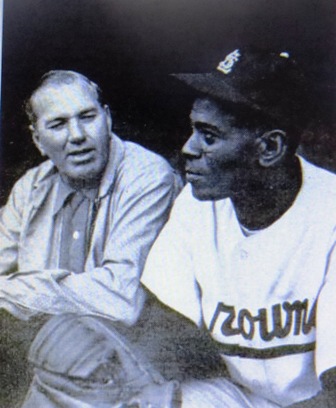
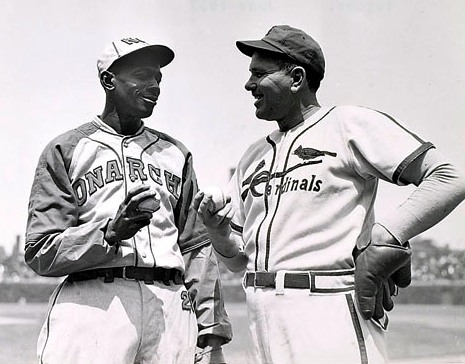
A Thousand Words–Satch and Diz

15 Mar

???????????????????????????????

Ted Williams called for the recognition of Negro League players in his 1966 Hall of Fame induction speech:

“The other day Willie Mays hit his five hundred and twenty second home run. He has gone past me, and he’s pushing, and I say to him, “Go get ’em, Willie.” Baseball gives every American boy a chance to excel. Not just to be as good as someone else, but to be better  This is the nature of man and the name of the game. I hope that one day Satchel Paige and Josh Gibson will be voted into the Hall of Fame as symbols of the great Negro players who are not here only because they weren’t given the chance.”

After Williams’ speech, Jay Hanna “Dizzy” Dean became one of Paige’s most vocal supporters.In 1968 Dean said:

“I think that he was one of the most outstanding pitchers I ever saw throw a ball and too bad he couldn’t have broken in in his prime when he could really fire that ball.”

Dean encouraged fans to write letters to members of the Baseball Writers Association of America to tell then “The venerable Leroy Robert Paige has proved he belongs in Cooperstown.”

Dean said he had “played more baseball against Satchel Paige,” than any other Major League player:

“I certainly think that if anybody belongs in the Hall of Fame, Satchel Paige deserves it as much as anyone else.  I think he was one of the outstanding pitchers of all times, and a guy who has given his life to baseball.”

Paige was the first player inducted to the Hall of Fame by The Special Committee on the Negro Leagues in 1971.

satchndiz

Things I Learned on the Way to Looking Up Other Things #1

7 Mar

There are many interesting, odd, great stories I stumble across when researching that are too short for a full post.

Sydney J. Harris, the late Chicago Daily News and Sun-Times Columnist had a regular feature by the same title as this post.  It seemed an appropriate name for this feature—so with a hat tip to Mr. Harris:

Arrested for Refusing to Fight Forest Fire

In December of 1911, Boston Red Sox pitcher Charley Hall and Pacific Coast League outfielder Harry Price were teammates on a winter league baseball team in Ventura, California, when a forest fire broke out in the area.  According to The Associated Press:

“When the fire was at its height Hall and Price…were sitting on the veranda of a hotel,  a deputy fire warden ordered them to fight the fire but they refused.”

Charley Hall, arrested for refusing to fight fire

Charley Hall, arrested for refusing to fight fire

Fire Warden John Kuhlman placed both players under arrest.  There is no record if they were ever convicted.

Baseball 1860

The New York Herald report on a July 5, 1860 game:

“The friendly game of ball between the Excelsior Club of Brooklyn and the Niagara Club of Buffalo resulted in an easy victory for the Excelsiors.

“The score was, Excelsior 50, Niagara 19.  In the fifth inning the Excelsiors made twenty-four runs.”

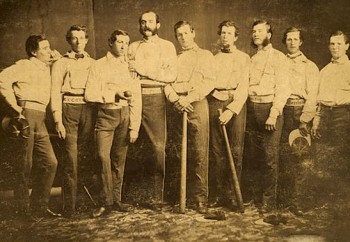
The Excelsiors, 1860

The Excelsiors, 1860

Carrier Pigeons

According to The Philadelphia Record in 1883 a zookeeper in Philadelphia used carrier pigeons dispatched between the zoo and Jefferson Street Grounds to provide updates on Athletic games.

Pigeons were also used by news organizations for the next several decades.  In 1900 The Milwaukee Journal bragged of their “carrier pigeon news service” which delivered updates from Milwaukee Park to the newspaper offices.  According to The Journal, sometimes the pigeons were more interesting to Brewers fans than the games.

The Journal’s carrier pigeon service attracted much attention on the field, and as each bird was released from the grand stand, the spectators of the game invariably lost interest for a moment in the diamond as they watched the bird dart upward and shape its course toward the city.

“Even the members of the contesting teams allowed their attention to be distracted at times by the unusual spectacle, and once, at the beginning of the sixth inning, when one of the liberated birds swooped down past big Perry Werden (Minneapolis Millers first baseman) as he stood guard over the initial bag…(Werden) raised an imaginary gun as though to take a shot at the pigeon, and of course the bleachers laughed.

“That The Journal’s service by means of the birds in not unknown to Milwaukeeans was well illustrated by the conversation of people seated around the spot from which the birds were set free.  They discussed the enterprise and those who did not understand the plan were quickly enlightened by the others, who knew all about how fast the birds flew, how they were kept and how they carried the news.”

The practice was continued at The Journal over the next decade.

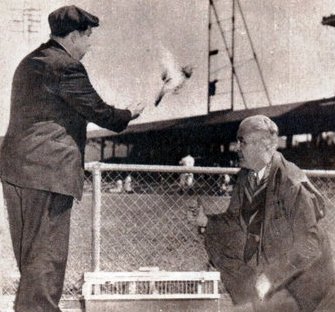
Cincinnati radio station WLW revived the practice for at least one game in 1939, when the station used pigeons to deliver information from a Reds game against the Pittsburgh Pirates to the studio.

Carrier Pigeons being released at Crosley Field,  Cincinnati, 1939

Carrier Pigeon being released at Crosley Field, Cincinnati, 1939