Tag Archives: Cap Anson

Jot Goar

15 May

Joshua Mercer “Jot” Goar had one good minor league season.

Born in 1870 in New Lisbon, Indian, Goar’s early career is mostly unknown, although he appears to have pitched for the Muncie club in the Indiana State League in 1890 and for a variety of semi-pro teams in that state during the early 90s.  In one version of a story I told in January (“Remarkable Baseball Stunt”), “Baseball Magazine” identified Goar as the pitcher who gave up six hits in one inning without a run scoring in an Indiana State League game versus Anderson.

Goar was signed by the Toledo Swamp Angels in the Western League in 1895 (the team would relocate to Terre Haute, Indiana during the season).  While his numbers don’t look impressive, 13-19 with a 3.38 ERA and 345 hits in 288 innings, Goar was called “The best twirler in the Western League,” by The Sporting Life, and quickly became a highly sought after prospect.  Goar also hit .273 as a part-time outfielder.

His manager Denny Long told Indiana papers that Cap Anson “offered him a neat sum,” to sell Goar to Chicago.  Instead, the pitcher was purchased by the Pittsburgh Pirates; The Anderson Herald said Pittsburgh paid $3,200 for Goar:

“Jot Goar, considered the greatest find in the Western League this year…is looked upon to be one of (the Pirates) mainstays for next year.”

Gore joined Connie Mack’s Pirates in Hot Springs, Arkansas in the spring of ’96 and made the team; he made his debut with the team on April 18, pitching in relief in a 7-2 victory over the Louisville Colonels.  Gore struggled in three games with the Bucs, he allowed 25 earned runs on 36 hits and eight walks in 13 1/3 innings, losing his only decision, and was sold to the Grand Rapids Rippers in the Western League on May.
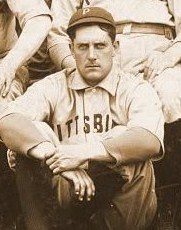
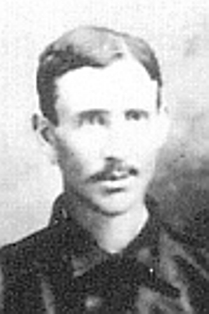
Jot_Goar

Jot Goar

No statistics survive for Goar’s 1896 season in Grand Rapids, but a mention of Goar in The New York American two years later said he had “deserted Grand Rapids,” at some point during the season.  Goar joined the Indianapolis Indians in 1897, and with a 25-9 record and a 1.39 ERA led the Indians to the Western League championship.  Goar was again highly sought after and his contract was purchased by the Cincinnati Reds.

Goar spent the winter refusing to sign a contract along with Frank “Noodles” Hahn, who had also pitched in Western League in 1897; the Cincinnati Enquirer said both players were asking for $1,800.  Goar finally signed in February, but the salary he settled upon was not reported, The Mansfield Daily Shield said:

 “Jot Goar has signed his Cincinnati contract and expects to play good ball this season.”

In March The Sporting News said:

“Jot Goar is showing more speed than any of the Reds pitchers.”

Goar did not live up to the expectations.  He hurt his arm in his first and only appearance; a two-inning mop up in an 11-5 loss to the Pirates, giving up, four hits, three runs, two earned, and a walk.

Pittsburgh Sports writer John Henry Gruber said Goar went to Reds manager Buck Ewing after the game “and at his own request was laid off until such time as he could get in shape.”

Goar returned to Indiana and for the remainder of 1898 and all of ’99 he managed and played first base for an independent team in his hometown in New Lisbon, that fall his team took part in a ballpark riot.  The Indiana State Journal said:

“The game of baseball between the Shamrock and Jot Goar teams on the Hagerstown grounds Sunday broke out in a riot.  Fists, clubs and stones were freely used and practically everyone who attended received some kind of injury.  The trouble arose over a decision of the umpire, who was Councilman John Geisler of Hagerstown.”

Gore began pitching again 1900 for the Indianapolis Hoosiers in the American League posting a 7-2 record in 10 games; he also played for the Western Association Hoosiers the following year, but there are no surviving records.

Goar returned again to New Lisbon, vowing that his pro career was not over, and accepted the position of postmaster and opened a general store while continuing to play for the local team. In 1904, The Sporting Life noted that he was still pitching in Indiana:

“Jot Goar, the old Cincinnati and Toledo pitcher, was doing things with the Connersville, Indiana team this season.  He pitched seven games for that club, six of which he won, the other being a 12-inning tie.  Only five runs were scored in the seven games, and he struck out seventy batters or an average of 10 a game.”

Goar gave up baseball after 1906.  He accidentally shot himself in the arm while hunting in 1907, and his general store burned to the ground, the 1911 “Reach Guide” said:

 “His place of business was completely ruined by a disastrous fire, which practically destroyed the business section of (New Lisbon).”

He rebuilt the store which he operated until 1921; Jot Goar died in 1947 at 77.
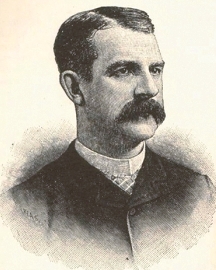
1876 Salaries

14 May

In July of 1876, The Brooklyn Argus published the salaries of the two highest paid teams in the newly formed National League; many of these have never appeared in any of the collections of early baseball salaries.

According to the article, the highest paid player was Chicago White Stockings pitcher Albert Goodwill Spalding who “as pitcher and manager, receives $3,000 for the year, with $1,000 bonus for producing the secession from the Hub (Boston) to Chicago.”  (The 1950 book “100 Years of Baseball,” by Lee Allen said Spalding earned $3,500 and a $500 bonus for the season).

A.G. Spalding, highest paid in National League

A.G. Spalding, highest paid in National League

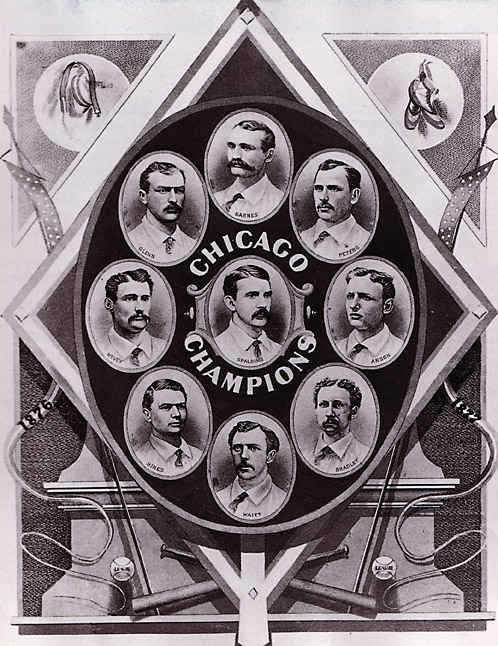
The three players Spalding brought with him from the Boston Red Stockings in the National Association, Catcher James “Deacon” White, first baseman Cal McVey and second baseman Ross Barnes were all paid $2,500.  The two players signed away from the Philadelphia Athletics, third baseman Adrian “Cap” Anson and outfielder Bob Addy received $2,200 and $1,500 respectively.

Outfielder Paul Hines earned 1.800, utility player Fred Andrus was paid 1,000, and the remaining members of the first National League Champions, shortstop John Peters and outfielders John Glenn and Oscar Bielaski were made $1500 each.

Chicago White Stockings, 1876 National League Champions--and highest salaried team.

Chicago White Stockings, 1876 National League Champions–and highest salaried team.

Harry Wright’s Boston Red Stockings filled the vacancies of White and Barnes with 18-year-old Lew Brown and 21-year-old John Morrill who The Argus said received “between 800 to 1000 dollars each.”

Manager Wright, who only appeared in one game, and his brother George were the highest paid members of the Boston club at $2,500 each.  Andy Leonard, who played second and outfield was paid $2,000.  Two other notable players on the Red Stockings, Hall of Famer “Orator Jim” O’Rourke and Tim Murnane received “between fifteen hundred and eighteen hundred dollars.”

According to The Argus, the White Stockings payroll of $21,500 topped the league, with Boston’s total of 18,000.

Crazy Schmit Stories

13 May

Fred “Crazy” Schmit was widely considered to be the first pitcher to keep a “book” on hitters, it was mostly attributed to his poor memory, and the pitcher kept an actual book in his pocket listing the weakness of each hitter.  The earliest reference to Schmit’s book was in The Sporting Life in 1894, but the story was repeated in newspapers for the next thirty years, usually as a story told by John McGraw or Hughie Jennings.

The article said Schmit kept:

“(A)n account of the weakness at bat of his opponents, setting them down in a small book, which he always carried with him on the diamond…One day when he had the Chicagos as opponents (it was the season that Captain Anson led the League in batting), Anson came to the bat. “Crazy” Schmit looked at the big first baseman, then went down into his pocket, and, taking out his book, read “Anson, base on balls.”

Over the years the story changed—the batter was sometimes Elmer Flick, Nap Lajoie, Ty Cobb, Honus Wagner, Tris Speaker, and as Jennings said in 1926, “Every good hitter since Anson’s day, but Anson is the player whose weakness was reported to be a base on balls.”

"Cap" Anson

“Cap” Anson

Jennings also claimed that during the 1890s as part of a prank by teammates aboard a ferry, Schmit’s suitcase, with his book inside, fell overboard, and said:

“Schmit was a losing pitcher from that time on.  He won a few games but lost a great many more…The bottom of Hudson River held his ‘pitching arm.’”

Pitcher turned sports cartoonist Al Demaree said Schmit “used to warm up with an old water-soaked ball that weighed several pounds—at a distance of 75 feet, and not the regulation 60 feet from his catcher.”

Al Demaree's Schmit cartoon--as with most references to the pitcher, his name is spelled incorrectly

Al Demaree’s Schmit cartoon–as with most references to the pitcher, his name is spelled incorrectly

After his final game with the Baltimore Orioles in 1901, Schmit continued to play with semi-professional and quasi-professional teams for more than a decade.  His antics continued to make the papers.

In 1906 Schmit joined Jim “Nixey” Callahan’s Logan Squares in the Chicago City League.  The Sporting News’ Revere Rodgers told a story (complete with Schmit speaking in a comic German accent) about the team going to Joliet, Illinois for a game:

“(The Logan Squares) knew the umpire was a ‘homer’—a man who couldn’t see a close decision without giving his team the best of it.  He stopped before the grandstand, hat in hand, and announced (the batteries)…’Crazy’ Schmit was right behind him and when (the umpire) finished Schmit took off his cap and making a sweeping bow said: ‘Laties and schentlmen, der umpire for der game today vill be Mister Miller of Joliet and he vill as usual slightly favor der home glub mit his decision.”

According to The Chicago Tribune’s Hugh Fullerton Schmit was deeply disappointed at the end of the 1906 season when Callahan did not allow him to pitch in the Logan Squares victories against the World Champion White Sox, and National League Champion Cubs.

Schmit continued to play in the Midwest and also did some scouting for John McGraw’s New York Giants.  A story that appeared in The Duluth News-Tribune said Schmit pitched a few games for the Fond du Lac in the Wisconsin-Illinois League (Schmit’s name does not appear on any Fond du Lac roster in either of the two years the other player mentioned in the story was with the team (1909, 1911)so the story may be apocryphal):

“Along about the seventh inning, with Rockford leading by 6 to 4 the first man up got on.  Schmit pitched out three times in an attempt to get the runner going down to second base, but the runner made no attempt to purloin the sack.  With the count three and nothing on the batter he grooved the next one, only to have the batter lean on it and drive it over the left field fence for a homerun.

“After the runners had circled the bases the umpire threw up another ball.  Schmit took it, shook his head and walked over to Bobby Lynch, who was playing third base…and said to him ‘Say, Bobby, no wonder I can’t beat these fellows.  I won’t pitch against them any longer.  I quit right now.  They don’t know how to play baseball and yet they are leading in this league.  The runner that was on first base just let me waste three balls and yet he does not attempt to steal; then when I put one over for the batter who has three balls and no strikes, he hits it.  Tell me, how can a man of my intelligence and baseball knowledge pitch a game of baseball against such boneheads and unscientific playing of the game?”

“Crazy” Smith died in Chicago in 1940.

Profiles of Members of Spalding’s World Tour, “The Stonewall Infield”

23 Apr

While with the players who took part in the world tour between the 1888 and ’89 seasons, Si Goodfriend observed:

 “My experience in traveling with baseball clubs, the circumstances of which necessarily brings about a close association, has impressed me with the fact that most of them are, as a rule, men of far more intelligence and better manners than they are generally given credit for.”

Among those players were all four members of the Chicago White Stockings “Stonewall Infield:” Adrian Constantine “Cap” Anson, Nathaniel Frederick “Fred” Pfeffer, Edward Nagle “Ned” Williamson, and Thomas Everett “Tom” Burns.

Goodfriend said of Anson:

“Decidedly the most unique and interesting figure of all is that of Captain Anson.  He shows the same peculiarities of temperament off as on the ball field.  He takes advantage of every point he sees and, and holds it…He may not admire a fellow baseball player personally, but this will not induce him to detract from his skill or standing as a player.

“’Old Anse’ has genuine sporting blood in him, and will bet on anything that turns up…There isn’t anything (aboard)the ship he won’t bet on if he has a fair chance of winning.  Anson’s nature is not nearly as harsh as some people imagine.  The rippling water in the moonlight or the graceful soaring of a bird will draw out the greatest sentiments from him.”

Like John Tener, Anson would enter politics, but was less successful.  After being elected Chicago’s city clerk in 1905, he was defeated in the Democratic primary for Cook County (IL) Sheriff in 1907

"Cap" Anson

“Cap” Anson

Of Pfeffer he observed:

“(He) is handsome and has no striking mental characteristics.  He has a long, flowing, brown mustache and soft brown eyes, both of which would readily come under the head of a womanly ‘lovely.’  To show the nature of the man I need only mention a little incident that is causing him much worry at the present time.  His only relative is his mother who lives in Louisville.  Before leaving on the trip he promised to write to her regularly and while on the ocean he promised to cable home from every point possible.  He did not know there was no cable from Honolulu, and now he is worrying himself that his old mother will be anxious about him until he can cable from Auckland.  It will seem an age to him until that city is reached.”

Pfeffer, along with “Monte” Ward was a leader in baseball’s nascent labor movement, Pfeffer was frequently at odds with Anson, and led the exodus of most of the White Stockings’ starters to the Players League.  Despite that, in 1918 Anson called Pfeffer the game’s all-time greatest second baseman after sportswriter Grantland Rice said Eddie Collins of the White Sox was the best ever.

Fred Pfeffer

Fred Pfeffer

Williamson, he said, was “unassuming” and:

“(A) big tender-hearted fellow, whom everybody likes.  He writes in an exceedingly clever and interesting style, and can ‘fake’ a good story like a veteran journalist.”

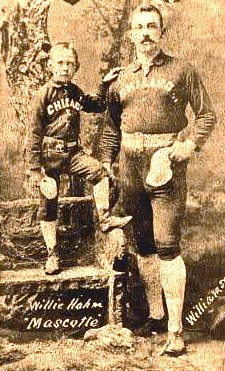
Ned Williamson with White stockings mascot

Ned Williamson with White stockings mascot

Williamson wrote his own dispatches from the tour which became popular features in Chicago papers.  He injured his knee on the tour and A.G. Spalding refused to help him with medical expenses; the 36-year-old Williamson jumped to the Players League in 1890, but his health began to deteriorate that year while playing for the Chicago Pirates.  He died of tuberculosis in 1894.

Goodfriend on third baseman Burns:

“(He) is a bright, intelligent man, who spends most of his time in reading; works of a standard heavy and weighty character being favorites.  He has the reputation of being a great dresser, and is said to have as many trunks with him as a New York belle would carry to Saratoga.”

Tom Burns

Tom Burns

Nearly a decade after the tour, Burns would be the man who replaced Anson as manager of the Chicago National League ballclub.  Burns took the reins of the “Orphans” in 1898, ending Anson’s 19-year run as manager.

Burns was named manager of the Jersey City Skeeters in the Eastern League in 1902, but died just weeks before the beginning of the season.

“Phil Powers Seems to be Dead to the World”

15 Apr

Phillip J. Powers again left the National League umpire staff at the close of the 1888 season.  In 1889 he returned to London, Ontario to manage the Tecumseh’s, quit in May to become an umpire in the International Association, and then resigned from that job to return to the National League as an umpire in July.

Phil Powers

Phil Powers

The Detroit Free Press said the former and current National League arbiter “would never be a success as an umpire.”

Within weeks he was again at the center of controversy.

After the Boston Beaneaters beat the Philadelphia Quakers on July 25, The Philadelphia Inquirer placed the blame for the home team’s loss squarely on the shoulders of one man:

“Anyone who saw Phil Powers umpire yesterday would set him down as incompetent or dishonest.  While he is neither of these he gave a combination of glaring decisions which robbed the Philadelphia club of the game…It was a hard game to lose and it was no wonder that nearly every one of the 6,7000 spectators joined in hooting at Powers.”

The Inquirer would continue to criticize Powers for the remainder of his career; a few sample quotes.

From 1890:

“Umpire Phil Powers seems to be dead to the world.”

From 1891:

“The rank work of umpire Powers.”

From 1892:

“Umpire Phil Powers has been unanimously elected a member of the Society for the Promotion of Riots.”

The Sporting Life joined the chorus and derided as a “decided detriment to the game,” his work in the Giants-White Stockings series in early August:

“Mr. Powers is not a competent umpire…He does not know the rules, and judging from his decisions on the bases his eyesight is certainly impaired.”

 The Chicago Daily News quoted “Cap” Anson saying Powers “ didn’t know his business.”

Powers did have one defender.  “Orator” Jim O’Rourke, of the New York Giants, wrote a long letter that was reprinted in The Sporting Life, and other papers, making the case for the “High opinion in which Mr. Powers is held by the majority of professionals”, and using the opportunity to heap scorn on Anson:

“No man ever filled the position to better advantage and with more honor and credit to himself.   Mr. Powers is conscientious, faithful and absolutely fearless in voicing his convictions; neither can there be any doubt of his intentions to discharge impartially the irksome duties which the office entail upon him.

“Anson’s hate of such a man is only limited by the capacity of his nature for hate. Now why is this so? Because this cross-grain brow-beater, with the swaggering air of a Mexican bandit, who is so susceptible to becoming red-headed In the presence of umpires and spectators, is forced by this honest referee to have the result of a game settled by the contesting clubs upon its merits and not by his disgusting methods, which have made him the laughing-stock of all players, not even excepting his own.”

Jim O'Rourke--Defender of Powers

Jim O’Rourke–Defender of Powers

Despite O’Rourke’s defense, the criticisms of Powers continued, but he managed to stay on the National League staff in 1890 and ’91.

The Sporting Life updated readers about the umpire through the 1891 season:

“(Powers) has been catching it along the Western line from spectators, players and reporters.”

“(The Pirates) ready to meet Anson’s team to the call of Umpire Phil Powers, who has never pleased Pittsburgh’s audiences”

“Western critics are unanimously of the opinion that Phil Powers argues too much with the players.”

“(Cleveland papers) roasted Phil Powers to their hearts’ content.”

In August of 1891 Powers was released as an umpire by the National League.  He died in New York City in 1914.

A postscript:

A story that has appeared in several books and articles (all citing previous secondary sources) claims Powers pulled a gun on enraged fans in either 1888 or ’89.  While similar stories have been attributed to other umpires (for example umpire Joe Ellick, in 1886, was escorted off the field in Philadelphia by police who drew their weapons to protect him from an angry mob) and there are numerous contemporaneous references to irate fans at games, some with Powers as umpire,  none mention the gun incident.

It is probably a conflation of stories such as Ellick’s and a wire service article that appeared in several newspapers in 1906, shortly after “Buck” Ewing’s death, and described another incident involving Powers and Ewing.

“It was in 1889 that one of the worst rows in the history of baseball was precipitated at Cleveland by “Buck” Ewing.  Phil Powers was umpiring and his weakness whenever a critical decision came up was so apparent that the crowd was on pins and needles as to which way the cat would jump.

“(Jimmy) McAleer hit for two bases.  After he had got (sic) to second, Ewing said something to Powers, and the umpire hesitated a moment and then declared McAleer out for not touching first base…(Powers) was not looking at first when McAleer passed, having turned his head as somebody yelled at him from the opposite side of the field.  This was plainly evident to the crowd, and the moment that the spectators understood why McAleer was out they bolted from the stands and made a rush for the umpire.

“(Powers) took one look at the approaching mob and fled to the players’ clubhouse.  The police cleared the field after a while and Powers was induced to come forth and finish the game, but with police protection on either side of him.”

According to the story (which makes no mention of a gun), Powers later admitted that he had no idea whether McAleer had touched first base and simply took “Ewing’s word for it.”

Jimmy McAleer, called out on Ewing's word

Jimmy McAleer, called out on Ewing’s word

“Leather-Fisted Phil”

12 Apr

“Leather –Fisted Phil” is what Phillip J. Powers was called in his 1914 Associated Press obituary which said:

“(Powers) was famous for his ability to stop the swiftest throws of the league’s star pitchers.”

He most likely earned the nickname in 1877 when, like many other catchers of the era, he began using a small, leather pad on his hand while with the London Tecumsehs of the International Association.

After the London team disbanded in August of 1878 Powers joined the Chicago White Stockings.  According to The Chicago Inter Ocean:

“He is a tall young fellow…He is described as a good catcher, but liable to get hurt, fair at the bat, and a genial man on the grounds.”

Powers would spend parts of seven seasons and 155 games in the National League and American Association with the Boston Red Stockings, Cleveland Blues, Cincinnati Red Stockings and Baltimore Orioles, hitting .180.  In between his engagements as a player Powers was an umpire.

It was as an umpire that he made a name for himself, but it probably wasn’t what he had in mind.  Few umpires, even in an era when members of the “profession” were poorly trained and underpaid, were the target of as much criticism as Powers.

In 1881 he began the season as a National League umpire.  By July he had become a target in several cities,

The Detroit News said:

“Phil Powers has acquired reputation enough in the last two weeks to last him a lifetime.  The erroneous umpiring he did here, people were inclined to regard as errors of judgment, but to say the least his ‘mistakes’ have become so numerous that his utter unfitness for the position he holds is unquestioned.”

The Cleveland Plain Dealer took the criticism even further:

“Powers is said to have been offered $150 to play ball (for the Detroit Wolverines) for one month, but refused it.  As an umpire he cannot, if square, earn more than $15 or $20 a week and expenses; and must take the chance at that of being chosen an umpire.  He preferred to be an umpire.  Several of his decisions on Saturday were grossly unfair, and, what is worse, they bore heavily on Cleveland.  They were so one-sided that many of the spectators believed he deliberately purposed to give the game to Troy.”

Despite the ill feelings in Cleveland, Powers joined the Blues in August and caught five games for the team after Michael “Doc” Kennedy was injured and John Clapp was “called away by an illness in his family.”   He finished the season with the New York Metropolitans in the Eastern Championship Association.

Powers again became a full-time player from 1882-1885, and was part of the Red Stockings American Association championship team in 1882.  He was released by Cincinnati in July of 1885, signed with the Baltimore Orioles and was again released the following month.

1882reds

1882 Cincinnati Red Stockings, Phil Powers standing 2nd from left

Powers was signed by the St. Louis Browns in the spring of 1886, but released before the beginning of the season, and was added to the National League umpiring staff in August.  He again worked as an umpire through the 1887 season, left to return to London, Ontario to manage the Tecumsehs in the International Association, but again returned to the National League as an umpire in August of 1888.   He came back just in time to find himself in the middle of a controversy involving two Hall of Famers.

New York Giants catcher/captain William “Buck” Ewing was hit on the wrist by a ball during a game with the White Stockings in Chicago.  In 1888 the opposing team’s captain had to agree that an injury was serious to necessitate a substitution; Chicago’s “Cap” Anson said he did not agree to a substitution when backup catcher “Big Bill” Brown entered the game in the 6th inning.  Anson appealed to the umpire, and according to The Chicago Inter Ocean, “(Powers) said that Captain Ewing was not so badly hurt that he could not play.”

After a heated argument, during which The Inter Ocean said Ewing acted “in a childish and fatuous manner,” Powers declared the game “forfeited to Chicago by a score of 9 to 0.”

Buck Ewing acted “in a childish and fatuous manner”

Buck Ewing acted “in a childish and fatuous manner”

Powers had been involved in a similar situation in 1886, refusing to allow Philadelphia Quakers catcher “Deacon” McGuire to leave a game after an injury.  The Chicago Tribune said Quakers captain Arthur Irwin “told McGuire to catch ‘away back’ (from the plate).” The Tribune said Irwin’s actions created a “scene” and “pandemonium reigned,” until Anson agreed to allow Philadelphia to replace McGuire.  White Stockings President A.G. Spalding “preferred charges against umpire Powers” for losing control of the game.

The substitution rule was changed in 1891, putting an end to controversies regarding the replacement of injured players.

But controversies involving Powers continued.  More on Monday.

“The most Extraordinary of the Championship Contests so far”

8 Feb

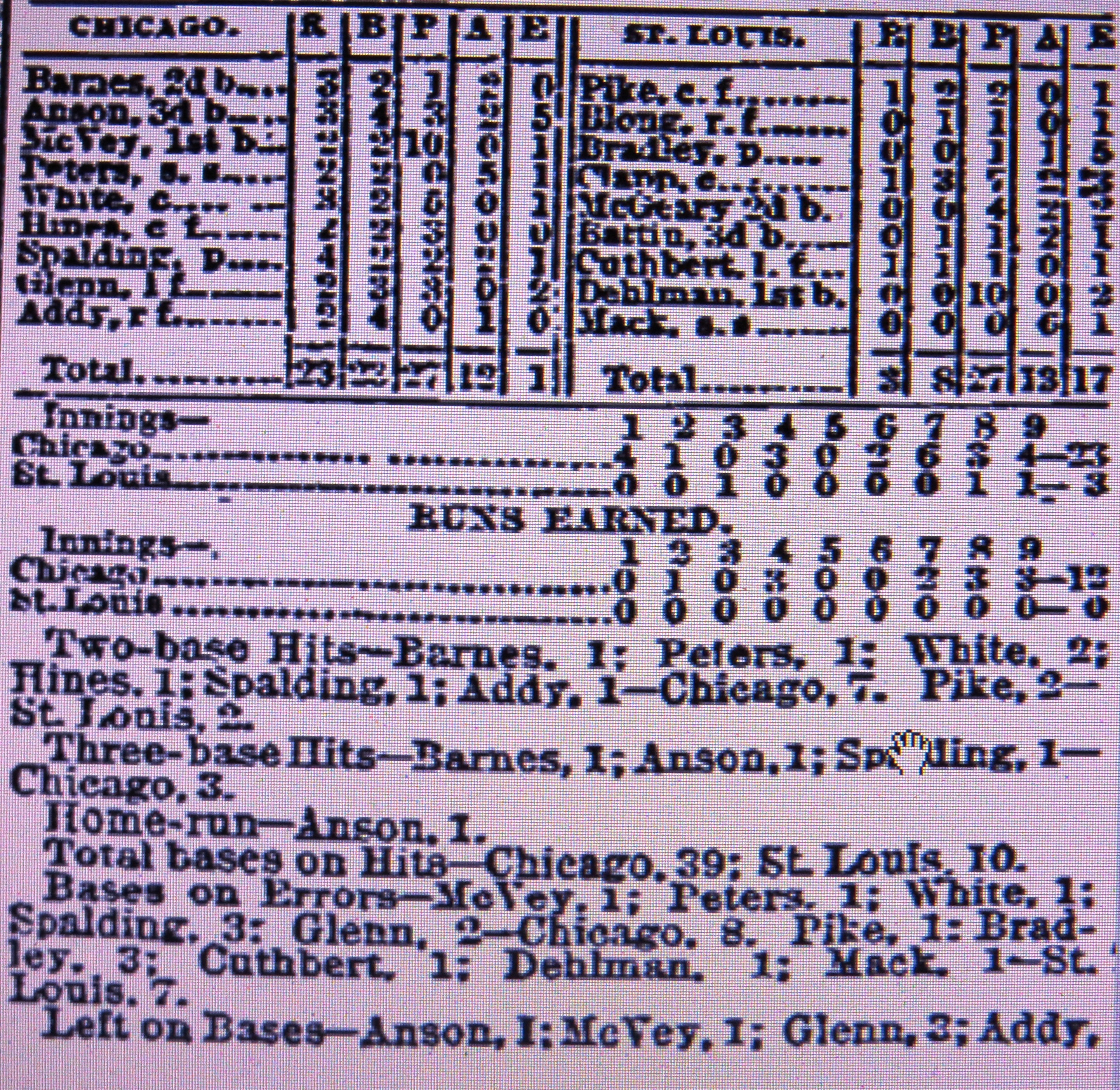
A game recap and box score from the National League’s inaugural season.  On August 26, 1876, the Chicago White Stockings defeated the St. Louis Brown Stockings 23-3 in Chicago.

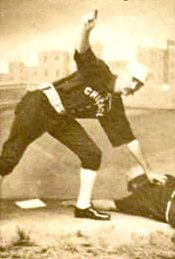
Cap Anson, 50 errors in 1876

Cap Anson, 50 errors in 1876

Among the game highlights, White Stockings 3rd baseman Cap Anson made five errors, on his way to 50 for the season, Brown Stockings pitcher George Bradley also committed five (he only had 12 for the season) and the two teams combined for 28 errors.

The Chicago Inter-Ocean said the game was the turning point of the season in the White Stockings drive for the first league championship in a breathless, meandering report:

“The closing game of the Chicago-St. Louis series which was played Saturday at the Twenty-Third Street grounds, proved to be by all odds the most extraordinary of the championship contests so far.  As if determined to wipe out every record of the St. Louis having ever won a game from them, the Chicagos turned themselves loose and broke Bradley’s heart…Nearly 5,000 witnessed the game, and the enthusiasm rose at times to fever-heat.”

The story said Anson redeemed himself for his errors “two or three” of which were “comparatively easy balls,” by hitting a triple and a home run:

“Obtained on a terrible drive to right field which went clear to the fence…The Chicago batting was tremendous, and the visitors were kept on a continual hunt for the ball.”

The box score:

???????????????????????????????

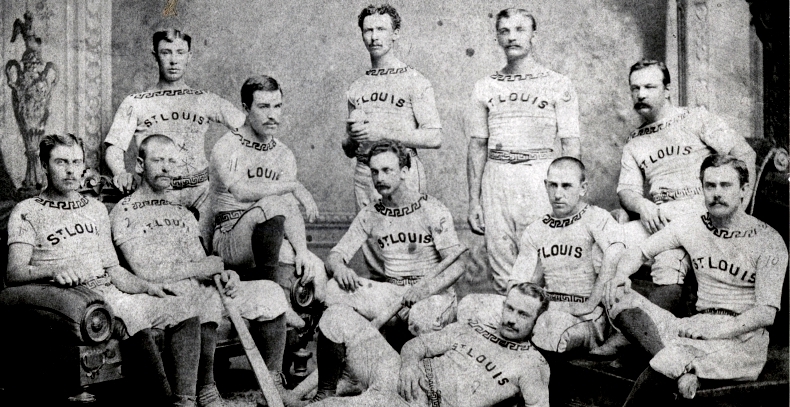
Albert Spalding, Chicago’s manager, and pitcher, who batted 7th started all but six of the White Stockings 66 games in 1876. Bradley, who batted third, started all 64 of the Brown Stockings games and pitched 573 of the 577 innings played by St. Louis—outfielder Joe Blong pitched 4 innings in one game.  Bradley also pitched the National League’s first no-hitter against the Hartford Dark Blues on July 15.  As expected with the number of errors, Bradley gave up 151 unearned runs for the season.

1876 St. Louis Brown Stockings, George Bradley

1876 St. Louis Brown Stockings, George Bradley, standing center, Joe Blong, standing left

After his 45-19 season for the third-place Brown Stockings, Bradley was acquired by the White Stockings in 1877, with Spalding moving to 1st base.  The White Stockings finished 5th with a 26-33 record, Bradley was 18-23.

St. Louis finished fourth, Blong split time between the outfield and the mound and went 10-9 for the Brown Stockings.


Zimmer Rules

20 Dec

After Charles “Chief” Zimmer’s single, difficult season managing the Philadelphia Phillies he briefly became a National League umpire.

Reports said the adjustment from player and manager to umpire were difficult at first.  According to a brief story that appeared in several newspapers on the eve of Opening Day:

“Chief Zimmer umpired the Pittsburgh-Little Rock game last week, but he could not resist coaching the players, for he forgot himself once in the third inning and yelled ‘Look out!’ to (Tommy) Leach when Little Rock was trying to catch him off first.”

But by May he seemed to have eased into his new position, telling reporters:

“I hesitated about taking up the work, knowing that the life of an umpire is supposed to be filled with anything but joy.  However, I can honestly say that I am more than pleased with the experience thus far.  I have had no trouble at all, and players and spectators have accorded me the best treatment.  I don’t think I’d give up my present work to go back to catching.”

In September The Pittsburgh Press said there was “No doubt (Zimmer) will be reappointed,” as a National League umpire in 1905, but by January it was announced that he had not been retained.

Zimmer entertained offers to play for the Toledo Mud Hens of the American Association and the Rochester Bronchos of the Eastern League, but instead took a position as an Eastern League umpire.

He returned as a player/manager the following season with the Little Rock Travelers in the Southern Association.

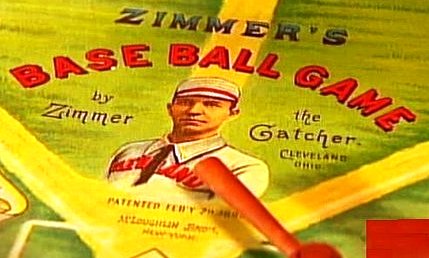
Through it all Zimmer was one of baseball’s earliest and best self-promoters.  In addition to endorsing Zimmer’s Baseball Game and his cigars, produced in what The Sporting Life said was “an extensive cigar factory in Cleveland.”  Zimmer always talked to reporters and always gave them something to write about, including his ideas for rule changes.

Zimmer's Baseball Game

Zimmer’s Baseball Game

In 1905 The Pittsburgh Press said “’Chief’ Zimmer has a scheme which he thinks would increase batting without abolishing the foul strike rule.” (The “scheme” was not Zimmer’s idea; it had been advocated by some for more than two decades, including “Cap” Anson and Zimmer’s former boss, Cleveland part owner Davis Hawley).  The plan would:

“Increase the territory of the fielders without increasing the length of the base lines…new foul lines (would be) drawn from the home plate to the fences.  At the point where they would pass first and third bases the lines would be six feet distant from the bases, gradually increasing the distance from the present foul lines as they neared the fences.”

Later he can out in favor of abolishing the foul strike rule when the issue was briefly discussed in the aftermath of the relatively low-scoring 1905 World Series.

In 1909 Zimmer suggested another rule; this one would essentially eliminate intentional walks by allowing any man on base to advance one base after a walk.  Zimmer said:

“It’s not right for a pitcher to take away Lajoie’s chance of hitting by walking him when there are men on bases.  I saw Larry passed four times in two games last fall.  He was paid to hit with the men on bases…Pitchers would have to put the ball over and the good batters would get a chance to do what they are paid for.”

Luckily like most of the other odd rule changes suggested during baseball’s first several decades, Zimmer’s “schemes” received little traction as both would have radically altered the game.  But Zimmer’s rules did succeed in accomplishing what they were most likely intended to do: they kept Zimmer’s name in the paper long after his career was over.

A final post on Zimmer and, perhaps, his greatest contribution tomorrow.

Chief and Cy

19 Dec

Charles “Chief” Zimmer caught Denton True “Cy” Young’s first Major League game; an 8-1 victory for the Cleveland Spiders over Cap Anson’s Chicago Colts.

Years later, Davis Hawley, a Cleveland banker and hotel magnate who also owned a minority share of the Spiders and served as the team’s secretary, related a story about Young’s debut:

“The night of Young’s first National League game, he complained to me that although he had let Anson’s team down with a few hits, he had not had his usual speed.”

Hawley who had watched him pitch in the Tri-State League asked why he felt that way.

“Well, down in Canton the catchers could not hold me I was so fast, but this man Zimmer didn’t have any trouble at all, so I guess I didn’t have much speed.”

Zimmer would go on to catch 247 of Young’s starts through 1898, including 19 shutouts; second in both categories to Lou Criger, who played with Young in Cleveland, St. Louis and Boston.

Zimmer would catch Young a few more times after 1898.

In 1921 the 54-year-old Young pitched two shutout innings, with the 60-year-old Zimmer catching, in a game between Cleveland Major League legends and amateur stars staged as part of Cleveland’s 135th anniversary celebration.  In addition to Young and Zimmer, Nap Lajoie, Earl Moore, Bill Bradley, Charlie Hickman, Nig Cuppy and Elmer Flick were among the participants.

Earl Moore, Cy Young, Bill Bradley, Charlie Hickman, Nap Lajoie and Chief Zimmer at the 1923 game.

Earl Moore, Cy Young, Bill Bradley, Charlie Hickman, Nap Lajoie and Chief Zimmer at the 1923 game.

The game was such a success that for the next four years it became an annual event at League Park (called Dunn Field during the 1920s); Young pitched the first two innings of each game with Zimmer catching. The event benefited the Cleveland Amateur Baseball Association medical fund.

Young always shared credit for his success with his catchers.  In the 1945 book “My Greatest Day in Baseball As told to John P. Carmichael and Other Noted Sportswriters,” he said:

“Every great pitcher usually has a great catcher, like Mathewson had Roger Bresnahan and Miner Brown had Johnny Kling. Well, in my time I had two. First, there was Chief Zimmer, when I was with Cleveland in the National League, and then there was Lou Criger, who caught me at Boston and handled my perfect game.”

A little more “Chief” tomorrow.

Filling in the Blanks— H. Pipp

1 Nov

Baseball Reference lists H. Pipp with the 1887 Big Rapids team in the Northern Michigan League.  Five years later he became a minor sensation in Chicago.

In January of 1892 Cap Anson announced that he had found a new second baseman for the Chicago Colts.  The signing of Henry L. Pipp of Kalkaska, Michigan was described by The Sporting Life:

“The good Captain dug up his latest phenom in the wilds of Michigan…Pipp is 26 years old, 6 ft. 2 in. high 205 pounds heavy, and as quick as a cat.”

The Chicago Daily News called Pipp “Anson’s great find.”

The Chicago Tribune was less impressed, and concerned that the untested Pipp might replace the popular Fred Pfeffer (sent to Louisville after a dispute with Anson) at second base:  “That would be a dangerous thing to do.  Second base is key to an infield as Anson learned to his cost in 1890,” (the Colts finished in second place with Bob Glenalvin at second after Pfeffer jumped to the Players League).

In March Pipp went to Hot Springs, Arkansas with the Colts, but the reviews were not good.  New York Giants shortstop “Shorty” Fuller said:

“Anson’s team (can’t win) unless he gets a second baseman.  He must have a man to take Pfeffer’s place that can play ball.  That man Pipp won’t do.  We played against him at Hot Springs and he is slower than molasses in January.”

Henry Pipp

With much less fanfare than his signing, Pipp was quietly let go before the season began, the Tribune simply said, “Pipp could not play the position.”

Henry Pipp returned to Michigan.

He owned a hardware store, received a U.S. patent in 1917 for a “Holding device” he invented, and played baseball for more than 20 years in Michigan based leagues.

There is another “Pipp” listed on the 1887 Big Rapids roster—it is most likely Pipp’s brother William.

William left Michigan in the early 1890s for Chicago.  His son, Henry’s nephew, became famous as the man replaced as New York Yankees first baseman by Lou GehrigWally Pipp.

Henry Pipp died in Benton Harbor, Michigan on February 16, 1936.