Tag Archives: Charlie Comiskey

“I Object to Being Made a Freak.”

17 Jul

In 1913 American League President Ban Johnson set out to put an end to the practice the Baseball Writers Association called “A growing Evil,” ghost-written articles appearing under the by-lines of famous ballplayers.

William Peet of The Washington Herald revealed the identities of the ghost writers in March of 1913; Gerhard “Roger” Tidden of The New York World had been the man responsible for articles bearing the name of Ty Cobb, but Tidden died just three months after the revelation.   While the practice waned after 1913, Cobb remained defiant, and continued “authoring” a syndicated column for the next several years.
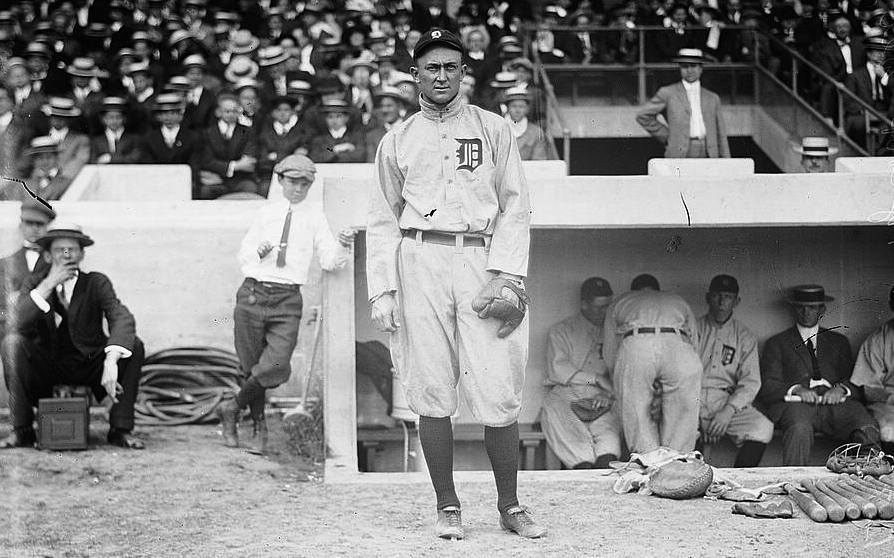
Ty Cobb

Ty Cobb

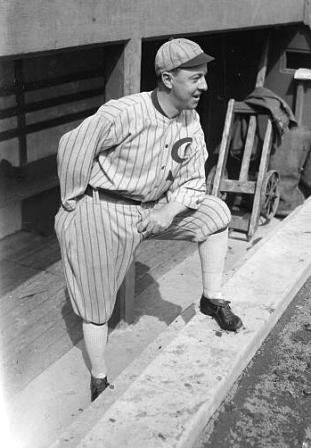
Cobb’s articles, for the most part, steered clear of trouble with the league president, but the assertions he made about the Chicago White Sox and manager Clarence “Pants” Rowland in June of 1915 caused a major stir.

Cobb said:

“Battery signal stealing, which has been the cause of several scandals in big league baseball threatens to make more trouble this season if anyone is able to prove what is generally suspected about one of the American League clubs.

“I will not mention the name of the organization which has been accused by the opposing players…because I couldn’t present any proof.”

Cobb then went on for seven paragraphs trying to present proof, and provided enough hints to make it clear he was talking about the White Sox.

Cobb’s said

 “The team I have in mind has won almost all its home games…It looks mighty funny, though, the way this club could hit at home and the feeble manner in which it has been swatting on the road and almost all of the Tigers will take an oath that something out-of-the-way is coming off.”

Chicago, through 49 games, was in first place; 22-8 at home and 9-10 on the road.  Detroit was in second place a game back.  If he left any doubt Cobb said later in the column when discussing the American League pennant race in general:

“The White Sox, who burned up things at home, have not been doing so well on the road.”

Everyone, including American League President Ban Johnson, assumed Cobb was talking about the Sox.  Johnson said:

 “(Cobb) must prove the charges, or I will keep him from playing baseball.  If any man in the American League makes a charge of dishonesty and refuses to back up his charge with the absolute evidence, that man will have to get out of the game.”

The White Sox were less concerned; The Chicago Tribune said the charges made Sox players “grin,” and Rowland told reporters:

“I suppose we had out tipping instruments planted in the Polo Grounds when we made nineteen hits in New York the other day.”

Clarence "Pants" Rowland

Clarence “Pants” Rowland

In his next column Cobb issued a non-denial denial and at the same time openly, and loudly, defied Johnson:

“I made no specific charge against the White Sox…What I did say was that a strong rumor of sharp practice was abroad, and I reiterate that statement right here.”

___

“Mr. Johnson even went to the extreme of saying that he would drive me out of baseball.  He hasn’t done this yet and I expect to stay around for a few more days.  If the league president is willing to pay the salary that my three-year contract calls for, I will be perfectly willing to take a vacation at that, for I have long wanted to do a number of things that baseball interferes with.”

Cobb reiterated the charges and offered no evidence, but said he was justified in making the claims because his manager might have believed them:

“(Tigers) Manager (Hughie) Jennings thought the report sufficiently serious to detail one of our players for plain clothes duty in the bleachers, and he also wrote Manager (Bill) Donovan of New York, telling him of a warning we had received and cautioning him to be on the lookout.  So you see the signal tipping report was not a creature of my own imagination, but a matter of sufficient seriousness to warrant an investigation by our manager in his official capacity.”

Cobb’s only bit of backtracking was to say that if “it should be proved the White Sox tried signal stealing it would be without the knowledge of Mr. (Charles) Comiskey.”  Cobb said Comiskey “wouldn’t countenance anything of this sort for a moment.”

Cobb took one last swing at Ban Johnson, charging the league president with giving “sensational interviews” about him to get “the people excited artificially. If this is Mr. Johnson’s idea, I wish he would abandon it.  I object to being made a freak.”

If there was any doubt whether the American League’s star player or the league president wielded more power, it became obvious within a week.

Johnson, who The Associated Press said “long has been opposed to players permitting their name to be used over baseball stories,” decided not only had Cobb not written the columns, but claimed “a Detroit newspaperman” made up the allegations “out of whole cloth,” and incredibly said that Cobb had “no knowledge,” of the columns despite Cobb being quoted by numerous sources discussing the charges.
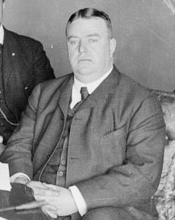
Ban Johnson

Ban Johnson

Hugh Fullerton of The Chicago Examiner summed it up best:

“We are rather surprised each morning upon picking up our newspaper to discover that Ty Cobb is still making two-base hits, two steals and catching a few flies instead of being driven out of baseball by (Ban) Johnson.  By the way how did Johnson get into baseball?”

As quickly as Johnson backed down, the charges went away.  Despite the strong start the White Sox faded, and continued to fade even after the acquisition of “Shoeless Joe” Jackson on August 21, finishing third, nine and a half games behind the pennant-winning Boston Red Sox and seven games behind the Tigers.

Cobb led the league for the ninth straight season, hitting .369.

The one legacy from the brief 1915 controversy seems to be Cobb’s dislike of Rowland, who later became a scout for the Tigers.  In his 1984 book “Ty Cobb,” Charles C. Alexander said Cobb only agreed to manage the Tigers before the 1921 season because he was told:

 “Pants Rowland, whom Cobb considered an incompetent fraud, might very well get it and Cobb would have to play for him.”

Rowland, who remained in baseball until 1959 as a manager, scout and executive with the Los Angeles Angels in the Pacific Coast League and Chicago Cubs in the National League, appears to have also held a grudge.   Up until his death at age 90 in 1969, Rowland often said two of his former players, Jackson and Eddie Collins were better than Cobb.

 In 1953 at the Old Timers Baseball Association of Chicago Banquet Rowland said “I wouldn’t have traded (Collins) for Cobb.  What made him greater than Cobb was that he inspired the entire ball club.  Ty was an individualist.  He was interested only in Cobb.”

Rowland called Jackson the “greatest natural hitter,’ he ever saw, and said Ted Williams, not Cobb, was the only player “of the same make-up.”
“The Sudden Reappearance of ‘Silver’ King”

27 Jun

Oliver Perry “O.P.” Caylor wrote in June of 1896 in The New York Herald:

“One of the baseball surprises of the season is the apparently successful reappearance of ‘Silver’ King upon the National League diamond.  Without any warning the Washington club sent him in against the Pittsburgh team, and he not only won his game, but held the latter down to six hits, Of course all this caused a great deal of gossip wherever baseball is a subject of interest.”

When Charles Frederick “Silver” King (born Koenig), took the mound for the Washington Senators and beat the Pittsburgh Pirates 8 to 1 in the second game of a May 30 doubleheader, it was his first appearance in professional baseball in nearly three years.

King had been one of baseball’s best pitchers of the 1880s, with a 142-70 record from 1887-1890 while playing for Charlie Comiskey, first with the St. Louis Browns in the American Association and then following Comiskey to the  Chicago Pirates in the Players League.

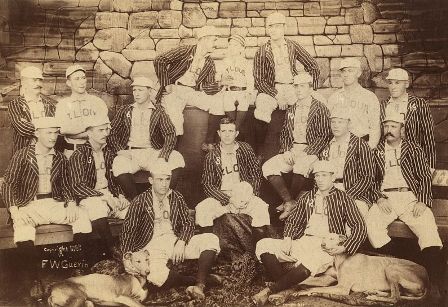
Comiskey (8) and pitcher Silver King (14) with the 1888 St. Louis Browns, King would follow Comiskey to the Chicago Pirates in the Players League in 1890

Comiskey, seated center(8) and Silver King standing second from right (14) with the 1888 St. Louis Browns, King would follow Comiskey to the Chicago Pirates in the Players League in 1890

Caylor said that during Flint’s heyday:

“His most successful delivery was what is known as ‘the cross fire,’ first used effectively, I believe, by (Charles “Old Hoss”) Radbourne and at present the prominent stock in trade of (Wilfred “Kid”) Carsey of the Philadelphias (Phillies).  It consists of standing on the extreme end of the pitcher’s plate, stepping away still farther from the direct line towards the batsman and sending the ball across the home base at an angle, which, although small, is very bothersome to the man with the bat.”

Silver King

Silver King

Caylor said King was “put out of the business” in 1893 when “the pitcher’s box was set back five feet,” (to the current 60’ 6”).  While King’s record slipped during the last two seasons the distance was 55 feet to a combined 36-53 while pitching for the Pirates and New York Giants, he had respectable ERAs of 3.11 and 3.29.  After the rule change King went 8-10 with a 6.08 ERA pitching for the Giants and Comiskey’s Cincinnati Reds in 1893, and then disappeared.

Caylor thought there was “a great deal of significance to King’s return to the diamond,” and predicted a trend:

“It means managers, having exhausted the new crop and finding nothing before them worth a trial, are forced to look behind and try to rekindle some of the half burned out embers. Washington not only took up King, but they gave (Les) German a trial after the New York club let him go.  (Cap) Anson (Chicago Colts) went back to (Fred) Pfeffer after finding (Algernon “Algie”) McBride, (Josh) Reilly and (George) Flynn wanting and was even forced to put himself into his nine to fill out the weak spots.”

Caylor said it was “astonishing  to look over the list of new material which was brought into the National League last spring and notice how small a part of it has been able to keep ‘in the swim.’  Every day one hears that some younger player has been released or that another has been loaned or farmed to a minor league club.”

Caylor’s prediction of success for the “trend,” and the players named was a mixed bag.  Anson, who had never really gone away, hit .331 in 108 games, for the Colts, but Pfeffer hit just .244 in 94 games. German fared the worst, he was 2-20 in 1896 and 3-5 the following season before being released in August.

King managed to post a 16-16 record for the Senators in 1896 and ’97 but never found his early career form.  After the 1897 season, he returned to St. Louis where he died in 1938.

Caylor would become ill the following season, and died in October of 1897.

The Curve and The Spitter

26 Jun

Hugh A. “Hughey” Reid only appeared in one professional game; he went 0-4 and played right field in a game for the American Association’s Baltimore Canaries against the White Stockings in Chicago in August of 1874,  as was the practice at the time, Baltimore recruited Reid, a local semi-pro player to fill in for the injured Oscar Bielaski.

Reid wasn’t known in the amateur and semi-pro leagues in Chicago as an outfielder.  He was considered one of the best pitchers in town, and played for the Chicago Aetnas, one of the premier teams in the city, and according to The Chicago Tribune “The champion amateur team of 1869.”

Hugh Reid

Hugh Reid

Among Reid’s teammates with the Aetnas were future big leaguers Jimmy Hallinan and Reid’s brother-in-law and catcher Paddy Quinn.

Reid worked as a stereotyper (made metal printing plates), for The Chicago Evening Post after his career ended.

In 1920, Reid was interviewed by Alfred Henry “Al” Spink, founder of The Sporting News.  By 1920, Spink, who had played amateur baseball in Chicago against Reid with a team called the Mutuals (named for the more famous aggregation in New York), had relocated to Chicago and was writing for The Evening Post.

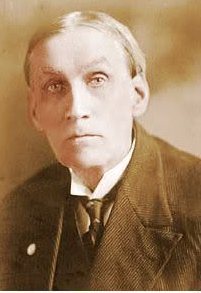
Al Spink

Al Spink

The occasion was “field day exercises of the old timers” at Pyott Park at the corner of Lake Street and Kilpatrick Avenue in Chicago; the days events were followed by a banquet.  “Cap” Anson, Charles Comiskey, Hugh Nicol, and Fred Pfeffer were among the dozens of former pro, semi-pro, and amateur players who attended.

Spink described the 70-year-old Reid; “same old smile, same old swagger, same old don’t care a tinker’s, same old Hughey.”

Nine years earlier Spink had credited William Arthur “Candy” Cummings with originating the curveball in his book “The National Game,” but by 1920 others were making the case for different candidates.  Spink asked Reid his opinion:

“Without a doubt Cummings was the first pitcher to put the curve on the ball.

“As Cummings was using the outcurve as early as 1867, and Bobby Matthews only broke into the game at Baltimore in 1869, there is very little doubt as to who discovered the art of curving.

“In fact, it was not until years later, when the rules allowed the pitchers to raise their arm above the waist, that Matthews became master of the curve.”

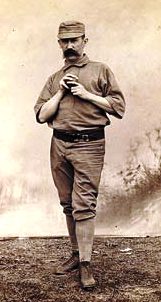
Candy Cummings

Candy Cummings

Reid also talked about the pitch Mathews did introduce:

“I am quite sure that Mathews was the first to work the delivery mow bearing the insanitary name

“Before delivering the ball he would rub it hard on his trousers, always on the same spot, where the seams are the farthest apart…he would draw his two fingers across his lips, take the ball with two fingers and a thumb and send it in with only fair speed.  He had perfect control and usually sent the ball about waist-high for a player calling for a low ball.  The break came just in front of the plate and the ball usually went into the ground or very high in the air.  Few line drives were made off of Mathews.”

Bobby Mathews

Bobby Mathews

Reid also talked about Alphonse Case “Phonney” Martin.  At the same time that Spink was making the case for Cummings in “The National Game,” Martin told William Aulick of The New York Globe that he developed the pitch. Aulick concluded:

“Some people say this was the first cousin of the curve ball, but they don’t say this when old Alphonse Martin is around.  He insists it wasn’t anyone’s cousin–it was Mister Curve himself.”

Reid disagreed, he described Martin’s pitch as a “freak ball,” and said:

“I first saw Martin pitch down on the old lake front grounds in Chicago against the original White Stocking team.  He simply threw a slow lob ball that came so slow you had to nearly break your back to hit it.  But, at that, his delivery was a success, and most of the balls hit from it went high in the air and came down in some fielder’s hands…He threw a slow teaser that reached the plate about shoulder-high and dropped while still spinning.”

Alphonse "Phonney" Martin

Alphonse “Phonney” Martin

Reid insisted Martin’s pitch was not a curve:

“Cummings and Cummins alone was the originator of the curve.”

“The Greatest Team Ever Organized”

24 Apr

Hopes were high for The Players League, and for Chicago’s franchise, the Pirates, in the newly formed baseball brotherhood.

Rumors had been reported for more than two months, but finally on January 18 The Chicago Daily News said that Charlie Comiskey “came to town yesterday morning, and at 4 o’clock signed…for three years,” to serve as captain and manager; the contract was said to be worth “$5,000 per annum.”

President Charles A. Weidenfelder had built a strong ballclub, with major assists from Fred Pfeffer, Chicago White Stockings second baseman, who encouraged most of that team to jump to the new league, and Frank Brunell, a former Chicago newspaper man who was secretary of the new league, and traveled to St. Louis to encourage Comiskey to jump to the brotherhood.

There was an embarrassing moment in March when Chicago newspapers reported that the carpenters union was complaining that non-union labor was being used to build the team’s ballpark at Thirty-Eighth Street and Wentworth Avenue.    The secretary of the union was quoted in The Chicago Tribune saying  Brunell had “promised to make it right.  But he didn’t.”

Despite the  irony of a league borne out of the game’s first labor movement betraying organized labor (there were similar difficulties in Boston and Philadelphia), enthusiasm for the new league was high; in Chicago the expectations were higher.  A week before the season opened The Chicago Tribune said:

“The elements which go to make up a great team are united in the Chicago Brotherhood Club, which, on paper, is the greatest team ever organized.”

Comiskey’s club opened the season on April 19 in Pittsburgh.  According to The Chicago Inter Ocean:

“It was a great day for the Players League…There were 9,000 people by the turnstiles’ count to see the fun…It was by all odds the biggest crowd that had ever turned out to witness an opening game of ball in Pittsburgh.”

The pregame festivities included a parade through the streets of Pittsburgh featuring both teams, league officials and a Grand Army of the Republic brass band.

“(Pittsburgh) Manager (Ned) Hanlon was presented with an immense floral horseshoe, Comiskey with a big floral ball on a stand of floral bats, Pfeffer with a basket of roses…(Chicago’s Arlie) Latham ‘stood on his head, with a smile well-bred, and bowed three times’ to the ladies.  (He had) the legend ‘We are the people’ in great black letters on (his) broad back.”

After the fanfare, “Pfeffer and the boys played a particularly brilliant game,” as Chicago defeated Pittsburgh 10-2.

Box Score--Chicago Pirates/Pittsburgh Burghers, Opening Day, 1890.

Box Score–Chicago Pirates/Pittsburgh Burghers, Opening Day, 1890.

Opening Day was the high point for Chicago. The league as a whole struggled financially and attendance dropped sharply after the initial excitement wore off.  Only eight games into the season, barely 500 people attended Chicago’s game in Cleveland on May 1.

Comiskey’s “greatest team ever organized,” was never able to keep pace with the league champion Boston Reds and finished fourth in the eight team league, 10 games back.

The Chicago Times lamented the team’s poor showing and blamed it on a “lack of discipline,” (the article appeared in slightly different form in several newspapers):

“The outside world cannot fully realize the bitter disappointment felt here over the poor showing made by Comiskey’s team during the season just closed.  Surely it was strongest aggregation of players ever collected in one club, but its lack of success was mainly from two causes—lack of discipline and the miserable condition of certain members of the club.

“There has been absolutely no discipline in the team, and some of the men paid as much attention to Comiskey’s orders as they would to a call from some church congregation.  An order to sacrifice was met with a smile of scorn, and the ball was hammered down to an infielder, who made an easy double play.”

The Times said “(Tip) O’Neill, Latham, Pfeffer, (Jimmy) Ryan and others utterly ignored Comiskey’s mandates, and in consequence there was continual disorder.”

The paper’s primary target was shortstop Ned Williamson.  The criticisms might have been unjustified: the former White Stockings favorite had struggled with the knee injury he sustained on the 1888-89 world tour, and might have already been ill as his health would decline rapidly, and he’d be dead by 1894; the victim of tuberculosis:

“Williamson played a game of which an amateur should have been ashamed, and was thirty pounds overweight throughout the season.”

The paper promised “there will be numerous, changes in the club, provided the players League is still in existence,” in 1891.

It was not to be.  By November league secretary Brunell told The Chicago Herald:

“The jig is up.  We are beaten and the Brotherhood is no more.”

Brunell attempted to put a positive spin on the news, telling the paper it was mistaken to infer the “Brotherhood has weakened.”  Rather “we began to see that the interest in baseball was on the wane, and in order to prevent it from dying out entirely…we finally concluded that a consolidation of forces (with the National League and American Association) would be better for all concerned.”

The Herald wasn’t buying Brunell’s statement:

Brunell’s talk has finally let in the light on a subject previously enveloped in darkness.  It appears now that the Players League folks actually courted a knockout, and bankrupted themselves from pure patriotic motives.  The ex-secretary is a funny little man.”

Brunell would go on to found The Daily Racing Form in 1894.

Comiskey returned to the St. Louis Browns in the American Association.  Tip O’Neill, who also jumped the Browns to join the Players League, returned to St, Louis with his manager.

Comiskey (8) was joined in Chicago by three members of his American Association championship teams in St. Louis.  Arlie Latham (7), Tip O'Neill (11), and pitcher Silver King (14) who posted a 30-22 record.

Comiskey (8) was joined in Chicago by three members of his American Association championship teams in St. Louis. Arlie Latham (7), Tip O’Neill (11), and pitcher Silver King (14) who posted a 30-22 record.

Fred Pfeffer stayed in Chicago, spending one more turbulent season with Cap Anson, before being traded to the Louisville Colonels.

Arlie Latham, “The Freshest Man on Earth” went to the Cincinnati Reds in the National League.

Ned Williamson never played again.

“Not Quite Such an Idiot”

5 Apr

The 1889 American Association season began and ended as a two-team race between the Brooklyn Bridegrooms and St. Louis Browns, who had won four straight championships—the third place Philadelphia Athletics finished 16 games back.  The battle between Brooklyn and St. Louis was bitter and culminated in September with a charge of umpire bribery.

St. Louis owner Chris von der Ahe made a charge of attempted bribery of an umpire.  He said Brooklyn Captain William “Darby” O’Brien had attempted to bribe umpire John Kerins “$100 and the chance for him to umpire in the World’s Series if Brooklyn got there.” (Some accounts claim the amount was $1000, but the overwhelming number of contemporaneous stories put the figure at $100).

Chris von der Ahe

Chris von der Ahe

The Browns owner claimed “I can prove,” the charges and said “Kerins himself told the story in my presence.  Captain (and manager Charles) Comiskey and another party were in the carriage at the time.”

The other “party” never materialized, and Comiskey, no stranger to dubious charges, never fully backed his boss with a statement confirming the accusation.

Kerins, who since 1884 had bounced back and forth between playing in the American Association with the Indianapolis Hoosiers, Louisville Colonels and Baltimore Orioles, and working as a minor league and Association umpire, called the claim “Simply absurd.”

John Kerins

John Kerins


He said he never spoke to von der Ahe, and “I never told Comiskey that any attempt had been made to bribe me,” and that all the charges came from a misinterpreted conversation he had with Comiskey.

Kerins said he simply mentioned to the Browns manager that O’Brien had made “A casual remark,” that “I would give $100 out of my own pocket if Brooklyn could win the championship.”

Kerins said he told O’Brien he’d like to serve as an umpire in the World Series (against eventual National League champions the New York Giants), but it appears Kerins, like every other Association umpire, told many people he’d like to earn the additional money paid to post-season umpires.

Kerins told The Baltimore American that he was:

“Not quite such an idiot as to sell (myself) for the paltry sum of $100.”

O’Brien issued an indignant statement about the charges that appeared in The Chicago Times and other newspapers:

“I was completely nonplussed when I read that story, and, as it was the first intimation I had had of it, you can well imagine my surprise.  To think that that story should reach the eyes of my folks in Peoria and that they might believe me capable of stooping to a dishonest act is what galls me.”

Darby O'Brien

Darby O’Brien

Brooklyn went on to beat the Browns by two games for the American Association Pennant and lost the World Series to the Giants six games to three.

Nothing came of the charges, and it seems doubtful von der Ahe and Comiskey actually believed they were true.

A postscript:  After Comiskey jumped the Browns the following season to join the Chicago Pirates in Players League, von der Ahe signed Kerins (who had all but called him a liar six months earlier), and named him manager in May (one of five Browns managers that season) for 17 games; under Kerins the browns were 9-8.  In June Kerins, hitting .127, was replaced as manager and released by the Browns.

Charlie Hoover–Infinite Baseball Card Set

21 Mar

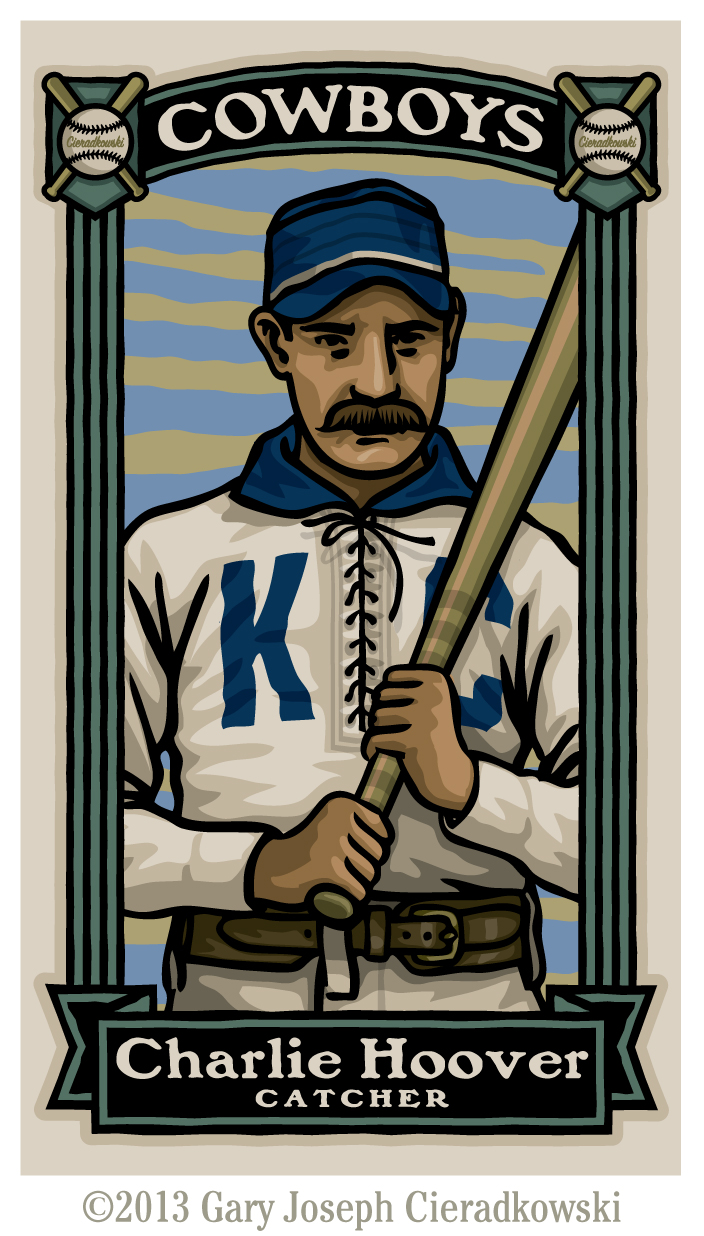
Gary Cieradkowski is an exceptionally talented artist from Covington, Kentucky.  Since 2010 he has produced the great Infinite Baseball Card Set Blog–with excellent stories and his incredible art work.  Gary contacted me recently about collaborating on a piece.  I chose Charlie Hoover.  Hoover was a talented, troubled 19th Century catcher who faded into obscurity and remains one of a handful of Major League players for which there is no information on the place or date of his death.  Read the piece here on Gary’s blog.

This is the card Gary created:

HOOVER_LG