Tag Archives: Chicago Colts

Filling in the Blanks— H. Pipp

1 Nov

Baseball Reference lists H. Pipp with the 1887 Big Rapids team in the Northern Michigan League.  Five years later he became a minor sensation in Chicago.

In January of 1892 Cap Anson announced that he had found a new second baseman for the Chicago Colts.  The signing of Henry L. Pipp of Kalkaska, Michigan was described by The Sporting Life:

“The good Captain dug up his latest phenom in the wilds of Michigan…Pipp is 26 years old, 6 ft. 2 in. high 205 pounds heavy, and as quick as a cat.”

The Chicago Daily News called Pipp “Anson’s great find.”

The Chicago Tribune was less impressed, and concerned that the untested Pipp might replace the popular Fred Pfeffer (sent to Louisville after a dispute with Anson) at second base:  “That would be a dangerous thing to do.  Second base is key to an infield as Anson learned to his cost in 1890,” (the Colts finished in second place with Bob Glenalvin at second after Pfeffer jumped to the Players League).

In March Pipp went to Hot Springs, Arkansas with the Colts, but the reviews were not good.  New York Giants shortstop “Shorty” Fuller said:

“Anson’s team (can’t win) unless he gets a second baseman.  He must have a man to take Pfeffer’s place that can play ball.  That man Pipp won’t do.  We played against him at Hot Springs and he is slower than molasses in January.”

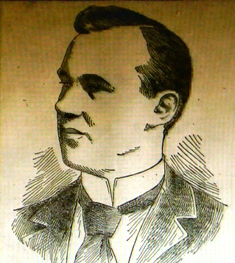
Henry Pipp
With much less fanfare than his signing, Pipp was quietly let go before the season began, the Tribune simply said, “Pipp could not play the position.”

Henry Pipp returned to Michigan.

He owned a hardware store, received a U.S. patent in 1917 for a “Holding device” he invented, and played baseball for more than 20 years in Michigan based leagues.

There is another “Pipp” listed on the 1887 Big Rapids roster—it is most likely Pipp’s brother William.

William left Michigan in the early 1890s for Chicago.  His son, Henry’s nephew, became famous as the man replaced as New York Yankees first baseman by Lou GehrigWally Pipp.

Henry Pipp died in Benton Harbor, Michigan on February 16, 1936.
A Really Bad Idea

19 Oct

James Aristotle Hart (his middle name is incorrectly listed as Abner on Baseball Reference) was an influential figure in shaping baseball’s rules.

Hart managed the Louisville Colonels in 1885 and ’86.  He then purchased the Milwaukee franchise in the Western League, and helped A.G. Spalding organize the first baseball teams to go on world tours.  He returned to the National League to manage the Boston Beaneaters in 1889.

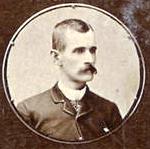
James Hart, 1886

In 1890 he went to England and Scotland to help launch a professional baseball league, and upon his return he became secretary of the Chicago Colts and served as an intermediary in the 1890 fight between the National League the nascent Players League.  He became president of the Chicago club the following year, succeeding Spalding, and served in that capacity until 1905.

The New York Times said:

“Many rules now deemed indispensable were championed by Hart.  The foul strike rule, one of the most important, was his final effort in the rule making.  He was largely responsible for…defining the coachers’ box, changing the pitchers’ box and substituting the slab, altering the shape of the home plate, requiring the catcher to play close up to the plate all the time, abolishing the foul tip and covering the players’ bench.”

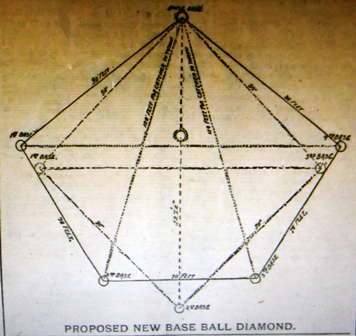
One rule that Hart considered seriously enough to release to the press “with earnest request for publication and comment,” would have completely changed the game as we know it.

The idea, proposed by a man from Rollo, Missouri named Cliff Spencer and submitted to Hart, called for a redesign of the baseball diamond.

The Sporting Life said of the design:

“The proposed new diamond is a startling innovation, but the more it is studied the more favorably it impresses.”

The new diamond would increase the number of bases from three to four and while the distance between the bases would remain 90 feet:

“(T)he new base lines would throw first and fourth bases about ten feet further out than the present base lines. Thus making a very much larger area for fair balls.”

After several more paragraphs espousing the virtues of the new design, The Sporting Life concluded:

“No decided disadvantages are apparent in this proposed new diamond except that it may operate to the extreme in batting, base running and run-scoring.  (The) objection, could however be easily overcome by deadening the ball somewhat more should the batting become too heavy.”

The article concluded:

“The proposed new diamond, if adopted, would be a radical innovation.  But it maybe that a radical remedy is requisite to restore the base ball patient to entire health and vigor. It is generally conceded that some changes in the game are urgently needed in order to make it more attractive, to lift it out of the rut of pitcher-domination.”

Diagram of the proposed new diamond laid over traditional diamond–home plate is at the top.

Even the glowing review of the proposed plan in The Sporting Life stopped short of absolutely endorsing the idea:  “It is not intended here to advocate, either reservedly or unreservedly, the adoption of this radical innovation,” because it was conceded that there were much less radical measures that could be adopted to increase run production.

Within a week The Sporting Life, and every other newspaper who had published a story about the new diamond concept, had concluded that the idea would never be adopted.

Hart, a long time advocate of increasing run production, was not known to have ever again commented on the new diamond.