Tag Archives: Chicago White Sox

“A Historical Account of a Great Game of Ball”

5 Mar

The headline above appeared in 1907 above an article written by Frederick North Shorey in The Freeman regarding a series between Andrew “Rube” Foster’s Leland Giants and Mike Donlin’s All-Stars “an aggregation composed of such noted players as Mike Donlin, Jake Stahl, Jimmie Ryan and Jimmy Callahan, probably the best semi-professional team in the country.”

Shorey said the series at South Side Park “exceeded in interest to the people it attracted anything that took place between the White Sox and Cubs last fall (1906 World Series).”

Rube Foster beat the Donlin All-Stars 3-1 in the first game, allowing only three hits:

“Rube Foster is the pitcher of the Leland Giants, and he has all the speed of (Amos) Rusie, the tricks of a Radbourne, and the heady coolness and deliberation of a Cy Young. What does that make him? Why, the greatest baseball pitcher in the country; that is what the best ballplayers of the white persuasion that have gone up against him say.”

Rube Foster
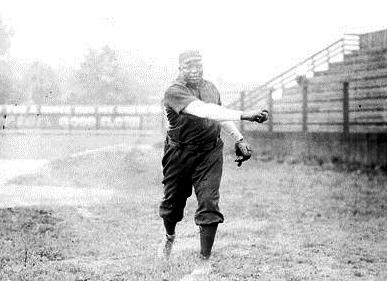
Rube Foster

Foster was so important to his fans, Shorey said:

“If it were in the power of the colored people to honor him politically or to raise him to the station to which they believe he is entitled, Booker T. Washington would have to be content with second place.”

The Chicago Tribune said of Foster’s domination of the All-Stars:
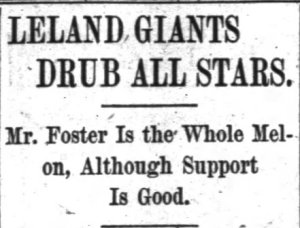
lelandsvsdonlins

Back to the series, and back to Shorey:

“While the all-stars were confident in their ability to win, several of the old players, including Mr. Donlin himself, who have known of the prowess of Mr. Foster…knew that it was by no means a certainty…but they had hopes that the colored team behind him might do something to undo the efforts of the twirler.

Mike Donlin
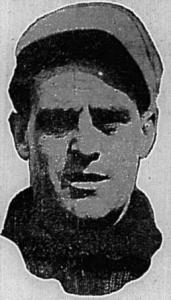
Mike Donlin

Shorey said the all-stars were over matched:

“The colored men set a new pace for base running, while foster’s cool, deliberate pitching was too much for the old-time players on Donlin’s team. Both teams put up brilliant fielding games.”

Foster pitched in four games in the series; he won all four.

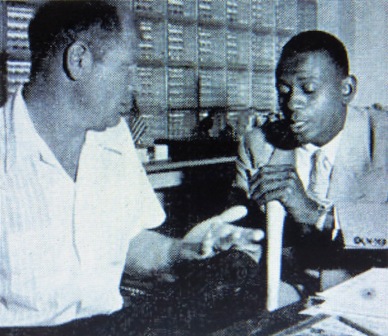
David Wyatt–who had been a teammate of Foster’s with the Chicago Union Giants in 1902, and who in 1920 was asked by Foster to help draft the constitution of the Negro National League—also wrote about the series in The Freeman:

“All the baseball critics in the city were out to look the Lelands over, many under the impression that they were overrated. The most interested of the number was Mr. Comiskey, owner of the white Sox…After witnessing the first game the white sox boss said if it were possible he would have annexed the signature of at least three of the boys to contracts, and he was so enthused over the fast, snappy work of the Lelands that he had his world’s champions to lay over one day in Chicago to watch the boys play.”

Wyatt had higher hopes for “Baseball as the common leveler” in general and the series specifically:

“There was no color line drawn anywhere; our white brethren outnumbered us by a few hundred, and all bumped elbows in the grand stand, the box seats and bleachers; women and men alike, all whetted freely with one another on the possible outcome of the series, the effect it would have upon the future of the negro in baseball, the merits of the different players etc…”

Foster’s heroics, Wyatt’s hopefulness, Comiskey’s words and Chicago’s enthusiasm were, of course, not enough to change the status quo; regardless of the “Great game of ball,” played at South Side Park in that 1907 series, the color line would remain intact for four more decades.
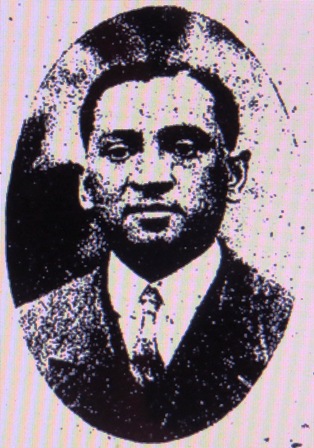
David Wyatt
David Wyatt

Veeck and Paige–a third time?

27 Feb

In 1959, when Bill Veeck purchased the White Sox rumors swirled in Chicago that the Sox owner was planning on having Satchel Paige start on Opening Day. Later, as the Sox were making a run for their first American League Pennant in 40 years the rumors resurfaced that the ageless Paige would join the White Sox for the Pennant run.

???????????????????????????????

Bill Veeck and Satchel Paige, 1959

Paige, who had played for Veeck with the Cleveland Indians and St. Louis Browns, had spent 1956-59 with the Miami Marlins in the International League, winning 31 games. He had returned to barnstorming with the Cuban Giants and Indianapolis Clowns in 1959, but it was reported he was looking for another chance in the Major Leagues, and in June it began to be reported again that Paige would be joining the Sox.

A United Press International story in July said that Veeck had “sent Paige two new Chicago White Sox uniforms,” and quoted Paige:

 “If they want me they’d have to pay me big money.  I’m not going back for nothing.”

Whether it was ever a serious discussion, or simply two famous showmen milking rumors for the maximum publicity will never be known, but Veeck and Paige let the rumors swirl well into August before Veeck finally put them to rest, telling Jet Magazine:

“We’re not giving any thought to hiring him.  I’m very fond of LeRoy and I see him whenever he’s in town.  I gave him the uniforms because we’re old friend and for no other reason.”

And with that White Sox fans missed the chance to see the pitcher who Veeck called “The best righthander baseball has ever known,” pitch for the 1959 Pennant winners.

Ty Cobb, Joe Jackson, Harry Hooper and Quackery

15 Feb

Baseball history is full of stories of products that have been routinely used in the belief they give players an edge.  Some, like steroids and amphetamines have obvious benefits; others like Power Balance bracelets provide none.

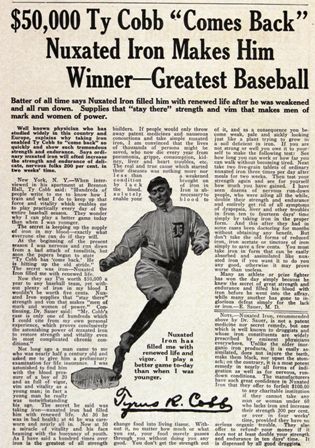
In 1916 advertisements began to appear in newspapers and magazines across the country for a new miracle drug from DAE Health Laboratories in Detroit: Nuxated Iron.

An ad featuring Ty Cobb said “Greatest Baseball Batter of all time says Nuxated Iron filled him with renewed life after he was weakened and all run down.”

Cobb said in the advertisement:

“At the beginning of the present season I was nervous and run down from a bad attack of tonsillitis, but soon the papers began to state ‘Ty Cobb has come back, he is hitting up the old stride.’ The secret was iron—Nuxated Iron filled me with renewed life.

“Now they say I’m worth $50,000 a year to any baseball team.”

cobbnux

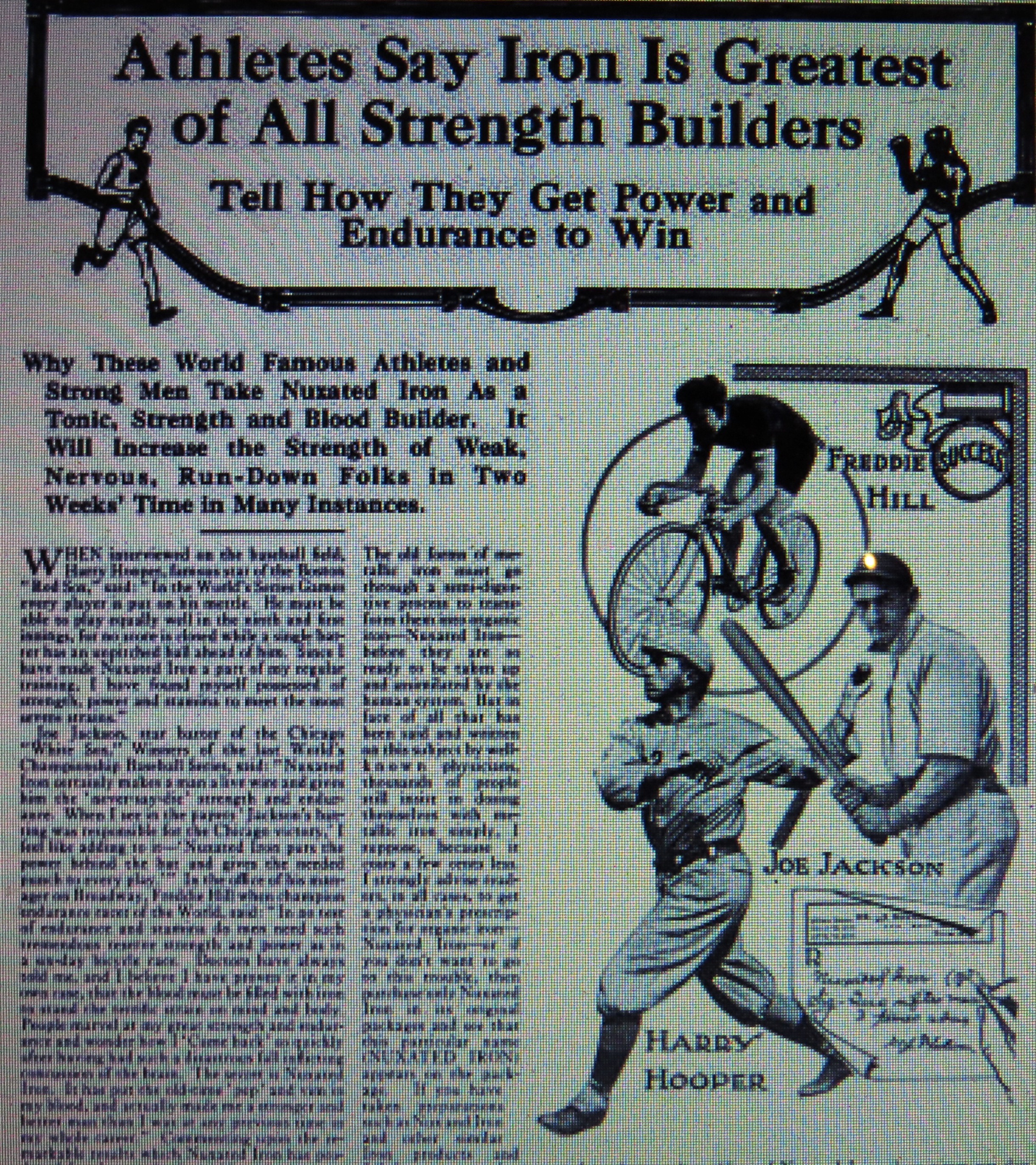
Other ads for Nuxated Iron began to appear, featuring boxer Jess Willard, cyclist Freddie Hill and baseball stars Harry Hooper and Joe Jackson.  Hooper said:

“Since I have made Nuxated Iron a part of my regular training, I have found myself possessed of strength, power and stamina to meet the most severe strains.”

Jackson said:

Nuxated Iron certainly makes a man a live wire and gives him the ‘never-say-die strength and endurance.”

The illiterate Jackson added: “When I see in the papers ‘Jackson’s batting was responsible for the Chicago victory,” I feel like adding to it—‘Nuxated Iron puts the power behind the bat and gives the needed punch to every play.’”

???????????????????????????????

The Journal of the American Medical Association took notice of the Nuxated Iron ad campaign and in October of 1916 had this to say about the “miracle drug:”

“Newspapers whose advertising ethics are still in the formative stage have, for some months past, been singing—at so much a song—the praised of “Nuxated Iron.”  The public has been that this nostrum is what makes Ty Cobb, “the greatest baseball batter of all time,” a “winner” and is what helped Jess Willard “to whip Frank Moran” besides being the “untold secret” of Willard’s “great triumph over jack Johnson.”

All that DAE would say about the ingredients were:

“Formula—The valuable blood, nerve force and tissue building properties of this preparation are due to organic iron in the form of ferrum peptonate in combination with nux vomica (strychnine) phosphoglycerate and other valuable ingredients.

But alas, The AMA Journal was not impressed with the claims made by Nuxated Iron’s endorsements:

“The Journal felt that it owed it to the public to find out just how much iron and nux vomica there were in ‘Nuxated Iron.’  Packages of the nostrum…were subjected to analysis.”

What the analysis found was that the formula that made Ty Cobb a “winner,” offered no health benefits:

“There is only one-twenty-fifth of a grain of iron in each ‘Nuxated Iron’ tablet, while the amount of nux vomica…is practically negligible…In a dollar bottle of ‘Nuxated Iron’ the purchaser gets, according to our analysis, less than 2 ½ grams of iron; in 100 Blaud’s Pills, which can be purchased at any drug store for from 50 to 75 cents, there are 48 grains of iron.”

To sum up their analysis The Journal called the claims made by Nuxated Iron “the sheerest advertising buncombe.”

Contemporary sources said Cobb earned as much as $1000 for his endorsement of Nuxated Iron; there is no record of what Hooper or Jackson were paid, but all three disappeared as paid spokesmen for the product by early 1917.

Nuxated Iron stayed on the market, and stayed in the crosshairs of the AMA until at least 1921.  But by then, the company no longer used baseball players to sing their players.

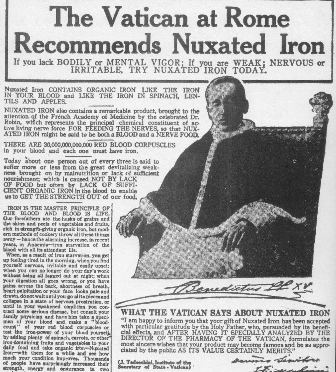
The 1921 ad campaign for Nuxated Iron sought a higher authority to promote the product’s benefits, and featured a picture of Pope Benedict XV under the headline:

“The Vatican at Rome Recommends Nuxated Iron.”

pope

Fielder Jones and the Chehalis Gophers

11 Feb

Most biographies of Fielder Jones—player-manager of the 1906 World Champion Chicago White Sox, the Hitless Wonders—mention that he managed the Chehalis Gophers, a team in the Washington State League, in 1910;  they never mention that he ended up there because of a near-fatal assault before he arrived.

The 36-year-old Jones left the White Sox after the 1908 season to settle in the Portland, Oregon and tend to his many business holdings in the area.  In 1909, he was named president of the Northwestern League, and served for one season.  According to West Coast newspaper reports, Jones was in the running to named president of the Pacific Coast League in 1910, before Thomas Graham was elected as a compromise candidate.

In the spring of 1910, Jones coached the Oregon Agricultural College (now Oregon State) baseball team to the school’s first conference championship.

At the same time, Jones was coaching at OAC, the Washington State League was getting underway—the league had been operating for at least three seasons, but 1910 was the first year it was recognized under baseball’s national agreement as an “official” minor league.

The Chehalis Gophers were led by 27-year-old Fred Nehring; he had previously played on the Pacific Coast, Northwestern and Connecticut State Leagues.  Nehring, who was born in Pueblo, Colorado in 1883, but grew up in Chehalis, had been playing on and off with the local team since leaving the Tacoma Tigers in 1908

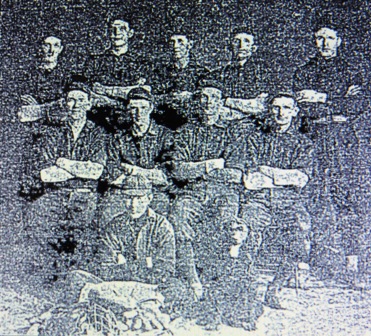
1908 Chehalis team. Fred Nehring standing 2nd from left, Tamp Osburn, standing 4th from left.

1908 Chehalis team. Fred Nehring standing 2nd from left, Tamp Osburn, standing 4th from left.

Another player who had spent time with Chehalis since 1908 was a pitcher known variously as “Tamp” Osburn, Osborn or Osborne (for the purpose of this story we’ll call him Osburn—most common usage by contemporaneous sources).  Tamp Osburn has, at least, two separate, partial listings on Baseball Reference.

Osburn was considered a talented pitcher, but an erratic character.  While pitching for the Spokane Indians in Northwestern League in 1907, he quit the team in June.  According to The Spokane Daily Chronicle:

“The whole trouble yesterday started when a couple of misplays in the eighth inning put a losing aspect on the game…Tamp blames the whole trouble on (William ‘Terry’) McKune, who he says ‘threw’ the game on him.”

Osburn had additional problems with teammates and developed a reputation as an eccentric, and like all eccentric pitchers of the era there was one he was often compared; The Daily Chronicle called him “The Rube Waddell of the Northwestern League.”

After playing together for Chehalis in 1908, both Nehring and Osburn played in the short-lived Inter-Mountain League in 1909; both returned to Chehalis after that league folded in July.

???????????????????????????????

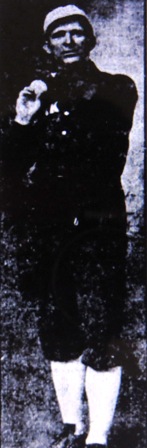
“Tamp” Osburn, 1908 with Spokane Indians

On May 20, just after the 1910 season opened, the Chehalis team boarded a train.  According to The Chehalis Bee-Nugget:

“(Osburn) who had been drinking before the train left Chehalis became so unruly on the train that the train crew called on Fred Nehring, captain of the Chehalis team to quiet him.  Tamp resented Nehring’s efforts to keep him from cursing in the presence of ladies, and pulled a knife and began to slash Nehring…Two severe cuts…in the left arm, and the other was in the breast.  If the latter had been an inch farther over, it would have penetrated the lungs.”

Nehring had the wounds dressed, left the hospital against doctor’s advice and managed the Chehalis team “from the bench.”  Despite the seemingly quick recovery, Nehring only appeared in a few games the rest of the season.  Osburn was arrested.

The Chehalis team floundered for the next several weeks.  In late June, it was announced that Fielder Jones would join the team as manager and centerfielder.

Under Jones, who was still property of the White Sox and needed Charles Comiskey’s approval to play, Chehalis easily won the league championship; Jones hit .358 in 37 games.

Jones had agreed to play for the team for no salary and was only reimbursed for his expenses.  This arrangement nearly cost Chehalis the league championship.  According to The (Portland) Oregonian, the second place Raymond Cougars protested to the league and the National Commission that all wins under Jones should be forfeited because Jones “was not under contract.”  The protest was denied and Chehalis was declared league champion.

Osburn was sent to the Lewis County Jail while awaiting trial, and according to The Oregonian was involved in an attempted escape along with other prisoners who occupied the jail’s first floor, a week after his arrest.  The paper said of Osburn “the baseball player, and one other man were taken to the cells on the second floor and locked up securely.”

There is no record of whether Osburn was convicted; in any case, he was free by July of 1911 and was pitching for the Missoula, Montana franchise in the Union Association when The Helena Daily Independent reported that Osburn:

“The Missoula pitcher, who started a rough house in a Missoula cafe and pulled a knife on a stranger, drew a severe panning from the judge, who, after fining him $25, -said: ‘There are some good men on your team, who behave themselves, but there is a lot of you whose conduct is a disgrace to the city and the national game. We don’t want that kind of men in Missoula uniforms, and you fellows have got to stop such actions.”

Contemporaneous newspaper accounts say he was a native of Utah, but given the inconsistent spelling of his last name, and a full first name never being listed, the trail for Osburn ends after this 1911 incident.

Nehring remained in Chehalis where he died on February 19, 1936.

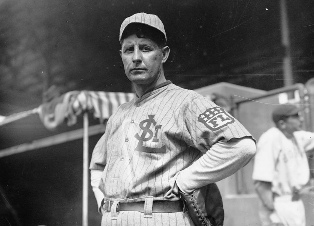
Jones returned briefly to baseball in 1914 and 1915 as manager of the Saint Louis Terriers in the Federal League.  He died in Portland in 1934.

Fielder Jones, 1914

Fielder Jones, 1914

A Thousand Words–Satchel Paige, Chicago White Sox

6 Feb

???????????????????????????????

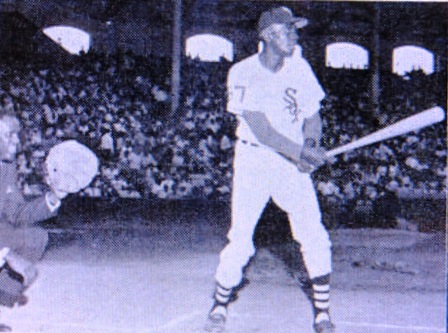
What if?  Satchel Paige in a White Sox uniform.  From 1938-1947 the Sox never finished better than 3rd, add Satchel Paige to those teams, which already had some good pitching including Ted Lyons, Eddie LopatThornton Lee, Monty Stratton and Orval Grove, and Sox fans might have had something to cheer about.  But of course, by the time Paige had a chance to play in the Major Leagues he was at least 42-years-old.  Paige would have helped at the box office as well.  For example, on July 18, 1942 the Sox drew slightly better than 24,000 for a doubleheader with the Detroit Tigers, across town at Wrigley Field a nearly identical amount came out to watch Paige pitch the first five innings for the Memphis Red Sox against the New York Cuban Stars.

Instead, all White Sox fans have is this rare photo taken in 1965 when Paige appeared with the Indianapolis Clowns at Comiskey Park (Chicago Cubs outfielder George Altman is the catcher in the picture).

——-

in 1935, Gene Coughlin, a sports writer for The Los Angeles Evening Post-Record wrote a column that went largely ignored, calling on organized baseball to break the color barrier which “not only makes (baseball) look ridiculous but is at the same time passing up increased business.”  Coughlin predicted that if a Pacific Coast League team were to sign Paige, it “would be good for an extra 10.000 in attendance every time he goes to the mound.  And he became good despite the inane prejudice that drives the colored baseball player to the sandlots and keeps him there.”

Coughlin’s column concluded:

“When you come right down to it, that baseball doesn’t give a darn whether it is pitched or caught by a white hand or a black one.  It is a symbol of game, a sport, and not a symbol of class distinction or color.”

Twelve years later organized baseball finally agreed.

Moriarty and Cobb

5 Feb

While the Detroit Tigers captain “jinx” almost cost George Moriarty his captaincy in 1912, he was also nearly traded to the Cleveland Naps in December of 1911.  The reason given for the Tiger’s desire to trade Moriarty was an alleged fight with Tigers star Ty Cobb.

Whether the fight actually took place is questionable, and an oft-told story about Cobb and Moriarty that grew out of the fight rumor is almost certainly untrue.

George Moriarty

George Moriarty

In December of 1911, The Associated Press reported the “Real reason for proposed trading of Moriarty.” The wire service said:

 “A battle royal between George Moriarty and Tyrus Cobb one day late in the season of 1911, is the reason why Detroit now wishes to dispose of the star third sacker.  Moriarty and Cobb started their argument upon the field at Detroit, and followed it up with an angry controversy at the club office.  Finally Cobb grabbed a bat and threatened to hit the big third baseman.  The latter armed himself in a similar manner, and they started to beat each other up.”

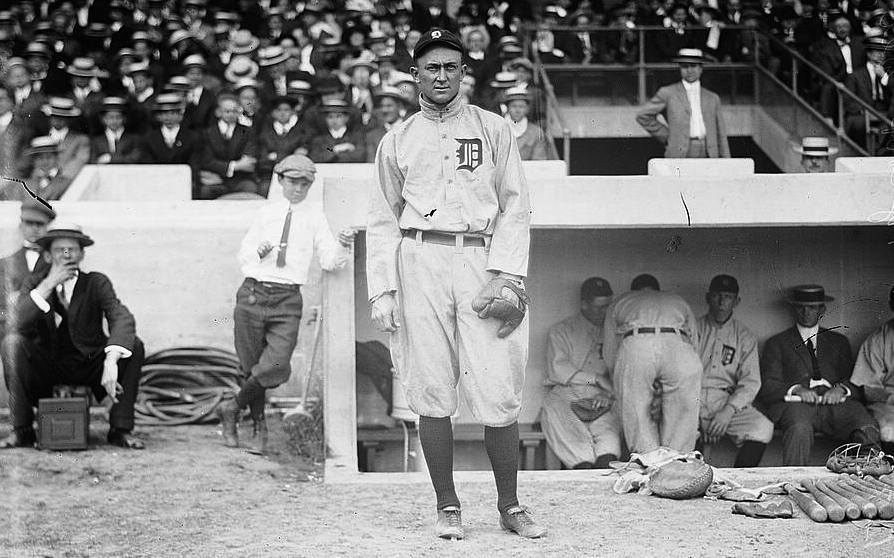
Ty Cobb

Ty Cobb

The story said the fight was broken up by teammates, and “Cobb then issued his ultimatum which was that he would not play with the Tigers if Moriarty was on the team, unless Moriarty apologized to him.”

Within days, both players and Tigers management denied that there had been any fight.  Cobb said:

“There has been a lot of talk that Moriarty and I almost had a fight in the clubhouse last season.  George and I are the best of friends.  We roomed together in the spring and were on the friendliest terms throughout the season.  The story that I put it up to (Tigers owner Frank) Navin to sell or trade George is a fabrication.  In the first place I had no grounds for such action, and in the second place I wouldn’t take such a step if I did have.  I wouldn’t put the Detroit club in a compromising position.”

While the story of a fight was told and retold over the next twenty years, Cobb and Moriarty always denied it happened.

The story that is still included in nearly every mention of Moriarty is that as he and Cobb were preparing to fight, Moriarty said “A fellow like you needs a bat to even things up when fighting an Irishman.”

The quote first appeared in a 1932 column by New York World-Telegram sportswriter Joe Williams when, as an American League umpire, Moriarty’s reputation as a fighter was renewed.  The Associated Press said after a double-header sweep by the Cleveland Indians, Chicago White Sox catcher

Charlie Berry followed the umpire into the runway of the clubhouse, accusing him of ‘missing’ a third strike on Earl Averill just before the Indian broke up the second game with a ninth-inning triple.

“Berry challenged Moriarty to a fight…Milt Gaston, Chicago pitcher, advanced himself.  The umpire felled Gaston…Then Berry, Frank Grube and Lew Fonseca rushed Moriarty, beating him until he was rescued by the Indians.”

In response to mentions of a fight with Cobb in the reports of the 1932 fight, Moriarty renewed his denial of a fight with Cobb, a denial he had also made in 1927 when he replaced Cobb as Detroit manager:

“Say anything else you like about me, but don’t spread the report that Ty and I fought.  We were roommates, and while we may have disagreed we never came to blows.”

Cobb and Moriarity relished their reputations as fighters, the fact that both continued to deny they fought long after it mattered would indicate that they often retold story is more wishful thinking than fact.

One more bit of trivia about Moriarity:  His grandson Michael Moriarty starred as Henry Wiggen in one of the greatest baseball movies, “Bang the Drum Slowly” with Robert De Niro.

Moriarty and De Niro in "Bang the Drum Slowly"

Moriarty and De Niro in “Bang the Drum Slowly”

Kauff and Perritt

29 Jan

Benny Kauff and Pol Perritt were two of the reasons why the New York giants won the National League Pennant in 1917.  Kauff led the team with a .308 average and Perritt was 17-7 with a 1.88 ERA.  Both came to the Giants by way of the Federal League, and with the help of “Sinister Dick” Kinsella, John McGraw’s right-hand man.

"Sinister Dick" Kinsella

“Sinister Dick” Kinsella

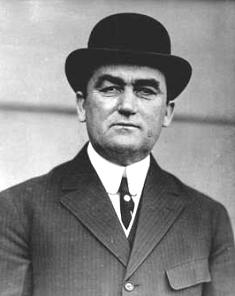
Kinsella was the former baseball magnate of Springfield, Illinois who went east to serve as McGraw’s chief scout.  He was a key player in the incident that led to Giants’ catcher Larry McLean’s banishment from organized baseball.

After the 1914 season, McGraw set his sights on the Indianapolis Hoosiers’ Kauff, who was being called the “Ty Cobb of the Federal League.”  Kauff led the league with a .370 average, 120 runs, 211 hits and 75 stolen bases.

When the debt-ridden Hoosiers were transferred to Newark for the 1915 season Kauff’s contract was sold to the Brooklyn Tip-Tops, and he joined the team in Browns Wells, Mississippi.

At the same time, Perritt coming off a 16-13 season was prepared to jump the St. Louis Cardinals and join the Pittsburgh Rebels in the Federal League.

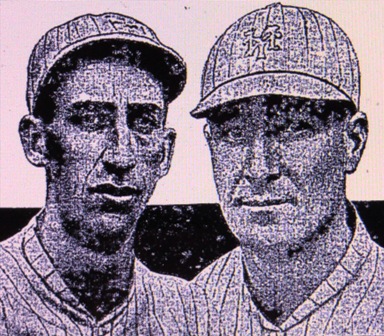
Pol Perritt and Benny Kauff, 1917

Pol Perritt and Benny Kauff, 1917

Sportswriter Frank G. Menke of Hearst’s International News Service picks up the story:

“Dick Kinsella, scout for the Giants, according to the story we get, hustled to Browns Wells and got a job on a plantation…Kinsella didn’t dare to put up at the same hotel because he was known by Manager Lee Magee, Business Manager Dick Carroll and others of the Brookfeds.”

Kinsella, according to Menke, was pretending to be a farm hand and also observing Kauff’s workouts and reporting back to McGraw who, along with Jack Hendricks of the Indianapolis Indians in the American Association (who held Kauff’s rights) was sending coded telegrams to Kauff signed “Father.”  Kauff received telegrams saying, “Mother wishes to see her boy,” and “All is forgiven.”

According to Menke, the telegrams were intended to inform Kauff that McGraw wanted him with the Giants and:

“The “everything forgiven” telegram was to tip Kauff off that if he jumped the National Commission probably would let him play.”

While Kauff was in Mississippi, Pol Perritt was in the process of  jumping to the Federal League.

According to Menke, Kinsella left Mississippi in the middle of the operation to secure Kauff in order to talk to Perritt.  What Kinsella said to Perritt is unknown, but Perritt’s meeting with Pittsburgh manager Rebel Oakes pretty much put an end to any chance of joining the Federal League.  The Associated Press said:

“Pitcher ‘Pol’ Perritt who jumped to the Pittsburgh Federal recently had a fist fight with Manager ‘Rebel’ Oakes…Those who saw the fight say that the pitcher delivered one blow that knocked Oakes over a chair…Friends and acquaintances interceded and hushed up the whole affair before police arrived on the scene.”

The story said Perritt was meeting with Cardinals’ management to “flop back to organized ball,” within weeks the Cardinals sold Perritt’s contract to the Giants, The AP said:

“Carefully guarded by “Sinister Dick” Kinsella…Perritt was delivered to John J. McGraw this noon…Kinsella brought his man in from Shreveport without struggle, and states that he did not even sight a Federal submarine during the entire journey.”

An alternate version of the story, published in The New York Times said it was McGraw who met with Perritt rather than Kinsella and highlighted the manager’s journey to meet the pitcher:

“McGraw had to travel forty miles on one railroad, nine miles on another, and then drive nine miles through the mud to get to Perritt’s home in Louisiana.”

Perritt was in the fold.  After a 12-18 season in 1915, he would win 18, 17 and 18 from 1916-18.

Kauff would be a bit more complicated.

While Kinsella was gone from Mississippi securing Perritt, Kauff signed a $6000 contract with Brooklyn, which he immediately regretted and contacted McGraw.

kinsellamcgraw

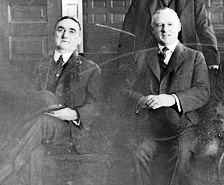
Dick Kinsella and John McGraw, 1920

According to Menke, Kauff:

“Related the difficulty he had with Robert B. Ward, president of the Brookfeds, over the contract.  The Giants people thought that owing to Kauff’s trouble—or alleged trouble—over the Brookfed contract that he was not legally under contract.”

Menke said the Giants signed Kauff for $7000 a year for three years with a $7000 bonus.

National League President John Tener voided the contract and Kauff was forced to return to the Tip Tops; he again led the league with a .342 average.

McGraw finally got his second man at the close of the 1915 season.  After the Federal League folded and Kauff was reinstated to organized baseball he signed a two-year contract for $6500 a season and a $5000 bonus with the Giants.

New York had finished in eighth place in 1915. They improved to fourth in 1916 and won the pennant by 10 games in 1917. McGraw’s Giants lost the to the Chicago White Sox four games to two in the World Series.  Perritt appeared in three games in relief, and Kauff hit a disappointing .160, despite two home runs in the Giants’ game four victory.

After the 1917 World Series Perritt and Kauff faded fast.

Perritt was 18-13 in 1918, but would only win four more games over the following three seasons with the Giants and Detroit Tigers; he was out of professional baseball before his 30th birthday.

Kauff’s demise is better known; his professional career came to an end at age thirty, the result of allegations of his involvement with gamblers, in general, and 1919 World series fixer Arthur Rothstein in particular.  Kauff, who owned an automobile accessory business with his half-brother and Giant teammate Jesse Barnes, was charged with stealing and reselling an automobile.  Although he was acquitted at trial, Kenesaw Mountain Landis banned Kauff for life.  Kauff’s oft-told story is told best in two excellent books by David Pietrusza:  Rothstein: The Life, Times, and Murder of the Criminal Genius Who Fixed the 1919 World Series and Judge and Jury: The Life and Times of Judge Kenesaw Mountain Landis.

Perritt died in Shreveport, Louisiana in 1947; Kauff died in Columbus, Ohio in 1961.

“One of the Two Greatest Sluggers”

28 Jan

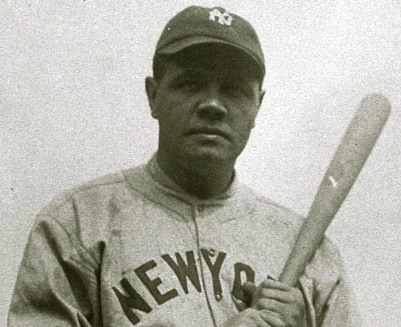
On July 19, 1920, Babe Ruth hit his 30th home run of the season off Dickie Kerr of the Chicago White Sox, breaking the Major League record he had set the previous season.  Perry Werden, working as an umpire in the South Dakota League was largely forgotten.

Babe Ruth

Babe Ruth

The Minneapolis Tribune, as a point of local pride, reminded readers that Ruth had not eclipsed the record set in their town:

“Beyond all doubt the mark made yesterday is a major league record of all time but the Babe has yet to equal the mark of 45 made by Perry Werden of the Minneapolis Western League club in 1895.”

Some reporters, like Al Spink of The Sporting News, dismissed Werden because “the park at Minneapolis, which was an unusually small inclosure (sic), with the right and left field fences close in.”  Regardless, Werden was back in the public eye; his forgotten record was revived as fans followed Ruth’s record season.  The Associated Press said:

“(Werden) admits that Babe Ruth has a harder swing than he had when he made his mark. ‘There is no doubt that Babe has it on all of them—modern and ancient’ says Werden”

When Ruth hit numbers 45 and 46, one in each game of a double-header at Fenway Park, The Associated Press said:

“(Ruth) broke all known world’s records for circuit drives in a single season.”

Werden, in his role as “the former holder of the home run record for organized baseball” was often asked about Ruth over the next decade.  Werden called Ruth “One of the two greatest sluggers that I have seen in fifty years.”

Perry Werden, 1930

Perry Werden, 1930

The only player Werden considered Ruth’s equal?   Ed Delahanty.

Werden told The North American Newspaper Alliance, in a nationally syndicated story:

“Ed Delahanty would have equaled or bettered the home run record of Babe Ruth if the lively ball had been in use…If Delahanty had any weakness no pitcher ever found out what it was.  He hit left-handers as easy and effectively as he did right-handers, and it made no difference to him where they threw the ball—high, low, inside, outside, curve fast ball or slow ball—they all looked alike to Big Ed.”

Werden said while playing first base for the Saint Louis Browns he saw just how hard Delahanty could hit:

“The Phillies had a runner on first base, and when Delahanty came up to bat we played in close for him, thinking he would bunt.  That was a mistake we never made again when Delahanty batted.  Instead of bunting he hit a ground ball so hard that it tore a shoe off George Pinkney, our third baseman, in addition to fracturing his right ankle.”

As further proof Werden said “Even with the lively ball…it was thirty-six years before Delahanty’s record of hitting four home runs in a single game was equaled by Lou Gehrig.”  Werden didn’t mention that Bobby Lowe had accomplished the same feat two years before Delahanty.

Ed Delahanty

Ed Delahanty

While Werden will never join Delahanty and Ruth in the Hall of Fame, he is remembered as one of the greatest minor league players of the 19th Century.  He died in Minneapolis in 1934.

Larry McLean

8 Jan

At 6’ 5” John Bannerman “Larry” McLean is still the tallest catcher to have played in the Major Leagues nearly a century after his final game.  Born in New Brunswick, Canada, McLean’s ability was mostly overshadowed by his frequent off-field troubles during his career.

McLean bounced between the minor leagues, semi-pro teams, and trials with the Boston Americans, Chicago Cubs and Saint Louis Cardinals from 1901-1904.  McLean joined the Portland Beavers in the Pacific Coast League in 1905 and it was here that he developed into a good ballplayer and a first-rate baseball character.

Larry McLean

Larry McLean

McLean hit .285 in 182 games with Portland in 1905, but also started to show signs of the troubles that would plague him for the remainder of his career; Portland added a “temperance clause” to his contract and McLean, who had originally planned on a boxing career, loved to fight.

In 1906, while hitting .355 for Portland, and catching the eye of the Cincinnati Reds who would purchase his contract in August; McLean announced that he was going to become a professional fighter.

The wire report which ran in The Bakersfield Daily Californian said:

“McLean the giant catcher of the Portland team…He is so big that umpires walk out behind the pitcher so they judge balls and strikes…announces that he will fight any man in the world, Big Jeff (Jim Jeffries) not barred.”

The story said McLean was training with Tom Corbett (older brother of “Gentleman Jim” Corbett) and Corbett said he “has a ‘sure ‘nuff’ champion in the big catcher.”

Talk of a ring career temporarily ended when McLean joined the Reds, but McLean’s legend grew.  In November of 1906, he caught a murderer while in a subway station with his wife.  The Boston Post said the suspect:

“Was seen to pull a gun and pump five bullets (into the victim)…Larry started after him and collard him just outside the entrance.  (McLean had the suspect) pinioned so he could not move.  The police soon arrived and took charge of McLean’s prisoner.”

McLean was a huge hit with Havana fans the following winter when the Reds touring Cuba; The Sporting Life said:

“Larry McLean was the favorite and every time he caught a ball the crowd applauded. McLean has been dubbed by the baseball fans ‘Chiquito.’”

McLean and Chicago White Sox pitcher Frank Smith were mentioned at various times as possible opponents for heavyweight champion Jack Johnson; boxing writer Tommy Clark said in 1910 that McLean “Thinks he has a good chance of lowering Johnson’s colors.”

But while McLean was a fan favorite he regularly ran afoul of Cincinnati management and none of the managers he played for was able to keep him out of trouble.

While with the Reds McLean was arrested at least four times–for disorderly conduct, passing a bad check and two assaults.  In one case, at the Savoy Hotel in Cincinnati, McLean knocked a newspaper man from Toledo unconscious after the man “Reproved McLean for using a vile name.”

While serving a suspension for breaking team rules in 1910 McLean Said:

“When I get back to Cincinnati there will be 25,000 fans at the depot waiting to shake hands with me.”

Frank Bancroft, Reds secretary and former manager said in response:

“Twenty-five thousand, why, they’ve not that many barkeepers in Cincinnati”

McLean had worn out his welcome by 1910, but Cincinnati was not able to find any takers for the catcher.  Pittsburgh Pirates owner Barney Dreyfuss said, “I wouldn’t give 30 cents for Larry McLean.”

McLean stayed with the Reds for two more seasons, but when Joe Tinker took over the team one of his first moves was to sell McLean to the Saint Louis Cardinals in January of 1913.  McLean said he had finally learned his lesson and promised to behave with the Cardinals:

“They didn’t want me around because they said I was a bum. Now I’m going to fool Tinker.”

McLean did behave himself in Saint Louis and seemed to appreciate the opportunity he was given by his former Reds teammate, manager Miller Huggins, even earning a “good behavior” incentive in his contract, and was hitting .270 for the Cardinals, but the cash-strapped team went with the younger, cheaper Ivey Wingo behind the plate and traded McLean to the New York Giants for Pitcher Doc Crandall.

Larry McLean, standing end right, Miller Huggins, standing end left, and Frank Bancroft, standing middle (in suit) on the 1908 Cuban tour.

Larry McLean, standing 5th from left, Miller Huggins, standing end left, and Frank Bancroft, standing middle (in suit) on the 1908 Cuban tour.

The rest of the McLean story tomorrow.

Anger Management

27 Dec

Thomas Timothy “Tim” Flood just couldn’t control himself.

Flood was a solid infielder and somewhat erratic hitter.  As a 17-year-old he hit .364 with the New Orleans Pelicans in the Southern Association in 1894 but hit .266 in his minor league career and .233 as a Major Leaguer.

He had a late season 10-game trial with his hometown St. Louis Perfectos in the National League in 1899.  He was given his next shot in the National league in 1902 when he was signed by Ned Hanlon’s Brooklyn Superbas to fill the void left at second when veteran Tom Daly jumped his contract to join the Chicago White Sox.

Flood was an upgrade in the field, and while a weaker hitter than Daly, he quickly became a favorite of Hanlon who named him Brooklyn’s captain for the 1903 season.

Tim Flood

Tim Flood

1903 was not a good season for the new captain; he continued to struggle at the plate and dealt with a knee injury that limited him to 84 games.  He was also suspended for two games in July for a physical altercation in Cincinnati with umpire James “Bug” Holiday.  Holiday, a former Major Leaguer had a stormy half season as a National league umpire and resigned several days after tangling with Flood.

Flood was released by Brooklyn in March of 1904 and joined the Los Angeles Angels in the Pacific Coast League.

He was a very popular player in Los Angeles and captained the Angeles in 1904 and part of 1905 until he assaulted Ira “Slats” Davis, another former Major Leaguer turned umpire during a game in June of 1905. Eugene Bart, president of the league suspended flood indefinitely.

Newspapers reported that Flood said he would “never fight another arbitrator whether he is in the right or wrong.”

In 1906, he signed with the Altoona Mountaineers in the “outlaw” Tri-State League, where he appears to have kept his pledge and had an incident-free season.

In 1907, he joined  the Toronto Maple Leafs in the Eastern League and managed to play 29 games before he was in trouble again.  Flood assaulted an umpire named John Conway during a game in Toronto; the attack included a kick to the umpire’s chest.

Flood was arrested.

He was charged with assault and ordered to appear in front of a magistrate. Friends told Flood the hearing would be a formality and that he should plead guilty and receive a small fine.

No one told Magistrate George Taylor Denison who said, “This sort of thing must be discouraged,” and sentenced Flood to “Fifteen days in jail with hard labor.” At the same time Patrick Powers, president of the Eastern League, banished Flood from the league.

Toronto fans were outraged and immediately began circulating petitions which “included the names of several clergymen” and were presented by team officials to Minister of Justice Allen Bristol Aylesworth in hopes of getting Flood pardoned.

Opinions of the punishment varied.  Several newspapers carried the following poem which lamented Flood’s fate for “Sassing” an umpire:

“’Holy Moses!’  In Toronto

There is news to make you pale

Sass the umpire if you want to—

That is, want to go to jail!

There is woe among the batters,

As around the field they scud;

And their pride is torn to tatters

By the fate of poor Tim Flood

Fifteen days in jail for Timmy

Soon the parks will close so tight

That you couldn’t with a jimmy

Let in one small streak of light.”

Others, including two former players, said Flood got what he deserved and implied that his behavior was not limited to the three well-publicized incidents.

Charles “Count” Campau, a former Major Leaguer and umpire, who had been a teammate of Flood’s in New Orleans said:

“I am sorry to see anyone go to jail, but, for the good of baseball. I am glad to see Tim Flood out of it for good. Rowdies of the Flood type are a disgrace to any sport or business, and especially baseball. He was always mixed up in just this way and was chased out of California, where b« was playing, for the same kind of tricks. Umpire baiting was always his long suit, and, from what I can understand, his attack on Umpire Owens [sic] was a most cowardly one: Flood is a good ballplayer, but his hasty temper, his meanness has put him out of the game forever, and incidentally Into Jail.”

Charles "Count" Campau

Charles “Count” Campau

Tim Murnane, Major Leaguer turned baseball writer said:

“Tim Flood has a new record, and will now be in a position to go back to his trade and give up the game he was unfitted for.  The courts all over the country should follow the example of the Canadian judge, who sent a ballplayer to lock-up for assaulting an umpire.  It wouldn’t take many decisions of this kind to drive the bad men out of the sport.  Imagine a player taking a running jump at a man and hitting him in the breast with his spiked shoes!”

Tim Murnane

Tim Murnane

After serving 10 days, Minister of Justice Aylesworth ordered Flood released.  The player, in various reports, claimed he lost between 10 and 16 pounds during his incarceration, citing the poor quality of the food.

President Powers rejected pleas from the Toronto management to reinstate Flood and permanently banned him from the Eastern League; however, contrary to Campau’s and Murnane’s wishes, Flood was out of baseball for less than a month.

Flood was signed before the end of July by the Saint Paul Saints in the American Association and vowed, as he had before, that he was a changed man.

It appears 10 days in jail might have made a difference.  Flood was named manager of the Saints in 1908 and continued to play and manage in the minor leagues for five more seasons, apparently without incident.

In 1914, The Sporting Life reported, with no irony, that Flood was hired as an umpire in the Northern League.

Flood died in St’ Louis in 1929.