Tag Archives: Chicago White Sox

A Thousand Words–New Orleans Pelicans

13 Nov

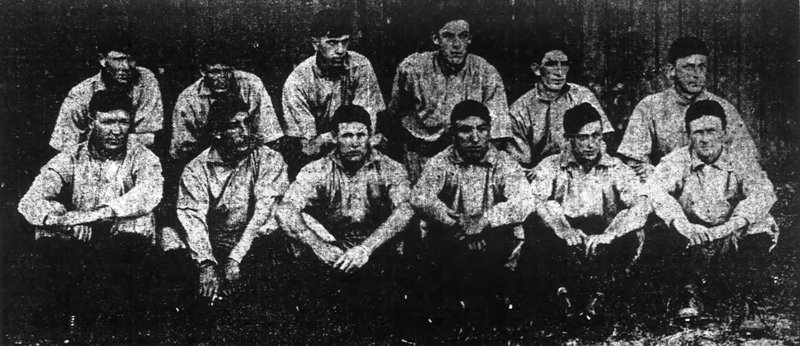
Another picture I’ve never seen published before—the 1906 New Orleans Pelicans of the Southern Association.

Top, Left to right.

Bill Phillipshe spent seven seasons in the Major Leagues with a 70-76 record; and won 256 games in a minor league career that began in 1890 and ended in 1909.

Mark “Moxie” Manuelwas said to have appeared as a both a left and right-handed pitcher for New Orleans in 1906 and 07, Manuel was a combined 37-26, earning him a second trip to the Major Leagues in 1908, where he posted a 3-4 record in 18 appearances for the Chicago White Sox.

Milo Stratton—a weak hitting (career .185) catcher who played in the minor leagues from 1903-1914.

William O’Brien—a .215 hitting first baseman in 1905 with the Toronto Maple  Leafs in the Eastern League and with the Pelicans in 1906.

Jake Atz—played for the Washington Senators in 1903 and the Chicago White Sox 1907-1909, a minor league manager for 21 seasons he won more than 1900 games.

Art Brouthers—a third baseman who played in 37 games for the 1906 Philadelphia Athletics, Brouthers managed the 1913 Paducah Indians to the Kitty League championship.  After his baseball career he was a hotel detective in Charleston, South Carolina.

Front, left to right

Whitey GueseGuese had several strong seasons in the minors, but in his lone Major League season with the Cincinnati Reds in 1901 he was 1-4.  The Youngstown Vindicator said, “He is a twirler who belongs to the disappointing species known as ‘morning glories.” And, “Seemingly has a heart like a canary.”

Joe Rickert—“Diamond Joe” Rickert stole 77 bases for the Pelicans in 1904; he played 15 games in the Major Leagues with the Pittsburgh Pirates and Boston Beaneaters.

William Blake—an outfielder with 13 different minor league teams from 1902 to 1910 and native of Louisville, Kentucky, little else is known.

Punch Knoll—another long-time minor league manager.  Knoll appeared in 79 games for the 1905 Washington Senators, he appeared in 3 games as a pinch hitter, collecting one hit, at 48-years-old while managing the Fort Wayne Chiefs in the Central League

Chick Cargo—brother of Major Leaguer Bobby Cargo, Charles “Chick” Cargo was a shortstop and 3rd baseman who played 19 seasons of minor league ball.

George Watt—Watt had three good seasons for the Little Rock Travelers, with a 53-34 record from 1902-1904.  He slipped to 20-37 in 1905-06 with Little Rock and New Orleans.  By 1907 he had dropped from “A” ball to “D” ball with the Zanesville franchise in the Pennsylvania-Ohio-Maryland League.  In 1908 he pitched for the Zanesville Infants in the Central League, was release in August after posting a 6-15 record and disappeared.

A Thousand Words

25 Oct

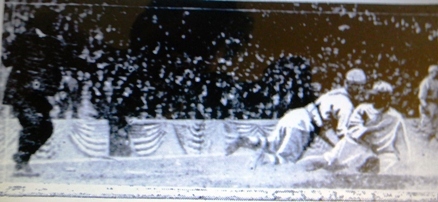
Occasionally you come across a photo that hasn’t been published anywhere in almost 100 years.  This one is from game 2 of the 1917 World Series.  New York Giant rightfielder Dave Robertson slides past Chicago White Sox Hall of Fame catcher Ray “Cracker”  Schalk, beating the throw home to score the first run of the game.  The umpire is Hall of Famer Billy Evans, “The Boy Umpire,” who at 22-years-old in 1906 became the youngest umpire in Major League history.

The White Sox went on to win the game 7-2 and won the series in 6 games.

Stallings Stealing Signs

17 Oct

George Stallings had turned the New York Highlanders around.

Hired by owner Frank Farrell after New York’s disastrous 51-103 season in 1908, Stallings guided the Highlanders to 74-77 record in 1909.

George Stallings

American League President Ban Johnson said he knew why Stallings’ team had improved.

During a series with the Highlanders in the summer of 1909 Washington Senators Manager Joe Cantillon thought he noticed something unusual past the center field wall in Hilltop Park.  He passed his suspicions on to Detroit Tigers Manager Hughie Jennings.

Tiger Manager Hughie Jennings

The Highlanders hit Detroit pitcher Ed Summers hard during the first game of Detroit’s next series in New York.  Jennings sent pitcher Bill Donovan out to center field to investigate, but according to The Sporting Life:

“Bill returned without having shown any ability as a Sherlock Holmes.”

Jennings then assigned trainer Harry Tuthill to the job.  Tuthill noticed that the letter “H” in a hat advertisement on the center field fence was moving, scaled the fence and made a discovery.

Initially the Tigers did nothing, Jennings had more on his mind; Detroit was headed to the World’s Series and despite New York’s improvement they were a fifth place team.

But rumors spread and the story was picked up by The Sporting Life, getting the attention of  the American League president.

Johnson sent a telegram to Tuthill threatening to bar him from the league if he did not provide the his office with a full report of what he knew.  Tuthill said that after he noticed the letter in the sign moving he went to the center field wall and upon climbing to the other side discovered a small area behind the sign where a man sat with a pair of field glasses.  According to Tuthill “The man ran out as I came in, I think I know who it is but can’t be positive.”

In other reports Tuthill said he was sure who the man was but would not reveal his identity—it was later alleged to be former Major League pitcher Gene McCann.

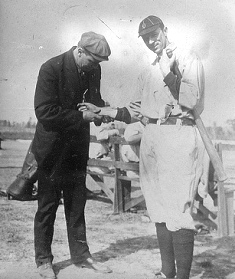
Trainer (and detective)  Harry Tuthill with Tigers first baseman Del Gainer

Jennings was convinced the Highlanders were stealing signs all year as did The Sporting Life:

“It has been a noticeable fact all season that the Highlanders always hit like fury at home and were punk batters on the road.”

The Highlanders scored 338 runs in 76 homes games; 251 in 75 road games.

The Sporting Life also speculated that Stallings, who had a poor relationship with the American League president, might be expelled from the league as a result of the allegations:

“President Johnson has conclusive evidence…and it is all but natural to suppose that the man in charge of the team which benefited by the system employed knew of its existence, and it is on this theory that Stallings’ resignation will be asked.”

Despite the speculation there was no rule at the time which prohibited stealing signs in the manner the Highlanders were accused

At the winter meetings that December the American League Board of Directors exonerated Stallings, but in their ruling vowed that any team official found stealing signs in the future would be “Barred from baseball for all time.”

Stallings was at the helm of the Highlanders for most of the 1910 season, and became embroiled in another sign stealing controversy in late July when “Big Ed” Walsh and several members of the Chicago White Sox accused the Highlanders of stealing signals in the same manner.

The Chicago Tribune said:

“There is not a player on the Sox club who isn’t confident the catcher’s signs are being tipped off.”

Stallings again denied the charges and said the White Sox pitching staff was tipping their pitches:

“What are you going to do when practically every Chicago pitcher insists on giving his own signals from the box and the signals get familiar, they are repeated so often?”

Stallings was again cleared of wrongdoing, but in spite of a guiding the Highlanders to a 78-59 record through September 19, he was replaced as manager after losing a struggle for control of the team with first baseman Hal Chase, who was named as his replacement.

Stallings went on to manage the World’s Series winning Boston Braves in 1914.

Demon Rum–or Demon Rum as an Excuse to Replace a Popular Manager

8 Oct

The 2011 Boston Red Sox were only the latest in a long history of alcohol taking the blame for a team’s poor performance.

As the Chicago Cubs faded into third place during the waning days of the 1912 season, team president Charles Murphy issued an order for “total abstinence” and all players would have a temperance calls in future contracts.

The move was not unprecedented—since 1909 Barney Dreyfus of the Pittsburgh Pirates had required his players to sign a temperance pledge.  What made Murphy’s order so newsworthy was that over the course of several days he issued numerous, often contradictory, “clarifications” and because it quickly became apparent the move was a intended to wrest control of his ballclub from Manager Frank Chance.

Murphy’s original statement said that “loose living and training methods” led to the team’s poor finish. At the same time he provided cover for popular Cub outfielder Frank Schulte who had been suspended by Chance in September his nighttime activities during a crucial August road trip in Cincinnati.  The Cubs lost three of four games to the Reds and fell out of contention.    Murphy’s statement presented Schulte as a man incapable of any personal responsibility:

“I desire to say that in my judgment Schulte has been more sinned against than sinner…from what I could gather he was a victim of too many so-called friends…if we had a rule similar to that in vogue in Pittsburgh this player could not have been led into temptation.”
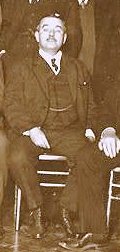
Chicago Cubs President Charles Murphy

The implication being that Chance had perhaps overreacted by suspending “the more sinned against” Schulte.  This statement was further complicated by Murphy’s several “clarifications,” some of which seemed to support Chance’s decision while some did not.

Chance quickly defended his players and his reaction to Murphy revealed just how bad the relationship was between the team president and his manager:

“Murphy only thinks of the team when it’s winning…his statement reflects upon me personally, and I have been in the business too long to allow Murphy or anyone else to insult me.”

Making matters worse, and calling Murphy’s motives into question was that Chance issued his response from a hospital bed in New York.  As a result of being hit in the head by numerous pitches throughout his career, Chance had developed a blood clot near his brain and had undergone surgery just a few days earlier.

Murphy didn’t hesitate to use Chance’s health issues against him.

A month earlier, plagued by doubts about his condition and suffering from severe headaches, Chance had suggested to Murphy that he might not be able to manage the Cubs in 1913.  At the time Murphy told his manager to wait until after the surgery to make a decision about his future.  Now he was using that conversation to assert that Chance had issued his resignation.

Once Murphy began claiming Chance had, in effect, quit in August the Chicago media which had almost universally supported the “abstinence pledge” called foul.  The Chicago Tribune and Chicago Examiner both said Murphy was using the conversation and the pledge as cover to run the legendary Chance—who led the Cubs to four pennants and two World Championships—out of town.

Chance went.  But he didn’t go quietly.

The manager had acquired 10 percent of the Cubs, shares Murphy had been trying to purchase for more than a year.  Chance sold the shares to Harry Ackerland a Pittsburgh investor who President Murphy did want owning part of his team.  Despite Murphy’s efforts to block the sale, it went through.

Chance was claimed on waivers by Cincinnati, but after the Reds acquired Joe Tinker from the Cubs and named him manager, Chance was waived to New York, where he became manager of the Yankees.

Chance led the Yankees for two losing seasons, managed the Los Angeles Angels in the Pacific Coast League in 1916 and ’17, and closed out his career with one dismal season in Boston; the Red Sox finished 61-91 under Chance.

Frank Chance

Johnny Evers was named Cubs manager for the 1913 season—the Cubs again finished third.

From the day Murphy issued his initial statement until Chance died in 1924, “The Peerless Leader” never missed an opportunity to take a shot at Murphy.

When the Cubs were sold to Cincinnati publishing magnate Charles Phelps Taft (President William Howard Taft’s half-brother) before the 1914 season Murphy claimed that he had made more than a half million dollars on the deal.  Chance and former Cubs pitcher Mordecai Brown (who had his own feud who Murphy who released him after the 1912 season, allegedly without giving Brown money he was owed for playing in that year’s “City Series” with the Chicago White Sox) quickly responded.  Both players confirmed what had long been rumored—that Murphy had been bankrolled by Taft who retained a majority of the shares.   Murphy, said Chance, “Never owned more than fifteen or twenty percent of the club stock.”

Both players also charged that Murphy’s treatment of his players was a primary reason for the formation of the upstart Federal League—at best an oversimplification of the conditions which led to Major League Baseball’s last “third league.”

Another Charles Murphy feud later this week.

.

More “Chief” Johnson

30 Aug

Last week I told you about George “Chief” Johnson’s release from the Chicago White Sox in the spring of 1913, allegedly because of his affiliation with the Winnebago (Ho-Chunk) Native-American Tribe.

Cincinnati Reds owner August Garry Herrmann and manager Joe Tinker were apparently more concerned with a good arm than the so-called “Winnebago ban,” and signed Johnson.

George “Chief” Johnson

Through the first month of the season, Johnson was the only effective Reds pitcher, winning three games (including two shutouts) for a team with a record of 5-16.

The New York Times took notice in an article, the racist tone of which was typical of the era:

“Big Chief Johnson of the Winnebagos [sic] is copper-colored and fat. At bat he displays as much activity as the wooden Redmen who hold forth at the doors of countless cigar stands. But on the mound this latest Indian to edge his way into the select circles of major leaguedom can deal out ciphers with as much success as the more illustrious Johnson of Washington.”

Johnson ended the season 14-16, with a 3.00 ERA for a team that finished 25 games under .500.

In 1914, the Federal League came calling.  Otto Knabe, Manager of the Baltimore Terrapins sent a telegram to Johnson asking for his terms.  According to Knabe, Johnson replied with a telegram sent collect saying “Will sign for $10,000 bonus and reasonable salary.” Knabe telegrammed Johnson collect “Asked for your terms, not Walter Johnson’s”

Otto Knabe

Johnson signed the following month with the Federal League Kansas City Packers for a more modest $3000 advance and $5000 salary; the only problem was that Johnson had already signed a contract with the Reds for 1914.

Johnson’s 1914 season was highlighted by a series of injunctions and court rulings that kept him sidelined for much of the season while organized baseball battled the upstart Federal League.  (The saga of the Federal League has been rehashed in numerous books and blogs, no need to reinvent the wheel here—I recommend this book)

Johnson played for Kansas City in 1914 and 1915 posting records of 9-10 and 17-17.  Throughout his tenure in Kansas City Johnson had numerous run-ins with the law over his drinking and was cited for desertion and non-support of his wife. Additionally, his weight ballooned to well over two hundred pounds.

Johnson’s major league career was over after 1915, but he pitched three more seasons in the Pacific Coast League.  Pitching for the Vernon Tigers near the end of the 1916 season Johnson was so out of shape that it was reported in the Los Angeles Times that the Portland Beavers chased him from a game in the third inning by having several hitters in a row lay down bunts that the overweight pitcher was unable to field.

Johnson reportedly returned in better shape in 1917 and was 25-23 pitching for Vernon and the San Francisco Seals.  Johnson returned  in 1918, posting a 2-6 record, and was joined in San Francisco for a short time by his brother John who appeared in one game for the Seals.

After his release by San Francisco Johnson barnstormed with a variety of teams throughout the Midwest and West and sold “snake-oil” in a traveling tent show.  On June 11, 1922, Johnson was in Des Moines, Iowa with his tent show when he was killed in a dispute over money during either a dice or poker game (news accounts varied).  Johnson’s killer, an African-American gambler named Ed Gillespie, was originally charged with first-degree murder, but the charges were reduced to manslaughter based on eye-witness accounts that claimed Johnson was “drunk and belligerent.”  He was buried at the Winnebago Cemetery in Winnebago, Nebraska.

A postscript.

A few days after Johnson’s death a small item appeared in Iowa newspapers; it was about a druggist in Des Moines who had agreed to put a display in his store window to promote Johnson’s tent show. The story said:

“Anyone anxious to own a nice horned rattlesnake may have one by taking the one left in his show window by the late Mr. Johnson.”

“Chief” Johnson and the “Winnebago Ban”

23 Aug

George Howard “Chief” Johnson was born on the Nebraska Winnebago (Ho-Chunk) Reservation to an Irish father and a mother who was likely only half Native American, yet like almost all players of his era with any tribal blood, he was branded “Chief.”

Johnson began his pro career at age 23 in 1909 with Sioux City and Lincoln in the Western League, after having played for several seasons with Guy Green’s barnstorming Nebraska Indians team.

Chief Johnson

Chief Johnson

Johnson constantly battled weight and alcohol issues; “The Chief is not noted for the care he takes of himself,” is how The Milwaukee Sentinel put it—but after a 23-10 record for the Saint Joseph Drummers in 1912, he was purchased by the Chicago White Sox.

Johnson appeared destined to make the Sox pitching staff according to The Chicago Tribune and Chicago Examiner, but was released before Opening Day by the Sox and signed with the Cincinnati Reds.  His release by Sox Manager Jimmy “Nixey” Callahan was explained the next season in several newspapers, including The Milwaukee Journal:

“The Chief…had shown ability and class; he had behaved well, but when Callahan learned that he was a Winnebago he decided to turn him away.”

The story, a tour de force of early 20th-century bigotry, went on to say:

“For many years the Winnebago tribe has been under a blacklist by all circuses, Wild West shows and film companies.  There are plenty of Winnebagoes, very conveniently located; they are fine-looking people, and, as a rule educated, so they would be the finest material for show purposes.  Nevertheless, the reputation of the tribe for love of firewater has been such that managers shun their reservation, and they can’t get work in the professions which yield big wages to the Sioux, Pawnees and Chippewa’s.”

White Sox Manager Jimmy “Nixey” Callahan

I’ll include another chapter in George Johnson’s short and eventful life next week.