Tag Archives: Chicago White Sox

Lost Advertisements–Ty Cobb in San Francisco

27 Nov

cobbad

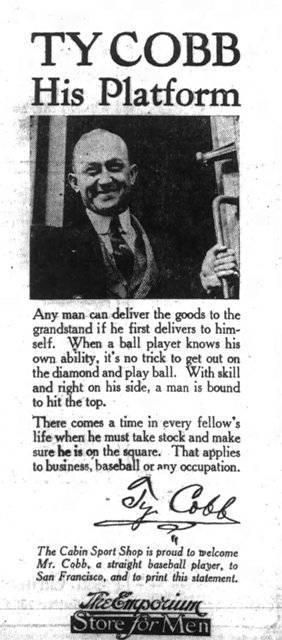
A 1920 advertisement that appeared in The San Francisco Call for The Emporium, a local department store, welcoming Ty Cobb.  He was on a nearly two-month barnstorming tour of the West Coast.

The ad included a quote from Cobb:

“Any man can deliver the goods to the grandstand if he first delivers to himself.  When a ballplayer knows his own ability, it’s no trick to get out on the diamond and play ball.  With skill and right on his side, a man is bound to hit the top.

“There comes a time in every fellow’s life when he must take stock and make sure he is on the square.  That applies to business, baseball or any occupation.”

The ad said Cobb was “A straight ballplayer.”  The integrity of the game and Cobb’s personal integrity were discussed regularly during his tour; he arrived in San Francisco on October 16, six days before a Cook County, Illinois grand jury handed down indictments against eight members of the Chicago White Sox.

In welcoming Cobb to the city, San Francisco Mayor James “Sunny Jim” Rolph said:

“You are welcome, Mr. Cobb because you typify the best in baseball.  This fight to clean baseball started in San Francisco, and I want you to know we in the West are in the fight to the finish.

“There will always be a welcome for you and all clean ballplayers, and for the other kind, no place in America should want them.”

Cobb’s “All-Stars,” a team that included Nick Altrock and Willie Kamm and other major leaguers and well-known Coast players,  drew large crowds and Cobb also appeared in front of school groups and civic organizations.

During a speech to the Press Club of San Francisco, Cobb told the crowd that the former player he had been told was the best ever was in the audience:

“I have always been told that San Francisco is the home of the best ballplayer ever in the game.  I refer to Bill Lange who is here today.”

He remained on the West Coast until November 28.

On his final day in California, a wet afternoon in Oakland,  the 33-year-old Cobb competed against 23-year-old Francis “Lefty” O’Doul in the days “field events.”  The San Francisco Chronicle said:

“O’Doul beat Cobb in the bunt and run contest.  Lefty went around the bases in 14 4/5 seconds while Cobb took 15 seconds to make the trip. The time was fast considering the heavy track.”

Cobb was nearly universally cheered during his West Coast tour.  The one exception, on Monday.

“Out of the Game”

2 Nov

ripley

A September 1920 cartoon in The New York Globe, “Cleaning Up” by Robert Ripley–later famous for “Ripley’s Believe it or Not” which he began drawing two years earlier–calling on organized baseball to banish  Hal Chase, Heinie Zimmerman, and six members of the Chicago White Sox: Swede Risberg, Joe Jackson, Eddie Cicotte, Buck Weaver. Happy Felsh [sic, Felsch] and Lefty Williams–Ripley left out Chick Gandil and Fred McMullin.

Ripley continued to draw baseball cartoons as “Believe it or Not” gained popularity, including the one below from 1921 winter meetings featuring Kenesaw Mountain Landis, Ban Johnson, Kid Gleason, Hooks Wiltse, Charles Ebbets, John McGraw, and Wilbert Robinson.  After The Globe folded in 1923, Ripley moved to The New York Evening News.

ripley2


“Pace is what decides Pennant Races”

28 Oct

Joseph B. Bowles ran a newspaper syndication service in Chicago during the first two decades of the 20th Century.  His content was mostly religion and baseball.  One series of articles he published asked players and managers to explain “How I Win.”

Hugh Duffy, the new manager of the Chicago White Sox was the subject of a 1910 article:

“There is an element in baseball which is not on the surface, and which players, spectators, lovers of the game and often managers themselves do not realize or understand.  This element is pace.

Hugh Duffy

                            Hugh Duffy

“Pace is what decides pennant races.  The team that is fast enough, well conditioned enough and smart enough to set the pace, and force the other clubs to play at top speed all the time to hold in the race, is the pennant-winning team unless it cuts out too fast a pace and breaks itself.  In races where all the clubs start slowly and are a long time rounding into true playing condition, some flash in the pan club may win by a spurt of speed, but in most races the conditioned, fast team plays steadily and forcing the pace against its closest competitors, wins.

“Ability to hold the pace is the test of the gameness and the fighting spirit of a club and no club can win a pennant, or be a consistent winner unless it is courageous enough to stand the strain and fight every step of the way.

“Pennants usually are won by the gamest club, rather than by the fastest ones or the best ones.  Before a season starts each manager calculates the strength, the speed, and the hitting and fielding ability of the men under him and calculates what sort of pace is best suited to his team.  If he thinks his club is strong enough he may force the speed from the start, trying to spread eagle the other clubs and win away by himself.  Sometimes this is the best policy, for often an inferior club, if permitted to gain a big lead on the others, will get so full of confidence that nothing can stop it.  There have been such cases but they are seldom, and the manager who strains his pitching staff and risks damaging his team in order to gain an early lead is likely to find himself in mid-season with a crippled and broken club.  On the other hand, the manager who strives to hold back and save the strength of his team for a hard finish is liable to have a discouraged and beaten club on his hands just at the time he is ready to make his spurt towards the lead.

“The manager must strive to strike the happy medium, to reserve the strength of his team, especially of pitchers, without falling completely out of the race.  Above all, he must keep the spirit and the condition of his men to a high standard.  The well-conditioned club, composed of players working in unity, and with brains enough to keep themselves in condition all the time, will beat much better ball clubs in a bruising race.

“As for individual standards, I want brains on my ball club.  The smart ballplayer, who keeps thinking all the time, who is looking for an opening, and out thinking his opponents, is a much better player than the men who can out bat, outrun and outfield him.  Speed and hitting ability are the main essentials of a team.  I do not claim that twenty reporters, who probably know the game better than any twenty ballplayers do, could win a pennant, but the brains must direct intelligently the actions of trained hands and feet and if, combined with brains, hands and feet, a player has the quality known as aggressiveness, he is a winning ballplayer.  The manager cannot think for twelve men.  He can correct their mistakes, or tell them about their blunders, may order their plays and discipline them, but there are a hundred times in each game when the men must think for themselves and if they do not, then defeat is to be expected.”

Duffy was unable to find the “pace” with his White Sox, who finished in sixth place with a 66-85 record. Late in the season, The Chicago Daily News placed the blame on the manager, saying it was:

“(A) generally recognized fact that President Charles A. Comiskey’s 1910 White Sox are a dismal failure…Lack of teamwork and the inability of Hugh Duffy to manage the team properly are the real causes of the disgraceful showing.”

In eight seasons as a major league manager he never finished better than fourth place—he did win two championships in the minor leagues, with the Milwaukee Creams in the Western League in 1903 and the Portland Duffs in the New England League in 1915.

Collins’ “Ten Commandments”

5 Oct

The Philadelphia Inquirer said in February of 1916, Eddie Collins of the Chicago White Sox, had broken “into the ‘Gospel League,’ after  the second baseman gave a temperance speech in front of “500 persons” at the Epworth Methodist Church in Palmyra, New Jersey church.

collins2

Eddie Collins

Despite Collins telling his audience he wasn’t  “contemplating a pulpit career,” the paper said they “(A)pplauded like World Series fans when he handed ‘booze’ some wallops that would have done credit to Billy Sunday.”

Collins’ talk focused on the evils of alcohol:

“I come to bring a message to your young people, from a baseball player’s viewpoint, of the necessity of clean living and I will be glad if anything I say will help any of you fight the battle of life…Temperate living in necessary for success in any field of action.”

He also praised his former manager from the pulpit:

“Life is a whole lot like playing baseball under Connie Mack’s orders.  Mack is the greatest baseball general the world has ever known and any man who has ever played on the old Athletics honors respects and loves the boss.”

Sunday said he approved of Collins taking to pulpit and providing a “boost” for baseball:

“The way to make the great game respectable is for every player to be respectable himself.”

The Inquirer told readers the following day that the Columbia University graduate had little in common with the evangelist who often mangled the language:

“The statement that Eddie Collins is emulating Billy Sunday is entirely erroneous…Eddie had a perfect record at the bat and fielded cleanly with the King’s English.”

Billy Sunday, evangelist

Billy Sunday, evangelist

Within a week, The Philadelphia Press said:

“Eddie Collins’ dip into evangelism has had a home-run effect among church people throughout the country, and he now is swamped with invitations to address church congregations, bible classes, and Sunday school meeting.

“The requests have swept in upon him at his home in Lansdowne (Pennsylvania) in such a deluge that he said today he had reached the point where he would have to give up base ball if he were to meet all the engagements asked.”

Collins told a reporter:

“I am gratified to learn that my little talk of last Sunday and my rules of life amounted to something but I don’t rank as an evangelist and can’t follow that calling.”

Instead of leaving the diamond for the pulpit, Collins printed and had distributed to churches, several thousand copies of part of the talk, what he called “The Ten Rules of Life.”

Some reporters, including William Peet of The Washington Herald, referred to the list as “Collins’ Ten Commandments:”

First: Safeguard your honor

Second: Don’t overeat

Third: Be a good loser

Fourth: Smile

Fifth: Keep good hours

Sixth: Have courage to do right

Seventh: Don’t think you know it all

Eighth: Be prompt

Ninth: Don’t drink alcoholic drinks

Tenth: Think clean thoughts.

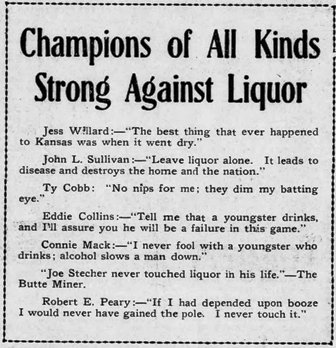
Collins’ statements about alcohol were used by various temperance organizations seeking prohibition.  Ads like the one below with quotes from Collins, Ty Cobb, and Connie Mack, and Admiral Robert Peary, as well as boxers Jess Willard, John L. Sullivan, and Joe Stecher appeared in newspapers and handbills distributed throughout the country.

temperance

“A Knocking Umpire had Attempted to keep Speaker back”

11 Sep

Jesse Doak Roberts was a prominent figure in Texas baseball.  He was the two-time president of the Texas League (1904-’06 and 1920-’29), and had an ownership stake and managed clubs in the Texas and North Texas Leagues.

Jesse Doak Roberts

Jesse Doak Roberts, circa 1929

In 1911, the then owner of the Houston Buffaloes gave The Houston Chronicle his version of how Tris Speaker ended up in Boston:

“I want to tell you the story of the force that endeavored to act against the rise of Speaker—a force that did not succeed, but which cost me $700 in purchase money, and it was a knocking umpire.

“When Speaker was going at his best in his last year in this league (1906), I had made arrangements with Charlie Comiskey to purchase Tris for $1500…the deal was almost closed.”

Roberts said he was approached “by a (Texas) League umpire,” during a late-season game in Austin who, he claimed, demanded “a commission” for recommending Speaker:

“I told him that I had never asked an umpire to sell one of my players and would not—that I would prefer that they would not recommend any of them…I must have angered him, for he knocked the greatest Lone Star player to Comiskey (later) I got a draft from the Old Roman: ‘We can’t use Speaker.’

(George) Huff, then scouting for Boston, was in town.  He came around to see me and asked what I would take for Speaker.  I told him $1500.  He said that was too much for a class C player—that he would give me $500.”

Roberts said he then tried to sell Speaker to the St. Louis Browns (the biography “Tris Speaker: The Rough and Tumble Life of a Baseball Legend” said Roberts had attempted to sell Speaker to St. Louis earlier that season)

“I refused to accept (Huff’s) offer and wired (Jimmy) McAleer at St. Louis.  I told him I would sell him Speaker under a positive guarantee that he would make good.”

Tris Speaker "hardest hit"

                                 Tris Speaker 

Roberts said McAleer never responded and he “finally made an agreement to sell the boy for $800 cash,’ to Boston.

“A knocking umpire had attempted to keep Speaker back and had kept us from getting the difference between Comiskey’s price if $1500 and Boston’s of $800. And the White Sox lost a great player.”

Roberts never named the umpire who he said cost him $700.

“That Short but Trite remark shaped my Career.”

24 Aug

In 1906, William George “Billy” Evans became the youngest umpire in major league history.  “The Boy Umpire” was just 22-years-old.

A decade later, in a syndicated newspaper article, he told the story of how he, by chance, he began his career as an umpire.  Somewhat altered versions of the story were told over the years, including a version in his obituary; however, this was his earliest, direct telling of the story:

Billy Evans

                                         Billy Evans

“It was one day in 1903 that I journeyed out to the ballpark to cover the game for the paper (The Youngstown Vindicator).  There was a delay when the time arrived to start to the contest.”

Evans said the umpire had become ill and while “a number of ex-players” were at the ballpark, the opposing managers could not agree.

“Finally, my name was suggested and proved acceptable to both managers.  I was informed of their decision but declined with thanks.

“The crowd was impatient.  It became noised about that I was the only man acceptable to both managers, and that since I refused to work the game would probably be called off.”

Evans was determined not to work the game, but said a voice from the stands changed his mind.

“Just when it seemed that I was to escape the ordeal a fan in the bleachers with a decidedly loud voice yelled: ‘What’s the matter—have you lost your nerve?’

“That short but trite remark shaped my career.”

Evans said one of the managers told him he’d earn $15 for the game—later versions said Youngstown Ohio Works Manager Marty Hogan told him what he’s be paid:

“Fifteen dollars for a couple of hours’ work—almost as much as I was getting for carrying the title of sporting editor for an entire week!  It made umpiring appeal to me.  Attired in the very best clothes I had, I took the field for my debut.”

Evans said that first game—a 1-0 victory in thirteen innings for the visiting team from Homestead, Pennsylvania—had “but few close decisions, and I got along famously.”

The regular umpire was still sick the following day.

“I gathered in $15 more.  My bankroll was so large that for the first time in my life I felt that a pocketbook was a necessity instead of a luxury.”

The following day, Evans accepted a permanent position “(A)lthough there were many times when I seriously doubted my wisdom in accepting the position.”

Three years later, Evans made his big league debut in New York.

“When I stepped on the field it seemed that wherever I looked I could see grinning faces.  I imagined that all of them were laughing at me when as a matter of fact I suppose there was scarcely a single person on the field who noticed me.”

Evans, who was harshly criticized early in his career, also wrote about his most dangerous incident on the field.

“I have dodged a million pop bottles…I have had them pass just above my head, between my legs, and, in fact, graze almost every part of my anatomy; but never have I been hit by a missile really intended for me.  I did stop a bottle that was intended for somebody else, and that stop almost resulted in the Great Umpire declaring me out.

“I was working a game at St. Louis, between the Detroit and the St. Louis clubs in the fall of 1907.”

The Tigers were locked in a three-team race  with the Philadelphia Athletics and Chicago White Sox—entering the series in second place, the Tigers fell to third after losing a doubleheader on September 14.

On September 15 the teams met for another doubleheader.  An overflow crowd filled an area of left field in front of a “swinging gate about six feet long out in the left field fence, about ten feet above the ground…used to facilitate the delivery of bottled goods into the park.”

With the game tied in the fifth inning, St. Louis pitcher Harry Howell was batting:

“(Howell) hit a ball into left field.  As I followed its course I was surprised to see the opening in the fence.  A few minutes before I had occasion to glance in that direction, and had observed nothing wrong.  I afterward learned that the gate had been opened only a few seconds before Howell hit the ball.

“It was my bad luck to have the ball pass squarely through the opening.  When Howell made the hit I had run toward third base in order to be able to follow the ball more closely.  When it passed through the opening I was about fifteen feet back of third base.  Howell paused at second base, and I motioned for him to continue home.”

[…]

“I was at once surrounded by a group of Tigers players all talking at the same time.  There is no fairer man in baseball that Hughey Jennings, the famous leader of the Detroit team, and I told that gentleman that the easiest way to settle the argument was to get rid of the players, and the two of us would thresh it out, which he proceeded to do.”

As Evans and Jennings wrapped up the argument, Evans suddenly slumped to the ground unconscious.

“The next thing I remember was when I came to in the hospital, and inquired what happened.”

What happened was a 17-year-old Browns fan named Hugo Dusenberg threw a pop bottle which struck Evans at the base of his skull.  As Evans lay unconscious on the field, fans attacked Dusenberg.

The St. Louis Post-Dispatch said:

“(Dusenberg) was saved from lynching by the quick action of the players who formed themselves into a guard and held back with bats a mob that swarmed.”

The St. Louis Republic said:

“Fifty policemen fought their way through the mob, rescued the assailant and with the greatest difficulty conducted him out of the grounds.”

Initial reports said Evans’ injury was serious—The Associated Press said his chance of recovery was “slim,” The Washington Post said he was “Probably fatally hurt.”  By the following day, it was reported that Evans would recover, but would likely miss the remainder of the season. Despite the grave predictions, Evans returned to work on October 5, the second to last day of the regular season; he worked the bases, with Jack Sheridan behind the plate, in a game between the Tigers and Brows in St. Louis.

Dusenberg, an American citizen who worked as a clerk at the German consulate in St. Louis, was charged with assault with the intent to kill Evans.  The Republic said in the days following the incident that “Sentiment is for the prosecution to the limit.”

Two months later Dusenberg was released after paying a $100 fine.

“He is a Model for the Young Ballplayer to Emulate”

21 Aug

March of 1916 was a bad month for “Prince Hal” Chase.

According to The International News Service, Chase, who spent the winter in San Jose, California playing for the Maxwells—a team sponsored by the automobile company–was “the last of the stars” of the defunct Federal League who had still not signed with a professional team.
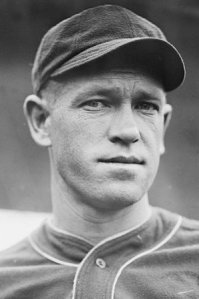
Hal Chase

                          Hal Chase

It got worse when he was arrested for failure to pay alimony and support to his ex-wife Nellie and their son Hal Jr.

He was released on $2000 bond, and it is unclear whether the case was ever fully adjudicated. After his release, Chase continued playing with the Maxwells and working out with Harry Wolverton‘s San Francisco Seals while rumors of who he would play for during the regular season were advanced on a daily basis.

The strongest rumors were that Chase would go to the New York Giants in a deal which would include Fred Merkle, who would be displaced at first base, going to the Chicago White Sox, the team Chase jumped to join the Federal League.

The Pittsburgh Post-Gazette said the deal was eventually foiled by Pirates Manager Jimmy “Nixey” Callahan, who “refuse(d) to waive.”

At the same time the papers in Cincinnati said Chase would be joining the Reds while West Coast papers said he might stay in California and join the Seals.

The Cincinnati Enquirer said Reds’ Manager Charles “Buck” Herzog “vigorously denied,” that Chase would join his club and said he would stick with Frederick “Fritz” Mollwitz at first base.
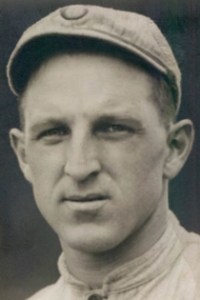
Buck Herzog

                     Buck Herzog

Herzog was even more forceful in his denial in The Cincinnati Times-Star:

“I wouldn’t have Chase at the camp.  Mollwitz is a very much better player, and he won’t jump when he is most needed.”

An even stronger indictment of Chase came from Detroit Tigers Manager Hugh Jennings, who told The Detroit News:

“As a player, there is nobody who can touch Chase for holding down first base.”

Jennings went on to note Chase’s intelligence, speed, and “superb” fielding:

“Yet for all his ability I would not have him on my club, and I do not believe any other major league manager will take a chance on him.  He will not heed training rules and has a demoralizing influence on the younger players.”
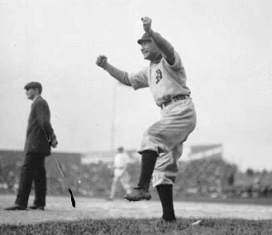
Tiger Manager Hugh Jennings

Tiger Manager Hugh Jennings

Jennings said while Chase managed the New York Highlanders in 1910 and ’11, led his team “astray,” instead of “trying to keep his players straight.”

Perhaps most damaging, Jennings said Chase was a source of dissent on the clubs he played for:

“One of his favorite stunts is to go around telling on man what another is supposed to have said about him, with the result that in a very short time he has the fellows pulling in all directions  instead of working together.  He is apt to take a dislike to the manager and work against him with the players until the whole squad is sore and will not give the sort of work that it is paid for.”

Jennings, whose team finished second in 1915 with George Burns at first base, said:

“The Tigers would win the pennant beyond question with a player of Hal’s ability on first this season, but I wouldn’t risk introducing a man who had such a bad disposition.  I believe that we can accomplish better results by having harmony on the squad, even if we have to get along with a first baseman with less talent.”

Despite the negative press, and over the objection of Herzog, the Reds purchased Chase’s contract from the defunct Buffalo Blues on April 6.

The New York Times lauded the move and defended Chase against his detractors.  The paper said “His failure with the New York Americans was due to petty controversies and rebellion against the club’s discipline,” and “(W)hen he is at his best there is not a player in the major leagues who is more spectacular than ‘Prince Hal.’”

Chase initially balked at reporting to Cincinnati, telling The San Francisco Chronicle “I haven’t made up my mind…it is possible that I would prefer to remain in California, even if there is no chance to play ball.”

Six days later, while his new team opened the season, Chase was on a train to Cincinnati.  The Associated Press said he agreed to join the Reds after receiving “word from Cincinnati that his entire contract with the Federal League, which calls for a salary of $8,000 a year, has been taken over,” by the Reds.

When Chase arrived in Cincinnati on April 15, the Reds had won three straight after losing their opener, and Mollwitz had played well at first base with five hits in 13 at-bats and just one error.

According to Frederick Bushnell “Jack” Ryder–college football star and Ohio State football coach turned sportswriter–of The Enquirer, Herzog had no intention of putting Chase in the game April 16:

“Herzog had little thought of playing him, as Fritz Mollwitz was putting up a bang-up game and hitting better than any member of the club,” until “Mollwitz made a bad mental mistake in the third inning.”

After Umpire Hank O’Day called a strike on Mollwitz, “the youngster allowed his tongue to slip,” and was ejected.
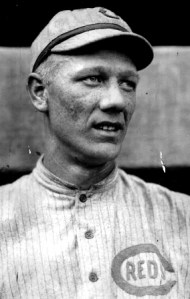
Fritz Mollwitz

                 Fritz Mollwitz

Chase came to bat with an 0-2 count and doubled off of Pirates pitcher Frank Miller, stole third, and after catcher Tommy Clark walked “(Chase) caused an upheaval in the stands by scoring on (a) double steal with Clark.”

Chase also wowed the crowd in the ninth.  After making “a nice stop” on Max Carey’s hard ground ball over first base and with pitcher Fred Toney unable to cover first in time, Chase dove “headforemost to first base to make a putout on the fleet Carey.”

In all, he played 98 games at first base, 25 in the outfield, and 16 at second base, he also hit a league-leading and career-high .329.

While the Reds struggled, Chase was wildly popular in Cincinnati.  The Enquirer’s Ryder was possibly his biggest fan—the writer raved about Chase’s performance in the outfield, his adjustment to playing second base, and his consistent bat.

While Chase thrived, Herzog, who had a contentious relationship with Reds’ owner August Herrmann, exacerbated by the signing of Chase against his wishes, began to unravel as the season progressed.  On May 30, he was hit in the head and knocked unconscious, by a throw from catcher Ivey Wingo during pregame warm-ups.  While he recovered physically, he became increasingly frustrated by the club’s performance.  On July 5—with a 29-40 record– he announced that he would retire at the end of the season when his contract expired.  He told The Times-Star:

“It would be a great blow to my pride to continue as a player, after being a manager for three years.”

The following day it was reported that the Chicago Cubs and New York Giants were interested in acquiring Herzog.  Within a week, it was reported that Herzog was heading to New York in a trade that would bring Christy Mathewson to Cincinnati to manage.  The negotiations continued over several days but floundered.  The Cubs reentered the picture—Owner Charles Weeghman told The Chicago Daily News “I brought the bankroll along…and I’ll get Herzog so quick I’ll make (the Reds) eyes pop.”  He later told the paper he offered “$25,000 and an outfielder” for Herzog.

At the same time The Brooklyn Daily Eagle said the Dodgers were after Herzog, and The Pittsburgh Post said the Pirates were in pursuit as well.

The pressure got to Herzog who held himself out of the lineup of July 17, The Enquirer said:

“The managerial situation is worrying Herzie, who had expected by this time to be cavorting at the third corner for the giddy Giants.  With the deal held off for various reasons, the Red leader is naturally a bit anxious.”

Herzog’s destination was unclear, but it was clear he would be gone.  With Mathewson seeming to be out of the picture, rumors persisted—fueled by Ryder of The Enquirer and William A. Phelon in The Times-Star—that Chase would be the new manager.

On July 20, Ivey Wingo managed the team to a doubleheader split with the Philadelphia Phillies, and the papers reported on Herzog’s successor:

The Enquirer ran Chase’s picture under the headline “Reds’ New Manager,” although they hedged in another headline which said he would “probably” be named.

The Times-Star said “Hermann has decided to allow Hal Chase to manage the team for the remainder of the season, and for this reason he does not want Mathewson.”

They were both wrong.

Within hours of the papers hitting the streets, a trade involving three future Hall of Famers was agreed to.  Herzog, along with catcher Wade “Red” Killefer went to New York for Mathewson, Edd Roush, and Bill McKechnie.  Mathewson was immediately named manager.
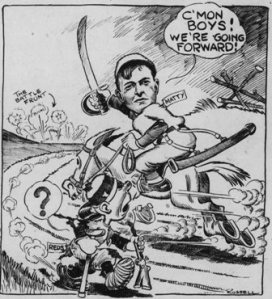
Cartoon accompanying the announcement of Mathewson's appointment.

          Cartoon which accompanied the announcement of Mathewson’s appointment.

Ryder said in The Enquirer that “Chase was greeted with a great round of applause” when he stepped to the plate for the first time on July 20:

“The fans at that time did not know of President Herrmann’s change of mind with regard to Matty, and they thought Chase was the new leader of the team.  The universal and hearty applause showed how popular the star third-sacker has become in this town.”

The Chase story is well-known; two years later Mathewson would suspend him, charge him with “indifferent playing.”  With Mathewson in Europe when the charges were heard by National League President John Heydler that winter, three Reds teammates, and Giants Manager Pol Perritt testified Chase had thrown games.

But in October of 1916 Chase appeared to have repaired his reputation, and his difficult March appeared to be far behind him.  In a season wrap-up, The Enquirer–there was no byline on the article, but it was likely the work of Ryder–published a glowing profile of the National League’s leading hitter and the man who nearly became the Reds’ manager:

“What has become of all the talk about Chase being a bad actor, a disorganizer, a former of cliques and a knocker of managers?  All gone to the discard.  Chase has not only played brilliant ball for the reds all season, but he has been loyal to the club and the managers.  He worked hard for Herzog and equally hard for Matty.  He has been a wonderful fellow on the club.  Chase is modest and does not seek notoriety or approbation…He played game after game in midseason when he was so badly crippled with a Charley horse that he could scarcely walk.  When Manager Herzog wanted to make an outfielder out of him he went to the garden and played sensational ball…Later in the season he filled in for several games at second base, a difficult position for a left-hand thrower, but he put up great ball there.  He is a natural ballplayer of the highest class, and with it all a perfect gentleman, both on and off the field.”

The profile concluded with this assessment of the man who would become synonymous with the baseball’s greatest sins:

“Chase has been a great man for the Reds, and there is many a manager of today who wishes that he had got in ahead of the Cincinnati club in signing him.  He is the smartest ballplayer and the quickest thinker in the National League today.  He is a model for the young ballplayer to emulate, because he is a real artist in his profession.”

“Demmitt!!”

20 Jul

Arthur “Bugs” Baer was a humorist and sportswriter—widely credited with coining the nickname “Sultan of Swat” for Babe Ruth—who often included his own cartoons with his articles.

Baer worked for The Philadelphia Public Ledger, The Washington Times, and William Randolph Heart’s King Features Syndicate, before moving to Hollywood where he wrote several film scripts, including the titles for “Headin’ Home,” the first movie Babe Ruth appeared in.

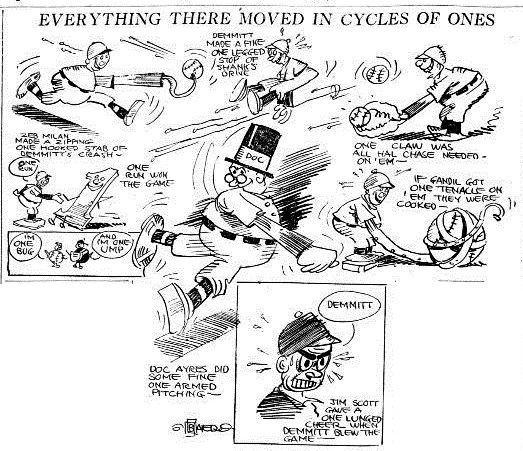
An example of Baer’s newspaper work; after a May 1914, 1-0 Washington Senators victory over the Chicago White Sox in 10 innings–Sox pitcher Jim Scott took a no-hitter into the 10th before allowing a single to Chick Gandil:

“Demmitt!!

“That’s the word.

“Oh! No!  We don’t mean what you mean.  (Ray) Demmitt is the right fielder on the Chicago White Sox, although we admit that it sounds as if he wasn’t.  He is the lad who made a brilliant one-legged stop of (Howie) Shanks’ drive in the tenth yesterday, allowing the ball to bruise our perfectly good right field wall and Jim Scott’s heart at the same time.  He came racing to snag the ball just like one of these pictures you see in the “Police Gazette.”  Just like a regular ball player, same as they have in big cities.  You’ve heard about those kind.

Demmitt!!

Demmitt!!

[…]

“The old pill went through him just like the Congressional Limited goes through Elkton, Maryland.  And Chick Gandil flat wheeled around the bases same as the Fourteenth Street car does around Thomas Circle…What we wanted to ask is did you notice how everything moved in cycles of one?

“One run won the game.  Demmitt’s one-legged stop allowed that one run to score and win one ballgame.  (Clyde) Zeb Milan (who made a bare handed stab of Demmitt’s sixth-inning single, and caught threw him out attempting to stretch it to a double) one-hooked stab saved the bacon, and Gandil’s one tentacled clutches chopped off many an error.

Hal Chase’s one-clawed catches of wide throws kept the Sox in the running and (Yancey) Doc Ayers’ great one-armed pitching put them out of it.  In fact, everybody acted as if they only had one arm.

Tommy Connolly did some fine one-cylindered umpiring.

“And Jim Scott gave a one-lunged cheer when Demmitt—there goes that word again—blew the game.”

Baer's cartoon that accompanied the article

The Baer cartoon that accompanied the article

“The Aristocrat of all Mascots”

1 Jul

Shortly after the 1920 World Series, The Associated Press (AP) claimed to have discovered why the Brooklyn Robins, after taking two out of three games from the Indians at home, dropped four straight in Cleveland:

“At last the secret…is out.  The Dodgers declined to take their mascot, Eddie Bennett, with them to the lair of the Indians, and without his lucky presence they were swamped.  And not only that.  Bennett, indignant over having been left at home, has quit the Brooklyns!  That’s revenge!”

The Brooklyn Daily Eagle said, Bennett, a Brooklyn native, came to the attention of baseball fans in 1919 when he served as bat boy and mascot for the American League Champion Chicago White Sox:

“(H)e used to hang around the players’ entrance to the ballparks on both sides of the bridge.  The Yankees were playing at the Polo Grounds then, and one day one of the White Sox noticed a wistful little fellow in the front row of hero worshippers.”

Eddie Bennett

Eddie Bennett

White Sox outfielder Oscar “Happy” Felsch, noticed Bennett suffered from kyphosis (the excessive curvature of the spine—in Bennett’s case it was said to have been caused by an injury when he fell out of his stroller as an infant) and asked “’Are you lucky?’ ‘Sure,’ cried Eddie Bennett eagerly.”  With Bennett serving as bat boy, the Sox defeated the Yankees.  With that:

“Felsch spoke to Eddie Cicotte about taking him back to Chicago. Cicotte spoke to Manager (William) Kid Gleason.  Eddie Bennett became the official White Sox mascot.”

Bennett spent the rest of the season with the Sox and roomed with pitcher Dickie Kerr on the road. After the Black Sox scandal broke—Bennett told reporters, “I was one of the honest ones”—the 16-year-old returned to New York and went to work for the Robins.

Dean Snyder, writing for Scripps’ Newspaper Enterprise Association, said of Bennett during Brooklyn’s pennant run:

“(The Robins) bought the kid a swell uniform and told him to hang around.

“From the day he started as the official mascot…things began to look up.”

But, Snyder noted, Bennett was strictly a mascot and not a bat boy in Brooklyn:

“Little Eddie is a hunchback. The players positively forbid him to touch their bats.  They just want him to stick around. They’re might superstitious about their war clubs.”

After being left home by the Robins for the club’s ill-fated trip to Cleveland, Bennett jumped to the Yankees; he told The AP:

“I’m going to be with a real club this year.  Oh boy, to watch that (Babe) Ruth sock them every day.”

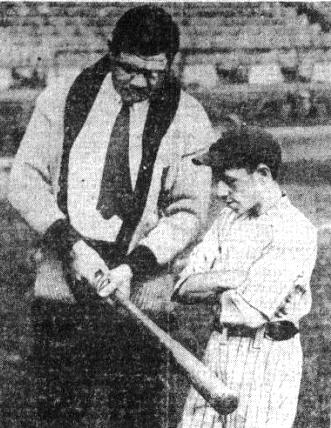
Bennett with Ruth

Bennett with Ruth

For the third straight season, Bennett was part of a pennant winner, and for the third straight year his team lost the World Series.  But this time he stayed put and remained a fixture with the Yankees for another decade.

American League Umpire Billy Evans, in one of his syndicated columns, said Bennett took his position very seriously and related a story about seeing him in a restaurant during a Yankee losing streak:

“Bennett was seated across from me at a table in the diner. We were served at about the same time, and I noticed he ate but little of the food he had ordered.

“’Something wrong with the food Eddie?’ I ventured.

“’The food is all right, I guess there is something wrong with me,’ replied Eddie.

“’Cheer up, Eddie.  The Yankees can’t lose all of them,’ I said with a laugh.

“’Babe hasn’t made a home run in a week.  The team never gets any runs for Bob Shawkey.  Every time Scotty (shortstop Everett Scott) makes an error it means a run.  Waite Hoyt has a bad inning every game,’ was Eddie’s come back.

“’Why worry about these things, Eddie?’ The Yankee mascot looked at me in a puzzled manner, as if I might be joshing him.

“’That’s my business, I’m a mascot,’ said Eddie in all seriousness.  ‘I am supposed to bring luck, to help Ruth make home runs, keep Scotty from making errors, have the team get runs for Shawkey, and no bad innings for Hoyt.’

“Eddie was disgusted at my failure to appreciate the importance of his position.”

In 1928, The Brooklyn Daily Eagle called Bennett “(T)he aristocrat of all mascots…eight flags in 10 years is the mark for other mascots, living and still to be born to try to equal.  It will probably never be beaten.”

Bennett’s career came to an end in May of 1932; according to The United Press (UP) he was riding in a cab which crashed and “was pinned to a pole,” Bennett suffered several broken bones, including a leg broken in several places, and spent months in the hospital. (The AP said he was hit by the cab while walking).

He made a brief, dramatic return to the Yankees a year later.

On May 23, 1933, Bennett entered the Yankees clubhouse on crutches in the midst of what The International News Service called “The great home run famine.”  Neither Babe Ruth nor Lou Gehrig had hit one since April 30:

“It was the longest home run slump for the twins since they started making life miserable for American League pitchers.  For weeks they rubbed their carcasses and bats with sundry kinds of magic oils and rabbit’s feet, consulted Yogi’s and employed every luck charm known to the superstitious in an effort to shake off the jinx.  It took Eddie Bennett, the little cripple who formerly was the club’s bat boy, to shatter the jinx.  Before yesterday’s game he solemnly tapped both sluggers with his magic crutch and that turned the trick.”

Eddie Bennett

Eddie Bennett

Both Ruth and Gehrig hit home runs off Oral Hildebrand (who came into the game with a 6-0 record) in an 8 to 6 victory over the Cleveland Indians.

It was a final happy moment for Bennett.

While he continued to be paid by Yankees owner Jacob Rupert, depression and alcoholism consumed the last years of his life.  The 31-year-old, “aristocrat of all mascots,” was found dead on January 17, 1935, according to The UP “cold and stiff in his drab rooming home…He lived out his days among his baseball trophies, drinking steadily”

Edit:  As noted in the comments, I say above that Bennett left the White Sox “when the scandal broke,”  which implies September of 1920 when the grand jury was impaneled. I should have said “when rumors of the scandal broke,” which began during the 1919 series and continued throughout the 1920 season.

“If Baseball is really the National Game let the Club Owners go out and prove it”

4 May

Haywood Broun, columnist for The New York World-Telegram, shook up the annual Baseball Writers Association dinner in February of 1933.  The Pittsburgh Courier said Broun “struck out boldly in advocacy of admitting Negroes to the charmed circle of big leagues.”

Heywood Campbell Broun

Heywood Broun

Broun said (and later wrote in The World-Telegram):

“I can see no reason why Negroes should not come into the National and American Leagues.

“Why in the name of fair play and gate receipts should professional baseball be so exclusive?”

[…]

“The introduction of a few star Negro ball players would do a great deal to revivify interest in the big leagues.  It would attract a number of colored rooters. And it would be a fair and square thing.  If baseball is really the national game let the club owners go out and prove it.”

Jimmy Powers of The New York Daily News said he polled the dinner guests after Broun’s remarks:

“I made an informal tour around the tables asking club owners and players their reactions to Broun’s little talk.  I was amazed at the sentiment in favor of the idea.”

Powers claimed that Yankees owner Jacob Rupert, St. Louis Cardinals General Manager Branch Rickey, and Babe Ruth were all in support of Broun’s statement.   John McGraw the dinner’s guest of honor—he had resigned as manager of the New Giants the previous summer due to his failing health—was, according to Powers, “The only prominent man present vetoing” the idea.

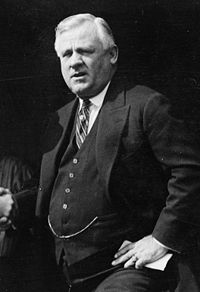
John McGraw

John McGraw vetoed the idea


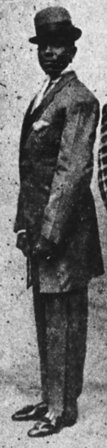
Salem Tutt Whitney, a prominent star of the black vaudeville circuit, commented on McGraw in the pages of The Chicago Defender:

“John McGraw and his Giants have been the idols of the Colored baseball fans.  Whenever and wherever there had been talk about the color line in major league baseball, the Colored fans were a unit that declared that if John McGraw could have his way there would be no color line.  ‘Didn’t he play (Charlie) Grant at second base on the Giants!’  ‘Look how long he employed a Colored trainer (Ed Mackall)!’”

[…]

 “It is my opinion that if the Colored baseball fans of Harlem are not convinced that Mr. McGraw has nothing more to do with the Giants, there will be a lack of personal color in bleachers and stands at the Giants’ stadium this summer.”

Salem Tutt Whitney

Salem Tutt Whitney

Not content to simply report on Broun’s pitch for integration, Powers made his own:

“I would like to make a case for the colored baseball player.  In football, Duke Slater, Fritz Pollard and Paul Robeson and stars of similar complexion played with and against the cream of Nordic colleges.  Eddie Tolan, Ralph Metcalfe and Phil Edwards have conducted themselves in a gentlemanly—not to mention championship—fashion.  Boxing has known Joe Gans, Sam Langford, Joe Walcott and Tiger Flowers.  There are only three popular sports in which the dark-skinned athletes are snubbed—tennis, golf and baseball.”

The New York Age approved:

“Here’s hoping all the other big white sportswriters have the courage of Jimmy Powers.”

Chester Washington, a sports writer at The Pittsburgh Courier announced that the paper was launching “A symposium of opinion, coming from outstanding figures in baseball circles,” designed to demonstrate a broad coalition of support for integration.

The Courier reported “The first of these statements,” in response to Washington’s outreach the following week—and it was a rather incredible one from John Heydler, president of the National League, who said:

“Beyond the fundamental requirement that a major league player must have unique ability and good character and habits, I do not recall one instance where baseball has allowed either race, creed or color enter into the selection of its players.”

Gerald Nugent “aggressive young owner of the Phillies,” was next to respond to The Courier:

“Nugent calls attention to the fact that no ‘color line’ is drawn on the dollars which are spent by colored and white fans for admissions in the various big-league parks…He further declares that the average colored semi-pro league player is better than his white brother in the same category.”

Support continued to come.  Chicago White Sox President J. Louis Comiskey:

“You can bet your last dime that I’ll never refuse to hire a great athlete simply because he isn’t the same color of some other player on my team if the alleged bar is lifted.”

While Commissioner Kennesaw Mountain Landis did not respond to The Courier, his right-hand man, Leslie O’Connor said “(T)here isn’t any rule which keeps colored players out.”  But, like Heydler, he made the incredible claim that “the subject of Negro ball players had never been brought up,” among the Major League Advisory Council.

Based on the initial responses, William Goldwyn Nunn, The Courier’s managing editor, expressed great, if premature, optimism:

“And the color will be black!

“As sure as the Ides of March are approaching, there’s going to be some added color in the Major Leagues.  AND, THAT COLOR WILL BE BLACK!”

Meanwhile Jimmy Powers quoted Lou Gehrig and Herb Pennock of the Yankees and Frankie Frisch of the Cardinals in The Daily News, all said they were “open-minded,” about the possibility integration.

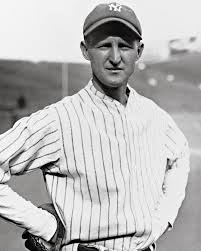
pennock

Pennock “Open-minded”


Two more prominent sportswriters came out in support:  Dan Parker of The New York Daily Mirror, and Gordon Mackay, who had been sports editor of three Philadelphia papers—The Enquirer, The Press and The Public Ledger.

And then, as abruptly as it began, the movement died.

Despite the brief groundswell of support, by the time the major league season opened Alvin J. Moses, another writer for The Courier admonished the papers readers:

“Aren’t you somewhat ashamed of yourselves that you haven’t seen fit to spare the time to flood (the paper) with letters that cry out against these NEGROPHOBES who for more than half a century have kept Negro ballplayers out of league competition?

“The cry of ‘Play Ball, Play Ball, Play Ball?’ is heard today in hundreds of parks the county over, and baseball statisticians have figured to show more than 40,000,000 fans walk past the turnstiles.  But what does that cry mean to you, and you, and you? Well, I’ll tell you—absolutely nothing.”