Tag Archives: Chicago White Stockings

No Such Thing as “Off the Record”–Even in 1875

19 Aug

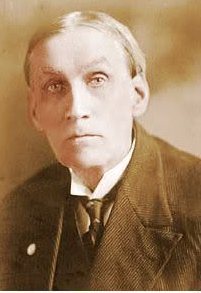
James Leon “Jimmy” Wood was a baseball pioneer.  The second baseman began his playing career as a 17-year-old in Brooklyn with the Eckfords in 1860.  After spending a decade as one of the best-known players on the East Coast Wood went to Chicago where he became the first manager of the newly formed White Stockings.

Wood is sometimes credited with being the man who invented spring training (a claim first advanced by Al Spink of The Sporting News) because in 1870 he took the Chicago team to New Orleans for a series of games with local teams, the Robert E. Lee’s, the Lone Stars, the Pelicans and the Southerns—most of those sources fail to mention that Harry Wright’s Red Stockings were in New Orleans at the same time.  (Wood’s reminiscences about the early days of the White Stockings coming up later this week).
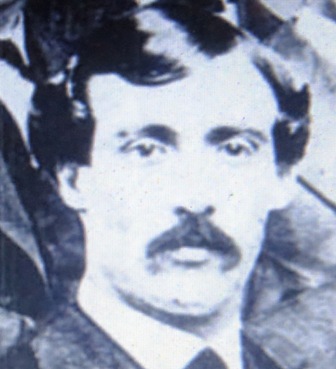
Jimmy Wood, 1871

Jimmy Wood, 1871

Wood also managed the team the following season, when the White Stockings became one of the charter members of the National Association.  They finished second in 1871  but disbanded as a result of the great Chicago Fire in October.

Wood next played for and managed two teams that wouldn’t survive the year; the Troy Haymakers went bankrupt in July and the Brooklyn Eckfords who folded at the conclusion of a 3-26 1872 season.

After leading the Philadelphia Whites to a second place finish in 1873, Wood returned to Chicago and the newly re-formed White Stockings.

Wood was slated to play second and serve as captain, but would never play a game for the White Stockings or any other team.  After falling at his home during the spring of 1873, he developed an abscess on his leg, which kept him out of the lineup as the infection got worse.

In July The Chicago Tribune said:

“The well-known base ball player and former captain of the Chicago nine Jas. Wood, has had his leg amputated.  He has been unable to play this summer, owing to a disease of the bones, and has been under medical care for some months.  He was a most conscientious player, and has the esteem of all with whom he was connected.”

On August 20 The Chicago Inter-Ocean said Wood was named “manager of the club for the remainder of the present season and for the season of 1875.”  While he “officially” served as manager for the last 23 games of the season, both The Inter-Ocean and The Tribune said Wood was “unable to assume active duties,” and would be led on the field by team president William Hulbert (called “Hurlburt” by The Inter-Ocean).

By the spring of 1875, Wood had returned full-time to the management of the White Stockings, with plans to take the team for “two weeks of practice,” in April.

The Chicago manager had an off the record conversation with a reporter for The St. Louis Democrat in which he unfavorably compared the newly formed St. Louis Brown Stockings to his own team.  The paper printed the manager’s comments verbatim; even including his assertion that the comments were “private:”

“Now, said he, let us compare the players individually.  ‘For catcher there is (Tom) Miller and Higham; the former is inexperienced, poor runner, fair batter, and the only catcher you have, while Dick Higham is one of the surest and heaviest batters in the country, has experience and is a first-class base-runner.  (George) Bradley and (George) Zettlein—Zett is a poor batter and runner, to be sure, but on a pitch you ought to know as much as I can tell you.  I do not know anything about Bradley, but, if (Jim) Devlin pitches, I think we have the best of it, as he was second on our batting list last season.  First base, (Herman) Dehlman and (John) Glenn,  the former may play the base the best, but in batting, base running and general playing, Glenn can discount him.  Second base, (John) Peters and (Joe) Battin.  Well, I won’t compare notes with them, as anyone ought to know that Peters is head and shoulders above Battin in every respect.  (Davy) Force and (Dickey) Pearce, shortstop.  There is no better player in the country than Force, he being one of the very best batters.  Pearce has been one of the best, but, I think his race is run.  This is private, remember(Frank) Fleet and Warren White, third base.  Why just think of it; there is as much difference in them as in Battin and Peters.  White is first-class at the bat, and led the score on the Baltimore team last season, and is a fine base-runner in the bargain, while Fleet is not as good, by a jug full.  (Ned) Cuthbert and (Paul) Hines, left field.  The latter took balls away out in Cuthey’s field last season (Hines had played left field, with Cuthbert in center for the White Stockings the previous season).  Hines stands better at the bat—Cuthey is a fast baserunner.  (Lip) Pike and (Oscar) Bielaski center field.  Pike is the hardest batter, but no surer than Bielaski, while both are about the same in the field, they being the fastest runners in the country.  (Jack “Death to Flying Things”) Chapman and (Winfield Scott) Hastings right field.  The former won’t begin to show up with Hastings, as he is one if the finest batters and catchers in the business.

“’Take us all in all we are much stronger at the bat.  While St. Louis has but Pike and Cuthbert for base runners, we have but one poor base-runner in Zett; all the others are first class.  We have change pitchers and catchers—St. Louis has not.  If we don’t beat St. Louis eight out of ten games, we deserve to be thrown into the lake.’”

Dickey Pearce, "his race is run," according to Wood

Dickey Pearce, “his race is run,” according to Wood
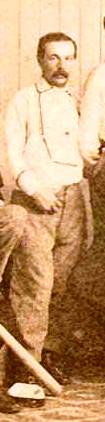
A few of the players Wood referred to in early March ended up playing different positions, or like Davy Force, of whom Wood said “There is no better player in the country,” didn’t play for the White Stockings at all.

Regardless, he underestimated the ability of most of the St. Louis’ roster, while wildly inflating his club’s prospects; Wood’s team would underperform all season, finishing 30-37 in sixth place, behind the fourth place (39-29) Brown Stockings.

Wood wildly overestimated the quality of his team and presided over a season of dysfunction and scandal.  More on the 1875 White Stockings tomorrow.
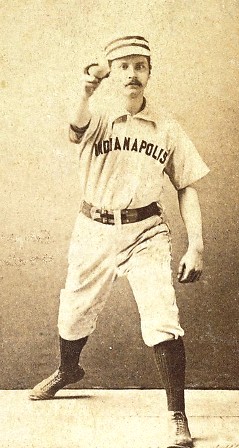
“There was probably none so Unique as Shreve”

24 Jul

Leven Lawrence “Lev” Shreve II came from a prominent family in Louisville, Kentucky.  His great-uncle, and namesake, had been president of the Louisville Gas and Water Company, and the Louisville & Nashville Railroad.

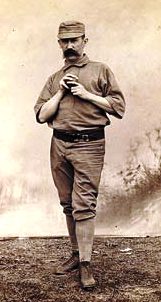
The 19-year-old made his professional debut in 1886, playing with Savannah, then Chattanooga; he was a combined 12-9 with 1.52 ERA.  Shreve was signed by Billy Barnie to join his young pitching staff with the Baltimore Orioles in the American Association.  He came to Baltimore with great expectations.

Lev Shreve

Lev Shreve

The Baltimore Daily News called him “Barnie’s phenom.”  In wasn’t the first time a relatively unknown pitcher was given that name by the Baltimore press.

Shreve had trouble getting as Barnie primarily relied on 21-year-old Matt Kilroy and 22-year-old Phenomenal Smith; Shreve, and fellow 20-year-old Ed Knouff saw limited action in the first two months of the season.

The Sporting Life said he wasn’t happy:

 “Shreve, the Louisville boy…complains that he does not get a fair deal.  He affirms that his arm is in fine trim, but that he is not allowed to pitch. Shreve is an ambitious ball player, and desires to show what is in him.  He says he will quit if Barnie does not play him.”

The Baltimore Sun said

“People are asking why Shreve isn’t given a chance.”

The Sporting Life, perhaps, provided an explanation for the lack of work later that month:

“Cigarette smoking is said to be impairing the efficiency of two Baltimore pitchers, Shreve and Knouff”

It would not be the last mention of cigarettes and Shreve in The Sporting Life;  the pitcher was also said to be “a cigarette fiend,” and “as noted for his cigarette habit” as his pitching.

Neither Shreve, who was sold to the Indianapolis Hoosiers in the National League, nor Knouff, who was sold to the St. Louis Browns, would finish the season with Baltimore; it’s unknown whether smoking was the cause.

Shreve was 3-1 with a 3.79 ERA in five games in Baltimore.

The sale to Indianapolis didn’t seem to hurt Shreve’s confidence according to George Myers, his catcher with the Hoosiers.  Meyers, two decades after playing with Shreve, said the pitcher was talented, cocky and erratic, and described Shreve’s first National League game; a 4-1 10-inning victory over the first place Detroit Wolverines on August 19:

“There was probably none so unique as Shreve…My, but he was a fresh youth…He had awful speed and good curves and perfect control of the ball.  His confidence and egotism were astounding.  I remember one day we were to play against Detroit (Wolverines).  It was when the big four, (Jack) Rowe, (Deacon) White, (Hardy) Richardson and (Dan) Brouthers were on the team.

“Mr. Shreve, who had been assigned to pitch, strutted to the box with the swagger that would have made John L. Sullivan look cheap when John L. was monarch of all in the fistic business.  ‘Just watch me fellows, and see what I do to those swell-headed guys from Michigan,’ said the smiling Shreve.  ‘I am going to make ‘em look like a lot of suckers.’

“Richardson was the first batter up…’So you are the great invincible Hardy Richardson, eh?’ drawled Mr. Shreve.  ‘Well Hardy, old chap, I’m going to show you that you are easy for a good pitcher…Shreve let go the first ball and it went around Hardy’s neck like a shot.  He struck at it after I had it in my hands.  Bang goes the second, also a strike, and the third a wide, slow, outshoot, fooled the great batter completely and Shreve said mockingly: ‘Back to the bench Hardy, I told you that you were easy.

“Big Dan Brouthers, who was always a terror to pitchers, came next and he had blood in his eye…’so this is the terrible Mr. Dan Brouthers,’ grinned the fresh pitcher.  ‘Hate to tell you Dan, how soft a mark you are’…Dan missed the first two, which went close to his chin, and the next he hit like a shot at the pitcher.  Shreve caught it in easy style and gave Brouthers the ‘ha ha’ in most tantalizing fashion as Dan ambled to the bench.

“Deacon White came next and Shreve kidded him unmercifully.  ‘Deacon who told you that you could hit anything?’ was the greeting white was given.  The Deacon scowled and muttered ominous.  ’Duck soup is what you are for me.’ Sand Shreve, as White missed the first ball by several inches.  ‘Oh, how easy,’ was the next rejoinder, and Deacon smashed blindly at an outshoot, a moment later striking out on one of those speedy ones such as had sent Richardson to the bench.

“The Big Four could do absolutely nothing with Shreve’s delivery, and the other members of their team were just as helpless…This fellow Shreve was one of the best pitchers I ever met, but he was an erratic chap, and dreadfully hard to handle.”

George Myers

George Myers

After beating the eventual National League champions in his first start, Shreve ended up a disappointing 5-9 with a 4.72 ERA for Indianapolis.

Myers said on another occasion Shreve approached him before pitching against the Chicago White Stockings, who had won the National League championship in 1886:

“’Say, George, what team is this we are up against today?’

“I immediately began to read him a lecture, telling him that a young man just starting in on his career as a professional ballplayer shouldn’t deport himself in such a manner. ‘The idea of you coming on to the grounds when the champion Chicagos are here, and not knowing it, why—‘  ‘The champion Chicagos,’ interrupted Shreve, ‘Never mind, George, just watch me.  Oh just wait and see what I will do to that bunch.”

Myer s said Shreve shutout the White Stockings.  (This story appears to be either apocryphal or conflated with another incident as Shreve did not shutout Chicago that season).

Shreve was 11-24 in 1888 and 0-3 in 1889 when he was released by the Hoosiers.  He played three minor league seasons and was out of professional baseball by the age of 24.

Myers said his former teammate was “erratic as Rube Waddell,” and:

“I could tell story after story about this man Shreve.  If he had taken care of himself he would have been the greatest pitcher in baseball history.”

“Baseball by Electricity”

11 Jul

In 1886, The Electrical Review told the story of the first attempts at “reproducing almost instantly a vivid view of the exact situations and plays in a game of baseball.”

The original plan was hatched by three telegraph operators in Nashville, Tennessee who “turned their enthusiasm for baseball to good account.”   J. U Rust, E.W. Morgan, and A.H Stewart made the first attempt to transmit a game between Chattanooga and Nashville in 1884:

“To do this they leased a wire from Nashville to Chattanooga, one end of which was on the ball field, with an expert operator, who was accurately informed in baseball playing, seated watching the game and immediately telegraphing each play as it progressed.  At the Nashville end of the wire were two other telegraphic and baseball experts.  As they received the record from their partner, one man reproduced it verbally to the audience, while the other man manipulated cards bearing the names of the players, around a painted view of the ball field which was placed in full view of the audience.”

The following season Southern League games were transmitted to opera houses in several of the league cities by Morgan & Co. “the ingenious firm” created by the three telegraph operators.

On July 9, 1886 Morgan & Co. transmitted the game between the Detroit Wolverines and the Chicago White Stockings from Chicago’s West Side Park to the Detroit Opera House. The “unique entertainment before a crowd of 600 persons,” was described by The Electrical Review:

“On the stage was a huge landscape—it would have done well as a drop curtain—having a well-painted perspective view of a baseball diamond and outfield.  At the points on the picture representing the positions of batsman, pitcher catcher and basemen, are openings into which may be shoved cards bearing the names of the players, and into which these names are placed as the telegraph operator seated at his instrument reads to the audience the progress of the game, even to the smallest details.”

The crowd at the Opera House “was wrought up to a very high pitch of enthusiasm.  For instance, when the operator read—with (Abner) Dalrymple’s name appearing as batsman—“foul fly to left,” the audience fairly held its breath, and when the next instant the operator called out, ‘and out to (James “Deacon”) White,’ there came a storm of applause, just such as heard on a veritable ball field…the excitement was intense.”

The Chicago White Stockings defeated the Detroit Wolverines 8-2 on July 9, on there way to the 1886 National League championship

The Chicago White Stockings defeated the Detroit Wolverines 8-2 on July 9, on their way to the 1886 National League championship

By the end of the 1886 season, games were presented in opera houses in Chicago, Boston, New York and Cincinnati.  By the end of the decade the practice would become commonplace in all big league cities.

By the mid 1890s the system for presenting games to the public had become much more advanced.

The Baltimore Morning Herald said in September of 1894:

“The ball game today between the Baltimore (Orioles) and Louisville (Colonels) clubs will be given as usual from the stage at Ford’s Grand Opera House at 4 o’clock by electricity.  The system utilized for the first game in the city is ‘The Compton Electric Baseball Game Impersonator.’   It has been used in New York and elsewhere with unbounded success.  It is a contrivance so ingenious that the slightest move of the players is visible, and the anxiety and interest of those present is just as great as though they had been occupying the grandstand.  Every strike is recorded and illustrated, and, whether at the bat, running the bases or in the field, all the players are known and watched…a visible reproduction of the game is given to the minutest detail.”

By the end of that season the Compton system was used to transmit games to fans in New York, Chicago, Philadelphia and Washington, and it, and numerous systems developed by competitors would become commonplace over the next four decades.

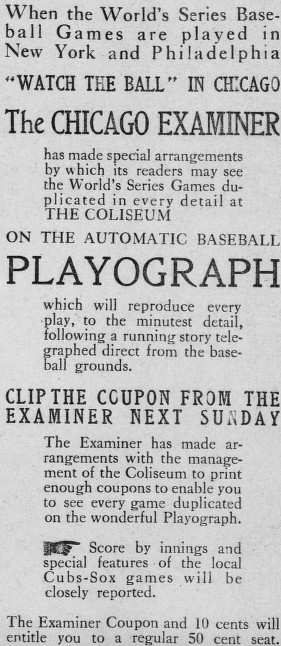
The Chicago Examiner sponsored the "automatic Baseball Playograph" exhibition of the 1913 World Series between the New York Giants and Philadelphia Athletics.

The Chicago Examiner sponsored the “automatic Baseball Playograph” exhibition of the 1913 World Series between the New York Giants and Philadelphia Athletics.

Usually sponsored by local newspapers, the exhibitions were an especially popular method for following the World Series in real-time.   It was not until 1938 (when the New York Yankees, New York Giants, and Brooklyn Dodgers became the last teams to have their games broadcast on radio) that the technological descendants of Morgan & Co. became completely obsolete.

The Curve and The Spitter

26 Jun

Hugh A. “Hughey” Reid only appeared in one professional game; he went 0-4 and played right field in a game for the American Association’s Baltimore Canaries against the White Stockings in Chicago in August of 1874,  as was the practice at the time, Baltimore recruited Reid, a local semi-pro player to fill in for the injured Oscar Bielaski.

Reid wasn’t known in the amateur and semi-pro leagues in Chicago as an outfielder.  He was considered one of the best pitchers in town, and played for the Chicago Aetnas, one of the premier teams in the city, and according to The Chicago Tribune “The champion amateur team of 1869.”

Hugh Reid

Hugh Reid

Among Reid’s teammates with the Aetnas were future big leaguers Jimmy Hallinan and Reid’s brother-in-law and catcher Paddy Quinn.

Reid worked as a stereotyper (made metal printing plates), for The Chicago Evening Post after his career ended.

In 1920, Reid was interviewed by Alfred Henry “Al” Spink, founder of The Sporting News.  By 1920, Spink, who had played amateur baseball in Chicago against Reid with a team called the Mutuals (named for the more famous aggregation in New York), had relocated to Chicago and was writing for The Evening Post.

Al Spink

Al Spink

The occasion was “field day exercises of the old timers” at Pyott Park at the corner of Lake Street and Kilpatrick Avenue in Chicago; the days events were followed by a banquet.  “Cap” Anson, Charles Comiskey, Hugh Nicol, and Fred Pfeffer were among the dozens of former pro, semi-pro, and amateur players who attended.

Spink described the 70-year-old Reid; “same old smile, same old swagger, same old don’t care a tinker’s, same old Hughey.”

Nine years earlier Spink had credited William Arthur “Candy” Cummings with originating the curveball in his book “The National Game,” but by 1920 others were making the case for different candidates.  Spink asked Reid his opinion:

“Without a doubt Cummings was the first pitcher to put the curve on the ball.

“As Cummings was using the outcurve as early as 1867, and Bobby Matthews only broke into the game at Baltimore in 1869, there is very little doubt as to who discovered the art of curving.

“In fact, it was not until years later, when the rules allowed the pitchers to raise their arm above the waist, that Matthews became master of the curve.”

Candy Cummings

Candy Cummings

Reid also talked about the pitch Mathews did introduce:

“I am quite sure that Mathews was the first to work the delivery mow bearing the insanitary name

“Before delivering the ball he would rub it hard on his trousers, always on the same spot, where the seams are the farthest apart…he would draw his two fingers across his lips, take the ball with two fingers and a thumb and send it in with only fair speed.  He had perfect control and usually sent the ball about waist-high for a player calling for a low ball.  The break came just in front of the plate and the ball usually went into the ground or very high in the air.  Few line drives were made off of Mathews.”

Bobby Mathews

Bobby Mathews

Reid also talked about Alphonse Case “Phonney” Martin.  At the same time that Spink was making the case for Cummings in “The National Game,” Martin told William Aulick of The New York Globe that he developed the pitch. Aulick concluded:

“Some people say this was the first cousin of the curve ball, but they don’t say this when old Alphonse Martin is around.  He insists it wasn’t anyone’s cousin–it was Mister Curve himself.”

Reid disagreed, he described Martin’s pitch as a “freak ball,” and said:

“I first saw Martin pitch down on the old lake front grounds in Chicago against the original White Stocking team.  He simply threw a slow lob ball that came so slow you had to nearly break your back to hit it.  But, at that, his delivery was a success, and most of the balls hit from it went high in the air and came down in some fielder’s hands…He threw a slow teaser that reached the plate about shoulder-high and dropped while still spinning.”

Alphonse "Phonney" Martin

Alphonse “Phonney” Martin

Reid insisted Martin’s pitch was not a curve:

“Cummings and Cummins alone was the originator of the curve.”

Chicago’s Lakefront Park 1878–The First Game

23 May

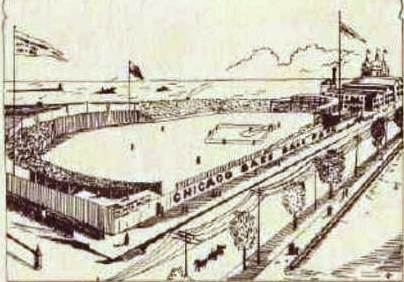
The Chicago White Stockings left Twenty-Third Street Park and relocated to Lake Front Park near the corner of Michigan Avenue and Randolph Street.  The old Union Baseball Grounds had stood at the same spot, but was destroyed in the Great Fire of 1871.

Lakefront Park

Lakefront Park

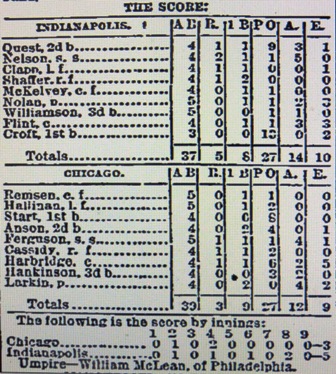
The ballpark opened on May 14, 1878 with a 3:45 pm “game between the Indianapolis nine (Blues) and the home nine.”  The Chicago Inter Ocean said:

“Although the day was very chilly and exceedingly unpleasant for out-door sports, fully 2,500 people assembled to witness the game and listen to a very ‘queer’ band, provided by President (William) Hulbert to officiate at the opening and funeral services of his white-hosed boys.”

——

“The game was not particularly interesting except from the fact that from the first inning until the twenty-seventh man had been retired it was extremely doubtful which club would win.  The play of (Joe) Quest of the Indianapolis (sic) was by far the most brilliant of the game.  He covered the position of second base with greater ease and accuracy than any player that has been seen for many a day.  He won the game for his club by a very clever double play in the ninth inning.  The game stood 3 to 5 in favor of Indianapolis with one man out and all the bases full.  (Jimmy) Hallinan came to the bat and hit a high ball to the right of second base which Quest succeeded in catching, and by very fast running reached the base before (Terry) Larkin

Edward “The Only” Nolan got the victory for Indianapolis but “did not particularly distinguish himself in the field,” making three errors.

Of the White Stockings, The Inter Ocean said:

(Frank) Hankinson played third without an error, and received very (sic) deserved applause for a number of excellent plays.  Hallinan was brilliant in the left field, and (Cap) Anson was remarkably stupid at second.”

None of the newspaper accounts of the game elaborated on Anson’s play at second.

The Inter Ocean did elaborate on Hulbert’s band:

“(T)he dismal music furnished by the band appeared to affect almost to tears the Chicago ball-players.  Another game will be played tomorrow afternoon at the same hour, and a far different result is expected.  There will be no band.”

The Box Score

The Box Score

The White Stockings would go on to win three straight National League Championships 1880-82) at Lakefront Park (sometimes referred to as Lakeshore Park).  The ballpark was expanded after the 1882 season and remained the White Stockings’ home until they moved to West Side Park in 1885.

“Begged the Crowd for God’s Sake not to Kill Him”

21 May

Edward Siegfried Hengel (often misspelled Hengle during his career) was a well-known umpire and manager in the 1880s.

Born in 1855, Hengel managed the Union Association franchise that began the season in Chicago, and relocated to Pittsburgh in August, 1884.  His career is occasionally confused with Emery “Moxie” Hengel (also often misspelled Hengle) who played second base for 1884 Chicago/Pittsburgh club, and had a long minor league career.  (The two were born two years apart in Chicago, but there is no indication they were related).

Emery "Moxie" Hengel

Emery “Moxie” Hengel

In 1886 Ed Hengel was an umpire in the Southern Association.  On August 5 he was working a game between Savannah and the Charleston Seagulls.  The Macon (GA) Telegraph said, in the sixth inning:

“”At this point of the game it became apparent to the audience, as well as to the players of the local team, that Hengle (sic), the umpire, had sold the game to Savannah; but notwithstanding his adverse decisions, the locals kept the Savannah team down to one run till the end of the ninth inning.  During the latter half of this inning (Hengel) gave the visitor three runs, letting them score in the following manner:  (John “Tug”) Arundel was at the bat. There were two out.  He hit a grounder to (Henry “Heinie”) Kappel who stopped it and threw it to first.  Arundel had stopped running and left the line when (first baseman Jim) Powell   failed to catch the ball”

Arundel then came back onto the field and ran to first, Hengel declared Arundel safe and a  run scored; the next hitter, Joe Miller, drove in two more runs, to win the game for Charleston, 4 to 3

The Telegraph said:

“As soon as the crowd caught on to the steal the grand stand and bleaching boards emptied their male contents on the ground, and for five minutes (the umpire) was in danger of getting very badly hurt, if not killed, by the infuriated crowd.”

The management of the Charleston team helped keep the fans at bay until police arrived:

“It were (sic) best for (Hengel) to get transferred immediately as another disgraceful piece of umpiring will cost him some inconvenience.  The people of Charleston will not stand another robbery.

“(Hengel) was scared nearly to death; he was as white as a sheet, and it is said begged the crowd, for God’s sake, not to kill him.  He did not deny having sold the game when charged with it by a director of the baseball club after he was safe.”

Hengel did not work another game in Charleston that season.

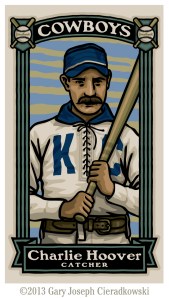
In October of 1887 The Aurora (IL) Daily Express credited Hengel with signing “(Charlie) Hoover crack-backstop of the Western League” for the Chicago White Stockings—within weeks Hoover’s long series of troubles would begin.

HOOVER_LG

Charlie Hoover

Hengel continued as an umpire, including stints in the Tri-State and Pacific Northwest Leagues,  and minor league manager for the next decade.  While managing the Hamilton (OH) club in the Tri-State League, Hengel saved a young girl from drowning, and “her grateful parents presented him a pair of diamond sleeve buttons.”

Hengel disappears from the newspapers after 1892;  he died in Great Britain in 1927; presumably not at the hands of angry Charleston fans.

Note:  Henry “Heinie” Kappel does not appear on surviving rosters for the 1886 Charleston Seagulls, but contemporaneous accounts in The Sporting Life and other newspapers confirm he was with the team.

Jot Goar

15 May

Joshua Mercer “Jot” Goar had one good minor league season.

Born in 1870 in New Lisbon, Indian, Goar’s early career is mostly unknown, although he appears to have pitched for the Muncie club in the Indiana State League in 1890 and for a variety of semi-pro teams in that state during the early 90s.  In one version of a story I told in January (“Remarkable Baseball Stunt”), “Baseball Magazine” identified Goar as the pitcher who gave up six hits in one inning without a run scoring in an Indiana State League game versus Anderson.

Goar was signed by the Toledo Swamp Angels in the Western League in 1895 (the team would relocate to Terre Haute, Indiana during the season).  While his numbers don’t look impressive, 13-19 with a 3.38 ERA and 345 hits in 288 innings, Goar was called “The best twirler in the Western League,” by The Sporting Life, and quickly became a highly sought after prospect.  Goar also hit .273 as a part-time outfielder.

His manager Denny Long told Indiana papers that Cap Anson “offered him a neat sum,” to sell Goar to Chicago.  Instead, the pitcher was purchased by the Pittsburgh Pirates; The Anderson Herald said Pittsburgh paid $3,200 for Goar:

“Jot Goar, considered the greatest find in the Western League this year…is looked upon to be one of (the Pirates) mainstays for next year.”

Gore joined Connie Mack’s Pirates in Hot Springs, Arkansas in the spring of ’96 and made the team; he made his debut with the team on April 18, pitching in relief in a 7-2 victory over the Louisville Colonels.  Gore struggled in three games with the Bucs, he allowed 25 earned runs on 36 hits and eight walks in 13 1/3 innings, losing his only decision, and was sold to the Grand Rapids Rippers in the Western League on May.

Jot_Goar

Jot Goar

No statistics survive for Goar’s 1896 season in Grand Rapids, but a mention of Goar in The New York American two years later said he had “deserted Grand Rapids,” at some point during the season.  Goar joined the Indianapolis Indians in 1897, and with a 25-9 record and a 1.39 ERA led the Indians to the Western League championship.  Goar was again highly sought after and his contract was purchased by the Cincinnati Reds.

Goar spent the winter refusing to sign a contract along with Frank “Noodles” Hahn, who had also pitched in Western League in 1897; the Cincinnati Enquirer said both players were asking for $1,800.  Goar finally signed in February, but the salary he settled upon was not reported, The Mansfield Daily Shield said:

 “Jot Goar has signed his Cincinnati contract and expects to play good ball this season.”

In March The Sporting News said:

“Jot Goar is showing more speed than any of the Reds pitchers.”

Goar did not live up to the expectations.  He hurt his arm in his first and only appearance; a two-inning mop up in an 11-5 loss to the Pirates, giving up, four hits, three runs, two earned, and a walk.

Pittsburgh Sports writer John Henry Gruber said Goar went to Reds manager Buck Ewing after the game “and at his own request was laid off until such time as he could get in shape.”

Goar returned to Indiana and for the remainder of 1898 and all of ’99 he managed and played first base for an independent team in his hometown in New Lisbon, that fall his team took part in a ballpark riot.  The Indiana State Journal said:

“The game of baseball between the Shamrock and Jot Goar teams on the Hagerstown grounds Sunday broke out in a riot.  Fists, clubs and stones were freely used and practically everyone who attended received some kind of injury.  The trouble arose over a decision of the umpire, who was Councilman John Geisler of Hagerstown.”

Gore began pitching again 1900 for the Indianapolis Hoosiers in the American League posting a 7-2 record in 10 games; he also played for the Western Association Hoosiers the following year, but there are no surviving records.

Goar returned again to New Lisbon, vowing that his pro career was not over, and accepted the position of postmaster and opened a general store while continuing to play for the local team. In 1904, The Sporting Life noted that he was still pitching in Indiana:

“Jot Goar, the old Cincinnati and Toledo pitcher, was doing things with the Connersville, Indiana team this season.  He pitched seven games for that club, six of which he won, the other being a 12-inning tie.  Only five runs were scored in the seven games, and he struck out seventy batters or an average of 10 a game.”

Goar gave up baseball after 1906.  He accidentally shot himself in the arm while hunting in 1907, and his general store burned to the ground, the 1911 “Reach Guide” said:

 “His place of business was completely ruined by a disastrous fire, which practically destroyed the business section of (New Lisbon).”

He rebuilt the store which he operated until 1921; Jot Goar died in 1947 at 77.

1876 Salaries

14 May

In July of 1876, The Brooklyn Argus published the salaries of the two highest paid teams in the newly formed National League; many of these have never appeared in any of the collections of early baseball salaries.

According to the article, the highest paid player was Chicago White Stockings pitcher Albert Goodwill Spalding who “as pitcher and manager, receives $3,000 for the year, with $1,000 bonus for producing the secession from the Hub (Boston) to Chicago.”  (The 1950 book “100 Years of Baseball,” by Lee Allen said Spalding earned $3,500 and a $500 bonus for the season).

A.G. Spalding, highest paid in National League

A.G. Spalding, highest paid in National League

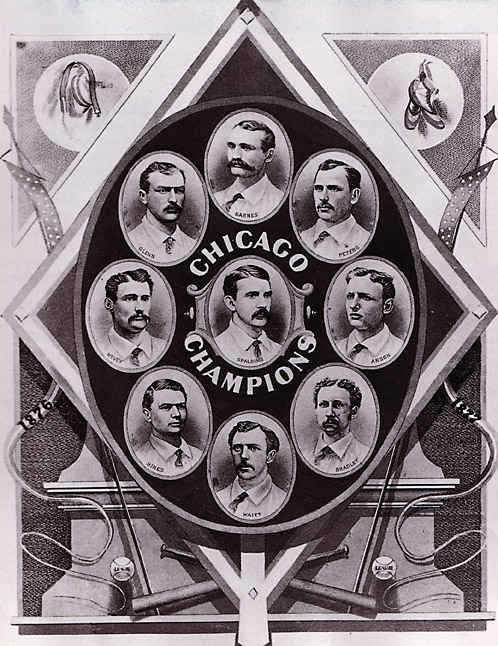
The three players Spalding brought with him from the Boston Red Stockings in the National Association, Catcher James “Deacon” White, first baseman Cal McVey and second baseman Ross Barnes were all paid $2,500.  The two players signed away from the Philadelphia Athletics, third baseman Adrian “Cap” Anson and outfielder Bob Addy received $2,200 and $1,500 respectively.

Outfielder Paul Hines earned 1.800, utility player Fred Andrus was paid 1,000, and the remaining members of the first National League Champions, shortstop John Peters and outfielders John Glenn and Oscar Bielaski were made $1500 each.

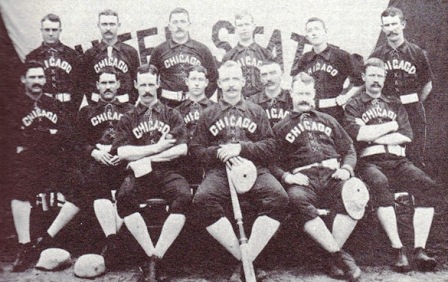
Chicago White Stockings, 1876 National League Champions--and highest salaried team.

Chicago White Stockings, 1876 National League Champions–and highest salaried team.

Harry Wright’s Boston Red Stockings filled the vacancies of White and Barnes with 18-year-old Lew Brown and 21-year-old John Morrill who The Argus said received “between 800 to 1000 dollars each.”

Manager Wright, who only appeared in one game, and his brother George were the highest paid members of the Boston club at $2,500 each.  Andy Leonard, who played second and outfield was paid $2,000.  Two other notable players on the Red Stockings, Hall of Famer “Orator Jim” O’Rourke and Tim Murnane received “between fifteen hundred and eighteen hundred dollars.”

According to The Argus, the White Stockings payroll of $21,500 topped the league, with Boston’s total of 18,000.

The Ross Barnes Case

2 May

Charles Roscoe “Ross” Barnes was one of the greatest players of his era, and largely forgotten today.

Barnes was a member Harry Wright’s Boston Red Stocking teams in the National Association from 1871-1875 and won the National League’s first batting title hitting .429 in 1876 as a member the Chicago White Stockings.

Ross Barnes

Ross Barnes

Teammates and contemporaries had no doubt about how good he was.

“Orator Jim” O’Rourke called Barnes “the greatest second baseman the game ever saw.”  In 1896, A.G. Spalding “declared Ross Barnes to have been the greatest ballplayer in America,” and Tim Murnane said of Barnes:

“His left-handed stops of hard-hit balls to right field were the prettiest stops ever made on the Boston grounds. As a base-runner no man of the present day is his equal, and as a batsman he must be reckoned very high.”

1871 Red Stockings. Spalding, standing second from left, Barnes, standing far right, O'Rourke, seated far left.

1871 Red Stockings. Spalding, standing second from left, Barnes, standing far right, O’Rourke, seated far left.

Some of Barnes’ success was due to the rule at the time regarding  balls that rolled foul in the infield, The Sporting Life said:

“It was Barnes who was the first to master the fair-foul hit. He was able to drive the ball so that it would land fair and then swing in foul just outside of the reach of the third baseman.”

Barnes became ill in 1877, although he started the season with the White Stockings, The Chicago Inter Ocean said in early May “he is now, and has been all spring, very sick with few signs of improvement.”  After a slow start, Barnes was out for more than three months before returning in late August.

The Chicago Tribune said:

“Barnes made his reappearance with the Whites, and played his old position at second base,  but he showed evidence of physical weakness and lack of practice,”

Barnes appeared in only 22 games, hitting .272.

The second baseman,  who was earning $2500 for the season, and as was often the case in 19th Century baseball,  was not paid for the time he missed.  Early in 1878 Barnes filed a lawsuit against the White Stockings to collect more than $1,000 the team did not pay him while he was ill.

Cook County Judge Mason B. Loomis heard the case, which The Inter Ocean said:

“(I)s a new one in the experience of ball clubs, and the result is looked forward to with some interest  in sporting circles.”

The result was not favorable for ballplayers.  Judge Loomis ruled against Barnes, The Tribune said:

“This makes clear the point that players are not legally entitled to wages when laid off by sickness.”

While some owners did pay players during time missed due to illness and injury, teams had the right, after 15 days, to suspend any player without pay; and the legal precedent established in Barnes’ case remained until 1916 when the “injury clause” was rescinded.

Barnes attempted to return to the White Stockings in 1878, but The Tribune said he “has never fully recovered,” from the illness, and was released.

He played with and managed the London Tecumsehs in the International Association in 1878, then made two comeback attempts with the Cincinnati Reds in 1879, and the Boston Red Stockings in 1881, his career was over at age 31.

Barnes retired to Chicago and was working for Peoples Gas, Light and Coke Co. when he died in 1915 at age 65.

“California Wonder”

30 Apr

Two West Coast ballplayers dubbed “California Wonder” by the press made their Major League debuts less than a week apart in 1887.  One went on to be one of the best leadoff hitters of his era; the other remains almost completely unknown.

George Van Haltren was a 21-year-old left-handed pitcher, outfielder and first baseman who had played two seasons with the Oakland franchise in the California and California State Leagues.

James McMullin, birth date unknown, had pitched for Mike Finn’s San Francisco Pioneers in 1886.

Mike Finn, manager, San Francisco Pioneers

Mike Finn, manager, San Francisco Pioneers

Van Haltren’s rights were acquired by the Pittsburgh Alleghenys, but because of his mother’s illness he said he would instead play for the San Francisco Haverlys.  The Chicago White Stockings traded for Van Haltren in April, but he still refused.  The Sporting Life said “the California Wonder will not come east,” quoted him saying:

“No, I will not play with Chicago this season; but if my left arm holds out and my parents are blessed with good health I will be open to Eastern engagements next season.”

The White Stockings threatened to have him blacklisted for not reporting but Van Haltren dug his heels in; only changing his mind after his mother passed away in May.

The Chicago Inter Ocean announced that he had arrived in town on June 25 and would be making his debut for the White Stockings on the two days later:

“(Van Haltren) at one time retired the Pioneer Club of San Francisco with a hit, and struck out seventeen men.  If he can continue this record here the Chicagos will come out of the race this season with another set of figures to put on the big flag at the park.”

Van Haltren’s debut was not good.  He walked 16 Boston Beaneaters and lost 17 to 11.  He finished the season 11-7, and would spend one more season as a full-time pitcher; going 13-13 in 1888 (he was 15-10, splitting time between the mound and outfield with the Brooklyn Ward’s Wonders in the Players league in 1890).  Van Haltren would distinguish himself as one of the game’s best leadoff men, hitting better than .300 every year from 1889-1901, except for 1892 when he hit .293.

Van Haltren ended his career in 1903 with 2544 hits.

George Van Haltren

George Van Haltren

McMullin’s debut was no better than Van Haltren’s.

He began the 1887 season with the Pioneers, but was acquired in June by the new York Mutuals of the American Association.

When McMullin joined the club The Sporting Life said:

“The Mets have got their new California pitcher and like him well in practice.  He has plenty of speed.”

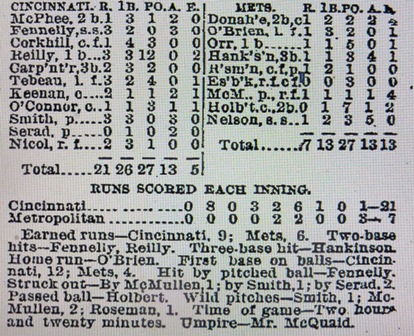
McMullin made his debut on July 2 against the Cincinnati Red Stockings.  The New York Times said of his performance, under the headline, “A ‘Wonder’ Exploded.  The Mets’ California Pitcher A Failure:”

“The debut of McMullen, the ‘California Wonder,’ was made (in Cincinnati) today in the presence of nearly 7,000 people, who went into hysterics from laughing at the awful exhibition given by the Wonder and his support.  He was utterly unable to get the ball over the plate and was miserably supported in the field.  After the third inning he retired to right field and there made a couple of errors.”

He gave up eight runs, made four errors and had two wild pitches in a 21-7 drubbing.

The box score from McMullin's debut.

The box score from McMullin’s debut.

McMullin only made two more appearances for the Metropolitans, and while he was credited with wins in both games his performance was no better; in his eight-day, three-game career he pitched 21 innings, gave up  25 runs (18 earned),  25 hits, walked 19, and struck out 2.  He made a total of five errors, and had one hit in 12 at bats.  The Mets released him on July 10.

And with that McMullin disappeared—there is no record of him having pitched anywhere after he left New York, there’s no record of whether he  threw and batted left-handed or right-handed, no pictures survive, and no record of when or where he died.  Another enigmatic figure of professional baseball’s early years.