Tag Archives: Christy Mathewson

“Another Phil Pitcher was Sacrificed on the altar of a Futile Attack”

6 Aug

When George Chalmers returned from Cuba with the Philadelphia Phillies in November of 1911 he wasn’t the same pitcher.

After pitching the first game of the series against Almendares and the great Cuban pitcher Jose Mendez, Chalmers saw little action in the final eight games.

While training in Hot Springs, Arkansas in the spring of 1912 it became clear that Chalmers’ shoulder was in bad shape.  The Philadelphia Inquirer said he was sent from Hot Springs to Youngstown, Ohio to “visit ‘Bonesetter’ Reese.” (John D. Reese was a Welsh-born “practitioner of alternative medicine.” The  “self trained”  Reese was, according to The Pittsburgh Press, visited by many of baseball’s biggest stars, including Frank Chance, Ty Cobb, Honus Wagner, and John McGraw.  At the same time he was condemned by Ohio physicians who said there was no evidence of Reese “curing a single case where there was actual fracture or displacement of bone.”)

The famous “Bonesetter” was unable to do anything for Chalmers.  The Wilkes-Barre Times-Leader said in April:

“It is reported on good authority that Chalmers, one of the Phillies star pitchers, will be unable to deliver the goods this season owing to the condition of his pitching arm.”

As a result of the injury Chalmers only appeared in 12 games in 1912, with a 3-4 record, and didn’t pitch at all from July 5 until September 4.   At the end of the season Phillies owner Horace Fogel, who would soon find himself chased out of the game, used Chalmers’ injury to suggest a change in how pitchers were paid.  According to The Philadelphia Bulletin:Ho

“Horace wants to employ pitchers on the percentage basis, paying them so much per game—no game, no pay.

“The Phillies President conceived the idea after he had figured that it had cost him an average of $800 per game for the few games pitched by George Chalmers during the present season.”

Phillies team photo from George Chalmers personal collection--appears to be the 1912 team.

Team photo from George Chalmers’ personal collection

The $800 per game figure was clearly wrong—Chalmers would have not earned anywhere near $9600 for the 1912 season (Christy Mathewson made between $8000 and $9000), Chalmers and “Pete” Alexander both probably made less than $3000.  It is doubtful Fogel’s plan would have gone anywhere had he remained president of the Phillies.

The following season was no better; with no improvement to the injured shoulder, Chalmers appeared in 26 games, 15 as a starter, and was 3-10 with 4.81 ERA.  It got so bad that after a loss near the end of the season The Wilkes-Barre Times-Leader said:

“Our old friend ‘Dut’ Chalmers got another trimming yesterday.  It has gotten to be such a regular thing for Chalmers to be beaten that he doesn’t mind it anymore.”

Two of the Phillies best pitchers in 1913, Tom Seaton (27-12), and Addison “Ad” Brennan (14-12) jumped to the Federal League, making Chalmers and his injured shoulder even more critical to the Phillies hopes for 1914.

In March The Philadelphia Inquirer said Chalmers had spent the winter in Hot Springs rehabilitating his shoulder and appeared “to be in splendid shape,” when he reported to spring training in Wilmington, North Carolina, and “(Charles “Red”) Dooin is thanking his lucky stars that Chalmers is in camp.”

The season turned out to be Chalmers’ worst.  He pitched in three games, losing all three with an ERA of 5.50, and he Phillies released him on June 22.  The Inquirer said his shoulder had never healed and attributed the injury to “rheumatism and a misplaced muscle.”
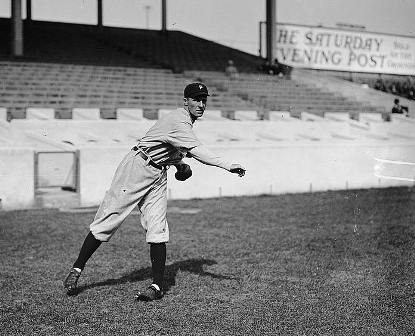
George "Dut" Chalmers

George “Dut” Chalmers

The Pittsburgh Press said:

“The frailty of baseball life and the quickness with which a career in the big show may be ruined are shown again in the case of George Chalmers…Chalmers may recover and come back some time, but it is doubtful, and his going marks the untimely end of a career that promised to be one of the most brilliant in baseball pitching history.”

According to The Inquirer, he was not yet ready for the end:

“Chalmers…had mighty little money, about $400 in all, and his best friends advised him to stick the little old four hundred into some good business and forget baseball…Good doctors had told George that his arm was gone.  Other pitchers, real friends of the Phillies star, had told him the same thing…Then he heard of a specialist in New York who had done a great job on another pitcher’s arm which had seemed to be gone (no articles mentioned the name of the specialist or the other pitcher).”

With his arm seemingly better, Chalmers was invited to spring training with John McGraw’s New York Giants in Marlin, Texas.  The New York Mail said “he looked good at Marlin,” but the Giants let him go before the season began.  On April 20 he was signed again by the Phillies, and sent out to pitch the next day.  The Inquirer said:

 “George Chalmers, once a Philly discard and lately spurned by the Giants, with whom he trained during the spring trip to the Southland, was the hero of today’s festive occasion for Philadelphia.  Chalmers had been without a big league contract and he was signed by (manager Pat) Moran only yesterday.  But he gave him a quick trial by shunting him at the Giants, and he showed his gratitude to the Quaker boss by pitching the best game of his career.”

Chalmers gave up only two hits and beat the Giants 6-1.

As the Phillies fifth starter in 1915 he was 8-9 with a 2.48 ERA, appearing in 26 games.  Jack Kofoed, a sportswriter for The Philadelphia Record said in “Baseball Magazine”that Chalmers’ record did not reflect how well he pitched:

“Throughout the season Chalmers twirled splendid ball, but played in tougher luck than any man on the Philly staff.  Had fate been as kind to him as to Al Demaree (14-11 3.05 ERA) , for instance, he would have won twice the number of games he did.  But the Phillies played more weird ball behind him than in back of any man on the staff.”

The Phillies won the National League pennant, and met the Boston Red Sox in the World Series.  With Philadelphia down two games to one, Chalmers was Moran’s choice to pitch game four in Boston.

Facing Ernie Shore, who won 19 games for the Red Sox, Chalmers pitched well, but lost 2-1 (the same score of Philadelphia’s losses Geo 2 and 3); The Inquirer said:

“Another Phil pitcher was sacrificed on the altar of a futile attack…through the futile efforts of his companions to obtain for him even the slender margin that was all he required.”

The Red Sox beat the Phillies four games to one.

In November of 1915 several Pennsylvania papers said Chalmers had used his “World Series coin as a matrimonial nest egg.”

The following season was his last.  The shoulder injury returned and the Phillies only used Chalmers in 12 games, he was 1-4 with a 3.19 ERA.  He did not appear in a game after August 7, and was released at the end of the season.  After an unsuccessful attempt to catch on with the Kansas City Blues in the American Association in 1917 Chalmers career was over before his 29th birthday.

In the waning days of his career, The Wilkes-Barre Times-Leader said:

“’Dut,’ as George is called by his playmates is a fine, upstanding, intelligent young fellow, with all the sturdy Scotch virtues as well as a Scotch burr in his speech, and whether or not he lasts in baseball he is very likely to be successful in life.”

Chalmers retired to New York and died in the Bronx in 1960.

Special thanks to Karen Weiss, George Chalmers’ great niece, for generously providing copies of photos from Mr. Chalmers’ scrapbook.
George Chalmers

5 Aug

George “Dut” Chalmers is one of only seven big league players born in Scotland.  He came to New York City as a young child and, according to The Philadelphia Inquirer “his baseball education was begun” with the Bradhurst Field Club which played their games at 145th and Lenox Avenue.  He also played on amateur teams in Hoboken, New Jersey and Red Hook, Brooklyn.

After attending Manhattan College, Chalmers began his professional career in 1909 with the Scranton Miners in the New York State League, managed by Gus ZeimerThe Sporting Life said:

“In George Chalmers, the giant young Manhattan College grad, Zeimer has landed what looks to be the prize-package pitcher of the league.   His work has been sensational.”

There are no complete statistics for 1909, but the following season the 22-year-old Chalmers was 25-6 for Scranton; finishing second in victories to 23-year-old Syracuse Stars pitcher Grover Cleveland “Pete” Alexander who was 29-11.

The Wilkes-Barre Times-Leader said Chalmers:

“Looks like one of the very best in the minor leagues, having a major league head and everything in the pitching line, including fine control and a spitball.”

At the end of the 1910 season the Philadelphia Phillies acquired both of the New York League’s star pitchers; Chalmers was purchased, for either $3000 or $4000, depending on the source, and Alexander was obtained through the Rule 5 Draft.

Both rookies made the club after spring training in Birmingham, Alabama.  Six years later The Philadelphia Evening Public Ledger said of Chalmers’ first days with the 1911 Phillies:

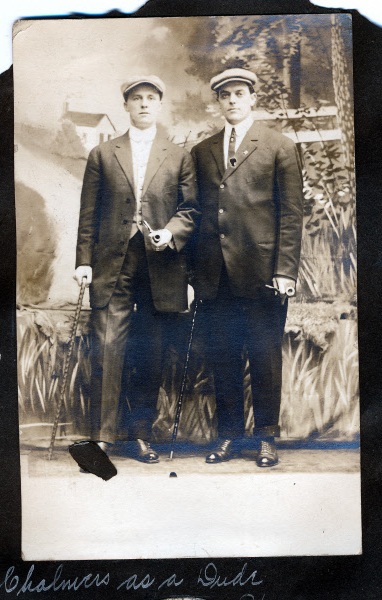
“Chalmers came with an elaborate trousseau, together with lots of pinch neckwear and considerable toggery that aroused the brunette population of Birmingham to deep, empurpled envy. “

chalmersasadude

George Chalmers, left, with teammate Alonzo Earl “Crossfire” Moore Displaying the style “that aroused the brunette population of Birmingham to deep, empurpled envy. “
Caption reads “Chalmers as a Dude.”  Photo from Chalmers’ personal scrapbook.

In addition to his fashion sense, Chalmers also impressed the Phillies with his pitching ability.

While Alexander got off to a great start, Chalmers started slow, but after back-to-back victories in July, Phillies manager and catcher Charles “Red” Dooin told The Philadelphia Times:

“That youngster is a great twirler.  You know they told me up in the New York League that Chalmers was a better pitcher than Alexander.

“Of course this is impossible because I think that ‘Alex’ is the greatest pitcher that ever drew breath, but I am going to say there’s not a club in either league which could beat the ball Chalmers has pitched for the last two weeks.

“I think I have another Alexander in Chalmers and if he don’t make good prediction I will say that he lacks the nerve and nothing else.  Chalmers has more stuff than Matty (Christy Mathewson) had.  He needs the experience and knowledge of batsmen, but aside from that he is the best young twirler I have ever seen excepting Alex.”

A syndicated story from The American Press Association said Chalmers had given up other sports for baseball:

“George Chalmers, one of the pitching sensations of the Philadelphia National League team, is a motorcycle rider as well as a box artist.  Before he joined the Phillies Chalmers occasionally picked up a little spare change acting as a pacemaker for Elmer Collins, the bicycle rider.  Chalmers has paced Collins several times in the latter’s races against Bobby Walthour.  Chalmers, however, doesn’t intend riding any more.  He fears a spill that might injure his arm and affect his pitching.

“Chalmers at one time had an ambition to become an automobile race driver.  He gave up this notion when he got his chance to join Philadelphia.  The big right-hand pitcher is not sorry that he sidetracked that ambition, for his pitching now is yielding him a healthy income.”

While he was overshadowed by Alexander, who was 28-13 with a 2.57 ERA, Chalmers had a respectable rookie season posting a 13-10 record with a 3.11 ERA.

In September it was announced that the Phillies would travel to Cuba for a 12-game series with the Almendares and Havana teams in November.  As the October 31 departure date drew near it became clear that, for a variety of reasons, many of the Phillies would not be making the trip.  Most notably Alexander, locked in a contract dispute, and Dooin would remain at home.

Besides Chalmers, the players who made the trip were:

Wallace “Toots” Shultz P

Eddie Stack P

Bill Killefer C

Fred Luderus 1B

Otto Knabe 2B

Hans Lobert 3B/MGR

Jimmy Walsh SS

Sherry Magee OF

Mike Mitchell OF (Borrowed from Cincinnati Reds)

Dick Cotter OF

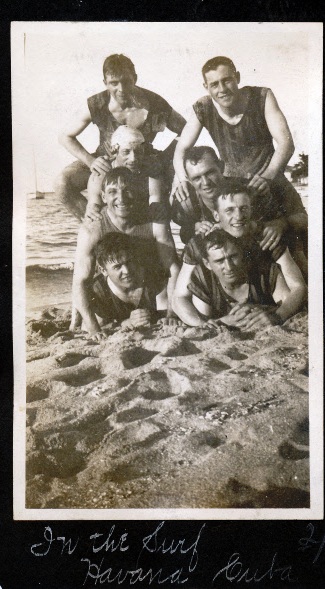
Chalmers and his Phillies teammates on the beach in Havana, Cuba

Chalmers and his Phillies teammates.  Caption reads “In the surf Havana Cuba”
Photo from Chalmers’ personal scrapbook.

The first game of the series, reduced from 12 to nine games because of the Phillies’ limited roster, took place on November 5.  Chalmers faced Almendares and Cuban legend Jose Mendez; the Phillies lost 3-1.  It is likely Chalmers hurt his arm during the series; he did not start another game, and Schultz picked up the slack, pitching six games, he was credited with the victory in the five games the Phillies won.

Upon returning to Key West the last week of November, Chalmers was briefly detained by authorities. The Philadelphia Times said the ship’s manifest listed Chalmers as American, but:

“On arrival in the states when he had to sign a long paper of identification, he told the officials that he was Scotch and never naturalized…Chalmers was reprimanded and the ship company was fined for carelessness”

Heading into the 1912 season The Philadelphia Times, and the second year pitcher, had high hopes:

“Chalmers is young and has every confidence in himself.  He is big and strong and is a perfect running mate for Alexander the Great.”

But the George Chalmers who returned from Cuba would never be the same pitcher.

More tomorrow.

Special thanks to Karen Weiss, George Chalmers’ great niece, for generously providing copies of photos from Mr. Chalmers’ scrapbook.
Thanks to Mark Fimoff co-chair SABR Pictorial History Committee for identifying Earl Moore in the first picture and correcting my incorrect, original caption placing Chalmers on the right–the information has been corrected in the caption.  October 18, 2013

Baseball’s “Growing Evil”

24 Jun

By 1913 newspaper articles under the byline of a famous player were common in newspapers across the country, and most of the game’s biggest stars were represented.

Most fans of that era assumed the players did their own writing until an expose appeared in The Washington Herald in March of 1913.  Sports Editor William Peet wrote:

“The dear old public fell for this stuff and swallowed hook, bait and sinker.  An article under the signature of Christy Mathewson led three-fourths of the fans to believe that the great pitcher himself wrote it.”

According to Peet, players were paid between $250 and $1000 for each story “and not one of them wrote a single word,” but it was still a good investment:

“The newspapers themselves regarded these feature articles as good investments, for the reason that the stories were syndicated to 25 or more outside publications and the revenues derived not only paid the amount guaranteed the baseball player for the use of his name, but left a handsome profit.”

Peet exposed the writers behind the articles “written” by the game’s biggest stars:

Christy Mathewson and Jeff Tesreau/John Wheeler, The New York Herald

Walter Johnson/Ralph MacMillan, The Boston Journal/The Boston Herald

John McGraw/Walter Turnbull, The New York Evening Sun

John “Chief” Meyers/Jim McBeth, The New York American

Richard “Rube” Marquard/Bill Farnsworth, The Atlanta Georgian/Hearst Newspapers

Denton “Cy” Young/Sam Carrick, The Boston Post

Tris Speaker/Tim Murnane, The Boston Globe

“Smokey” Joe Wood/Jim O’Leary, The Boston Globe

Ty Cobb/Roger Tidden, The New York World

Hughie Jennings/George “Stoney” McLinn, The Philadelphia Press

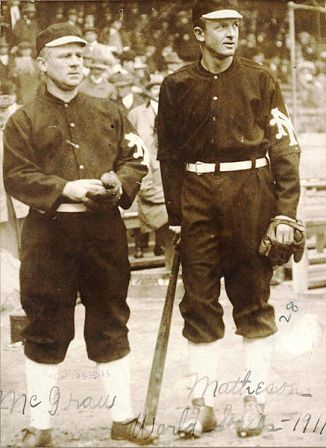
John McGraw and Christy Mathewson

John McGraw and Christy Mathewson

Peet called the practice dishonest, and said it had gone too far, and in New York and Boston the practice   had “become a mania.”  Peet singled out an article “written” by John McGraw criticizing “Chief” Myers that caused an “explosion,” and said the articles featuring “Rube” Marquard’s byline, and written by Farnsworth got Marquard “in bad with his teammates, for Farnsworth spared no one is his scathing criticisms.”

Pittsburgh Pirate manager Fred Clarke disagreed with the practice, telling Peet:

“I do not think it is any ball player’s place to butt into the newspaper end of the game…I think it is foolish for any player, especially those who take part in the world’s Series, to write about the games.”

As a result of Peet’s revelations the American League club owners condemned the practice of players’ names appearing on articles they did not write, but came just short of officially banning the practice. In September, the Baseball Writers Association petitioned the National Commission to end the “growing evil” of players authoring or appearing to author articles during the upcoming World Series.

The commission agreed, and American League President Ban Johnson informed Philadelphia Athletics manager Connie Mack on the eve of the World Series that star players Eddie Collins and Frank Baker “have been instructed not to write baseball stories or give the impression they are writing them.  If they ignore this request, a way of punishing them would be found. “

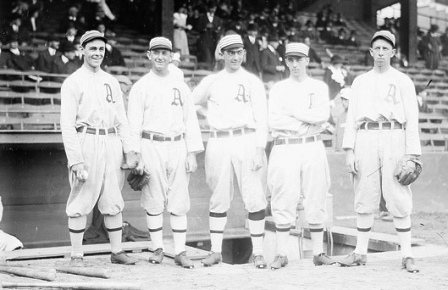
Frank Baker, center, Eddie Collins, far right,

Frank Baker, center, Eddie Collins, far right,

Johnson even threatened “Collins and Baker would not be permitted to take part in the World Series,” if they wrote articles or permitted their names to be attached to articles.

At one point Johnson and National Commission Chairman August Hermann said they would consider calling off the series if players refused to comply.  Dave Fultz, the former player, practicing attorney, and president of the Fraternity of Baseball Players, said members of the commission could be personally liable for damages if the series was cancelled.  Johnson and Herman’s threat to cancel the series as a whole was put to rest.

Mack argued that the players had contracts with newspapers and that Johnson had said earlier that players who were “capable” of writing their own articles would be permitted to do so, but as he prepared his team to play the New York Giants, he prepared for the worst, telling The Associated Press:

“(I)f the commission decides the players must not write under any conditions and players decide not to abide by the ruling, I will be prepared to put a team on the field,” The AP speculated that utility infielder John “Doc” Lavan  would play second base  and outfielder Rube Oldring would be moved to third base, with Amos Strunk taking Oldring’s place in the outfield.

Mack’s adjustments weren’t required.  Collins was allowed to write for The Philadelphia Record because his deal with the paper predated the commission’s ruling, and Baker did not write articles.  Together they led the Athletics to a 4-1 Series win, hitting .421 and .450.

Ghost written articles, and articles actually written by players never disappeared, but the practice became much less popular after the revelations and battles of 1913.

“A Heart-Breaking Play, Engineered by Wagner”

29 Mar

The defending World Series Champion New York Giants had gotten off to a fast start in 1906; on May 15 they were 19-7, the Chicago Cubs were 21-9, when they arrived in Pittsburgh for a four game series.

The Giants were shut out by the Pirates in the first two games.  In the third game of the series Christy Mathewson blew a three-run lead and the Giants trailed 7-5 heading into the top of the eighth inning..

Outfielder Sam Mertes walked, moved to second on Bill Dahlen’s single and scored on a two-out single by second baseman Billy Gilbert.  The Giants were behind 7-6 with runners on first and second; manager John McGraw was about to send Sammy Strang to pinch hit for Mathewson, when, according to The New York Times:

“A heart-breaking play, engineered by (Honus) Wagner in the last second of the eighth inning, beat the Champion New Yorks…It was a hard game to lose, and might not have been lost had Dahlen not fallen a victim to the wiles of Wagner.  The big Dutchman was guilty of the trick of hiding the ball, and when Bill stepped off second base, thinking (pitcher Albert “Lefty”) Leifield had the ball, Wagner, who had concealed it, touched Dahlen, which made the third out.”

Bill Dahlen

Bill Dahlen

The Pirates held on to win 7-6; The Times said of Dahlen:

“The New York shortstop felt so bad that he fairly wept.  McGraw, too, was angry, and it was said tonight he fined Dahlen heavily for his bit of carelessness.”

The Giants were unable to keep pace with the Cubs who finished 20 games ahead of New York for National League Pennant.

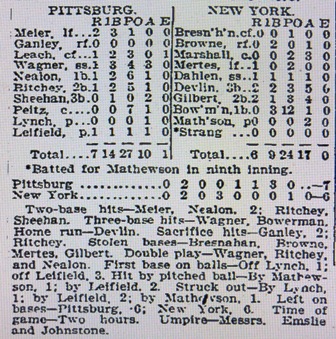
The Box Score

The Box Score

Lost Advertisements-Christy Mathewson “Big Six” Indoor Baseball Game

13 Mar

???????????????????????????????

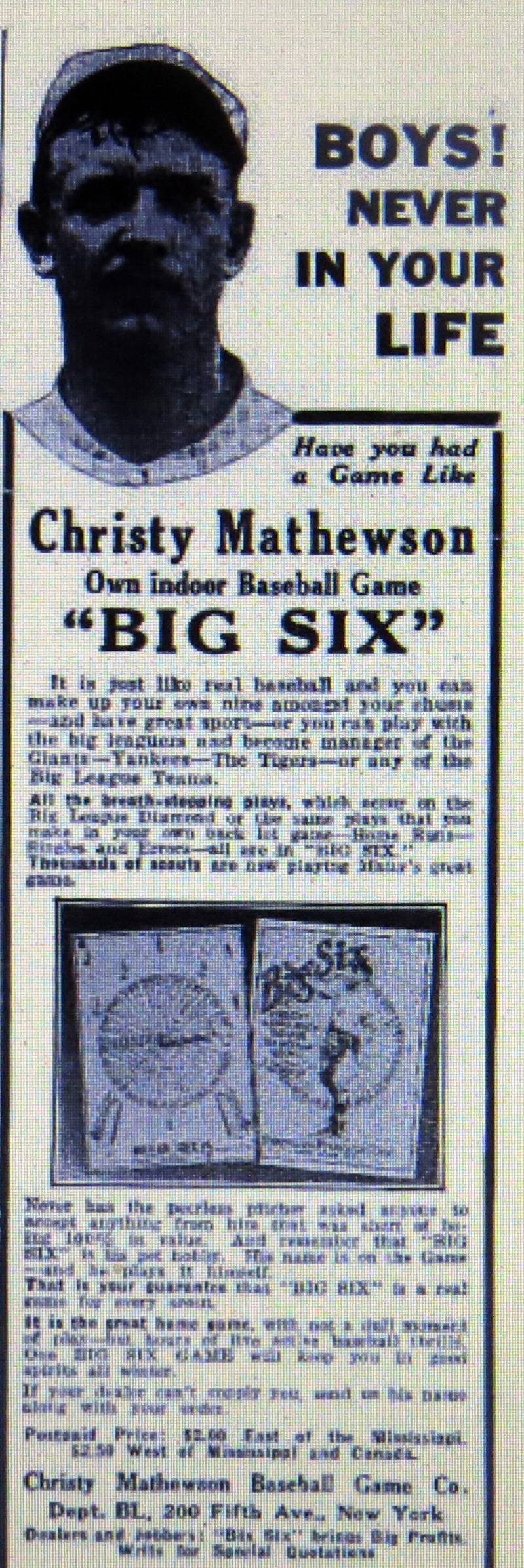
From 1922–$2.00 East of the Mississippi, $2.50 West of the Mississippi and Canada.

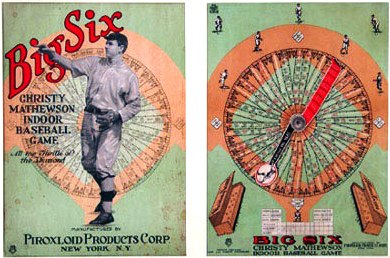
Boys! Never in your life have you had a game like Christy Mathewson Own Indoor Baseball Game “Big Six.”  it is just like real baseball and you can make your own nine amongst your chums–and have great sport–or you can play with the big leaguers and be manager of the Giants–Yankees–The Tigers or any of the Big League Teams.

Box cover and Game Board--Christy Mathewson "Big Six" Game

Box cover and game board–Christy Mathewson “Big Six” Game

A Thousand Words–Lost Advertisements, Christy Mathewson

24 Jan

mattyad

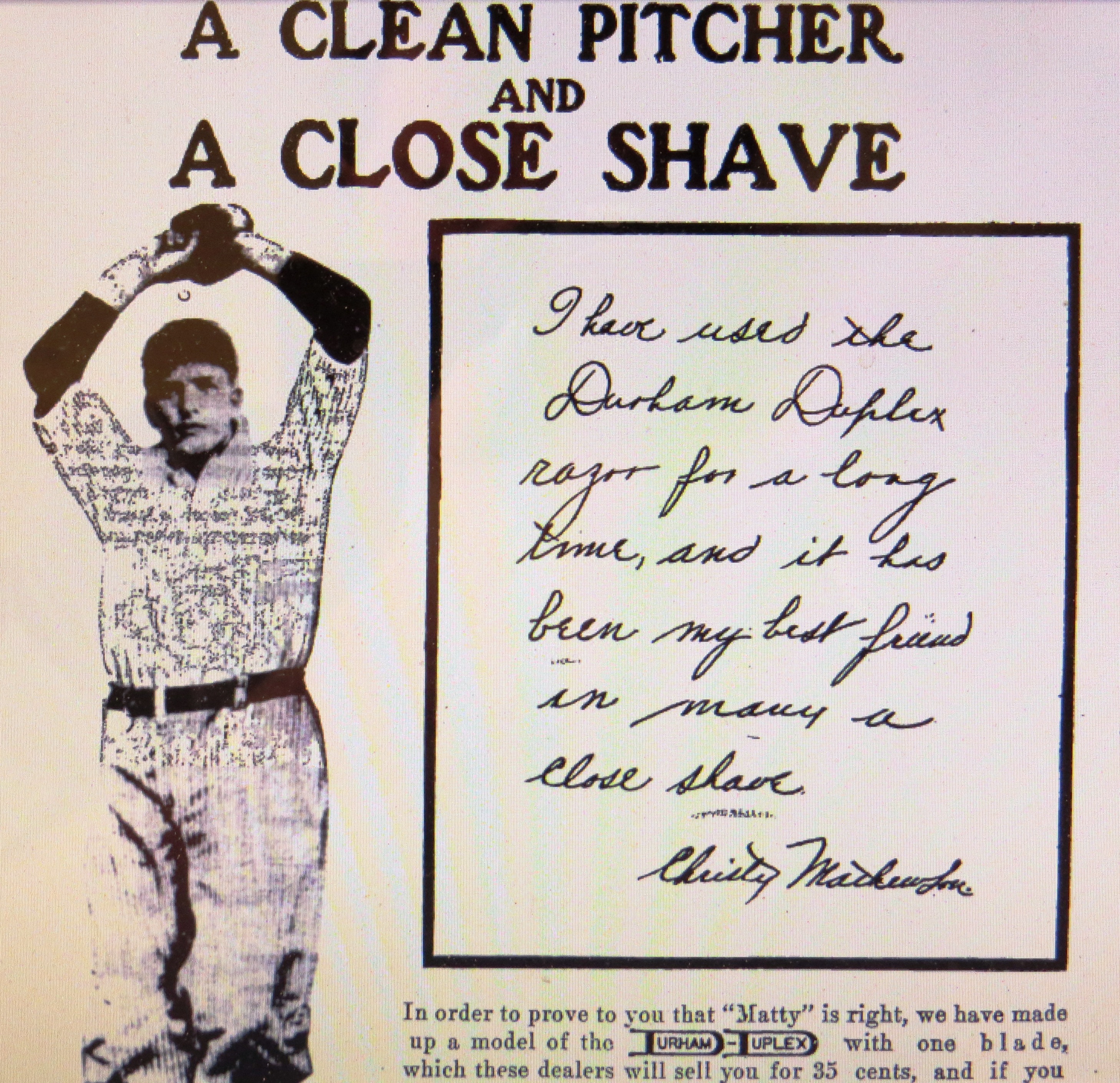
“A Clean Pitcher and a Close Shave.”  Hall of Fame pitcher Christy Mathewson for the Durham Duplex razor.  “Big Six” says:

“I have used the Durham Duplex Razor for a long time, and it has been my best friend in many a close shave.”

Mathewson won 372 games for The New York Giants and one for the Cincinnati Reds from 1900-1916, including four 30-win seasons, and was a member of the first Hall of Fame induction class.

“Christy Mathewson brought something to baseball no one else had ever given the game. He handed the game a certain touch of class, an indefinable lift in culture, brains, and personality.’”
— Grantland Rice