Tag Archives: Cincinnati Reds

Things I Learned on the Way to Looking Up Other Things #1

7 Mar

There are many interesting, odd, great stories I stumble across when researching that are too short for a full post.

Sydney J. Harris, the late Chicago Daily News and Sun-Times Columnist had a regular feature by the same title as this post.  It seemed an appropriate name for this feature—so with a hat tip to Mr. Harris:

Arrested for Refusing to Fight Forest Fire

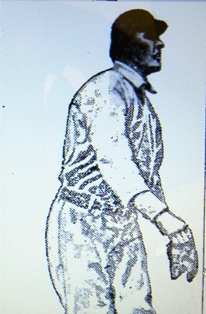
In December of 1911, Boston Red Sox pitcher Charley Hall and Pacific Coast League outfielder Harry Price were teammates on a winter league baseball team in Ventura, California, when a forest fire broke out in the area.  According to The Associated Press:

“When the fire was at its height Hall and Price…were sitting on the veranda of a hotel,  a deputy fire warden ordered them to fight the fire but they refused.”

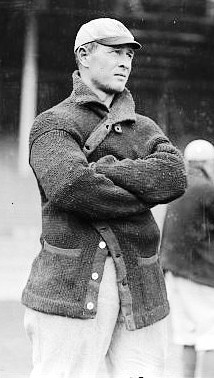
Charley Hall, arrested for refusing to fight fire
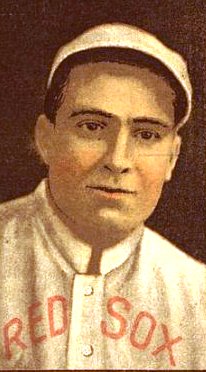
Charley Hall, arrested for refusing to fight fire

Fire Warden John Kuhlman placed both players under arrest.  There is no record if they were ever convicted.

Baseball 1860

The New York Herald report on a July 5, 1860 game:

“The friendly game of ball between the Excelsior Club of Brooklyn and the Niagara Club of Buffalo resulted in an easy victory for the Excelsiors.

“The score was, Excelsior 50, Niagara 19.  In the fifth inning the Excelsiors made twenty-four runs.”
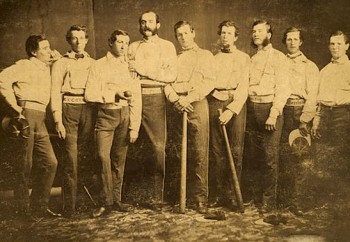
The Excelsiors, 1860

The Excelsiors, 1860

Carrier Pigeons

According to The Philadelphia Record in 1883 a zookeeper in Philadelphia used carrier pigeons dispatched between the zoo and Jefferson Street Grounds to provide updates on Athletic games.

Pigeons were also used by news organizations for the next several decades.  In 1900 The Milwaukee Journal bragged of their “carrier pigeon news service” which delivered updates from Milwaukee Park to the newspaper offices.  According to The Journal, sometimes the pigeons were more interesting to Brewers fans than the games.

The Journal’s carrier pigeon service attracted much attention on the field, and as each bird was released from the grand stand, the spectators of the game invariably lost interest for a moment in the diamond as they watched the bird dart upward and shape its course toward the city.

“Even the members of the contesting teams allowed their attention to be distracted at times by the unusual spectacle, and once, at the beginning of the sixth inning, when one of the liberated birds swooped down past big Perry Werden (Minneapolis Millers first baseman) as he stood guard over the initial bag…(Werden) raised an imaginary gun as though to take a shot at the pigeon, and of course the bleachers laughed.

“That The Journal’s service by means of the birds in not unknown to Milwaukeeans was well illustrated by the conversation of people seated around the spot from which the birds were set free.  They discussed the enterprise and those who did not understand the plan were quickly enlightened by the others, who knew all about how fast the birds flew, how they were kept and how they carried the news.”

The practice was continued at The Journal over the next decade.

Cincinnati radio station WLW revived the practice for at least one game in 1939, when the station used pigeons to deliver information from a Reds game against the Pittsburgh Pirates to the studio.
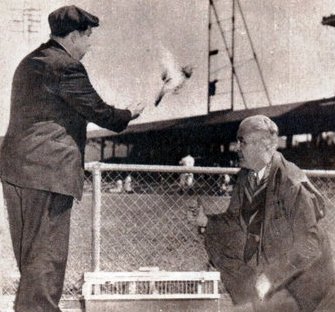
Carrier Pigeons being released at Crosley Field,  Cincinnati, 1939
Carrier Pigeon being released at Crosley Field, Cincinnati, 1939

A Thousand Words–Lost Advertisements, Christy Mathewson

24 Jan

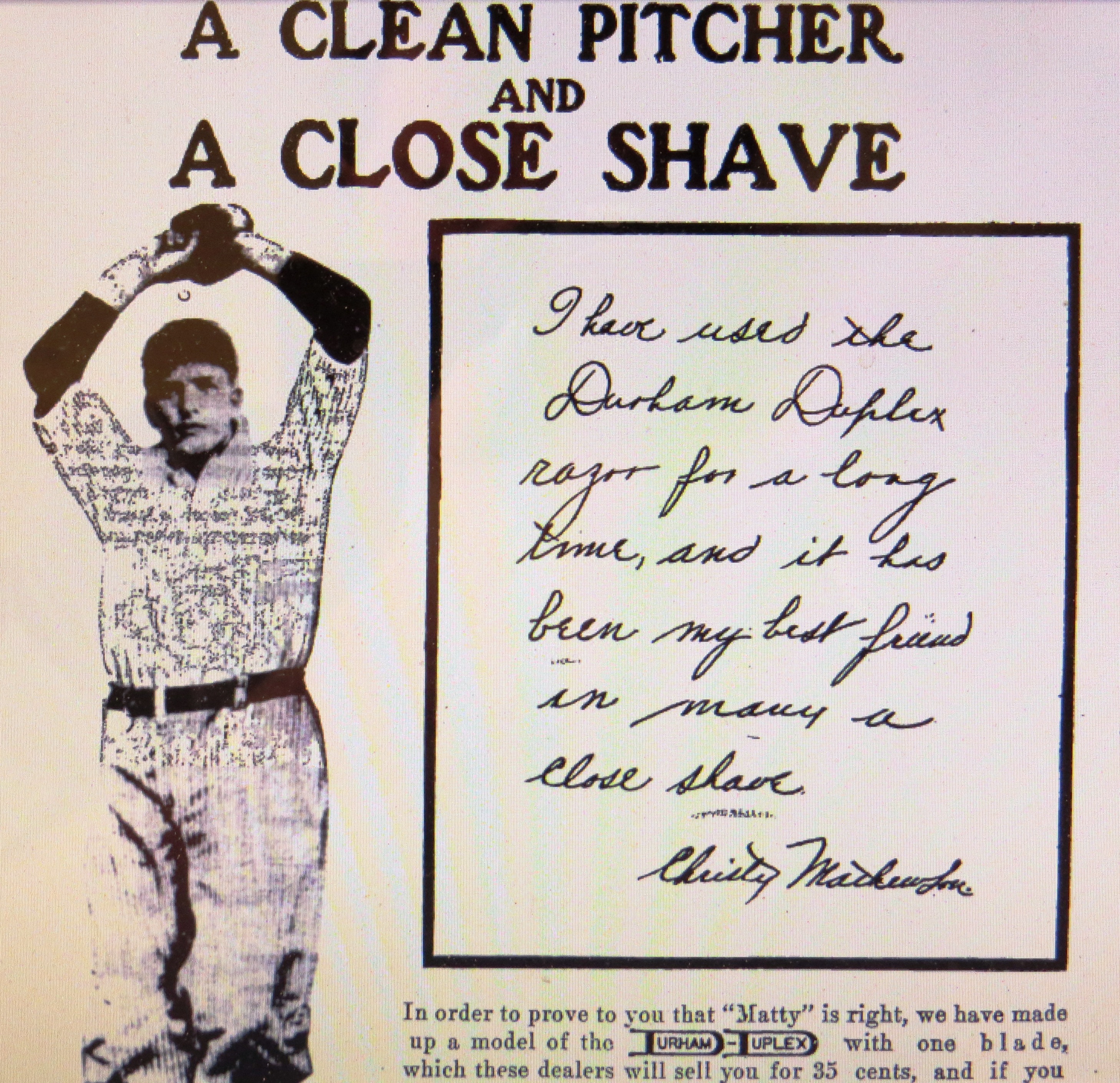
mattyad

“A Clean Pitcher and a Close Shave.”  Hall of Fame pitcher Christy Mathewson for the Durham Duplex razor.  “Big Six” says:

“I have used the Durham Duplex Razor for a long time, and it has been my best friend in many a close shave.”

Mathewson won 372 games for The New York Giants and one for the Cincinnati Reds from 1900-1916, including four 30-win seasons, and was a member of the first Hall of Fame induction class.

“Christy Mathewson brought something to baseball no one else had ever given the game. He handed the game a certain touch of class, an indefinable lift in culture, brains, and personality.’”
— Grantland Rice

Larry McLean

8 Jan

At 6’ 5” John Bannerman “Larry” McLean is still the tallest catcher to have played in the Major Leagues nearly a century after his final game.  Born in New Brunswick, Canada, McLean’s ability was mostly overshadowed by his frequent off-field troubles during his career.

McLean bounced between the minor leagues, semi-pro teams, and trials with the Boston Americans, Chicago Cubs and Saint Louis Cardinals from 1901-1904.  McLean joined the Portland Beavers in the Pacific Coast League in 1905 and it was here that he developed into a good ballplayer and a first-rate baseball character.

Larry McLean

Larry McLean

McLean hit .285 in 182 games with Portland in 1905, but also started to show signs of the troubles that would plague him for the remainder of his career; Portland added a “temperance clause” to his contract and McLean, who had originally planned on a boxing career, loved to fight.

In 1906, while hitting .355 for Portland, and catching the eye of the Cincinnati Reds who would purchase his contract in August; McLean announced that he was going to become a professional fighter.

The wire report which ran in The Bakersfield Daily Californian said:

“McLean the giant catcher of the Portland team…He is so big that umpires walk out behind the pitcher so they judge balls and strikes…announces that he will fight any man in the world, Big Jeff (Jim Jeffries) not barred.”

The story said McLean was training with Tom Corbett (older brother of “Gentleman Jim” Corbett) and Corbett said he “has a ‘sure ‘nuff’ champion in the big catcher.”

Talk of a ring career temporarily ended when McLean joined the Reds, but McLean’s legend grew.  In November of 1906, he caught a murderer while in a subway station with his wife.  The Boston Post said the suspect:

“Was seen to pull a gun and pump five bullets (into the victim)…Larry started after him and collard him just outside the entrance.  (McLean had the suspect) pinioned so he could not move.  The police soon arrived and took charge of McLean’s prisoner.”

McLean was a huge hit with Havana fans the following winter when the Reds touring Cuba; The Sporting Life said:

“Larry McLean was the favorite and every time he caught a ball the crowd applauded. McLean has been dubbed by the baseball fans ‘Chiquito.’”

McLean and Chicago White Sox pitcher Frank Smith were mentioned at various times as possible opponents for heavyweight champion Jack Johnson; boxing writer Tommy Clark said in 1910 that McLean “Thinks he has a good chance of lowering Johnson’s colors.”

But while McLean was a fan favorite he regularly ran afoul of Cincinnati management and none of the managers he played for was able to keep him out of trouble.

While with the Reds McLean was arrested at least four times–for disorderly conduct, passing a bad check and two assaults.  In one case, at the Savoy Hotel in Cincinnati, McLean knocked a newspaper man from Toledo unconscious after the man “Reproved McLean for using a vile name.”

While serving a suspension for breaking team rules in 1910 McLean Said:

“When I get back to Cincinnati there will be 25,000 fans at the depot waiting to shake hands with me.”

Frank Bancroft, Reds secretary and former manager said in response:

“Twenty-five thousand, why, they’ve not that many barkeepers in Cincinnati”

McLean had worn out his welcome by 1910, but Cincinnati was not able to find any takers for the catcher.  Pittsburgh Pirates owner Barney Dreyfuss said, “I wouldn’t give 30 cents for Larry McLean.”

McLean stayed with the Reds for two more seasons, but when Joe Tinker took over the team one of his first moves was to sell McLean to the Saint Louis Cardinals in January of 1913.  McLean said he had finally learned his lesson and promised to behave with the Cardinals:

“They didn’t want me around because they said I was a bum. Now I’m going to fool Tinker.”

McLean did behave himself in Saint Louis and seemed to appreciate the opportunity he was given by his former Reds teammate, manager Miller Huggins, even earning a “good behavior” incentive in his contract, and was hitting .270 for the Cardinals, but the cash-strapped team went with the younger, cheaper Ivey Wingo behind the plate and traded McLean to the New York Giants for Pitcher Doc Crandall.

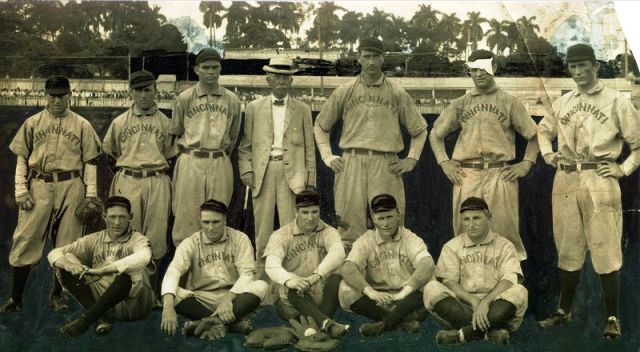
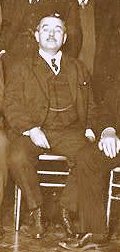
Larry McLean, standing end right, Miller Huggins, standing end left, and Frank Bancroft, standing middle (in suit) on the 1908 Cuban tour.

Larry McLean, standing 5th from left, Miller Huggins, standing end left, and Frank Bancroft, standing middle (in suit) on the 1908 Cuban tour.

The rest of the McLean story tomorrow.

Elton Chamberlain

17 Dec

Elton Chamberlain (for the last thirty years always referred to by the nickname “Icebox,” but that name was not in common use for him contemporaneously; although he was called Iceberg fairly often.) was primarily known for two things: A righthander, he pitched ambidextrously in at least one game, and on May 30, 1894 he gave up four home runs and a single to Bobby “Link” Lowe—17 total bases, a record which stood for 60 years.

He was also embroiled in one of the early controversies over gambling while playing for the Cincinnati Reds in 1893 when he was accused by his manager, Charles Comiskey, of throwing the first game of a July 4 doubleheader against the Philadelphia Phillies.

The Cincinnati Enquirer said:

“Pitcher Elton Chamberlain of the Cincinnatis is accused of throwing the game to the Philadelphias yesterday morning. He is charged with being in league with Joe Brill, a local gambler.”

The story said Comiskey, notified of the allegation:

“(D)ecided to investigate (and) after a consultation with a club official, put Chamberlain in for three innings to watch him. Chamberlain’s pitching was very bad and be was taken out of the game in the third inning.”

Chamberlain’s teammates Jim Canavan and Silver King quickly came to his defense. King said he thought he would be the starting pitcher, not Chamberlain, until just before the game started; therefore Brill and Chamberlain could not have conspired.

Chamberlain said of the story:

“It was cruel and cowardly to try to ruin a man like that.”

The Sporting Life ripped The Enquirer and Comiskey:

“This is not the first time The Enquirer has accused ball players of dishonesty, and once it got into and lost a libel suit with Tony Mullane for accusing him of crookedness. Comiskey in his time has also made similar charges and Insinuations against guiltless players.”

The New York Herald said “The whole affair was so silly,” and seemed to have Comiskey in mind with this statement:

“The club official who suspends a player on the charge of dishonesty should be made to prove his charges or himself be forever barred from further connection with any club.”

The Herald also recommended that steps be taken to officially clear Chamberlain and punish those who accused him:

“The National Board should at once take up pitcher Chamberlain’s case and investigate it beyond the limit of doubt and when they reach the facts, whatever the facts; someone should be made to suffer.”

Cincinnati’s management, Comiskey included, quickly repudiated the charges that appeared in The Enquirer, although from all indications they were directly responsible for the charges being reported in the first place.

Elton Chamberlain

Elton Chamberlain

The headlines of July faded by August; there was no official investigation and no one was “made to suffer.”

Charles Comiskey

Charles Comiskey

Chamberlain finished the season with a 16-12 record and his 3.73 ERA led the Reds’ pitching staff. The following year was his last full season in the Major Leagues.

In 1895 he played for the Warren (PA) franchise in the Iron and Oil League. The team won the pennant behind the pitching of Chamberlain and another former Major Leaguer, Tom Vickery.

They also had a 21-year-old shortstop named Honus Wagner.

No statistics survive for that season, but forty years later Wagner, writing for The Pittsburgh Press, said Chamberlain “Seldom lost a ballgame for us,” and that Chamberlain and Vickery “gave out plenty of their knowledge to us youngsters.”

Chamberlain bounced around minor and semi-pro leagues after one last Major League trial with the Cleveland Spiders in 1896. In 1898 he accepted, then rejected, an offer to serve as a National League umpire. After turning down the umpire job Chamberlain, a Buffalo native, said he would become a professional boxer and challenged a local middleweight named Jack Baty to a fight that would include a $500 side bet. Baty’s fight record indicates the bout did not take place.

Chamberlain attempted to resume his baseball career with the Buffalo Bisons in the Western League in 1899—by July he was released and The Sporting Life reported that Chamberlain, a rabid horse player “is once more following the races.”

Chamberlain Died in Baltimore in 1929.

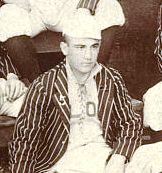
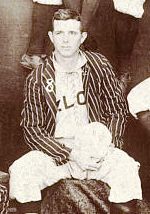
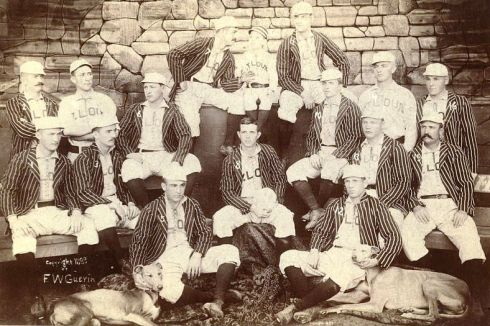
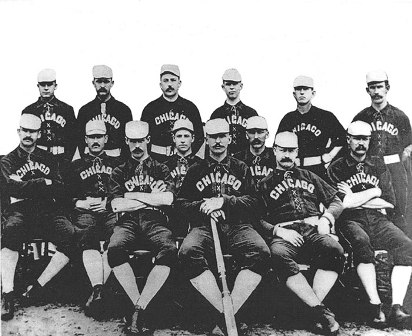
Chamberlain and Comiskey as teammates with the St. Louis Browns.  Chamberlain is 5, Comiskey 8.

Chamberlain and Comiskey were also teammates with the St. Louis Browns. Chamberlain is 5, Comiskey 8.

“The Man who Ate Himself out of the American League”

20 Nov

Frank Frederick Schneiberg was born in Milwaukee in 1882 (Baseball Reference lists his year of birth as 1880, but all available documents say 1882).

He began playing baseball for amateur teams in the Milwaukee city league, and after playing for the Pabst Brewery team in 1903 signed with the Springfield Hustlers in the Three-I League.  No records survive, but according to The Milwaukee Journal Schneiberg “won 19 out of 21 starts.”  He played with the Freeport Pretzels in the Wisconsin State League in 1905 and according to the Journal “won 12 straight.”

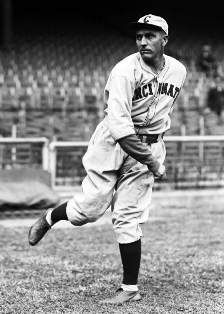
Frank Schneiberg

He won 22 games the following season with the La Crosse Pinks, which earned him a shot with the Detroit Tigers.

It didn’t go well.

Schneiberg was released to the Milwaukee Brewers before the beginning of the season.

The Associated Press said:

“He has the earmarks of a great pitcher…speed, curves, control and a pretty good collection of baseball brains…but Schneiberg was lazy…He wasn’t eager to pitch.”

The story quoted Tigers manager Hugh Jennings:

“He knows how (to pitch) but he won’t exert himself, I don’t want anybody who will not hustle.”

The Toledo News-Bee blamed his release on something else:

“He is known all over the country as the man who ate himself out of the American League.”

It is unknown whether either or both versions of his time with the Tigers is accurate, in either case, Detroit did try to claim that Schneiberg was still their property later that season when he was pitching well for the Brewers.  The claim was denied and he remained in Milwaukee.

Schneiberg pitched for the Brewers for three seasons compiling a 40-48 record.

While a fan favorite in Milwaukee, Schneiberg appears not to have been popular in at least one other American Association city.  The Toledo News-Bee accused him of being a head hunter in 1908:

“Schneiberg has the reputation of threatening to ‘bean’ batters.”

The following season The News-Bee claimed the Brewers were trying to trade the pitcher and said the team was:

“(V)ery anxious to trade the German, who does not work with any spirit, but the player is not highly regarded around the circuit.”

Regardless of the opinion in Toledo, The Brooklyn Superbas thought highly enough of Schneiberg to draft him from the Brewers at the end of the 1909 season.

He appeared in his only Major League game. On June 8, 1910, with Brooklyn trailing the Cincinnati Reds 4-0, Schneiberg relieved Nap Rucker in the top of seventh inning.  He walked four, gave up five hits and allowed 7 runs (Baseball Reference shows Schneiberg giving up eight runs, with seven earned—the box score from the game shows 7 total).

Schneiberg was lifted for a pinch-hitter in the bottom of the seventh.  Within days, he was traded to the Des Moines Boosters in the Western League.

He retired after the 1910 season, but in February of 1913 signed with the Memphis Chickasaws of the Southern Association.  He appeared in two games and was released, and in June signed with the Springfield Watchmakers in the Three-I League.  It’s unclear whether he appeared in any games with Springfield.

Frank Schneiberg 1932

Schneiberg retired to Milwaukee after the 1913 season, he became an asbestos worker and an official in the Asbestos Workers Union.  He passed away in Milwaukee in 1948.

A Thousand Words–New Orleans Pelicans

13 Nov

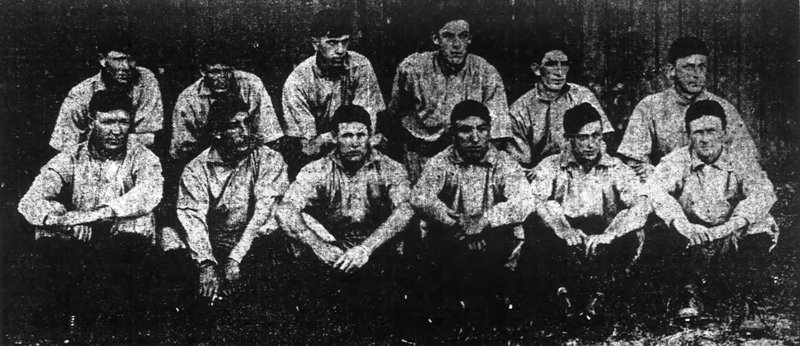
Another picture I’ve never seen published before—the 1906 New Orleans Pelicans of the Southern Association.

Top, Left to right.

Bill Phillipshe spent seven seasons in the Major Leagues with a 70-76 record; and won 256 games in a minor league career that began in 1890 and ended in 1909.

Mark “Moxie” Manuelwas said to have appeared as a both a left and right-handed pitcher for New Orleans in 1906 and 07, Manuel was a combined 37-26, earning him a second trip to the Major Leagues in 1908, where he posted a 3-4 record in 18 appearances for the Chicago White Sox.

Milo Stratton—a weak hitting (career .185) catcher who played in the minor leagues from 1903-1914.

William O’Brien—a .215 hitting first baseman in 1905 with the Toronto Maple  Leafs in the Eastern League and with the Pelicans in 1906.

Jake Atz—played for the Washington Senators in 1903 and the Chicago White Sox 1907-1909, a minor league manager for 21 seasons he won more than 1900 games.

Art Brouthers—a third baseman who played in 37 games for the 1906 Philadelphia Athletics, Brouthers managed the 1913 Paducah Indians to the Kitty League championship.  After his baseball career he was a hotel detective in Charleston, South Carolina.

Front, left to right

Whitey GueseGuese had several strong seasons in the minors, but in his lone Major League season with the Cincinnati Reds in 1901 he was 1-4.  The Youngstown Vindicator said, “He is a twirler who belongs to the disappointing species known as ‘morning glories.” And, “Seemingly has a heart like a canary.”

Joe Rickert—“Diamond Joe” Rickert stole 77 bases for the Pelicans in 1904; he played 15 games in the Major Leagues with the Pittsburgh Pirates and Boston Beaneaters.

William Blake—an outfielder with 13 different minor league teams from 1902 to 1910 and native of Louisville, Kentucky, little else is known.

Punch Knoll—another long-time minor league manager.  Knoll appeared in 79 games for the 1905 Washington Senators, he appeared in 3 games as a pinch hitter, collecting one hit, at 48-years-old while managing the Fort Wayne Chiefs in the Central League

Chick Cargo—brother of Major Leaguer Bobby Cargo, Charles “Chick” Cargo was a shortstop and 3rd baseman who played 19 seasons of minor league ball.

George Watt—Watt had three good seasons for the Little Rock Travelers, with a 53-34 record from 1902-1904.  He slipped to 20-37 in 1905-06 with Little Rock and New Orleans.  By 1907 he had dropped from “A” ball to “D” ball with the Zanesville franchise in the Pennsylvania-Ohio-Maryland League.  In 1908 he pitched for the Zanesville Infants in the Central League, was release in August after posting a 6-15 record and disappeared.

“The Rube Waddell of the Central League”

11 Oct

Edward S. Van Anda was the most talented pitcher in the Central League from 1904 to 1908; he was also the most erratic personality in the league–and was often compared to baseball’s most eccentric pitching legend “Rube” Waddell.

Van Anda was born June 6, 1881 in Wapakoneta, Ohio. He pitched for independent teams in Ohio from 1900-1903, getting as much attention for his enormous ego and behavior as he did for his pitching.

Nicknamed “Lord Chesterfield,” or simply “Chesty,” Van Anda would disappear for long stretches and his shameless self promotion made him unpopular with teammates He was signed by the Fort Wayne Railroaders in the Central League in 1904. His statistics for that season are lost, but according to The Youngstown Vindicator: “(H)e won every game he pitched except one toward the close of the season.”

In 1905 Van Anda again pitched for Fort Wayne (the team relocated to Canton, Ohio during the season) and posted a record of 20-14. The Fort Wayne News described Van Anda’s abilities as a ballplayer:

“There is only one thing Van Anda can do and that is pitch. He cannot hit a balloon and he runs bases like an ice wagon.”

The Fort Wayne Gazette said:

“He is rather erratic but has great pitching caliber in him.”

Every article about Van Anda described him as “eccentric,” or as the Toledo Bee put it:

“That Freak Van Anda.”

And the Bluffton (IN) Chronicle said:

“Van Anda is the name of the latest freak to break into baseball.”

A story about his self promotion that made the rounds in newspapers in 1905 was retold several years later in column by former major league pitcher Al Demaree:

“I used to know a fellow named Van Anda…he’d go out into the bleachers, and if the pitcher in the box began to falter, he’d yell “Put in Van Anda he’s the best pitcher on the club. Then he’d move over back of third and start up the same cheer in the crowd.”

The 1905 version of the story included his fellow pitchers, angry at Van Anda’s antics, setting him up

But he could pitch, and appeared destined for the Major Leagues. The Youngstown Vindicator said at the close of the 1905 season:

“Van Anda, known on account of his eccentricities as “the Rube Waddell of the Central League,” has been drafted by the Cincinnati Reds.”

At the close of the 1905 season Van Anda pitched for the local Wapakoneta team in an exhibition against the Reds, the Major Leaguers got 14 hits and beat Van Anda 12-0, it was the last time he faced a Major League team.

After a strong 1906 season with the Grand Rapids Wolverines (23-13), Van Anda was acquired by the Trenton Tigers in the Tri-State League. His time there was short; during a spring training game Van Anda walked off the mound and led the field in the middle of a game, which led to his immediate release.

According to The Fort Wayne News Van Anda “Known all over the Central as an eccentric …was given a bus ticket and returned to Fort Wayne.”

Edward Van Anda

Van Anda pitched for neither Trenton nor Fort Wayne during the 1907 regular season, but signed with the Central League South Bend Greens in June. He only appeared in one game, losing 7-1 to the Wheeling Stogies. He was released a few days later, not resurfacing until the following season.

In 1908 he went 15-11 for Fort Wayne and was purchased by the Montgomery Senators of the Southern Association and posted a 6-5 record. Early in the 1909 season Van Anda was suspended indefinitely by Fort Wayne for “insubordination.” The Fort Wayne News reported that Van Anda signed with the Galveston Sand Crabs of the Texas League, but there is no record he ever played for that team.

Van Anda became a traveling salesman in 1910. He remained in Fort Wayne until his death on October 17, 1965.

Demon Rum–or Demon Rum as an Excuse to Replace a Popular Manager

8 Oct

The 2011 Boston Red Sox were only the latest in a long history of alcohol taking the blame for a team’s poor performance.

As the Chicago Cubs faded into third place during the waning days of the 1912 season, team president Charles Murphy issued an order for “total abstinence” and all players would have a temperance calls in future contracts.

The move was not unprecedented—since 1909 Barney Dreyfus of the Pittsburgh Pirates had required his players to sign a temperance pledge.  What made Murphy’s order so newsworthy was that over the course of several days he issued numerous, often contradictory, “clarifications” and because it quickly became apparent the move was a intended to wrest control of his ballclub from Manager Frank Chance.

Murphy’s original statement said that “loose living and training methods” led to the team’s poor finish. At the same time he provided cover for popular Cub outfielder Frank Schulte who had been suspended by Chance in September his nighttime activities during a crucial August road trip in Cincinnati.  The Cubs lost three of four games to the Reds and fell out of contention.    Murphy’s statement presented Schulte as a man incapable of any personal responsibility:

“I desire to say that in my judgment Schulte has been more sinned against than sinner…from what I could gather he was a victim of too many so-called friends…if we had a rule similar to that in vogue in Pittsburgh this player could not have been led into temptation.”

Chicago Cubs President Charles Murphy

The implication being that Chance had perhaps overreacted by suspending “the more sinned against” Schulte.  This statement was further complicated by Murphy’s several “clarifications,” some of which seemed to support Chance’s decision while some did not.

Chance quickly defended his players and his reaction to Murphy revealed just how bad the relationship was between the team president and his manager:

“Murphy only thinks of the team when it’s winning…his statement reflects upon me personally, and I have been in the business too long to allow Murphy or anyone else to insult me.”

Making matters worse, and calling Murphy’s motives into question was that Chance issued his response from a hospital bed in New York.  As a result of being hit in the head by numerous pitches throughout his career, Chance had developed a blood clot near his brain and had undergone surgery just a few days earlier.

Murphy didn’t hesitate to use Chance’s health issues against him.

A month earlier, plagued by doubts about his condition and suffering from severe headaches, Chance had suggested to Murphy that he might not be able to manage the Cubs in 1913.  At the time Murphy told his manager to wait until after the surgery to make a decision about his future.  Now he was using that conversation to assert that Chance had issued his resignation.

Once Murphy began claiming Chance had, in effect, quit in August the Chicago media which had almost universally supported the “abstinence pledge” called foul.  The Chicago Tribune and Chicago Examiner both said Murphy was using the conversation and the pledge as cover to run the legendary Chance—who led the Cubs to four pennants and two World Championships—out of town.

Chance went.  But he didn’t go quietly.

The manager had acquired 10 percent of the Cubs, shares Murphy had been trying to purchase for more than a year.  Chance sold the shares to Harry Ackerland a Pittsburgh investor who President Murphy did want owning part of his team.  Despite Murphy’s efforts to block the sale, it went through.

Chance was claimed on waivers by Cincinnati, but after the Reds acquired Joe Tinker from the Cubs and named him manager, Chance was waived to New York, where he became manager of the Yankees.

Chance led the Yankees for two losing seasons, managed the Los Angeles Angels in the Pacific Coast League in 1916 and ’17, and closed out his career with one dismal season in Boston; the Red Sox finished 61-91 under Chance.

Frank Chance

Johnny Evers was named Cubs manager for the 1913 season—the Cubs again finished third.

From the day Murphy issued his initial statement until Chance died in 1924, “The Peerless Leader” never missed an opportunity to take a shot at Murphy.

When the Cubs were sold to Cincinnati publishing magnate Charles Phelps Taft (President William Howard Taft’s half-brother) before the 1914 season Murphy claimed that he had made more than a half million dollars on the deal.  Chance and former Cubs pitcher Mordecai Brown (who had his own feud who Murphy who released him after the 1912 season, allegedly without giving Brown money he was owed for playing in that year’s “City Series” with the Chicago White Sox) quickly responded.  Both players confirmed what had long been rumored—that Murphy had been bankrolled by Taft who retained a majority of the shares.   Murphy, said Chance, “Never owned more than fifteen or twenty percent of the club stock.”

Both players also charged that Murphy’s treatment of his players was a primary reason for the formation of the upstart Federal League—at best an oversimplification of the conditions which led to Major League Baseball’s last “third league.”

Another Charles Murphy feud later this week.

.

Jack Ogden

28 Sep

John Mahlon Ogden had limited success in three stints in Major League Baseball, but for an eight year period he was one of the greatest minor league pitchers in history.

Born in 1897, Ogden played baseball at Swarthmore College (where his brother, Major League pitcher Warren “Curly” Ogden also played), and went directly to John McGraw’s New York Giants.  The 20 year old appeared in five games for the Giants before being shipped to the Newark Bears in the International League where he went 5-5 with a 1.48 ERA.  Ogden spent 1919 with the Rochester Hustlers posting a 10-13 record with a 2.37 ERA.

His career took off the next season with the Baltimore Orioles.  The 22 year old Ogden led the International League champions with a 27-9 record—future Hall of Famer Lefty Grove was 12-2 for the O’s that year.  Egan followed that up with an incredible 31-8 record with a 2.29 ERA in 1921.  Beginning on May 10 Ogden won 18 straight decisions, finally losing 3-2 to the Jersey City Skeeters on July 22.  Ogden then won his next five starts.  Baltimore won their third of seven straight IL championships (Grove was 25-10 with a 2.56 ERA).

Over the next six seasons Ogden went 133-63, including a 28-win season in 1925, the last championship in Baltimore’s domination of the International League.

Jack Ogden

Ogden made it back to the Major Leagues with the Saint Louis Browns in 1928 and ’29 where he was a combined 19-24 with an ERA above 4. Ogden was acquired by Cincinnati for the 1930 season, but due to an illness he announced his retirement and took a high school coaching job.

Ogden attempted a comeback in 1931, going a combined 6-10 for the Reds in ’31 and ’32, followed by two more minor league stints with Rochester (after being traded by the Reds to Cardinals) and Baltimore.  He retired for good in 1934 and accepted the position of Vice President and General Manager of the Orioles and became assistant to Philadelphia Phillies President Gerald Nugent in 1939.

In 1941 Ogden bought controlling interest of the Elmira Pioneers in the Eastern League.  His son, John Jr., also a star pitcher and basketball player at Swarthmore, helped Ogden operate the team until he was drafted in 1943.   PFC John Mahlon Ogden Jr. was killed in France on August 8, 1944. Ogden sold the Elmira franchise shortly after his son’s death.

Ogden continued in baseball serving as a scout for a number of teams and managed high school and college teams.  He passed away in 1977 in Philadelphia.

Ogden is a member of the International League Hall of Fame.

11-Inning No-Hitter

24 Sep

Harry Wormwood played seven seasons in the New England League with Worcester, Fall River and Portland.  His statistics are incomplete but he was basically a .500 pitcher and weak hitting utility infielder with a fairly uneventful career until June 9, 1910.

Pitching for the Fall River Indians Wormwood pitched an 11-Inning no-hitter against his former team, the Worcester Busters.  Game summaries mention that Fall River did not commit any errors, but don’t say whether Wormwood walked any batters.

The Eastern press couldn’t ignore the fact that just one year earlier in the Bluegrass League Fred Toney of the Winchester Hustlers had thrown a 17-inning no-hitter against the Lexington Colts, so the papers referred to Wormwood’s feat as “The Eastern record for a no-hit game.”

Toney of course would become famous for another no-hitter in 1917 when he was with the Cincinnati Reds—he and Chicago Cubs pitcher Jim “Hippo” Vaughn hooked up in one of baseball’s greatest pitching duels, with neither allowing a hit through nine innings.  Vaughn would allow a hit in the 10th and lose the game 1-0.

But back in 1910 Toney was not well known and was referred to in the New York Times and other papers simply as “Pitcher Torrey (sic) of Winchester, KY,” in the coverage of Wormwood’s no-hitter.

The following season Wormwood nearly duplicated his feat.  He held the Lawrence Barristers hitless for 10 2/3 innings; Wormwood gave up three straight singles in the 11th, but retired the side without giving up a run.  He held Lawrence hitless for two more innings and the game ended in a 0-0 tie after 13 innings.  1911 was Wormwood’s best season, he posted a 20-15 record and hit .289.

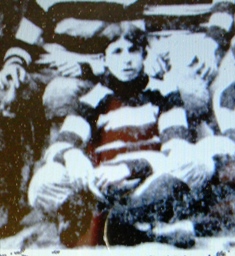
Harry Wormwood, from a picture of his high school football team in Auburn, ME

Wormwood finished his career with the Portland Duffs in 1913—newspaper reports from 1914 and 1915 say he spent time with the Lewiston Cupids in the New England League and the Hartford Senators in the Colonial League, but there are no records to confirm this.

Wormwood passed away January 9, 1955 in Auburn, Maine.