
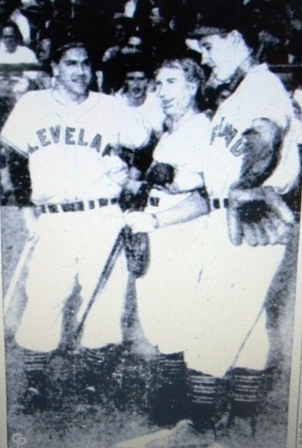
Harpo Marx with manager Lou Boudreau and pitcher Bob Feller at the Cleveland Indians’ training camp at Randolph Park (now Hi Corbett Field) in Tuscon, Arizona, March 1947.
Harpo Marx with manager Lou Boudreau and pitcher Bob Feller at the Cleveland Indians’ training camp at Randolph Park (now Hi Corbett Field) in Tuscon, Arizona, March 1947.

Leroy “Satchel” Paige talks baseball with local children in Mexico on the set of the 1960 movie “The Wonderful Country.” Robert Mitchum and Julie London starred; Paige played Cavalry Sgt. Tobe Sutton.
It was Paige’s only real acting role (He made a cameo appearance as himself ten years earlier in “The Kid from Cleveland“), and it’s a pretty good film.

Satchel Paige as Sgt. Sutton
Satchel Paige demonstrates four of his favorite pitches to The Baltimore Afro-American, 1948:
The sidearm curve (outshoot): “A wrist-twist causes counter-clockwise spin which makes the ball bend away from a right-handed batter.”

Sidearm Curve–outshoot
The overhand curve (drop): “Is gripped and thrown with a twist as to let the ball leave the hand with a snap between thumb and forefinger. Overspin thus makes ball take a sudden dip.”

Overhand curve–drop
The Screwball (inshoot): “Ball slides off fingers with a rapid clockwise spin, making it twist away from a left-handed hitter.”

Screwball–inshoot
The knuckleball: “takes odd twists and turns even the pitcher can’t predict.”
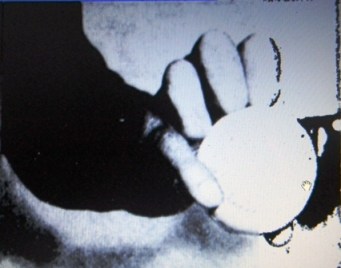
Knuckle ball
“May every page you turn be a Satchel Paige.” Greg Proops, The Smartest Man in the World Podcast.
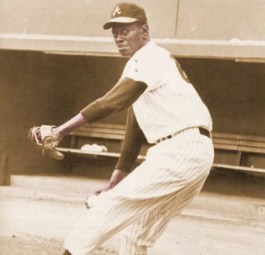
Trammell Scott (Incorrectly listed as Trammel in multiple sources) was born in 1886 to a prominent Dalton, Georgia family. After playing baseball at the University of Georgia, Scott played minor league ball in the south. He spent time in the Georgia State League, South Atlantic League, and the Carolina Association—he was said to have also played with Houston in the Texas League but no statistics survive.
After his brief playing career Scott was the victim of a near fatal shooting in 1916. The Atlanta Constitution covered the story closely and reported that Scott, while “In a dying condition,” told his mother “I told you they would get me.” Trammell recovered, but never identified his assailant and no motive or suspects were ever identified–just 10 days after the shooting Atlanta Chief of Detectives Newport Langford said they were closing their investigation. and according to the Constitution “Leaving the mystery unsolved.”
Scott joined the army in World War I, was decorated for bravery in action and promoted to the rank of Major.
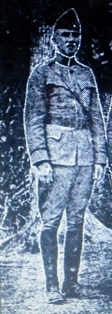
Trammell Scott 1919
Upon returning to Georgia Scott became a well known sportsman. He was boxing referee and later served on the state boxing commission, owned a sporting goods store, was actively involved in local semi-pro baseball and basketball, and was prominent hunter and breeder of champion bird dogs.
In January of 1938 Scott was named interim President of the Southern Association in a contentious split vote. At the end of the year he was named President.
In December of 1942 Scott boarded a train in Atlanta to attend the baseball winter meetings in Chicago. Due to arrive for the league meeting at 4 pm, Scott’s train was delayed.
When the meeting convened without Scott, the owners who opposed his original appointment seized the opportunity. Thomas Watkins from Memphis, Larry Gilbert of New Orleans, Roy Thompson of Little Rock and Bob Allen of Knoxville led a revolt which was soon joined by Paul Florence of Birmingham.
Within an hour Scott had been voted out and replaced by Billy Evans, a former American League umpire and one time general manager of the Cleveland Indians and Boston Red Sox. Evans was at the meeting in hopes of landing a different position, but the Southern Association bosses settled on him as the new compromise candidate to run the league.
There was a problem. No one attempted to reach Scott to inform him of the decision.
That evening, having finally arrived in Chicago, Scott hurried to the National Association dinner meeting of all the league presidents. Taking his seat, the Associated Press noted “It was a tense moment as (National Association) President William G. Bramham informed Scott the Southern had named a new president.”
Scott said he never saw his dismissal coming and said league owners threw him “A low curve,” by replacing him in the manner they did.
Less than three weeks after his dismissal Scott was turkey hunting on friend’s farm near Newton, Georgia. After returning for the day, Scott told his friends he was returning to the fields in search of a turkey he had wounded earlier in the day. The following day Scott was found with a gunshot wound to the chest.
The medical examiner ruled that the wound was self-inflicted but the official ruling said it was “Undetermined whether the shooting was accidental or pre-meditated.”
Many of Scott’s friends said that in spite of being embarrassed by his dismissal he was far from distraught and noted that while being an experienced hunter, Scott was not always careful, “On occasion he was known to have leaned a loaded shotgun against his middle while lighting a cigaret (sic).” This, they speculated, could have caused the type of injury that killed Scott.
Scott was interred at Westview Cemetery in Atlanta—the whole story about two shootings 25 years apart, buried with him.

Please consider a small Paypal donation to help fund my next research trip. Thank you.
 Baseball History Daily