
Tag Archives: Dan Brouthers

“I Believe that a Pitcher of a Slow Ball could make Monkeys out of Opposing Batsmen”

21 May

After the success of William Arthur “Candy” Cummings’ decades-long campaign to be recognized as the inventor of the curveball—his claim was supported by influential voices like A.G. Spalding, Cap Anson,  and Tim Murnane—culminated with his 1908 “Baseball Magazine” article “How I Pitched the First Curve,” Cummings was often sought out by the press for his opinions on pitching.

Candy Cummings

Candy Cummings

In 1910, an article “By Arthur Cummings, Discoverer of the Curve,” appeared in several newspapers, including The Boston Post.  Cummings took current pitchers to task for throwing too hard:

“Speed, speed, speed seems to be the cry of the pitcher today.  The more steam a fellow has, the more valuable he appears in the eyes of the managers.  It’s only once or twice in a game that a twirler will let loose his slow ball, and then he doesn’t put a whole lot of faith in it.  Of course there are some exceptions, like Mathewson, but I am talking about the general run.  To my mind, the speed craze is an obsession and many a pitcher would meet with greater success if he’d only revert to the old style of pitching and try slow ones oftener.  Players and managers of today think that the only way to win a ballgame is to have a pitcher who can throw a ball with such force that it will go through a six-inch plank, and if the fellow hasn’t got that amount of speed he is no good.

“If some managers would go back to the old-time style of pitching and send men in the box who would serve up slow balls there wouldn’t be as much base running as there is now, but the ball would be batted more and there would be better exhibitions of fielding.  Players of today can’t hit a slow ball with any degree of safety, they having become used to the swift article.  That’s why I believe that a pitcher of a slow ball could make monkeys out of opposing batsmen.

“Of course, there is a difference in the national sport, as now exemplified, when you compare it with the game when I was in it some thirty years ago.  The pitcher’s box now is further away from the home plate than it was when I used to pitch.  At that time it was forty-five feet from the home plate; now it is more than sixty, and it takes some speed to get over the plate.  I don’t know as I could go in a pitcher’s box, such as it is used today, and get a ball over the home plate, but if they moved it up to forty-five feet I could get my slow overshoots over the pan and I’ll bet a cigar the batsman wouldn’t hit it; he’d hit at it, though, and swing for all he’s worth.

“But even though the plate is further back, the pitchers have the curve worked down to such a science that they can make their ‘floaters’ break more sharply than we old timers could, and consequently they would much more easily fool the hitters.  Once in a while a genuine slow ball pitcher pops up and gets along but little confidence is placed in him; his victories are attributed to luck, and he is not used very regularly.

“Fans laugh these days when a pitcher takes it into his head to serve up a slow ball, which scorers call a change of pace, and see a heavy hitter almost break his back trying to kill the ball.  When he misses, it pleases the bugs immensely, but let me tell you, that the slower a ball is the harder it is for the batsman to connect with.  The hitting column wouldn’t have as big averages as it does now, and a man who could bat for .300 would be a wonder indeed, if slow balls were used by pitchers.

“But it seems as if the day of the slow ball has gone by.  A scout will not sign a pitcher unless he has got something good in the way of speed or a peculiarly curving swift ball, like Harry Howell’s or Eddie Cicotte’s knuckle ball.  It seems as if when we old timers dropped out of the game and the present generations took it up where we left off, they thought they would introduce new features to the game, and selected speed as the proper thing.  Of course, the invention of the mask, protector and heavy mitts had something to do with slow pitching passing out of existence, but it was the ideas of the young pitchers more than anything else that developed the desire of captains and managers for pitchers with great speed.

Ed Cicotte's knuckleball grip

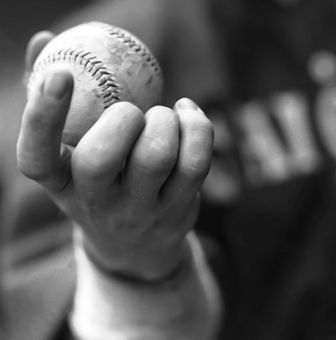
Eddie  Cicotte’s knuckleball grip

“Perhaps you notice that these pitchers of today who have such great speed and assortment of curves do not work very regularly.  Well, when I played ball I was in the box one day and in the field the next and in that way I kept my arm in good shape and my batting eye keen, just because I was at the game all the time.  I never used much speed; therefore my arm was in condition to work.  Perhaps some manager will come along yet and decide that there was better pitching in the old days and give a slabbist with a slow curve ball a chance to work in the box.

“When that day arrives the fans will see some fun, for the long-distance hitters will find it hard to connect with the ball very often.”
In 1921 Cummings, then 72-years-old was sitting in the press box of Ebbetts Field, a guest of The Brooklyn Eagle, for a game between the Dodgers and Philadelphia Phillies.  Cummings told The Eagle’s Sports Editor Abe Yager:

“I think I could out-guess   Babe Ruth if I were pitching right now.  I had to pitch against Dan Brouthers, Cap Anson and other sluggers of bygone fame and believe me it was some feat to fool them.  We did it often, but of course, they hit ‘em out just as often.  Ruth can be fooled by an outcurve, a high one in close or a drop the same as the sluggers of old, but of course, he will connect once in every three times by the law of averages.”
“There was probably none so Unique as Shreve”

24 Jul

Leven Lawrence “Lev” Shreve II came from a prominent family in Louisville, Kentucky.  His great-uncle, and namesake, had been president of the Louisville Gas and Water Company, and the Louisville & Nashville Railroad.

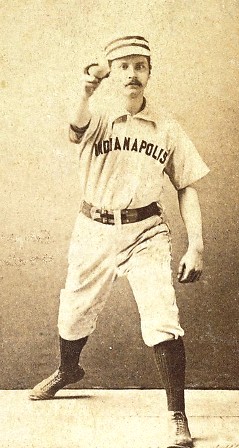
The 19-year-old made his professional debut in 1886, playing with Savannah, then Chattanooga; he was a combined 12-9 with 1.52 ERA.  Shreve was signed by Billy Barnie to join his young pitching staff with the Baltimore Orioles in the American Association.  He came to Baltimore with great expectations.

Lev Shreve

Lev Shreve

The Baltimore Daily News called him “Barnie’s phenom.”  In wasn’t the first time a relatively unknown pitcher was given that name by the Baltimore press.

Shreve had trouble getting as Barnie primarily relied on 21-year-old Matt Kilroy and 22-year-old Phenomenal Smith; Shreve, and fellow 20-year-old Ed Knouff saw limited action in the first two months of the season.

The Sporting Life said he wasn’t happy:

 “Shreve, the Louisville boy…complains that he does not get a fair deal.  He affirms that his arm is in fine trim, but that he is not allowed to pitch. Shreve is an ambitious ball player, and desires to show what is in him.  He says he will quit if Barnie does not play him.”

The Baltimore Sun said

“People are asking why Shreve isn’t given a chance.”

The Sporting Life, perhaps, provided an explanation for the lack of work later that month:

“Cigarette smoking is said to be impairing the efficiency of two Baltimore pitchers, Shreve and Knouff”

It would not be the last mention of cigarettes and Shreve in The Sporting Life;  the pitcher was also said to be “a cigarette fiend,” and “as noted for his cigarette habit” as his pitching.

Neither Shreve, who was sold to the Indianapolis Hoosiers in the National League, nor Knouff, who was sold to the St. Louis Browns, would finish the season with Baltimore; it’s unknown whether smoking was the cause.

Shreve was 3-1 with a 3.79 ERA in five games in Baltimore.

The sale to Indianapolis didn’t seem to hurt Shreve’s confidence according to George Myers, his catcher with the Hoosiers.  Meyers, two decades after playing with Shreve, said the pitcher was talented, cocky and erratic, and described Shreve’s first National League game; a 4-1 10-inning victory over the first place Detroit Wolverines on August 19:

“There was probably none so unique as Shreve…My, but he was a fresh youth…He had awful speed and good curves and perfect control of the ball.  His confidence and egotism were astounding.  I remember one day we were to play against Detroit (Wolverines).  It was when the big four, (Jack) Rowe, (Deacon) White, (Hardy) Richardson and (Dan) Brouthers were on the team.

“Mr. Shreve, who had been assigned to pitch, strutted to the box with the swagger that would have made John L. Sullivan look cheap when John L. was monarch of all in the fistic business.  ‘Just watch me fellows, and see what I do to those swell-headed guys from Michigan,’ said the smiling Shreve.  ‘I am going to make ‘em look like a lot of suckers.’

“Richardson was the first batter up…’So you are the great invincible Hardy Richardson, eh?’ drawled Mr. Shreve.  ‘Well Hardy, old chap, I’m going to show you that you are easy for a good pitcher…Shreve let go the first ball and it went around Hardy’s neck like a shot.  He struck at it after I had it in my hands.  Bang goes the second, also a strike, and the third a wide, slow, outshoot, fooled the great batter completely and Shreve said mockingly: ‘Back to the bench Hardy, I told you that you were easy.

“Big Dan Brouthers, who was always a terror to pitchers, came next and he had blood in his eye…’so this is the terrible Mr. Dan Brouthers,’ grinned the fresh pitcher.  ‘Hate to tell you Dan, how soft a mark you are’…Dan missed the first two, which went close to his chin, and the next he hit like a shot at the pitcher.  Shreve caught it in easy style and gave Brouthers the ‘ha ha’ in most tantalizing fashion as Dan ambled to the bench.

“Deacon White came next and Shreve kidded him unmercifully.  ‘Deacon who told you that you could hit anything?’ was the greeting white was given.  The Deacon scowled and muttered ominous.  ’Duck soup is what you are for me.’ Sand Shreve, as White missed the first ball by several inches.  ‘Oh, how easy,’ was the next rejoinder, and Deacon smashed blindly at an outshoot, a moment later striking out on one of those speedy ones such as had sent Richardson to the bench.

“The Big Four could do absolutely nothing with Shreve’s delivery, and the other members of their team were just as helpless…This fellow Shreve was one of the best pitchers I ever met, but he was an erratic chap, and dreadfully hard to handle.”

George Myers

George Myers

After beating the eventual National League champions in his first start, Shreve ended up a disappointing 5-9 with a 4.72 ERA for Indianapolis.

Myers said on another occasion Shreve approached him before pitching against the Chicago White Stockings, who had won the National League championship in 1886:

“’Say, George, what team is this we are up against today?’

“I immediately began to read him a lecture, telling him that a young man just starting in on his career as a professional ballplayer shouldn’t deport himself in such a manner. ‘The idea of you coming on to the grounds when the champion Chicagos are here, and not knowing it, why—‘  ‘The champion Chicagos,’ interrupted Shreve, ‘Never mind, George, just watch me.  Oh just wait and see what I will do to that bunch.”

Myer s said Shreve shutout the White Stockings.  (This story appears to be either apocryphal or conflated with another incident as Shreve did not shutout Chicago that season).

Shreve was 11-24 in 1888 and 0-3 in 1889 when he was released by the Hoosiers.  He played three minor league seasons and was out of professional baseball by the age of 24.

Myers said his former teammate was “erratic as Rube Waddell,” and:

“I could tell story after story about this man Shreve.  If he had taken care of himself he would have been the greatest pitcher in baseball history.”
