Tag Archives: Federal League

“Another Phil Pitcher was Sacrificed on the altar of a Futile Attack”

6 Aug

When George Chalmers returned from Cuba with the Philadelphia Phillies in November of 1911 he wasn’t the same pitcher.

After pitching the first game of the series against Almendares and the great Cuban pitcher Jose Mendez, Chalmers saw little action in the final eight games.

While training in Hot Springs, Arkansas in the spring of 1912 it became clear that Chalmers’ shoulder was in bad shape.  The Philadelphia Inquirer said he was sent from Hot Springs to Youngstown, Ohio to “visit ‘Bonesetter’ Reese.” (John D. Reese was a Welsh-born “practitioner of alternative medicine.” The  “self trained”  Reese was, according to The Pittsburgh Press, visited by many of baseball’s biggest stars, including Frank Chance, Ty Cobb, Honus Wagner, and John McGraw.  At the same time he was condemned by Ohio physicians who said there was no evidence of Reese “curing a single case where there was actual fracture or displacement of bone.”)

The famous “Bonesetter” was unable to do anything for Chalmers.  The Wilkes-Barre Times-Leader said in April:

“It is reported on good authority that Chalmers, one of the Phillies star pitchers, will be unable to deliver the goods this season owing to the condition of his pitching arm.”

As a result of the injury Chalmers only appeared in 12 games in 1912, with a 3-4 record, and didn’t pitch at all from July 5 until September 4.   At the end of the season Phillies owner Horace Fogel, who would soon find himself chased out of the game, used Chalmers’ injury to suggest a change in how pitchers were paid.  According to The Philadelphia Bulletin:Ho

“Horace wants to employ pitchers on the percentage basis, paying them so much per game—no game, no pay.

“The Phillies President conceived the idea after he had figured that it had cost him an average of $800 per game for the few games pitched by George Chalmers during the present season.”

Phillies team photo from George Chalmers personal collection--appears to be the 1912 team.

Team photo from George Chalmers’ personal collection

The $800 per game figure was clearly wrong—Chalmers would have not earned anywhere near $9600 for the 1912 season (Christy Mathewson made between $8000 and $9000), Chalmers and “Pete” Alexander both probably made less than $3000.  It is doubtful Fogel’s plan would have gone anywhere had he remained president of the Phillies.

The following season was no better; with no improvement to the injured shoulder, Chalmers appeared in 26 games, 15 as a starter, and was 3-10 with 4.81 ERA.  It got so bad that after a loss near the end of the season The Wilkes-Barre Times-Leader said:

“Our old friend ‘Dut’ Chalmers got another trimming yesterday.  It has gotten to be such a regular thing for Chalmers to be beaten that he doesn’t mind it anymore.”

Two of the Phillies best pitchers in 1913, Tom Seaton (27-12), and Addison “Ad” Brennan (14-12) jumped to the Federal League, making Chalmers and his injured shoulder even more critical to the Phillies hopes for 1914.

In March The Philadelphia Inquirer said Chalmers had spent the winter in Hot Springs rehabilitating his shoulder and appeared “to be in splendid shape,” when he reported to spring training in Wilmington, North Carolina, and “(Charles “Red”) Dooin is thanking his lucky stars that Chalmers is in camp.”

The season turned out to be Chalmers’ worst.  He pitched in three games, losing all three with an ERA of 5.50, and he Phillies released him on June 22.  The Inquirer said his shoulder had never healed and attributed the injury to “rheumatism and a misplaced muscle.”
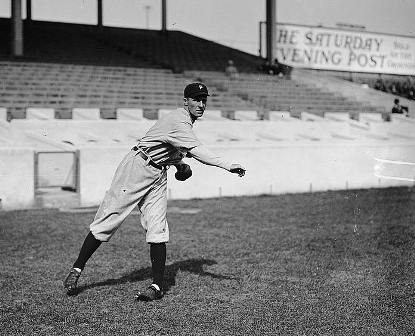
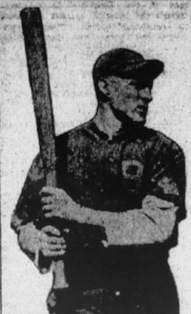
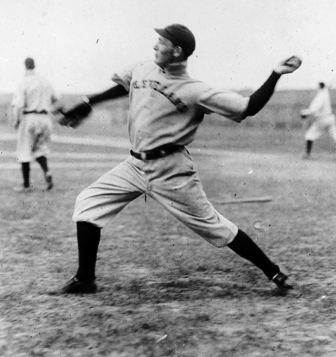
George "Dut" Chalmers

George “Dut” Chalmers

The Pittsburgh Press said:

“The frailty of baseball life and the quickness with which a career in the big show may be ruined are shown again in the case of George Chalmers…Chalmers may recover and come back some time, but it is doubtful, and his going marks the untimely end of a career that promised to be one of the most brilliant in baseball pitching history.”

According to The Inquirer, he was not yet ready for the end:

“Chalmers…had mighty little money, about $400 in all, and his best friends advised him to stick the little old four hundred into some good business and forget baseball…Good doctors had told George that his arm was gone.  Other pitchers, real friends of the Phillies star, had told him the same thing…Then he heard of a specialist in New York who had done a great job on another pitcher’s arm which had seemed to be gone (no articles mentioned the name of the specialist or the other pitcher).”

With his arm seemingly better, Chalmers was invited to spring training with John McGraw’s New York Giants in Marlin, Texas.  The New York Mail said “he looked good at Marlin,” but the Giants let him go before the season began.  On April 20 he was signed again by the Phillies, and sent out to pitch the next day.  The Inquirer said:

 “George Chalmers, once a Philly discard and lately spurned by the Giants, with whom he trained during the spring trip to the Southland, was the hero of today’s festive occasion for Philadelphia.  Chalmers had been without a big league contract and he was signed by (manager Pat) Moran only yesterday.  But he gave him a quick trial by shunting him at the Giants, and he showed his gratitude to the Quaker boss by pitching the best game of his career.”

Chalmers gave up only two hits and beat the Giants 6-1.

As the Phillies fifth starter in 1915 he was 8-9 with a 2.48 ERA, appearing in 26 games.  Jack Kofoed, a sportswriter for The Philadelphia Record said in “Baseball Magazine”that Chalmers’ record did not reflect how well he pitched:

“Throughout the season Chalmers twirled splendid ball, but played in tougher luck than any man on the Philly staff.  Had fate been as kind to him as to Al Demaree (14-11 3.05 ERA) , for instance, he would have won twice the number of games he did.  But the Phillies played more weird ball behind him than in back of any man on the staff.”

The Phillies won the National League pennant, and met the Boston Red Sox in the World Series.  With Philadelphia down two games to one, Chalmers was Moran’s choice to pitch game four in Boston.

Facing Ernie Shore, who won 19 games for the Red Sox, Chalmers pitched well, but lost 2-1 (the same score of Philadelphia’s losses Geo 2 and 3); The Inquirer said:

“Another Phil pitcher was sacrificed on the altar of a futile attack…through the futile efforts of his companions to obtain for him even the slender margin that was all he required.”

The Red Sox beat the Phillies four games to one.

In November of 1915 several Pennsylvania papers said Chalmers had used his “World Series coin as a matrimonial nest egg.”

The following season was his last.  The shoulder injury returned and the Phillies only used Chalmers in 12 games, he was 1-4 with a 3.19 ERA.  He did not appear in a game after August 7, and was released at the end of the season.  After an unsuccessful attempt to catch on with the Kansas City Blues in the American Association in 1917 Chalmers career was over before his 29th birthday.

In the waning days of his career, The Wilkes-Barre Times-Leader said:

“’Dut,’ as George is called by his playmates is a fine, upstanding, intelligent young fellow, with all the sturdy Scotch virtues as well as a Scotch burr in his speech, and whether or not he lasts in baseball he is very likely to be successful in life.”

Chalmers retired to New York and died in the Bronx in 1960.

Special thanks to Karen Weiss, George Chalmers’ great niece, for generously providing copies of photos from Mr. Chalmers’ scrapbook.
“Good day—Double Crosser”

30 Jul

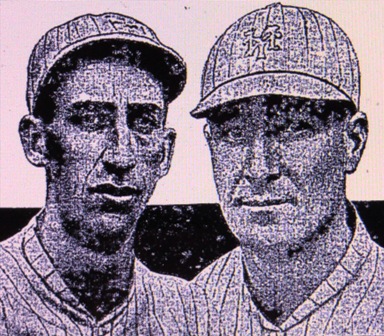
Hap Myers’ abrupt exit from the Boston Braves was never fully explained; the Boston press said he simply didn’t get along with manager George Stallings, Myers said it was because of his activities as one of the leaders of baseball’s most recent labor movement.

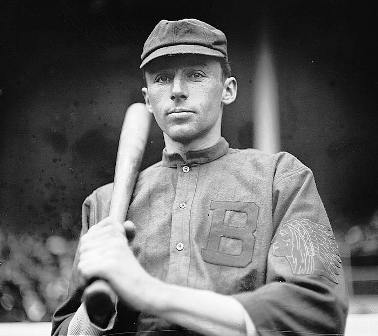
"Hap" Myers

“Hap” Myers

Two articles from The Associated Press about George Stallings that appeared after the braves won the World Series might have shed some light on the relationship between the two—one mentioned an incident that took place during a game, and the other had to do with Stallings’ well-known and strange superstitions.

The first article was about “a game played in Boston in the summer of 1913,” (box scores indicate it was most likely, the second game of a double-header with the Cincinnati Reds on July 22).

“Two men were out and the Braves had a man on first and another on second…A long hit would either tie the score or win the game.  ‘Hap’ let the first one pass—and bunted the second.  He was thrown out by at least 10 feet and the game was over.  The Braves had lost.

“’Hap’ in terror over a possible rebuke…escaped into the clubhouse.  Stallings was there, enshrouded in deepest gloom.  Baseball never knew a harder loser that Stallings.  But Stallings never said a word to Myers then, and Myers ducked out.

“The next morning found Stallings at Myers’ home.  Myers had just gotten up.”

When Myers answered the door, Stallings asked him why he had bunted with two on and two out.  Myers told his manager that he thought he’s “double-cross the other fellows…catch ‘em asleep.”

Stalling blew up at the first baseman:

“Well, let me tell you this Myers, if you ever again try any of that ‘double-crossing’ stuff there’ll be a funeral in this particular neighborhood.  Good day—double crosser.”

The second article said that during a losing streak in June of 1913 the superstitious Stallings blamed the “jinx” on a colorful necktie Myers wore—the only tie the first baseman owned.  According to the article, Stallings told his equally superstitious owner James Gaffney:

“That necktie of his—that horrible looking sight, that drapes down from his collar.  No wonder we can’t win.  No wonder we are jinxed.  That necktie would hoodoo anybody.”

The story said Stallings stole the tie from Myers, and after the Braves won the following day told Gaffney:

 “Told you so, didn’t I?”

The Boston Globe told a slightly different version of the story in 1931 in an article about Stallings.

By the time these stories were published, Myers was in his second season with the Brooklyn Tip-Tops in the Federal League.  He hit a disappointing .220 in 1914, but stole 43 bases.  In 1915 he hit .287 and was suspended for several days in June after he and Chicago Whales player-manager Joe Tinker “exchanged blows.”

"Hap" Myers Brooklyn Tip-Tops

“Hap” Myers Brooklyn Tip-Tops

When the Federal League folded Myers returned home to California and signed a contract with the San Francisco Seals, who already had veteran William “Chick” Autry at first.  When Myers arrived in San Francisco, The San Jose Mercury News said:

“The fight for the job will be a battle which will be watched with more than passing interest by San Jose fans, for most of them remember Myers as an elongated youngster who wielded a ferocious bat when he first broke into professional ball in this city.”

Myers hurt his arm and the battle never took place; he only appeared in three games, and was hitless in two at bats.  He would never play organized baseball again.

Where Myers spent the remainder of the 1916 season is unknown; The Mercury-News said he went to Ray, Arizona to join the Tri-Copper League, but no reference to Myers can be found in league statistics—whether he played in Arizona or not, he did spend time in the Southwest that year.

In November of 1916 Myers and two other men were arrested in Los Angeles on a warrant from El Paso, Texas.  The Associated Press said Myers was “wanted by the El Paso Police on a charge of highway robbery…one resident (was robbed of) a $1500 diamond ring and $48 in cash, and another resident, a diamond ring valued at $325,”

In January of 1917, when the trial took place, highway robbery was punishable by death in Texas.

On January 23 Myers and his co-defendants were acquitted.

Myers, now a free man, remained in the Southwest and went to work as a metallurgist with a copper mining company in Grant County, New Mexico.

In 1918 the 31-year-old Myers enlisted in the military; joining Company B of the Field Signal Battalion at Camp Lewis, Washington.   He played baseball at Camp Lewis and in France with the United States Army—among Myers teammates were professional players Ten Million, “Coaster Joe” Connolly, Howard Mundorff and Charlie Schmutz.

After returning from France Myers worked as an insurance adjuster in Seattle and later in automobile financing back in his hometown of San Francisco.

“The elongated first baseman” died in San Francisco in 1967 at age 80.

Hap Myers

29 Jul

When the 6’ 3” 175 pound Ralph Edward “Hap” Myers was let go by the Boston Braves after the 1913 season a reporter told Braves shortstop Rabbit Maranville he was sorry to see Myers go.  Maranville joked:

“Well, you might be, but I’m not.  Do you know that guy is so thin that every time I picked up a grounder I had to shade my eyes with my gloved hand to locate him before throwing the ball.”

Myers began his professional career after graduating from University of California, Berkeley in 1909, where he also played baseball.  The San Francisco native hit a combined .311 playing for the Sacramento Sacts in the Pacific Coast League, and the San Jose Prune Pickers and Santa Cruz Sand Crabs in the California League.

Myers went east in 1910 after being purchased by the Boston Red Sox, but became ill, with scarlet fever, and as a result appeared in only six games in Boston before being  sent first to the Toronto Maple leafs in the Eastern league, then the Louisville Colonels in the American Association.

Despite hitting just .240 with Louisville, Myers was selected by the St. Louis Browns in the Rule 5 draft.  The Red Sox claimed Myers still belonged to them and his contract was awarded to Boston, where he began the season, was sold to the St. Louis Browns, who quickly released him despite hitting .297 in 11 games, then back to the Red Sox where he hit .368 in twelve games before being sent to the Jersey City Skeeters in the Eastern League.

It was never clear why, in spite of hitting .333 in 81 at bats in 1910-1911, Myers couldn’t stick in the American League.

In 1912 he returned to the West Coast to play for the Spokane Indians in the Northwestern League where he led the league in hits, and runs, hit .328, and led all of professional baseball with 116 stolen bases.  The Portland Oregonian said:

“Myers base stealing smashes any previous performance in Northwestern League history.  You have to go back 20 years in official guide books to find any record to compare…and that includes every league in organized baseball.”

Spokane owner Joe Cohn went overboard in his praise of Myers in The Spokane Spokesman-Review:

“Best ballplayer in the Northwestern League by a long shot.  He is the greatest ballplayer I ever saw.  Boy I tell you this Myers is a wonder.  Ty Cobb, Hans Wagner, Tris Speaker and all of them have nothing on Myers…I think Myers has it on Cobb, Wagner, Lajoie, Jackson and the whole bunch.”

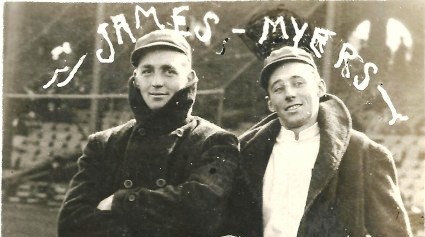
Myers, and Portland catcher Rex DeVogt were purchased by the Braves from Portland, Devogt would only last for three games, and six hitless at-bats in April of 1913.  Myers would become the Braves starting first baseman.  Another Pacific Coast League player, pitcher “Seattle Bill” James also joined the Braves.

hap3

“Seattle Bill” James and “Hap” Myers

Myers got off to a slow start; he was hitting just .224 in early July, but was leading the National League in steals.  An article in The Tacoma Times said:

“When Hap Myers, recruit first baseman of the Boston Braves is in full stride stealing bases, he covers nine feet…the average stride of a sprinter is six feet. “

The article said the average player took 13 steps, roughly seven feet per step, between bases but Myers took only ten steps:

“Myers is something of a baseball curiosity, and his work is watched with interest by the fans.  If the time comes that the big fellow climbs into the .300 class as a batter, he is apt to become a veritable terror of the paths.”

He was also said to use “a bat of unusual length,” but the size was never mentioned.

After the slow start, Myers hit well in the second half of the season, ending with a .273 average and 57 stolen bases (second to Max Carey of the Pittsburgh Pirates who stole 61).  Despite his strong finish, Myers was replaced at first base for 22 games in August and September by Butch Schmidt, who was purchased from the Rochester Hustlers in the International League.

"Hap" Myers

“Hap” Myers

At the end of the season Myers was sold to the Hustlers, the deal was, in effect, a trade for Schmidt.  The Boston press simply said Myers did not get along with manager George Stallings; Myers told a reporter in San Francisco that there was another reason; baseball’s labor unrest:

  “I was assigned by the fraternity to get as many Braves as possible into the fraternity, and succeeded in enrolling nearly the entire team.  The powers that be evidently didn’t relish my actions for soon my every move began to bring calldowns and I was not surprised to read in the newspapers a little later that I had been sent to Rochester.”

Myers jumped Rochester to join the Federal League; his signing was reported months before he actually signed.  The Associated Press said in March of 1914:

“Although it has been generally understood that Hap Myers, last season’s first baseman of the Boston National has been under a Federal League contract for some time, the elongated first sacker did not put his name to a contract until yesterday afternoon.  Myers originally expected to play with Larry Schlafly on the Buffalo Federals, but was transferred to Brooklyn, and seemed altogether pleased with the move.”

Myers got off to a strong start, and The Sporting Life said:

“Brooklyn fans cannot understand why Hap was passed out of the National League. They have had a chance already to give his successor at first base on the Boston team (Butch Schmidt) the once over, and the general opinion is that- Hap Myers “lays all over.”

His success in Brooklyn didn’t last; in 92 games Myers hit just .220.

Hap’s story continued tomorrow.

Butcher Boy Schmidt

25 Jul

Charles John “Butch” “Butcher Boy” Schmidt was credited by Connie Mack with being the catalyst for the Boston Braves World Series upset of Mack’s Philadelphia Athletics in 1914; one year later Schmidt walked away from baseball in his prime.

Butch Schmidt

Butch Schmidt

He was born in Baltimore in 1886, and played amateur ball while working in the family meat market, which earned him his nickname.

Schmidt signed as a pitcher with the Baltimore Orioles  in the Eastern League and assigned to the Holyoke Papermakers in the Connecticut State League, where he posted a 10-9 record.  In late August the Orioles recalled him, and he went 5-1 in 11 games with Baltimore.

The New York Highlanders drafted Schmidt and the 22-year-old pitcher started the 1909 season in New York.  He appeared in only one game, on May 11, giving up 10 hits and eight runs, four earned, in five innings.  Early in June he was returned to the Orioles.

After appearing in eight games on the mound with the Orioles, Schmidt was moved to first base.  After hitting .244 for the remainder of ’09, he hit .292, .291, and .274 the next three seasons, and was sold to the Rochester Hustlers in the International League, where he hit .321; he was purchased by the Boston Braves on August 22, and hit .308 in 22 games playing in place of Ralph “Hap” Myers.

At the end of the 1913 season Boston sold Myers’ contract to Rochester; The Boston Post reported that Braves manager George Stallings simply didn’t like Myers.  (Myers had a different theory for his release—that story next week)

Schmidt was installed as the Braves first baseman in 1914, and as Boston made their improbable run to the National league pennant Schmidt   hit .285 with 71 RBI and .990 fielding percentage, and finished 16th in the voting for the Chalmers Award, for the most valuable player in the National League; teammates Johnny Evers and Rabbit Maranville finished first and second in the voting.

Grantland Rice said in The New York Tribune:

“There are few greater first basemen in baseball and none who is steadier or a better fighter.  For Schmidt is also of the aggressive type and a hustler every second.”

The New York Times didn’t think quite as highly of Schmidt and on the eve of the World Series said the “advantage favors the Athletics” at first base:

(John “Stuffy”) McInnis makes exceptionally brilliant plays…has been through Worlds Series fire and proved just as cool as if he were playing an exhibition game in the springtime.  Schmidt has yet to face the strain and tension of the big baseball classic…While Schmidt is not a scientific batsman, he is a free swinger and hits the ball hard, but he doesn’t hit it often.”

The pressure of the series didn’t seem to bother Schmidt, the Braves first baseman hit .294 with five hits, two runs and two RBIs in the four game sweep of the Athletics; McInnis hit just .143.

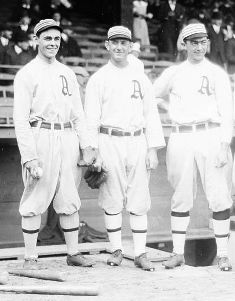
In game one he made a play in the first inning that Connie Mack said set the tone for the series and “sparked the Braves.”  With runners on first and second with one out, Athletics third baseman Frank “Home Run” Baker hit a foul pop-up into short right field.  Athletics outfielder Eddie Murphy tagged up and attempted to go to third; The Associated Press said Schmidt made a “great throw…from a difficult angle,” to third baseman Charlie Deal to retire Murphy.

Stuffy McInnis, Eddie Murphy and "Home Run" Baker,

Stuffy McInnis, Eddie Murphy and “Home Run” Baker,

Early in the 1915 season Braves manager George Stallings called Schmidt “The best first baseman in the game,” but his performance at the plate slipped.  Schmidt hit just .251 with 60 RBIs.  The Braves again found themselves in 8th place in July, and while they made another strong run, finished 2nd, seven games behind the Philadelphia Phillies.

Despite the mediocre season at the plate, it was assumed the 28-year-old Schmidt would remain the Braves first baseman.  Schmidt shocked Stallings, Boston fans, and all of baseball when he announced in January of 1916 that he was retiring from baseball.

Butch Schmidt at bat

Butch Schmidt at bat

The Associated Press said Schmidt was leaving “to devote his entire time to his private business.”

Grantland Rice said Schmidt’s business included “six meat markets in Baltimore,” and that he earned $8000 a year from his stores.

The Sporting Life said it was just as likely that Schmidt, listed at 200 pounds, retired because:

Hard work in that old rubber shirt to get down to weight, especially when the extra weight comes off slowly, more slowly each succeeding season, is a trial that anyone would like to sidestep if he could. “

Boston manager George Stallings filled the void left by Schmidt by purchasing Ed Konetchy from the Pittsburgh Rebels from the newly defunct Federal League.

The Boston Post said the change at first base would not hurt the Braves:

“Konetchy, a heavier hitter than Schmidt, is just about as capable in other ways.”

Despite the confidence of The Post, Stallings was not convinced and continued to try to induce Schmidt to return; his efforts were unsuccessful.

After Konetchy hit .260 for the third place Braves in 1916 it was reported that Schmidt would return to the team.  After several weeks of speculation, Schmidt told The Boston Globe “no offer” could induce him to return to Boston.

Konetchy hit .272 and .236 the next two seasons, and each off season it was rumored Schmidt would return, and every year he stayed home where he continued to run his business and play semi-pro ball in Baltimore’s Inter-City League.

Before the 1919 season Konetchy was traded to the Brooklyn Robins and the Braves acquired Walter Holke from the Cincinnati Reds.  Holke hit .292 for the Braves in 1919, but rumors continued that Schmidt, out of organized baseball for four years, would be returning to Boston.  The Associated Press said:

“George Stallings of the Boston Braves is trying to get Charlie “Butch” Schmidt, the Baltimore butcher boy who played first base for the world’s champions of 1914, to return to the Boston Braves.  Schmidt is reported to be in wonderful condition as he has kept in practice since his retirement.”

Schmidt never returned to professional ball, and was finally removed from Boston’s reserve list in 1922.

Butch Schmidt walked away from professional baseball and never looked back; he died in 1952 of a heart attack while inspecting cattle at the Baltimore Union Stock Yards.

Bill Brennan versus Philadelphia

10 Jul

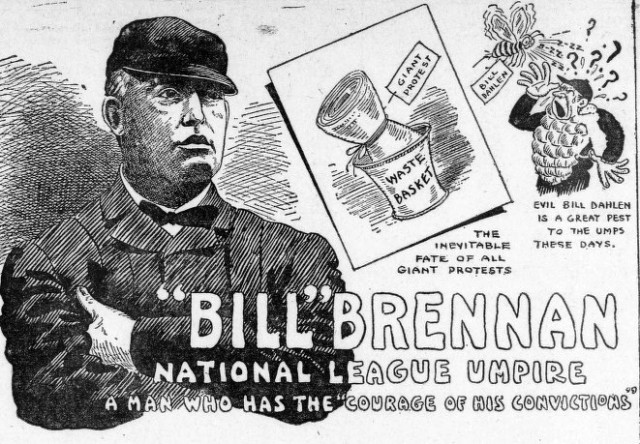
Umpire William “Bill” Brennan was at the center of the controversy that led to Philadelphia Phillies owner Horace Fogel being banished from the National League.  Fogel maintained that the 1912 pennant race was fixed, and that Brennan and the rest of the league’s umpires were in the tank for the champion New York Giants.

After Fogel was expelled Brennan dropped a threatened libel suit against him and the umpire’s life went back to normal, until August 30, 1913.

Fogel was working the game in Philadelphia’s Baker Bowl between the Phillies and the New York Giants.  The Giants, who were in first place by nine games, were trailing the Phillies 8-6 in the ninth inning.

Harry “Moose” McCormick, pinch-hitting for Fred Merkle, led off the inning with a groundout to second baseman Otto KnabeThe Philadelphia Inquirer said:

“As the big Giants’ pinch hitter started for the players’ bench he motioned towards the center field bleachers and shouted to Brennan that the white shirts there had blinded him.”

Brennan walked out to the center field bleachers and told the fans seated in the area to vacate their seats:

“They greeted him with jeers and catcalls; Brennan paused helplessly for minute and then walked back into the diamond.  Approaching Mike Doolan, captain of the Phillies, he ordered him to have the crowd removed.  Doolan laughed and said that it was impossible.  Then Brennan walked over to the New York bench and held a conference with Manager (John) McGraw.”

Philadelphia manager Charles “Red” Dooin had been ejected earlier in the game, so Brennan told acting manager Hans Lobert to move the crowd out of center field.  Lobert and the Phillies “explained that it could not be done.”

Brennan again went out to the center field bleachers, this time ordering a Philadelphia police officer to remove the crowd:

“The bluecoat laughed at him and said that he could not, under any circumstances, take his orders.

“’You’re under my orders,’ said Brennan.

“’I’m under no orders except from my sergeant or captain,’ was the answer.”

The crowd of 22,000 was “storming angrily for the game to proceed,” and the other umpire, Mal Eason, suggested the game be continued and played under protest.  Instead, Brennan again huddled with McGraw.

“Strangely enough, McGraw, who is generally the most volatile man in the world and charges all over the field in excitement, this time, remained quietly on the New York Players’ bench.”

Brennan walked back on the field and said, “This game is forfeited to New York, 9 to 0.”  The Giants were “running towards the clubhouse before (Brennan) completed his statement,” according to The Inquirer.

“Bedlam cut loose at that instant.  Screaming in rage the bleacherites by the thousands poured over the low rail into the playing field…a cushion seat struck Brennan in the face as he was walking towards the exit…His walk turned into an undignified run.  The bleach crowd had first tried to stop the New York players who butted their way to safety.  Then they turned toward Brennan.”

Bill Brennan

Bill Brennan

Escorted by police “with drawn revolvers,” Breen was able to get off the field.   Mobs formed outside the Baker Bowl and pursued the Giants, and Brennan, with his police escort, on their separate routes to the North Philadelphia Railroad Station:

“Brennan and his guard reached the entrance to the station just at the instant McGraw and his players came fleeing around the corner at Broad Street.  The police forsook the umpire to try and head off the larger crowd behind the New Yorkers.  With drawn guns they held them at bay for a few minutes. “

While police held two mobs at bay, a third waited for Brennan inside the station and “jumped upon him by the dozens.  (Brennan) was beaten to the ground, rose, (and) was beaten down again.”

The Inquirer claimed that McGraw and Brennan in their haste to escape the crowd boarded the wrong train, “an extra fare train from Pittsburgh,” rather than the train to New York.

Despite the mob, the chaos, and the “Missiles of all kinds,” that were thrown by Phillies fans, there was only one injury.  Giants’ utility man Arthur Tillie Shafer was hit in the head with a brick, but was not seriously injured.

Two days later National League President Thomas Lynch assigned Brennan to work the Phillies September 1 double-header with the Dodgers. The Inquirer said:

“President Lynch, of the National league, exhibited anything but a keen sense of delicacy in sending Brennan in to umpire the two games between the Phillies and Brooklyn on Monday,  or perhaps he is trying to work up a reputation as a humorist.”

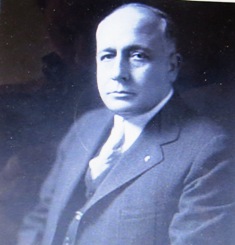
National League President Thomas Lynch

National League President Thomas Lynch

Philadelphia won both games without any serious incidents.  The Inquirer headline read:

“Man Who Helped Giants Couldn’t Aid Dodgers.”

Two days later Lynch reversed Brennan’s decision, The Associated Press said:

“Lynch, in his decision says that Umpire Brennan exceeded his authority in declaring the game forfeited to the New York club and formally awards it to the Philadelphia team by a score of 8 to 6.”

While New York appealed Lynch’s decision, Brennan‘s troubles were just starting.

He learned that a warrant was issued for his arrest in Philadelphia; a Phillies fan named Henry Russell claimed “Brennan in his efforts to get out of the park pummeled him and knocked him to the ground where he was trampled by the crowd.”  At the same time, it was rumored that Brennan would be let go by the National League.  The Associated Press said:

“(Tom Lynch) is certain to let him out, it is said if he is reelected, and if another man is chosen to head the circuit he will be instructed by his nominators to dispense with Brennan.  It is not the case of the forfeit that mitigates against Brennan so much, according to the yarn circulated, but his generally inconsistent work in games where the spirit of battle ran high.  He is said to be over excitable.”

Two weeks after Lynch’s decision, he was overruled by the National League Board of Directors, and it was determined that the game would be completed on October 2,

The Philadelphia Record and The Inquirer called the decision unfair and gave the second place Phillies “all the worst of it.”

In the end, the decision made no difference.  The Phillies, nine games behind the Giants on the day of the forfeit, never got closer than seven games out of first place, and finished the season twelve and a half games behind the Giants.  The pennant was a foregone conclusion when what The Inquirer called “The longest game on record,” was finally completed.

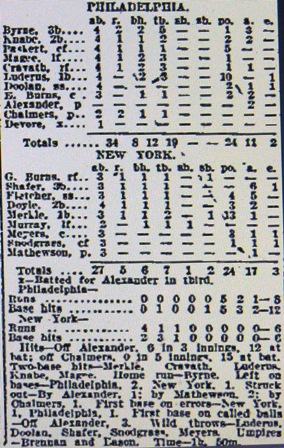
The anti-climactic two-thirds of an inning ended quickly on October 2.  Tacked on to the beginning of a double-header, pitcher George Chalmers faced three batters:  John “Red” Murray grounded out, John “Chief” Meyers singled; Eddie Grant ran for Meyers and was forced at second on Larry McLean’s ground ball.  The Phillies “ran from the bench and danced in glee at the speedy decision in favor of the long-standing dispute.”

billbrennan

After New York won the 1913 pennant, Giant pitcher and cartoonist Al Demaree featured Brennan in one of his nationally syndicated cartoons.

In December Lynch resigned as National League president; the following month it was announced that Brennan had jumped from the National League, signing a three-year contract to become a Federal League umpire (the league would only last two seasons).

The last word in the Brennan/Philadelphia controversy belonged to a journeyman boxer and fight promoter in Superior, Minnesota named Curly Ulrich.  Three weeks after the 1913 season ended The Duluth News-Tribune said Brennan, a St. Paul resident,  “attended the bouts in Superior.”  Promoter Ulrich introduced him:

“Ladies and gentlemen, I wish to present to you Bill Brennan, National League umpire and member of the New York Giants.”

The box score as it appeared on August 31

The box score as it appeared on August 31

A Thousand Words–Joe Tinker

1 Jul

Quick hits Monday through Friday this week for the holiday–regular items will return next week.

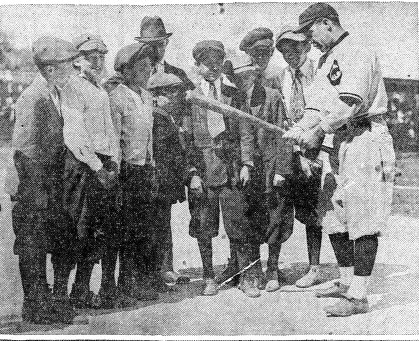
joetinkerkids

Joe Tinker, manager of the Chicago Cubs shows boys from the Chicago Schools Baseball League the finer of points of hitting before a July 1916 game with the Boston Braves.

Tinker returned to the Cubs in 1916 after having managed the Chicago Whales to the Federal League pennant the year before.  Whales owner Charles Weeghman purchased the Cubs after the Federal League folded and installed Tinker as manager.  Chicago fans had high expectation for Tinker’s team, because in addition to the manager, Weeghman brought most of the key players from the Federal champions to the Cubs.  But after a 9-17 record in July.  Rumors began to swirl that Weeghman would replace Tinker as manager after the Cubs owner traded for catcher Art Wilson on July 29; Wilson had been a Weeghman favorite when he caught for the Whales.

In August, Tinker blamed the Cubs disappointing season on third baseman Heinie  Zimmerman, telling The Chicago Daily News:

“Zimmerman is no good to the ball team.  he does not take any interest in his work and does not care whether the club wins or loses.  He did not report for practice yesterday and on other days is always the last one out for work.  Most of the players feel he does not belong on the team.  He is killing the harmony we had and that is why I would prefer to dispose of him.  He won’t play ball and does not use any judgment and with a man like that a flag cannot be won.”

Tinker survived the season, Zimmerman did not.  He was traded to the New York Giants on July 28.

The Cubs finished in 5th place, 67-86.  Tinker was let go after the season, he was not replaced by Wilson, as rumored, but instead by Fred Mitchell, who after a fifth place in 1917 led the Cubs to the National League pennant in 1918.

Tinker managed, and was a part owner, of  the Columbus Senators in the American Association in 1917 and ’18.

Fielder Jones and the Chehalis Gophers

11 Feb

Most biographies of Fielder Jones—player-manager of the 1906 World Champion Chicago White Sox, the Hitless Wonders—mention that he managed the Chehalis Gophers, a team in the Washington State League, in 1910;  they never mention that he ended up there because of a near-fatal assault before he arrived.

The 36-year-old Jones left the White Sox after the 1908 season to settle in the Portland, Oregon and tend to his many business holdings in the area.  In 1909, he was named president of the Northwestern League, and served for one season.  According to West Coast newspaper reports, Jones was in the running to named president of the Pacific Coast League in 1910, before Thomas Graham was elected as a compromise candidate.

In the spring of 1910, Jones coached the Oregon Agricultural College (now Oregon State) baseball team to the school’s first conference championship.

At the same time, Jones was coaching at OAC, the Washington State League was getting underway—the league had been operating for at least three seasons, but 1910 was the first year it was recognized under baseball’s national agreement as an “official” minor league.

The Chehalis Gophers were led by 27-year-old Fred Nehring; he had previously played on the Pacific Coast, Northwestern and Connecticut State Leagues.  Nehring, who was born in Pueblo, Colorado in 1883, but grew up in Chehalis, had been playing on and off with the local team since leaving the Tacoma Tigers in 1908

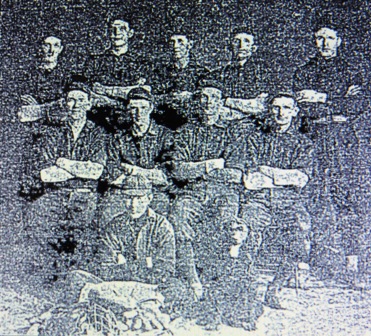
1908 Chehalis team. Fred Nehring standing 2nd from left, Tamp Osburn, standing 4th from left.

1908 Chehalis team. Fred Nehring standing 2nd from left, Tamp Osburn, standing 4th from left.

Another player who had spent time with Chehalis since 1908 was a pitcher known variously as “Tamp” Osburn, Osborn or Osborne (for the purpose of this story we’ll call him Osburn—most common usage by contemporaneous sources).  Tamp Osburn has, at least, two separate, partial listings on Baseball Reference.

Osburn was considered a talented pitcher, but an erratic character.  While pitching for the Spokane Indians in Northwestern League in 1907, he quit the team in June.  According to The Spokane Daily Chronicle:

“The whole trouble yesterday started when a couple of misplays in the eighth inning put a losing aspect on the game…Tamp blames the whole trouble on (William ‘Terry’) McKune, who he says ‘threw’ the game on him.”

Osburn had additional problems with teammates and developed a reputation as an eccentric, and like all eccentric pitchers of the era there was one he was often compared; The Daily Chronicle called him “The Rube Waddell of the Northwestern League.”

After playing together for Chehalis in 1908, both Nehring and Osburn played in the short-lived Inter-Mountain League in 1909; both returned to Chehalis after that league folded in July.

???????????????????????????????

“Tamp” Osburn, 1908 with Spokane Indians

On May 20, just after the 1910 season opened, the Chehalis team boarded a train.  According to The Chehalis Bee-Nugget:

“(Osburn) who had been drinking before the train left Chehalis became so unruly on the train that the train crew called on Fred Nehring, captain of the Chehalis team to quiet him.  Tamp resented Nehring’s efforts to keep him from cursing in the presence of ladies, and pulled a knife and began to slash Nehring…Two severe cuts…in the left arm, and the other was in the breast.  If the latter had been an inch farther over, it would have penetrated the lungs.”

Nehring had the wounds dressed, left the hospital against doctor’s advice and managed the Chehalis team “from the bench.”  Despite the seemingly quick recovery, Nehring only appeared in a few games the rest of the season.  Osburn was arrested.

The Chehalis team floundered for the next several weeks.  In late June, it was announced that Fielder Jones would join the team as manager and centerfielder.

Under Jones, who was still property of the White Sox and needed Charles Comiskey’s approval to play, Chehalis easily won the league championship; Jones hit .358 in 37 games.

Jones had agreed to play for the team for no salary and was only reimbursed for his expenses.  This arrangement nearly cost Chehalis the league championship.  According to The (Portland) Oregonian, the second place Raymond Cougars protested to the league and the National Commission that all wins under Jones should be forfeited because Jones “was not under contract.”  The protest was denied and Chehalis was declared league champion.

Osburn was sent to the Lewis County Jail while awaiting trial, and according to The Oregonian was involved in an attempted escape along with other prisoners who occupied the jail’s first floor, a week after his arrest.  The paper said of Osburn “the baseball player, and one other man were taken to the cells on the second floor and locked up securely.”

There is no record of whether Osburn was convicted; in any case, he was free by July of 1911 and was pitching for the Missoula, Montana franchise in the Union Association when The Helena Daily Independent reported that Osburn:

“The Missoula pitcher, who started a rough house in a Missoula cafe and pulled a knife on a stranger, drew a severe panning from the judge, who, after fining him $25, -said: ‘There are some good men on your team, who behave themselves, but there is a lot of you whose conduct is a disgrace to the city and the national game. We don’t want that kind of men in Missoula uniforms, and you fellows have got to stop such actions.”

Contemporaneous newspaper accounts say he was a native of Utah, but given the inconsistent spelling of his last name, and a full first name never being listed, the trail for Osburn ends after this 1911 incident.

Nehring remained in Chehalis where he died on February 19, 1936.

Jones returned briefly to baseball in 1914 and 1915 as manager of the Saint Louis Terriers in the Federal League.  He died in Portland in 1934.

Fielder Jones, 1914

Fielder Jones, 1914

Kauff and Perritt

29 Jan

Benny Kauff and Pol Perritt were two of the reasons why the New York giants won the National League Pennant in 1917.  Kauff led the team with a .308 average and Perritt was 17-7 with a 1.88 ERA.  Both came to the Giants by way of the Federal League, and with the help of “Sinister Dick” Kinsella, John McGraw’s right-hand man.

"Sinister Dick" Kinsella

“Sinister Dick” Kinsella

Kinsella was the former baseball magnate of Springfield, Illinois who went east to serve as McGraw’s chief scout.  He was a key player in the incident that led to Giants’ catcher Larry McLean’s banishment from organized baseball.

After the 1914 season, McGraw set his sights on the Indianapolis Hoosiers’ Kauff, who was being called the “Ty Cobb of the Federal League.”  Kauff led the league with a .370 average, 120 runs, 211 hits and 75 stolen bases.

When the debt-ridden Hoosiers were transferred to Newark for the 1915 season Kauff’s contract was sold to the Brooklyn Tip-Tops, and he joined the team in Browns Wells, Mississippi.

At the same time, Perritt coming off a 16-13 season was prepared to jump the St. Louis Cardinals and join the Pittsburgh Rebels in the Federal League.

Pol Perritt and Benny Kauff, 1917

Pol Perritt and Benny Kauff, 1917

Sportswriter Frank G. Menke of Hearst’s International News Service picks up the story:

“Dick Kinsella, scout for the Giants, according to the story we get, hustled to Browns Wells and got a job on a plantation…Kinsella didn’t dare to put up at the same hotel because he was known by Manager Lee Magee, Business Manager Dick Carroll and others of the Brookfeds.”

Kinsella, according to Menke, was pretending to be a farm hand and also observing Kauff’s workouts and reporting back to McGraw who, along with Jack Hendricks of the Indianapolis Indians in the American Association (who held Kauff’s rights) was sending coded telegrams to Kauff signed “Father.”  Kauff received telegrams saying, “Mother wishes to see her boy,” and “All is forgiven.”

According to Menke, the telegrams were intended to inform Kauff that McGraw wanted him with the Giants and:

“The “everything forgiven” telegram was to tip Kauff off that if he jumped the National Commission probably would let him play.”

While Kauff was in Mississippi, Pol Perritt was in the process of  jumping to the Federal League.

According to Menke, Kinsella left Mississippi in the middle of the operation to secure Kauff in order to talk to Perritt.  What Kinsella said to Perritt is unknown, but Perritt’s meeting with Pittsburgh manager Rebel Oakes pretty much put an end to any chance of joining the Federal League.  The Associated Press said:

“Pitcher ‘Pol’ Perritt who jumped to the Pittsburgh Federal recently had a fist fight with Manager ‘Rebel’ Oakes…Those who saw the fight say that the pitcher delivered one blow that knocked Oakes over a chair…Friends and acquaintances interceded and hushed up the whole affair before police arrived on the scene.”

The story said Perritt was meeting with Cardinals’ management to “flop back to organized ball,” within weeks the Cardinals sold Perritt’s contract to the Giants, The AP said:

“Carefully guarded by “Sinister Dick” Kinsella…Perritt was delivered to John J. McGraw this noon…Kinsella brought his man in from Shreveport without struggle, and states that he did not even sight a Federal submarine during the entire journey.”

An alternate version of the story, published in The New York Times said it was McGraw who met with Perritt rather than Kinsella and highlighted the manager’s journey to meet the pitcher:

“McGraw had to travel forty miles on one railroad, nine miles on another, and then drive nine miles through the mud to get to Perritt’s home in Louisiana.”

Perritt was in the fold.  After a 12-18 season in 1915, he would win 18, 17 and 18 from 1916-18.

Kauff would be a bit more complicated.

While Kinsella was gone from Mississippi securing Perritt, Kauff signed a $6000 contract with Brooklyn, which he immediately regretted and contacted McGraw.

kinsellamcgraw

Dick Kinsella and John McGraw, 1920

According to Menke, Kauff:

“Related the difficulty he had with Robert B. Ward, president of the Brookfeds, over the contract.  The Giants people thought that owing to Kauff’s trouble—or alleged trouble—over the Brookfed contract that he was not legally under contract.”

Menke said the Giants signed Kauff for $7000 a year for three years with a $7000 bonus.

National League President John Tener voided the contract and Kauff was forced to return to the Tip Tops; he again led the league with a .342 average.

McGraw finally got his second man at the close of the 1915 season.  After the Federal League folded and Kauff was reinstated to organized baseball he signed a two-year contract for $6500 a season and a $5000 bonus with the Giants.

New York had finished in eighth place in 1915. They improved to fourth in 1916 and won the pennant by 10 games in 1917. McGraw’s Giants lost the to the Chicago White Sox four games to two in the World Series.  Perritt appeared in three games in relief, and Kauff hit a disappointing .160, despite two home runs in the Giants’ game four victory.

After the 1917 World Series Perritt and Kauff faded fast.

Perritt was 18-13 in 1918, but would only win four more games over the following three seasons with the Giants and Detroit Tigers; he was out of professional baseball before his 30th birthday.

Kauff’s demise is better known; his professional career came to an end at age thirty, the result of allegations of his involvement with gamblers, in general, and 1919 World series fixer Arthur Rothstein in particular.  Kauff, who owned an automobile accessory business with his half-brother and Giant teammate Jesse Barnes, was charged with stealing and reselling an automobile.  Although he was acquitted at trial, Kenesaw Mountain Landis banned Kauff for life.  Kauff’s oft-told story is told best in two excellent books by David Pietrusza:  Rothstein: The Life, Times, and Murder of the Criminal Genius Who Fixed the 1919 World Series and Judge and Jury: The Life and Times of Judge Kenesaw Mountain Landis.

Perritt died in Shreveport, Louisiana in 1947; Kauff died in Columbus, Ohio in 1961.

The Man who Dried up Memphis

4 Jan

Finis Albert “Fin” Wilson had a brief, unsuccessful Major League career.  After four minor league seasons—two with the Knoxville Reds in the Appalachian League and two with the New Orleans Pelicans in the Southern Association—and a brief spring trial with the Cleveland Indians, Wilson signed a contract to play with the Brooklyn Tip-Tops in the Federal League in September of 1914.

Appearing in two games that September, Wilson went 0-1 with a 7.71 ERA.  Despite a respectable 3.78 ERA in 1915, Wilson‘s Major League career was over after a 1-8 season for the Tip-Tops.

Wilson signed with the Atlanta Crackers in the Southern Association in 1916, but became sick in April and missed most of the first half of the season.  He returned to the team in July and ended the season with a 4-6 record.

Finis Wilson 1914

Finis Wilson 1914

He returned home to Greensburg. Kentucky and served two terms in the Kentucky General Assembly.  In 1928 he was appointed as a federal prohibition administrator in Memphis, Tennessee, primarily responsible for stopping the transportation of illegal liquor on the Mississippi River.

Wilson was very popular in Atlanta because while pitching for New Orleans in 1913 he beat the Mobile Sea Gulls on the last day of the 1913 season securing the championship for the Crackers and shortly after his appointment he was the subject of a glowing profile in The Atlanta Constitution:

“In an office at the custom-house here in old Shelby County with the Mississippi meandering by just outside the window I found the man who won the 1913 pennant for the Atlanta Crackers. Finis E. Wilson, who left a bank presidency in Kentucky to battle Shelby county bootleggers, does not look like the young left-handed pitcher who gave the greatest exhibition of courage the Southern Association ever saw. His hair is gray now and he looks positively genial.”

He was on the front line of the government’s battle with moonshiners.  In one raid Wilson, according to The Associated Press he:

 “Dried Memphis up… (Wilson) directed the greatest cleanup Memphis ever experienced…more than 150 persons were arrested and confiscated 1,500 gallons of whiskey, 800 gallons of wine and 20,000 quarts of home-brew.

In another raid two of Wilson’s boats were bombed as agents destroyed 1300 gallons of liquor and arrested six men.  Wilson told The Associated Press:

“If it’s war the moonshiners want it’s war they’ll get.”

And it was a war; 16 agents were killed and 183 were injured in 1928 and ’29 alone; and while corruption among agents was widespread, it appears that no agents under Wilson were charged with any wrongdoing.

Wilson left government service sometime after the repeal of the Volstead Act in 1933, and died in Coral Gables, Florida in 1959.

Finis Wilson circa 1930

Finis Wilson circa 1930

Mique Malloy

10 Dec

John Michael “Mique” Malloy has at least three different listings under various forms of his name on Baseball Reference.

Malloy was born in Chicago in 1885, and played mostly amateur and semi-pro ball in Illinois, Wisconsin and Minnesota, but had a brief professional career as a player and manager in the Wisconsin-Illinois and Minnesota-Wisconsin Leagues.  The few statistics that survive include a .301 batting average in 133 at bats as a player-manager with the 1913 Wausau Lumberjacks–Malloy fractured his ankle in June and was released in July.

With his playing career over Malloy joined the Chicago Cubs as a scout, but left after the 1913 season to scout for the Chicago franchise in the Federal League.

Malloy became a footnote in the battle between the Federal League and the American and National Leagues, when in April of 1914 according to The Chicago Examiner he filed a $2000 lawsuit against the Cubs claiming he was not paid by the team for helping to sign Zip Zabel and Fritz Mollwitz.

It appears the suit was settled amicably and Malloy returned to the Cubs scouting staff after the Federal League folded.

He stayed with the Cubs with several years, but after World War I entered the business for which he was best known.

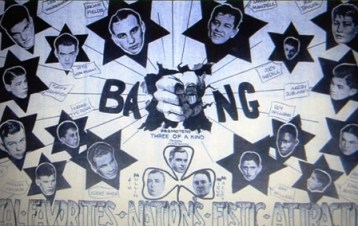
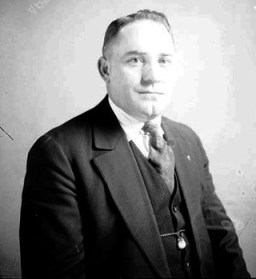
Throughout the 1920s and 30s Malloy was one of the most prominent boxing promoters in Chicago.  Malloy, Paddy Harmon, the man responsible for building Chicago Stadium, and Jim Mullen had a piece of every major fight that took place in Chicago.

1930s poster featuring promoters Mique Malloy, Jim Mullen and Paddy Harmon, and some of their stable of fighters.

1930s poster featuring promoters Mique Malloy, Jim Mullen and Paddy Harmon, and some of their stable of fighters.

In August of 1930, The Chicago Daily News said Malloy offered Washington Senators First Baseman Art Shires “(A) guarantee of $50,000 (and) two-thirds of the gate over expenses,” if he returned to the ring–Commissioner Kennesaw Mountain Landis had ruled that no Major League player would be permitted to box after Shires’ five fights  in December of 1929 and January of 1930—Shires, at the height of celebrity failed to cash in on the offer and found himself broke and returning to the ring for two much less lucrative fights in 1935.

John Michael "Mique" Malloy, 1922

John Michael “Mique” Malloy, 1922

Malloy, at various times, was closely associated with champions Primo Carnera, John Henry Lewis and Henry Armstrong.  It was a rift with Armstrong that led to the worst publicity of Malloy’s career.  After a February 1938 bout Malloy promoted at the International Amphitheater, Armstrong vowed never to fight for Malloy again and claimed that the promoter had seated fans in segregated sections.  There is no record of whether or not Malloy responded to the charges.

Malloy continued to promote boxing and wrestling cards in Chicago until he retired in 1947; he died in Chicago in 1952.

Another Malloy story tomorrow.