Tag Archives: George Gore

“Random Notes on the Leading Members of the Brotherhood.”

29 Sep

Ernest Justin Jarrold wrote for The New York Sun in the 1880s and 90s and was best known as the author of the “Mickey Finn” stories which were serialized in The Sun—Jarrold also wrote for the paper under the pseudonym “Mickey Finn,” about his travels through Ireland.
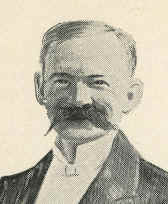
Ernest Jarrold

Ernest Jarrold

In 1889 Jarrold was at New York’s Fifth Avenue Hotel for “the meeting of the Ball Players Brotherhood for the purpose of forming the Players’ League.”  He provided readers with his “random notes on the leading members of the Brotherhood.”

Jarrold said:

“I met all the leaders.  The man who attracted the most attention was John Montgomery Ward, the celebrated shortstop.  This little man—for he is a pygmy compared with some of his associates—is generally admitted to have the largest business faculty of any baseball man in the country.  He originated the scheme of the new league while on the trip around the world last year, and, with the help of Fred Pfeffer, of Chicago, and Edward Hanlon, of Pittsburgh, formulated the plans while on the steamer going from Australia to Europe.  This conspiracy was carried out under the very nose of Al Spalding, and many secret conferences were interrupted by the entrance of Mr. Spalding.  Ward has a winning personality.  He dresses modestly but neatly.  He is the husband of the celebrated actress Helen  Dauvray, and has saved money from his earnings as a ballplayer.  This he has invested mostly in western real estate.  He is variously estimated to be worth from $50,000 to $75,000.

“Perhaps the next man in popular interest seen in the corridors was Michael Kelly.  In addition to being one of the handsomest men in the new league, Kelly is probably the wittiest.  He has created more original coaching expressions than any of his contemporaries.  He dresses well and wears diamonds.  Kelly is credited with executive ability on the ball field of a high order.  Most of the tricks in ball playing are the tricks of his prolific Irish brain. “

Jarrold said “one of the most striking figures” present at the meeting was the six-foot-four 200 pound Jay Faatz:
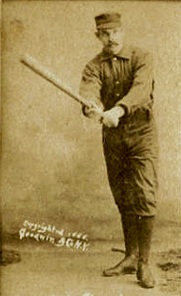
Jay Faatz

Jay Faatz

Faatz is the most expert poker player in the United States.  He has a passionate love for diamonds and always carries in his shirt bosom and cuffs $1,500 worth of these gems…He also has a snug sum in the bank.  Faatz always takes in the prize fights and the dog disputes which occur in his vicinity.  He is a level-headed, clear thinker, and the orator o the Brotherhood.

Fred Pfeffer, of Chicago, is one of the few players who has put money into the new league.  He has invested $3,000.  He is said to be the best fielder in the West.  Pfeffer is remarkable for his neat appearance when playing ball.  He is quiet and reserved.  He wears a brown mustache, a silk hat and a pleasant smile.  The New York reporters couldn’t elicit any information from him even when they used a corkscrew.

William Ewing, the greatest ball player in the world, is a bachelor. He is a very ordinary looking citizen in street attire.  He earned $6,500 last season (The New York Times said he earned $5,500, the “Spalding Guide” said $5,000).  Ewing was the first man to sign the agreement which bound the players to the new scheme.  He said he had no grievance, as the league had always used him well, but he wanted to cast his lot with ‘the boys.’  For a long time he was distrusted by the players on account o his intimacy with Mr. Day (Giants owner John B. Day).  Ewing will be captain of the New York team.

Lawrence G. Twitchell, five years ago, was a carpenter, working for $2 per day.  Today he is a capable left fielder, and earns $2,500 for working about six months in the year.  Tony, as he is familiarly known, is remarkable for his fine physique.  No more perfect man physically ever set foot on a diamond.  The trip east from his house in Ohio to attend the convention cost him $500.  He married a wealthy young woman, who became enamored of him while playing ball at Zanesville, Ohio…Tony says he is not obliged to play ball for a livelihood.  He does it for love of the game.  He is young, beardless and handsome;  also enthusiastic as to the ultimate success of the new league.

Larry Twitchell

Larry Twitchell

Edward Hanlon, who will fill the onerous position of captain of the new Pittsburgh club, will also act as manager and centerfielder of the team.  He has been frugal and has saved money during his long and illustrious baseball career.  Hanlon is one of the progenitors of the new league.”
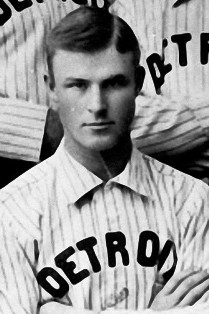
Hanlon had been responsible for making the initial contact with street car magnate Albert Loftin Johnson, who would become one of the league’s principal financial backers, and according to Jarrold “the missionary of the new baseball venture.”  Jarrold said:

“(Johnson is) an ardent admirer of the game…All preliminary meetings in the formation of the Players’ League were held in his rooms in Cleveland.  A policeman was stationed at the door to keep out reporters.  It was mainly through his efforts that the seal of secrecy was kept over the organization for so long a time.  He can talk longer and state less facts for reportorial use than any man connected with the baseball fraternity.  It can be stated truthfully that no organization of such interest to the public as the Players’ League was ever handled so secretly as has this one.  This was mainly due to Johnson’s perspicuity.  He is a heavy backer of the new enterprise, and is known as the Moses of the new baseball dispensation.  Johnson doesn’t pay much attention to clothes or diamonds.”

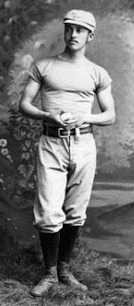
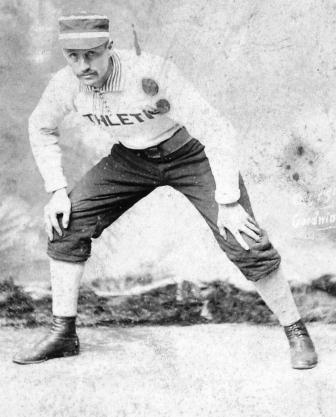
Among those present at the meeting, Jarrold seemed to think most highly of outfielder George Gore “One of the most dashing, devil-may-care men in the new league.”  Jarrold said:
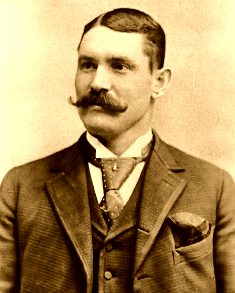
George Gore

George Gore

“Gore has the happy faculty of laying aside his profession when off the diamond, which faculty is shared by but few ball players.  As a rule these men are very sensitive, and when a game is lost it is not uncommon for them to be so depressed in spirits that they cannot eat or sleep.  Gore, however is not that kind.  As John Ward says:  ‘Gore lets care get behind the wood pile when his work is over.’  He used to run a paper machine in Saccarappa, Maine in 1878.  Gore lives up to his income and has saved no money.”

Within a year, the Players League was finished and “Mickey Finn” had moved on to writing about his travels in Ireland.
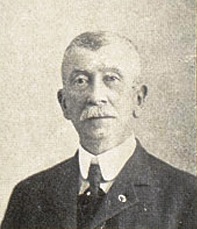
Frank Bancroft

14 Jul

When Frank Carter Bancroft died in 1921 at age 74, “Spalding’s Official Baseball Guide” said:

“His executive ability and Knowledge of Base Ball, combined with the fact that he was for sport first and the show element of Base Ball secondarily, rendered him one of the most competent of men to handle the affairs of a professional team.”

Frank Bancroft

Frank Bancroft

While working in the front office of the Reds in 1892, Bancroft talked with Harry Weldon, sports editor of The Cincinnati Enquirer about some of the players who got their start with his teams.  He also didn’t seem to mind taking a swipe at a couple former players:

“Probably no man now before the public except Harry Wright or Adrian C. Anson have had a longer or more varied experience with the intricacies of the great National Game than Frank C. Bancroft.  He never wore the spangles, like a great many other managers, but he has been connected with the game in a managerial capacity since the early seventies.  ‘Bannie’ is one of the wittiest men in the profession and he has a fund of anecdotes about players and plays that are well worth hearing.  Many of the great baseball stars now before the public made their debut under Mr. Bancroft’s management.  Many of them who are now drawing $4,000 or $5,000 a season worked under Bannie for about one-tenth that amount and were glad to get it.  Bancroft was one of the leading lights in the original New England League, which graduated a great many of the stars of today.

“At the present time Mr. Bancroft is business manager of the Cincinnati Reds.  He has nothing whatever to do with the players. All of that part of the club’s affairs being under the supervision of Captain (Charlie) Comiskey.  All Bannie has to do is look after the gate, railroad rates and dates.  The other evening the veteran manager was in The Enquirer office and grew reminiscent.  His recital of the details of the debut of some of the stars is worth reproducing.

Harry Stovey, one of the greatest ballplayers today, began his professional career under Manager Bancroft.  He began his career in the pitcher’s box and graduated out of the ranks of a Philadelphia amateur team called the Defiance in 1877 (the Philadelphia Defiance were a professional team, part of the league Alliance).  Manager Bancroft heard of him, and in 1878 engaged him as a change pitcher for the New Bedfords.  G. Washington ‘Grin’ Bradley was the regular pitcher of the team, and as he was an every-day pitcher Stovey was never allowed an opportunity of displaying his pitching abilities on the New Bedford team.  He had to be content with warming the bench until fate was kind and he had a chance.

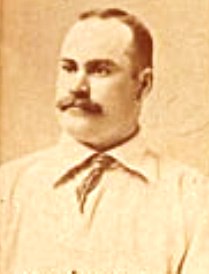
Stovey

Harry Stovey

“‘Stovey played his first game with our team at Baltimore,’ said Mr. Bancroft.  ‘we were making an exhibition tour when John Piggot, the first baseman, was taken ill, and as we only carried ten men, Stovey was called on to make an attempt to play first base.  His maiden effort was a brilliant one—so brilliant that it lost Piggott his job and made Stovey a fixture on first.  He had at least twenty putouts, no errors and several cracking hits to his credit that day.  He played the season with us, and his fame spread so that he was signed by the Worcester (Ruby Legs) League team and afterward with the Athletics Stovey’s salary the first season in New Bedford for $50 a month.  Now he is paid nearly that much a game.’

George Gore, the crack center-fieder of the New Yorks is another player who came into prominence with the New Bedfords that year.  Gore’s home was in Maine, at a little town called Saccarappa…Gore was about as green a specimen as ever stepped into the business.  He played a few games with the Fall Rivers, and then the New Bedfords got him.  He was a big, awkward country boy then, but he could run like a deer and hit the ball like a trip hammer.  Gore signed with the New Bedfords under Manager Bancroft for $50 a month, but he did not stay with them long.  His terrific batting attracted the attention of the whole baseball world, and soon the more prominent clubs were after him.  While the Chicagos were in Boston the late lamented (William) Hulbert, President of the National League, who was with them, ran up to New Bedford to have a talk with Gore.  Luck was with big George.  He had his eye with him, and made three home runs in the game.  That feat settled his fate.  Before Hulbert left New Bedford he had Gore’s name to a contract to play in Chicago in 1879 at $150 a month.  His career since that time is well known.  Today he is yet a great hitter, and reached first base as frequently as any player in the business, by either hits, errors or bases on balls.  His ability to reach first causes him to be selected to head the battery list of the New Yorks.

Arthur Irwin is another player whom Manager Bancroft put in the business. ‘He made a grand impression in his opening game with me,” said Manager Bancroft.  ‘I was then manager of the Worcester League team, and we were on the hog train for a while, owing to Charlie Bennett’s glass arm and Buck (William “Farmer”) Weaver’s faint heart.  Matters were so bad that a crisis was at hand.  A meeting of the stockholders of the club was called, and it was voted to place the team in my hands for one month, and if no improvement was shown at the end of that time I was to be given the chase.  It was a dying chance for me, and you could gamble that I had my eyes and ears open for a savior of some kind.  Arthur Irwin was then playing with an amateur team called the Aetnas, of South Boston, and I engaged him to play short with the Worcester.  (J. Lee) Richmond, the once famous left-handed pitcher, who played here with the Reds in 1886, was then with the Brown University team and he was telegraphed to come for a trial.  We played the Chicagos that day, and we shut them out, only one man getting first base.  Irwin made a great hit at short, and Richmond was a wizard.  Irwin was a fifty-dollar-a-month man, and that was the start of his professional career.  Richmond is now a physician at Geneva, Ohio.’”

The game Bancroft referred to was an exhibition between Worcester (a member of the National Association) and the National League’s Chicago White Stockings played on June 2 in Worcester. Richmond walked the first batter, Abner Dalrymple, and then retired the next twenty-one before the game was called after seven innings.  The Chicago Tribune said Richmond struck out 8.  Worcester tagged Frank Hankinson for 12 hits and 11 runs (Chicago also committed 11 errors).  Bancroft was correct that Richmond became a physician, but by 1892, he was no longer practicing and was working as a teacher in Toledo, Ohio.

J. Lee Richmond

J. Lee Richmond

“Big Roger Connor of last season’s New Yorks, but now of Philadelphia, received his professional introduction under Manager Bancroft.  ‘It sounds queer to say that such a cracking hitter as Roger Connor was ever released for poor batting, but such was the case’ said Manager Bancroft

“’I had him with the New Bedfords in 1878, but he was hitting so poorly that I released him.  He afterward signed with the New Havens the same season, but the disbanded.  Roger left New Haven and went to Waterbury, his home, where he joined an amateur team in that city called the Monitors.  Up to that time he had batted right-handed, but he decided to turn around and try it left-handed.  The change saved his life.  He blossomed out as a great slugger, and his reputation has been growing ever since.

“Connor, like Stovey, began his professional career at $50 a month, and has since climbed to the top rung of high salaried players.  Many young players of today should look upon these as examples for honest and temperate habits have enabled them to remain at the head of the profession, while the path is strewn with a multitude of others who might have been where they are if they had not thought this world was a continuous round of gaiety and fun and discovered their mistake when it was too late.”


“No Exhibition was ever Received in this City with more Enthusiasm”

2 Jul

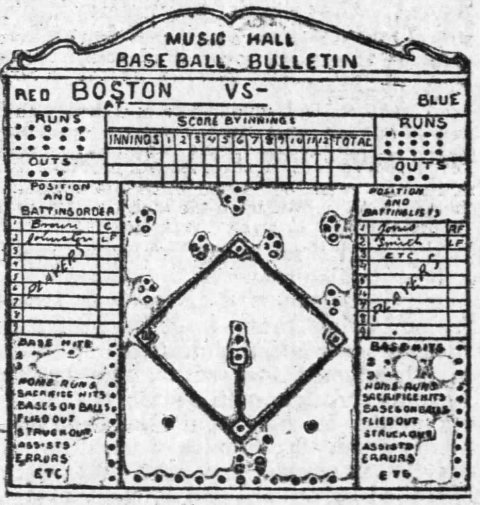
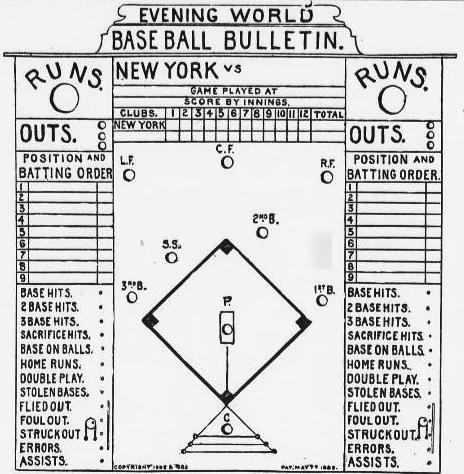
The New York World unveiled a newly updated attraction for baseball fans on August 6, 1889; the “Baseball Bulletin,” a version of which had also been introduced at the Boston Music Hall earlier that summer.

The Boston Music Hall "Bulletin Board."

The Boston Music Hall “Bulletin Board.”

The Associated Press said some fans thought the board was “an advantage over the actual game, in that it not only reproduces the plays graphically and simultaneously, but it keeps at the same time a simple and conspicuous record of the contest.”

The New York World's "Bulletin Board."

The New York World’s “Bulletin Board.”

The Boston Herald said their board measured “fifteen feet square.”  New York’s board was an improved version of one that had been used the previous October for the Giants six game to four World Series victory over the American Association’s St. Louis Browns.

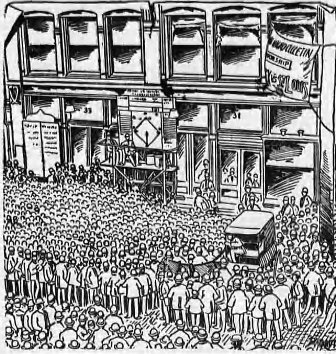
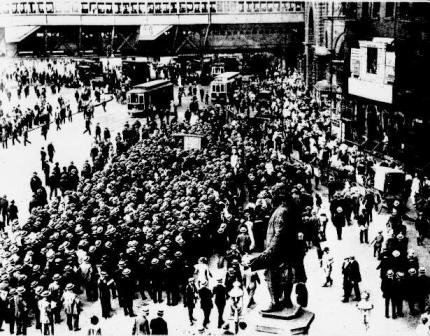
The crowd on Park Row for the 1888 World Series

The crowd on Park Row for the 1888 World Series

The board was the creation of  reporter Edward Van Zile of The World; Van Zile received a patent for the invention, although it was another member of the paper’s staff, Publisher Joseph Pulitzer’s secretary Edwin A Grozier, who turned it into a profitable enterprise. After purchasing the original rights from Van Zile, Grozier improved the design and received his own patent.

The World said the new version was a bigger sensation than the one introduced the previous October:

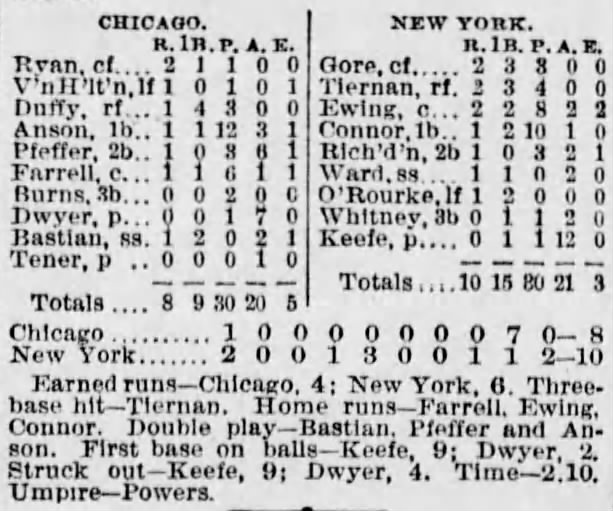
“’Perfection’ is the word which expressed the verdict of the baseball public who had the good fortune to witness the game between the New York Giants and Baby Anson’s team on The  World’s Baseball Bulletin Board yesterday afternoon…it is safe to say that no exhibition was ever received in this city with more enthusiasm than was the baseball bulletin.

“And the crowd too!  What a vast number!  There must have been fully 10,000 people in the audience, and the way they cheered when the Giants made a run was a sound that would have made Baby Anson sick.”

The presentation of the game took place on New York’s “Newspaper Row” (Park Row), with a crowd on the east side of the street

“(E)xtending from above The World Building to far below it (and) on the west side of the street the crowd was much larger.  There was a long line of people from Mail Street almost down to the other end of the big Federal Building.

“No point from which the game could be witnessed was left vacant.  The boys climbed up and lodged themselves in among the pillars of the Post Office…Even the lamp post was monopolized by the urchins, and when our boys made a good play they generally led the cheering.”

The “expert board operator placed the Chicago men in the field,” for the first inning, and leadoff hitter George Gore at the plate:

“When (Gore) slid down to first base the crowd were just ready to cheer, but they saw him put out and they reserved their applause for another occasion.

“They did not have long to wait, however, for (Mike) Tiernan and (Buck) Ewing  each succeeded in gaining bases, and then big Roger Connor was placed over home plate

“The crowd held its breath in anticipation of what was to come.  Their enthusiasm was drawn up to a high pitch, and was just waiting for a chance to break its bonds.  And they got it!  The little red disk representing Connor slid up to first and Tiernan slid across home plate.  Then there was a volley of cheers.  It broke forth clear and strong, and the sound could be heard blocks away.

“Up on the tops of the tall buildings in the neighborhood the cheers of the crowd could be heard resounding forth as a victorious army returning from battle.

“And it was all the same through the game. A great many people were attracted to the spot by the cries of the crowd, and when they saw the baseball bulletin they all united in declaring it to be the greatest thing they had ever seen.”

Chicago scored seven runs off Tim Keefe in the ninth to tie the score at 8.  The crowd’s “disapproval resolved itself into a continued groan.”

The Giants scored two runs in the tenth, and when the white Stockings came to bat in the last half of the inning:

“(T)he crowd watched more intently than at any time before.As each Chicago man went out there was a yell, and when they all went out without having made a run it was impossible to say a word that could be heard.”

The Box Score

The Box Score

The paper commemorated their innovation with a poem:

A boy was passing down the street,

Another lad he chanced to meet;

‘I’ll bet,’ he said, ‘we’re licked once more.

What is the score?’

A merchant coming down that way,

Lifted his bearded head so gray;

And ceased o’er book and cash to pore—

‘What is the score?’

A preacher wrestled with his text,

And wondered what he’d best say next;

Then called out through his study door;

What is the score?’

The Mayor in his office sat

And pondered over this and that,

The said: ‘I’m sure the game is o’er.

What is the score?’

If they had only chanced to go

Into the middle of Park Row,

And see the bulletin of The World,

And the glorious pennant there unfurled,

They’d never ask the question more

‘What is the score?’

The  World predicted the initial crowd was just the beginning:

“Today’s game between the Chicagos and the New Yorks will be duly recorded on the board.  There is room for everybody to see, and it is expected that the crowd will be twice as large as yesterday.”

The following day the paper did not say the crowd had doubled—to 20,000—but claimed it was “The largest crowd that had ever been on Park Row,” for the Giants 4 to 2 victory over the White Stockings.

Crowds continued to come to Park Row as the Giants battled the Boston Beaneaters and won the pennant on the final day of the season.

Baseball Bulletin Boards, and other versions of the concept, remained a popular feature well into the 20th Century. More often than not they were sponsored and presented by local newspapers.

The New York Sun presented their own "Baseball Bulletin Board"  on New York's Park Row in 1914

The New York Sun presented their own “Baseball Bulletin Board” on New York’s Park Row in 1914


Alternate Uniforms, Circa 1879

14 Feb

On the eve of the 1879 season The Chicago Times endorsed an innovation about to be introduced by the Chicago White Stockings:

“The management of the Chicago Club has very wisely decided that the skinny white uniform with tips of blue, in which it has dressed its men from time immemorial, is not the best of its kind; that good taste dictates higher colors for the field, something that will bring out, instead of dwarfing the muscular development of its wearer.  The result of the consultations over the matter has been the adoption of something which has merit of novelty about it, at least, and, at the first blush, there seems to be no reason why it should not produce a pretty effect on the field.”

The Times noted that three years earlier, the White Stockings had worn individually colored caps in order to make it either for fans to identify the players.  The move “for some unknown reason was discarded” at the end of the 1876 season.

“The present change is in the same line, except that it goes further and applies the principle to the entire uniform.  The customary white flannel will be used for the body of the dress.  In this respect they will all be alike; but each man will be furnished with an individual color to finish it with, including cap, neck-tie, belt and a band some three inches wide around the thickest part of the calf.  The colors have been selected, and Spalding Bros. are now at work upon the uniforms.”

The 1879 Chicago roster by color:

Silver Flint:  Blue

Terry Larkin: Brown

“Cap” Anson: Grey

Joe Quest: Black and yellow

John Peters: Green

Frank Hankinson: Scarlet

Abner Dalrymple: White

George “Orator” Shafer: Red and black

George Gore: Blue and white

Bill Harbridge: Red and white

Frank Hankinson--wore scarlet in 1879

Frank Hankinson–wore scarlet in 1879

The move was taunted in at least one National League city–The Syracuse Courier derisively referred to the team as the “Chicago Rainbows.”

The Times said “Cap” Anson was in favor of the new uniforms and “says there’s luck in it.”

The paper agreed with Anson’s assessment:

“The individual caps won in 1876.  Since then they have been discarded, and Chicago hasn’t been able to win anything.”

Anson’s “luck” didn’t hold in 1879.  The White Stockings were in first place from Opening Day until August 1, then Anson became ill in July and eventually left the team which went 5-12  the rest of the season under Silver Flint, and finished in fourth place.

The uniforms disappeared and Anson returned for the 1880 season. When the team took the field for the opener The Chicago Tribune said:

“The Chicagos appeared for the first time in their regular League uniform for this year, with all-white stockings that are a marked improvement over the many-colored rings of last year.”

The 1880 White Stockings

The 1880 White Stockings “with all-white stockings”