Tag Archives: Hall of Fame

Lost Advertisements–“Home Run” Baker for Coca-Cola

23 Aug

???????????????????????????????


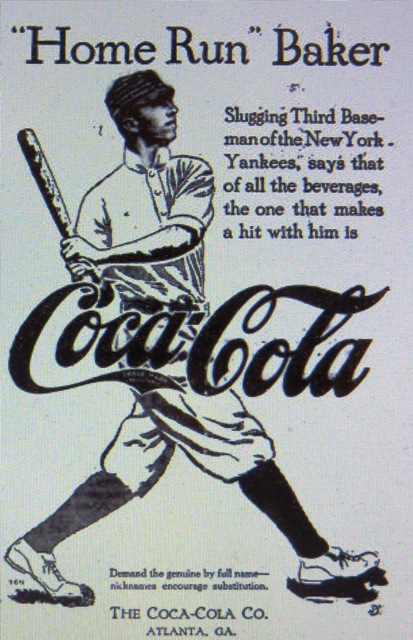
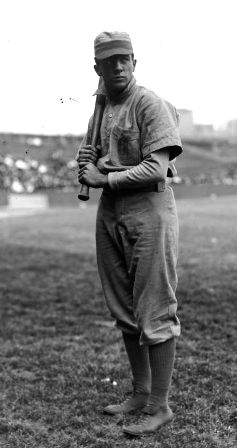
A 1916 advertisement featuring Frank “Home Run” Baker.

Slugging Third Baseman of the New York Yankees says that of all the beverages, the one that makes a hit with him Coca-Cola

Baker was sold to the Yankees for $37,500 in February of 1916 after the star of the Philadelphia Athletics had sat out the 1915 season over a salary dispute with Connie Mack.  The Hall of Famer remained a star while in New York, but never again put up the numbers he did before missing an entire season in the prime of his career.

“He was Greater than Ty Cobb ever dared to be.”

15 Aug

Hall of Famer Jake “Eagle Eye” Beckley still holds the all-time record for putouts and total chances for first baseman, more than 100 years after his career ended.  He also hit .308 for his career and his 244 triples rank fourth on the all-time list.

However, it appears he wasn’t a great source on who was the greatest player ever.

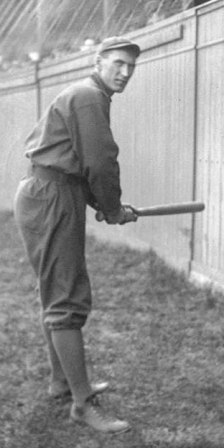
Jake "Eagle Eye" Beckley

Jake “Eagle Eye” Beckley

In 1915 Beckley told a Kansas City reporter that he had played with the greatest player ever.  Over the next year the quotes appeared in many newspapers including The Washington Post and The Pittsburgh Press:

“You can have your Ty Cobbs and your Benny Kauffs, I’ll take Billy Sunday for my ball club right now, and I said the same thing back in the nineties.”

Beckley said the ballplayer turned evangelist was as good as any player he’d seen:

“He’s fifty-two years old today, but he’s running bases and sliding every day in that pulpit just as he did back in the old days.  If he’d stayed in the game Cobb never would have been famous.

“He was greater than Ty Cobb ever dared to be in three departments of the game.

“Everybody thinks Cobb can run bases.  I’d spot him a second against Billy Sunday and then watch Bill score first.”

Sunday was the first player to circle the bases in 14 seconds.

“They think Cobb covers outfield territory.  They should have seen Sunday in his prime.

“And throw—say he could throw from center field just as easily as Tris Speaker.”

Beckley had several excuses for Sunday’s weaknesses as a hitter:

“Batting was where Sunday was weak, but in another year or so he would have overcome that weakness.  E was just that kind.

“He had more fight in his heart than any man I ever saw.  He was learning more about the art and science of batting every day.

“You see, Billy Sunday broke in under a handicap.  Pop Anson picked him up because of his speed and not because of his baseball ability.  He was fast, but when he started in a bat was strange to him.

“He fanned so many times his first year (18 in 55 plate appearances) he must have been busy when the season ended.  But when he came to our ball club (Pittsburgh Alleghenys 1888) he was improving and improving fast.”

Sunday’s “fast” improvement resulted in .236, .240 and .258 batting averages from 1888-1890.

Beckley concluded that Sunday’s “calling” was the real reason he never became a good hitter:

“But he didn’t give enough attention to his batting.  He used to spend a lot of time before the game in the clubhouse always reading the bible or studying.”

Sunday walked away from baseball after the 1890 season to accept the position of assistant secretary with the YMCA in Chicago; he became one of the nation’s most popular evangelists and died in 1935.

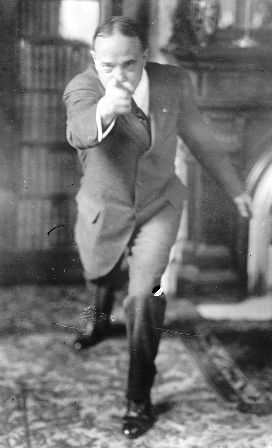
Billy Sunday

Billy Sunday

Beckley played until 1907, collecting 2934 hits during his 20-year career.  He was elected to the Hall of Fame in 1971, more than 50 years after he died in Kansas City at age 50.

“Is the Best the Game has Known”

23 Jul

Joining the Boston Braves for the 1914 season provided second baseman Johnny Evers with the opportunity to appear in one more World Series, and gave him the chance to take a very public swipe at one of his most famous former teammates, shortstop Joe Tinker.

In December of 1912 the Chicago Cubs traded Tinker to the Cincinnati Reds, and depending on which version of the story was to believed, Tinker and Evers had not spoken a word to one another for either five or six years.
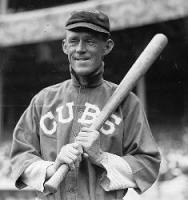
Johnny Evers

Johnny Evers

Tinker said the two stopped talking in 1908 after Evers jumped in a horse-drawn cab leaving Tinker and other teammates behind before an exhibition game in Indiana leading to an on-field fight between the two later that day; Evers said a year earlier Tinker initiated the bad blood between the two by throwing a ball so hard to the second baseman on a force play that it injured his finger.

Evers said years later:

“I yelled to him, you so-and-so. He laughed. That’s the last word we had for-well, I just don’t know how long.”

The 1914 Braves got off to a horrible 4-18 start, and were still in eighth place on July 18, but surged to second place by August 10, winning 18 of 21 games.  By September 2 the Braves had first place to themselves, and ended up running away with the pennant, beating the second place New York Giants by 10 ½ games, and sweeping Connie Mack’s Philadelphia Athletics in the World Series.

Evers, named Boston’s captain by manager George Stallings, led National League second basemen in fielding; hit .279 for the season, and .438 in the World Series.  Evers received baseball’s last “Chalmers Award,” a forerunner of the Most Valuable Player Award, which was presented from 1911-1914.  The award was sponsored by the Chalmers Motor Car Company and was presented to Evers along with a new car.

The runner-up for the Chalmers Award was Evers’ teammate, shortstop Walter James Vincent “Rabbit” Maranville.  Maranville, Evers and first baseman Charles “Butch” Schmidt were an excellent double-play combination throughout the season; Evers participated in a career-high 73 twin killings, more than he’s ever turned in a season with Tinker and Frank Chance.

Years later Maranville said of Evers:

“It was just Death Valley, whoever hit a ball down our way.  Evers with his brains taught me more baseball than I ever dreamed about.  He was psychic.  He could sense where a player was going to hit if the pitcher threw the ball where he was supposed to.”

Two days after the Braves won the World Series; Evers took the opportunity to take a swipe at his former teammate Tinker.  Evers told William Peet, sportswriter for The Boston Post that:

“(Maranville’s) the best shortstop the game has ever known.

“Better than Joe Tinker; your old side partner?

“Yes, he’s better than Tinker.”
Joe Tinker

Joe Tinker

Peet sad:

“Evers has been given credit for making Maranville the great player he has shown himself to be this season, but Johnny declares this s untrue, stating that Maranville learned the game and all its fine points unaided.”

Peet said Evers’ claim that Maranville “is a greater shortstop than Tinker is about the highest praise anyone can shower on the peppery little chap who was such a prominent factor n the Braves’ victory.”
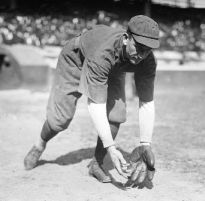
Rabbit Maranville

Rabbit Maranville

Evers and Peet failed to mention where Honus Wagner would be ranked if Maranville was, in fact, “the best shortstop the game has ever known.”

No response from Tinker was recorded.

Evers and Tinker would not speak again for another decade.  In 1924, the two finally spoke when they were summoned to California by Chance, their former teammate and manager, who was dying.
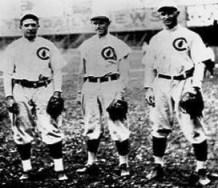
Tinker, Evers and Chance

Tinker, Evers and Chance

Tinker, Evers and Chance were inducted into the Hall of Fame together in 1946 by the veterans committee; Maranville was elected by the Baseball Writers Association of America in 1954.

A Thousand Words–Jim Jeffries and Baseball

12 Jul

jeffries


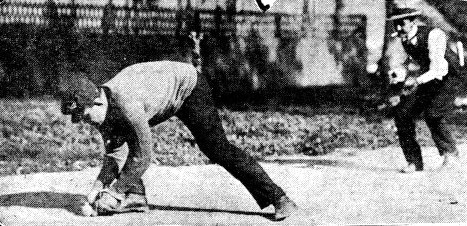
Former Heavyweight Champion Jim Jeffries fields a ground ball at his ranch in Burbank, California as he prepares for “The Fight of the Century,” against reigning  champion Jack Johnson; Johnson pummeled the former champ on July 4 in Reno, Nevada, retaining his title on a TKO in the 15th round.

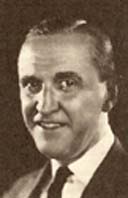
Behind him is Harley M. “Beanie” Walker, sports editor of The Los Angeles Examiner.

A decade earlier, while champion, Jeffries along with fellow fighters John L.  Sullivan and “Gentleman Jim” Corbett began making appearances as umpires (Corbett also played at times) in many minor league games.  The use of fighters as umpires appears to have been the idea of Atlantic League president, and future Hall of Famer Ed Barrow, although all three fighters appeared at professional games in many leagues across the country.   When Barrow died in 1953, Al Abrams of The Pittsburgh Post-Gazette said he once paid Jeffries “60 percent of the gate receipts,” for appearing at a game.

After Jeffries defeated Corbett in 1900 he did a series of  appearances at ballparks across the country. The Kansas City Star said:

“Jeffries had an easy time as the players were so scared they forgot all the baiting tactics.”

Jeffries often included a sparring exhibition as part of his appearance, when he didn’t, fans usually left disappointed.    The St. Joseph (MO) Herald said during his 1900 ballpark tour:

“He merely walked up and down between first and second bases, but was not heard either by the crowd or the players, to make any decisions…The crowd had expected that Jeffries, besides umpiring the game throughout, would be placed on exhibition and put through his paces…such remarks as ‘Where’s the punching bag?’ and ‘Who’s going to box with him?’ were heard among the crowd, and when no bag or sparring mate was produced the disappointment of the spectators was so apparent that it had a depressing effect on the teams.”

Jim Jeffries

Jim Jeffries

“Beanie” Walker would leave the newspaper business in 1917 and become a screenwriter for movie producer Hal Roach, writing title cards during the silent film era and dialogue for talkies.  Walker wrote for Roach’s films featuring Laurel & Hardy, Harold Lloyd, and Our Gang.

Beanie Walker

Beanie Walker

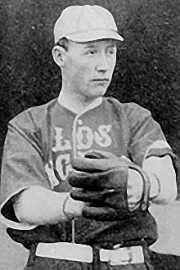
Walker is also credited with coining the nickname for a  redheaded teenage pitcher for the Los Angeles Angels in the Pacific Coast League with an excellent fastball, who would became the first big league player from Arizona.  Lee William “Flame” Delhi only pitched one game for the Chicago White Sox;  the 19-year-old, who had already pitched nearly 700 inning of professional ball (not including two seasons of winter ball), had a dead arm by the time he joined the Sox.

Flame Delhi

Flame Delhi


“Said–Tinker to Evers to Chance”

5 Jul

???????????????????????????????

Franklin Pierce Adams’ famous poem “Baseball’s Sad Lexicon” appeared in The New York Evening Mail in 1910 and immortalized Chicago Cubs shortstop Joe Tinker, second baseman Johnny Evers and first baseman Frank Chance—within three years, the above cartoon appeared in newspapers along with a new, less well-known, poem written by Adams’ colleague at The Evening Mail, James P. Sinnott.

By 1913, baseball fans became aware that Tinker and Evers had barely spoken to each other since 1905, and the rivalry among the three exploded in public.  The former teammates, now all managers, Tinker with the Cincinnati Reds, Evers with the Cubs, and Chance, the recently deposed Cubs manager, with the New York Yankees.

In February Chance told reporters that Tinker was a better player than Evers; Evers responded and accused Tinker of trying to “tamper” with pitcher Larry Cheney and other members of the Cubs, as for Chance he said:

“I do not know whether Chance is jealous of my getting the position of leader, and I do not like to think so, but from the remarks he is making, I am forced to.”

By March, Hugh Fullerton said in The Chicago Examiner that Evers was unable to control his players; he said “Chance could whip any man on (the) team—Evers can’t,” and predicted a fourth place finish for the Cubs (they finished third).  Tinker’s Reds finished seventh in the National League; Chance’s Yankees were seventh in the American.

Sinnott’s poem appeared at the end of September:

“A Manager’s life is tough!

Said Tinker to Evers to Chance—

‘A manager’s road is rough!’

Said Tinker to Evers to Chance—

‘Here are we three, a lookin’ on

The big world’s series game,

In which we once were principals,

In which we gained our fame’

‘A manager’s life is no cinch!’

Said Tinker to Evers to Chance—

I’d almost as soon be Lynch!’

Said Tinker to Evers to Chance.”

“Lynch” was Thomas Lynch, who was about to be replaced as president of the National League.

It would not be until 1924, shortly before Chance’s death that the three reconciled.  Chance had been hired to manage the Chicago White Sox, but became too ill and returned home to California; he was replaced by Evers.

Chance summoned his former teammates to California that spring, where the three spent several days together.  Chance died in September.  Tinker, Evers and Chance, were inducted into the Hall of Fame together in 1946.

Tinker, Evers and Chance

Tinker, Evers and Chance

A Thousand Words “Cool Papa” Bell

3 Jul

cool

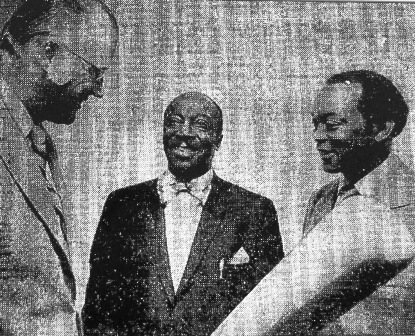
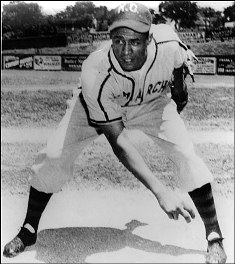
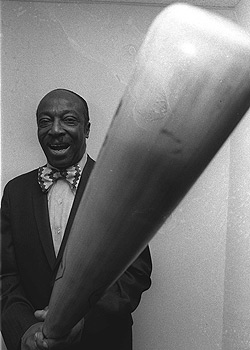
James “Cool Papa” Bell (center) poses with an oversized bat, Commissioner Bowie Kuhn (left) and Monte Irvin, in 1974 after Bell was inducted into the Hall of Fame by the Negro league Committee.  Irvin was inducted the year before.

In 1984 Negro League pitcher Chet Brewer said of Bell’s legendary speed:

Chet Brewer

Chet Brewer

“In Mexico, he was on the same team that I was on.  The first game that he played in, he was on first base and the next hitter hit a ball into right field.  Cool Papa went into third base so fast that they stopped the game and said he cut across behind the pitcher.  The said, ‘it’s impossible, no pasaria, it just couldn’t happen.  Nobody could go from first to third that fast.”

bell cool2

Browning and Delahanty

25 Jun

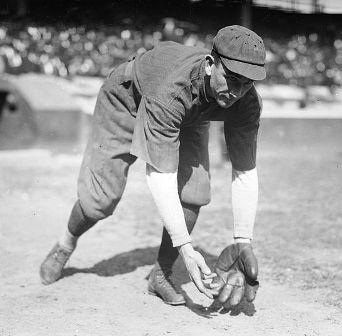
John Anthony “Honest Jack” Boyle played in the American Association, Players League and National League from 1886 to 1898.

Boyle’s career was on the decline by the end of the 1898 season (he had only appeared in six games with the Philadelphia Phillies that year), but was effectively ended in November when he was the victim of a mysterious knife attack in his hometown of Cincinnati.

The Cincinnati Commercial Tribune said Boyle was “attacked from behind by an unknown man, who, before the player could defend himself, plunged a knife into his shoulder.”

A piece of the knife broke off in Boyle’s shoulder and he didn’t play regularly again until 1905 when he appeared in 101 games for the Toledo Mud Hens in the American Association ; he was a player-manager for the Terre Haute Hottentots in the Central League the following season.

Jack Boyle

Jack Boyle

By 1910 Boyle, who was operating a saloon in Cincinnati, told William A. Phelon of The Chicago Tribune that the two best hitters he ever saw were Pete Browning and Ed Delahanty, and provided a window into the minds of two of the biggest stars of the 19th Century:

“(T)here never were two men more radically different in their ideas of and their opinions of the game than these two great sluggers.  They looked at the game from totally different angles, and they regarded their occupation with widely varying views.

“Pete Browning was an artist.  To him baseball was an art or a profession and batting an absorbing passion.

“Delahanty was a workman.  Baseball to him was labor or a trade, and batting simply part of the daily toil.

“When Browning left the field the game wasn’t over.  He continued to talk batting, theorize on batting, figure out new ideas on batting, and I think, dreamed of batting all night long.

Pete Browning

Pete Browning

“When Delahanty left the ballpark the game was all through for the day, exactly as if he was a laborer going home to supper.  He ceased to think baseball.

Ed Delahanty

Ed Delahanty

“If Browning failed to make a hit at the time of need, he would have tears in his eyes and would bitterly bewail his misfortune.  If Delahanty fell down in the pinch, he shrugged his shoulders, hoofed back to the bench and began to talk racing or the weather.

“When an outfielder galloped to the fence and pulled down one of Browning’s mighty drives, Pete would regard it as a personal insult, and glower at the outfielder like a baffled tiger.  When a fielder robbed Del of a home run, Ed would grunt ‘Good catch, boy, didn’t think you’d get it’ and forget it forever.

“If you had told Pete Browning that the business was losing money, and that you would have to cut his salary next season, he would have accepted the money rather than lose the chance to play the game.  If you handed that talk to Delahanty, he would have sneered scornfully and remarked that you’d have to come up with 500 more beans before he’d even look at a contract.

“Neither Pete nor Del cared much where their teams finished on the season.  Pete thought only of hits and the glory of making them.  Del thought of a comfortable winter life on the money he had made in the summertime.”

Boyle said the only thing the two really had in common was an inability to bunt:

“Del wouldn’t simply try.  Pete, with much groaning and protestation, would be coaxed to make the attempt, but his attempts were fizzles.”

Boyle, or Phelon, omitted the other thing the two had in common: serious drinking problems that hurt them on and off the field and contributed to their early deaths.

Boyle died in Cincinnati in 1913.

“Calvo May Come Out But No One Cares”

5 Jun

Jacinto Calvo and San Francisco Seals owner Charlie Graham were unable to come to terms on a contract for 1918, and the local press quickly turned on the outfielder.

The San Francisco Chronicle said:

“(Calvo) is a simple-minded Cuban boy…When he is hitting he can go around the bases in nothing flat.  When he has a batting slump, he develops water on the knee and can hardly limp up to the plate.”

He remained in Cuba and served as a police officer in Havana.

It was rumored again in 1919 that Calvo might return to the Seals, but The Chronicle, under the headline “Calvo May Come Out But No One Cares,” made it clear that twelve months had not softened opinions about the holdout outfielder:

“Calvo has written friends that he wants to come back, but if he stays in that dear old Havana until Charlie Graham coaxes him back, he will grow whiskers a foot long.  Graham really tried to get Calvo last year, for he was in a bad way for lack of outfielders, but if there is any coaxing to be done this year, Calvo will do it.”

Calvo

Calvo

Terms were not reached for 1919, and Calvo remained in Havana for another year.

In February of 1920 The Chronicle said Calvo, “Who bobs up every year about this time,” had written Graham saying he wanted to return to the Seals, then in March the paper reported that “The Havana World” said that Calvo “has joined the Franklin, PA independent team together with (Manuel) Cueto.”

Neither report proved true; instead, Calvo was signed by Clark Griffith for a second tour of duty with the Washington Senators.  In 17 games he had only one hit, a triple, in 23 at-bats before being sent to the Little Rock Travelers in the Southern Association in July.

Calvo could not hit American League pitching, but no one questioned his throwing arm; except teammate Stanley “Bucky” Harris.  The future Hall of Famer wrote in 1925, in a series of articles he wrote for The North American Newspaper Alliance, that his doubts about Calvo’s arm almost cost him his career:

“I thought I could hurl a baseball farther than anyone on the club and entered into a contest with Jack Calvo, an outfielder.  The Cuban has a reputation for having a great arm.  I had won a long-distance throwing contest…while with the Buffalo club.  That convinced me I could hold my own.”

Despite being warned against taking on Calvo by teammate Clyde Milan, Harris went ahead with the contest, the two stood in the infield:

“(Calvo) cut loose.  He threw the ball over the right field bleacher wall.  I realized it was a truly wonderful peg.”

Harris said he was concerned about being caught by manager Clark Griffith and rushed his throw:

“My elbow cracked as the ball left my hand.  It sounded to me as if a board had been broken across a fence…The ball dropped yards inside the park.”

Harris said for three weeks he “wondered if I ever would be able to throw a ball again.”  By the time Harris returned to the lineup, Calvo was on his way to Little Rock where he hit .306.

From 1921 through 1926 Calvo spent his summers playing baseball in the states; most notably in Fort Worth, where he helped lead the Texas league Panthers to two Dixie Series victories over the Southern Association champions in 1923 and ’24.  His winters were spent working as a lieutenant in Havana’s Harbor police and playing baseball in the Cuban League.

Calvo’s career ended abruptly in September of 1926.  The San Antonio Light reported that the former Fort Worth outfielder, then with the Memphis Chickasaws in the Southern Association “must forego baseball…and return to his job, his leave of absence was about to expire, and he packed up and beat it for a boat.”

Calvo played briefly in Cuba that winter but never played professionally again.  He was elected to the Cuban Baseball Hall of Fame in 1948 and died in Miami in 1965.

“The Speed of Rusie”

30 May

Hall of Famer Amos Rusie “The Hoosier Thunderbolt,” was famous for his fastball; it’s been estimated that he threw in the high 90s.  In only nine full seasons he led National League pitchers in strikeouts five times.

Amos Rusie

Amos Rusie

Sports writer William A. Phelon contended that Rusie was the fastest pitcher he had seen, and in 1913 he told a story by James Tilford Jones who played for the Louisville Colonels in 1897, and was still a fairly well-known minor league player.

The likely apocryphal story (Jones only had one at bat as a pinch hitter that season, and did not strike out)  appeared in The Cincinnati Times Star, and according to Phelon, Jones said:

“ Don’t tell me that Walter Johnson, or any other pitcher of the present time, is faster than Rusie, or even that any man has the speed that Rusie used to throw…That man was unique and individual –there was never one like him before his time, and none since.  I don’t think there ever will be.

“My first experience with Rusie happened a long, long time ago, when he was in full swing and I was playing with Louisville, then a member of the big circuit.  I was warming the bench that particular afternoon, and wasn’t specially noticing the work of the other side, when our manager (Fred Clarke) beckoned me.  ‘Joensey’ said he, ‘you go up and bat for the pitcher.  Two on, two down—we just gotta have this game.  Go up there and lay the bat against the leather.’

“’All right sir’ I assented.  I’ll pickle one outside the lot if he puts it over.’  And up I strode, with a fat bat in my hands.  I saw a very large, red-faced man standing out there on the pitching line and I saw him raise his right arm.  I was wondering why on earth he didn’t throw it, when heard something go POW, just like that, behind me.  I looked around.  It was the thud of the ball ramming into the big mitt, and the umpire said, ‘One strike.’

“I watched the big man keenly, and again he raised his arm while I set myself to annihilate the ball.  An instant later I saw a ball going by me, and swung at it.  It was the ball being returned by the catcher, and I thought it was coming up instead of going away.

“By this time I was furious, also desperately determined.  So I set myself almost upon the plate, with the bat jutting out, and watched the big man very closely.  Then something crashed into my bat, ripped it from my hands, and drove it round against the back of my neck—and I knew no more.

“Two or three days later, the situation was exactly the same—Rusie pitching, our pitcher up, and dire need of a pinch hitter.  Again the manager beckoned me. ‘Go up and hit him, Jonesey’ growled he.

“I marched up to the plate, but went up empty-handed— didn’t even pick up my bat—and calmly stood there in the batter’s box, with nothing but my bare hands.  ‘Hey you,’ yelled the manager, ‘where’s your bat.’

“’Don’t need it,’ I shouted back.  ‘I can’t see them anyway, and it is a whole lot safer with nothing in my hands than be up here with a chunk of timber that he might drive clear through my head!’

“Oh, yes, yes.  Rusie had some speed when he wanted to use it, and I never remember seeing him any time when he wasn’t inclined to use it, either.”

Jones only appeared in two games during the 1897 season; in his first game he pitched 6 2/3 innings in relief in a 36-7 loss to the Chicago Colts, giving up 22 runs, 14 earned—the Colts’ 36 runs are still the Major League record.

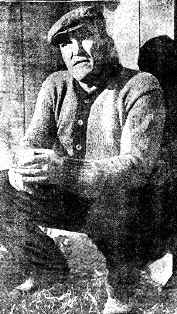
Jimmy Jones

Jimmy Jones

Jones became a full-time outfielder in 1900 and returned to the National league with the New York Giants in 1901; he appeared in 88 games for the 1901-02 Giants, hitting .209 and .237.

He returned to the minor leagues and continued playing until 1914, and finished his career managing the Maysville (KY) Burley Cubs in the Ohio State League in 1916.  He served as Laurel County Clerk for twenty years, and died in London, Kentucky in 1953.

Rusie retired with a 245-174 record, striking out 1,934 and walking 1.704.  He died in 1942 and was elected to the Hall of Fame by the Veterans Committee in 1977.

Memorial Day—Major League Baseball’s First World War Casualty

27 May

By the time he enlisted in the United States Army in July of 1917, Edward Leslie “Harvard Eddie” Grant had retired from baseball to practice law in Boston.

He attended Harvard, but only played baseball as a freshman; he was declared ineligible after being paid for playing with a semi-pro team.  After that Grant played intramural baseball at Harvard and played with Northeastern outlaw teams during the summer.

In 1905 Grant made his Major League debut when the visiting Cleveland Naps recruited him to fill in for two games at second base for Hall of Famer Napoleon Lajoie against the Boston Americans—he was 3 for 8 and made one error.

He was with the Jersey City Skeeters in the Eastern League in 1906, hitting .322, which earned him a contract with the Philadelphia Phillies.  He would spend the next nine seasons in the National League, also playing for the Cincinnati Reds and New York Giants.  Grant was never a star, but he was popular with fans and the press.  The New York Times said:

“He was a handy utility player and could fill in any position on the infield.  While never a heavy batsman, he was skillful fielder and a smart baserunner.”

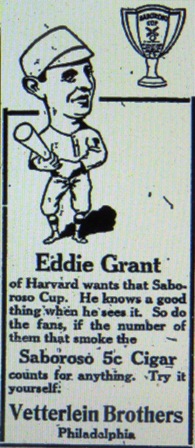
1910 Advertisement for the  Vetterlein Brothers Cigar Company; the Saboroso Cup mentioned in the ad was presented to the phillies or Athletics player with the highest batting average.

1910 Advertisement for the Vetterlein Brothers Cigar Company; the Saboroso Cup mentioned in the ad was presented to the Phillies or Athletics player with the highest batting average.

Grant was among the first wave of prominent athletes to join the military, making his enlistment news.  A wire service article under the headline “Eddie Grant Joins Uncle Sam’s League” appeared in numerous papers across the country.

On October 5 1918, he would become the first Major League player to be killed during World War I, The Associated Press said:

“Captain Edward Grant, former third baseman of the New York National League Club, and attached to the 307th Infantry, was killed by a shell when leading a unit to the aid of the famous ‘Lost Battalion.’

“The battalion was surrounded for five days in the Argonne Forest and Captain Grant was killed in one of the attempts to reach it.”

Grant was originally buried in the Argonne Forest, and his body was later moved to the Meuse-Argonne American Cemetery.