Tag Archives: Harry Wright

“It may well be Doubted whether Beals should be Permitted to play Second Base again”

23 Jul

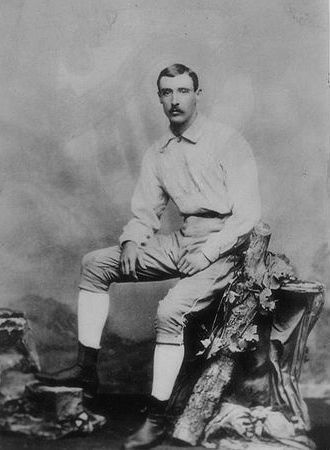
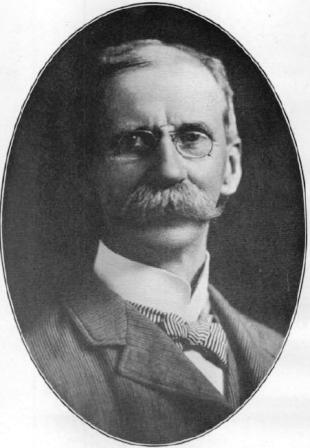
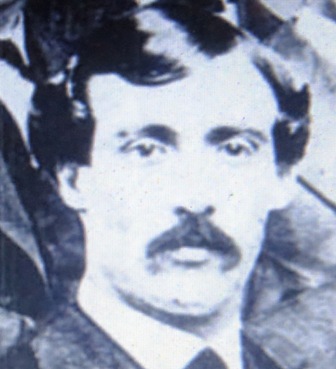
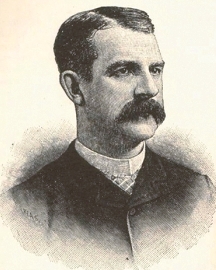
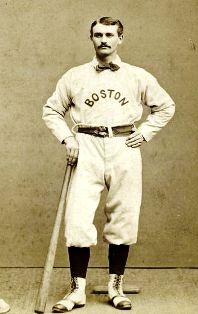
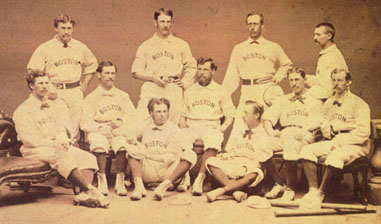
Thomas Lamb “Tommy” Beals had a complicated relationship with Harry and George Wright.

George named his son, the Hall of Fame tennis player, Beals Wright after his friend and former teammate.  But, The Chicago Tribune said when the two played together, “George Wright and Tommy Beals went many a day without a friendly word,” a charge Wright denied.

After signing a contract to play second base for Harry Wright’s Red Stockings for 1876—the first season of the National League—Beals decided instead to jump the contact and go to Colorado where he worked as a miner.
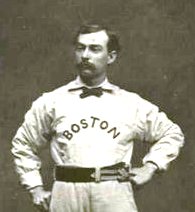
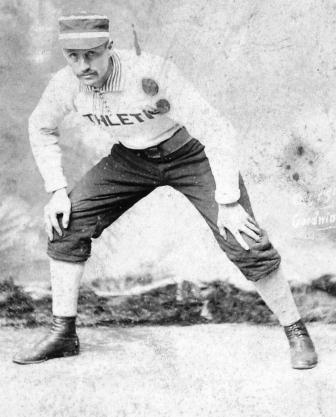
Tommy Beals

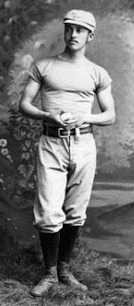
Tommy Beals

He eventually left Colorado and went to the West Coast where he played a handful of games in 1879 for the San Francisco Mutuals and Oakland Pioneers in the California League.  In the spring of 1880 he signed a contract with the Chicago White Stockings.

Harry Wright protested the signing of his former player, or as The Tribune said:

“Some parties in Boston have been making a wholly unnecessary fuss over the engagement of Beals by the Chicago Club, claiming that after engaging to play with the Bostons in 1876 he refused to report for duty.”

The Tribune noted that the contract was actually signed before the league was officially founded on February 2, 1876, but:

“The Boston people argue that, although the League was not in existence at the time Beals retired from baseball, it was agreed, upon its formation, that that all contracts existing between clubs and players should be recognized.”

The newspapers in Wright’s former hometown of Cincinnati weighed in.  The Commercial Gazette encouraged the Boston protest and said Wright should make it “a test case (and) prevent the Chicago Club from playing him during the coming season.”  The Cincinnati Enquirer took the opportunity to accuse Wright of protesting activities he was himself regularly guilty of engaging in:

“The disposition shown by the Boston Club management to create an unpleasantness in the matter of the engagement of Tommy Beals by the Chicago Club, upon the ground that Beals was under some sort of engagement with Boston four or five years ago, has had the effect of recalling some reminiscences calculated to show that the pharisaical kickers of the Hub are in no position to give us the ‘holier than thou’ racket.  In the first place Boston has slept upon its rights, if it ever had any, in the Beals case so long that the matter is outlawed long since, and ought never be raked up at this late day, especially in view of the fact that Chicago acted in good faith and without any suspicion of a cloud upon its title to the services of Beals.

“In the next place Boston had better be repenting for some of its own sins before assuming the role of exhorter towards other folks.  That club has now under contract three players whose engagements will not bear the closest kind of scrutiny.  In 1877 the Boston Club, in the middle of the season, committed an act of piracy on the Lowell Club of which it ought to be ashamed, by jerking (John) Morrill and (Lew) Brown out of the Lowell nine in regular highwayman fashion, both these players being then under contract for the entire season in Lowell…we (also) find that (Jack) Burdock was under contract to Chicago in 1875 and never showed up.  He might have been expelled by Chicago, but was not, and continues an honored and valued member of the Boston outfit.  In 1876, again Thomas Bond was suspended from play and pay by the Hartford Club, of which he was then a member, and in spite of this cloud upon his name and fame, was engaged the following year by Boston, and has been there ever since.”

Morrill, Burdock and Bond were all still members of the Red Stockings, comprising three-fourths of the team’s infield.

The Enquirer also criticized Boston because the team acted to “choke off” an attempt by Hartford Manager Bob Ferguson to bring the allegations which led to Bond’s suspension to light during a league meeting—Bond, during a season-long feud with Ferguson had accused his manager, among other things, of “selling” games.  Bond was suspended by Ferguson on August 21 of 1876 despite posting a 31-13 record for the second place Dark Blues—Bond’s replacement as Hartford’s primary pitcher was Candy Cummings.

Tommy Bond

Tommy Bond

The Enquirer took a final shot at Wright noting that when the league instituted the new rule for 1879 which barred non-playing managers from the bench “Boston squealed because Harry Wright couldn’t enjoy privileges  denied to everybody else, and this year they are playing baby about Beals on grounds equally absurd.”

The Tribune laid out Chicago’s long list of grievances for “plenty of ‘queer’ work in which Boston has been engaged.”  In addition to the incidents mentioned by The Enquirer, The Tribune said in 1877 after Albert Spalding had secured infielder Ezra Sutton for Chicago, “Sutton was worked upon by Boston and went there to play.”

So, according to Boston’s critics the club’s entire 1880 infield had come to the team via questionable circumstances.

The Boston Herald responded:

“It is not to be expected that the Chicago Club will recognize the position of the Boston Club in this matter, and release Beals.  That organization has on more than one occasion, shown its utter contempt for League rules, or in fact, for anything that interferes with its own particular self, and, to expect justice in this case, is not to be thought of.  In the meanwhile, the Boston Club will probably not take any official action in the premises, but let the Chicago Club enjoy all the honor (?) there is in playing such a man.”

After the weeks of allegations, posturing and name-calling in the press, the season began on May 1; Boston never lodged a formal complaint about the signing of Beals.

Chicago cruised to the National League title, spending only one day (after the season’s second game) out of first place.  Beals, rusty from his layoff made little impact for the champions, hitting just .152 in 13 games at second base and in the outfield.  By August, with the fight to defend his signing long forgotten, The Tribune said after a rare Beals start in a 7 to 4 loss to the Worcester Ruby Legs:

“Beals played as though he had never seen a ball-field before…It may well be doubted whether Beals should be permitted to play second base again…any amateur who could be picked at random would be likely to do better both in fielding and batting.  Worcester would have made two or three less runs yesterday if second base had been left vacant altogether, as what time Beals didn’t muff grounders he threw wild and advanced men to bases they would not otherwise have reached.”

Beals was 0 for 3 with three errors that afternoon—for the season he committed 4 errors in thirteen total chances at second for a fielding percentage of .692.

Let go by Chicago at the end of the season, Beals’ professional baseball career was over and he returned to the west.  In 1894 he was elected to one two-year term in the Nevada State Legislature as a Republican representing a district that included the town of Virginia City.  By 1900 he was back in Northern, California, where little is known about his activities.  He died in Colma, California in 1915
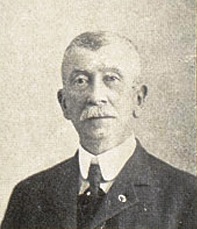
Frank Bancroft

14 Jul

When Frank Carter Bancroft died in 1921 at age 74, “Spalding’s Official Baseball Guide” said:

“His executive ability and Knowledge of Base Ball, combined with the fact that he was for sport first and the show element of Base Ball secondarily, rendered him one of the most competent of men to handle the affairs of a professional team.”

Frank Bancroft

Frank Bancroft

While working in the front office of the Reds in 1892, Bancroft talked with Harry Weldon, sports editor of The Cincinnati Enquirer about some of the players who got their start with his teams.  He also didn’t seem to mind taking a swipe at a couple former players:

“Probably no man now before the public except Harry Wright or Adrian C. Anson have had a longer or more varied experience with the intricacies of the great National Game than Frank C. Bancroft.  He never wore the spangles, like a great many other managers, but he has been connected with the game in a managerial capacity since the early seventies.  ‘Bannie’ is one of the wittiest men in the profession and he has a fund of anecdotes about players and plays that are well worth hearing.  Many of the great baseball stars now before the public made their debut under Mr. Bancroft’s management.  Many of them who are now drawing $4,000 or $5,000 a season worked under Bannie for about one-tenth that amount and were glad to get it.  Bancroft was one of the leading lights in the original New England League, which graduated a great many of the stars of today.

“At the present time Mr. Bancroft is business manager of the Cincinnati Reds.  He has nothing whatever to do with the players. All of that part of the club’s affairs being under the supervision of Captain (Charlie) Comiskey.  All Bannie has to do is look after the gate, railroad rates and dates.  The other evening the veteran manager was in The Enquirer office and grew reminiscent.  His recital of the details of the debut of some of the stars is worth reproducing.

Harry Stovey, one of the greatest ballplayers today, began his professional career under Manager Bancroft.  He began his career in the pitcher’s box and graduated out of the ranks of a Philadelphia amateur team called the Defiance in 1877 (the Philadelphia Defiance were a professional team, part of the league Alliance).  Manager Bancroft heard of him, and in 1878 engaged him as a change pitcher for the New Bedfords.  G. Washington ‘Grin’ Bradley was the regular pitcher of the team, and as he was an every-day pitcher Stovey was never allowed an opportunity of displaying his pitching abilities on the New Bedford team.  He had to be content with warming the bench until fate was kind and he had a chance.

Stovey

Harry Stovey

“‘Stovey played his first game with our team at Baltimore,’ said Mr. Bancroft.  ‘we were making an exhibition tour when John Piggot, the first baseman, was taken ill, and as we only carried ten men, Stovey was called on to make an attempt to play first base.  His maiden effort was a brilliant one—so brilliant that it lost Piggott his job and made Stovey a fixture on first.  He had at least twenty putouts, no errors and several cracking hits to his credit that day.  He played the season with us, and his fame spread so that he was signed by the Worcester (Ruby Legs) League team and afterward with the Athletics Stovey’s salary the first season in New Bedford for $50 a month.  Now he is paid nearly that much a game.’

George Gore, the crack center-fieder of the New Yorks is another player who came into prominence with the New Bedfords that year.  Gore’s home was in Maine, at a little town called Saccarappa…Gore was about as green a specimen as ever stepped into the business.  He played a few games with the Fall Rivers, and then the New Bedfords got him.  He was a big, awkward country boy then, but he could run like a deer and hit the ball like a trip hammer.  Gore signed with the New Bedfords under Manager Bancroft for $50 a month, but he did not stay with them long.  His terrific batting attracted the attention of the whole baseball world, and soon the more prominent clubs were after him.  While the Chicagos were in Boston the late lamented (William) Hulbert, President of the National League, who was with them, ran up to New Bedford to have a talk with Gore.  Luck was with big George.  He had his eye with him, and made three home runs in the game.  That feat settled his fate.  Before Hulbert left New Bedford he had Gore’s name to a contract to play in Chicago in 1879 at $150 a month.  His career since that time is well known.  Today he is yet a great hitter, and reached first base as frequently as any player in the business, by either hits, errors or bases on balls.  His ability to reach first causes him to be selected to head the battery list of the New Yorks.

Arthur Irwin is another player whom Manager Bancroft put in the business. ‘He made a grand impression in his opening game with me,” said Manager Bancroft.  ‘I was then manager of the Worcester League team, and we were on the hog train for a while, owing to Charlie Bennett’s glass arm and Buck (William “Farmer”) Weaver’s faint heart.  Matters were so bad that a crisis was at hand.  A meeting of the stockholders of the club was called, and it was voted to place the team in my hands for one month, and if no improvement was shown at the end of that time I was to be given the chase.  It was a dying chance for me, and you could gamble that I had my eyes and ears open for a savior of some kind.  Arthur Irwin was then playing with an amateur team called the Aetnas, of South Boston, and I engaged him to play short with the Worcester.  (J. Lee) Richmond, the once famous left-handed pitcher, who played here with the Reds in 1886, was then with the Brown University team and he was telegraphed to come for a trial.  We played the Chicagos that day, and we shut them out, only one man getting first base.  Irwin made a great hit at short, and Richmond was a wizard.  Irwin was a fifty-dollar-a-month man, and that was the start of his professional career.  Richmond is now a physician at Geneva, Ohio.’”

The game Bancroft referred to was an exhibition between Worcester (a member of the National Association) and the National League’s Chicago White Stockings played on June 2 in Worcester. Richmond walked the first batter, Abner Dalrymple, and then retired the next twenty-one before the game was called after seven innings.  The Chicago Tribune said Richmond struck out 8.  Worcester tagged Frank Hankinson for 12 hits and 11 runs (Chicago also committed 11 errors).  Bancroft was correct that Richmond became a physician, but by 1892, he was no longer practicing and was working as a teacher in Toledo, Ohio.

J. Lee Richmond

J. Lee Richmond

“Big Roger Connor of last season’s New Yorks, but now of Philadelphia, received his professional introduction under Manager Bancroft.  ‘It sounds queer to say that such a cracking hitter as Roger Connor was ever released for poor batting, but such was the case’ said Manager Bancroft

“’I had him with the New Bedfords in 1878, but he was hitting so poorly that I released him.  He afterward signed with the New Havens the same season, but the disbanded.  Roger left New Haven and went to Waterbury, his home, where he joined an amateur team in that city called the Monitors.  Up to that time he had batted right-handed, but he decided to turn around and try it left-handed.  The change saved his life.  He blossomed out as a great slugger, and his reputation has been growing ever since.

“Connor, like Stovey, began his professional career at $50 a month, and has since climbed to the top rung of high salaried players.  Many young players of today should look upon these as examples for honest and temperate habits have enabled them to remain at the head of the profession, while the path is strewn with a multitude of others who might have been where they are if they had not thought this world was a continuous round of gaiety and fun and discovered their mistake when it was too late.”


“My Forte is Base-Ball, and not Speaking”

28 May

The Red Stockings arrived in Wheeling, West Virginia on June 29, 1869; the final stop on their 21-game tour, which began in Mansfield, Ohio on June 1.  They had won the previous 20 games on the trip and The Cincinnati Enquirer said:

“The only real sensation which our city has enjoyed of late has been that created by our victorious Red Stockings on their Eastern tour.”

The Wheeling Intelligencer said of their arrival:

“These celebrated base ballists reached our city last evening, over the Baltimore and Ohio Railroad.  They were met at Benwood by a committee of reception, on behalf of the Baltics…Quite a crowd gathered at the depot to greet them, and when the train reached here (Wheeling) they entered a special omnibus and were driven at once to the McClure House.  After brushing off the dust of travel and refreshing the inner man, they were taken in charge by the committee and spent the remainder of the evening in sightseeing.  They are courteous in their manners and jubilant at the prospect that the arduous labors of the month’s campaign are so nearly ended.  A more splendid tour has never been made by any club.  They (will) return to the Queen City with a record of unexampled brilliancy.”

The paper said admission to the game at the Wheeling Fair Grounds was 25 cents for adults and fifteen cents for children, and told their readers:

“We would advise all who wish to witness the finest playing ever seen in this region, to be present.”

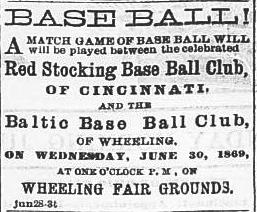
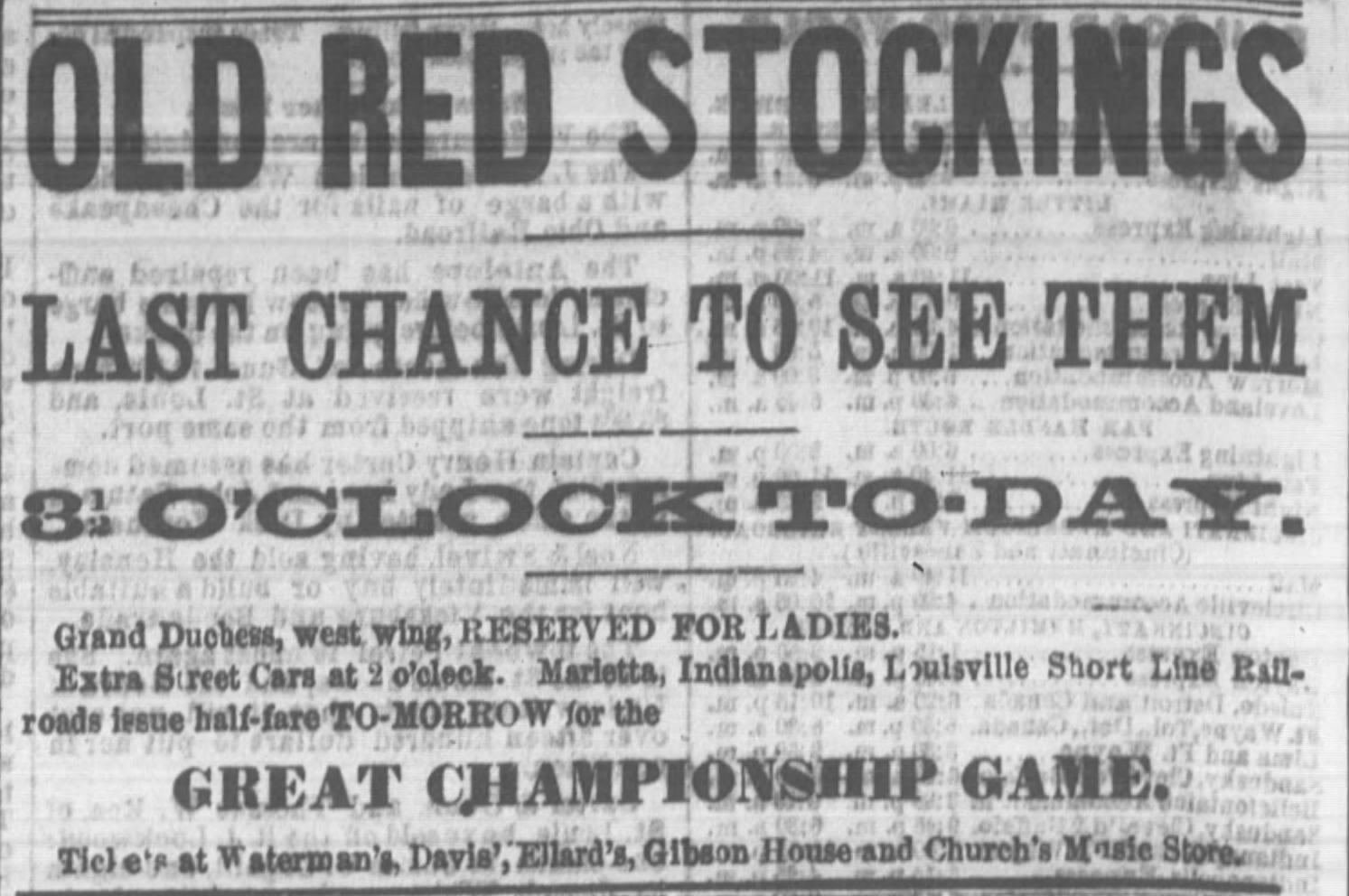
Advertisement for the Wheeling game.

Advertisement for the Wheeling game.

The game was played the following day (some sources incorrectly list the date of the game as July 1).  The Intelligencer said:

 “At one o’clock yesterday afternoon, the long anticipated game of baseball between the Red Stockings, of Cincinnati, and the Baltics, of our city, was opened.

“The Red Stockings were first at the bat and succeeded in making almost a score of runs (the Red Stockings scored 11).  The Baltics came to the bat and were whitewashed.  The same ill luck happened them during the three innings played (4 ½ innings were played).  At four o’clock the game closed—the Red Stockings being compelled to leave at that hour so as to make an evening train to Cincinnati…They went off in the best possible spirits—feeling conscious that they were the champion base ballists in the country.  In their recent tour they did not sustain a single defeat. “The game yesterday was witnessed by about fifteen hundred persons , among them a large number of ladies, and although the Red Stockings almost annihilated one of our home clubs, the fine playing of the strangers elicited the heartiest and warmest applause.  As the play progressed the excitement amounted almost to enthusiasm.  Good order was preserved throughout the game. “We neglected to mention in the proper place that the score stood at the close: Red Stockings, 52; Baltics, 0. Time occupied, three hours.”

While the Wheeling paper didn’t mention rain, The Cincinnati Enquirer said rain caused the early ending:

“The Cincinnatis went to bat for the fifth inning and scored eight runs, making the total score of fifty-two.  It now commenced to rain and game was called, the Baltics not being given the opportunity to be white-washed gain.”

The official score was 44-0, and the Red Stockings had completed a 21-0 month-long road trip on their way to a perfect 65-0 record. The Enquirer said of their return:

“Our victorious Red Stockings, the first nine of which met and conquered all the first-class base-ball clubs of the country, after a tour of one month, arrived at home at ten o’clock yesterday morning via the Little Miami Railroad.  The day when our boys should arrive home, has during the past week been eagerly looked for, and arrangements to give them a hearty welcome were completed.”

Four thousand people turned for the return:

“The train arrived at the depot promptly on time, when the boys, amid the enthusiastic cheers of the spectators, were escorted to carriages provided for the occasion and taken over the line of march prescribed to the Gibson House.  At the head of the procession was the Zouave band in an open transfer wagon, gaily decorated with flags and banners.”

After the team arrived at the Gibson House, they appeared on a hotel balcony:

“Loud calls were made for Mr. (Aaron Burt) Champion, President of the club, (Harry) Wright, (Charlie) Gould and (Doug) Allison, and, in fact, every member of the nine.”

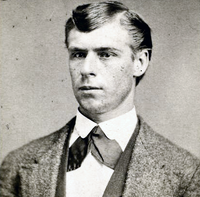
Doug Allison

Doug Allison

After the team members were “shown to private apartments where they had an opportunity of resting.”  Later, they appeared again:

“(T)he nine dressed in their neat white uniforms, with the well-known red stockings, were seated in carriages and driven to the Union Grounds where fully 3,000 people persons has assembled to again welcome them and witness the game with a picked nine.”

Before the game the team was presented with a 27 ½ foot long ash baseball bat “lettered with the names of the First Nine and the two substitutes.” The Red Stockings beat the local picked nine 53-11. A banquet was held in the team’s honor that evening.  The Cincinnati Commercial said it was a “glorious reception…An extra pig was killed in honor of the ‘boys.’”  The Enquirer said the crowd called on the Harry Wright to make a speech:

“Loud calls were made for Harry Wright, Captain on the Nine.  He arose and rather bashfully asked to be excused from making a speech; it was something that he was not in the habit of doing, but he would do all in his power to aid in keeping the reputation of the nine.”

One-by-one each player on the team refused to give a speech for the crowd.  Wright’s brother George said “Gentlemen, you must excuse me, as nobody else is making speeches.  My forte is base-ball, and not speaking, therefore I’ll stop short.”

George Wright

George Wright

The closest thing to a speech came from one of the team’s two reserves, James Fowler.  Fowler rarely played, and appeared in only one game during the tour—Allison was hit over the left eye by a foul ball during the June 24 game with the Maryland Club of Baltimore, George Wright moved behind the plate and Fowler played the final three innings at short.  Fowler, primarily acted as the team’s scorekeeper, does not appear in the team photo and is usually not listed on the team roster. Fowler told the crowd:

“Mr. Champion says that I slept through all these matches; if I didn’t play I talked, and helped in that way.  I am happy to be a member of the Cincinnati Nine—or rather Eleven.”

The Red Stockings "Eleven" minus James Fowler

The Red Stockings “Eleven” minus James Fowler

While none of the players were willing to give a speech, the crowd, and local dignitaries, made a series of toasts to the team.  The Enquirer said:

“At a late hour our reporter left the scene of conviviality, at which time the company were enjoying themselves in the happiest manner, and doing all in their power to manifest their appreciation of the victorious ‘Red Stockings.’  So ended the grand ovation—the most complete, in every respect, ever extended to any similar organization in the country.”

Despite the late night and “conviviality,” the Red Stockings beat the Olympics of Washington twice that week, 25 to 14 and 32 to ten.

“Such Men are Demoralizing Agents in any Team”

19 Dec

Henry Chadwick is called by many “The Father of Baseball.”  Is Hall of Fame plaque calls him “Baseball’s preeminent pioneer.”  Chadwick is credited with creating the box score and writing baseball’s first rule book.  He was also a sportswriter for more than 50 years.  In 1880 he wrote an article for The New York Clipper about what qualities teams should looks for in the players they sign.  O.P. Caylor of The Cincinnati Enquirer said Chadwick “Never wrote more truth in so little space:”

“In the first place, what a manager must avoid is the engagement of players is the habit of indulging in intoxicating liquors.  Such men are demoralizing agents in any team in which they allowed to play, as the experience of 1879, especially in the League arena, fully proved.  Not only is a drunken professional his own enemy, but his presence in a team is also necessarily destructive of its morals.  In fact, temperate habits among professional ball players are more essential to success than is any special skill they may possess in playing their several positions; for a poor player who is a temperate man and earnest in his work is more serviceable than any man who is a fine player can be who is under the influence of drinking habits.

“Secondly, quick-tempered, passionate men are unfit to be in a nine made up to play for the side.  Hot temper is not only opposed to clear judgment, but it entirely prevents a man under its influence from playing for the side.  Such men, when they ‘get their mad up’ at anything, do not hesitate a moment to indulge their spite at a brother player at the cost of even the loss of the match.

Henry Chadwick

Henry Chadwick

“Thirdly, in making up a team for carrying out this policy, you must avoid putting players in it who have any ambitious views for preferment, such as a desire to be made captain of the nine or manager of the team.  It is impossible for such men to play for the side.  They are so busy in organizing cliques against the powers that be, and in maneuvering for the desired place, that they think of little else, and they play the game only with this one object in view.  This has always been a cause of difficulty in teams in which there are two or more ex-captains or ex-managers.  The player who has once tasted the fruit of authority is rarely amenable to control when occupying a subordinate position unless it be under some ruler whom he knows to be his superior as a captain or manager.  Ex-captains or ex-managers might serve under Harry Wright, for instance, but they would be restive under the rule of a less experienced and capable man.

“Fourthly, players who have an “itching palm’ should be avoided in the make-up of a team selected for carrying out the policy of playing for the side.  Men of this class are always (on the alert) for opportunities to do a little outside business in a quiet way which will help to increase their pecuniary receipts of the season.

“Fifthly, the longer players are kept in the service of one club the more they may be relied upon to play for the side, as a general rule; and it is not an unfair conclusion to arrive at that that player who is ready to leave the service of a good club at the temptation of the offer of a couple of hundred dollars a year more salary, is a man whose heart is not in his work sufficiently to make him a good player for his side.  In fact, this club feeling—that is, a feeling of special interest in the success of his club outside of any interested motive of a more personal nature—is one of the foundation stones of the policy of playing for the side.  Players who possess none of this kind of feeling are of that class who are ready to exclaim ‘I don’t care a snap for the club; I go in to play my best for my record, and if this helps to win games, well and good; but you bet I ain’t a-going to spoil my average just to win a match for no club in the league.  That’s the kind of a player I am, and don’t you forget it.’”

Harry Wright Returns to Cincinnati

17 Dec

In 1871, Harry Wright took several of his Red Stockings players, as well as the team name, moved to Boston and joined the newly formed National Association.  Wright’s exit from Cincinnati was contentious, but despite that he was invited back for an exhibition game in July between his former team and a “picked nine” consisting of the members of Wright’s current team and the Washington Olympics.

Advertisement for the July 3, 1871 game

Advertisement for the July 3, 1871, game

The Cincinnati Enquirer said the two thousand people in attendance indicated “that the interest in base-ball is not dead in this city, but only needs the stimulus of first-class games to awaken it to renewed life.”

The paper said:

“The old Reds did not have the services of George Wright (who was injured), and did not play with the skill characteristic of them in 1868-’69, which may have been due to fact that there was nothing at stake than gate money.”

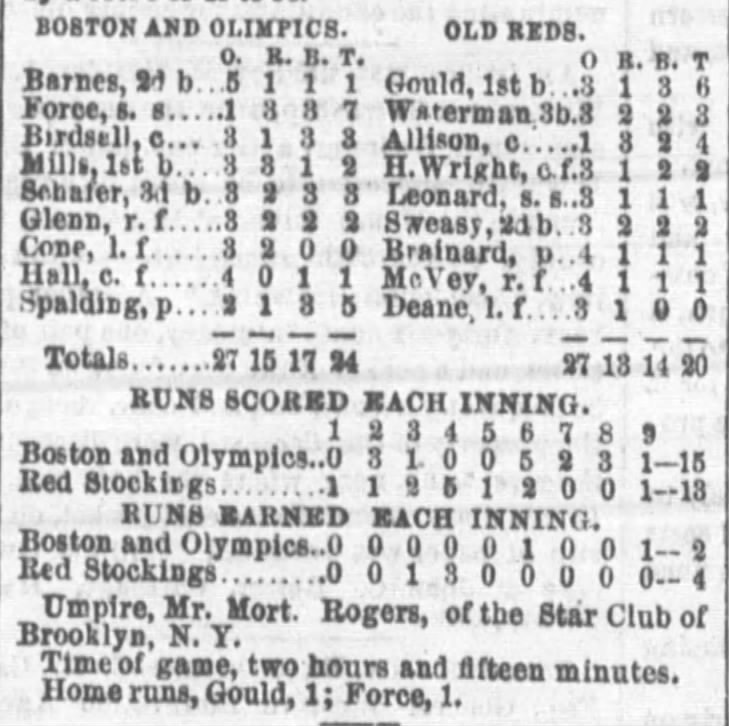
Albert Spalding pitched for the “picked nine” and beat Wright’s club, with Asa Brainard pitching, 15-13. The Enquirer said former Cincinnati players Cal McVey and Charlie Gould, who both joined Wright in Boston, “have improved in their batting powers.”

Wright’s team led 10 to 4 through five innings, but the opponents posted a five-run sixth which included a home run by Davy Force and added two in the seventh and three in the eighth.

The box score

The box score

One sign that all might not have yet been forgiven in Cincinnati:  while Harry Wright was listed in the box score and the inning-by-inning recap of the game, The Enquirer didn’t use his full name in any of the game advertisements or articles.

Professional baseball returned to Cincinnati in 1876 when the reds became an inaugural member of the National league.

” I had Lamed my Shoulder with Cricket Playing”

5 Dec

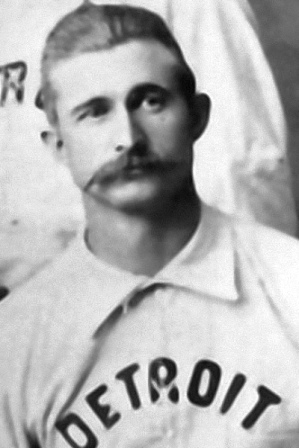
Hall of Fame outfielder Sam Thompson was known for his excellent arm.  After four seasons with the Detroit Wolverines, he was sold to the Philadelphia Quakers in October of 1888. Several months after the sale it was revealed that he had a bad shoulder.

Sam Thompson

Sam Thompson

The speculation about how the injury might affect Thompson led The Cincinnati Enquirer to talk to “the old man of base-ball” Harry Wright about the art of throwing:

“Thompson’s trouble was entirely in the shoulder.  His arm muscles or elbow joint never bothered him.  He can, if he chooses, learn to throw without using his shoulder quite so severely as is natural for him.  The correct way to throw is to start the ball at the height of the ear, but after a man has had trouble with any of his throwing muscles he can often change his style of throwing with benefit.  Take Jack Rowe for an example.  He cannot throw naturally, and yet he plays a very good shortstop by snapping the ball with a peculiar wrist motion.  (John) Meister throws in a similar fashion.

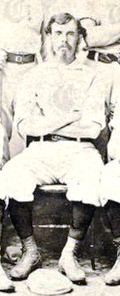
Harry Wright

Harry Wright


“When I first tried to play baseball I could not throw twenty yards, and yet I could bowl very effectively.  I had lamed my shoulder with cricket playing.  I knew that I must learn to throw if I wanted to play baseball, so I put in a whole winter of practicing.  I was then living in Hoboken, and every day I would go down to the river and throw stones for an hour or so.  I had to snap my arm and wrist something as Rowe does, and at first, I could not tell where the stone was going to land.  I would throw an old bottle or piece of wood out into the stream and practice at that.  Before spring, I could hit the mark nearly every time, and could throw a ball seventy yards without difficulty.”

“Chicago has been Successful in her Efforts to Wrest the Base Ball Supremacy from Cincinnati”

26 Aug

In 1916 Jimmy Wood recounted his greatest triumph, his Chicago White Stockings’ two victories over the Cincinnati Red Stockings.

“When we went to Cincinnati for that first game even our most loyal rooters were pessimistic.  It was not that they lacked confidence in our ability, but because they feared we would be ‘jobbed’ by some Cincinnati umpire, or menaced so by the rowdy crowds that we wouldn’t play our real game because of fear of violence if we should win.”

Most of the doubts in Chicago had disappeared.  Even The Chicago Tribune, which pronounced the team a failure before Wood and Tom Foley had completed putting it together and remained critical through their early struggles, allowed that the game was “liable to be a close one.”

The White Stockings would benefit from the injury to Red Stockings shortstop George Wright; and contrary to Wood’s recollection, they also benefitted from the selection of the umpire.

Wood’s 1916 account told a far-fetched story of the selection of the game’s umpire:

“Just before the game we made an announcement to the stands that we wanted some spectators to umpire the game for us—and that Cincinnati and Chicago residents were barred.  From out of the stands, after a long delay, stepped a salesman, named Milligan, from Philadelphia.  He convinced us quickly that he was thoroughly conversant with the game, and he was named an umpire.”

William Milligan might have been a salesman, but he was also a former member of the West Philadelphia Club amateur baseball team with whom Chicago outfielder Ned Cuthbert played briefly in 1867.  The Cincinnati press also discovered that he had traveled to Cincinnati with the White Stockings and stayed with them at the Gibson House Hotel.

The Cincinnati Gazette said of Milligan:

“The umpire was doubtless a very nice sort of man, but he knew precious little of base ball.  His decisions were given in a weak and faltering voice and after much hesitation, and we hardly think Captain Harry Wright could have made a worse selection.”

Wood cast the umpire in a much different light:

“Milligan was of an heroic mold.  He umpired that game fairly and squarely as he saw it.  He played no favorites.”

The Gazette also noted George Wright’s absence as “a serious drawback upon the nine, and they do not now play with the vim and energy usual to them when the King is present at short field.”  Despite that, the paper did give some credit to Wood’s club:

“The Chicago nine could not have been in better condition for a grand trial of skill with the famous Cincinnatis than they were yesterday.”

George Wright, Red Stockings shortstop missed the first game

George Wright, Red Stockings shortstop missed the first game

The White Stockings won the game 10-6 leaving; The Gazette said the “The base ball public of Cincinnati will feel deeply humiliated,” by the loss.

The New York Times said as a result of the victory Chicago was experiencing “the warmest expressions of delight, the more so, as no one anticipated it.”

The Chicago Tribune’s headline and sub headline were less subdued:

WHITE ABOVE THE RED

 The Redoubtable Red Stockings Defeated by Chicago’s $18,000 Nine. When the Garden City Sets Out to Do a Thing, She Does it. It Took Money      to Accomplish the Business, but it is Done.

Jimmy Wood

Jimmy Wood

Wood said in his questionable 1916 account that after the victory his team barely escaped the fans:

“Immediately after the game was over the crowd swarmed upon the field, intent upon wreaking vengeance upon us.  I had anticipated this move and instructed my players for a quick get-away.  When the last out was made we dashed for the exits and jumped into our carriages.  As we ran across the field many of us were struck with stones and bottles.”

After the White Stockings made their escape—allegedly with umpire Milligan joining them for the return trip—back to Chicago where Wood said “we were given a greeting unlike any ever accorded ball players before.”

The following month the rematch was played at Chicago’s Dexter Park.

Wood claimed in 1916:

“Before the game began, 27,000 admissions at $1 each had been sold, with another 25,000 in a wild scramble for tickets…The paid admission for the game was 27,000; the ‘free admissions’ went well beyond 25,000, making a 52,000 crowd within the park when the call ‘play ball’ sounded.”

According to every contemporary report of the game the attendance was around 15,000 (The Chicago Tribune said it was 18,000), still an incredible crowd for 1870, but far less than Wood’s memory.  The Cincinnati Commercial also observed that “Not more than 500 ladies were present.”

For this game the mutually agreed upon umpire was Brooklyn Atlantics catcher Bob (the other“Death to Flying Things”) Ferguson.

Umpire Bob Ferguson

Umpire Bob Ferguson

In recounting the game in 1916, once again Wood’s recollections were far from accurate, but reporter and “baseball historian” Frank G. Menke did nothing to verify Wood’s memories:

“Things broke badly for us in the early innings.  An error or two on the part of my boys, mixed with several long hits by the Red Stockings, gave them a lead of five runs.  Later on they increased it and when the seventh inning was ended the score stood 11 to 2 in favor of the Cincinnati club.”

Actually, Chicago scored one run in the first inning, Cincinnati tied it in the third, the red Stockings scored four in the sixth and the White Stockings added one in the seventh; making the score 5 to 2 at the end of seven.  The White Stockings scored 14 runs in the last two innings and won 16 to 13.

The Chicago Republican said:

“From first to last the game was one of the finest ever seen in the country…Up to the end of the fifth inning not a point was lost on either side, and even then the increase in the scores was rather the effect of an increase in the strength of the batting than the result of errors.”

The Chicago Tribune said:

“It has been done again; this time in a manner which leaves no doubt as to whether Chicago has been successful in her efforts to wrest the base ball supremacy from Cincinnati.”

Of course the newspapers in the two towns viewed the performance of the umpire differently.

Chicago’s take, from The Republican:

“Of the umpire, Mr. Ferguson, too much cannot be said in praise…he presented one of the best specimens of an umpire ever seen.  It is sufficient, perhaps, to say, that neither side questioned one of his decisions.”

And Cincinnati’s from The Gazette:

“The umpire was against us, the weather was against us, the crowd was against us, the heavens were against us, the ground was against us, the pestilential air of the Chicago River was against us, the Chicago nine were against us, and last, but not least, the score was against us.”

However, The Cincinnati Commercial did praise Ferguson, saying he “umpired the game superbly.”

Wood and Tom Foley had achieved their goal in organizing the White Stockings; they had defeated Harry Wright’s Red Stockings.  They were named “champions” of the National Association of Base Ball Players that year (in a disputed decision—and a story for another day).

After his baseball career ended in 1875 Wood went into various business ventures in Chicago.  In 1891 he bought a tavern on Dearborn Street with another famous Chicago ballplayer, New Williamson—the two remained partners in the business until Williamson’s death in 1894.  Wood eventually settled in New Orleans, he died while on a trip to San Francisco in 1927.

Foley, remained well-known in Chicago for his connection with baseball, but became even better known for his role in popularizing billiards.  The Associated Press called him “the father of base ball and billiards in the west,” in his 1926 obituary, and said Foley was:

“Promoter of the first amateur billiard tournament in the country, Foley made a significant contribution to the game when he was a prominent member of the committee which in 1882 formulated the balk line form of play.  He was himself an expert cueist and held the Illinois championship for two years.”

Tom Foley "King of base ball and billiards in the west"

Tom Foley “King of base ball and billiards in the west”

More more bit of billiard trivia about Foley.  In 1897 The New York Times reported that he had opened the first “Billiard parlor for women,: when he created a “ladies annex” to his new pool hall in Chicago:

“Foley has a friend who likes billiards and also likes his wife, but refuses to buy a billiard table for his better half.  He told Foley about it the other day, and Foley after a little thought determined to test the scheme which he now announces.”

No Such Thing as “Off the Record”–Even in 1875

19 Aug

James Leon “Jimmy” Wood was a baseball pioneer.  The second baseman began his playing career as a 17-year-old in Brooklyn with the Eckfords in 1860.  After spending a decade as one of the best-known players on the East Coast Wood went to Chicago where he became the first manager of the newly formed White Stockings.

Wood is sometimes credited with being the man who invented spring training (a claim first advanced by Al Spink of The Sporting News) because in 1870 he took the Chicago team to New Orleans for a series of games with local teams, the Robert E. Lee’s, the Lone Stars, the Pelicans and the Southerns—most of those sources fail to mention that Harry Wright’s Red Stockings were in New Orleans at the same time.  (Wood’s reminiscences about the early days of the White Stockings coming up later this week).

Jimmy Wood, 1871

Jimmy Wood, 1871

Wood also managed the team the following season, when the White Stockings became one of the charter members of the National Association.  They finished second in 1871  but disbanded as a result of the great Chicago Fire in October.

Wood next played for and managed two teams that wouldn’t survive the year; the Troy Haymakers went bankrupt in July and the Brooklyn Eckfords who folded at the conclusion of a 3-26 1872 season.

After leading the Philadelphia Whites to a second place finish in 1873, Wood returned to Chicago and the newly re-formed White Stockings.

Wood was slated to play second and serve as captain, but would never play a game for the White Stockings or any other team.  After falling at his home during the spring of 1873, he developed an abscess on his leg, which kept him out of the lineup as the infection got worse.

In July The Chicago Tribune said:

“The well-known base ball player and former captain of the Chicago nine Jas. Wood, has had his leg amputated.  He has been unable to play this summer, owing to a disease of the bones, and has been under medical care for some months.  He was a most conscientious player, and has the esteem of all with whom he was connected.”

On August 20 The Chicago Inter-Ocean said Wood was named “manager of the club for the remainder of the present season and for the season of 1875.”  While he “officially” served as manager for the last 23 games of the season, both The Inter-Ocean and The Tribune said Wood was “unable to assume active duties,” and would be led on the field by team president William Hulbert (called “Hurlburt” by The Inter-Ocean).

By the spring of 1875, Wood had returned full-time to the management of the White Stockings, with plans to take the team for “two weeks of practice,” in April.

The Chicago manager had an off the record conversation with a reporter for The St. Louis Democrat in which he unfavorably compared the newly formed St. Louis Brown Stockings to his own team.  The paper printed the manager’s comments verbatim; even including his assertion that the comments were “private:”

“Now, said he, let us compare the players individually.  ‘For catcher there is (Tom) Miller and Higham; the former is inexperienced, poor runner, fair batter, and the only catcher you have, while Dick Higham is one of the surest and heaviest batters in the country, has experience and is a first-class base-runner.  (George) Bradley and (George) Zettlein—Zett is a poor batter and runner, to be sure, but on a pitch you ought to know as much as I can tell you.  I do not know anything about Bradley, but, if (Jim) Devlin pitches, I think we have the best of it, as he was second on our batting list last season.  First base, (Herman) Dehlman and (John) Glenn,  the former may play the base the best, but in batting, base running and general playing, Glenn can discount him.  Second base, (John) Peters and (Joe) Battin.  Well, I won’t compare notes with them, as anyone ought to know that Peters is head and shoulders above Battin in every respect.  (Davy) Force and (Dickey) Pearce, shortstop.  There is no better player in the country than Force, he being one of the very best batters.  Pearce has been one of the best, but, I think his race is run.  This is private, remember(Frank) Fleet and Warren White, third base.  Why just think of it; there is as much difference in them as in Battin and Peters.  White is first-class at the bat, and led the score on the Baltimore team last season, and is a fine base-runner in the bargain, while Fleet is not as good, by a jug full.  (Ned) Cuthbert and (Paul) Hines, left field.  The latter took balls away out in Cuthey’s field last season (Hines had played left field, with Cuthbert in center for the White Stockings the previous season).  Hines stands better at the bat—Cuthey is a fast baserunner.  (Lip) Pike and (Oscar) Bielaski center field.  Pike is the hardest batter, but no surer than Bielaski, while both are about the same in the field, they being the fastest runners in the country.  (Jack “Death to Flying Things”) Chapman and (Winfield Scott) Hastings right field.  The former won’t begin to show up with Hastings, as he is one if the finest batters and catchers in the business.

“’Take us all in all we are much stronger at the bat.  While St. Louis has but Pike and Cuthbert for base runners, we have but one poor base-runner in Zett; all the others are first class.  We have change pitchers and catchers—St. Louis has not.  If we don’t beat St. Louis eight out of ten games, we deserve to be thrown into the lake.’”

Dickey Pearce, "his race is run," according to Wood

Dickey Pearce, “his race is run,” according to Wood

A few of the players Wood referred to in early March ended up playing different positions, or like Davy Force, of whom Wood said “There is no better player in the country,” didn’t play for the White Stockings at all.

Regardless, he underestimated the ability of most of the St. Louis’ roster, while wildly inflating his club’s prospects; Wood’s team would underperform all season, finishing 30-37 in sixth place, behind the fourth place (39-29) Brown Stockings.

Wood wildly overestimated the quality of his team and presided over a season of dysfunction and scandal.  More on the 1875 White Stockings tomorrow.

1876 Salaries

14 May

In July of 1876, The Brooklyn Argus published the salaries of the two highest paid teams in the newly formed National League; many of these have never appeared in any of the collections of early baseball salaries.

According to the article, the highest paid player was Chicago White Stockings pitcher Albert Goodwill Spalding who “as pitcher and manager, receives $3,000 for the year, with $1,000 bonus for producing the secession from the Hub (Boston) to Chicago.”  (The 1950 book “100 Years of Baseball,” by Lee Allen said Spalding earned $3,500 and a $500 bonus for the season).

A.G. Spalding, highest paid in National League

A.G. Spalding, highest paid in National League

The three players Spalding brought with him from the Boston Red Stockings in the National Association, Catcher James “Deacon” White, first baseman Cal McVey and second baseman Ross Barnes were all paid $2,500.  The two players signed away from the Philadelphia Athletics, third baseman Adrian “Cap” Anson and outfielder Bob Addy received $2,200 and $1,500 respectively.

Outfielder Paul Hines earned 1.800, utility player Fred Andrus was paid 1,000, and the remaining members of the first National League Champions, shortstop John Peters and outfielders John Glenn and Oscar Bielaski were made $1500 each.

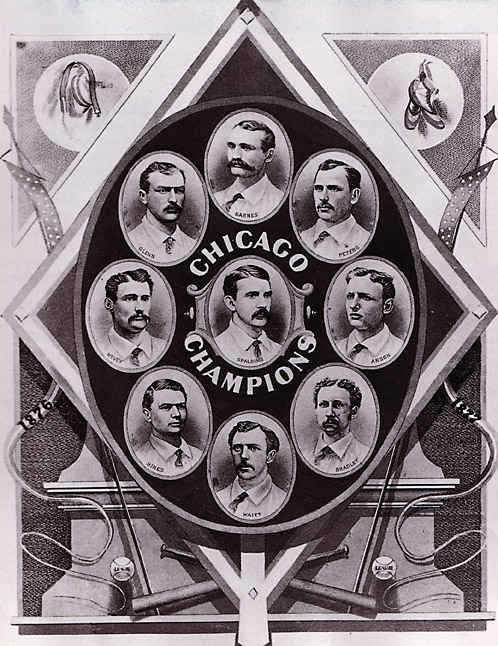
Chicago White Stockings, 1876 National League Champions--and highest salaried team.

Chicago White Stockings, 1876 National League Champions–and highest salaried team.

Harry Wright’s Boston Red Stockings filled the vacancies of White and Barnes with 18-year-old Lew Brown and 21-year-old John Morrill who The Argus said received “between 800 to 1000 dollars each.”

Manager Wright, who only appeared in one game, and his brother George were the highest paid members of the Boston club at $2,500 each.  Andy Leonard, who played second and outfield was paid $2,000.  Two other notable players on the Red Stockings, Hall of Famer “Orator Jim” O’Rourke and Tim Murnane received “between fifteen hundred and eighteen hundred dollars.”

According to The Argus, the White Stockings payroll of $21,500 topped the league, with Boston’s total of 18,000.

The Ross Barnes Case

2 May

Charles Roscoe “Ross” Barnes was one of the greatest players of his era, and largely forgotten today.

Barnes was a member Harry Wright’s Boston Red Stocking teams in the National Association from 1871-1875 and won the National League’s first batting title hitting .429 in 1876 as a member the Chicago White Stockings.

Ross Barnes

Ross Barnes

Teammates and contemporaries had no doubt about how good he was.

“Orator Jim” O’Rourke called Barnes “the greatest second baseman the game ever saw.”  In 1896, A.G. Spalding “declared Ross Barnes to have been the greatest ballplayer in America,” and Tim Murnane said of Barnes:

“His left-handed stops of hard-hit balls to right field were the prettiest stops ever made on the Boston grounds. As a base-runner no man of the present day is his equal, and as a batsman he must be reckoned very high.”

1871 Red Stockings. Spalding, standing second from left, Barnes, standing far right, O'Rourke, seated far left.

1871 Red Stockings. Spalding, standing second from left, Barnes, standing far right, O’Rourke, seated far left.

Some of Barnes’ success was due to the rule at the time regarding  balls that rolled foul in the infield, The Sporting Life said:

“It was Barnes who was the first to master the fair-foul hit. He was able to drive the ball so that it would land fair and then swing in foul just outside of the reach of the third baseman.”

Barnes became ill in 1877, although he started the season with the White Stockings, The Chicago Inter Ocean said in early May “he is now, and has been all spring, very sick with few signs of improvement.”  After a slow start, Barnes was out for more than three months before returning in late August.

The Chicago Tribune said:

“Barnes made his reappearance with the Whites, and played his old position at second base,  but he showed evidence of physical weakness and lack of practice,”

Barnes appeared in only 22 games, hitting .272.

The second baseman,  who was earning $2500 for the season, and as was often the case in 19th Century baseball,  was not paid for the time he missed.  Early in 1878 Barnes filed a lawsuit against the White Stockings to collect more than $1,000 the team did not pay him while he was ill.

Cook County Judge Mason B. Loomis heard the case, which The Inter Ocean said:

“(I)s a new one in the experience of ball clubs, and the result is looked forward to with some interest  in sporting circles.”

The result was not favorable for ballplayers.  Judge Loomis ruled against Barnes, The Tribune said:

“This makes clear the point that players are not legally entitled to wages when laid off by sickness.”

While some owners did pay players during time missed due to illness and injury, teams had the right, after 15 days, to suspend any player without pay; and the legal precedent established in Barnes’ case remained until 1916 when the “injury clause” was rescinded.

Barnes attempted to return to the White Stockings in 1878, but The Tribune said he “has never fully recovered,” from the illness, and was released.

He played with and managed the London Tecumsehs in the International Association in 1878, then made two comeback attempts with the Cincinnati Reds in 1879, and the Boston Red Stockings in 1881, his career was over at age 31.

Barnes retired to Chicago and was working for Peoples Gas, Light and Coke Co. when he died in 1915 at age 65.