Tag Archives: Hugh Fullerton

“The Cleverest bit of Quick Thinking I ever Witnessed”

26 Nov

Hugh Fullerton was one of baseball’s most influential writers; his career began in 1889 and he was active into the 1930s.  Widely credited as the first writer to directly quote players and managers, he is the source of hundreds of stories. Some, like the story the story of Bill Lange’s fence-crashing catch, are likely untrue.  Others may be apocryphal, or exaggerated.

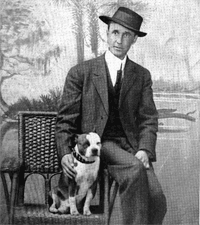
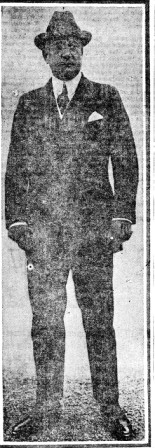
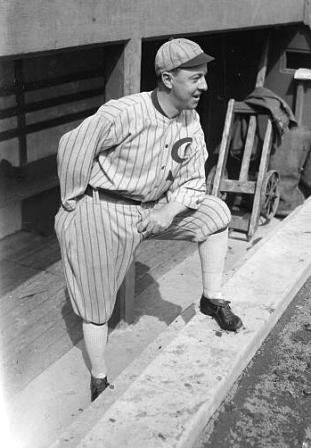
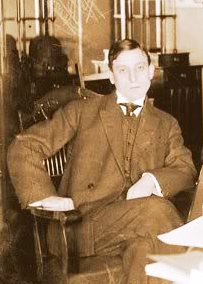
Hugh Fullerton

Hugh Fullerton

This one is about Hall of Famer John Alexander “Bid” McPhee:

“The cleverest bit of quick thinking I ever witnessed was years ago in Cincinnati, and Bid McPhee, the ‘King,’ pulled it off.  How fast he thought only can be guessed.  It must have been instantaneous.  Bid was on first base with nobody out, when somebody drove a ball straight at ‘Wild’ Bill Everitt who was playing first for Chicago.  Bill dug up the ball, touched first, and made one of his copyrighted throws to second to catch Bid, having plenty of time for the double play.

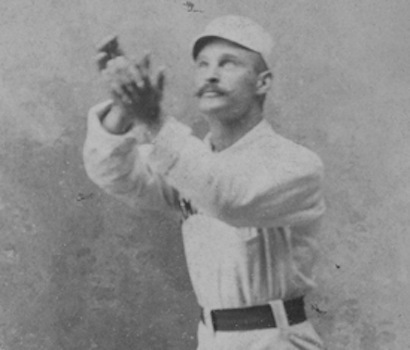
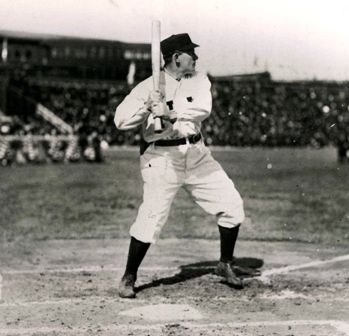
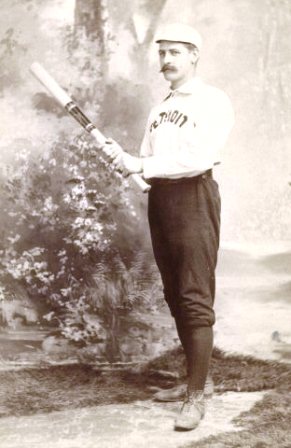
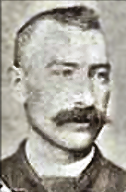
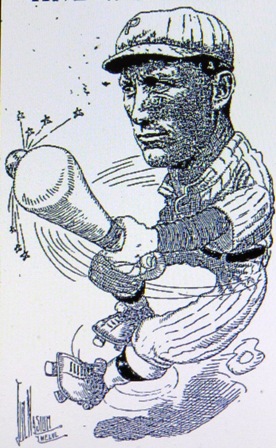
Bid McPhee

Bid McPhee

“The ball disappeared.  (Bill) Dahlen, who was on second, never saw it.  He thought the ball had hit Bid.  The umpire, crouching to see the play at the base, lost the ball.  Bid hesitated at second, glanced around, saw the entire Chicago infield running around wildly and tore for third.  At third, after turning the base, he hesitated again, looked back, and then tore for home.  From his actions both at second and third any spectator would have sworn Bid was as ignorant of the whereabouts of the ball as were the Chicago players.

“The Chicago team was wild with excitement and the crowd was mystified.  No one knew where the ball was.  The only clue was a yell of amusement from the Cincinnati bench.

“The ball had disappeared utterly and the umpire threw out a new one.  After the game we learned what had become of the ball.  Everitt hit Bid with it.  The ball had struck him under the arm, and holding it tight against his body Bid carried it entirely around the bases and to the bench while acting as if he didn’t know where it was.”

“The fans make us the ‘goat’ for Everything”

21 Nov

Chicago Orphans Manager Tom Burns suspended pitcher Bill Phyle without pay in August of 1899, even after Burns was replaced by Tom Loftus, Phyle remained in limbo.

Tom Loftus

Tom Loftus

In January Hugh Fullerton said in The Chicago Tribune that Loftus “probably will give him a chance.”  But in early February The Chicago Inter Ocean said even though Phyle had met with team President James Hart nothing had been resolved.  Phyle told the paper he was offered a contract but was “in no hurry to sign.”

Phyle finally signed at the end of the February, but The Tribune said Chicago would most likely trade him “although Loftus thinks highly of him.”

The team trained in West Baden Springs, Indiana, where according to The Tribune Phyle was “sarcastically called ‘Lucky,’ because of his proverbial hard luck, (he) rarely escapes a day without being hurt.”  He also managed to alienate his new manager.

After several days of poor weather in Indiana, Loftus decided to take the team further south, to Selma, Alabama on March 18.  According to The Tribune Phyle was not on the train:

“Phyle may not be with the team in Selma.  He left Friday (March 16), announcing he was going to see the fights in Chicago.  Manager Loftus hunted up the pitcher before he departed and told him it was a bad plan to start the year in such a manner.  Phyle then said he was ill and was making the journey in order to consult a physician in Chicago.”

Phyle did return from Chicago (where he claimed he had an unspecified operation), and joined the team on the trip south.  Upon his return he continued to suffer a series of illnesses and injuries, which included a bad reaction to a vaccination and a being hit in the knee with a thrown bat, both of which kept him inactive for several days.

Phyle was left in Chicago when the team opened the season in Cincinnati, and his imminent trade or release was speculated upon nearly daily in the Chicago press; he was finally traded to the Kansas City Blues in the American League with Sam Dungan and Bill Everitt for John Ganzel on May 18.  Phyle refused to report to Kansas City and spent the season playing for Chicago City League teams and a semi-pro team in DeKalb County, Illinois.  He was also a regular attendee at Chicago’s boxing venues and was said to own a piece of featherweight contender Eddie Santry.

Phyle returned to the National League in 1901 posting a 7-10 record for the New York Giants.  In 1902 he went to the California League as an infielder and never pitched again.  After his controversial exit from Memphis in 1903—and the aftermath—he continued to play until 1909.

Phyle worked as a boxing referee and as an umpire for more than 20 years in the Canadian, Eastern and Pacific Coast and International  Leagues, and was involved in two final controversies.

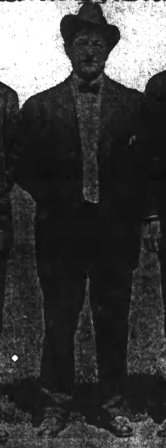
Bill Phyle, 1913

Bill Phyle, 1913

In 1920 a grand jury was impaneled in Los Angeles to investigate charges of game fixing in the Pacific Coast League.  Players Harl Maggert, William “Babe” Borton, Bill Rumler and Gene Dale were implicated.  While all criminal charges were eventually dismissed, the four were banned from baseball in 1921.

Phyle was called to testify in front of the grand jury, and said umpires were often blamed when players were crooked:

“The fans make us the ‘goat’ for everything that goes on during the ball game.  How many times we have suffered to suit the whims of a ballplayer who might have been working with the gamblers will never be known.  They just slough us around, call us whatever names they please and yell murder when we happen to fire them out of the game or have them suspended.

“An umpire should have the same authority as a referee has in the prize-ring.  If he believes a ballplayer isn’t giving his best toward the game, he ought to have the privilege of ousting him without taking the manager into confidence.”

In July of 1923 Phyle was working an International League game between the Baltimore Orioles and Rochester Tribe.  Phyle called a Rochester runner safe at first, then immediately reversed his decision.  He was dismissed the following day by league President John Conway Toole.

As a result of the dismissal, four other umpires resigned in sympathy.  Toole, who was attending the game, claimed he had not released him because of the blown call, but because Phyle had failed to work a double hitter he was assigned to earlier in the month.   The decision was upheld, and within three days the four other umpires withdrew their resignation.

Phyle ended his career back in the Pacific Coast League in 1926, and died in Los Angeles in 1953.

“In the ‘90s Nobody ever Thought Anything of telling the Manager to go Chase Himself”

6 Nov

Bill Lange played only seven seasons in the National League—all with Chicago–but his reputation lived on long after he walked away from the game in 1899 at 28 years-old.  Two of his biggest supporters, Connie Mack and Clark Griffith, remained influential until their deaths in the mid 1950s, and both helped to keep Lange’s legend alive until his death in 1950.

Long after his retirement to enter the insurance and real estate business in his native San Francisco, Lange remained extremely popular in Chicago;  he was frequently quoted by Chicago sportswriters (most often his friend Hugh Fullerton), and was even retained The Chicago Examiner’s  “World Series expert” in the early and mid teens.

Bill Lange

Bill Lange

In 1909, when the White Sox were training in San Francisco, Lange told a reporter for The Chicago Inter Ocean that “the batsmen of the present time had not advanced in any way” over the hitters of his day—and Lange felt they took too many pitches:

“I have noticed that the habit nowadays is to be altogether too scientific.  And that science is ruining the batters.  There used to be such things as .400 hitters in the big leagues and now the managers are spending fortunes in the hopes of finding a .250 hitter.  The reason they are so hard to find is because the batsmen don’t follow their natural inclinations to wallop the ball, but stall around at the plate in the artificial hope of drawing a pass instead of breaking a board in the back fence.

“No batter, who has any eye at all, ought ever to wait when he has three balls and one strike on him, unless the pitcher is uncommonly wild.  Think of the advantage of hitting when three balls have been called.  You are dead sure that the next one will be over the plate if the pitcher can get it there.  If he doesn’t, let it go and take your base.  But if you let a good one go then you are up against another proposition.

“Then the batsman is in a worse hole than the pitcher and his chances of making a safe hit are at least 4 to 1 against him, for a nervy pitcher will take a chance on a curve or a high one in the hope of making the batsman bite.  He wouldn’t dare do that very often when the count was only three and one.  The batsman who waits too long is just giving himself the worst of the deal.”

Unlike many players of his generation, Lange did note that some aspects of the game had improved since he played:

“We didn’t hustle like the players of the today do.  We would shirk morning practice all the time, so we could sleep late.  And take it from me, a lot of us needed the sleep, for most all of the boys belonged to the Ancient Order of Owls.

“The teams of today report at the grounds at 9:30 in the morning and work to beat the band for two hours. In the old days, after we had stalled the manager off as long as possible, we would finally show up for morning practice.  I don’t know all the systems the players on other teams had for dodging morning work, but with the old Chicago bunch we left it up to (Bill) Dahlen to break up the practice after about ten minutes of hustling.

“Dahlen could turn the trick might easily.  All he had to do was whiz four or five low throws at Anson’s shins.  ‘Pop’ used to bawl Dahlen out for a few minutes, but Bill would keep up the bum throwing until Anse would say ‘Enough.’  Nothing like that goes in the big or small leagues now.  It is a question of work and buckle down to business.  In the ‘90s nobody ever thought anything of telling the manager to go chase himself.  I haven’t heard of anybody doing anything like that in late years, and getting away with it.”

Bill Dahlen

Bill Dahlen

Lange on pitching, tomorrow.

“He Used to Knock Down Infielders”

4 Nov

William Alexander “Bill” Lange is best known for a play that likely never happened.  The legend was that he had made a spectacular catch that culminated with the Chicago Colts’ outfielder crashing through the left-field fence in Washington in an 1897 game with the Senators.  It is most likely another in a long line of exaggerations and apocryphal stories from Lange’s friend, Chicago sportswriter Hugh Fullerton—a story that first appeared in that paper with no byline in 1903, but was repeated by Fullerton many times in later years.   A nice analysis of that story appears here.

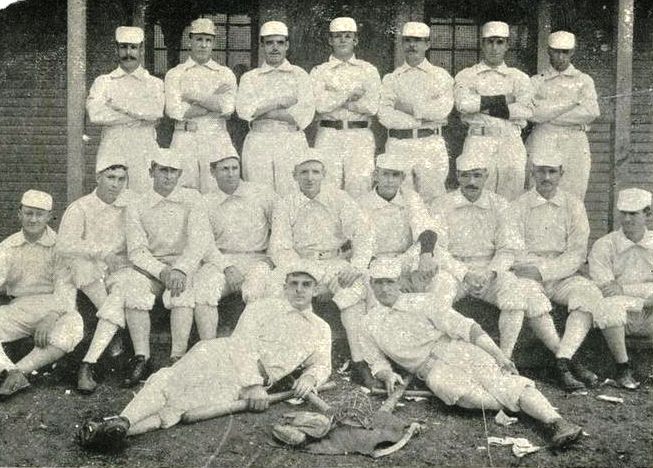
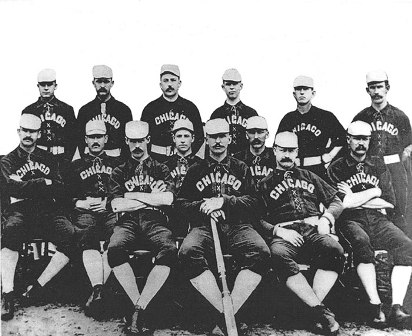
Bill Lang, seated fourth from left, with 1896 Chicago Colts

Bill Lang, seated fourth from left, with 1896 Chicago Colts

Lange played just seven seasons, retiring after the 1899 season at age 28 to join his father-in-law in the insurance and real estate business in San Francisco.

During the spring of 1900, The Chicago Daily News said “The wise ones in the baseball business” were certain he’d be back, including Chicago’s manager Tom Loftus and President James Hart, and Charlie Comiskey, “’When the season opens and the sun warms up he can’t stay away,’ remarks Comiskey, with a knowing wink.”

Despite the certainty that he would, Lange never returned.

Lange, who stole 400 career bases, was called “Little Eva” because of his gracefulness.  In 1909 Billy Sunday called him “the greatest outfielder in baseball history.”  Connie Mack called him the best base-runner he ever saw.  In fact,  Mack and Clark Griffith considered Lange so good that they petitioned the Hall of Fame in 1940 to change the “rules (which) restrict membership to players of the twentieth century” in order to allow for Lange’s induction.

Griffith said Lange was “the best outfielder that ever played behind me:”

“Lange here was rougher base-stealer than (Billy) Hamilton.  He used to knock down infielders.  Once I saw him hit a grounder to third base.  He should have been out, but he knocked down the first baseman.

“Then he knocked down the second and third baseman and scored.  Connie Mack was the catcher.  No he didn’t knock Connie down because he didn’t have to.”

Mack told the same story over the years.

Lange never made the Hall of Fame.  He died in 1950.

Bill Lange 1931

Bill Lange 1931

In his final years the story about the “catch” had become so ingrained in the legend of Bill Lange that other players told essentially the same story Fullerton did (the most widely disseminated versions appeared in “The American Magazine” in 1909 and in Johnny Evers‘ book “Touching Second,” coauthored by Fullerton), but inserted themselves into the story.  In 1946 Griffith told reporters:

“It happened right here in Washington, I was pitching for Chicago.  Bill missed the train from New York, and arrived in the fourth inning.  We were then with the Chicago Colts and Cap Anson fined Lange $100 before he put him in the game.

“I had a one-run lead when Al (“Kip”) Selbach of Washington hit a terrific drive.  Lange ran back hard, and when he crashed into the wooden fence his 210 pounds took him right through the planks.

“He caught the ball at the same time and held it.  All we could see were his feet sticking through the fence and Bill’s arm holding the ball.  When he came back to the bench, he handed the ball to Anson and said:

‘This ought to cancel that $100 fine.’ It did too.”

When Lange died Griffith said:

“I have seen all the other great outfielders—Speaker, Cobb, DiMaggio –in action and I consider Bill Lange the equal of, if not better than, all outfielders of all time.  There wasn’t anything he couldn’t do.”

“He Would let a Fast one hit him Square in the Chest”

11 Sep

Charlie Bennett was one of the best catchers of the 1880s, and is credited with inventing the chest protector.  Bennett always gave the credit for the invention to his wife. The Detroit Free Press told the story in the 1914:

“It was a constant source of worry to Mrs. Bennett to watch her husband being made a target for the speed merchants of thirty years ago.  And she fully realized the pressing necessity of some kind of armor to prevent the hot shot sent through by these speedy slabmen from caving in a rib or two which belonged to her better half.

“So she and her hubby proceeded to contrive some means of saving the aforementioned ribs.  After much deep thinking and considerable labor they gradually shaped out something that had a faint resemblance to the protector worn today.  A crude but very substantial shield was made by sewing strips of cork of a good thickness in between heavy bed ticking material.   After much hard work and many dove like spats they had it ready for trial.  Charlie didn’t have the nerve to wear it outside his shirt for fear of the fans roasting him about being chicken-hearted, so he wore it under his baseball shirt.”

Charlie Bennett

Charlie Bennett

The article said after Bennett began wearing the protector in games sometimes “he would let a fast one hit him square in the chest.  The ball would rebound back almost to the pitcher, much to the amazement of the fans and players, who weren’t on to the hidden cause.”

Bennett’s career came to an end after the 1893 season.  While taking a train with former Boston Beaneaters teammate John Clarkson for a hunting trip, Bennett slipped while getting off a moving train to speak to a friend, when the train began moving he tried to climb back aboard, slipped and fell under the wheels.  Bennett lost his left leg at the ankle and his right at the knee.

Johnny Evers, in his book “Touching Second: Science of Baseball” written in 1910 with Hugh Fullerton, told a story about Bennett watching a game years after his accident:

 “He was watching a game at Detroit when a young base runner, trying to steal second, slid straight at the baseman, who was reaching to take a high throw.  The baseman blocked him with one leg, caught the ball and touched the runner out. “’I could have beaten that myself,’ muttered Bennett in disgust. “’Without legs, Charlie?’ inquired a friend. “Yes—without legs,’  Snorted Bennett angrily, ‘for I would have had brains enough not to slide where he could block my feet.’”

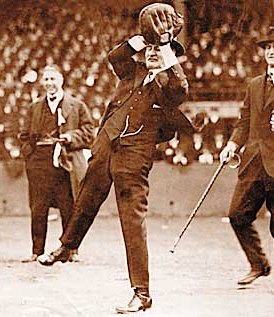
Charlie Bennett threw out the first pitch at every Detroit Opening Day from 1896-1926...he died in February of 1927.

Charlie Bennett threw out the first pitch at every Detroit Opening Day from 1896-1926…he died in February of 1927.

Another Rube Waddell Story

31 Jul

There are probably as many stories about George Edward “Rube” Waddell as any player in the history of baseball; and some of them might be true,

This one was told by Hugh Fullerton in The Chicago Tribune, and is about the contract Waddell signed to join the Chicago Orphans in 1901.

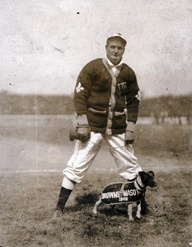
Waddell with St. Louis Browns Mascot

Rube Waddell

Despite the erroneous story, told through the decades, that the Pirates were so anxious to rid themselves of Waddell that they let him go for a cigar (or a box of cigars in some versions), there was actually a great deal of interest in Waddell and while the sale price was never disclosed, The Chicago Daily News said Chicago paid “good money” for the pitcher.

In addition to Chicago, other contemporaneous reports said the Boston Beaneaters were very interested in obtaining Waddell.

Fullerton told a good story, maybe just as erroneous as the cigar story, of how Chicago manager Tom Loftus was able to sign Waddell and thus beat Boston to the punch of purchasing his release from Pittsburgh:

“(Rube) was threatening to annihilate several members of the team and he was on one of his periodical rampages.  Boston wanted him badly—and so did Chicago.  Boston offered to give him $3,500 for the remainder of the season, and Chicago was willing to pay him only $2,400 and Loftus was delegated to sign Rube and make him be glad to knock off $1,000 from his earnings from the end of May to the middle of October.  Loftus cornered George Edward and commenced jollying him.

“’I’ll tell you, Tom,’ said Eddie, ‘I’d rather play with you than with Boston, but they offer me $1,100 more.

“’That’s all right,’ said Tom.  ‘Don’t let a little thing like that stop you from joining a good ball club with a lot of good fellows.”

Fullerton said the two discussed the pros and cons of Waddell accepting Chicago’s offer when Loftus finally said:

 “’I’ll tell you, Eddie, what I’ll do.  You sign that contract, and when we get to New York I’ll buy you the best Panama hat in town.

’“’All right,’ said George Edward.  ‘Just put that in the contract.’”

Fullerton said the deal was made and “When they got to New York Loftus bought him the $1,000 Panama hat—for $28.”

Tom Loftus

Tom Loftus

Waddell’s time in Chicago was brief, and typically bizarre.  After posting a 14-14 record and a 2.81 ERA for Loftus and the Orphans, Rube received an offer he couldn’t refuse in September.

The Tribune told the “pitiable little story, this tale of ‘Rube’ Waddell and his love of nature.”  Waddell had deserted the team to play for an amateur club in the town of Grayslake, Illinois, about 40 miles north of Chicago.  The Tribune said Waddell was induced to go north with the promise of being able to fish six days a week, if he pitched on the seventh.

The Orphans suspended Waddell for the remainder of the season.  In December he jumped Chicago to join Los Angeles in the California League.

“I Object to Being Made a Freak.”

17 Jul

In 1913 American League President Ban Johnson set out to put an end to the practice the Baseball Writers Association called “A growing Evil,” ghost-written articles appearing under the by-lines of famous ballplayers.

William Peet of The Washington Herald revealed the identities of the ghost writers in March of 1913; Gerhard “Roger” Tidden of The New York World had been the man responsible for articles bearing the name of Ty Cobb, but Tidden died just three months after the revelation.   While the practice waned after 1913, Cobb remained defiant, and continued “authoring” a syndicated column for the next several years.
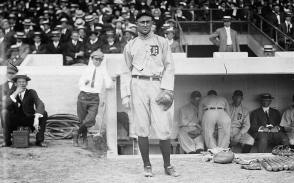
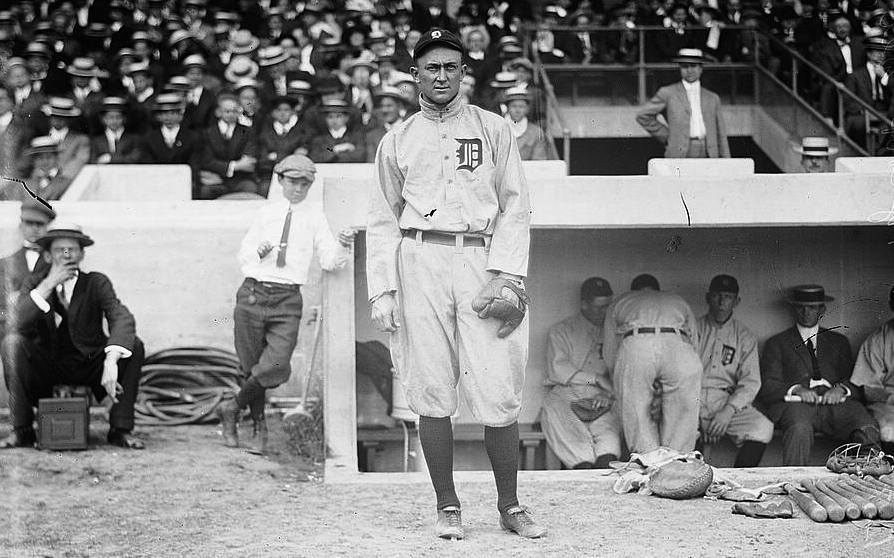
Ty Cobb

Ty Cobb

Cobb’s articles, for the most part, steered clear of trouble with the league president, but the assertions he made about the Chicago White Sox and manager Clarence “Pants” Rowland in June of 1915 caused a major stir.

Cobb said:

“Battery signal stealing, which has been the cause of several scandals in big league baseball threatens to make more trouble this season if anyone is able to prove what is generally suspected about one of the American League clubs.

“I will not mention the name of the organization which has been accused by the opposing players…because I couldn’t present any proof.”

Cobb then went on for seven paragraphs trying to present proof, and provided enough hints to make it clear he was talking about the White Sox.

Cobb’s said

 “The team I have in mind has won almost all its home games…It looks mighty funny, though, the way this club could hit at home and the feeble manner in which it has been swatting on the road and almost all of the Tigers will take an oath that something out-of-the-way is coming off.”

Chicago, through 49 games, was in first place; 22-8 at home and 9-10 on the road.  Detroit was in second place a game back.  If he left any doubt Cobb said later in the column when discussing the American League pennant race in general:

“The White Sox, who burned up things at home, have not been doing so well on the road.”

Everyone, including American League President Ban Johnson, assumed Cobb was talking about the Sox.  Johnson said:

 “(Cobb) must prove the charges, or I will keep him from playing baseball.  If any man in the American League makes a charge of dishonesty and refuses to back up his charge with the absolute evidence, that man will have to get out of the game.”

The White Sox were less concerned; The Chicago Tribune said the charges made Sox players “grin,” and Rowland told reporters:

“I suppose we had out tipping instruments planted in the Polo Grounds when we made nineteen hits in New York the other day.”
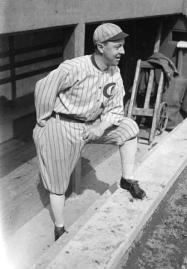
Clarence "Pants" Rowland

Clarence “Pants” Rowland

In his next column Cobb issued a non-denial denial and at the same time openly, and loudly, defied Johnson:

“I made no specific charge against the White Sox…What I did say was that a strong rumor of sharp practice was abroad, and I reiterate that statement right here.”

___

“Mr. Johnson even went to the extreme of saying that he would drive me out of baseball.  He hasn’t done this yet and I expect to stay around for a few more days.  If the league president is willing to pay the salary that my three-year contract calls for, I will be perfectly willing to take a vacation at that, for I have long wanted to do a number of things that baseball interferes with.”

Cobb reiterated the charges and offered no evidence, but said he was justified in making the claims because his manager might have believed them:

“(Tigers) Manager (Hughie) Jennings thought the report sufficiently serious to detail one of our players for plain clothes duty in the bleachers, and he also wrote Manager (Bill) Donovan of New York, telling him of a warning we had received and cautioning him to be on the lookout.  So you see the signal tipping report was not a creature of my own imagination, but a matter of sufficient seriousness to warrant an investigation by our manager in his official capacity.”

Cobb’s only bit of backtracking was to say that if “it should be proved the White Sox tried signal stealing it would be without the knowledge of Mr. (Charles) Comiskey.”  Cobb said Comiskey “wouldn’t countenance anything of this sort for a moment.”

Cobb took one last swing at Ban Johnson, charging the league president with giving “sensational interviews” about him to get “the people excited artificially. If this is Mr. Johnson’s idea, I wish he would abandon it.  I object to being made a freak.”

If there was any doubt whether the American League’s star player or the league president wielded more power, it became obvious within a week.

Johnson, who The Associated Press said “long has been opposed to players permitting their name to be used over baseball stories,” decided not only had Cobb not written the columns, but claimed “a Detroit newspaperman” made up the allegations “out of whole cloth,” and incredibly said that Cobb had “no knowledge,” of the columns despite Cobb being quoted by numerous sources discussing the charges.
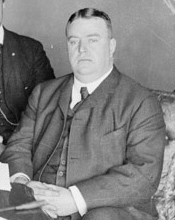
Ban Johnson

Ban Johnson

Hugh Fullerton of The Chicago Examiner summed it up best:

“We are rather surprised each morning upon picking up our newspaper to discover that Ty Cobb is still making two-base hits, two steals and catching a few flies instead of being driven out of baseball by (Ban) Johnson.  By the way how did Johnson get into baseball?”

As quickly as Johnson backed down, the charges went away.  Despite the strong start the White Sox faded, and continued to fade even after the acquisition of “Shoeless Joe” Jackson on August 21, finishing third, nine and a half games behind the pennant-winning Boston Red Sox and seven games behind the Tigers.

Cobb led the league for the ninth straight season, hitting .369.

The one legacy from the brief 1915 controversy seems to be Cobb’s dislike of Rowland, who later became a scout for the Tigers.  In his 1984 book “Ty Cobb,” Charles C. Alexander said Cobb only agreed to manage the Tigers before the 1921 season because he was told:

 “Pants Rowland, whom Cobb considered an incompetent fraud, might very well get it and Cobb would have to play for him.”

Rowland, who remained in baseball until 1959 as a manager, scout and executive with the Los Angeles Angels in the Pacific Coast League and Chicago Cubs in the National League, appears to have also held a grudge.   Up until his death at age 90 in 1969, Rowland often said two of his former players, Jackson and Eddie Collins were better than Cobb.

 In 1953 at the Old Timers Baseball Association of Chicago Banquet Rowland said “I wouldn’t have traded (Collins) for Cobb.  What made him greater than Cobb was that he inspired the entire ball club.  Ty was an individualist.  He was interested only in Cobb.”

Rowland called Jackson the “greatest natural hitter,’ he ever saw, and said Ted Williams, not Cobb, was the only player “of the same make-up.”

“Said–Tinker to Evers to Chance”

5 Jul

???????????????????????????????

Franklin Pierce Adams’ famous poem “Baseball’s Sad Lexicon” appeared in The New York Evening Mail in 1910 and immortalized Chicago Cubs shortstop Joe Tinker, second baseman Johnny Evers and first baseman Frank Chance—within three years, the above cartoon appeared in newspapers along with a new, less well-known, poem written by Adams’ colleague at The Evening Mail, James P. Sinnott.

By 1913, baseball fans became aware that Tinker and Evers had barely spoken to each other since 1905, and the rivalry among the three exploded in public.  The former teammates, now all managers, Tinker with the Cincinnati Reds, Evers with the Cubs, and Chance, the recently deposed Cubs manager, with the New York Yankees.

In February Chance told reporters that Tinker was a better player than Evers; Evers responded and accused Tinker of trying to “tamper” with pitcher Larry Cheney and other members of the Cubs, as for Chance he said:

“I do not know whether Chance is jealous of my getting the position of leader, and I do not like to think so, but from the remarks he is making, I am forced to.”

By March, Hugh Fullerton said in The Chicago Examiner that Evers was unable to control his players; he said “Chance could whip any man on (the) team—Evers can’t,” and predicted a fourth place finish for the Cubs (they finished third).  Tinker’s Reds finished seventh in the National League; Chance’s Yankees were seventh in the American.

Sinnott’s poem appeared at the end of September:

“A Manager’s life is tough!

Said Tinker to Evers to Chance—

‘A manager’s road is rough!’

Said Tinker to Evers to Chance—

‘Here are we three, a lookin’ on

The big world’s series game,

In which we once were principals,

In which we gained our fame’

‘A manager’s life is no cinch!’

Said Tinker to Evers to Chance—

I’d almost as soon be Lynch!’

Said Tinker to Evers to Chance.”

“Lynch” was Thomas Lynch, who was about to be replaced as president of the National League.

It would not be until 1924, shortly before Chance’s death that the three reconciled.  Chance had been hired to manage the Chicago White Sox, but became too ill and returned home to California; he was replaced by Evers.

Chance summoned his former teammates to California that spring, where the three spent several days together.  Chance died in September.  Tinker, Evers and Chance, were inducted into the Hall of Fame together in 1946.

Tinker, Evers and Chance

Tinker, Evers and Chance

“A Baseball with a Mystery Attached to it”

13 Jun

The Chicago Tribune’s Hugh Fullerton claimed that somewhere at Chicago’s West Side Grounds, home of the Cubs, “if it has not decayed, there is a baseball with a mystery attached to it.”

Hugh Fullerton

Hugh Fullerton

The incident took place on May 11, 1899 “in the middle of a hot game between Louisville (Colonels) and Chicago…this ball disappeared—and as far as anyone knows never yet has been found.”

Fullerton said:

“The score was 4 to 4 in the seventh inning, with Chicago at bat, when Arthur Nichols, the little catcher, came up with one man out. He whanged into the ball and drove it safe to right.  Charlie Dexter threw to second and Nichols slid safe just as the ball arrived.  Tommy Leach was covering second base, and as Nichols slid he lost sight of the ball.  He said it struck his forearm and fell to the ground, and when he started to pick it up it wasn’t there.  He thought it was under Nichols and waited until the runner arose. The ball was not there.

“Nichols waited and held the base, fearing the ball was hidden and he would be tagged out. (Claude) Ritchey and Leach were busy hunting for it.  Everybody joined in.  Still Nichols feared a trick and stuck to the bag.  After five minutes umpire (William) Smith, who was working on the bases, called the Louisville players down, and after accusing them of hiding the ball threw a new one into play.  Chicago kicked and Nichols was ordered to run home.  He ran, but Smith sent him back to second and ordered play begun with a new ball.”

Art Nichols

Art Nichols

Pitcher Jack Taylor singled to right, and Nichols was thrown out at home plate by Dexter.  Louisville went on to win the game 5-4 in ten innings.

Fullerton said:

“Leach, Nichols and Ritchey, the only men near the ball, vowed they never saw it.  What really became of it no one seems to know.”

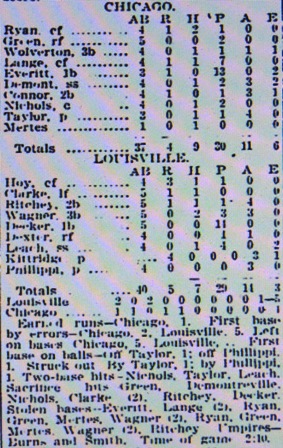
The Box Score

The Box Score

Things I Learned on the Way to Looking Up Other Things #4

22 May

A Ballplayers Hands

Joe Ardner played second base in the National League for the Cleveland Blues in 1884 and the Cleveland Spiders in 1890; he played another 12 years in the minors.  In 1888 he was with the Kansas City Blues in Western League and provided the following explanation of the care and maintenance of an infielder’s hands:

“A ballplayer’s hands should not be hard, they should be soft.  When my hands are in perfect condition they are almost as soft as a lady’s.  Hard hands on a ballplayer will crack and get sore, but when the skin is pliable and tough there is little danger of the hands bruising, cracking or puffing.  Some folks imagine a ballplayer’s hands to be as hard as a board, but they are wrong.”

Joe Ardner

Joe Ardner

They have realized that the Umpire is Almost Human

National League President Harry Clay Pulliam was very pleased with how civilized his league had become by 1908.  In an interview with The Chicago Tribune he said:

“The game is getting cleaner all the time.  Why, I’ve only suspended about half a dozen men this year, to about forty last year, and I want to say that the players are trying harder to keep the game clean…They have realized that the umpires are almost human.  It’s business with the player now, and they’re banking instead of boozing…It’s a grand game, clean, wholesome, and it’s the spirit of contest that gives it its virility.  Civic pride is another vital adjunct to it.  Every town likes to have its own team a winner.  Sort of local pride or another form of patriotism, I call it.”

Harry Pulliam--National League President

Harry Pulliam–National League President

Soo League Night Games

The Copper Country Soo League was recognized as a league for the first time by the National Association of Professional Baseball Leagues in 1905; its last season in operation.  The four-team league located in Michigan’s Upper Peninsula was made up of mining towns along the Soo Line Railroad: the Calumet Aristocrats, the Sault Ste. Marie Soos, the Hancock Infants and the Lake Linden Lakers.

Nearly no records or roster information survives, other than that three future Major Leaguers played in the league: Donie Bush and Fred Luderus played for Sault Ste. Marie and Pat Paige played for Calumet.

In an effort to boost sagging attendance in June, the league first  attempted to merge with the Northern League, and when that effort failed announced a scheduling change.

The Duluth News-Tribune said:

“An innovation…will be introduced by managers of the clubs comprising the Copper Country Soo League.  Owing to the peculiar conditions which exist in some of the cities, it has been decided to play some of the games after supper as an experiment as it is believed the attendance will be larger.”

The Chicago Tribune‘s Hugh Fullerton said:

“(I)n the copper country baseball depends on miners for support…the plan proved quite a success…The miners would come out of their shift at 6 o’clock, the games were called at 6:30 and finished about 8:30 at twilight.  There were few games called by darkness.”

While the move helped three of the teams at the gate, the Sault Ste. Marie Soos failed to draw fans and disbanded late in August.

Calumet won the championship, and along with Hancock and Lake Linden  merged with the Northern league to form the Northern-Copper Country League–Calumet won the league’s first championship in 1906, playing a schedule of day games.


Future Phillies star Fred Luderus was a 19-year-old rookie with the Sault Ste. Marie Soos

Future Phillies star Fred Luderus was a 19-year-old rookie with the Sault Ste. Marie Soos