Tag Archives: International League

“He was Not Crazy as Reported”

18 Jul

Ervin Thomas “Erve” “Dutch” Beck hit the first home run in the American League; on April 25, 1901, the second day of the season, as a member of the Cleveland Blues; Beck homered off White Sox pitcher John Skopec at Chicago’s South Side Park.

It was a highlight in a short, promising career, like many at the turn of the 20th Century, destroyed by alcoholism.

Beck was considered the best young player in Toledo, Ohio when he joined the Adrian Reformers in the Michigan State League as a 16-year-old in 1895, then for the next five seasons, he was the star of his hometown Toledo Mud Hens in the Interstate League.  For the two seasons in Toledo for which complete records survive, Beck hit .298 in 1898 with 11 home runs and, a league-leading .360 with 15 home runs in 1900.
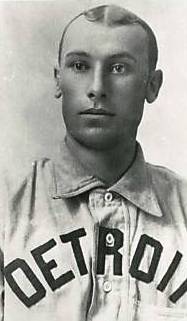
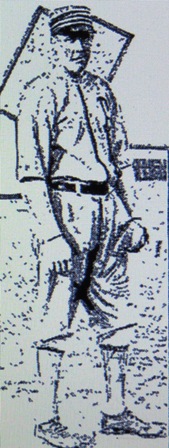
Erve Beck

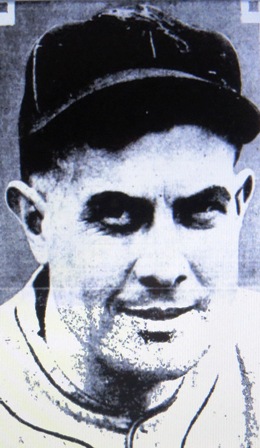
Erve Beck

Earning the Nickname “Home run Dutch” in the Toledo papers, Beck was credited with 67  during his five seasons with the Mud Hens;  he would remain the team’s all-time career home run leader until 2007 when Mike Hessman (currently with the Louisville Bats in the International League) hit his 68th as a Mud Hen.

Beck also had a brief trial with the Brooklyn Superbas in the National League in 1899, hitting .167 in eight September games.

It’s unclear exactly when Beck’s problems with alcohol began, but according to fellow Ohioan Ed Ashenbach (alternately spelled Ashenback by several contemporary sources), a minor league contemporary who wrote a book in 1911 called “Humor among the Minors”,  it was well-known during Beck’s career that he was “addicted to strong drink,” and as a result suffered from “hallucinations.”
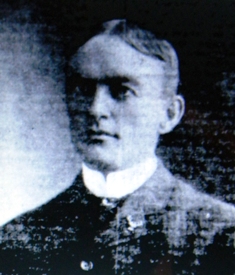
Ed Ashenbach

Ed Ashenbach (Ashenback)

Before the 1901 season, Beck, whose rights were held by the Cincinnati Reds, jumped to the Cleveland Blues in the newly formed American League; the twenty-two-year-old hit .289 and accounted for six of Cleveland’s twelve home runs.

Beck jumped back to the Reds before the 1902 season and received rave reviews early in the season.  The Cincinnati Tribune seemed to like him more at second base than veteran Heine Peitz:

“Erve Beck looks more like a second baseman than anyone who has filled the position since (Bid) McPhee went into retirement (in 1899).  He covers the ground, seems to know where to play and is capable of swinging the bat with some effect.”

His teammate, pitcher Frank “Noodles” Hahn claimed Beck hit the ball “harder than (Napoleon) Lajoie.”

Beck hit better than .300 playing second base in May but went to the bench when Peitz, who was filling in behind the plate for an injured Bill Bergen returned to second.

In June first baseman Jake Beckley missed a week with an injury and Beck filled in there; The Cincinnati Enquirer’s Ren Mulford said:

“(Beck) played the bag in splendid style…In handling ground balls Beck is as good as Beckley, and he is a better thrower… Beck gave another display of his versatility by plugging up a hole in right field.  He made one catch that was a lollapalooza…Most players would have lost heart when benched as Beck was, but he remained as chipper as a skunk during his term of inactivity, and gladly accepted the opportunity to get back into the swim. Beck is a phlegmatic soul, who takes life, as he finds it without a growl.”

In spite of a .305 batting average in 48 games and the great press he received, Beck was released by the Reds in July.  Whether the release was simply because he was the odd man out with Peitz, Beckley and right fielder Sam Crawford healthy or as a result of drinking is unknown.

Beck was signed almost immediately by the Detroit Tigers where he took over at first base after Frank “Pop” Dillon was sent to the Baltimore Orioles.  He hit .296 in 41 games but was again released at the end of the season.

Beck would never return to the big leagues.

In 1903 he .331 for the Shreveport Giants in the Southern Association, he jumped Shreveport the following season and played for the Portland Browns in the Pacific Coast League.   He returned to the Southern Association with the New Orleans Pelicans in 1905.  After starting the 1906 season in New Orleans, he was released in July and signed by the Nashville Volunteers; his combined average with both Southern Association teams was .211.

Beck’s drinking was, according to Ashenback and contemporary newspaper accounts, common knowledge by the time he wore out his welcome in Nashville in August and was sold to the Augusta Tourists in the South Atlantic League.

That stop would last for only one game.

The 27-year-old, four years removed from the American League, played first base for the Tourists on August 6.  Augusta second baseman Ed McKernan said, “It was evident when he reported there was something amiss with him,” and claimed Beck chased “an imaginary flock of geese away from first base” during the game.

The following day, according to The Augusta Chronicle, Beck “created a sensation in the clubhouse…causing all but two of the players to leave the house.”  As a result, Augusta released him.

The following day The Chronicle said:

“(Beck) ran amuck this morning and created great excitement on the street.

“While in a room on the third floor of the Chelsea hotel the big infielder suddenly began to see things and sprang from the third story window to the ground below.  Only two intervening telephone wires and a rose bush saved his life.

“He then darted down an alley and hid himself in a store.  He was finally captured and came quietly back to his room with a policeman and (Tourists outfielder Frank) Norcum.”

The Sporting Life assured their readers that Beck “was not crazy, as reported, but only suffering from the effects of a (drunken) spree.”

McKernan said “During his convalescence…Beck would smilingly avow his determination to abstain from strong drink.”

There were varying reports regarding the extent of his injuries, and it’s unknown whether he was physically able to play after the fall, but Beck would never play professionally again.

He returned to Toledo where he operated a tavern and appears to have been unable “to abstain from strong drink;” he died in 1916 of Articular Rheumatism complicated by Hepatic Cirrhosis.
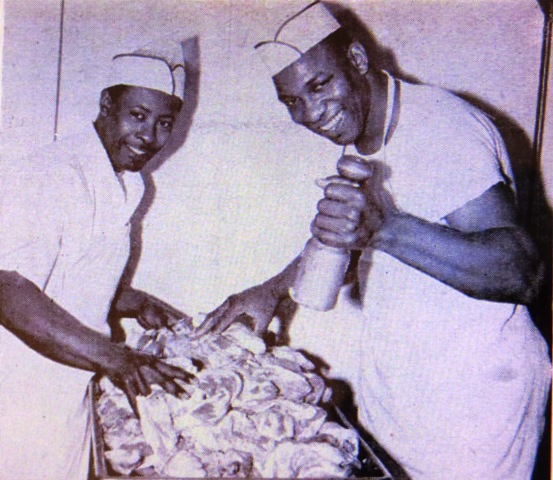
Luke Easter, Sausage King

31 May

???????????????????????????????

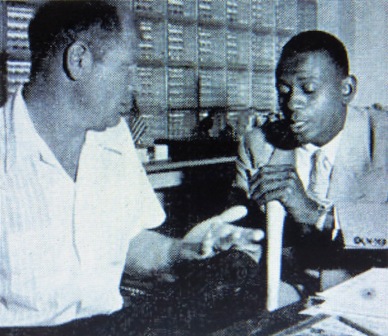
Between the 1952 and ’53 season, Cleveland Indians first baseman Luke Easter (r) went into the sausage business with his brother-in-law Raymond Cash (l).  The business, Ray’s Sausage still operates in Cleveland.  In a Jet Magazine article  Easter said they only managed to sell 20 pounds their first week, but by January of 1953 they were selling 2,300 pounds a day.  The article said Easter had “taken out a license to place his sausage on sale” at Indians games.  He said:

“I can make this business go by hitting lots of home runs (but) even if our sausage makes a million dollars I won’t quit baseball, I’ll stay in baseball as long as I can walk.”

During the fourth game of the 1953 season Easter was hit by a pitch, breaking a bone in his foot, as a result the 37-year-old, who had hit 31 home runs with 97 RBIs in 127 games the previous season, dropped to 7 and 31 in 68 games;  his career with the Indians ended after only 6 games in 1954.  But while Easter didn’t hit “lots of home runs” in Cleveland after starting the company, he did stay in baseball for almost “as long as (he could) walk.”

Playing primarily in the International League with the Buffalo Bisons and Rochester Red Wings, Easter remained in baseball until 1964, hitting more than 235 homes runs.

Easter was killed in a hold up in Cleveland in 1979.  The Cleveland Plain Dealer editorialized the day after his death:

“For all of his huge size and great strength, Luke Easter was a gentle man.  It is a contradiction to the way in which he lived that his life should be ended violently.

“He had courage.  He played first base for the Cleveland Indians from 1949 to 1954, a time when it was far from easy to be a black athlete in the major leagues…He was shot dead yesterday at age 63, victim of a cowardly attack from ambush outside a bank office .

“It is a wound to the community.  Luke Easter, athlete and gentleman, will be missed.”

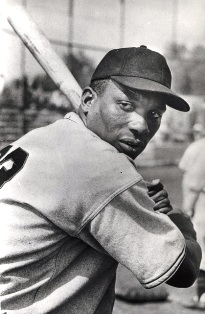
Luke Easter, 1949

Luke Easter, 1949

McCloskey, Mays and Hair Color

12 Mar

Carl Mays is best known for being the pitcher who hit Cleveland Indians shortstop Ray Chapman with a pitch, resulting in the only hit by pitch death of a Major League player. In fifteen seasons he posted a 208-126 record with a 2.92 ERA.

Five years before he became infamous for Chapman’s death, Mays became embroiled in a strange feud with former National League manager John James McCloskey; the dispute was over hair color.

Carl Mays

Carl Mays

In December of 1914, McCloskey was a well-respected figure in baseball, credited with being the “father” of the original Texas League in 1888, he had spent five seasons as manager of the Louisville Colonels and St. Louis Cardinals in the National League, and another 23 as a minor league manager and owner.

Mays was coming off a 24-8 season for the Providence Grays in the international League, and while called up to the Red Sox in the closing weeks of the season had not yet appeared in a big league game.

The controversy originated when Charles “Toby” Fullerton, a pitcher for the Seattle Giants in the Northwestern League was quoted in an article that appeared in The Pittsburgh Press and several other papers about pitcher “Seattle Bill” James, who had just led the Boston Braves to a World Championship. Fullerton said when he and James were teammates in Seattle in 1912, manager Shad Barry had, “condemned the youngster for being a blond,” he then was quoted saying McCloskey also, “has no use in the world for blonde ball players.”

“Seattle Bill” James

The strange, silly, throwaway quote should have been the end of it, but it was apparently serious enough for McCloskey to issue a long denial from his home in Louisville, Kentucky. The full-page letter McCloskey wrote appeared in more newspapers than the original story, and read in part:

“Let me say, I have been accused of every crime in the calendar, but this is too much.”

McCloskey claimed the “rumor” originated when he was managing the Milwaukee Brewers in the American Association in 1910. Outfielder Rube DeGroff played for McCloskey (incidentally, Shad Barry was also a member of the team), and according to McCloskey:

“We were playing in Kansas City, we were behind…and made a big rally that came near giving us the game. The bases were full in the last inning, with two men out, when the big, blonde and good-natured Rube DeGroff, who was a splendid all-around player and life of the club, came to bat with the bases full and struck out. I was sore over losing the game and made the remark that I never saw a cotton-top who ever made good in a pinch.”

McCloskey said he also believed anything Barry might have said to or about James was certainly a joke, and closed with a final defense:

“In fact, in my humble opinion, I think the blonde has a shade over the brunette. But why the color of a man’s hair should have anything to do with his ability as a ball player is a mystery to me, and I hope this explanation will put an end to these silly rumors.”

It didn’t.

Within days Carl Mays weighed in, claiming that he had twice been rejected for an opportunity to pitch for McCloskey’s Ogden Canners in the Union Association because he was blond.

Mays said:

“McCloskey is a liar pure and simple…In 1912, when I was on my way to Boise to try out for the Boise team; I stopped off at Ogden, thinking possibly owner McCloskey might give me a trial. I met him downtown in a billiard parlor and went up and introduced myself.

“McCloskey looked me over carefully, like a horse-trader examining a piece of horseflesh, and then suddenly espied my blond hair. ‘No,’ said he coolly, ‘I don’t want you. In fact I wouldn’t have you around the ranch. I don’t want any blonds in my camp.’”

Mays also claimed that later in 1912 while compiling a 22-9 record for the Boise Irrigators in the Western Tri-State League; he was nearly sold to McCloskey’s pitching-strapped Ogden Canners until:

“One of the Ogden players happened to mention the fact that he was the same blond-haired fellow who had asked for a job earlier.”

According to Mays, McCloskey said:

“’Deal is off. Send that white-haired guy over here and I’ll kill him.’”

The story stuck with McCloskey for more than 20 years. A 1916 story in The Providence Tribune said:

“Scouts all over the country know McCloskey and never did one in his employ recommend a light-haired ballplayer…His peculiarity was well-known, and he knew that no one would have the temerity to recommend to him a blond or light-haired ballplayer. “

The black-haired John McCloskey

The black-haired John McCloskey

In 1934, The Milwaukee Journal called McCloskey, “one grizzled veteran who frowned on blond athletes.”

The article quoted E. Lee Keyser, a long-time minor league executive, who said when McCloskey managed Butte, “One of (McCloskey’s) players was an Indian outfielder whose hair was black,” the player struck out in a critical situation. According to Keyser, when the unnamed player returned to the clubhouse later, McCloskey grabbed his hair and said: “I just want to know if you’re wearing a wig. You hit like a blond.”

McCloskey managed in the minor leagues until he was 70-years-old, he died eight years later in 1940.

“An Umpire Nearly Lynched”

11 Mar

The above headline appeared on an Associated Press story in August of 1890.  Former Major Leaguer Jimmy Manning, then managing the Kansas City Blues in the Western Association had interceded to quell a riot at the end of a game with the Denver Grizzlies in Kansas City:

“Two questionable decisions by umpire Jovin (Sic) in the ninth inning, when Kansas City was about to tie the score, angered the crowd to such an extent that they swarmed into field, hooting and jeering the umpire.  Two young boys got hold of a rope, and in fun proposed to lynch him.  This added to the excitement, and it looked for a time as if the umpire would be mobbed.  Jimmy Manning climbed up to the top of the fence and addressed the mob.  He said the umpire had decided rightly and advised that no violence be attempted.  This quieted the mob to a degree.  In the meantime the players of both clubs formed a hollow square around the umpire and conducted him to the clubhouse.”

Jimmy Manning

Jimmy Manning

“Jovin” was actually Fred Jevne, a 26-year-old minor league veteran who had become an umpire just a month earlier.  After joining the Spokane franchise in the Pacific Northwest League in April, Jevne was suspended in May for punching an umpire.

In July The Spokane Falls Daily Chronicle said Jevne and teammate Tom Turner “quit the nine because they were excessively fined and ill-treated.”  According to the paper the two players showed up at the July, 1 game “in an intoxicated condition and acted like ruffians in the grand stand.” Turner was eventually reinstated and finished the season in Spokane, Jevne did not.

Since 1885 Jevne had played for a variety of teams in several leagues, including the Southern, International, and California.  When he was signed by Spokane to play center field and serve as captain, The Daily Chronicle said:

“Jevne is rather short.  He is a good batsman and a good player generally.  The San Francisco papers, when he played there, alternately praised him and berated him, but all agree that he was a good player.”

Jevne made one more attempt at playing, joining the Evansville Hoosiers in the Northwestern League in 1891.  He then returned to the Western Association as an umpire.

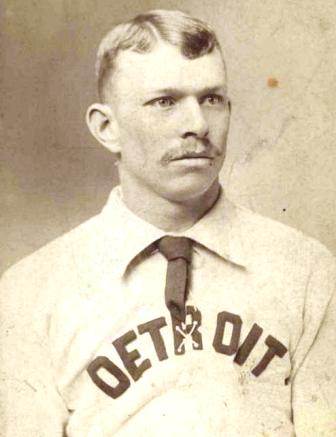
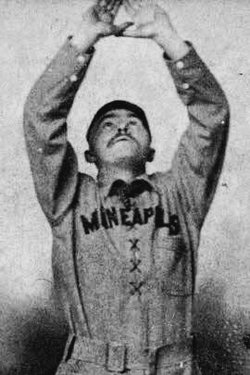
Fred Jevne

Fred Jevne with the Minneapolis Millers, 1889

In December of 1894 Jevne was named to the National League umpiring staff, where his work received mixed reviews.  In June The Baltimore Sun called him “As good an umpire as there is in the business.” In August, after a he worked a game between the Boston Beaneaters and Chicago Colts, The Boston Globe said “Umpire Jevne did poor work, both sides suffering from his yellow decisions.”  The Pittsburgh Press called Jevne’s performance in a September game between the Pittsburgh Pirates and Philadelphia Athletics “By far the worst exhibition of umpiring given this season.”

Jevne was not offered a position in the National League for 1896, and went to work in the Southern Association, where he seems to have a continued his fighting ways.  In July, The Birmingham Age-Herald said Jevne had missed the previous day’s game between the Montgomery Senators and Columbus River Snipes:

“Jevne, the regular umpire, arrived in town last night, but this morning loaded himself up with the spirit of hilarity, got into a fight with a citizen and when the hour for playing arrived was in the hands of the police, and failing to make bond was unavoidably absent from the field.”

Despite his troubles, or because of them, Jevne was asked to join the Interstate League at the end of the 1896 season because, according to The Sporting Life, umpires were losing control of games:

 “(Interstate League President Charles) Powers to-night wired for Fred Jevne the ex-National League umpire, who is so handy with his fists, to report for duty.”

Jevne was not popular with players or the press down south, and said his time in the Southern Association was difficult:

“It was no snap umpiring down South.  Fines didn’t go—were never paid—and so I used to remove men from the game.  Sometimes I would have to take out about half of a team before they would behave, and then the papers would roast me good and plenty the next morning…I had a scrap with a player named (Al) Gifford (Atlanta Crackers shortstop), and punched him in a car going from the grounds.  The local paper came out the next morning and urged the chartering of a special car for the umpire. So that he could be alone in his dignity, and another paragraph hinted that a cigar sign or dummy could be put in the special car for the umpire to punch”

Jevne appears to have returned to the Southern Association for parts of the 1897 and ’98 seasons.  He spent at least part of 1899 and 1900 in his hometown, Chicago, where he worked as an umpire in some college games.  In 1901 Jevne became a Western League umpire and that year met with a violent and mysterious end.

Initial newspaper reports said Jevne had fallen from a third story window in Denver’s Hotel Victor on August 2; he lingered for two days before dying. His body was returned to Chicago and he was buried at Graceland Cemetery.

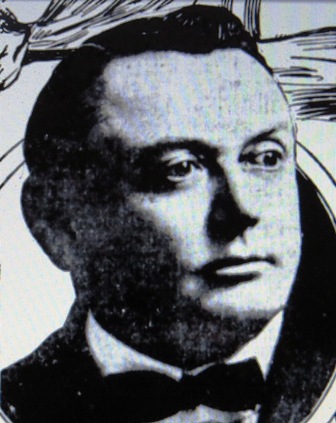
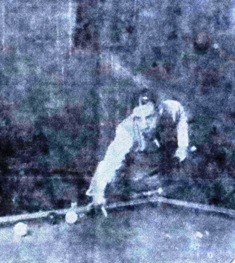
However, several months after his death, Jevne’s brother Lloyd, a well-known three cushion billiard champion, told The Associated Press he was certain he had been murdered, and that before dying Jevne had said he was pushed:

“I saw Fred’s body after it was shipped back to Chicago, where the burial took place, and the most prominent feature of his injuries was the bruise on his nose.  Doctors I saw believe that he was struck across the face with some blunt object… When he was about to die it is not probable he would have told a falsehood.  He would not have said at that time that he had been pushed out the window.”

Lloyd Jevne

Lloyd Jevne

Whether Fred Jevne fell or was pushed from that hotel window has never been positively determined.

Another “Rube”

4 Mar

Hall of Famer “Lefty” Grove and Jack Ogden were the best known pitchers of the great Baltimore Orioles teams that won seven straight International League Pennants from 1919-1925, but in 1923 both were out-pitched by James Arthur “Rube” Parnham.

Parnham began his professional career in 1914 with the Huntington Blue Sox in the Ohio State League.  In 1915 he joined the Raleigh Capitals in the North Carolina State League, managed by Connie Mack’s son Earle.  The 21-year-old was an unspectacular 9-15 for Raleigh, but caught the eye of the elder Mack and spent the spring of 1916 with Jacksonville with the Philadelphia Athletics.

Rube Parnham, 1917

Rube Parnham, 1917

Parnham returned to the North Carolina State League for the 1916 season, splitting time between Raleigh and the Durham Bulls, posting a 17-19; his contract was purchased by the Athletics in late August.  Nearly a month later Parnham made his Major League debut; he appeared in four games for Mack’s last place (36-117) ballclub, he was 2-1 with a 4.01 ERA.

Parnham was with the Athletics in Jacksonville again in 1917, but was sent to Baltimore before the beginning of the season.  He won 16 games for the Orioles and earned one more shot with Mack in Philadelphia; Parnham was 0-1 with a 4.09 ERA in two September appearances.

As Parnham started winning games for Baltimore he developed a reputation as a work horse; in 1917 he won both ends of a double-header against the Rochester Hustlers, pitching a total of 24 innings in two 3-2 victories; in 1919 he won both games of a twin bill twice.   At the same time he began to earn a reputation as “eccentric’ and “erratic,” the inevitable comparisons to Rube Waddell and his small time roots earned Parnham the nickname “Rube,” he was also known as “Uncle.”

Baltimore sold Parnham to the Louisville Colonels in the American Association in March of 1918, but within two months was sold back to Baltimore, where he rejoined manager Jack Dunn, with who he had, and would continue to have, a contentious relationship.  He won 22 games in 1918 and followed with 28 in 1919, leading the Orioles to their first championship since 1908.

As the Orioles jumped out to a quick lead in 1920 (Parnham was 5-0, and was joined on the pitching staff by Ogden and Grove) the erratic Rube Parnham surfaced again. He was prone to disappearing for days at a time and also appears to have been hurt.  By mid-season he was gone.

More recent accounts have said Parnham jumped the Orioles to play semi-pro ball in Pennsylvania; just as likely, Parnham, who was suspended in June by Dunn for being out of shape, and who was clearly overshadowed by Grove (12-2) and Ogden (27-9); as well as Jack Bentley (16-3) and Harry Frank (25-12), was let go.

Lending credence to Parnham not having jumped is a January 1922 Associated Press item that said the pitcher “whose arm went on him” would rejoin “the Baltimores for the 1922 season.  Parnham wrote Dunn that he believed he could come back next season and pitch successfully.”  He won 16 games for the Orioles in 1922.

The following season would be Parnham’s best; the 29-year-old pitcher led the Orioles with a 33-7 record, Grove was 27-10, Ogden 17-12.   In addition to out-pitching his two teammates, Parnham set an international League record by winning 20 consecutive games.

Parnham’s old ways returned before the 1924 season when he failed to report to Florida for spring training.  The Associated Press said:

“Rube never reported at the Oriole training camp in the south and never even deigned to notify Jack Dunn whether he was going to play ball this year.”

Parnham eventually reported, but had another stormy, abbreviated season.  With a 6-5 record and a 4.84 ERA, Dunn suspended the pitcher in June, and he appears to have not pitched for the Orioles again that season.

The only reference to Parnham in 1925 was a May game he pitched for a semi-pro team in Duquesne, Pennsylvania and was beaten 8-0 by the Homestead Grays.

His career appeared to be over, but Dunn, it seems was willing to give his pitcher one more chance.

The Baltimore Sun said shortly before the 1926 season:

“Uncle Rube Parnham, the most colorful figure in the International League, will be back on the mound for the Orioles next season.”

Parnham was 13-9 with a 5.05 ERA, and spent the entire season feuding with Dunn; It was the end of the Orioles dynasty, the Toronto Maple Leafs won the championship in 1926 and Baltimore would not finish first again until 1944.

The Orioles were finally through with Parnham, The Baltimore Sun said:

“There was so much trouble between Parnham and Dunn last year that it was apparent Rube had spent his last season with the Orioles.” “

The 32-year-old was still considered valuable enough that the Milwaukee Brewers in the American Association purchased the pitcher from Baltimore.

The Brewers expected big things from their new pitcher, The Milwaukee Journal said:

“At times his playfulness leads him away from the straight and narrow, and he nearly drove Jack Dunn nutty last season…But Parnham is a great pitcher, despite his eccentricities, and if (Brewers owner) Otto Borchert can hire a good keeper for him is certain to be a winner with the Brewers.”

By March Parnham had worn out his welcome with another manager when he didn’t bother to report to Hot Springs, Arkansas for spring training.  The Journal said:

“Disgusted with the dilatory tactics of Rube Parnham, Jack Lelivelt, boss of the Brewers, hinted Saturday night that unless the eccentric righthander reports at once that he would probably be turned back to Baltimore.  Former International Leaguers …have told the Milwaukee leader about some of Reuben’s idiosyncrasies  and Lelivelt is beginning to feel that he will become a stepsister to Kid trouble if he had the former Oriole on his club.”

Parnham never played for the Brewers, and was returned to Baltimore, but Dunn was finished with him as well and he was shipped off to the Reading Keystones.  After a 2-8 season split between Reading and the Newark Bears, Parnham’s career was over.

rube

Rube Parnham, 1923

Parnham retired to McKeesport, Pennsylvania, where the troubles that followed him throughout his career seem to have continued.  James Bready, an editor for The Baltimore Sun went to Pennsylvania to interview the former Oriole hero in 1961:

“The story was that he had gone downhill. Falling asleep in the snow, recently, he had lost several toes. On the phone, the director of a home for indigents said he would notify Parnham of the interview project. He gave me the street address — and a caution: ‘Try to get here before noon.’

“Paper, pen — I knocked and Rube beckoned me inside what today would be called a shelter. He was wearing an overcoat (I understand that better, now) and had not shaved recently. We sat down, facing, on two of half a dozen cot beds.  I tried a question. ”Gbbmhdahlr,” he replied. I stared at him; slowly, the meaning penetrated. I reached in my pocket and handed him a dollar.”

Parnham died two years later in McKeesport.

Veeck and Paige–a third time?

27 Feb

In 1959, when Bill Veeck purchased the White Sox rumors swirled in Chicago that the Sox owner was planning on having Satchel Paige start on Opening Day. Later, as the Sox were making a run for their first American League Pennant in 40 years the rumors resurfaced that the ageless Paige would join the White Sox for the Pennant run.

???????????????????????????????

Bill Veeck and Satchel Paige, 1959

Paige, who had played for Veeck with the Cleveland Indians and St. Louis Browns, had spent 1956-59 with the Miami Marlins in the International League, winning 31 games. He had returned to barnstorming with the Cuban Giants and Indianapolis Clowns in 1959, but it was reported he was looking for another chance in the Major Leagues, and in June it began to be reported again that Paige would be joining the Sox.

A United Press International story in July said that Veeck had “sent Paige two new Chicago White Sox uniforms,” and quoted Paige:

 “If they want me they’d have to pay me big money.  I’m not going back for nothing.”

Whether it was ever a serious discussion, or simply two famous showmen milking rumors for the maximum publicity will never be known, but Veeck and Paige let the rumors swirl well into August before Veeck finally put them to rest, telling Jet Magazine:

“We’re not giving any thought to hiring him.  I’m very fond of LeRoy and I see him whenever he’s in town.  I gave him the uniforms because we’re old friend and for no other reason.”

And with that White Sox fans missed the chance to see the pitcher who Veeck called “The best righthander baseball has ever known,” pitch for the 1959 Pennant winners.

“King of the Natural Hitters”

25 Jan

Percival Wheritt “Perry” “Moose” Werden began his baseball career as a pitcher for the semi-professional team of his employer; the Ira Perry Pie Company in Saint Louis.  He was discovered by the St. Louis Browns who offered him a contract but ultimately signed with the Saint Louis Maroons in the Union Association.

(An oft-repeated story that Werden’s discovery involved him leaving a pie wagon unattended to join a game, resulting in the wagon being destroyed is almost certainly apocryphal, although it has been repeated as fact with little or no support by several writers)

In 1884 the 22-year-old was 12-1 with a 1.97 for the Maroons who at 94-19 won the Union Association pennant by 21 games; despite the strong start, Werden would never pitch in the Major Leagues again.

The Maroons joined the National League the following season and Werden ended up with the Memphis Reds in the Southern League.  He was primarily a catcher a first baseman, and his career as a pitcher pretty much ended; he appeared on the mound in only three games that season and had only 14 more minor league appearances over the next 10 years because of arm trouble.

Perry Werden, 1908

Perry Werden, 1908

From 1886-88, Werden played with five minor league teams and played three games in the National League with Washington in 1888.  In 1889, Werden joined the Toledo Black Pirates in the International League, where he became a great hitter.

Werden hit .394 for Toledo; in 424 at-bats, he had 167 hits, which was the hit record for the franchise for nearly 100 years, finally broken by Greg “Boomer” Wells in 1982 (Wells had 182 hits in 541 at-bats).

Toledo became a Major League franchise the following season, joining the American Association as the Maumees, Werden was the their starting first baseman, hit .295 and led the team in hits, runs, triples, and RBIs.  The Maumees finished 68-64 in their only season.

Werden was sold by Toledo to the Baltimore Orioles in 1891 and had another solid season, leading the team in hits, triples and RBI’s.  The following season he was signed by the Saint Louis Browns to replace Charles Comiskey at first base; Comiskey had jumped the Browns to join the Cincinnati Reds.

Werden hit .256 and .290 in two seasons with the Browns.  In 1894, he returned to the minor leagues with the Minneapolis Minnies in the Western League.  That’s where he became a legend.

In 1894, Werden exploded.  He hit .417 with 43 home runs.  In 1895, he improved to .428 with 45 home runs.

The Western League was no doubt a hitter’s league; eight players with at least 100 at-bats hit .400 or better in 1894 and 11 did so in 1895.  And the Minnies home field, Athletic Park, where Werden hit most of his home runs, was by all estimates a hitter’s paradise with a short (some sources say 250 feet) fence.

Regardless, 45 home runs would remain a professional baseball record until 1920. The Duluth News-Tribune said several years later that Werden hit seven home runs in a double-header in 1895; under the headline “Perry Werden was King of the Natural Hitters:”

“It was one of the greatest batting feats ever seen on a baseball lot anywhere.”

Werden had one last season in the Major Leagues.  At 35-years-old in 1897, he hit .301 for the Louisville Colonels, then returned to the minor leagues where he continued to hit well; .330 for his minor league career.

Werden became an umpire in the American Association in 1907, and became a baseball pioneer in 1908 when he joined the Indianapolis Indians in the same league; he was one of the first full-time coaches in professional baseball.  The Associated Press said:

“Perry Werden will go to Indianapolis to act as assistant manager, coach and advisor in general of the Indianapolis baseball club this year.”

In October The Indianapolis News declared Werden a success in the new role:

“Werden was one of the biggest factors in bringing Indianapolis her first pennant since 1902.  Without his services it’s highly probable the flag would have flown elsewhere”

The Indianapolis Star predicted that Werden’s “novel position,” would become the norm with the Indians, and throughout baseball.

Werden eventually returned to umpiring, working in the western, Dakota, South Dakota and Northern leagues.

His 43 home run season became news again in 1920 as Babe Ruth was closing in on Werden’s professional record.  Werden said there was one player in his era who was Ruth’s equal as a hitter.  Who was it?

Read about it on Monday.

Zimmer Rules

20 Dec

After Charles “Chief” Zimmer’s single, difficult season managing the Philadelphia Phillies he briefly became a National League umpire.

Reports said the adjustment from player and manager to umpire were difficult at first.  According to a brief story that appeared in several newspapers on the eve of Opening Day:

“Chief Zimmer umpired the Pittsburgh-Little Rock game last week, but he could not resist coaching the players, for he forgot himself once in the third inning and yelled ‘Look out!’ to (Tommy) Leach when Little Rock was trying to catch him off first.”

But by May he seemed to have eased into his new position, telling reporters:

“I hesitated about taking up the work, knowing that the life of an umpire is supposed to be filled with anything but joy.  However, I can honestly say that I am more than pleased with the experience thus far.  I have had no trouble at all, and players and spectators have accorded me the best treatment.  I don’t think I’d give up my present work to go back to catching.”

In September The Pittsburgh Press said there was “No doubt (Zimmer) will be reappointed,” as a National League umpire in 1905, but by January it was announced that he had not been retained.

Zimmer entertained offers to play for the Toledo Mud Hens of the American Association and the Rochester Bronchos of the Eastern League, but instead took a position as an Eastern League umpire.

He returned as a player/manager the following season with the Little Rock Travelers in the Southern Association.

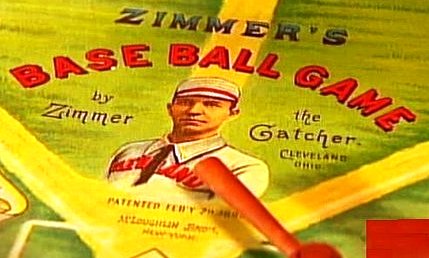
Through it all Zimmer was one of baseball’s earliest and best self-promoters.  In addition to endorsing Zimmer’s Baseball Game and his cigars, produced in what The Sporting Life said was “an extensive cigar factory in Cleveland.”  Zimmer always talked to reporters and always gave them something to write about, including his ideas for rule changes.

Zimmer's Baseball Game

Zimmer’s Baseball Game

In 1905 The Pittsburgh Press said “’Chief’ Zimmer has a scheme which he thinks would increase batting without abolishing the foul strike rule.” (The “scheme” was not Zimmer’s idea; it had been advocated by some for more than two decades, including “Cap” Anson and Zimmer’s former boss, Cleveland part owner Davis Hawley).  The plan would:

“Increase the territory of the fielders without increasing the length of the base lines…new foul lines (would be) drawn from the home plate to the fences.  At the point where they would pass first and third bases the lines would be six feet distant from the bases, gradually increasing the distance from the present foul lines as they neared the fences.”

Later he can out in favor of abolishing the foul strike rule when the issue was briefly discussed in the aftermath of the relatively low-scoring 1905 World Series.

In 1909 Zimmer suggested another rule; this one would essentially eliminate intentional walks by allowing any man on base to advance one base after a walk.  Zimmer said:

“It’s not right for a pitcher to take away Lajoie’s chance of hitting by walking him when there are men on bases.  I saw Larry passed four times in two games last fall.  He was paid to hit with the men on bases…Pitchers would have to put the ball over and the good batters would get a chance to do what they are paid for.”

Luckily like most of the other odd rule changes suggested during baseball’s first several decades, Zimmer’s “schemes” received little traction as both would have radically altered the game.  But Zimmer’s rules did succeed in accomplishing what they were most likely intended to do: they kept Zimmer’s name in the paper long after his career was over.

A final post on Zimmer and, perhaps, his greatest contribution tomorrow.

Jack Ogden

28 Sep

John Mahlon Ogden had limited success in three stints in Major League Baseball, but for an eight year period he was one of the greatest minor league pitchers in history.

Born in 1897, Ogden played baseball at Swarthmore College (where his brother, Major League pitcher Warren “Curly” Ogden also played), and went directly to John McGraw’s New York Giants.  The 20 year old appeared in five games for the Giants before being shipped to the Newark Bears in the International League where he went 5-5 with a 1.48 ERA.  Ogden spent 1919 with the Rochester Hustlers posting a 10-13 record with a 2.37 ERA.

His career took off the next season with the Baltimore Orioles.  The 22 year old Ogden led the International League champions with a 27-9 record—future Hall of Famer Lefty Grove was 12-2 for the O’s that year.  Egan followed that up with an incredible 31-8 record with a 2.29 ERA in 1921.  Beginning on May 10 Ogden won 18 straight decisions, finally losing 3-2 to the Jersey City Skeeters on July 22.  Ogden then won his next five starts.  Baltimore won their third of seven straight IL championships (Grove was 25-10 with a 2.56 ERA).

Over the next six seasons Ogden went 133-63, including a 28-win season in 1925, the last championship in Baltimore’s domination of the International League.

Jack Ogden

Ogden made it back to the Major Leagues with the Saint Louis Browns in 1928 and ’29 where he was a combined 19-24 with an ERA above 4. Ogden was acquired by Cincinnati for the 1930 season, but due to an illness he announced his retirement and took a high school coaching job.

Ogden attempted a comeback in 1931, going a combined 6-10 for the Reds in ’31 and ’32, followed by two more minor league stints with Rochester (after being traded by the Reds to Cardinals) and Baltimore.  He retired for good in 1934 and accepted the position of Vice President and General Manager of the Orioles and became assistant to Philadelphia Phillies President Gerald Nugent in 1939.

In 1941 Ogden bought controlling interest of the Elmira Pioneers in the Eastern League.  His son, John Jr., also a star pitcher and basketball player at Swarthmore, helped Ogden operate the team until he was drafted in 1943.   PFC John Mahlon Ogden Jr. was killed in France on August 8, 1944. Ogden sold the Elmira franchise shortly after his son’s death.

Ogden continued in baseball serving as a scout for a number of teams and managed high school and college teams.  He passed away in 1977 in Philadelphia.

Ogden is a member of the International League Hall of Fame.

Filling in the Blanks—Fletcher Hodge, Fletcher Hodges

29 Aug

Baseball Reference lists Fletcher Hodge, a pitcher for Cleveland, Tennessee in the Appalachian League in 1921 and Grand Rapids in the Michigan-Ohio League in 1924, and Fletcher Hodges appearing in six games with the Rochester Tribe in the International League in 1924.   He was the same player, with a life that spiraled out of control after an arm injury.

Born Ernest Fletcher Hodge (various sources give his birth date between 1898 and 1900) in Advance, Missouri, Hodge pitched for local teams around Sikeston, Missouri. There’s no record of how big Hodge was, but newspaper stories described him as “The giant righthander.”

He went 8-11 in the Appalachian League in 1921 and there is no record of him in professional baseball again until 1924.  Hodge was 9-6 with 3.00 ERA in 16 games at Grand Rapids when his contract was purchased by Rochester.

Hodge appeared in six games with Rochester.  Although no statistics exist, it is clear Hodge did not pitch well in the International League.  When his contract was sold to Terre Haute in the Three-I League in August the Rochester Journal said “In all his starts with the Tribe he was wild as a tornado.”  Hodge also reportedly injured his arm while with the Tribe.

Shortly after his contract was sold to Terre Haute, Hodge had his first confirmed brush with the law; he was arrested in Cincinnati for attempting to pass several bad checks drawn on a Rochester bank.  There’s no record of the disposition of the case, but it was reported that Rochester owner Walter Hapgood had interceded to get the charges either reduced or dropped (depending on the source).

In either case, Hodge never played for Terre Haute or Rochester and it appears he never played professionally again, although there were at least five pitchers identified only as “Hodge” who pitched for various teams from 1925-27. (here, here, here, here, and here)

By 1930 Hodge was living in Sikeston, Missouri.  On the evening of June 13 he went to a rooming house in Blytheville, Arkansas where his wife was visiting her mother.  Hodge shot and killed his wife Anna and fired four shots at his mother-in-law, who escaped injury.  He escaped to Sikeston and then Poplar Bluff, Mo before being taken into custody.

Hodge’s trial was scheduled to begin on November 4, 1930 when he instead pleaded guilty and was sentenced to life in prison.  There is no record of Hodge’s death, or if he was ever released from prison.