Tag Archives: Louisville Colonels

Sammy Strang

5 Nov

Samuel Strang Nicklin, “The Dixie Thrush,” was one of baseball’s great renaissance men.

Born in Tennessee in 1876, he was the scion of one of Chattanooga’s most prominent families.  His father John Bailey Nicklin served in the Union Army during the Civil War, moved to Chattanooga in 1866, and served as mayor from 1887-1889.
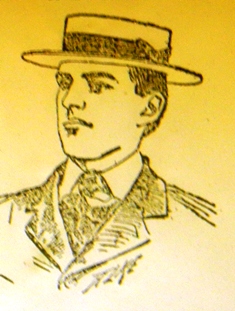
Sammy Strang

Samuel Nicklin spent one year at the University of Tennessee where he starred on the football and baseball teams. He also had two short stints in professional baseball 1893 and 1896, which included 14 games with the Louisville Colonels in the National League when he was 19.  Late in 1896, he enlisted as a private in the Tennessee Volunteers, served in Spanish-American War and rose to the rank of captain.

After leaving the service, Nicklin signed a contract with Cedar Rapids Bunnies in the Western Association and dropped his last name; he was known as Sammy Strang for the rest of his career.

The Milwaukee Journal said of the name change:

“(Strang) came of a rich southern family with deep prejudices against professional ball.”

This “prejudice” likely had nothing to do with it given that in addition to serving as Chattanooga mayor, the elder Nicklin was active in professional baseball, serving as president of the Southern Association in the 1890s.

A career .269 hitter, Strang was best known for being one of baseball’s first regular pinch-hitters while playing for John McGraw’s New York Giants from 1905 until June of 1908.  According to The Associated Press:

“McGraw noted the regularity with which he hit in pinches.  So he called him a ‘pinch hitter’—and the term stuck.”

During the 1909 season, Strang began coaching the baseball team at West Point.  He retired from baseball after playing from 1908-1910 with the Baltimore Orioles in the Eastern League, to study opera.
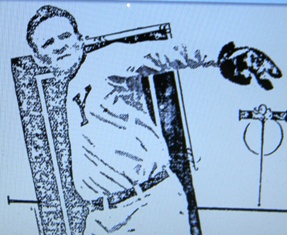
Sammy Strang

During his baseball career, Strang was known for writing songs and singing but decided to seriously pursue a music career in 1910.  He traveled to Paris where he trained under Jean De Reszke, one of the greatest male opera stars of the 1890s.

Upon returning from Paris, he chose not to accept an offer to join an opera company and instead returned to West Point, where he continued as coach until 1917.

Strang returned Tennessee shortly before his father’s death in 1919 to manage and take over ownership of the struggling Chattanooga Lookouts in the Southern League.  While the Lookouts did not win a league championship during Strang’s tenure, he was credited with turning the franchise around and sold the team, for which he paid nothing 1919, for a reported $75,000 in 1927, while retaining ownership of the stadium, Andrews Field.

Unfortunately, Strang’s most ambitious plan–to sign Satchel Paige in 1926–never materialized.

According to Larry Tye’s book “Satchel Paige: The Life and Times of an American Legend,”   Strang failed in an attempt to sign Paige for $500 to pitch a game against the Atlanta Crackers. Paige said of the deal:

“I just had to let him paint me white.”

Samuel Strang Nicklin died in Chattanooga in 1932.
Cooney Snyder

22 Oct

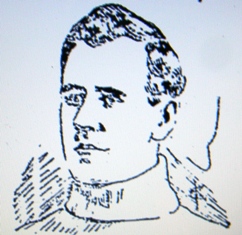
“Cooney” Snyder‘s Major League career lasted only 17 games for the 1898 Louisville Colonels in the National League.

Born in Canada in 1873, Abraham Conrad Snyder was most frequently identified as “Frank” Snyder during his career.

Snyder played in the Western Association in 1884 and he is mentioned frequently in contemporaneous news stories as a member of the 1885 Guelph Maple Leafs in the Canadian League, although no records survive.

Snyder earned his shot in the Major Leagues after hitting .333 for the London Cockneys in the Canadian League and .340 for the Toronto Canucks in the Eastern League in 1897.

The Sporting Life said, “Snyder is credited with an extraordinary throwing arm as well as a strong swing as a batsman,” and attributed his strength to the job he held before playing professional ball:

 “Snyder acquired this strength in a peculiar way.  Before he became proficient in base ball “Cooney” was a keeper in a Canadian insane asylum. His daily task was to wrestle with the patients who showed a desire to buck against the rules of the institution.”

Snyder was Drafted by the Washington Senators, then sold to the Colonels before the 1898 season.  After hitting a disappointing .164, Snyder was released by Louisville and returned to the Canucks, then finished the season with the St. Thomas Saints in the Canadian League.

Snyder finished his career with the Reading Coal Heavers in the Atlantic League in 1899.

“Cooney” Snyder, 1899

After the 1899 season, it was reported by The Reading Eagle that Snyder had accepted a job at a hotel owned by former major leaguer, and Reading resident Larry Ressler.  The article said Snyder was “Considering offers from several Eastern League teams,” but it appears he never played again.

Snyder made the news one more time before eventually returning to Canada and passing away there in 1917; in December of 1899 when The Reading Herald reported on Snyder’s heroic actions during a factory fire at the Nolde and Horst Hosiery Mill:

 “For nearly an hour he stood under a burning building breaking the fifteen-foot fall of many factory girls, who were penned in the blazing structure like rats in a trap. His position was one of the greatest peril, as red hot brick and burning embers were failing all around him.”

The Reading Times said he caught at least six women in this manner.

A Really Bad Idea

19 Oct

James Aristotle Hart (his middle name is incorrectly listed as Abner on Baseball Reference) was an influential figure in shaping baseball’s rules.

Hart managed the Louisville Colonels in 1885 and ’86.  He then purchased the Milwaukee franchise in the Western League, and helped A.G. Spalding organize the first baseball teams to go on world tours.  He returned to the National League to manage the Boston Beaneaters in 1889.

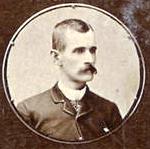
James Hart, 1886

In 1890 he went to England and Scotland to help launch a professional baseball league, and upon his return he became secretary of the Chicago Colts and served as an intermediary in the 1890 fight between the National League the nascent Players League.  He became president of the Chicago club the following year, succeeding Spalding, and served in that capacity until 1905.

The New York Times said:

“Many rules now deemed indispensable were championed by Hart.  The foul strike rule, one of the most important, was his final effort in the rule making.  He was largely responsible for…defining the coachers’ box, changing the pitchers’ box and substituting the slab, altering the shape of the home plate, requiring the catcher to play close up to the plate all the time, abolishing the foul tip and covering the players’ bench.”

One rule that Hart considered seriously enough to release to the press “with earnest request for publication and comment,” would have completely changed the game as we know it.

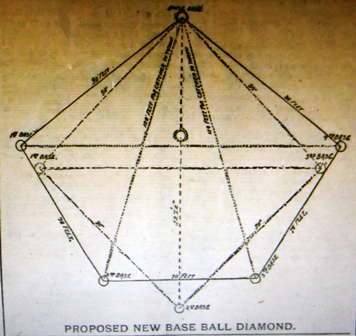
The idea, proposed by a man from Rollo, Missouri named Cliff Spencer and submitted to Hart, called for a redesign of the baseball diamond.

The Sporting Life said of the design:

“The proposed new diamond is a startling innovation, but the more it is studied the more favorably it impresses.”

The new diamond would increase the number of bases from three to four and while the distance between the bases would remain 90 feet:

“(T)he new base lines would throw first and fourth bases about ten feet further out than the present base lines. Thus making a very much larger area for fair balls.”

After several more paragraphs espousing the virtues of the new design, The Sporting Life concluded:

“No decided disadvantages are apparent in this proposed new diamond except that it may operate to the extreme in batting, base running and run-scoring.  (The) objection, could however be easily overcome by deadening the ball somewhat more should the batting become too heavy.”

The article concluded:

“The proposed new diamond, if adopted, would be a radical innovation.  But it maybe that a radical remedy is requisite to restore the base ball patient to entire health and vigor. It is generally conceded that some changes in the game are urgently needed in order to make it more attractive, to lift it out of the rut of pitcher-domination.”

Diagram of the proposed new diamond laid over traditional diamond–home plate is at the top.

Even the glowing review of the proposed plan in The Sporting Life stopped short of absolutely endorsing the idea:  “It is not intended here to advocate, either reservedly or unreservedly, the adoption of this radical innovation,” because it was conceded that there were much less radical measures that could be adopted to increase run production.

Within a week The Sporting Life, and every other newspaper who had published a story about the new diamond concept, had concluded that the idea would never be adopted.

Hart, a long time advocate of increasing run production, was not known to have ever again commented on the new diamond.