Tag Archives: New York Giants

Filling in the Blanks— H. Pipp

1 Nov

Baseball Reference lists H. Pipp with the 1887 Big Rapids team in the Northern Michigan League.  Five years later he became a minor sensation in Chicago.

In January of 1892 Cap Anson announced that he had found a new second baseman for the Chicago Colts.  The signing of Henry L. Pipp of Kalkaska, Michigan was described by The Sporting Life:

“The good Captain dug up his latest phenom in the wilds of Michigan…Pipp is 26 years old, 6 ft. 2 in. high 205 pounds heavy, and as quick as a cat.”

The Chicago Daily News called Pipp “Anson’s great find.”

The Chicago Tribune was less impressed, and concerned that the untested Pipp might replace the popular Fred Pfeffer (sent to Louisville after a dispute with Anson) at second base:  “That would be a dangerous thing to do.  Second base is key to an infield as Anson learned to his cost in 1890,” (the Colts finished in second place with Bob Glenalvin at second after Pfeffer jumped to the Players League).

In March Pipp went to Hot Springs, Arkansas with the Colts, but the reviews were not good.  New York Giants shortstop “Shorty” Fuller said:

“Anson’s team (can’t win) unless he gets a second baseman.  He must have a man to take Pfeffer’s place that can play ball.  That man Pipp won’t do.  We played against him at Hot Springs and he is slower than molasses in January.”

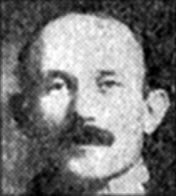
Henry Pipp
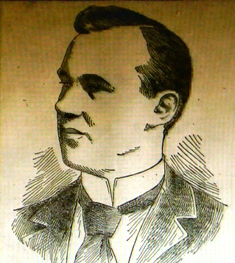
With much less fanfare than his signing, Pipp was quietly let go before the season began, the Tribune simply said, “Pipp could not play the position.”

Henry Pipp returned to Michigan.

He owned a hardware store, received a U.S. patent in 1917 for a “Holding device” he invented, and played baseball for more than 20 years in Michigan based leagues.

There is another “Pipp” listed on the 1887 Big Rapids roster—it is most likely Pipp’s brother William.

William left Michigan in the early 1890s for Chicago.  His son, Henry’s nephew, became famous as the man replaced as New York Yankees first baseman by Lou GehrigWally Pipp.

Henry Pipp died in Benton Harbor, Michigan on February 16, 1936.
Tom Colcolough

26 Oct

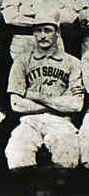
Thomas Bernard “Coke” Colcolough (his name was pronounced “Cokely”) posted a 14-11 record in parts of four seasons in the National League with the Pittsburgh Pirates and News York Giants.

His greatest baseball achievement has been lost to history.

Before the 1893 season, professional baseball eliminated the five and a half by four-foot pitcher’s box and replaced it with the rubber, while moving the distance to the current 60 feet, six inches.  Intended to increase offense the change had the desired effect increasing batting averages throughout baseball.

Not everyone immediately took to the new rule.  The Boston Globe and Cleveland Plain Dealer predicted the rule would be eliminated.  They were wrong, it was there to stay.

One consequence of the new rule was the sharp decline in no-hitters.  In the National League seven no-hitters were thrown between 1890 and 1892.  From the beginning of the 1893 season until Cy Young’s in September of 1897, there was but one:  On August 16, 1893, Bill Hawke of the Baltimore Orioles no-hit the Washington Senators.

Hawke’s was not the first professional no-hitter after the change.  That belonged to Charleston Seagulls pitcher Tom Colcolough on June 23 against the Montgomery Colts in the Southern Association.  The Sporting Life said:

“Colcolough, the rising young pitcher of the Charleston Club, has the honor of being the first pitcher under the new rules to dispose of an opposing team without a safe hit in a full game.  He accomplished the feat against the hard-hitting Montgomerys.”

Colcolough was 16-11 for Charleston and earned his first trip to the Major Leagues.   Prone to wildness (166 walks in 319 1/3 Major League innings), Colcolough was returned to the minor Leagues in 1895, pitching for the Wilkes-Barre Coal Barons in the Eastern League from 1895 through 1898.

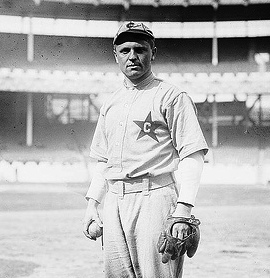
Tom Colcolough

Colcolough earned one more shot in the National League with the Giants in 1899 posting a 4-5 record.  He was sent to Jim O’Rourke’s Bridgeport Orators in the Connecticut League in July and was released at the end of the season.

Colcolough returned to Charleston, South Carolina and served as a city councilman.  He passed away there in 1919.

A Thousand Words

25 Oct

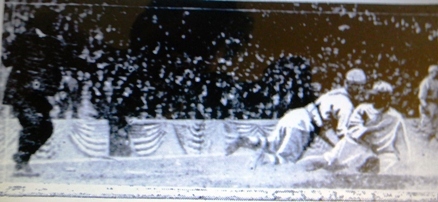
Occasionally you come across a photo that hasn’t been published anywhere in almost 100 years.  This one is from game 2 of the 1917 World Series.  New York Giant rightfielder Dave Robertson slides past Chicago White Sox Hall of Fame catcher Ray “Cracker”  Schalk, beating the throw home to score the first run of the game.  The umpire is Hall of Famer Billy Evans, “The Boy Umpire,” who at 22-years-old in 1906 became the youngest umpire in Major League history.

The White Sox went on to win the game 7-2 and won the series in 6 games.

Jack Ogden

28 Sep

John Mahlon Ogden had limited success in three stints in Major League Baseball, but for an eight year period he was one of the greatest minor league pitchers in history.

Born in 1897, Ogden played baseball at Swarthmore College (where his brother, Major League pitcher Warren “Curly” Ogden also played), and went directly to John McGraw’s New York Giants.  The 20 year old appeared in five games for the Giants before being shipped to the Newark Bears in the International League where he went 5-5 with a 1.48 ERA.  Ogden spent 1919 with the Rochester Hustlers posting a 10-13 record with a 2.37 ERA.

His career took off the next season with the Baltimore Orioles.  The 22 year old Ogden led the International League champions with a 27-9 record—future Hall of Famer Lefty Grove was 12-2 for the O’s that year.  Egan followed that up with an incredible 31-8 record with a 2.29 ERA in 1921.  Beginning on May 10 Ogden won 18 straight decisions, finally losing 3-2 to the Jersey City Skeeters on July 22.  Ogden then won his next five starts.  Baltimore won their third of seven straight IL championships (Grove was 25-10 with a 2.56 ERA).

Over the next six seasons Ogden went 133-63, including a 28-win season in 1925, the last championship in Baltimore’s domination of the International League.

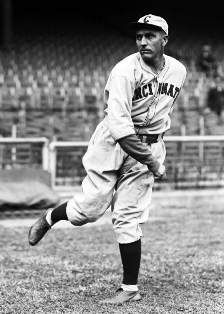
Jack Ogden

Ogden made it back to the Major Leagues with the Saint Louis Browns in 1928 and ’29 where he was a combined 19-24 with an ERA above 4. Ogden was acquired by Cincinnati for the 1930 season, but due to an illness he announced his retirement and took a high school coaching job.

Ogden attempted a comeback in 1931, going a combined 6-10 for the Reds in ’31 and ’32, followed by two more minor league stints with Rochester (after being traded by the Reds to Cardinals) and Baltimore.  He retired for good in 1934 and accepted the position of Vice President and General Manager of the Orioles and became assistant to Philadelphia Phillies President Gerald Nugent in 1939.

In 1941 Ogden bought controlling interest of the Elmira Pioneers in the Eastern League.  His son, John Jr., also a star pitcher and basketball player at Swarthmore, helped Ogden operate the team until he was drafted in 1943.   PFC John Mahlon Ogden Jr. was killed in France on August 8, 1944. Ogden sold the Elmira franchise shortly after his son’s death.

Ogden continued in baseball serving as a scout for a number of teams and managed high school and college teams.  He passed away in 1977 in Philadelphia.

Ogden is a member of the International League Hall of Fame.

“The Phlinging Pharmacist”

15 Aug

In addition to having one of the best names in the history of organized baseball, Phifer Fullenwider had one of the best nicknames also.

A minor league pitcher for 13 seasons, Fullenwider went to spring training with the New York Giants in 1912 after a 26-9 record the previous season for the Columbia Commies in the Sally League.

Phifer Fullenwider

A Pharmacist in the off season, Fullenwider was a fan favorite in Buffalo, where he pitched four full seasons and part of a fifth for the Bisons in the Eastern League, including a 20-win season in 1913.

The Buffalo fans and sportswriters tagged him with the sobriquet “Phifer Phullenwider the Phlinging Pharmacist.”

Fullenwider pitched until 1923 compiling a record of 192-135.  Born in Rowan, North Carolina December 13, 1886, after his playing days he returned to North Carolina where he died in Durham on June 15, 1982.

“The Greatest Play Ever Made”

2 Aug

Most fans know that the first confirmed major league unassisted triple play was turned by Neal Ball of the Cleveland Naps July 19, 1909, and that one credited to Paul Hines of the Providence Grays against the Boston Red Caps May 8, 1878 has been disputed.

What most don’t know is that the first confirmed unassisted triple play in professional baseball was turned on August 18, 1902 by Hal O’Hagan of Rochester in an Eastern League game in Jersey city, New Jersey.  The New York Times called it “The Greatest Play Ever Made in Baseball.”

Patrick Henry “Hal” O’Hagan had two brief stays in the major leagues.  He played in one game as a twenty-two-year-old rookie with Washington in 1892, and trials with Chicago and New York in the National League and Cleveland in the American League in 1902.

After being released by the Giants in mid-July, O’Hagan was signed by Rochester to manage and play first base.

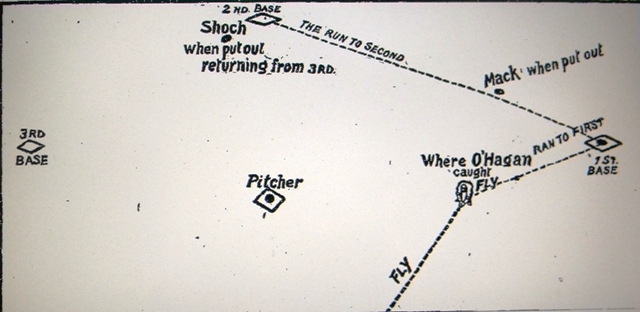
John Butler was batting for Jersey City with George Shoch on second and “Mack” on first (every contemporary newspaper account identified the runner on first this way, it was probably catcher/1st baseman Frank McManus).  Butler attempted a sacrifice bunt as The Times reported “O’Hagan ran in and caught the ball within a few inches of the ground, a seemingly impossible catch.”

According to the glowing account: “Having in his quick-thinking mind the possibility of a triple play, O’Hagan, with the coolness and agility which are part of a baseball player’s earning capacity, ran back and placed his foot on the initial bag thus completing a double play.”  O’Hagan then ran to second as Shoch returned from third, “It was a hot race, but O’Hagan, ball in hand, reached the bag first, thus dismissing the side.”

Diagram of the play published in The New York Times and several newspapers across the country

O’Hagan continued playing until 1908, finishing his career with Lynn in the New England League.  He passed away on January 14, 1913 in Newark, New Jersey at 43 years old.