
0.000000
0.000000
On July 19, 1920, Babe Ruth hit his 30th home run of the season off Dickie Kerr of the Chicago White Sox, breaking the Major League record he had set the previous season. Perry Werden, working as an umpire in the South Dakota League was largely forgotten.
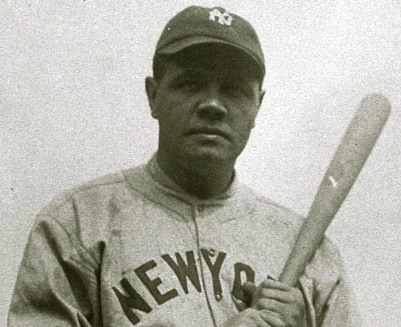
Babe Ruth
The Minneapolis Tribune, as a point of local pride, reminded readers that Ruth had not eclipsed the record set in their town:
“Beyond all doubt the mark made yesterday is a major league record of all time but the Babe has yet to equal the mark of 45 made by Perry Werden of the Minneapolis Western League club in 1895.”
Some reporters, like Al Spink of The Sporting News, dismissed Werden because “the park at Minneapolis, which was an unusually small inclosure (sic), with the right and left field fences close in.” Regardless, Werden was back in the public eye; his forgotten record was revived as fans followed Ruth’s record season. The Associated Press said:
“(Werden) admits that Babe Ruth has a harder swing than he had when he made his mark. ‘There is no doubt that Babe has it on all of them—modern and ancient’ says Werden”
When Ruth hit numbers 45 and 46, one in each game of a double-header at Fenway Park, The Associated Press said:
“(Ruth) broke all known world’s records for circuit drives in a single season.”
Werden, in his role as “the former holder of the home run record for organized baseball” was often asked about Ruth over the next decade. Werden called Ruth “One of the two greatest sluggers that I have seen in fifty years.”
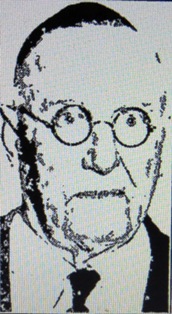
Perry Werden, 1930
The only player Werden considered Ruth’s equal? Ed Delahanty.
Werden told The North American Newspaper Alliance, in a nationally syndicated story:
“Ed Delahanty would have equaled or bettered the home run record of Babe Ruth if the lively ball had been in use…If Delahanty had any weakness no pitcher ever found out what it was. He hit left-handers as easy and effectively as he did right-handers, and it made no difference to him where they threw the ball—high, low, inside, outside, curve fast ball or slow ball—they all looked alike to Big Ed.”
Werden said while playing first base for the Saint Louis Browns he saw just how hard Delahanty could hit:
“The Phillies had a runner on first base, and when Delahanty came up to bat we played in close for him, thinking he would bunt. That was a mistake we never made again when Delahanty batted. Instead of bunting he hit a ground ball so hard that it tore a shoe off George Pinkney, our third baseman, in addition to fracturing his right ankle.”
As further proof Werden said “Even with the lively ball…it was thirty-six years before Delahanty’s record of hitting four home runs in a single game was equaled by Lou Gehrig.” Werden didn’t mention that Bobby Lowe had accomplished the same feat two years before Delahanty.
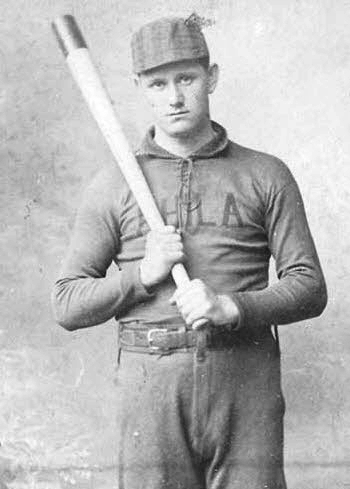
Ed Delahanty
While Werden will never join Delahanty and Ruth in the Hall of Fame, he is remembered as one of the greatest minor league players of the 19th Century. He died in Minneapolis in 1934.
James Timothy Burke had a stormy tenure with the Saint Louis Cardinals from 1903-1905, including a disastrous 35-56 record as player-manager in 1905, replacing Kid Nichols (who remained on the pitching staff)—Burke resigned in August, and the Cardinals were in such disarray that owner Stan Robison eventually took over the team for the remainder of the season.
Burke had been with five teams from 1898 through 1902 before being traded to the Cardinals.
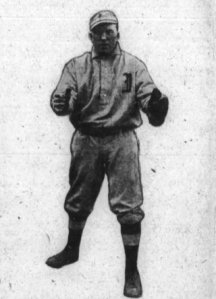
Jimmy Burke
During his time with the Cardinals Burke had various fights and feuds, it was said he was the ringleader in a group of players trying to undermine manager Patsy Donovan in 1903; he had a long-standing feud with shortstop Dave Brain and the two seldom spoke, and he feuded with Robison throughout his short tenure as manager. After his resignation he said:
“When I took charge of the team it was with the understanding that I was to be manager or nothing. I have suffered as Donovan and Nichols with too much interference.”
Burke also had trouble with a Saint Louis sportswriter named Joe Finnegan. Their contentious relationship came to a head at the Victoria Hotel in Chicago in September of 1904 after Finnegan had written an article in which he called Burke “a cow’s foot,” (apparently those were fighting words circa 1904).
The Pittsburgh Press provided the colorful blow-by-blow of the fight:
“First round–Burke hit Finnegan in the lobby, and followed the blow with a left hook on the back of the neck, breaking the scribe’s collar. Burke pressed the advantage and struck Finnegan near the cigar stand. Finnegan blocked cleverly, uppercut with the left and caught Burke in the snout. Finnegan crossed his right and landed on Jimmy’s potato-trap. Burke jolted Finnegan in the rotunda and followed with a short swing near the Turkish parlor. Finnegan shot the right to the ear, and the left to the lamp. They clinched. Terrific short-arm fighting, completely wrecking Finnegan’s collar and cuff. Johnny Farrell separated the men. Time.
“Second round—The house detective threw both fighters out in the alley. Time. Decision to Finnegan.”
Burke’s Major League career ended after the 1905 season. New Cardinal manager John McCloskey said he wanted to retain Burke as his third baseman, but Robison, against his manager’s wishes (and continuing the pattern which led papers to call Cardinals managers “figureheads”) waived Burke.
Burke became a successful minor league manager and returned to the Major Leagues as a coach with the Detroit Tigers in 1914. He also served as a coach with the St. Louis Browns and managed the team for three seasons.
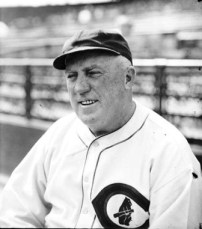
Jimmy Burke, Cubs coach
Burke served as Joe McCarty’s right hand from 1926-1930 with the Chicago Cubs and followed him to the New York Yankees where they continued together until a stroke necessitated Burke’s retirement after the 1933 season. McCarthy had played for Burke with the Indianapolis Indians in the American Association in 1911.
Burke died in St. Louis in 1942.
Baseball Reference lists H. Pipp with the 1887 Big Rapids team in the Northern Michigan League. Five years later he became a minor sensation in Chicago.
In January of 1892 Cap Anson announced that he had found a new second baseman for the Chicago Colts. The signing of Henry L. Pipp of Kalkaska, Michigan was described by The Sporting Life:
“The good Captain dug up his latest phenom in the wilds of Michigan…Pipp is 26 years old, 6 ft. 2 in. high 205 pounds heavy, and as quick as a cat.”
The Chicago Daily News called Pipp “Anson’s great find.”
The Chicago Tribune was less impressed, and concerned that the untested Pipp might replace the popular Fred Pfeffer (sent to Louisville after a dispute with Anson) at second base: “That would be a dangerous thing to do. Second base is key to an infield as Anson learned to his cost in 1890,” (the Colts finished in second place with Bob Glenalvin at second after Pfeffer jumped to the Players League).
In March Pipp went to Hot Springs, Arkansas with the Colts, but the reviews were not good. New York Giants shortstop “Shorty” Fuller said:
“Anson’s team (can’t win) unless he gets a second baseman. He must have a man to take Pfeffer’s place that can play ball. That man Pipp won’t do. We played against him at Hot Springs and he is slower than molasses in January.”
Henry Pipp
With much less fanfare than his signing, Pipp was quietly let go before the season began, the Tribune simply said, “Pipp could not play the position.”
Henry Pipp returned to Michigan.
He owned a hardware store, received a U.S. patent in 1917 for a “Holding device” he invented, and played baseball for more than 20 years in Michigan based leagues.
There is another “Pipp” listed on the 1887 Big Rapids roster—it is most likely Pipp’s brother William.
William left Michigan in the early 1890s for Chicago. His son, Henry’s nephew, became famous as the man replaced as New York Yankees first baseman by Lou Gehrig—Wally Pipp.
Henry Pipp died in Benton Harbor, Michigan on February 16, 1936.
The 2011 Boston Red Sox were only the latest in a long history of alcohol taking the blame for a team’s poor performance.
As the Chicago Cubs faded into third place during the waning days of the 1912 season, team president Charles Murphy issued an order for “total abstinence” and all players would have a temperance calls in future contracts.
The move was not unprecedented—since 1909 Barney Dreyfus of the Pittsburgh Pirates had required his players to sign a temperance pledge. What made Murphy’s order so newsworthy was that over the course of several days he issued numerous, often contradictory, “clarifications” and because it quickly became apparent the move was a intended to wrest control of his ballclub from Manager Frank Chance.
Murphy’s original statement said that “loose living and training methods” led to the team’s poor finish. At the same time he provided cover for popular Cub outfielder Frank Schulte who had been suspended by Chance in September his nighttime activities during a crucial August road trip in Cincinnati. The Cubs lost three of four games to the Reds and fell out of contention. Murphy’s statement presented Schulte as a man incapable of any personal responsibility:
“I desire to say that in my judgment Schulte has been more sinned against than sinner…from what I could gather he was a victim of too many so-called friends…if we had a rule similar to that in vogue in Pittsburgh this player could not have been led into temptation.”
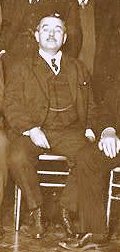
Chicago Cubs President Charles Murphy
The implication being that Chance had perhaps overreacted by suspending “the more sinned against” Schulte. This statement was further complicated by Murphy’s several “clarifications,” some of which seemed to support Chance’s decision while some did not.
Chance quickly defended his players and his reaction to Murphy revealed just how bad the relationship was between the team president and his manager:
“Murphy only thinks of the team when it’s winning…his statement reflects upon me personally, and I have been in the business too long to allow Murphy or anyone else to insult me.”
Making matters worse, and calling Murphy’s motives into question was that Chance issued his response from a hospital bed in New York. As a result of being hit in the head by numerous pitches throughout his career, Chance had developed a blood clot near his brain and had undergone surgery just a few days earlier.
Murphy didn’t hesitate to use Chance’s health issues against him.
A month earlier, plagued by doubts about his condition and suffering from severe headaches, Chance had suggested to Murphy that he might not be able to manage the Cubs in 1913. At the time Murphy told his manager to wait until after the surgery to make a decision about his future. Now he was using that conversation to assert that Chance had issued his resignation.
Once Murphy began claiming Chance had, in effect, quit in August the Chicago media which had almost universally supported the “abstinence pledge” called foul. The Chicago Tribune and Chicago Examiner both said Murphy was using the conversation and the pledge as cover to run the legendary Chance—who led the Cubs to four pennants and two World Championships—out of town.
Chance went. But he didn’t go quietly.
The manager had acquired 10 percent of the Cubs, shares Murphy had been trying to purchase for more than a year. Chance sold the shares to Harry Ackerland a Pittsburgh investor who President Murphy did want owning part of his team. Despite Murphy’s efforts to block the sale, it went through.
Chance was claimed on waivers by Cincinnati, but after the Reds acquired Joe Tinker from the Cubs and named him manager, Chance was waived to New York, where he became manager of the Yankees.
Chance led the Yankees for two losing seasons, managed the Los Angeles Angels in the Pacific Coast League in 1916 and ’17, and closed out his career with one dismal season in Boston; the Red Sox finished 61-91 under Chance.
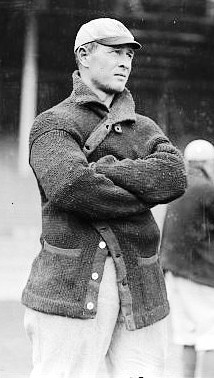
Frank Chance
Johnny Evers was named Cubs manager for the 1913 season—the Cubs again finished third.
From the day Murphy issued his initial statement until Chance died in 1924, “The Peerless Leader” never missed an opportunity to take a shot at Murphy.
When the Cubs were sold to Cincinnati publishing magnate Charles Phelps Taft (President William Howard Taft’s half-brother) before the 1914 season Murphy claimed that he had made more than a half million dollars on the deal. Chance and former Cubs pitcher Mordecai Brown (who had his own feud who Murphy who released him after the 1912 season, allegedly without giving Brown money he was owed for playing in that year’s “City Series” with the Chicago White Sox) quickly responded. Both players confirmed what had long been rumored—that Murphy had been bankrolled by Taft who retained a majority of the shares. Murphy, said Chance, “Never owned more than fifteen or twenty percent of the club stock.”
Both players also charged that Murphy’s treatment of his players was a primary reason for the formation of the upstart Federal League—at best an oversimplification of the conditions which led to Major League Baseball’s last “third league.”
Another Charles Murphy feud later this week.
.
Please consider a small Paypal donation to help fund my next research trip. Thank you.
 Baseball History Daily