Tag Archives: Northwestern League

McCloskey, Mays and Hair Color

12 Mar

Carl Mays is best known for being the pitcher who hit Cleveland Indians shortstop Ray Chapman with a pitch, resulting in the only hit by pitch death of a Major League player. In fifteen seasons he posted a 208-126 record with a 2.92 ERA.

Five years before he became infamous for Chapman’s death, Mays became embroiled in a strange feud with former National League manager John James McCloskey; the dispute was over hair color.

Carl Mays

Carl Mays

In December of 1914, McCloskey was a well-respected figure in baseball, credited with being the “father” of the original Texas League in 1888, he had spent five seasons as manager of the Louisville Colonels and St. Louis Cardinals in the National League, and another 23 as a minor league manager and owner.

Mays was coming off a 24-8 season for the Providence Grays in the international League, and while called up to the Red Sox in the closing weeks of the season had not yet appeared in a big league game.

The controversy originated when Charles “Toby” Fullerton, a pitcher for the Seattle Giants in the Northwestern League was quoted in an article that appeared in The Pittsburgh Press and several other papers about pitcher “Seattle Bill” James, who had just led the Boston Braves to a World Championship. Fullerton said when he and James were teammates in Seattle in 1912, manager Shad Barry had, “condemned the youngster for being a blond,” he then was quoted saying McCloskey also, “has no use in the world for blonde ball players.”

“Seattle Bill” James

The strange, silly, throwaway quote should have been the end of it, but it was apparently serious enough for McCloskey to issue a long denial from his home in Louisville, Kentucky. The full-page letter McCloskey wrote appeared in more newspapers than the original story, and read in part:

“Let me say, I have been accused of every crime in the calendar, but this is too much.”

McCloskey claimed the “rumor” originated when he was managing the Milwaukee Brewers in the American Association in 1910. Outfielder Rube DeGroff played for McCloskey (incidentally, Shad Barry was also a member of the team), and according to McCloskey:

“We were playing in Kansas City, we were behind…and made a big rally that came near giving us the game. The bases were full in the last inning, with two men out, when the big, blonde and good-natured Rube DeGroff, who was a splendid all-around player and life of the club, came to bat with the bases full and struck out. I was sore over losing the game and made the remark that I never saw a cotton-top who ever made good in a pinch.”

McCloskey said he also believed anything Barry might have said to or about James was certainly a joke, and closed with a final defense:

“In fact, in my humble opinion, I think the blonde has a shade over the brunette. But why the color of a man’s hair should have anything to do with his ability as a ball player is a mystery to me, and I hope this explanation will put an end to these silly rumors.”

It didn’t.

Within days Carl Mays weighed in, claiming that he had twice been rejected for an opportunity to pitch for McCloskey’s Ogden Canners in the Union Association because he was blond.

Mays said:

“McCloskey is a liar pure and simple…In 1912, when I was on my way to Boise to try out for the Boise team; I stopped off at Ogden, thinking possibly owner McCloskey might give me a trial. I met him downtown in a billiard parlor and went up and introduced myself.

“McCloskey looked me over carefully, like a horse-trader examining a piece of horseflesh, and then suddenly espied my blond hair. ‘No,’ said he coolly, ‘I don’t want you. In fact I wouldn’t have you around the ranch. I don’t want any blonds in my camp.’”

Mays also claimed that later in 1912 while compiling a 22-9 record for the Boise Irrigators in the Western Tri-State League; he was nearly sold to McCloskey’s pitching-strapped Ogden Canners until:

“One of the Ogden players happened to mention the fact that he was the same blond-haired fellow who had asked for a job earlier.”

According to Mays, McCloskey said:

“’Deal is off. Send that white-haired guy over here and I’ll kill him.’”

The story stuck with McCloskey for more than 20 years. A 1916 story in The Providence Tribune said:

“Scouts all over the country know McCloskey and never did one in his employ recommend a light-haired ballplayer…His peculiarity was well-known, and he knew that no one would have the temerity to recommend to him a blond or light-haired ballplayer. “

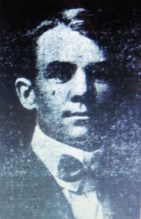
The black-haired John McCloskey
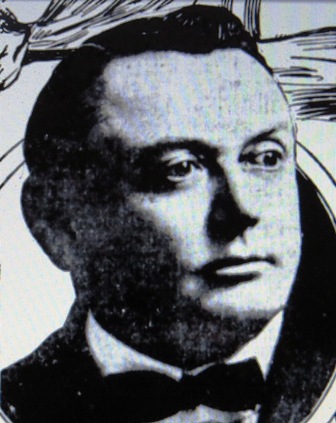
The black-haired John McCloskey

In 1934, The Milwaukee Journal called McCloskey, “one grizzled veteran who frowned on blond athletes.”

The article quoted E. Lee Keyser, a long-time minor league executive, who said when McCloskey managed Butte, “One of (McCloskey’s) players was an Indian outfielder whose hair was black,” the player struck out in a critical situation. According to Keyser, when the unnamed player returned to the clubhouse later, McCloskey grabbed his hair and said: “I just want to know if you’re wearing a wig. You hit like a blond.”

McCloskey managed in the minor leagues until he was 70-years-old, he died eight years later in 1940.
“An Umpire Nearly Lynched”

11 Mar

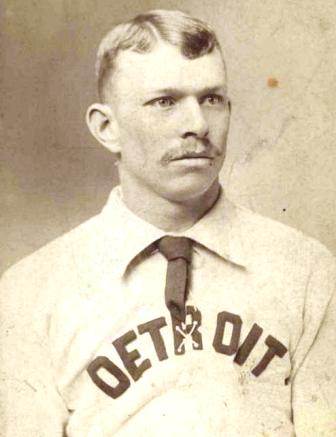
The above headline appeared on an Associated Press story in August of 1890.  Former Major Leaguer Jimmy Manning, then managing the Kansas City Blues in the Western Association had interceded to quell a riot at the end of a game with the Denver Grizzlies in Kansas City:

“Two questionable decisions by umpire Jovin (Sic) in the ninth inning, when Kansas City was about to tie the score, angered the crowd to such an extent that they swarmed into field, hooting and jeering the umpire.  Two young boys got hold of a rope, and in fun proposed to lynch him.  This added to the excitement, and it looked for a time as if the umpire would be mobbed.  Jimmy Manning climbed up to the top of the fence and addressed the mob.  He said the umpire had decided rightly and advised that no violence be attempted.  This quieted the mob to a degree.  In the meantime the players of both clubs formed a hollow square around the umpire and conducted him to the clubhouse.”

Jimmy Manning

Jimmy Manning

“Jovin” was actually Fred Jevne, a 26-year-old minor league veteran who had become an umpire just a month earlier.  After joining the Spokane franchise in the Pacific Northwest League in April, Jevne was suspended in May for punching an umpire.

In July The Spokane Falls Daily Chronicle said Jevne and teammate Tom Turner “quit the nine because they were excessively fined and ill-treated.”  According to the paper the two players showed up at the July, 1 game “in an intoxicated condition and acted like ruffians in the grand stand.” Turner was eventually reinstated and finished the season in Spokane, Jevne did not.

Since 1885 Jevne had played for a variety of teams in several leagues, including the Southern, International, and California.  When he was signed by Spokane to play center field and serve as captain, The Daily Chronicle said:

“Jevne is rather short.  He is a good batsman and a good player generally.  The San Francisco papers, when he played there, alternately praised him and berated him, but all agree that he was a good player.”

Jevne made one more attempt at playing, joining the Evansville Hoosiers in the Northwestern League in 1891.  He then returned to the Western Association as an umpire.

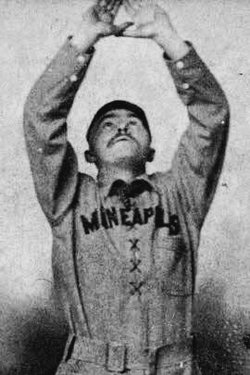
Fred Jevne

Fred Jevne with the Minneapolis Millers, 1889

In December of 1894 Jevne was named to the National League umpiring staff, where his work received mixed reviews.  In June The Baltimore Sun called him “As good an umpire as there is in the business.” In August, after a he worked a game between the Boston Beaneaters and Chicago Colts, The Boston Globe said “Umpire Jevne did poor work, both sides suffering from his yellow decisions.”  The Pittsburgh Press called Jevne’s performance in a September game between the Pittsburgh Pirates and Philadelphia Athletics “By far the worst exhibition of umpiring given this season.”

Jevne was not offered a position in the National League for 1896, and went to work in the Southern Association, where he seems to have a continued his fighting ways.  In July, The Birmingham Age-Herald said Jevne had missed the previous day’s game between the Montgomery Senators and Columbus River Snipes:

“Jevne, the regular umpire, arrived in town last night, but this morning loaded himself up with the spirit of hilarity, got into a fight with a citizen and when the hour for playing arrived was in the hands of the police, and failing to make bond was unavoidably absent from the field.”

Despite his troubles, or because of them, Jevne was asked to join the Interstate League at the end of the 1896 season because, according to The Sporting Life, umpires were losing control of games:

 “(Interstate League President Charles) Powers to-night wired for Fred Jevne the ex-National League umpire, who is so handy with his fists, to report for duty.”

Jevne was not popular with players or the press down south, and said his time in the Southern Association was difficult:

“It was no snap umpiring down South.  Fines didn’t go—were never paid—and so I used to remove men from the game.  Sometimes I would have to take out about half of a team before they would behave, and then the papers would roast me good and plenty the next morning…I had a scrap with a player named (Al) Gifford (Atlanta Crackers shortstop), and punched him in a car going from the grounds.  The local paper came out the next morning and urged the chartering of a special car for the umpire. So that he could be alone in his dignity, and another paragraph hinted that a cigar sign or dummy could be put in the special car for the umpire to punch”

Jevne appears to have returned to the Southern Association for parts of the 1897 and ’98 seasons.  He spent at least part of 1899 and 1900 in his hometown, Chicago, where he worked as an umpire in some college games.  In 1901 Jevne became a Western League umpire and that year met with a violent and mysterious end.

Initial newspaper reports said Jevne had fallen from a third story window in Denver’s Hotel Victor on August 2; he lingered for two days before dying. His body was returned to Chicago and he was buried at Graceland Cemetery.

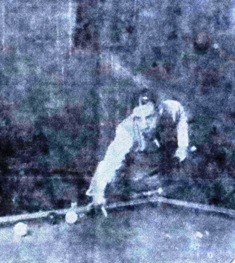
However, several months after his death, Jevne’s brother Lloyd, a well-known three cushion billiard champion, told The Associated Press he was certain he had been murdered, and that before dying Jevne had said he was pushed:

“I saw Fred’s body after it was shipped back to Chicago, where the burial took place, and the most prominent feature of his injuries was the bruise on his nose.  Doctors I saw believe that he was struck across the face with some blunt object… When he was about to die it is not probable he would have told a falsehood.  He would not have said at that time that he had been pushed out the window.”

Lloyd Jevne

Lloyd Jevne

Whether Fred Jevne fell or was pushed from that hotel window has never been positively determined.

Blame it on the Uniform

3 Jan

Justin Titus “Pug” Bennett could hit.  After playing baseball at tiny Blackburn College in Carlinville, Illinois, in 1895 and ’96, there’s no record of him again until 1899 when, at 25-years-old, he played with the Indiana-Illinois League franchise that began the season in Kokomo, Indiana and finished in Mattoon, Illinois.

Pug Bennett circa 1904

Pug Bennett circa 1904

Back-to-back .300 seasons with the Nashville Volunteers in the Southern Association and the Seattle Siwashes in the Pacific Coast League earned the 32-year-old his first shot in the Major leagues.  The Bennett hit .248 for two seasons with the Saint Louis Cardinals and returned to the minor leagues with Seattle, now in the Northwestern League.

Bennett returned to his old ways for two seasons, hitting .305 and a league leading .314 in 1908 and 1909.

1910 was not going well for Bennett, the perennial .300 hitter was hovering around .240 all season.

The Spokane-Spokesman Review provided an explanation late in the season:

“(Bennett) claims the white uniform worn by the umpires is the principal stumbling block in the way of batting averages this year.  Bennett says the light suits shade the white ball and make any pitcher with a crossfire or a sharp break much more effective.”

Bennett might have had a point.  There was not a single hitter in the Northwestern League with more than 50 at bats who hit .300;  Lou Nordyke led the league with a .290 average.

The following year the umpires’ uniforms were changed.  Ten players hit over .300 and Art Bues led the league with a .352 average.  The 37-year-old Bennett, with the Vancouver Beavers, rebounded with a .300 season.

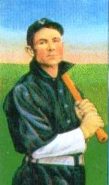
Pug Bennet, t-206 card with Vancouver

Pug Bennet, t-206 card with Vancouver

Bennett continued playing in the Northwestern League until 1917.  He lived in Washington until his death in 1935.

Baseball’s First Chinese Player

30 Jul

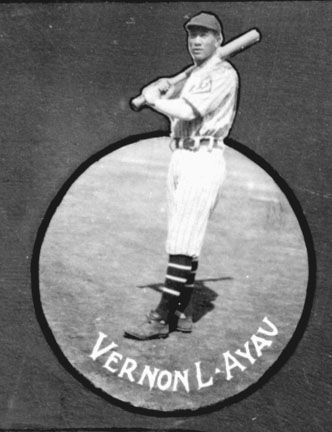
Vernon L. Ayau’s professional career lasted less than half of one season, but in the process, he became the first Chinese player in professional baseball and his signing nearly broke up a league.

Ayau, born January 31, 1894, in Maui, Hawaii, played on the Chinese University of Hawaii team that toured the US in 1913, 14 and 15.  He was said to have caught the eye many in professional baseball including New York Giants manager John McGraw.

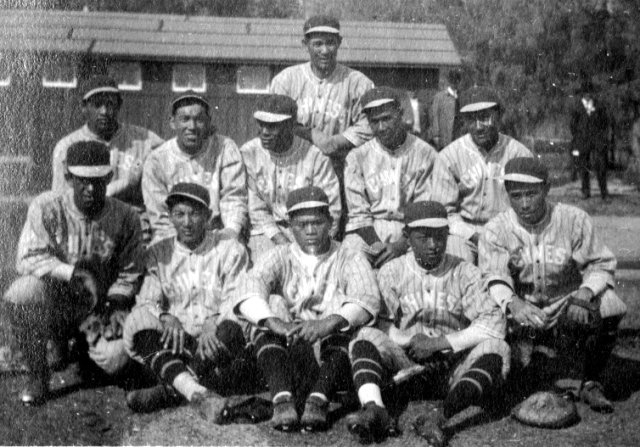
Chinese University Team

Ayau was described as a slick fielding shortstop with an excellent arm, but a weak hitter.  In December of 1916, he was offered a contract by Bill Leard, manager of the Seattle Giants in the Northwestern League.  Leard played against Ayau when he went to Hawaii after the 1916 season with an all-star team put together by former Northwestern and Pacific Coast League player Charles “Cy” Swain.

Within weeks, Northwest League players passed a petition expressing their displeasure with the signing, and newspapers in league cities came out strongly against Ayau.

Anti-Chinese sentiment was especially strong in areas where Chinese workers were being hired as miners, and mining unions in Butte and Great Falls (two league cities) threatened to “take action to have (Ayau) removed from the league.”  Shortly before the signing, a Chinese mine worker had been dropped from a bridge into the Missouri River by members of the miners union.

Leard received death threats but along with Seattle’s ownership held his ground and Ayau was on Seattle’s opening day roster.

His time with Seattle only lasted until May 20 when Leard announced his release.  Despite the early threats of boycotts and other action, he was actually signed and released by Tacoma and later Vancouver in the Northwest League over the next six weeks.

By July 1917, Ayau’s career in professional baseball was over.  He hit only .203 in 133 at bats with the three teams.  Contemporary news reports noted his weak hitting but universally praised his glove and arm.  That month he joined a semi-pro team in Wildwood, NJ that also included his former Chinese University teammate Lee Tin.

After serving in the US Army as a member of the infantry in France, Ayau returned to New Jersey where he continued to play semi-pro ball for several years.

He died in Penns Grove, New Jersey on March 28, 1976.