Tag Archives: Pittsburgh Pirates

Another Rube Waddell Story

31 Jul

There are probably as many stories about George Edward “Rube” Waddell as any player in the history of baseball; and some of them might be true,

This one was told by Hugh Fullerton in The Chicago Tribune, and is about the contract Waddell signed to join the Chicago Orphans in 1901.

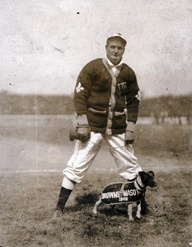
Waddell with St. Louis Browns Mascot

Rube Waddell

Despite the erroneous story, told through the decades, that the Pirates were so anxious to rid themselves of Waddell that they let him go for a cigar (or a box of cigars in some versions), there was actually a great deal of interest in Waddell and while the sale price was never disclosed, The Chicago Daily News said Chicago paid “good money” for the pitcher.

In addition to Chicago, other contemporaneous reports said the Boston Beaneaters were very interested in obtaining Waddell.

Fullerton told a good story, maybe just as erroneous as the cigar story, of how Chicago manager Tom Loftus was able to sign Waddell and thus beat Boston to the punch of purchasing his release from Pittsburgh:

“(Rube) was threatening to annihilate several members of the team and he was on one of his periodical rampages.  Boston wanted him badly—and so did Chicago.  Boston offered to give him $3,500 for the remainder of the season, and Chicago was willing to pay him only $2,400 and Loftus was delegated to sign Rube and make him be glad to knock off $1,000 from his earnings from the end of May to the middle of October.  Loftus cornered George Edward and commenced jollying him.

“’I’ll tell you, Tom,’ said Eddie, ‘I’d rather play with you than with Boston, but they offer me $1,100 more.

“’That’s all right,’ said Tom.  ‘Don’t let a little thing like that stop you from joining a good ball club with a lot of good fellows.”

Fullerton said the two discussed the pros and cons of Waddell accepting Chicago’s offer when Loftus finally said:

 “’I’ll tell you, Eddie, what I’ll do.  You sign that contract, and when we get to New York I’ll buy you the best Panama hat in town.

’“’All right,’ said George Edward.  ‘Just put that in the contract.’”

Fullerton said the deal was made and “When they got to New York Loftus bought him the $1,000 Panama hat—for $28.”

Tom Loftus

Tom Loftus

Waddell’s time in Chicago was brief, and typically bizarre.  After posting a 14-14 record and a 2.81 ERA for Loftus and the Orphans, Rube received an offer he couldn’t refuse in September.

The Tribune told the “pitiable little story, this tale of ‘Rube’ Waddell and his love of nature.”  Waddell had deserted the team to play for an amateur club in the town of Grayslake, Illinois, about 40 miles north of Chicago.  The Tribune said Waddell was induced to go north with the promise of being able to fish six days a week, if he pitched on the seventh.

The Orphans suspended Waddell for the remainder of the season.  In December he jumped Chicago to join Los Angeles in the California League.

Hap Myers

29 Jul

When the 6’ 3” 175 pound Ralph Edward “Hap” Myers was let go by the Boston Braves after the 1913 season a reporter told Braves shortstop Rabbit Maranville he was sorry to see Myers go.  Maranville joked:

“Well, you might be, but I’m not.  Do you know that guy is so thin that every time I picked up a grounder I had to shade my eyes with my gloved hand to locate him before throwing the ball.”

Myers began his professional career after graduating from University of California, Berkeley in 1909, where he also played baseball.  The San Francisco native hit a combined .311 playing for the Sacramento Sacts in the Pacific Coast League, and the San Jose Prune Pickers and Santa Cruz Sand Crabs in the California League.

Myers went east in 1910 after being purchased by the Boston Red Sox, but became ill, with scarlet fever, and as a result appeared in only six games in Boston before being  sent first to the Toronto Maple leafs in the Eastern league, then the Louisville Colonels in the American Association.

Despite hitting just .240 with Louisville, Myers was selected by the St. Louis Browns in the Rule 5 draft.  The Red Sox claimed Myers still belonged to them and his contract was awarded to Boston, where he began the season, was sold to the St. Louis Browns, who quickly released him despite hitting .297 in 11 games, then back to the Red Sox where he hit .368 in twelve games before being sent to the Jersey City Skeeters in the Eastern League.

It was never clear why, in spite of hitting .333 in 81 at bats in 1910-1911, Myers couldn’t stick in the American League.

In 1912 he returned to the West Coast to play for the Spokane Indians in the Northwestern League where he led the league in hits, and runs, hit .328, and led all of professional baseball with 116 stolen bases.  The Portland Oregonian said:

“Myers base stealing smashes any previous performance in Northwestern League history.  You have to go back 20 years in official guide books to find any record to compare…and that includes every league in organized baseball.”

Spokane owner Joe Cohn went overboard in his praise of Myers in The Spokane Spokesman-Review:

“Best ballplayer in the Northwestern League by a long shot.  He is the greatest ballplayer I ever saw.  Boy I tell you this Myers is a wonder.  Ty Cobb, Hans Wagner, Tris Speaker and all of them have nothing on Myers…I think Myers has it on Cobb, Wagner, Lajoie, Jackson and the whole bunch.”

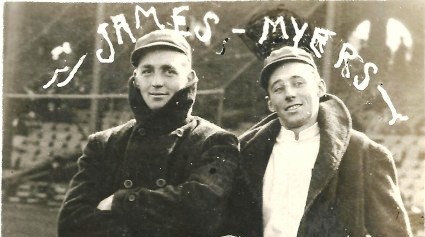
Myers, and Portland catcher Rex DeVogt were purchased by the Braves from Portland, Devogt would only last for three games, and six hitless at-bats in April of 1913.  Myers would become the Braves starting first baseman.  Another Pacific Coast League player, pitcher “Seattle Bill” James also joined the Braves.
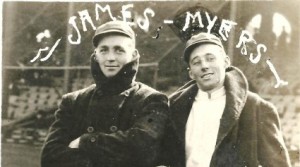
hap3

“Seattle Bill” James and “Hap” Myers

Myers got off to a slow start; he was hitting just .224 in early July, but was leading the National League in steals.  An article in The Tacoma Times said:

“When Hap Myers, recruit first baseman of the Boston Braves is in full stride stealing bases, he covers nine feet…the average stride of a sprinter is six feet. “

The article said the average player took 13 steps, roughly seven feet per step, between bases but Myers took only ten steps:

“Myers is something of a baseball curiosity, and his work is watched with interest by the fans.  If the time comes that the big fellow climbs into the .300 class as a batter, he is apt to become a veritable terror of the paths.”

He was also said to use “a bat of unusual length,” but the size was never mentioned.

After the slow start, Myers hit well in the second half of the season, ending with a .273 average and 57 stolen bases (second to Max Carey of the Pittsburgh Pirates who stole 61).  Despite his strong finish, Myers was replaced at first base for 22 games in August and September by Butch Schmidt, who was purchased from the Rochester Hustlers in the International League.
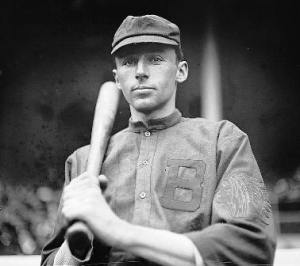
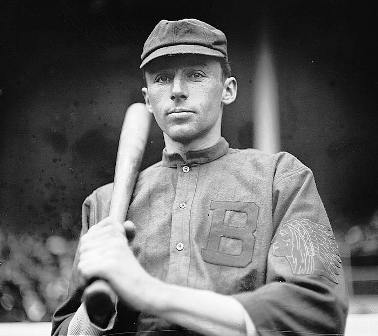
"Hap" Myers

“Hap” Myers

At the end of the season Myers was sold to the Hustlers, the deal was, in effect, a trade for Schmidt.  The Boston press simply said Myers did not get along with manager George Stallings; Myers told a reporter in San Francisco that there was another reason; baseball’s labor unrest:

  “I was assigned by the fraternity to get as many Braves as possible into the fraternity, and succeeded in enrolling nearly the entire team.  The powers that be evidently didn’t relish my actions for soon my every move began to bring calldowns and I was not surprised to read in the newspapers a little later that I had been sent to Rochester.”

Myers jumped Rochester to join the Federal League; his signing was reported months before he actually signed.  The Associated Press said in March of 1914:

“Although it has been generally understood that Hap Myers, last season’s first baseman of the Boston National has been under a Federal League contract for some time, the elongated first sacker did not put his name to a contract until yesterday afternoon.  Myers originally expected to play with Larry Schlafly on the Buffalo Federals, but was transferred to Brooklyn, and seemed altogether pleased with the move.”

Myers got off to a strong start, and The Sporting Life said:

“Brooklyn fans cannot understand why Hap was passed out of the National League. They have had a chance already to give his successor at first base on the Boston team (Butch Schmidt) the once over, and the general opinion is that- Hap Myers “lays all over.”

His success in Brooklyn didn’t last; in 92 games Myers hit just .220.

Hap’s story continued tomorrow.

“The Sudden Reappearance of ‘Silver’ King”

27 Jun

Oliver Perry “O.P.” Caylor wrote in June of 1896 in The New York Herald:

“One of the baseball surprises of the season is the apparently successful reappearance of ‘Silver’ King upon the National League diamond.  Without any warning the Washington club sent him in against the Pittsburgh team, and he not only won his game, but held the latter down to six hits, Of course all this caused a great deal of gossip wherever baseball is a subject of interest.”

When Charles Frederick “Silver” King (born Koenig), took the mound for the Washington Senators and beat the Pittsburgh Pirates 8 to 1 in the second game of a May 30 doubleheader, it was his first appearance in professional baseball in nearly three years.

King had been one of baseball’s best pitchers of the 1880s, with a 142-70 record from 1887-1890 while playing for Charlie Comiskey, first with the St. Louis Browns in the American Association and then following Comiskey to the  Chicago Pirates in the Players League.

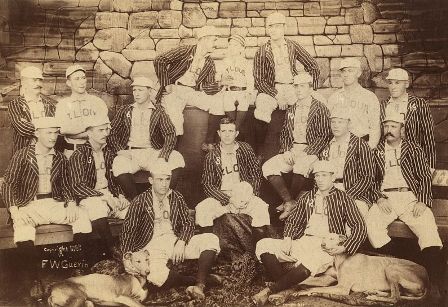
Comiskey (8) and pitcher Silver King (14) with the 1888 St. Louis Browns, King would follow Comiskey to the Chicago Pirates in the Players League in 1890

Comiskey, seated center(8) and Silver King standing second from right (14) with the 1888 St. Louis Browns, King would follow Comiskey to the Chicago Pirates in the Players League in 1890

Caylor said that during Flint’s heyday:

“His most successful delivery was what is known as ‘the cross fire,’ first used effectively, I believe, by (Charles “Old Hoss”) Radbourne and at present the prominent stock in trade of (Wilfred “Kid”) Carsey of the Philadelphias (Phillies).  It consists of standing on the extreme end of the pitcher’s plate, stepping away still farther from the direct line towards the batsman and sending the ball across the home base at an angle, which, although small, is very bothersome to the man with the bat.”

Silver King

Silver King

Caylor said King was “put out of the business” in 1893 when “the pitcher’s box was set back five feet,” (to the current 60’ 6”).  While King’s record slipped during the last two seasons the distance was 55 feet to a combined 36-53 while pitching for the Pirates and New York Giants, he had respectable ERAs of 3.11 and 3.29.  After the rule change King went 8-10 with a 6.08 ERA pitching for the Giants and Comiskey’s Cincinnati Reds in 1893, and then disappeared.

Caylor thought there was “a great deal of significance to King’s return to the diamond,” and predicted a trend:

“It means managers, having exhausted the new crop and finding nothing before them worth a trial, are forced to look behind and try to rekindle some of the half burned out embers. Washington not only took up King, but they gave (Les) German a trial after the New York club let him go.  (Cap) Anson (Chicago Colts) went back to (Fred) Pfeffer after finding (Algernon “Algie”) McBride, (Josh) Reilly and (George) Flynn wanting and was even forced to put himself into his nine to fill out the weak spots.”

Caylor said it was “astonishing  to look over the list of new material which was brought into the National League last spring and notice how small a part of it has been able to keep ‘in the swim.’  Every day one hears that some younger player has been released or that another has been loaned or farmed to a minor league club.”

Caylor’s prediction of success for the “trend,” and the players named was a mixed bag.  Anson, who had never really gone away, hit .331 in 108 games, for the Colts, but Pfeffer hit just .244 in 94 games. German fared the worst, he was 2-20 in 1896 and 3-5 the following season before being released in August.

King managed to post a 16-16 record for the Senators in 1896 and ’97 but never found his early career form.  After the 1897 season, he returned to St. Louis where he died in 1938.

Caylor would become ill the following season, and died in October of 1897.

“The Deterioration in the Morale of the Players”

10 Jun

The Chicago Tribune had had enough:

“The deterioration in the morale of the players has been followed by deterioration in that of the spectators.  The latter relish the obscene profanity and the slugging exploits of the hulking brutes of the baseball field.”

The Tribune provided an “account of the more disgraceful of the many rows witnessed by spectators of baseball games,” during the just-ended 1899 season:

“May 2—Row at Pittsburgh—St. Louis game.  (Frank) Bowerman was put out of the game.  (Jack) O’Connor was taken off the field by the police, and the crowd chased umpires (Tom) Burns and (William) Smith.

May 19—Umpire Burns put (Giants’ William “Kid”) Gleason out of the game at St. Louis.  Gleason’s protest was so strong Burns forfeited the game to St. Louis.

June 1—Row on the grounds at Washington.

June 16—After a long wrangle and continued rowing on the field at New York.  Umpire Burns forfeited the game to Brooklyn.

June 16—(Fred) Clarke and (Clarence “Cupid”) Childs fight on the field in Louisville.

June 27—Rowdy action of players caused the crowd at the Pittsburgh game to mob umpire (James “Chippy”) McGarr.

July 18—(Tommy) Corcoran slugged (John) McGraw at Baltimore after being first attacked, and his action started a riot.

July 26—(Emerson “Pink”) Hawley, (Fred) Tenney, and (Hugh) Duffy engaged in a game of fisticuffs at Cincinnati.

Aug 16—(Oliver “Patsy”) Tebeau, McGraw and (George “Candy”) LaChance fought at Baltimore

Aug 18—Riot at Baltimore game started by (Tim) Donahue throwing a handful of dirt at (Steve) Brodie’s face.

Sept 1—Childs and Aleck Smith fight on the field in Louisville.

Sept 7—Riots at St. Louis and Brooklyn.

Sept 15—Clarke taken off Philadelphia grounds by police.

Sept 16—Chicago players jerked (Ed) Swartwood around the diamond because he called the game in the eighth inning on account of darkness.

Oct 9—(George “Win”) Mercer assaulted (Al) Mannassau at Washington.

Oct 14—(Jimmy) Scheckard assaulted umpire (John) Hunt, refused to retire, and Hunt forfeited the game to Brooklyn.”

Cupid Childs, repeat offender

Cupid Childs, repeat offender

Al Mannassau, assaulted by Win Mercer in Washington

Al Mannassau, assaulted by Win Mercer in Washington

In addition to the fans, The Tribune blamed team owners:

 “For the multifarious minor acts of blackguardism and rowdyism of which the hired men of the club owners were guilty there is no room.  It is sufficient to say that they, like the graver offenses mentioned above, did not wound the feelings or jar on the nerves of the proprietors of these baseball roughs.  Those proprietors seem to have come to the conclusion that audiences like these ruffianly interludes.”

Like hundreds of predictions before and thousands more to come over the years, The Tribune saw dire consequences for baseball given the current state of the game:

“There was a time when Chicagoans went to see the games of the Chicago club because they had a feeling of proprietorship in that organization.  That day is over.  Men do not go to see games out of local pride, nor do they go to see fine playing.  They go to listen to the language of the slums and to witness the horseplay and brutalities of the players or performers.  When these have lost their attractions professional baseball will disappear. “

“The Worst Bone Play Ever Made in Baseball”

16 May

The Pacific Coast League pioneer and all-star self-promoter Mique Fisher spent his later years as a near-constant source of material for west Coast sports writers.

In 1937 William Lair Hill Gregory, who wrote for The Portland Oregonian for nearly 60 years wrote about a play in 1904 that Fisher called “the worst bone play ever made in baseball;” it involved pitcher James Marcellin St. Vrain, and happened when Fisher was managing the Tacoma Tigers to a pennant; winning both halves of the 1904 Pacific Coast League season:

“On the Tigers was a southpaw pitcher named Jimmy St. Vrain.  In a close game one day, St. Vrain singled and with two outs was on second.  The batter lashed a line drive out of the shortstop’s reach, but right over St. Vrain’s head.

“’What did that left-hander do when he should have been scoring the winning run,’ complains Mique, ‘but reach up and catch the ball! Of course he was out…hit by a batted ball.’”

Jim St. Vrain

Jim St. Vrain

St. Vrain is also known for another boneheaded play alleged to have happened during his brief, 12-game career as a pitcher for the Chicago Orphans.  The story was first told The Detroit Free Press in 1906 by Tigers outfielder Davy Jones, who had been St. Vrain’s teammate in Chicago; Jones later told the same story to Lawrence Ritter in the great baseball book “The Glory of Their Times.”  The version in the book—aided by another 50-years of telling the story, and more colorful—is included below.

 “He was a left-handed pitcher and a right-handed batter. But an absolutely terrible hitter — never even got a loud foul off anybody.

“Well, one day we were playing the Pittsburgh Pirates and Jimmy was pitching for us. The first two times he went up to bat that day he looked simply awful. So when he came back after striking out the second time Frank Selee, our manager, said, “Jimmy, you’re a left-handed pitcher, why don’t you turn around and bat from the left side, too? Why not try it?”

“Actually, Frank was half-kidding, but Jimmy took him seriously. So the next time he went up he batted left-handed. Turned around and stood on the opposite side of the plate from where he was used to, you know.  And darned if he didn’t actually hit the ball. He tapped a slow roller down to Honus Wagner at shortstop and took off as fast as he could go … but instead of running to first base, he headed for third!

“Oh, my God! What bedlam!  Everybody yelling and screaming at poor Jimmy as he raced to third base, head down, spikes flying, determined to get there ahead of the throw. Later on, Honus told us that as a matter of fact, he almost did throw the ball to third.

“‘I’m standing there with the ball in my hand,” Honus said, looking at this guy running from home to third, and for an instant there I swear I didn’t know where to throw the damn ball. And when I finally did throw to first, I wasn’t at all sure it was the right thing to do!'”

Davy Jones

Davy Jones

Jot Goar

15 May

Joshua Mercer “Jot” Goar had one good minor league season.

Born in 1870 in New Lisbon, Indian, Goar’s early career is mostly unknown, although he appears to have pitched for the Muncie club in the Indiana State League in 1890 and for a variety of semi-pro teams in that state during the early 90s.  In one version of a story I told in January (“Remarkable Baseball Stunt”), “Baseball Magazine” identified Goar as the pitcher who gave up six hits in one inning without a run scoring in an Indiana State League game versus Anderson.

Goar was signed by the Toledo Swamp Angels in the Western League in 1895 (the team would relocate to Terre Haute, Indiana during the season).  While his numbers don’t look impressive, 13-19 with a 3.38 ERA and 345 hits in 288 innings, Goar was called “The best twirler in the Western League,” by The Sporting Life, and quickly became a highly sought after prospect.  Goar also hit .273 as a part-time outfielder.

His manager Denny Long told Indiana papers that Cap Anson “offered him a neat sum,” to sell Goar to Chicago.  Instead, the pitcher was purchased by the Pittsburgh Pirates; The Anderson Herald said Pittsburgh paid $3,200 for Goar:

“Jot Goar, considered the greatest find in the Western League this year…is looked upon to be one of (the Pirates) mainstays for next year.”

Gore joined Connie Mack’s Pirates in Hot Springs, Arkansas in the spring of ’96 and made the team; he made his debut with the team on April 18, pitching in relief in a 7-2 victory over the Louisville Colonels.  Gore struggled in three games with the Bucs, he allowed 25 earned runs on 36 hits and eight walks in 13 1/3 innings, losing his only decision, and was sold to the Grand Rapids Rippers in the Western League on May.

Jot_Goar

Jot Goar

No statistics survive for Goar’s 1896 season in Grand Rapids, but a mention of Goar in The New York American two years later said he had “deserted Grand Rapids,” at some point during the season.  Goar joined the Indianapolis Indians in 1897, and with a 25-9 record and a 1.39 ERA led the Indians to the Western League championship.  Goar was again highly sought after and his contract was purchased by the Cincinnati Reds.

Goar spent the winter refusing to sign a contract along with Frank “Noodles” Hahn, who had also pitched in Western League in 1897; the Cincinnati Enquirer said both players were asking for $1,800.  Goar finally signed in February, but the salary he settled upon was not reported, The Mansfield Daily Shield said:

 “Jot Goar has signed his Cincinnati contract and expects to play good ball this season.”

In March The Sporting News said:

“Jot Goar is showing more speed than any of the Reds pitchers.”

Goar did not live up to the expectations.  He hurt his arm in his first and only appearance; a two-inning mop up in an 11-5 loss to the Pirates, giving up, four hits, three runs, two earned, and a walk.

Pittsburgh Sports writer John Henry Gruber said Goar went to Reds manager Buck Ewing after the game “and at his own request was laid off until such time as he could get in shape.”

Goar returned to Indiana and for the remainder of 1898 and all of ’99 he managed and played first base for an independent team in his hometown in New Lisbon, that fall his team took part in a ballpark riot.  The Indiana State Journal said:

“The game of baseball between the Shamrock and Jot Goar teams on the Hagerstown grounds Sunday broke out in a riot.  Fists, clubs and stones were freely used and practically everyone who attended received some kind of injury.  The trouble arose over a decision of the umpire, who was Councilman John Geisler of Hagerstown.”

Gore began pitching again 1900 for the Indianapolis Hoosiers in the American League posting a 7-2 record in 10 games; he also played for the Western Association Hoosiers the following year, but there are no surviving records.

Goar returned again to New Lisbon, vowing that his pro career was not over, and accepted the position of postmaster and opened a general store while continuing to play for the local team. In 1904, The Sporting Life noted that he was still pitching in Indiana:

“Jot Goar, the old Cincinnati and Toledo pitcher, was doing things with the Connersville, Indiana team this season.  He pitched seven games for that club, six of which he won, the other being a 12-inning tie.  Only five runs were scored in the seven games, and he struck out seventy batters or an average of 10 a game.”

Goar gave up baseball after 1906.  He accidentally shot himself in the arm while hunting in 1907, and his general store burned to the ground, the 1911 “Reach Guide” said:

 “His place of business was completely ruined by a disastrous fire, which practically destroyed the business section of (New Lisbon).”

He rebuilt the store which he operated until 1921; Jot Goar died in 1947 at 77.

Lost Advertisements—Old Underoof Whiskey, 1909 World Series and 1910 A.L. Race

11 Apr

oldunder1909ws

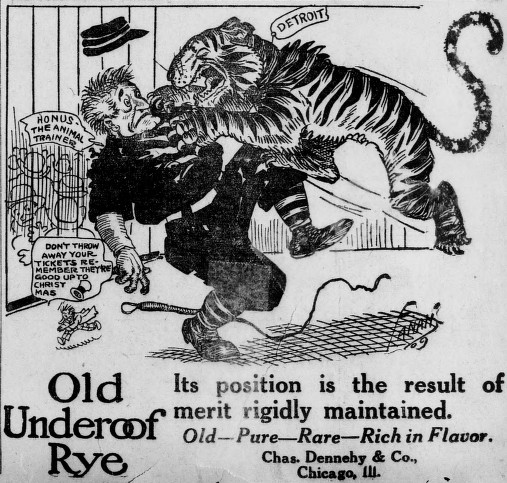
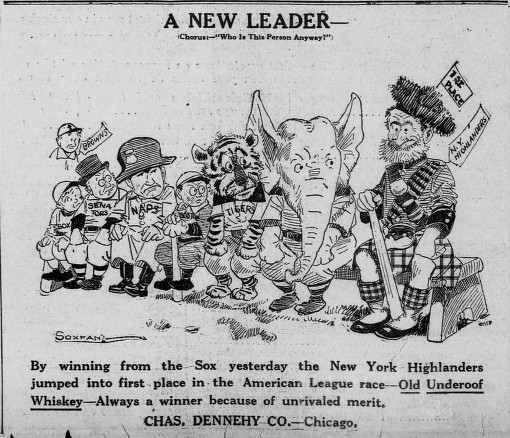
During the first decade of the 20th Century cartoon ads from Chas. Dennehy & Co., distributor of Underoof Bourbon and Rye Whiskey appeared regularly in Chicago newspapers.  Most focused on the Cubs and White Sox, the two featured today do not.

The ad above appeared after game 4 of the 1909 World Series when the Detroit Tigers evened the series with the Pittsburgh Pirates at two games apiece on George Mullin’s a five hitter;  Pirate star Honus Wagner, who would hit .333 for the series was held hitless by Mullin.  The Pirates would go on to win the series in seven games.

The one below was published on June 6, 1910 when the New York Highlanders, after winning two of three in a series with the White Sox, moved into first place.  The Philadelphia Athletics quickly overtook New York and would win the American League Pennant by 14 1/2 games.


oldunder1910Highlanders

Lost Advertisements–“I Shave with Gillette”

2 Apr

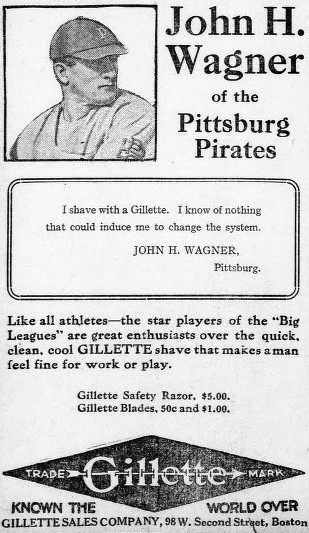
wagnergilletteA 1908 advertisement for Gillette–featuring John H. Wagner (Honus Wagner’s actual full name was John Peter Wagner).

“I Shave with a Gillette.  I know of nothing that could induce me to change the system.” John H. Wagner, Pittsburgh.

“Like all athletes–the star players of the “Big Leagues” are great enthusiasts over the quick, clean, cool, GILLETTE shave that makes a man feel fine for work or play.”

“A Heart-Breaking Play, Engineered by Wagner”

29 Mar

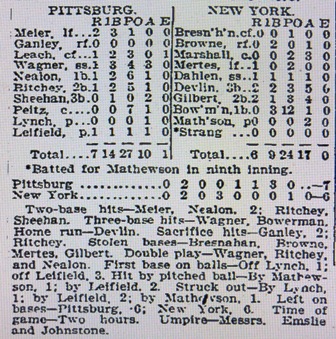
The defending World Series Champion New York Giants had gotten off to a fast start in 1906; on May 15 they were 19-7, the Chicago Cubs were 21-9, when they arrived in Pittsburgh for a four game series.

The Giants were shut out by the Pirates in the first two games.  In the third game of the series Christy Mathewson blew a three-run lead and the Giants trailed 7-5 heading into the top of the eighth inning..

Outfielder Sam Mertes walked, moved to second on Bill Dahlen’s single and scored on a two-out single by second baseman Billy Gilbert.  The Giants were behind 7-6 with runners on first and second; manager John McGraw was about to send Sammy Strang to pinch hit for Mathewson, when, according to The New York Times:

“A heart-breaking play, engineered by (Honus) Wagner in the last second of the eighth inning, beat the Champion New Yorks…It was a hard game to lose, and might not have been lost had Dahlen not fallen a victim to the wiles of Wagner.  The big Dutchman was guilty of the trick of hiding the ball, and when Bill stepped off second base, thinking (pitcher Albert “Lefty”) Leifield had the ball, Wagner, who had concealed it, touched Dahlen, which made the third out.”

Bill Dahlen

Bill Dahlen

The Pirates held on to win 7-6; The Times said of Dahlen:

“The New York shortstop felt so bad that he fairly wept.  McGraw, too, was angry, and it was said tonight he fined Dahlen heavily for his bit of carelessness.”

The Giants were unable to keep pace with the Cubs who finished 20 games ahead of New York for National League Pennant.

The Box Score

The Box Score

Lost Advertisements—Old Underoof Whiskey, Cubs and White Sox

26 Mar

oldunder1910cubssoxmayDuring the first decade of the 20th Century cartoon ads from Chas. Dennehy & Co., distributor of Underoof Bourbon and Rye Whiskey appeared regularly in Chicago newspapers.  Most focused on the Cubs and White Sox, but other teams were featured as well.  The ads above and below are from 1910.

The first ad appeared on May 2;  The White Sox beat the Detroit Tigers 4-3. the Cubs beat the Pittsburgh Pirates 2-1.

The second appeared three days later after the White Sox lost 4-0 to Detroit and the Cubs were beaten 8-3 by the Pirates.

oldunder1910cubssox