Tag Archives: Players League

“Hilariously and Shockingly Drunk”

11 Dec

The Philadelphia Athletics were in second place, two games behind the St. Louis Browns in the American association pennant race in June of 1889; but The Philadelphia Times said the team was underachieving, and blamed it on drinking:

“Watch your men, Manager (Bill) Sharsig.

“It is a matter of notorious publicity that a portion of the best players on the Athletic Base Ball Club are not living up to their contracts.  They drink, carouse and make exhibitions of drunkenness that are disgusting the people who so liberally contribute to the support of the national game, and unless the management put an immediate stop to such proceedings the club will be certain to finish the season with a balance on the wrong side of the ledger.”

The paper said because it was “unjust to criticize the club as a whole” they would name the guilty parties:

“It is an open secret that (Denny) Lyons, (Curt) Welch, (Mike) Mattimore, (Henry) Larkin, (Harry) Stovey and sometimes (Frank) Fennelly and (Lou) Bierbauer are frequently in a beastly state of intoxication, and it is easy to prove when and where they have recently been seen so in public places.”

The Times singled out Welch, who was out of the lineup because Sharsig said he was ill:

“Sick he may be, and those who saw him in company with Lyons last Tuesday morning at the early hour of 3 O’clock wonder that he is not laid up.  That model pair were sitting on the curbstone on the South Penn Square side of the City Hall, hilariously and shockingly drunk.

“Saloon-keeper Irwin, who keeps on Juniper Street, told a friend that Welch and another ballplayer became so vulgarly and obscenely boisterous in his place on Monday night that he had to order them out.”

Curt Welch
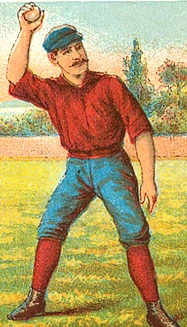
Curt Welch

The Times said the Athletics loss on June 16—they were defeated 9 to 5 by the Browns—“was largely due to errors made by Welch, Stovey, Larkin and Lyons, all of whom showed traces of their Saturday night’s outing.”

The team’s activities were not limited to Philadelphia, from “every city on the circuit came stories of debauches and sprees,” involving the Athletics:

Chris von der Ahe, of the champion Browns, is responsible for the statement that on the last trip made by the Athletics to St. Louis six of the players became so drunk and noisy in the big Anheuser-Busch saloon that the proprietor had to have then ejected, and a ballplayer on another club that chanced to meet the Athletics in East St. Louis said yesterday that he never saw so many drunken men on one team and that their unseemly conduct was the subject of general talk around the depot.  From Baltimore and Brooklyn come well authenticated stories of boisterous sprees and hilarious conduct in public places.”

The Times said even the most famous umpire of the era, “Honest John” Gaffney, “whom a ballplayer has no truer friend,” commented on the state of the Athletics:

“He says that he has repeatedly seen some of them come up to bat so drunk that they could hardly stand.”

John Gaffney

John Gaffney

The paper said Sharsig, “an exceedingly clever gentleman,” had completely lost control of the team:

“The ballplayers all like him and avow their willingness to do for him whatever he asks, but he is apparently unable to keep them sober even at home and when away they are absolutely beyond his control.  He does not believe in imposing fines…Stovey, Welch and Larkin know that it would be hard to fill their places and laugh at threatened dismissal.”

The Athletics lost six straight games after the story appeared, and 16 of their next 22.  They ended the season in third place with a record of 75-58.
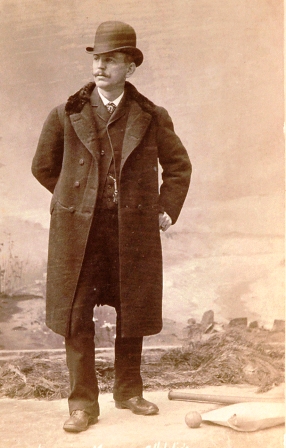
Manager Bill Sharsig

Manager Bill Sharsig

Mattimore was released in August.  Larkin, Bierbauer and Stovey jumped to the Players League after the season ended, and Fennelly was sold to the Brooklyn Gladiators.

Sharsig’s 1890 team led the American Association until July 17, then faded badly and finished in eighth place.  There was no mention in the Philadelphia press about whether drunkenness contributed to the 1890 collapse.
“The Great Baseball Question has been what will Capt. Comiskey do next Season”

3 Dec

In January of 1890 The St. Louis Globe-Democrat said what was on the minds of every baseball executive, writer, and fan:  “The great baseball question has been what will Capt. Comiskey do next Season”

For weeks there was speculation about whether Charles Comiskey, captain and manager of the St. Louis Browns, would remain in the American Association or join the Players’ National League of Professional Baseball Clubs (Players League), the league borne out of baseball’s first union the Brotherhood of Professional Base-Ball Players.

Charles Comiskey, against slang in baseball stories.

Charles Comiskey

On January 15, in a letter to The Sporting News, Comiskey announced his decision:

“During the past few weeks many interviews have appeared with me in different newspapers of the country relative to my having signed a contract with the St. Louis and Chicago Brotherhood clubs.  Up to this writing I am mind and fancy free.  But before Saturday night, January 18, I will have signed a contract to play at first base for the Chicago Brotherhood team.  I take this step for the reason that I am in sympathy with the Brotherhood.

“I believe its aims are for the best welfare and interest of the professional players.  I believe that if the players do not this time stand true to their colors and maintain their organization they will from this day forward be at the mercy of the corporations who have been running the game, who drafted the reserve rule and give birth to the obnoxious classification system.

“I have taken all the chances of success and failure into consideration, and I believe that if the players stand true to themselves they will score the grandest success ever achieved in the baseball world.

“But besides having the welfare of the players at heart I have other reasons for wanting to play in Chicago.  My parents and all my relatives reside there, and the all the property I own is located in the city.  I was raised there and have a natural liking for the place.  But, outside of all these reasons, my relations with the management of the St. Louis club have, during the past year been so unpleasant I do not care to renew them.  I have many friends in St. Louis, and for their sake I hate to leave here, but the other reasons out-balance this friendship, so I will cast my lines with the Chicago club.

“This is the first letter I have written on the subject which seems to have interested the baseball world throughout the whole of the present winter.

“Yours respectfully, Chas. Comiskey”

A week before the season began The Chicago Tribune said Comiskey’s new club “on paper, is the greatest team ever organized.”   Despite the hype, Comiskey’s Chicago Pirates finished in fourth place.  The Players League lasted only one season and dissolved in November of 1890.

Comiskey’s backing of the Brotherhood against “the corporations who have been running the game” would probably have come as a surprise to many of those who played for him when he owned the Chicago White Sox.  Arnold “Chick” Gandil, banned from baseball for his role in the 1919 Black Sox scandal said of Comiskey in a 1956 article in “Sports Illustrated:”

“ He was a sarcastic, belittling man who was the tightest owner in baseball. If a player objected to his miserly terms, Comiskey told him: “You can take it or leave it.” Under baseball’s slave laws, what could a fellow do but take it? I recall only one act of generosity on Comiskey’s part. After we won the World Series in 1917, he splurged with a case of champagne.”

Chick Gandil

Chick Gandil

Davy Force

28 Oct

David W. “Davy” Force was a popular figure in 19th Century baseball.  Francis Richter, founder and editor of The Sporting Life said the five-foot four-inch Force was, along with George Wright ”the two greatest shortstops of the early days of baseball.”  Nick Young, National League president, told Ren Mulford Jr. of The Cincinnati Enquirer that Force was second only to Wright as the greatest.

Davy Force

Davy Force

Force played in the National Association and National League from 1871 to 1886, and finished his professional career in the Western Association with the Sioux City Corn Huskers.

He remained popular, and well-known enough that multiple newspapers reported in 1890 that the former player “sided with the Brotherhood,” and supported the Players League; he even made news that year for growing a beard:  “Force has raised a crop of whiskers as long as himself. “

So when it was reported on Christmas Eve of 1896 that Force had shot and killed a man—a former ballplayer no less–in a San Francisco bar and then fled, the news was reported in papers across the country.

The Louisville Courier Journal:

Ball Player Kills Another

The Cincinnati Enquirer:

Old Cincinnati Ball Player Kills a Man in Frisco

The Salt Lake City Tribune:

Baseball Player Shoots Another Without Warning

The Chicago Tribune:

Police now on Lookout for Force

The Baltimore Sun:

‘Davy’ Force Wanted for Killing a Man

Towns where Force had been a popular player were quick to distance themselves.  The Sioux City Journal said that while fans “took a sort of paternal and patronizing interest” in Force when he played in Sioux City “the Golden Gate murder is quite another story…If he has been leading a wild, reckless life, possibly discouragements and vicissitudes have made a different man of him.”

The victim, Joseph Manning, was described as “an ex-ballplayer,” and in various articles was conflated with former big leaguers Jim Manning and Tim Manning.

Once it was determined Manning was not Jim or Tim, no one seemed to know anything about him.

Seven days after the murder, Abraham Mills, former National League president, issued a statement:

“I have known Davy Force almost continuously since I engaged him in 1867 to play in the Olympic Base Ball Club of Washington.  For the last seven years he has been in the employ of the company for which I am an officer, (The Otis Elevator Company) and is a steady, hard-working man, and I fully believe his statement that he never knew a Joseph Manning, and that he has never had any serious difficulty with or made any assault of any kind upon any ballplayer, either during or since his professional career.”

Mills’ statement was printed in only a fraction of the newspapers that reported the shooting.

The accusations faded, and by the time Force died in 1918 there was no mention of the case of mistaken identity in the ballplayer’s obituary.

Who exactly Joseph Manning was, and whether he was actually a professional baseball player, remains a mystery; as does the identity of the “Davy Force” who killed him in San Francisco.

“Figures of your kind are Pathetic”

13 Aug

John McGraw made news for an “innovation” in 1909.  The Associated Press said:

“McGraw has adopted an innovation in baseball which will appeal to fandom throughout the National league circuit and probably prevent (Fred) Merkle and others from running to the clubhouse before they ‘touch second.’ The innovation is the signing of the once famous player Arlie Latham as coach for the base runners.”

Arlie Latham, top center, facing team mascot, with 1888 American Association champion St. Louis Browns

Arlie Latham, top center, facing team mascot, with 1888 American Association champion St. Louis Browns

Walter Arlington “Arlie” Latham, was “particularly known for his humor” in the 1880s and 90s.  Primarily a third baseman with the St. Louis Browns in the American Association, the Chicago Pirates in the Players League and the Cincinnati Reds in the National League, Latham was nicknamed “The Freshest Man on Earth.”

The Associated Press said Latham:

“(B)rought much enjoyment to spectators of the Cincinnati club’s games and the Reds kept Latham a long while after he deteriorated as a player because of his drawing power as a comedian and humorist.

“Latham will don the uniform of the Giants and take his place in the coacher’s box while the Giants are at bat and between coaching the baserunner and batsmen and ‘getting the goat’ of the opposing pitchers will furnish an interesting sidelight to the New York games.”

Things did not go smoothly when Latham joined the team.  During spring training in Marlin, Texas Latham and McGraw were returning to their rooms at the Arlington Hotel when Giants outfielder James “Cy” Seymour, according to The St. Louis Post Dispatch, “knocked him down, and then bit him on the cheek.”  The article said McGraw and Latham did not know the “reason (Latham) was attacked,” but McGraw announced that Seymour was given his unconditional release.  McGraw said:

“Seymour is done with the New York club, and that goes.  It was the worst thing I ever saw pulled off.  Nothing like that can go on the New York club.”

Despite what he said McGraw did not release Seymour; the outfielder was suspended for the first week of the regular season, and The Dallas Morning News said McGraw made Seymour pay “his own expenses in Texas after the unpleasant episode.”

Arlie Latham, New York Giants coach

Arlie Latham, New York Giants coach

Latham was often criticized for his antics and even more often for the quality of his work as a coach, which became such a running joke that The New York Times said after the Giants had beaten the Cardinals in a September 1910 game:

“Arlie Latham’s team won it with their eyes shut, 11 to 3.  Latham’s coaching was invaluable yesterday.  He advised the players to touch every base and this tip won the game for them.”

The Sporting Life said:

“(Latham) undoubtedly lost a lot of games by bad coaching.  He got so unreliable that in a tight pinch McGraw would shift him from third to first and take the third line himself.”

The Sporting Life also said that Latham served as McGraw’s spy;  a position that would later be filled by another colorful McGraw coach, Dick Kinsella.

Giants outfielder Fred Snodgrass told Lawrence Ritter in “The Glory of their Times,” that Latham “was probably the worst third base coach who ever lived.”

It looked like the end of the line for baseball’s first full-time coach after the 1910 season.  The New York Herald said Latham “will not wear a Giant uniform next season,” and:

“He may amuse old timers, who remember him as a great ball player with (Charlie) Comiskey’s St. Louis Browns, but the new generation of fans seems to regard his efforts with disfavor.”

Despite the criticisms and predictions of his impending firing, Latham was back with Giants in 1911.  After the Giants pennant winning season Latham again joined the Giants for spring training in Texas in 1912, but in March, according to The Associated Press:

“(Latham) was carried as one of the twenty-five men permitted on the payroll.  McGraw did not want to let Latham go, but needed the place on the payroll for a real player.”

While McGraw didn’t want to lose his coach, most of baseball thought the end of Latham’s coaching career was a good thing; but even the New York press was not as harsh in their assessment of Latham as was Ed Remley, the baseball writer for The Fort Worth Star-Telegram:

“Arlie Latham has passed.

“May he rest in peace, for he is truly dead…Arlie has been called the fool of baseball and with much justice.  He was not the fool in any modern sense but more like the professional jesters who were kept in the courts of kings in the middle ages.

“Today, reading descriptions of the position of the court jesters, their crude horseplay jokes, we are not filled with laughter but with pity…The crude vassals of a former generation thought the brutal jokes of the court fool were funny; the bleacherites of today laugh at Arlie Latham pretending an engrossing interest in a game which he cannot even play himself…Vale, Latham—You have our sympathy, but we are not really sorry you are gone.  Figures of your kind are pathetic and pathos has nothing to do with baseball.”

Latham was next heard from when he accepted a coaching position with Patrick “Patsy” Flaherty’s Lynn Fighters in the New England League; that job only lasted until June.  Latham managed to run afoul of the entire Lynn team.  The Associated Press said he was forced to resign because “Players thought he was after manager Flaherty’s job and threatened to go on strike unless he was dismissed.”

Latham finished the 1914 season as an umpire in the Massachusetts and Rhode Island based Colonial League.  He did not return the following season, and in May of 1915 The Pittsburgh Press reported under the headline “Arlie Latham Has Quit The Diamond for All Time Now,” that he had found a new line of work; operating a deli in the Washington Heights neighborhood in Manhattan:

“He declares that as a delicatessener he is batting only .106 at present, but that when he gets properly warmed up and learns how to shave 15 ½ ounces of ham for a pound he will hit with the best of them in the delicatessen league.”

By 1917 Latham was in Europe, for the last act of his baseball career.  From 1917 to 1923 he lived in London and organized baseball leagues for military personnel.  The highlight of his stay was the July 4, 1918 game between the Army and Navy teams.  Latham served as umpire and greeted the most important dignitary at the game, King George V.  The Associated Press said:

“It had been planned to have the king throw out the first ball, but this was abandoned because of the netting in front of the royal box, so the king brought the ball out on the field and handed it to the umpire.  One of the balls used was autographed by the king with an American fountain pen and mailed tonight to President Wilson as a souvenir. “

Arlie Latham, front row center, with army team in London, 1918

Arlie Latham, front row center, with army team in London, 1918

After returning to the States, Latham first returned to the deli, then later was hired to work in the press box at the Polo Grounds, he remained a fixture at the New York ballpark until his death at age 92 in 1952.

As a result of outliving his critics and becoming one of the last surviving links to the 19th Century game by the time of his death, memories had faded about the “pathetic” figure of Latham, and only the image as  “baseball’s clown prince” remained.

“The Sudden Reappearance of ‘Silver’ King”

27 Jun

Oliver Perry “O.P.” Caylor wrote in June of 1896 in The New York Herald:

“One of the baseball surprises of the season is the apparently successful reappearance of ‘Silver’ King upon the National League diamond.  Without any warning the Washington club sent him in against the Pittsburgh team, and he not only won his game, but held the latter down to six hits, Of course all this caused a great deal of gossip wherever baseball is a subject of interest.”

When Charles Frederick “Silver” King (born Koenig), took the mound for the Washington Senators and beat the Pittsburgh Pirates 8 to 1 in the second game of a May 30 doubleheader, it was his first appearance in professional baseball in nearly three years.

King had been one of baseball’s best pitchers of the 1880s, with a 142-70 record from 1887-1890 while playing for Charlie Comiskey, first with the St. Louis Browns in the American Association and then following Comiskey to the  Chicago Pirates in the Players League.

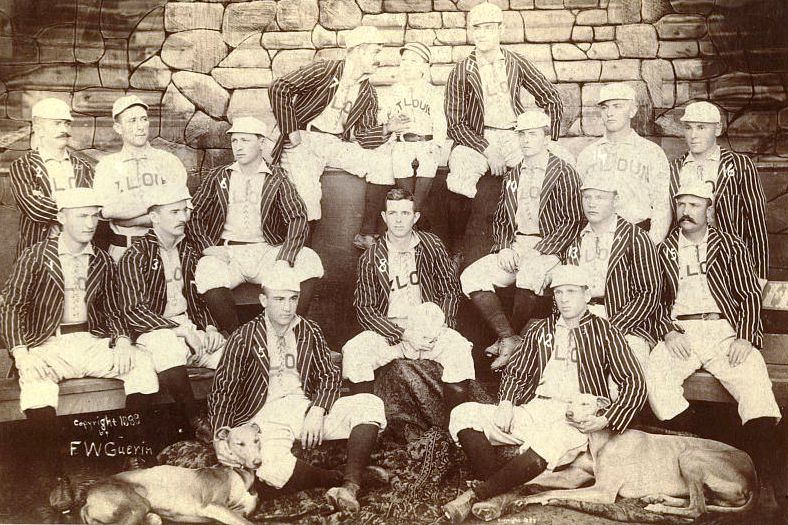
Comiskey (8) and pitcher Silver King (14) with the 1888 St. Louis Browns, King would follow Comiskey to the Chicago Pirates in the Players League in 1890

Comiskey, seated center(8) and Silver King standing second from right (14) with the 1888 St. Louis Browns, King would follow Comiskey to the Chicago Pirates in the Players League in 1890

Caylor said that during Flint’s heyday:

“His most successful delivery was what is known as ‘the cross fire,’ first used effectively, I believe, by (Charles “Old Hoss”) Radbourne and at present the prominent stock in trade of (Wilfred “Kid”) Carsey of the Philadelphias (Phillies).  It consists of standing on the extreme end of the pitcher’s plate, stepping away still farther from the direct line towards the batsman and sending the ball across the home base at an angle, which, although small, is very bothersome to the man with the bat.”

Silver King

Silver King

Caylor said King was “put out of the business” in 1893 when “the pitcher’s box was set back five feet,” (to the current 60’ 6”).  While King’s record slipped during the last two seasons the distance was 55 feet to a combined 36-53 while pitching for the Pirates and New York Giants, he had respectable ERAs of 3.11 and 3.29.  After the rule change King went 8-10 with a 6.08 ERA pitching for the Giants and Comiskey’s Cincinnati Reds in 1893, and then disappeared.

Caylor thought there was “a great deal of significance to King’s return to the diamond,” and predicted a trend:

“It means managers, having exhausted the new crop and finding nothing before them worth a trial, are forced to look behind and try to rekindle some of the half burned out embers. Washington not only took up King, but they gave (Les) German a trial after the New York club let him go.  (Cap) Anson (Chicago Colts) went back to (Fred) Pfeffer after finding (Algernon “Algie”) McBride, (Josh) Reilly and (George) Flynn wanting and was even forced to put himself into his nine to fill out the weak spots.”

Caylor said it was “astonishing  to look over the list of new material which was brought into the National League last spring and notice how small a part of it has been able to keep ‘in the swim.’  Every day one hears that some younger player has been released or that another has been loaned or farmed to a minor league club.”

Caylor’s prediction of success for the “trend,” and the players named was a mixed bag.  Anson, who had never really gone away, hit .331 in 108 games, for the Colts, but Pfeffer hit just .244 in 94 games. German fared the worst, he was 2-20 in 1896 and 3-5 the following season before being released in August.

King managed to post a 16-16 record for the Senators in 1896 and ’97 but never found his early career form.  After the 1897 season, he returned to St. Louis where he died in 1938.

Caylor would become ill the following season, and died in October of 1897.

Browning and Delahanty

25 Jun

John Anthony “Honest Jack” Boyle played in the American Association, Players League and National League from 1886 to 1898.

Boyle’s career was on the decline by the end of the 1898 season (he had only appeared in six games with the Philadelphia Phillies that year), but was effectively ended in November when he was the victim of a mysterious knife attack in his hometown of Cincinnati.

The Cincinnati Commercial Tribune said Boyle was “attacked from behind by an unknown man, who, before the player could defend himself, plunged a knife into his shoulder.”

A piece of the knife broke off in Boyle’s shoulder and he didn’t play regularly again until 1905 when he appeared in 101 games for the Toledo Mud Hens in the American Association ; he was a player-manager for the Terre Haute Hottentots in the Central League the following season.

Jack Boyle

Jack Boyle

By 1910 Boyle, who was operating a saloon in Cincinnati, told William A. Phelon of The Chicago Tribune that the two best hitters he ever saw were Pete Browning and Ed Delahanty, and provided a window into the minds of two of the biggest stars of the 19th Century:

“(T)here never were two men more radically different in their ideas of and their opinions of the game than these two great sluggers.  They looked at the game from totally different angles, and they regarded their occupation with widely varying views.

“Pete Browning was an artist.  To him baseball was an art or a profession and batting an absorbing passion.

“Delahanty was a workman.  Baseball to him was labor or a trade, and batting simply part of the daily toil.

“When Browning left the field the game wasn’t over.  He continued to talk batting, theorize on batting, figure out new ideas on batting, and I think, dreamed of batting all night long.

Pete Browning

Pete Browning

“When Delahanty left the ballpark the game was all through for the day, exactly as if he was a laborer going home to supper.  He ceased to think baseball.

Ed Delahanty

Ed Delahanty

“If Browning failed to make a hit at the time of need, he would have tears in his eyes and would bitterly bewail his misfortune.  If Delahanty fell down in the pinch, he shrugged his shoulders, hoofed back to the bench and began to talk racing or the weather.

“When an outfielder galloped to the fence and pulled down one of Browning’s mighty drives, Pete would regard it as a personal insult, and glower at the outfielder like a baffled tiger.  When a fielder robbed Del of a home run, Ed would grunt ‘Good catch, boy, didn’t think you’d get it’ and forget it forever.

“If you had told Pete Browning that the business was losing money, and that you would have to cut his salary next season, he would have accepted the money rather than lose the chance to play the game.  If you handed that talk to Delahanty, he would have sneered scornfully and remarked that you’d have to come up with 500 more beans before he’d even look at a contract.

“Neither Pete nor Del cared much where their teams finished on the season.  Pete thought only of hits and the glory of making them.  Del thought of a comfortable winter life on the money he had made in the summertime.”

Boyle said the only thing the two really had in common was an inability to bunt:

“Del wouldn’t simply try.  Pete, with much groaning and protestation, would be coaxed to make the attempt, but his attempts were fizzles.”

Boyle, or Phelon, omitted the other thing the two had in common: serious drinking problems that hurt them on and off the field and contributed to their early deaths.

Boyle died in Cincinnati in 1913.

“A Man Can’t Play Ball When He ain’t Getting no Money for it”

29 May

In January of 1890 Louis Rogers Browning, Pete, “the Gladiator,” the biggest star, even if no longer the best player, of the 27-111 Louisville Colonels of the American Association, jumped to the Cleveland Infants in the Players League.

Browning, illiterate, alcoholic, superstitious, and nearly deaf as a result of an untreatable ear condition, had quickly become popular among his hometown fans—despite being called out for on-field drunkenness as early as 1882 by The Louisville Courier-Journal.

Browning had won two American Association batting titles (1882, 1885), but had slipped to .313 in 1888 and .256 in 1889 playing in 99 and 83 games.

The New York Sun said the signing caused a “sensation” in Louisville despite that:

“(I)t has been said for two years that he had lost his usefulness by reason of his  defective eyesight and intemperate habits.”

Browning’s “defective eyesight” was said to be the result of his belief that stating into the sun would improve his “lamps.”

Pete Browning

Pete Browning

The Sun said Browning provided a “funny explanation” (all grammar errors are from the original text) for leaving his hometown to sign with Cleveland:

“I have been waiting for this chance for four years.  They ain’t treated me right here since 1886.  I used to play great ball for ‘em till they put the screws on me so hard, then I just quit.  I don’t mean that I didn’t play honest ball, but I just got discouraged and couldn’t do it.  A man can’t play ball when he ain’t getting no money for it.  I tell yer they have been socking it to me ever since 1886.  I’ve been fined so heavy that my salary ain’t ever been over $1,000, when I could have been making $2,000 and $3,000 from other clubs.  Newspapers have done me up so that people in the East have thought I was no more good.”

Browning said that after financially troubled owner Mordecai Davidson turned the Louisville franchise over to the American Association in July of 1889, and the league secured new, local ownership, he thought his situation would improve.

“They said my peeps was out of condition and I couldn’t hit a balloon.  Well, you ought to a ‘seed me line ‘em out.  They couldn’t put the ball nowhere I couldn’t get ‘em.  I played the game of my life.  I knocked the cover off the ball right along.  When I come home (from a road trip in August) I thought they would meet with a brass band.  Well I got a letter from (the Colonels new management) sayin’ I was laid off.  The papers said I had been drinkin’ when I hadn’t touched a drop for months.  They wouldn’t give old Pete a chance.”

In the fall of 1889 Browning played for a team in Knoxville, Tennessee, The Sporting Life’s “Louisville correspondent” said he had stayed out of trouble:

 “I understand that Pete’s conduct while recently with the Knoxville Club was quite exemplary, and tat be drank nothing but water.  Since his return to Louisville he has behaved himself in the same manner. Pete, however, always had a strange way of keeping sober during the winter and getting drunk in the spring when it was time to play ball.”

Browning told The Sun that his performance in Knoxville had earned him several offers from other teams, that he was in great shape, and that Louisville management was to blame for a lot of his problems:

“I give you my word of honor I haven’t touched a drop of anything for seven months.  I know that I have gone wrong sometimes, but if they had come to me an’ talked to me like gentlemen, I’d a done anything for ‘em: but they don’t do it, an’ they run off to the papers with another story of old Pete bein’s on a tear.  That just made me worse.  Do you think I’ve got no feelin’s left?

“Well I’m goin’ away, an’ you just watch me.  Talk about my peeps, there was never nothin’ the matter ‘em.  It was my nerve that was weak…Pete knows his biz, and he’ll get a chance someday.  An’ he has.  Keep an eye on me this season.”

Presumably Browning’s “peeps” were not completely ruined yet by his staring into the sun; he hit .373 and won the Players League’s only batting championship.

He would play through the 1894 season, compiling a lifetime .341 average.  The sad story of Browning’s post-baseball life and his death in Louisville in 1905 are well documented elsewhere.

“California Wonder”

30 Apr

Two West Coast ballplayers dubbed “California Wonder” by the press made their Major League debuts less than a week apart in 1887.  One went on to be one of the best leadoff hitters of his era; the other remains almost completely unknown.

George Van Haltren was a 21-year-old left-handed pitcher, outfielder and first baseman who had played two seasons with the Oakland franchise in the California and California State Leagues.

James McMullin, birth date unknown, had pitched for Mike Finn’s San Francisco Pioneers in 1886.

Mike Finn, manager, San Francisco Pioneers

Mike Finn, manager, San Francisco Pioneers

Van Haltren’s rights were acquired by the Pittsburgh Alleghenys, but because of his mother’s illness he said he would instead play for the San Francisco Haverlys.  The Chicago White Stockings traded for Van Haltren in April, but he still refused.  The Sporting Life said “the California Wonder will not come east,” quoted him saying:

“No, I will not play with Chicago this season; but if my left arm holds out and my parents are blessed with good health I will be open to Eastern engagements next season.”

The White Stockings threatened to have him blacklisted for not reporting but Van Haltren dug his heels in; only changing his mind after his mother passed away in May.

The Chicago Inter Ocean announced that he had arrived in town on June 25 and would be making his debut for the White Stockings on the two days later:

“(Van Haltren) at one time retired the Pioneer Club of San Francisco with a hit, and struck out seventeen men.  If he can continue this record here the Chicagos will come out of the race this season with another set of figures to put on the big flag at the park.”

Van Haltren’s debut was not good.  He walked 16 Boston Beaneaters and lost 17 to 11.  He finished the season 11-7, and would spend one more season as a full-time pitcher; going 13-13 in 1888 (he was 15-10, splitting time between the mound and outfield with the Brooklyn Ward’s Wonders in the Players league in 1890).  Van Haltren would distinguish himself as one of the game’s best leadoff men, hitting better than .300 every year from 1889-1901, except for 1892 when he hit .293.

Van Haltren ended his career in 1903 with 2544 hits.

George Van Haltren

George Van Haltren

McMullin’s debut was no better than Van Haltren’s.

He began the 1887 season with the Pioneers, but was acquired in June by the new York Mutuals of the American Association.

When McMullin joined the club The Sporting Life said:

“The Mets have got their new California pitcher and like him well in practice.  He has plenty of speed.”

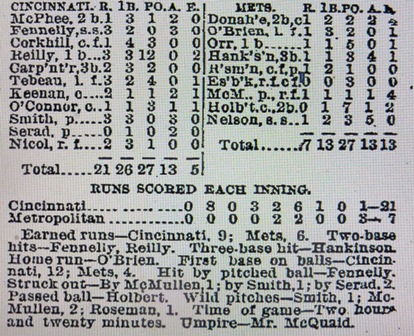
McMullin made his debut on July 2 against the Cincinnati Red Stockings.  The New York Times said of his performance, under the headline, “A ‘Wonder’ Exploded.  The Mets’ California Pitcher A Failure:”

“The debut of McMullen, the ‘California Wonder,’ was made (in Cincinnati) today in the presence of nearly 7,000 people, who went into hysterics from laughing at the awful exhibition given by the Wonder and his support.  He was utterly unable to get the ball over the plate and was miserably supported in the field.  After the third inning he retired to right field and there made a couple of errors.”

He gave up eight runs, made four errors and had two wild pitches in a 21-7 drubbing.

The box score from McMullin's debut.

The box score from McMullin’s debut.

McMullin only made two more appearances for the Metropolitans, and while he was credited with wins in both games his performance was no better; in his eight-day, three-game career he pitched 21 innings, gave up  25 runs (18 earned),  25 hits, walked 19, and struck out 2.  He made a total of five errors, and had one hit in 12 at bats.  The Mets released him on July 10.

And with that McMullin disappeared—there is no record of him having pitched anywhere after he left New York, there’s no record of whether he  threw and batted left-handed or right-handed, no pictures survive, and no record of when or where he died.  Another enigmatic figure of professional baseball’s early years.

“The Greatest Team Ever Organized”

24 Apr

Hopes were high for The Players League, and for Chicago’s franchise, the Pirates, in the newly formed baseball brotherhood.

Rumors had been reported for more than two months, but finally on January 18 The Chicago Daily News said that Charlie Comiskey “came to town yesterday morning, and at 4 o’clock signed…for three years,” to serve as captain and manager; the contract was said to be worth “$5,000 per annum.”

President Charles A. Weidenfelder had built a strong ballclub, with major assists from Fred Pfeffer, Chicago White Stockings second baseman, who encouraged most of that team to jump to the new league, and Frank Brunell, a former Chicago newspaper man who was secretary of the new league, and traveled to St. Louis to encourage Comiskey to jump to the brotherhood.

There was an embarrassing moment in March when Chicago newspapers reported that the carpenters union was complaining that non-union labor was being used to build the team’s ballpark at Thirty-Eighth Street and Wentworth Avenue.    The secretary of the union was quoted in The Chicago Tribune saying  Brunell had “promised to make it right.  But he didn’t.”

Despite the  irony of a league borne out of the game’s first labor movement betraying organized labor (there were similar difficulties in Boston and Philadelphia), enthusiasm for the new league was high; in Chicago the expectations were higher.  A week before the season opened The Chicago Tribune said:

“The elements which go to make up a great team are united in the Chicago Brotherhood Club, which, on paper, is the greatest team ever organized.”

Comiskey’s club opened the season on April 19 in Pittsburgh.  According to The Chicago Inter Ocean:

“It was a great day for the Players League…There were 9,000 people by the turnstiles’ count to see the fun…It was by all odds the biggest crowd that had ever turned out to witness an opening game of ball in Pittsburgh.”

The pregame festivities included a parade through the streets of Pittsburgh featuring both teams, league officials and a Grand Army of the Republic brass band.

“(Pittsburgh) Manager (Ned) Hanlon was presented with an immense floral horseshoe, Comiskey with a big floral ball on a stand of floral bats, Pfeffer with a basket of roses…(Chicago’s Arlie) Latham ‘stood on his head, with a smile well-bred, and bowed three times’ to the ladies.  (He had) the legend ‘We are the people’ in great black letters on (his) broad back.”

After the fanfare, “Pfeffer and the boys played a particularly brilliant game,” as Chicago defeated Pittsburgh 10-2.

Box Score--Chicago Pirates/Pittsburgh Burghers, Opening Day, 1890.

Box Score–Chicago Pirates/Pittsburgh Burghers, Opening Day, 1890.

Opening Day was the high point for Chicago. The league as a whole struggled financially and attendance dropped sharply after the initial excitement wore off.  Only eight games into the season, barely 500 people attended Chicago’s game in Cleveland on May 1.

Comiskey’s “greatest team ever organized,” was never able to keep pace with the league champion Boston Reds and finished fourth in the eight team league, 10 games back.

The Chicago Times lamented the team’s poor showing and blamed it on a “lack of discipline,” (the article appeared in slightly different form in several newspapers):

“The outside world cannot fully realize the bitter disappointment felt here over the poor showing made by Comiskey’s team during the season just closed.  Surely it was strongest aggregation of players ever collected in one club, but its lack of success was mainly from two causes—lack of discipline and the miserable condition of certain members of the club.

“There has been absolutely no discipline in the team, and some of the men paid as much attention to Comiskey’s orders as they would to a call from some church congregation.  An order to sacrifice was met with a smile of scorn, and the ball was hammered down to an infielder, who made an easy double play.”

The Times said “(Tip) O’Neill, Latham, Pfeffer, (Jimmy) Ryan and others utterly ignored Comiskey’s mandates, and in consequence there was continual disorder.”

The paper’s primary target was shortstop Ned Williamson.  The criticisms might have been unjustified: the former White Stockings favorite had struggled with the knee injury he sustained on the 1888-89 world tour, and might have already been ill as his health would decline rapidly, and he’d be dead by 1894; the victim of tuberculosis:

“Williamson played a game of which an amateur should have been ashamed, and was thirty pounds overweight throughout the season.”

The paper promised “there will be numerous, changes in the club, provided the players League is still in existence,” in 1891.

It was not to be.  By November league secretary Brunell told The Chicago Herald:

“The jig is up.  We are beaten and the Brotherhood is no more.”

Brunell attempted to put a positive spin on the news, telling the paper it was mistaken to infer the “Brotherhood has weakened.”  Rather “we began to see that the interest in baseball was on the wane, and in order to prevent it from dying out entirely…we finally concluded that a consolidation of forces (with the National League and American Association) would be better for all concerned.”

The Herald wasn’t buying Brunell’s statement:

Brunell’s talk has finally let in the light on a subject previously enveloped in darkness.  It appears now that the Players League folks actually courted a knockout, and bankrupted themselves from pure patriotic motives.  The ex-secretary is a funny little man.”

Brunell would go on to found The Daily Racing Form in 1894.

Comiskey returned to the St. Louis Browns in the American Association.  Tip O’Neill, who also jumped the Browns to join the Players League, returned to St, Louis with his manager.

Comiskey (8) was joined in Chicago by three members of his American Association championship teams in St. Louis.  Arlie Latham (7), Tip O'Neill (11), and pitcher Silver King (14) who posted a 30-22 record.

Comiskey (8) was joined in Chicago by three members of his American Association championship teams in St. Louis. Arlie Latham (7), Tip O’Neill (11), and pitcher Silver King (14) who posted a 30-22 record.

Fred Pfeffer stayed in Chicago, spending one more turbulent season with Cap Anson, before being traded to the Louisville Colonels.

Arlie Latham, “The Freshest Man on Earth” went to the Cincinnati Reds in the National League.

Ned Williamson never played again.

Profiles of Members of Spalding’s World Tour

22 Apr

Among those who joined A.G. Spalding’s world tour between the 1888 and 1889 seasons, was Simon “Si” Goodfriend, a sports writer for The New York World who later became a theatrical agent.  In 1935 The New York Times said of Goodfriend “has watched baseball as a fan and a sportswriter since the days of the Civil War.”

Simon "Si" Goodfriend

Simon “Si” Goodfriend

Throughout the trip Goodfriend wrote brief profiles of some of the players:

On Hall of Famer John Montgomery “Monte” Ward:

“Ward is a credit to the professional brotherhood of ballplayers.  He is not only ambitious to elevate the standing of the profession but he is equally ambitious personally.  He is exceedingly studious and never visits a strange city (without visiting) the art galleries, museums and libraries and takes copious notes of what he sees.  He presents the same disposition on the sea voyage.  He is a busy person both with his pencil and at his ball practice.”

Ward, who had spearheaded the effort to create the first player’s union in 1885 and the creation of the Players League in 1890.

John Montgomery Ward

John Montgomery Ward

Of John Kinley Tener, White Stockings pitcher and future United States Congressman and Pennsylvania Governor:

“I was going to allude to John K. Tener as a typical handsome American gentleman, but unfortunately I learned, but a day or two ago, that he was born in Ireland and came to America with his parents when he was 9-years-old…His features are clear cut, regular and refined.  His manners are gentle and cultured. Baseball players secured a worthy brother professional when he joined their forces, and there is a to be regretted possibility that he may retire again next season…Anson can be relied on to make a great effort to hold him back.  On the trip Mr. Tener acts as a secretary and treasurer to Mr. Spalding.”

John Tener

John Tener

Tener jumped the Cubs to join the Pittsburgh Burghers in Players League in 1890; after posted a 3-11 record with an ERA of 7.31 Tener left baseball for the banking business, and ultimately politics.

Jimmy Manning, who would quite possibly save an umpire’s life in Kansas City in 1890, was also on the tour:

“(He) is another modest young man with a blond mustache, of which he is proud.   He recently graduated from the Boston college of Pharmacy.”

Jimmy Manning

Jimmy Manning

Philadelphia Quakers outfielder Jim Fogarty:

(Monte Ward) mentions in his book on baseball (that Fogarty was) probably the best right fielder in the country, is a bright looking young fellow with an exuberance of spirits, unquestionably inherited from the land of Erin, and that apparently has no limit.  It is said that he is writing for a Philadelphia paper.  If his letters are half as bubbling and genial as he is at sea they will make interesting reading.  With the exception of (Charlie) Bennett of the Detroits, Fogarty probably has as bad a pair of hands from hard knocks in baseball games as any player in the country.”

Fogarty also jumped to the Players League, joining the brotherhood team in Philadelphia; however he became ill during the season would die of tuberculosis in May of 1891.

Jim Fogarty

Jim Fogarty

Of Billy Earle, “The Little Globetrotter,” McClure said:

“Little William Earle…has already proven himself a first-class backstop (and) is still quite a lad, being only 21 years old.  He is heavy-set has a jolly round face, an habitual smile and tightly curled hair.  He rarely smokes, doesn’t drink and would almost sooner play ball than eat.

Billy Earle

Billy Earle

Some of Goodfriend’s observations about Earle would prove to be wrong, as discussed in an earlier post.

Goodfriend’s profiles of the White Stockings’ “stone wall infield” tomorrow.