Tag Archives: Rube Waddell

Another “Rube”

4 Mar

Hall of Famer “Lefty” Grove and Jack Ogden were the best known pitchers of the great Baltimore Orioles teams that won seven straight International League Pennants from 1919-1925, but in 1923 both were out-pitched by James Arthur “Rube” Parnham.

Parnham began his professional career in 1914 with the Huntington Blue Sox in the Ohio State League.  In 1915 he joined the Raleigh Capitals in the North Carolina State League, managed by Connie Mack’s son Earle.  The 21-year-old was an unspectacular 9-15 for Raleigh, but caught the eye of the elder Mack and spent the spring of 1916 with Jacksonville with the Philadelphia Athletics.
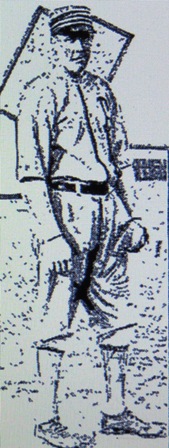
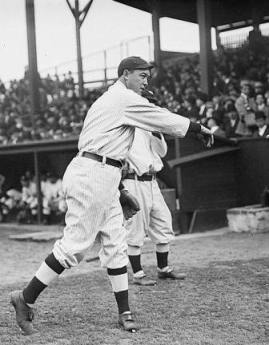
Rube Parnham, 1917

Rube Parnham, 1917

Parnham returned to the North Carolina State League for the 1916 season, splitting time between Raleigh and the Durham Bulls, posting a 17-19; his contract was purchased by the Athletics in late August.  Nearly a month later Parnham made his Major League debut; he appeared in four games for Mack’s last place (36-117) ballclub, he was 2-1 with a 4.01 ERA.

Parnham was with the Athletics in Jacksonville again in 1917, but was sent to Baltimore before the beginning of the season.  He won 16 games for the Orioles and earned one more shot with Mack in Philadelphia; Parnham was 0-1 with a 4.09 ERA in two September appearances.

As Parnham started winning games for Baltimore he developed a reputation as a work horse; in 1917 he won both ends of a double-header against the Rochester Hustlers, pitching a total of 24 innings in two 3-2 victories; in 1919 he won both games of a twin bill twice.   At the same time he began to earn a reputation as “eccentric’ and “erratic,” the inevitable comparisons to Rube Waddell and his small time roots earned Parnham the nickname “Rube,” he was also known as “Uncle.”

Baltimore sold Parnham to the Louisville Colonels in the American Association in March of 1918, but within two months was sold back to Baltimore, where he rejoined manager Jack Dunn, with who he had, and would continue to have, a contentious relationship.  He won 22 games in 1918 and followed with 28 in 1919, leading the Orioles to their first championship since 1908.

As the Orioles jumped out to a quick lead in 1920 (Parnham was 5-0, and was joined on the pitching staff by Ogden and Grove) the erratic Rube Parnham surfaced again. He was prone to disappearing for days at a time and also appears to have been hurt.  By mid-season he was gone.

More recent accounts have said Parnham jumped the Orioles to play semi-pro ball in Pennsylvania; just as likely, Parnham, who was suspended in June by Dunn for being out of shape, and who was clearly overshadowed by Grove (12-2) and Ogden (27-9); as well as Jack Bentley (16-3) and Harry Frank (25-12), was let go.

Lending credence to Parnham not having jumped is a January 1922 Associated Press item that said the pitcher “whose arm went on him” would rejoin “the Baltimores for the 1922 season.  Parnham wrote Dunn that he believed he could come back next season and pitch successfully.”  He won 16 games for the Orioles in 1922.

The following season would be Parnham’s best; the 29-year-old pitcher led the Orioles with a 33-7 record, Grove was 27-10, Ogden 17-12.   In addition to out-pitching his two teammates, Parnham set an international League record by winning 20 consecutive games.

Parnham’s old ways returned before the 1924 season when he failed to report to Florida for spring training.  The Associated Press said:

“Rube never reported at the Oriole training camp in the south and never even deigned to notify Jack Dunn whether he was going to play ball this year.”

Parnham eventually reported, but had another stormy, abbreviated season.  With a 6-5 record and a 4.84 ERA, Dunn suspended the pitcher in June, and he appears to have not pitched for the Orioles again that season.

The only reference to Parnham in 1925 was a May game he pitched for a semi-pro team in Duquesne, Pennsylvania and was beaten 8-0 by the Homestead Grays.

His career appeared to be over, but Dunn, it seems was willing to give his pitcher one more chance.

The Baltimore Sun said shortly before the 1926 season:

“Uncle Rube Parnham, the most colorful figure in the International League, will be back on the mound for the Orioles next season.”

Parnham was 13-9 with a 5.05 ERA, and spent the entire season feuding with Dunn; It was the end of the Orioles dynasty, the Toronto Maple Leafs won the championship in 1926 and Baltimore would not finish first again until 1944.

The Orioles were finally through with Parnham, The Baltimore Sun said:

“There was so much trouble between Parnham and Dunn last year that it was apparent Rube had spent his last season with the Orioles.” “

The 32-year-old was still considered valuable enough that the Milwaukee Brewers in the American Association purchased the pitcher from Baltimore.

The Brewers expected big things from their new pitcher, The Milwaukee Journal said:

“At times his playfulness leads him away from the straight and narrow, and he nearly drove Jack Dunn nutty last season…But Parnham is a great pitcher, despite his eccentricities, and if (Brewers owner) Otto Borchert can hire a good keeper for him is certain to be a winner with the Brewers.”

By March Parnham had worn out his welcome with another manager when he didn’t bother to report to Hot Springs, Arkansas for spring training.  The Journal said:

“Disgusted with the dilatory tactics of Rube Parnham, Jack Lelivelt, boss of the Brewers, hinted Saturday night that unless the eccentric righthander reports at once that he would probably be turned back to Baltimore.  Former International Leaguers …have told the Milwaukee leader about some of Reuben’s idiosyncrasies  and Lelivelt is beginning to feel that he will become a stepsister to Kid trouble if he had the former Oriole on his club.”

Parnham never played for the Brewers, and was returned to Baltimore, but Dunn was finished with him as well and he was shipped off to the Reading Keystones.  After a 2-8 season split between Reading and the Newark Bears, Parnham’s career was over.
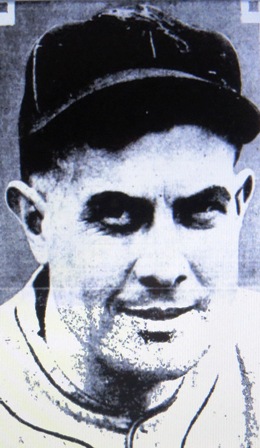
rube

Rube Parnham, 1923

Parnham retired to McKeesport, Pennsylvania, where the troubles that followed him throughout his career seem to have continued.  James Bready, an editor for The Baltimore Sun went to Pennsylvania to interview the former Oriole hero in 1961:

“The story was that he had gone downhill. Falling asleep in the snow, recently, he had lost several toes. On the phone, the director of a home for indigents said he would notify Parnham of the interview project. He gave me the street address — and a caution: ‘Try to get here before noon.’

“Paper, pen — I knocked and Rube beckoned me inside what today would be called a shelter. He was wearing an overcoat (I understand that better, now) and had not shaved recently. We sat down, facing, on two of half a dozen cot beds.  I tried a question. ”Gbbmhdahlr,” he replied. I stared at him; slowly, the meaning penetrated. I reached in my pocket and handed him a dollar.”

Parnham died two years later in McKeesport.
“Bugs” and Trains

28 Dec

Arthur “Bugs” Raymond was one of the most talented pitchers to end his career with a sub .500 (45-57) record.  Known more for his drinking problems and erratic behavior, Raymond was dead by 30.

John McGraw, the only manager who even for a short time, managed to get the best out Raymond, told sportswriter Grantland Rice that he had the best motion he’d ever seen and “Even half sober Raymond would have been one of the greatest.”

Rube Waddell, whose eccentricities were the standard by which all players of his era were judged, weighed in about Raymond, saying about Bugs something he could have said about himself:

“It’s a shame that fellow doesn’t take care of himself.  He would be a wonder if he would just keep in condition and pay strict attention to business.”

Bugs Raymond

Bugs Raymond

While Waddell was fascinated with fire and on many occasions assisted fire fighters (although there is no evidence supporting the long-held myth that Waddell left the mound during a game to follow a fire wagon), Raymond was enamored of trains.

According to the Hall of Fame sportswriter Hugh Fullerton III Raymond loved trains:

“The moment he enters a sleeping car he begins to take possession of the train and it isn’t long until he’s captured it.  Usually he begins by borrowing a blue coat with brass buttons and a uniform cap from some trainman or porter who admires baseball players, and arrayed in these he saunters through the train trying to collect fares, issuing orders and generally enjoying himself.”

Fullerton wrote about a 1907 road trip:

“(R)ushing through the darkness in two sections.   The St. Louis Cardinals were traveling in the rear car of the first section and the other section was following five minutes behind.  Suddenly there was a jarring of the brakes, the shrilling of air, the jar of sudden stoppage, and the second section jolted to a sudden standstill shaking sleepers out of their berths and awaking everybody.”

According to Fullerton the sudden stoppage and near accident of the following train was explained in the report issued several days later by the railroad:

“Raymond, who was looking for amusement, had stationed himself on the rear platform of the first section and amused himself touching off the red flare which is carried for use as a warning s and danger signals…the second section saw the warning and stopped.”

Hugh Fullerton

Hugh Fullerton


”The Dreadful Rumor is Probably only too True”

16 Nov

The unpredictable, eccentric George Edward “Rube” Waddell made several attempts to parlay his baseball fame into an off-season sideline in the theater.

Waddell’s stage debut was December 5, 1900, in Brookville, Pennsylvania as part of “Hindman and Kummers’ Union Scout” touring company.   The Sporting Life did not approve, their headline read:

“Rude Waddell to Make a Clown of Himself for Cheap Theatrical Gain.”

The touring variety show appears to have been a success and included Waddell leading a brass band in a street parade and performing in skits.

Rube Waddell

Waddell’s next foray into the theater was in 1903.  He played a detective in a melodrama called “The Stain of Guilt.”   Waddell the actor was as difficult to control as Waddell the pitcher.  According to The Pittsburgh Press:

“On several occasions he has been numbered with the missing when the curtain has come up.”

The Chicago Tribune reviewed the play which made its debut at the city’s Alhambra Theater:

“Rube has what may be classified as a thinking part, for he isn’t called upon to say much.  In the four acts of the play he delivers himself of twenty-four words.”

The review ended with the facetious assertion that in the fourth act Waddell, “Fairly shines…he hurls twelve whole words at the cowering villain and grateful hero.”

The universally negative reviews might have dissuaded a lesser man than the self-proclaimed “Greatest baseball pitcher in the world.”  But Waddell was back the next year.

The Butler (PA) Times said:

“More alarming than the news of the probabilities of war between Russia and Japan, is the announcement that Rube Waddell, the notorious baseball player, is to join his ability as an actor…in the production of “A Daring Woman.”

The Times suggests hopefully that the announcement is a publicity stunt but concluded:

“A New York special says that Rube is in that city taking part in the rehearsals of the play, so that dreadful rumor is probably only too true.”

The play does not appear to have actually been staged.

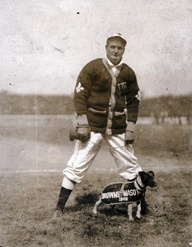
Waddell with St. Louis Browns Mascot


“The Rube Waddell of the Central League”

11 Oct

Edward S. Van Anda was the most talented pitcher in the Central League from 1904 to 1908; he was also the most erratic personality in the league–and was often compared to baseball’s most eccentric pitching legend “Rube” Waddell.

Van Anda was born June 6, 1881 in Wapakoneta, Ohio. He pitched for independent teams in Ohio from 1900-1903, getting as much attention for his enormous ego and behavior as he did for his pitching.

Nicknamed “Lord Chesterfield,” or simply “Chesty,” Van Anda would disappear for long stretches and his shameless self promotion made him unpopular with teammates He was signed by the Fort Wayne Railroaders in the Central League in 1904. His statistics for that season are lost, but according to The Youngstown Vindicator: “(H)e won every game he pitched except one toward the close of the season.”

In 1905 Van Anda again pitched for Fort Wayne (the team relocated to Canton, Ohio during the season) and posted a record of 20-14. The Fort Wayne News described Van Anda’s abilities as a ballplayer:

“There is only one thing Van Anda can do and that is pitch. He cannot hit a balloon and he runs bases like an ice wagon.”

The Fort Wayne Gazette said:

“He is rather erratic but has great pitching caliber in him.”

Every article about Van Anda described him as “eccentric,” or as the Toledo Bee put it:

“That Freak Van Anda.”

And the Bluffton (IN) Chronicle said:

“Van Anda is the name of the latest freak to break into baseball.”

A story about his self promotion that made the rounds in newspapers in 1905 was retold several years later in column by former major league pitcher Al Demaree:

“I used to know a fellow named Van Anda…he’d go out into the bleachers, and if the pitcher in the box began to falter, he’d yell “Put in Van Anda he’s the best pitcher on the club. Then he’d move over back of third and start up the same cheer in the crowd.”

The 1905 version of the story included his fellow pitchers, angry at Van Anda’s antics, setting him up

But he could pitch, and appeared destined for the Major Leagues. The Youngstown Vindicator said at the close of the 1905 season:

“Van Anda, known on account of his eccentricities as “the Rube Waddell of the Central League,” has been drafted by the Cincinnati Reds.”

At the close of the 1905 season Van Anda pitched for the local Wapakoneta team in an exhibition against the Reds, the Major Leaguers got 14 hits and beat Van Anda 12-0, it was the last time he faced a Major League team.

After a strong 1906 season with the Grand Rapids Wolverines (23-13), Van Anda was acquired by the Trenton Tigers in the Tri-State League. His time there was short; during a spring training game Van Anda walked off the mound and led the field in the middle of a game, which led to his immediate release.

According to The Fort Wayne News Van Anda “Known all over the Central as an eccentric …was given a bus ticket and returned to Fort Wayne.”

Edward Van Anda

Van Anda pitched for neither Trenton nor Fort Wayne during the 1907 regular season, but signed with the Central League South Bend Greens in June. He only appeared in one game, losing 7-1 to the Wheeling Stogies. He was released a few days later, not resurfacing until the following season.

In 1908 he went 15-11 for Fort Wayne and was purchased by the Montgomery Senators of the Southern Association and posted a 6-5 record. Early in the 1909 season Van Anda was suspended indefinitely by Fort Wayne for “insubordination.” The Fort Wayne News reported that Van Anda signed with the Galveston Sand Crabs of the Texas League, but there is no record he ever played for that team.

Van Anda became a traveling salesman in 1910. He remained in Fort Wayne until his death on October 17, 1965.

What Would He Think of the Ones They Use Now?

25 Sep

One constant in baseball is that every generation thinks the game was better in the past.

Jake Morse was one of the most influential early baseball writers who contributed to game’s popularity.  He was with the Boston Herald from 1884-1907 and founded Baseball Magazine in 1908.

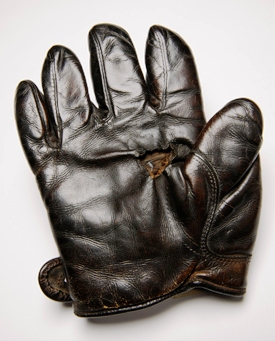
By 1907 Morse longed for the early days and was bothered by the lack of hitting during the first decade of the 20th century –he blamed it on the baseball mitt:

“There is no doubt that patrons of the national game are becoming heartily sick and tired of the kind of baseball they compelled to see today. ..Who is there who has not noticed game after game how the infielder can block the hottest of driven balls and throw out a man after it?”

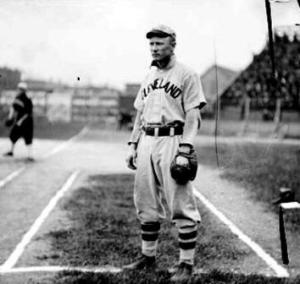
Morse went on to mention a play made by Cleveland Indians shortstop Terry Turner (who, incidentally made 39 errors in 1907):

Turner

Turner

“Turner blocked a ball that he could never have stopped but for the protection he wore on his hands.  Line ball after line ball is blocked and caught by the help of the mitt.”

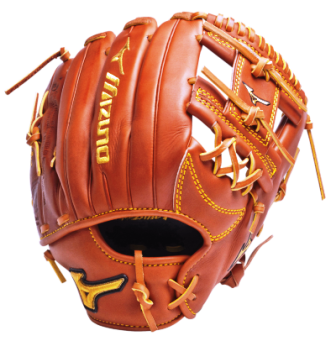
What would Morse make of this?

1905 Rube Waddell glove