Tag Archives: San Francisco Seals

A Bobby Eager Story

23 Feb

The 1906 San Francisco earthquake left the city in ruins; it also put the future of the Pacific Coast League (PCL) in serious jeopardy.

Years later PCL veteran Bobby Eager wrote about the league in the aftermath of the quake in The San Jose Evening News:

“Did you ever hear of a bunch of ballplayers owning their club in a league?  I never did, but I came within an ace of being a part owner at one time.”

Bobby Eager

Bobby Eager

Eager, then with the Los Angeles Angels, said the league was “pretty much on the bum,” and while leagues in the East had agreed to help the PCL financially, there was no sense of how the league would operate.

Jim Morley, the owner of a large pool hall in Los Angeles, owned and managed the Angels, but said Eager:

“(H)e got cold feet early.  He practically dismissed the team and said he was through.”

San Francisco Seals owner James Calvin (J. Cal) Ewing, whose deep pockets kept the league afloat, was “furious at Morley, quitting like a hound.”

Local boxing promoter “Uncle” Tom McCarey was asked by Ewing and league president Eugene Bert to take control of the club, but when that failed they reached out to a local businessman.

“They got a fellow by the name of Gil Meade to take over…It was decided to play the San Francisco games at Oakland, and go on with the league and give the fans some ball.  Of course it was an uphill fight all around with no grounds at Frisco.

“Meade shot his $5,000, which was his bankroll, in a couple months and he was done and out.”

At the time, The Los Angeles Examiner said Meade left as a result of the league failing to award him a large block of stock in the team that was promised.

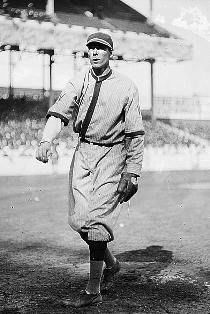
Eager said after Meade departed the team was called together by field manager and Captain Frank “Pop” Dillon:

Frank "Pop" Dillon

Frank “Pop” Dillon

“He first wanted to know how much money we all had and we told him.  Then he laid before us his plans.  He showed us how we could take over the club by putting up three or four hundred dollars apiece.  He said we would not get any salaries that year but the next year he thought the club would pay big.  A few of the players (Eager included) were willing to take a chance but most wanted their salaries.  They were not gamblers.”

Dillon could not convince enough of the Angles and Eager’s dream to own a club died.

“The result was the league dug up (William Henry) “Hen” Berry who was running a little poolroom.  Hen’s brother (Clarence, who made a fortune in the oil and horse businesses) let him have enough to back the club the rest of the season which was about $8,000, but next year we won the pennant and Berry cleaned up big.  I know every stockholder who had a $100 share got a $40 dividend the next year.  If we players had taken the club we would have made just as much and might have started something new in baseball in the way of profit-sharing.”

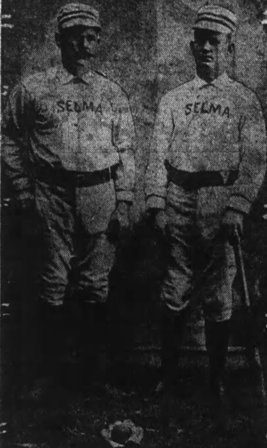
Clarence, left, and William Henry Berry played for the amateur Selma (CA) Tigers in the 1890s

Clarence, left, and William Henry Berry played for the amateur Selma (CA) Tigers in the 1890s

Another “Hen” Berry story on Wednesday.

Life on the Road, 1914

6 Feb

In 1914, before beginning his second season as manager of the San Francisco Seals, George “Del” Howard gave the readers of The San Francisco Call a rare look behind the scenes of a baseball team.

Del Howard

Del Howard

“One of the many difficulties which beset a ballplayer is ‘killing’ time while playing away from home…Del Howard was telling only yesterday how the various members of the Seal squad act while on the road.  All the boys are quartered at the same hotel and they usually pass the time in each other’s company.  Card playing for the most part is the favorite pastime, with theater-going running a close second..  There are a few of the San Francisco players who like to hide behind a book, others frequent billiard parlors for a game with the cue, but the majority sit around a table and do their best to deal out pairs.”

Howard even shared the team’s rules for road trips:

“Don’t stay out later than midnight.

Don’t fail to answer 8 A.M. call.

Don’t fail to be down to breakfast by 8:15.

Don’t run around to dances

Don’t play ‘craps’ at any time.

Don’t go over 25 cent limit at cards.

Don’t drink to excess.

Otherwise the players are free to do as they please.”

He said of his “don’ts”:

“We haven’t many rules but the ones we have must be observed.  We don’t tell a player he mustn’t drink nor smoke but we do take action when the privileges are abused.  A player knows best what is good for him and free rein is given him.  A player is allowed to remain up until midnight, if he is in good company, and he is required to be up at 8 in the morning.   There is nothing to do but it is healthy for him to be out of bed.  We breakfast at 8:15.  Very few players eat any lunch and at 6 we go to dinner.  Then there is a long evening to be faced and t is certainly a problem putting in time.”

Howard then described how some of the Seals’ most popular players were “putting in time:”

Howard Mundorff is the life of the club.  ‘Mundy’ is full of fun and the players gather around him and listen for hours while he tells stories and amuses them.  Howard is also one of the card sharks.

Mundorff

Howard Mundorff

Jimmy Johnston is an enthusiastic pool player and he usually can be found at night trying for the 15-ball in the side pocket.  Pete Standridge is also handy with the cue.

Walter Schmidt is quiet and keeps to himself a deal of the time.  He delights in taking strolls and Walter Cartwright, another quiet chap, occasionally accompanies him.

(Jay) Nig Clarke seems to lose himself on every trip and Manager Howard declares that for the life of him he cannot tell just how Nig passes the time.

(Roy) Corhan plays cards pretty regularly, but he spends a lot of his time writing, for he keeps up a continuous line of communication with his better half, when he is on the road, writing consistently every day.

Roy Corhan

Roy Corhan

Charlie Fanning is a bug with the camera and takes pretty good pictures of all the places of interest.  “Skeeter” also knows when to lay down two pair.

“(Albert “Lefty”) Leifield is a very interesting talker and he was a running-mate with Mundorff in amusing the gang.”

Howard said shortstop Harry McArdle was the “most popular player he ever encountered.  Mac has admirers in every town and was kept pretty busy keeping engagements.”

Harry McArdle (sliding)

Harry McArdle (sliding)

As for his time on the road, Howard said, “I walk around and look over things.  I was fortunate in having a well-behaved club last season and did not have any trouble keeping them in line…A busher has the time of his life in a strange town, but a veteran only figures to do something to keep busy.”

After a 104-104 fourth-place finish in 1913, Howard’s Seals—minus Johnston, who drafted by the Chicago Cubs and McArdle, who was traded to the Venice Tigers–behaved themselves well enough to finish third with a 115-96 record in 1914.  The following season he was replaced by Harry Wolverton who led the seals to a 188-89 season, and the Pacific Coast League championship.

Sam Crane on International Baseball

30 Jul

Samuel Newhall “Sam” Crane, like Tim Murnane, turned to sports writing after his career on the field ended.  His involvement in a scandal might have contributed to his departure from the diamond—but contrary to oft-repeated stories it was not the direct result.

Sam Crane

Sam Crane

Crane was named as a respondent in a Scranton, Pennsylvania divorce in 1889—a prominent Scranton businessman named Edwin Fraunfelter (some contemporary newspapers incorrectly said “Travenfelter”) charged that Crane had stolen his wife, and $1500.  Crane had played for the Scranton Miners in 1887 and ’88 and departed the city with Fraunfelter’s wife Hattie in 1889, relocating to New York.  Crane and Hattie Fraunfelter were returned to Scranton to face trial for the theft.

In October of 1889, they were acquitted.  The Philadelphia Times said the two were released and Mr. Fraunfelter was ordered to pay the court costs, and “The congratulations which were showered on the second baseman and the woman made a scene in the courtroom.”

Despite the scandal the New York Giants (twice) and the Pittsburgh Alleghenys were happy to sign Crane in 1890.  The end of his career was more of a result of the 36-year-old’s .179 batting average and diminishing fielding skills—twelve errors in 103 total chances at second base–and, of course, he probably wouldn’t have found himself in Scranton in 1887 and ’88 had his career not already been on a downward trajectory.

Crane immediately went to work for The New York Press upon his retirement and remained one of the most respected sports writers in the country.  He edited the “Reach Guide” from 1902 until his death in 1926.

In 1905 Crane, then with The New York Journal, wrote about the boom in International baseball on the eve of the visit of the Waseda University baseball team:

“The Japanese are nothing if not progressive, and even with their country in the throes of a disastrous war (The Russo-Japanese War) they have found time to devote attention to our national game.”

Crane said the Waseda visit would:

“(M)ark a red letter day in the history of the game,  It will be a sensational era in the life of the sport, and in fact, that of all athletic sports.”

Japan was not alone in embracing the game:

“Baseball is also flourishing in South Africa.  The Transvaal Leader, a progressive newspaper, has taken up the sport and publishes full scores of the games and the records of the players.

“There is a South African baseball association and the players of the different teams can hit the ball, even if they have not yet attained the accuracy and agility in fielding their American cousins have reached.  According to The Leader, out of thirty-seven batsmen who figure in the official  record from July 1 to October 8, twenty-three of them batted over .300…A batter named Suter of the Wanderers was the Lajoie of the league, and he made our own ‘Larruping Larry’s’ record of .381 look like a bush league mark.  Suter’s batting percentage was .535.

“The second batter to Suter was Hotchkiss, also of the Wanderers, who walloped out a base hit every other time at bat, making his average .500…Wonder what the Africans would do with ‘Rube’ Waddell and the Chesbro ‘spit ball?’”

As evidence that the South Africans had “grasped the American style of reporting games” Crane gave an example from a recent edition of The Leader:

“’The diamond was very hard, and, as a consequence, the ball frequently wore whiskers, as some infielders can testify.’”

Crane expressed surprise that baseball had taken such a “stronghold” in an “English possession”  like South Africa:

“Britons, wherever found, look upon the great American game as a direct infringement on the sporting rights as established by cricket.

“’It is only an offshoot of our rounders,’ they are wont to say, and that ancient game is about on the level of ‘one old cat’ and ‘barnball.’

“Englishmen are extremely conservative about their sports, especially of cricket, which is considered their national game, and in their own stanch little island they have always pooh-poohed baseball.  But when the Briton gets away from home influences he becomes an ardent admirer of the American game and is loud in his praise of the sharp fielding it develops.

“In Canada, South Africa and Australia, where there is more hustling, and time is more valuable than in the staid old mother country, the quick action, liveliness and all around hustling of baseball that give a result in a couple of hours, is fast becoming more popular with the colonials than cricket, that requires as many days to arrive at a decision.

“Great strides have been made in baseball in the Sandwich (Hawaiian) Islands.  Honolulu is the headquarters just now, but the game is fast spreading to other localities.  The game has been played in the Sandwich Islands for many years, but it was not until the United States was given possession that it flourished.”

Crane mentioned that his late brother Charles–who died in 1900, and incidentally, married his brother Sam’s ex-wife who Sam divorced before leaving Scranton with Mrs. Fraunfelter) had been the catcher on the team representing the naval vessel the USS Vandalia and frequently played games against teams in Hawaii and Samoa during the 1880s:

“The natives took to the game very quickly and soon learned to enjoy it.  They welcomed every arrival of the Vandalia with loud demonstrations of joy, and there was a general holiday whenever a game was to be played.”

Crane predicted that baseball would continue to flourish in the islands, and throughout Asia, noting that a Chinese player “plays third base on the leading club, and has the reputation of being the best player in the whole league.”

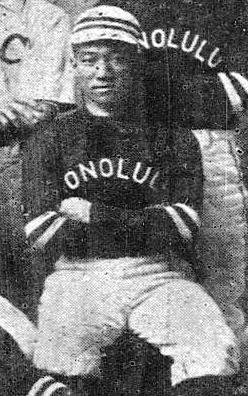
He was likely referring to 20-year-old Charles En Sue Pung, a teammate of Barney Joy’s on the Honolulu Athletic Club team who was also one of Hawaii’s best track athletes.  Pung was rumored to be joining Joy when the pitcher signed with the San Francisco Seals in the Pacific Coast League in 1907, and in 1908 there were brief rumors in the press that Chicago Cubs Manager Frank Chance wanted to sign the Chinese third baseman—neither materialized, and he remained in Hawaii.

Charles En Sue Pung

Charles En Sue Pung

Crane said the growth of the game internationally would be endless; he said the introduction of the game in the Philippines was a prime example:

“(T)here are several enclosed grounds in Manila to which are attracted big crowds…I know they can learn to play the game, for when the (New York) Giants were in Savannah (Georgia) for practice last spring a team of soldiers from a nearby fort played an exhibition game with the Giants.”

Crane said the team was accompanied by “a young Filipino, who, while he did not play on the soldier team, practiced with them and showed surprising proficiency… (The) youth knew all the points of the game as well as Henry Chadwick.”

For Crane, that was enough to declare that “in short order” the Philippines would adopt the game as had, and would, “all people that are blessed with real red blood and progressive.”

Franz Hosp

19 May

Franz Philip Hosp Jr. was born in Cincinnati in 1884 (some records, including cemetery documents and his grave say 1883).  His father was a well-known landscape architect and horticulturist who moved the family to Riverside, California in 1888.

The elder Hosp was responsible for many projects in the Southwest and Southern California; he is probably most famous for his landscaping of Victoria Avenue in Riverside, which remains a tourist attraction and is listed on the National Register of Historic Places, and for planting the gardens at the El Tovar Hotel in Grand Canyon National Park.

The family also ran a successful nursery in Oceanside, California  and Hosp worked with his father while playing baseball in the San Diego area.
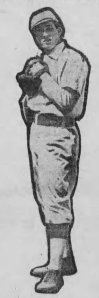
Franz Hosp

Franz Hosp, 1909

In December 1906 he pitched for the San Diego Pickwicks (sponsored by San Diego’s Pickwick Theater) of the California Winter League.  Hosp quickly caught the eye of West Coast professional teams; according to The Los Angeles Times he had a streak of thirty-one scoreless innings that winter and “fanned as many as eighteen men in a single game.”

The Los Angeles Herald said two teams, The Butte Miners and the Seattle Siwashes of the Northwestern League, had already “tried hard to secure his services,” when he pitched against the Los Angeles Angels of the Pacific Coast League (PCL) in a February exhibition game in San Diego.

The Associated Press said the game

 “(W)as the first time in which he allowed as many as seven hits, and after doing, he took a brace and fanned out an equal number of Los Angeles’ best artists, with the result being that the Angels’ manager (Henry ”Hen”  Berry) lost no time in annexing Hosp to his own aggregation.”

Hosp said he chose to play with Los Angeles so he could continue working at the family business in Oceanside.

The pitcher was a popular member of the Angels.  The Los Angeles Herald said:

“Pitcher Franz Hosp is not only one of the best twirlers in the coast league, but he is also one of the most genial boys who ever donned a baseball uniform.  Hosp has forgotten more baseball, young as he is, than many of the swell headed players who roar at decisions have ever learned.”

The Times said of Hosp, who also played second base and shortstop:

“His work in the field and at the bat is equal to his performance in the box making him one of the best all-around men in the business.”

Hosp was 12-7 with a 2.73 ERA for the PCL champion Angels in 1907; he also played 13 games in the infield, hitting just .105.
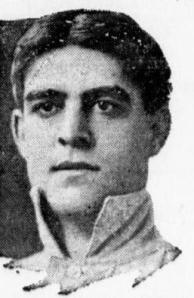
franzhosppix

Franz Hosp

The following season Hosp (22-14 2.02), William “Dolly” Gray (26-11, 2.12), and Walter “Judge” Nagle (24-10, 1.94) led the Angels to another league championship.  On July 26 he had the most embarrassing moment of his career during a game with the San Francisco Seals.  The San Francisco Chronicle said:

“Hosp of the Angels established a unique and startling record yesterday afternoon, one that bids to stand a long time in baseball circles.  Not only did he literally pitch the game away, but in one inning—the fourth—he walked six men and hit two more, forcing in five runs across the plate without a hit by the Seals.  Not a ball was hit out of the diamond.”

(Just more than a year later, August 28, 1909, Hosp’s former teammate Dolly Gray, now a 30-year-old rookie with the Washington Senators, set the major league record by walking eight Chicago White Sox batters in one inning).

Hosp was 16-14 in August of 1909 when he was signed by the Cincinnati Reds for 1910.  Within a week he hurt his arm and did not pitch again for the remainder of the season.

By the spring of 1910 there were conflicting reports about the condition of Hosp’s arm.

The Times reported that according to Angels pitcher Andy Briswalter:

“Franz Hosp, whose clever pitching resulted in his purchase by the Cincinnati Reds, may never play ball again.”

The Herald said Hosp:

“(D)enied with considerable indignation the story purporting to be an interview with Andy Briswalter.  According to this story, Hosp’s arm was said to be in such condition that he might never play ball again.  While Hosp was overworked last season, when his sensational work with the Seraphs resulted in his being purchased by the Cincinnati Reds, he stated that he never felt better and that the rest of the past winter overcame any inconvenience or ill effects.  Hosp says he hasn’t seen Briswalter in six months.”

Hosp joined the Reds in Hot Springs, Arkansas, and was first tried in the outfield.  The Cincinnati Enquirer said after his debut:

(Ward) Miller and (George “Dode”) Paskert will have a dangerous rival for the right field job in the person of Franz Hosp, the recruit from the coast, who was signed as a pitcher but will try out as a fielder…He is a right-hand hitter, a good-sized, well-built fellow, and meets the ball square on the nose.  He came to bat five times; made a double and two clean singles…He showed a lot of speed on the bases and appears to be a kid who will bear watching.”

When finally given a chance to pitch, against the Boston Red Sox on March 25, after two scoreless innings, he gave up four singles and doubles to Harry Lord and Tris Speaker, in the third, resulting in three runs and was lifted for a pinch hitter the following inning.

Hosp was also tried in the infield where he “has made a fine impression.”  But it wasn’t enough to stick with the Reds.

The Herald reported in early May:

“Franz Hosp, one of the best pitchers who ever worked in the Coast League and who was released to Los Angeles by Cincinnati almost ten days ago because his pitching arm is kafluey for a time is warming up with the Angels every day and Hen Berry thinks he will get back into pitching form again soon.  He is a crack infielder too, and a heavy sticker, so it is dollars to cents that he will not be idle long.”

Hosp made his mound debut for the Angels on May 20; he pitched a complete game, losing 5 to 3.  The Herald said:

“Hosp showed excellent form for a pitcher who has been out of the game as long as he, and with a weak and sore arm, and he should be able get back to his best form with a little patience and careful slab work until his arm is ripe again.”

The paper was wrong, the extent of Hosp’s activity as a pitcher after that game was four innings in three games over the next year and a half.

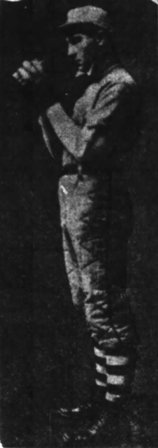
Hosp was released by the Angels on June 15, along with Briswalter, who The Times claimed four months earlier had said  Hosp’s arm was shot; Briswalter had not recovered from a hip injury sustained during the 1909 season, he developed Tuberculosis of the injured bone and died in 1912.
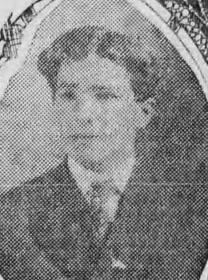
Andy Briswalter

Andy Briswalter


Hosp continued to play for a decade.

Within weeks he was signed to play shortstop for the Vernon Tigers.   He hit just .240 for the Tigers, but The (Portland) Oregonian called him “a nifty fielder.”

Hosp became the team’s regular shortstop, through their move to Venice, California.  He hit .261 in 1911, and 1912, .255 in 1913, and then slipped to .208 in 1914.  He was released before the 1915 season and played for the Wichita Witches in the Western League.  He returned briefly to the PCL at the end of 1915, but was released by the Oakland Oaks prior to the 1916 season.  He returned to the PCL in 1918, playing for four teams over the next three seasons, ending his career after 56 games with the Salt Lake City Gulls in 1920.
Hosp returned to Southern California where he played and managed for semi-pro and industrial league teams and lived in Los Angeles.

On June 30, 1928 he was killed in a car accident on Coast Highway (US 101) 16 miles north of Oceanside.

Ovie, Oh, Ovie

17 Jan

Arm trouble ended Orval Overall’s career early.  When he left baseball for the first time after the 1910 season he had a 104-66 record, won 20 games twice, and went to the World Series four times with the Chicago Cubs (3-1 in eight appearances).

orvie

Orval Overall

After a visit to John D. “Bonesetter” Reese, a self-trained Youngstown, Ohio-based practitioner of alternative medicine, who while popular among many of the era’s major stars, was condemned by medical professionals.  Despite being “healed,” Overall was unable to come to terms with the Cubs and sat out the 1911 season.

Remaining in his native California, Overall worked at the gold mine he owned with Cubs teammate Mordecai “Three Finger” Brown in Three Rivers and pitched for Stockton team in the “outlaw” California League.  His success in California during the fall of 1911 gave the Chicago press hope he would return to the Cubs in 1912.  The Chicago Inter Ocean said:

“Orval Overall’s arm seems to get better every time he pitches a game.  Last week the former Cub whom Manager (Frank) Chance is trying to persuade to return to the West Side team struck out seventeen men twirling against the All-Sacramento team for Cy Moreing’s Stockton outlaws.”

Later in the fall Overall hurt his arm again.  He returned to “Bonesetter” Reese in December and told The Youngstown Vindicator he was finished with organized baseball, and would “Confine himself to his mining business and with occasional independent ball.”

Overall pitched a few games for a semi-pro team in Visalia; thirty minutes from his mine.

Orville Overall

Orville Overall

In February of 1913, he petitioned the National Commission to reinstate him and declare him a free agent because the Cubs “omitted to send him a contract” in 1912.  The commission granted his reinstatement but returned him to the Cubs.

Overall pitched in just 11 games, with a 4-5 record and .3.31 ERA; he was released to the San Francisco Seals in the Pacific Coast League (PCL) in early August.

Overall’s return to the West Coast was an event, and Seals fans even attempted to tell the club when the popular pitcher should make his first start.  The San Francisco Chronicle said:

“Orval Overall, the famous California pitcher, who built up such a reputation with the Chicago Cubs, will pitch for San Francisco today against Venice (Tigers).  A petition signed by sixty Seal fans was sent to (Manager) Del Howard yesterday, with the request that Overall’s first appearance be billed for Sunday afternoon.”

Howard chose to start Overall the day before the fans requested, nevertheless, the game drew a crowd of nearly 10,000 and The Chronicle said: “they gave him a reception long to be remembered.”

Overall gave up five runs, and was lifted in the ninth inning for a pinch hitter.  The Seals lost 8-5 in 11 innings.  He ended the season 8-9 with a 2.14 ERA.

At the end of the 1913 season, Overall announced his retirement.  San Francisco fans were not convinced and said The Chronicle said he “was being counted upon to be one of the mainstays in the box.” But chose to take a job with Maier Brewing Company “in the South” (Venice, CA—still a separate city from Los Angeles at the time.  The Maier family also owned the PCL’s Venice Tigers).  San Francisco fans were not convinced, and there was speculation for the next four months that Overall would return.

Reporter L. W. Nelson, The San Francisco Call’s resident poet composed a verse to try to coax the pitcher back:

Ovie, Oh, Ovie

Ovie, oh, Ovie, come home to us now,

For the season is soon to begin,

And we need you, yes, badly, to show the folks how

The Seals, when they have you, can win!

Ovie, oh, Ovie, sign up with us quick,

Put your name on the contract from Cal,

For we know you can make all others looks sick,

If you pitch for our Seal crew, old pal!

Ovie, we know it is your fondest dream

To work down in Venice for Maier,

Midst the Milwaukee water, the lager and steam—

We know you would like it down there!

Ovie, oh, Ovie, sign up to play ball,

And don’t try your beer selling skill,

For the job in the brew’ry won’t help us at all,

But your pitching most certainly will!

(“Cal” was Seals owner James Calvin Ewing)

As late as March 1914 Overall hinted that he might return, but the pleas and the poem did not sway him.

He left the beer business after a year to manage his family’s large lemon and orange growing operation near Visalia, which would make him quite wealthy.  He became a banker and dabbled in politics and competitive trap shooting.  He died in 1947.

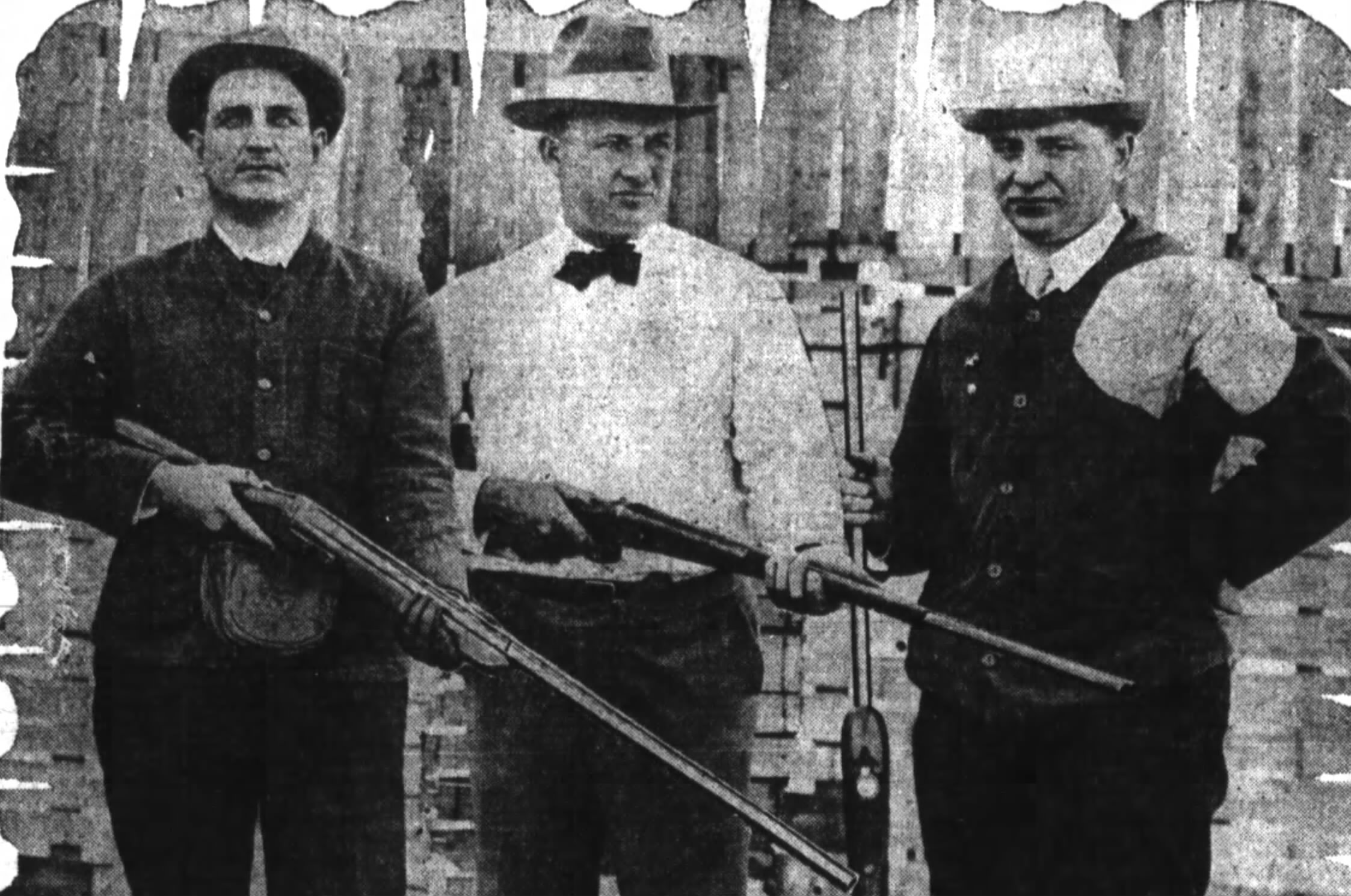
Overall (center) was president of the California-Nevada Trap Shooters Association (1918)

Overall (center) was president of the California-Nevada Trap Shooters Association (1918)

Morrie Rath

25 Nov

In August of 1913, the Chicago White Sox sold second baseman Morris “Morrie” Rath to the Kansas City Blues of the American Association.

Morrie Rath

Morrie Rath

The Chicago Eagle said the sale wasn’t the result of Rath’s .200 batting average, or 16 errors, but because of his performance coaching first base during a game in Philadelphia earlier in the month:

“Morris was coaching at first base and (Manager Nixey) Callahan was at third.  (Harry) Lord was at bat.  He hit a bounder to one of the infielders and as it was a slow hit he figured he could beat it out.  He ran with every ounce of speed and strength that he possessed.  The play was mighty close.

Harry Lord

Harry Lord

“’Out,’ cried the umpire.

“Lord figuratively hit the ceiling.  He threw his cap down and jumped upon it.  He picked it up and threw it down again.  He howled and he scowled.  He allowed that if there ever was a blind umpire that he was working on the bases that day.  He assured the ump that in all his experience as a ball player it was the worst decision he ever saw.  Then up spoke Rath.  His voice was as gentle as could be:

“’Yes, you were out Harry.’

“And Lord collapsed.  That beat the other thing.  Never in his experience as a ball player had he heard another player agree with the umpire when it meant that one of his pals was out instead of safe.  That was beyond the comprehension of Lord.  He just wilted and staggered to the bench.

“By this time Callahan was over there.  There was fire in his eye, and he was fighting mad.  ‘Of all the—‘ he started in and then stopped.  For the umpire was laughing.

‘What’s the matter?’ howled Cal.

‘Why Rath here agrees that he was out,’ laughed the ump.

“What did Cal do?  What could he do?  He also was dazed.  It was a new one on him.  He had been around ball fields for many years, but never before had a member of his team taken sides with the ump against a teammate.”

It was a long road back to the big leagues for Rath.  He played for Kansas City until June of 1915 when he was sold to the Toronto Maple Leafs.  In 1916, He joined the Salt Lake City Bees in the Pacific Coast League, after hitting .300 and .341 he was drafted by the Cincinnati Reds after the 1917 season in the Rule 5 Draft.

After spending 1918 in the United States Navy where he was captain of the baseball team at the Philadelphia Navy Yard, Rath finally joined the Reds for the 1919 season.  He was Cincinnati’s regular third baseman in 1919 and 1920 and appeared in all eight games of the 1919 World Series against his former team.

Rath finished his career with the San Francisco Seals in the Pacific Coast League in 1921.

After his career, he operated a sporting goods store in Upper Darby, Pennsylvania.  In 1945, suffering from ill-health, he committed suicide.

Buddy Ryan

15 Oct

During the 1912 season pitcher Bob Groom was having what would be the best season of his career; he was 24-13 with a 2.62 ERA for the Washington Senators.

His former teammate John “Buddy” Ryan was hitting .271 during his first season with the Cleveland Naps.

Groom and Ryan had been teammates with the Portland Beavers in the Pacific Coast League (PCL) in 1908. Ryan claimed that while they played together Groom had nearly quit baseball.  According to The (Portland) Oregonian:

“(Groom) was a most sensitive fellow.  One day we were playing San Francisco and had them 4 to 1 in the sixth inning, when Groom became a trifle wild , Mac (Walter “Judge” McCredie) jerked him after he had filled the bases with none out.  Bobby did not like it and he threw off his glove angrily and walked to the bench made as a wet hen.

According to Ryan, when Groom reached the bench he told McCredie he was through with the “blamed old club” and was going home.  All three San Francisco runners scored, tying the game.  The following inning:

“We got the bases full and (Otis) Ote Johnson up, when Groom ambled dejectedly out of the clubhouse, carrying his little grip with all of his baseball togs and stuff in it.  He got about as far as third base when Ote landed on one for one of those long triples of his, and Bobby forgot about quitting the club and going home, for he threw his cap, grip and everything in the air and yelled ‘Come on you Swede boy, it’s good for three.’ We won the game and Bobby never said a word about going home.”

Bob Groom

Bob Groom

Bob Groom remained in the big leagues through the 1918 season, compiling a 119-150 record with Washington, the St. Louis Brown, Cleveland Indians and St. Louis Terriers in the Federal League.

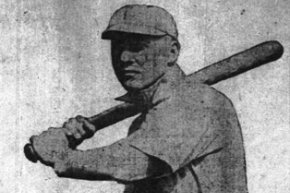
Buddy Ryan spent just two seasons in the major leagues, hitting .282 as Cleveland’s fourth outfielder in 1912 and 1913.  He returned to the Pacific Coast League and became one of the league’s most popular figures for the next twenty years.

buddyryan1

Buddy Ryan

His unusual wedding made headlines in 1915:

“John F. (Buddy) Ryan, one of the best-known and popular baseball stars on the Coast, was arrested early yesterday morning on a charge of immorality preferred by Deputy District Attorney Richard Ceich. At 2:08 PM he was married by Municipal Judge Stevenson to Miss Ruby Winters and the charge was dismissed.

“Miss Winters, who was at first held as a witness against the ballplayer, has been living with him for nearly 10 years, according to her statement, and has been known as Mrs. Ryan.  She said yesterday that she had asked Buddy to marry her several times.”

Failing that, she had him arrested:

“With Ed Kennedy (Ryan’s former Portland teammate and county jailer), as best man, the two were wedded in the Municipal Courtroom yesterday afternoon.  The bride wept for several minutes following the ceremony.  Mr. and Mrs. Ryan left last night for the training camp of the new Salt Lake Coast League team.”

Ryan had his best season in Salt Lake City in 1915, hitting .340 for the Bees.  That winter he had an emergency appendectomy and developed an infection, the newspaper headlines said his condition was grave: The San Francisco Chronicle said he was “In Very Bad Shape,” The San Bernardino News said “Buddy Ryan Near Death.”

Ryan recovered in time to return to the Bees for the beginning of the 1916 season.  He hit better than .300 the next three seasons, and after the completion of the PCL’s war-shortened 1918 season he played for and managed a team in Seattle’s Puget Sound “Shipyard League.”

He sat out the 1919 season and returned to the PCL in 1920—the rest of his story tomorrow.

“Krug Seemingly Lost his Head”

25 Sep

The 1902 Southern Association season was so contentious that a headline in The Atlanta Constitution said the day after it ended:

To the Relief of All the Season is Now Over

In addition to the months-long battle between Charlie Frank and the league, there was an on-field incident that The Columbus (GA) Daily Enquirer called “an exhibition as was never before seen on an Atlanta Diamond.”  Henry “Heine” Krug was at the center of it.

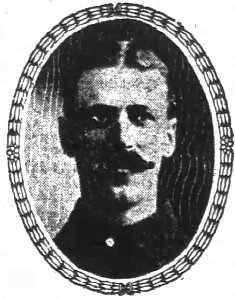
Henry Krug

Henry Krug, 1902

In February of 1902, Ed Peters, new owner and president of the Atlanta Firemen signed Ed Pabst to manage the team.  Pabst had played the previous season with the San Francisco Wasps in the California League and brought with him to Atlanta his friend Krug, a 25-year-old shortstop who had been playing for West Coast professional teams since he was 17.

When Krug was signed The Constitution said he was “beyond doubt the star of the Pacific Coast,”

The Sporting Life said Krug had already signed a contract with the Philadelphia Phillies, but jumped the Phillies to join Atlanta.

Krug’s average never dipped below .300, and was very popular with fans and the press.  The Constitution called him “The best all-around professional of the Southern Association” in June.

On July 15 the paper noted his “dashing, errorless work that has been classed as phenomenal.”

Two days later the tone changed dramatically.

The fourth place Firemen were playing Charlie Frank’s Memphis Egyptians and Krug was having a rough day.  Early in the game a throw from first baseman George Winters hit Krug “and gave him a severe blow in the mouth.”  Krug had walked off the field, intending to leave the game, but came back.  He probably shouldn’t have.

Krug went on to make three errors, two of which The Constitution said “in the opinion of the crowd might have been avoided.”

The crowd began to taunt Krug and “Instead of taking the roast the bleachers proceeded to give him as any sensible player would take it, Krug seemingly lost his head and with all the vicious intent imaginable, he secured the ball and threw it with all his strength into the bleachers.”

The Constitution said Krug, “phenomenal” just two days earlier, now said the shortstop’s “conduct on former occasions has been offensive to the patrons of the game.”  Although Krug was ejected from a game earlier in the week, there didn’t appear from newspaper reports to be any pattern of “offensive conduct.”

Atlanta bleacher fans “dodged the sphere” and no one was hurt.  Team president Peters immediately approached Ed Pabst and “instructed him to order Krug out of the game.”  Pabst refused:

“He did not like what he considered an infringement on his prerogative, and at once tendered his resignation as manager of the Atlanta team.  President Peters was just as ready to accept as Manager Pabst was to tender, and within the space of a few seconds the ball player who has been managing the Atlanta team since the playing season of 1902 opened found himself deposed.”

Ed Pabst

Ed Pabst

Peters took over as manager and remained in the position for the rest of the season.  His first act as manager was to remove Krug from the game and suspend him.  The Constitution said:

“Krug’s baby act was witnessed by Sergeant Martin and policemen Norman and Hollingsworth.  They placed him under arrest.”

Some reports said a bottle and rock were thrown at Krug, but the player said he didn’t see that and was reacting only to the verbal taunts.  He appeared in court the following day and was fined $10.75; The Daily Chronicle said, “Krug appeared very penitent.”

Peters sold Krug’s contact to the New Orleans Pelicans the following day, but Krug refused to report sending a wire to Peters and Pelicans owner Abner Powell saying “that if he could not play in Atlanta he would not play,” in the league.

Despite the incident, there was no shortage of interest in Krug’s services.  In addition to New Orleans, the Phillies, who he jumped to join Atlanta and the San Francisco franchise in the California League offered him contracts.

Krug signed with Philadelphia and made his debut with the Phillies on July 26; the day after Atlanta management petitioned the National Association of Baseball Leagues (NAPBL) to blacklist Krug.

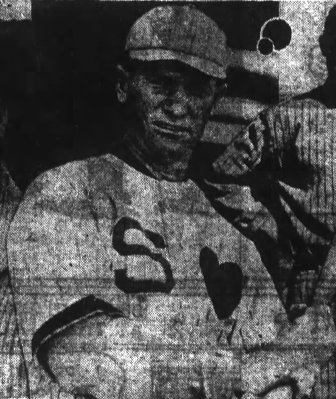
No action was taken and Krug played out the season in Philadelphia, hitting .227 in 53 games.  He spent 1903 with the San Francisco Seals in the Pacific Coast League (PCL).  Peters sold his interest in Atlanta in 1903.

Before the 1904 season, the PCL and the NAPBL reached an agreement that made the league part of the National Association and no more an “outlaw league.”  As part of the deal, PCL players who were under contract with other teams were returned.  As a result, Krug returned to Atlanta.

The Constitution assured their readers:

“He has promised to be good and to do his best to help the team win.  It is the belief of many fans in this city that he wishes to redeem the past.”

Krug played two incident-free, if unspectacular seasons in Atlanta, then played in the New York State League with the Scranton Miners and the American Association with the Indianapolis Indians.

krug1

Henry Krug,1907

The 31-year-old returned to San Francisco, where he was “negotiating for a place with the California State League,” and had accepted a position coaching the baseball team at Cogswell College.  Krug underwent surgery for “an abscess upon his throat” on January 12, 1908, and died from complications from the operation two days later.

Two months after his death all had been forgiven in Atlanta.  The Constitution named him to the paper’s “All-Atlanta Ball Team,” the best professional players to have played in the city.  Krug “was a power with the stick.  No better man ever played on the Atlanta team when it came to breaking up a game.”

Ernest Nichols

6 Jun

Ernest Nichols seemed destined for stardom.  He was the subject of a bidding war before he ever pitched in a professional game.  The San Francisco Chronicle said that his hometown San Francisco Seals wanted to sign him, but had a lot of competition:

Parke Wilson wanted him for the Pacific Coast League in Seattle (the Siwashes), Matt Stanley recommended him to (Dan) Dugdale for the opposition team in Seattle (the Chinooks of the Pacific National League), and Spokane came along with a contract calling for a large figure and took Nichols away from the other bidders.”

Ernest Nichols

Ernest Nichols

The 21-year-old, six-foot, 190 pound right-hander was in high demand after pitching for the amateur Reliance Athletic Club team of Oakland in Northern California’s Mid-Winter League, and an independent team in Vancouver in 1902.  The Chronicle said:

“Speed and control were Nichols’ strong suit, and he had the remarkable record of thirty-five strikeouts in two consecutive games (with Vancouver).”

Upon joining the Spokane Indians Nichols immediately lived up to the hype.  By mid July he had started 24 games, winning 20.  During a one week stretch in June he beat the Tacoma Tigers four times.  The Chronicle said Nichols, who supported his mother and sisters had his salary “raised voluntarily by the Indians.”

On July 20 Nichols and two teammates went swimming at the pool in Natatorium Park, park of the amusement park that also included the Indians’ ballpark.   After swimming, the three began to watch a ballgame between two local teams.  The Spokane Spokesman-Review said:

“(Nichols) complained of cramps.  The three started to walk to catch a car.  When a car arrived he was lifted aboard and speeded to Dr. Kimball’s office.  The doctor saw that he was dead.”

He died of septic endocarditis.  Two days later The Spokesman-Review said:

“The last sad rites were rendered to the remains of pitcher Ernest Nichols yesterday afternoon by his friends and associates who knew him intimately and by a great mass of the public who knew him only through his baseball fame. “

Nichols’ body was returned to San Francisco and plans were quickly made to play a benefit game in his honor in Spokane.  The game between the Indians and the Butte Miners raised $1025.

In October of 1903 The Chronicle said:

“In all the league averages no box man is found with a record approaching that of the late Ernest Nichols, the San Francisco boy who won 20 out of a possible 24 games before death called him.”

“Calvo May Come Out But No One Cares”

5 Jun

Jacinto Calvo and San Francisco Seals owner Charlie Graham were unable to come to terms on a contract for 1918, and the local press quickly turned on the outfielder.

The San Francisco Chronicle said:

“(Calvo) is a simple-minded Cuban boy…When he is hitting he can go around the bases in nothing flat.  When he has a batting slump, he develops water on the knee and can hardly limp up to the plate.”

He remained in Cuba and served as a police officer in Havana.

It was rumored again in 1919 that Calvo might return to the Seals, but The Chronicle, under the headline “Calvo May Come Out But No One Cares,” made it clear that twelve months had not softened opinions about the holdout outfielder:

“Calvo has written friends that he wants to come back, but if he stays in that dear old Havana until Charlie Graham coaxes him back, he will grow whiskers a foot long.  Graham really tried to get Calvo last year, for he was in a bad way for lack of outfielders, but if there is any coaxing to be done this year, Calvo will do it.”

Calvo

Calvo

Terms were not reached for 1919, and Calvo remained in Havana for another year.

In February of 1920 The Chronicle said Calvo, “Who bobs up every year about this time,” had written Graham saying he wanted to return to the Seals, then in March the paper reported that “The Havana World” said that Calvo “has joined the Franklin, PA independent team together with (Manuel) Cueto.”

Neither report proved true; instead, Calvo was signed by Clark Griffith for a second tour of duty with the Washington Senators.  In 17 games he had only one hit, a triple, in 23 at-bats before being sent to the Little Rock Travelers in the Southern Association in July.

Calvo could not hit American League pitching, but no one questioned his throwing arm; except teammate Stanley “Bucky” Harris.  The future Hall of Famer wrote in 1925, in a series of articles he wrote for The North American Newspaper Alliance, that his doubts about Calvo’s arm almost cost him his career:

“I thought I could hurl a baseball farther than anyone on the club and entered into a contest with Jack Calvo, an outfielder.  The Cuban has a reputation for having a great arm.  I had won a long-distance throwing contest…while with the Buffalo club.  That convinced me I could hold my own.”

Despite being warned against taking on Calvo by teammate Clyde Milan, Harris went ahead with the contest, the two stood in the infield:

“(Calvo) cut loose.  He threw the ball over the right field bleacher wall.  I realized it was a truly wonderful peg.”

Harris said he was concerned about being caught by manager Clark Griffith and rushed his throw:

“My elbow cracked as the ball left my hand.  It sounded to me as if a board had been broken across a fence…The ball dropped yards inside the park.”

Harris said for three weeks he “wondered if I ever would be able to throw a ball again.”  By the time Harris returned to the lineup, Calvo was on his way to Little Rock where he hit .306.

From 1921 through 1926 Calvo spent his summers playing baseball in the states; most notably in Fort Worth, where he helped lead the Texas league Panthers to two Dixie Series victories over the Southern Association champions in 1923 and ’24.  His winters were spent working as a lieutenant in Havana’s Harbor police and playing baseball in the Cuban League.

Calvo’s career ended abruptly in September of 1926.  The San Antonio Light reported that the former Fort Worth outfielder, then with the Memphis Chickasaws in the Southern Association “must forego baseball…and return to his job, his leave of absence was about to expire, and he packed up and beat it for a boat.”

Calvo played briefly in Cuba that winter but never played professionally again.  He was elected to the Cuban Baseball Hall of Fame in 1948 and died in Miami in 1965.