Tag Archives: Southern Association

Zimmer Rules

20 Dec

After Charles “Chief” Zimmer’s single, difficult season managing the Philadelphia Phillies he briefly became a National League umpire.

Reports said the adjustment from player and manager to umpire were difficult at first.  According to a brief story that appeared in several newspapers on the eve of Opening Day:

“Chief Zimmer umpired the Pittsburgh-Little Rock game last week, but he could not resist coaching the players, for he forgot himself once in the third inning and yelled ‘Look out!’ to (Tommy) Leach when Little Rock was trying to catch him off first.”

But by May he seemed to have eased into his new position, telling reporters:

“I hesitated about taking up the work, knowing that the life of an umpire is supposed to be filled with anything but joy.  However, I can honestly say that I am more than pleased with the experience thus far.  I have had no trouble at all, and players and spectators have accorded me the best treatment.  I don’t think I’d give up my present work to go back to catching.”

In September The Pittsburgh Press said there was “No doubt (Zimmer) will be reappointed,” as a National League umpire in 1905, but by January it was announced that he had not been retained.

Zimmer entertained offers to play for the Toledo Mud Hens of the American Association and the Rochester Bronchos of the Eastern League, but instead took a position as an Eastern League umpire.

He returned as a player/manager the following season with the Little Rock Travelers in the Southern Association.

Through it all Zimmer was one of baseball’s earliest and best self-promoters.  In addition to endorsing Zimmer’s Baseball Game and his cigars, produced in what The Sporting Life said was “an extensive cigar factory in Cleveland.”  Zimmer always talked to reporters and always gave them something to write about, including his ideas for rule changes.
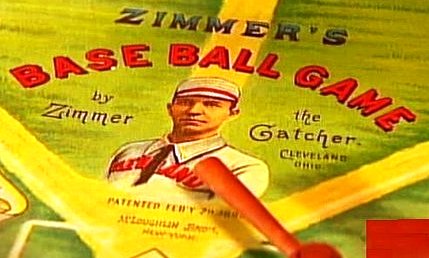
Zimmer's Baseball Game

Zimmer’s Baseball Game

In 1905 The Pittsburgh Press said “’Chief’ Zimmer has a scheme which he thinks would increase batting without abolishing the foul strike rule.” (The “scheme” was not Zimmer’s idea; it had been advocated by some for more than two decades, including “Cap” Anson and Zimmer’s former boss, Cleveland part owner Davis Hawley).  The plan would:

“Increase the territory of the fielders without increasing the length of the base lines…new foul lines (would be) drawn from the home plate to the fences.  At the point where they would pass first and third bases the lines would be six feet distant from the bases, gradually increasing the distance from the present foul lines as they neared the fences.”

Later he can out in favor of abolishing the foul strike rule when the issue was briefly discussed in the aftermath of the relatively low-scoring 1905 World Series.

In 1909 Zimmer suggested another rule; this one would essentially eliminate intentional walks by allowing any man on base to advance one base after a walk.  Zimmer said:

“It’s not right for a pitcher to take away Lajoie’s chance of hitting by walking him when there are men on bases.  I saw Larry passed four times in two games last fall.  He was paid to hit with the men on bases…Pitchers would have to put the ball over and the good batters would get a chance to do what they are paid for.”

Luckily like most of the other odd rule changes suggested during baseball’s first several decades, Zimmer’s “schemes” received little traction as both would have radically altered the game.  But Zimmer’s rules did succeed in accomplishing what they were most likely intended to do: they kept Zimmer’s name in the paper long after his career was over.

A final post on Zimmer and, perhaps, his greatest contribution tomorrow.
“The Man who Ate Himself out of the American League”

20 Nov

Frank Frederick Schneiberg was born in Milwaukee in 1882 (Baseball Reference lists his year of birth as 1880, but all available documents say 1882).

He began playing baseball for amateur teams in the Milwaukee city league, and after playing for the Pabst Brewery team in 1903 signed with the Springfield Hustlers in the Three-I League.  No records survive, but according to The Milwaukee Journal Schneiberg “won 19 out of 21 starts.”  He played with the Freeport Pretzels in the Wisconsin State League in 1905 and according to the Journal “won 12 straight.”

Frank Schneiberg

He won 22 games the following season with the La Crosse Pinks, which earned him a shot with the Detroit Tigers.

It didn’t go well.

Schneiberg was released to the Milwaukee Brewers before the beginning of the season.

The Associated Press said:

“He has the earmarks of a great pitcher…speed, curves, control and a pretty good collection of baseball brains…but Schneiberg was lazy…He wasn’t eager to pitch.”

The story quoted Tigers manager Hugh Jennings:

“He knows how (to pitch) but he won’t exert himself, I don’t want anybody who will not hustle.”

The Toledo News-Bee blamed his release on something else:

“He is known all over the country as the man who ate himself out of the American League.”

It is unknown whether either or both versions of his time with the Tigers is accurate, in either case, Detroit did try to claim that Schneiberg was still their property later that season when he was pitching well for the Brewers.  The claim was denied and he remained in Milwaukee.

Schneiberg pitched for the Brewers for three seasons compiling a 40-48 record.

While a fan favorite in Milwaukee, Schneiberg appears not to have been popular in at least one other American Association city.  The Toledo News-Bee accused him of being a head hunter in 1908:

“Schneiberg has the reputation of threatening to ‘bean’ batters.”

The following season The News-Bee claimed the Brewers were trying to trade the pitcher and said the team was:

“(V)ery anxious to trade the German, who does not work with any spirit, but the player is not highly regarded around the circuit.”

Regardless of the opinion in Toledo, The Brooklyn Superbas thought highly enough of Schneiberg to draft him from the Brewers at the end of the 1909 season.

He appeared in his only Major League game. On June 8, 1910, with Brooklyn trailing the Cincinnati Reds 4-0, Schneiberg relieved Nap Rucker in the top of seventh inning.  He walked four, gave up five hits and allowed 7 runs (Baseball Reference shows Schneiberg giving up eight runs, with seven earned—the box score from the game shows 7 total).

Schneiberg was lifted for a pinch-hitter in the bottom of the seventh.  Within days, he was traded to the Des Moines Boosters in the Western League.

He retired after the 1910 season, but in February of 1913 signed with the Memphis Chickasaws of the Southern Association.  He appeared in two games and was released, and in June signed with the Springfield Watchmakers in the Three-I League.  It’s unclear whether he appeared in any games with Springfield.

Frank Schneiberg 1932

Schneiberg retired to Milwaukee after the 1913 season, he became an asbestos worker and an official in the Asbestos Workers Union.  He passed away in Milwaukee in 1948.

A Thousand Words–New Orleans Pelicans

13 Nov

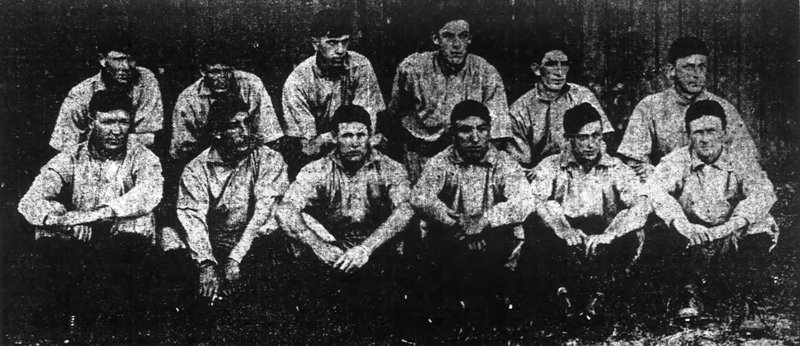
Another picture I’ve never seen published before—the 1906 New Orleans Pelicans of the Southern Association.

Top, Left to right.

Bill Phillipshe spent seven seasons in the Major Leagues with a 70-76 record; and won 256 games in a minor league career that began in 1890 and ended in 1909.

Mark “Moxie” Manuelwas said to have appeared as a both a left and right-handed pitcher for New Orleans in 1906 and 07, Manuel was a combined 37-26, earning him a second trip to the Major Leagues in 1908, where he posted a 3-4 record in 18 appearances for the Chicago White Sox.

Milo Stratton—a weak hitting (career .185) catcher who played in the minor leagues from 1903-1914.

William O’Brien—a .215 hitting first baseman in 1905 with the Toronto Maple  Leafs in the Eastern League and with the Pelicans in 1906.

Jake Atz—played for the Washington Senators in 1903 and the Chicago White Sox 1907-1909, a minor league manager for 21 seasons he won more than 1900 games.

Art Brouthers—a third baseman who played in 37 games for the 1906 Philadelphia Athletics, Brouthers managed the 1913 Paducah Indians to the Kitty League championship.  After his baseball career he was a hotel detective in Charleston, South Carolina.

Front, left to right

Whitey GueseGuese had several strong seasons in the minors, but in his lone Major League season with the Cincinnati Reds in 1901 he was 1-4.  The Youngstown Vindicator said, “He is a twirler who belongs to the disappointing species known as ‘morning glories.” And, “Seemingly has a heart like a canary.”

Joe Rickert—“Diamond Joe” Rickert stole 77 bases for the Pelicans in 1904; he played 15 games in the Major Leagues with the Pittsburgh Pirates and Boston Beaneaters.

William Blake—an outfielder with 13 different minor league teams from 1902 to 1910 and native of Louisville, Kentucky, little else is known.

Punch Knoll—another long-time minor league manager.  Knoll appeared in 79 games for the 1905 Washington Senators, he appeared in 3 games as a pinch hitter, collecting one hit, at 48-years-old while managing the Fort Wayne Chiefs in the Central League

Chick Cargo—brother of Major Leaguer Bobby Cargo, Charles “Chick” Cargo was a shortstop and 3rd baseman who played 19 seasons of minor league ball.

George Watt—Watt had three good seasons for the Little Rock Travelers, with a 53-34 record from 1902-1904.  He slipped to 20-37 in 1905-06 with Little Rock and New Orleans.  By 1907 he had dropped from “A” ball to “D” ball with the Zanesville franchise in the Pennsylvania-Ohio-Maryland League.  In 1908 he pitched for the Zanesville Infants in the Central League, was release in August after posting a 6-15 record and disappeared.

Tom Colcolough

26 Oct

Thomas Bernard “Coke” Colcolough (his name was pronounced “Cokely”) posted a 14-11 record in parts of four seasons in the National League with the Pittsburgh Pirates and News York Giants.

His greatest baseball achievement has been lost to history.

Before the 1893 season, professional baseball eliminated the five and a half by four-foot pitcher’s box and replaced it with the rubber, while moving the distance to the current 60 feet, six inches.  Intended to increase offense the change had the desired effect increasing batting averages throughout baseball.

Not everyone immediately took to the new rule.  The Boston Globe and Cleveland Plain Dealer predicted the rule would be eliminated.  They were wrong, it was there to stay.

One consequence of the new rule was the sharp decline in no-hitters.  In the National League seven no-hitters were thrown between 1890 and 1892.  From the beginning of the 1893 season until Cy Young’s in September of 1897, there was but one:  On August 16, 1893, Bill Hawke of the Baltimore Orioles no-hit the Washington Senators.

Hawke’s was not the first professional no-hitter after the change.  That belonged to Charleston Seagulls pitcher Tom Colcolough on June 23 against the Montgomery Colts in the Southern Association.  The Sporting Life said:

“Colcolough, the rising young pitcher of the Charleston Club, has the honor of being the first pitcher under the new rules to dispose of an opposing team without a safe hit in a full game.  He accomplished the feat against the hard-hitting Montgomerys.”

Colcolough was 16-11 for Charleston and earned his first trip to the Major Leagues.   Prone to wildness (166 walks in 319 1/3 Major League innings), Colcolough was returned to the minor Leagues in 1895, pitching for the Wilkes-Barre Coal Barons in the Eastern League from 1895 through 1898.

Tom Colcolough

Colcolough earned one more shot in the National League with the Giants in 1899 posting a 4-5 record.  He was sent to Jim O’Rourke’s Bridgeport Orators in the Connecticut League in July and was released at the end of the season.

Colcolough returned to Charleston, South Carolina and served as a city councilman.  He passed away there in 1919.

Southern Association Pennant Race Scandal

15 Oct

The Memphis Egyptians collapsed in the final three weeks of the 1907 Southern Association race.  After leading the league from the beginning of the season, poor play in the last weeks led to them being overtaken by the Atlanta Crackers.

Vague rumors circulated that Memphis might have thrown the race—but became a full blown scandal on June 2 of 1908 when the rumors became formal allegations.

Former Memphis pitcher Otis Stocksdale, who had been released following the ’07 season and signed with the Mobile Sea Gulls, said Memphis manager Charlie Babb:

“Threw the pennant…to the Atlanta club, and did so deliberately and for business reasons.”

Stocksdale alleged that he had been forced to pitch while he was sick and that players were instructed by the manager “Not to win games.”  Stocksdale charged that Babb, who also played 3rd base, had deliberately misplayed balls during games in Nashville.

If there was any doubt, Stocksdale doubled down on his charges later the same day, telling reporters:

“Every word of this charge is true, and, what is more, I am going to prove the correctness of what I say and by affidavit…I am not going to stop, now that I have started, until this thing is given to the public and Babb gets the punishment he deserves.  The thing was done in order to make a closer race for the flag and get the money in the gates.

“Charley (sic) Babb has no right to be a manager in this league.”

Stocksdale also claimed that two additional players Richard James and Robert “Nick” Carter could, and would corroborate the charges.

Babb denied the allegations.  Atlanta Manager William Smith said, “The league will have to blacklist either Babb or Stocksdale, and I don’t think it will be Babb.”

Atlanta Mayor Walthall Joyner asked Southern Association President William Marmaduke Kavanaugh for an immediate investigation.

A hearing was scheduled for the following week in Memphis.  Stocksdale promised to make his case.

He didn’t.

According to The Sporting Life:

“He had no witnesses.  He had no affidavits.  He merely entered formal denial of the published statements.”

Stocksdale blamed reporters for misquoting him.

The Memphis club presented their case which included live testimony and dozens of statements refuting the charges, including one from Nick Carter, who Stocksdale had said would affirm his allegations.

Stocksdale was suspended indefinitely for, as The Sporting Life said, “Besmirching Baseball’s Fair Fame.”

Otis Stocksdale, the accuser

It was speculated that 36-year-old Stocksdale’s career was over, and that even if he did manage to play again that he would be blackballed from the Southern Association; however, when the suspension was lifted before the 1909 season after a petition drive that collected more than 1000 signatures in each Southern Association city, Stocksdale returned to the Sea Gulls and stayed in the league through the 1910 season.

Stocksdale finished his career as a player-manager with the Lynchburg Shoemakers in the Virginia League in 1912.

Babb remained as manager of Memphis until 1910 and continued managing in the minor leagues until 1913.

Charlie Babb, the accused

An interesting Postscript involving Atlanta Manager William Smith who vigorously defended Babb and insisted Stocksdale’s allegations were false.  After leading the Crackers to another league title in 1909 Smith was fired.  The deposed manager claimed the reason for his firing was his refusal to rein his team in the final weeks in order to increase gate receipts.  Smith’s complaint was dismissed by the league.

“The Rube Waddell of the Central League”

11 Oct

Edward S. Van Anda was the most talented pitcher in the Central League from 1904 to 1908; he was also the most erratic personality in the league–and was often compared to baseball’s most eccentric pitching legend “Rube” Waddell.

Van Anda was born June 6, 1881 in Wapakoneta, Ohio. He pitched for independent teams in Ohio from 1900-1903, getting as much attention for his enormous ego and behavior as he did for his pitching.

Nicknamed “Lord Chesterfield,” or simply “Chesty,” Van Anda would disappear for long stretches and his shameless self promotion made him unpopular with teammates He was signed by the Fort Wayne Railroaders in the Central League in 1904. His statistics for that season are lost, but according to The Youngstown Vindicator: “(H)e won every game he pitched except one toward the close of the season.”

In 1905 Van Anda again pitched for Fort Wayne (the team relocated to Canton, Ohio during the season) and posted a record of 20-14. The Fort Wayne News described Van Anda’s abilities as a ballplayer:

“There is only one thing Van Anda can do and that is pitch. He cannot hit a balloon and he runs bases like an ice wagon.”

The Fort Wayne Gazette said:

“He is rather erratic but has great pitching caliber in him.”

Every article about Van Anda described him as “eccentric,” or as the Toledo Bee put it:

“That Freak Van Anda.”

And the Bluffton (IN) Chronicle said:

“Van Anda is the name of the latest freak to break into baseball.”

A story about his self promotion that made the rounds in newspapers in 1905 was retold several years later in column by former major league pitcher Al Demaree:

“I used to know a fellow named Van Anda…he’d go out into the bleachers, and if the pitcher in the box began to falter, he’d yell “Put in Van Anda he’s the best pitcher on the club. Then he’d move over back of third and start up the same cheer in the crowd.”

The 1905 version of the story included his fellow pitchers, angry at Van Anda’s antics, setting him up

But he could pitch, and appeared destined for the Major Leagues. The Youngstown Vindicator said at the close of the 1905 season:

“Van Anda, known on account of his eccentricities as “the Rube Waddell of the Central League,” has been drafted by the Cincinnati Reds.”

At the close of the 1905 season Van Anda pitched for the local Wapakoneta team in an exhibition against the Reds, the Major Leaguers got 14 hits and beat Van Anda 12-0, it was the last time he faced a Major League team.

After a strong 1906 season with the Grand Rapids Wolverines (23-13), Van Anda was acquired by the Trenton Tigers in the Tri-State League. His time there was short; during a spring training game Van Anda walked off the mound and led the field in the middle of a game, which led to his immediate release.

According to The Fort Wayne News Van Anda “Known all over the Central as an eccentric …was given a bus ticket and returned to Fort Wayne.”

Edward Van Anda

Van Anda pitched for neither Trenton nor Fort Wayne during the 1907 regular season, but signed with the Central League South Bend Greens in June. He only appeared in one game, losing 7-1 to the Wheeling Stogies. He was released a few days later, not resurfacing until the following season.

In 1908 he went 15-11 for Fort Wayne and was purchased by the Montgomery Senators of the Southern Association and posted a 6-5 record. Early in the 1909 season Van Anda was suspended indefinitely by Fort Wayne for “insubordination.” The Fort Wayne News reported that Van Anda signed with the Galveston Sand Crabs of the Texas League, but there is no record he ever played for that team.

Van Anda became a traveling salesman in 1910. He remained in Fort Wayne until his death on October 17, 1965.

Assumed Names II

9 Oct

Players using assumed names were common enough during professional baseball’s first four decades that some players still exist in the record books as separate individuals.

John Berkel is one such case.  He has four separate listing on Baseball Reference.

The “official” record for John H. Berkel begins in 1910 with the Atlanta Crackers of the Southern Association and ends in 1914 with the Fort Forth Panthers of the Texas League.

That was the second half of his career.

Under the name John Bierkotte he started playing pro ball with the Mattoon-Charleston Canaries in the Kitty League when he was 20 years old.

A slick fielding, weak hitting shortstop and third baseman, Berkel, as John Bierkotte, played with the Jacksonville Jays and Augusta Tourists of the South Atlantic League from 1907-1910 (further complicating the trail of Berkel-Bierkotte is that Baseball reference lists him as “Bierkortte” on the Jays’ 1909 roster with a unique player listing).

John Bierkotte with the Augusta Tourists, 1909

On June 30, 1910 John Bierkotte was acquired by Atlanta from Augusta.

John Bierkotte made his debut with the Crackers on August 1.  On August 2 the Atlanta Constitution said:

“John Berkel.  You fans will have to learn to call our new shortstop by that name, for that is really his name…When he first broke into baseball he was trifle afraid he might not make good and rather than cause the laugh to be thrown on him, he decided to change his name.  This he did, and he chose Bierkotte, a weird name, as the one.”

John Berkel 1910

Berkel received high marks for his fielding but struggled at the plate and hit only .207 for Atlanta.  At the end of the 1910 season he was sold to Albany in the South Atlantic League.  From there he went to the Scranton Miners in the New York Penn League in 1912.  The “official” listing for Berkel only adds 10 games with Fort Worth in 1914.

The rest of his career is under the listing “Berkel.”

Berkel spent 1914 on the West Coast, playing for the Fresno Packers of the California State League.  After those 10 games in Fort Worth he played for the Decatur Commodores in the Three-I League, and then was sold to the Peoria Distillers in the same league.  Berkel was offered a contract by Peoria for 1915, but chose to retire and move to the west coast.

The Berkel trail runs cold until 1926 when he turns up as a 40-year-old infielder for the Spokane Eagles in the semi-pro Idaho-Washington League.

Berkel continued to live in Spokane until his death in 1975.  There is no record of why he chose the name Bierkotte.

What Happened to Trammell Scott?

2 Oct

Trammell Scott (Incorrectly listed as Trammel in multiple sources) was born in 1886 to a prominent Dalton, Georgia family.  After playing baseball at the University of Georgia, Scott played minor league ball in the south.  He spent time in the Georgia State League, South Atlantic League, and the Carolina Association—he was said to have also played with Houston in the Texas League but no statistics survive.

After his brief playing career Scott was the victim of a near fatal shooting in 1916.  The Atlanta Constitution covered the story closely and reported that Scott, while “In a dying condition,” told his mother “I told you they would get me.”  Trammell recovered, but never identified his assailant and no motive or suspects were ever identified–just 10 days after the shooting Atlanta Chief of Detectives Newport Langford said they were closing their investigation. and according to the Constitution “Leaving the mystery unsolved.”

Scott joined the army in World War I, was decorated for bravery in action and promoted to the rank of Major.

Trammell Scott 1919

Upon returning to Georgia Scott became a well known sportsman.  He was boxing referee and later served on the state boxing commission, owned a sporting goods store, was actively involved in local semi-pro baseball and basketball, and was prominent hunter and breeder of champion bird dogs.

In January of 1938 Scott was named interim President of the Southern Association in a contentious split vote.  At the end of the year he was named President.

In December of 1942 Scott boarded a train in Atlanta to attend the baseball winter meetings in Chicago.  Due to arrive for the league meeting at 4 pm, Scott’s train was delayed.

When the meeting convened without Scott, the owners who opposed his original appointment seized the opportunity.  Thomas Watkins from Memphis, Larry Gilbert of New Orleans, Roy Thompson of Little Rock and Bob Allen of Knoxville led a revolt which was soon joined by Paul Florence of Birmingham.

Within an hour Scott had been voted out and replaced by Billy Evans, a former American League umpire and one time general manager of the Cleveland Indians and Boston Red Sox.  Evans was at the meeting in hopes of landing a different position, but the Southern Association bosses settled on him as the new compromise candidate to run the league.

There was a problem.  No one attempted to reach Scott to inform him of the decision.

That evening, having finally arrived in Chicago, Scott hurried to the National Association dinner meeting of all the league presidents.  Taking his seat, the Associated Press noted “It was a tense moment as (National Association) President William G. Bramham informed Scott the Southern had named a new president.”

Scott said he never saw his dismissal coming and said league owners threw him “A low curve,” by replacing him in the manner they did.

Less than three weeks after his dismissal Scott was turkey hunting on friend’s farm near Newton, Georgia.  After returning for the day, Scott told his friends he was returning to the fields in search of a turkey he had wounded earlier in the day.  The following day Scott was found with a gunshot wound to the chest.

The medical examiner ruled that the wound was self-inflicted but the official ruling said it was “Undetermined whether the shooting was accidental or pre-meditated.”

Many of Scott’s friends said that in spite of being embarrassed by his dismissal he was far from distraught and noted that while being an experienced hunter, Scott was not always careful, “On occasion he was known to have leaned a loaded shotgun against his middle while lighting a cigaret (sic).” This, they speculated, could have caused the type of injury that killed Scott.

Scott was interred at Westview Cemetery in Atlanta—the whole story about two shootings 25 years apart, buried with him.

Ty Lober

27 Sep

Elmer “Ty” Lober was a long-time minor league player, manager in the Wisconsin State League, served in the Army in WWI and was a central figure in a scandal that briefly rocked the Pacific Coast League in 1914.

In September of 1914 police in Portland, Oregon announced the arrest of four men, and issued a warrant for a fifth.  The men were charged with “Wholesale traffic in school girls between the age of 14 and 16.”

Two of the men arrested were Portland outfielder Lober and third baseman Bobby Davis.  Also arrested were a local jeweler and an actor named Bert Roach (Roach would go on to appear in more than 300 films).  The warrant was issued for Mission Wolves and former Major League pitcher Frank Arellanes.

Early reports indicated that the players had confessed and that there would be several more arrests.  But the “open and shut case” described by West Coast newspapers seemed to quickly fall apart, and concerns about wide spread human trafficking among Pacific Coast League players quickly faded.

Just three weeks after the arrests the grand jury came back with indictments for only two of those arrested; Davis and Arellanes.  The cases against these two quickly fell apart also and all three players were in uniform at the beginning of 1915, Lober and Davis with Portland and Arellanes with Denver in the Western League.

Lober went on to play with Lincoln in the Western League before entering the service in 1918.  He spent 1920 with an independent team in Zanesville, Ohio and was signed to play with the Milwaukee Brewers in the American Association in 1921.  He finished his career with the Little Rock Travelers of the Southern Association in 1925 (he’s misidentified as “Lobar” on Baseball Reference).

Elmer “Ty” Lober

Lober managed and occasionally played for Two Rivers in the Wisconsin State League into the early 30s

He passed away on November 6, 1946 in Two Rivers.

Ollie Pecord

26 Sep

Oliver T. Pecord had a brief minor league career during the last decade of the 19th century, but for a brief time was known around the world for his pivotal role in another sport.

Born April 5, 1869, in Troy, NY, Pecord began his career in 1890 with the Flint Flyers in the Michigan League.  Pecord is credited with a .371 career average, but the available statistics appear incomplete.   For example, several newspaper accounts put Pecord with the Columbus Reds of the Western League in 1892, but there are no surviving statistics for 1892 for Pecord with any ballclub.

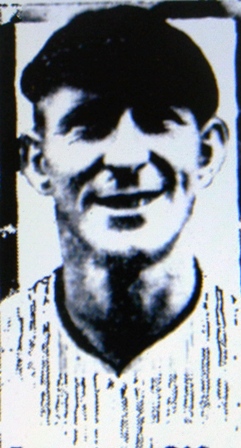
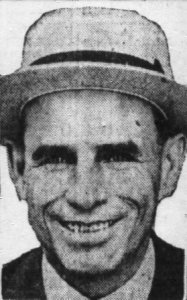
pecord

Ollie Pecord

After playing in the Southern Association, Western League and Eastern Iowa League (where he is credited with a .660 average, 31 for 47 in 14 games with Rock Island in 1895) Pecord left professional baseball to focus on boxing.

Pecord was a popular fighter, and while mentioned often for bouts in and around his home in Toledo, he appears to have been a journeyman and unknown outside of Ohio.  In 1900, Pecord turned his attention to work as an umpire for local semi-pro baseball leagues, managing fighters, and serving as a boxing referee.

Pecord went from a local sports figure to being known nationally when, in 1919, he was named as referee of the July 4 fight in Toledo between challenger Jack Dempsey and champion Jess Willard.

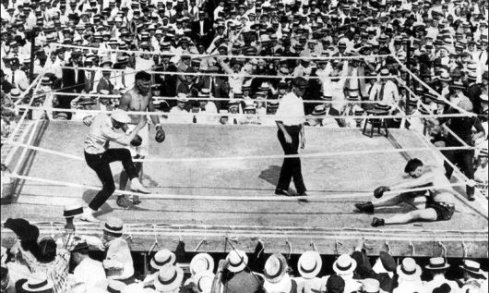
Pecord was at the center of the fight’s two controversies.  The ringside bell had malfunctioned and replaced by a whistle which Pecord, nor anyone else in the crowd, could hear.  Willard, knocked down for the seventh time in that round, was counted out by Pecord who raised Dempsey’s arm, and Dempsey left the ring.  But the round had actually ended at the count of seven; Pecord informed Dempsey’s manager Jack Kearns that the fight was not over and his fighter needed to return to the ring.

Pecord in the ring with Dempsey and Willard

Pecord in the ring with Dempsey and Willard

Willard was unable to answer the bell for the fourth round and Dempsey was declared the winner, but because Willard’s corner did not throw in the towel until after the fourth round had begun, it fell to Pecord to rule exactly when, and how the fight ended.  Two days later Pecord ruled the fight ended by a knockout in the third round.

This was not an insignificant decision because of the huge amount of money wagered on the bout—as an example, it was reported by the Associated Press that a man in Chicago who ran pari-mutual machines and a book on the fight, made $82,500 on the fight; $25,000 more than he would have made if Pecord ruled the fight over in the fourth round.

After the controversy around the fight died down, Pecord returned to relative obscurity nationally, but remained a popular figure in Toledo and served as a fight referee until the mid-thirties when illness forced his retirement.

Pecord died in Toledo on July 1, 1941.  The Toledo Blade called him “(T)he most prominent figure in sports Toledo has ever produced.”