Tag Archives: Texas League

“Calvo May Come Out But No One Cares”

5 Jun

Jacinto Calvo and San Francisco Seals owner Charlie Graham were unable to come to terms on a contract for 1918, and the local press quickly turned on the outfielder.

The San Francisco Chronicle said:

“(Calvo) is a simple-minded Cuban boy…When he is hitting he can go around the bases in nothing flat.  When he has a batting slump, he develops water on the knee and can hardly limp up to the plate.”

He remained in Cuba and served as a police officer in Havana.

It was rumored again in 1919 that Calvo might return to the Seals, but The Chronicle, under the headline “Calvo May Come Out But No One Cares,” made it clear that twelve months had not softened opinions about the holdout outfielder:

“Calvo has written friends that he wants to come back, but if he stays in that dear old Havana until Charlie Graham coaxes him back, he will grow whiskers a foot long.  Graham really tried to get Calvo last year, for he was in a bad way for lack of outfielders, but if there is any coaxing to be done this year, Calvo will do it.”

Calvo
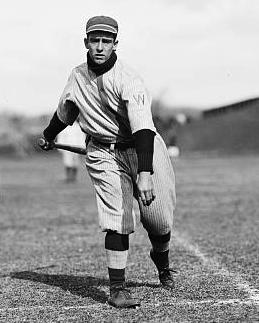
Calvo

Terms were not reached for 1919, and Calvo remained in Havana for another year.

In February of 1920 The Chronicle said Calvo, “Who bobs up every year about this time,” had written Graham saying he wanted to return to the Seals, then in March the paper reported that “The Havana World” said that Calvo “has joined the Franklin, PA independent team together with (Manuel) Cueto.”

Neither report proved true; instead, Calvo was signed by Clark Griffith for a second tour of duty with the Washington Senators.  In 17 games he had only one hit, a triple, in 23 at-bats before being sent to the Little Rock Travelers in the Southern Association in July.

Calvo could not hit American League pitching, but no one questioned his throwing arm; except teammate Stanley “Bucky” Harris.  The future Hall of Famer wrote in 1925, in a series of articles he wrote for The North American Newspaper Alliance, that his doubts about Calvo’s arm almost cost him his career:

“I thought I could hurl a baseball farther than anyone on the club and entered into a contest with Jack Calvo, an outfielder.  The Cuban has a reputation for having a great arm.  I had won a long-distance throwing contest…while with the Buffalo club.  That convinced me I could hold my own.”

Despite being warned against taking on Calvo by teammate Clyde Milan, Harris went ahead with the contest, the two stood in the infield:

“(Calvo) cut loose.  He threw the ball over the right field bleacher wall.  I realized it was a truly wonderful peg.”

Harris said he was concerned about being caught by manager Clark Griffith and rushed his throw:

“My elbow cracked as the ball left my hand.  It sounded to me as if a board had been broken across a fence…The ball dropped yards inside the park.”

Harris said for three weeks he “wondered if I ever would be able to throw a ball again.”  By the time Harris returned to the lineup, Calvo was on his way to Little Rock where he hit .306.

From 1921 through 1926 Calvo spent his summers playing baseball in the states; most notably in Fort Worth, where he helped lead the Texas league Panthers to two Dixie Series victories over the Southern Association champions in 1923 and ’24.  His winters were spent working as a lieutenant in Havana’s Harbor police and playing baseball in the Cuban League.

Calvo’s career ended abruptly in September of 1926.  The San Antonio Light reported that the former Fort Worth outfielder, then with the Memphis Chickasaws in the Southern Association “must forego baseball…and return to his job, his leave of absence was about to expire, and he packed up and beat it for a boat.”

Calvo played briefly in Cuba that winter but never played professionally again.  He was elected to the Cuban Baseball Hall of Fame in 1948 and died in Miami in 1965.
Jim Lillie

28 May

The Sporting Life described Jim Lillie as “one of the most sensational of right fielders,” and “the rival of Mike (King) Kelly in the position.”  The New Haven Register said he earned his nickname “grasshopper”  as a result of his “agility in the outfield.”

His career was brief, and his short post-baseball life was tragic.

The 21-year-old Connecticut native was said to have been discovered by “Orator Jim” O’Rourke “on the lots and commons of New Haven.”  He played his first professional game on May 17, 1883 with the Buffalo Bisons in the National League.  Lillie appeared in 50 games, hitting .234. In November his hometown newspaper, The New Haven Register, got his position wrong (saying he was used primarily as a catcher—he caught in two games), but said “his record was highly credible,” and that he had already signed for the 1884 season.

Jim Lillie

Jim Lillie

Lillie spent two more seasons in Buffalo; leading the team in games played both seasons.  In 1884 he led National League outfielders with 41 assists; his 40 errors also led the league.  He committed 33 errors the following season; he hit .223 and .249 for the Bisons.  When the team disbanded after the 1885 season, his contract was assigned by the National League to the Kansas City Cowboys, who had been admitted to the league on a trial basis.

He had, for him, a typical season in the field: 30 errors (third in league), 30 assists (second) and 199 putouts (third).  He also had one of the all-time worst performances at the plate; hitting .175 in 426 at bats, with only nine extra base hits (all doubles), he finished the season with 82 total bases—for identical .197 on base and slugging percentages.

The 30-91 Cowboys were dissolved in February of 1887, with the players being sold to the league.

Lillie remained in Kansas City, and had the best season of his career with the Cowboys, now in the Western League.  He also met an 18-year-old woman named Nellie O’Shea, the daughter of a wealthy Kansas City contractor and said The Kansas City Star, “a young lady highly spoken of.”

Lillie, playing primarily in left field, hit .369; a hitter’s haven, the Western League leader, Jimmy Macullar hit .464, and Lillie’s average was good for 34th best in the league.

On December 29, 1887 Lillie married Nellie O’Shea.

He joined the Fort Worth Panthers in the Texas League around June 1 of 1888, but left the team in less than two weeks.  The Dallas Morning News said he was released, The New Haven Register said he left Texas to be with his wife and go to work for his father-in-law, “(Lillie) promised her to settle down,” and planned on returning to baseball for the 1889 season.

He never had the chance to return to the game.  On September 10, 1888, the Lillie’s child was stillborn.  Two days later, a fire broke out in their home.  The Associated Press said:

“(Nellie) was making preparations for supper when the accident occurred…She had moved the gasoline stove too near the cooking stove and in filling the reservoir with gasoline some of it became ignited.  The flames at once enveloped her…(Lillie) entered at that moment or (she) would have been burned to death…Lillie did not notice his own condition until after he had summoned  a physician.”

Mrs. Lillie lingered for nearly three weeks before dying of her injuries on October 4.  Lillie, who had attempted to remove his wife’s burning clothes, had his hands burned “down to the bone,” and initial reports said he’d have to have some of his fingers amputated.  There’s no record of how well his hands recovered, but he never played baseball again.

He stayed in Kansas City and according to The Kansas City Star “managed (Nellie’s) estate.”  Within two years he would contract typhoid fever, and he died November 9, 1890.  The Star said his last words were to a friend at his bedside:

“I am afraid, Charlie, it is three strikes and out.”

The Worst, or Best Game Recap Ever—1888

9 Apr

In June of 1888 the Dallas Hams were coasting to the Texas League championship; the team was so good, and so far in front, the league would be reformed in July as the Texas Southern League.  Dallas would win that championship as well.

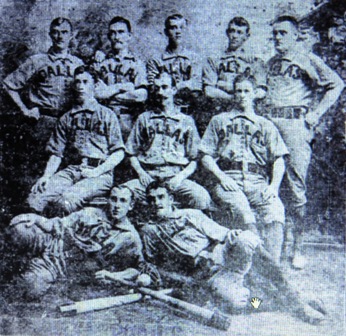
The 1888 Dallas Hams

The 1888 Dallas Hams

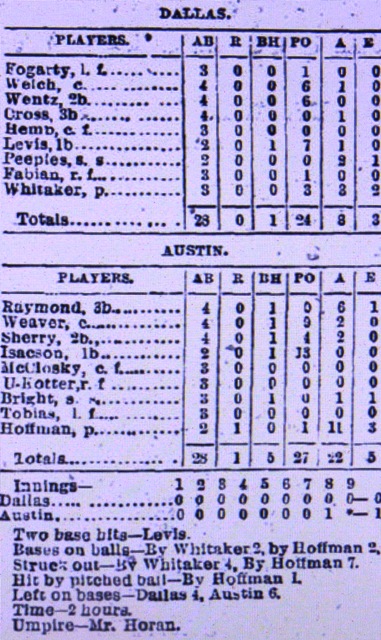
Unfortunately most stories did not have bylines in 1888, as a result we’ll probably never know who wrote this recap of the June 12 game between the Hams and the Austin Senators in The Dallas Morning News:

“It was a good game on both sides, still a listless, lifeless, inanimate game.  Neither side showed any life or spirit.  They played like they were asleep, or dead.  There were only about 150 spectators and the boys couldn’t throw any life into the game.

“For seven innings neither side made a run.  Each side played ball and kept the other from scoring. In the eighth inning (Frank) Hoffman for Austin scored.  It was (William) ‘Kid’ Peeples error that lost the game.  A beautiful, way up, pop fly came over to him, falling so prettily right into his hands, and he let it slip—muffed it.  Jack Wentz was on one side of him (Clarence) ‘Daddy’ Cross at the other, each one standing ready and waiting, but it was Peeples’ ball and they stood by.  He muffed it.  He said afterward that he had his hands out for it to come down between his breast and his hands, which it did, but he had his hands too far out and it slipped through.

“The game was lost for Dallas by Peeples’ error of the fly already mentioned.  Look at the score and you will see that while Austin made five base hits, Dallas made nothing except Charlie Levis’ two bagger.

“It is not necessary to go through the minutia of the game.  It was goose egg after goose egg up to the eighth inning, when Austin made one.  There wasn’t a brilliant play in the whole game.  Charlie Levis did make a two bagger, and is entitled to credit for it.  Nobody else did anything.

“Only about 150 people were present to see the game.  The small crowd discouraged the boys and they played without verve, without spirit, without animation.”

The Box Score

The Box Score

McCloskey, Mays and Hair Color

12 Mar

Carl Mays is best known for being the pitcher who hit Cleveland Indians shortstop Ray Chapman with a pitch, resulting in the only hit by pitch death of a Major League player. In fifteen seasons he posted a 208-126 record with a 2.92 ERA.

Five years before he became infamous for Chapman’s death, Mays became embroiled in a strange feud with former National League manager John James McCloskey; the dispute was over hair color.

Carl Mays

Carl Mays

In December of 1914, McCloskey was a well-respected figure in baseball, credited with being the “father” of the original Texas League in 1888, he had spent five seasons as manager of the Louisville Colonels and St. Louis Cardinals in the National League, and another 23 as a minor league manager and owner.

Mays was coming off a 24-8 season for the Providence Grays in the international League, and while called up to the Red Sox in the closing weeks of the season had not yet appeared in a big league game.

The controversy originated when Charles “Toby” Fullerton, a pitcher for the Seattle Giants in the Northwestern League was quoted in an article that appeared in The Pittsburgh Press and several other papers about pitcher “Seattle Bill” James, who had just led the Boston Braves to a World Championship. Fullerton said when he and James were teammates in Seattle in 1912, manager Shad Barry had, “condemned the youngster for being a blond,” he then was quoted saying McCloskey also, “has no use in the world for blonde ball players.”

“Seattle Bill” James

The strange, silly, throwaway quote should have been the end of it, but it was apparently serious enough for McCloskey to issue a long denial from his home in Louisville, Kentucky. The full-page letter McCloskey wrote appeared in more newspapers than the original story, and read in part:

“Let me say, I have been accused of every crime in the calendar, but this is too much.”

McCloskey claimed the “rumor” originated when he was managing the Milwaukee Brewers in the American Association in 1910. Outfielder Rube DeGroff played for McCloskey (incidentally, Shad Barry was also a member of the team), and according to McCloskey:

“We were playing in Kansas City, we were behind…and made a big rally that came near giving us the game. The bases were full in the last inning, with two men out, when the big, blonde and good-natured Rube DeGroff, who was a splendid all-around player and life of the club, came to bat with the bases full and struck out. I was sore over losing the game and made the remark that I never saw a cotton-top who ever made good in a pinch.”

McCloskey said he also believed anything Barry might have said to or about James was certainly a joke, and closed with a final defense:

“In fact, in my humble opinion, I think the blonde has a shade over the brunette. But why the color of a man’s hair should have anything to do with his ability as a ball player is a mystery to me, and I hope this explanation will put an end to these silly rumors.”

It didn’t.

Within days Carl Mays weighed in, claiming that he had twice been rejected for an opportunity to pitch for McCloskey’s Ogden Canners in the Union Association because he was blond.

Mays said:

“McCloskey is a liar pure and simple…In 1912, when I was on my way to Boise to try out for the Boise team; I stopped off at Ogden, thinking possibly owner McCloskey might give me a trial. I met him downtown in a billiard parlor and went up and introduced myself.

“McCloskey looked me over carefully, like a horse-trader examining a piece of horseflesh, and then suddenly espied my blond hair. ‘No,’ said he coolly, ‘I don’t want you. In fact I wouldn’t have you around the ranch. I don’t want any blonds in my camp.’”

Mays also claimed that later in 1912 while compiling a 22-9 record for the Boise Irrigators in the Western Tri-State League; he was nearly sold to McCloskey’s pitching-strapped Ogden Canners until:

“One of the Ogden players happened to mention the fact that he was the same blond-haired fellow who had asked for a job earlier.”

According to Mays, McCloskey said:

“’Deal is off. Send that white-haired guy over here and I’ll kill him.’”

The story stuck with McCloskey for more than 20 years. A 1916 story in The Providence Tribune said:

“Scouts all over the country know McCloskey and never did one in his employ recommend a light-haired ballplayer…His peculiarity was well-known, and he knew that no one would have the temerity to recommend to him a blond or light-haired ballplayer. “

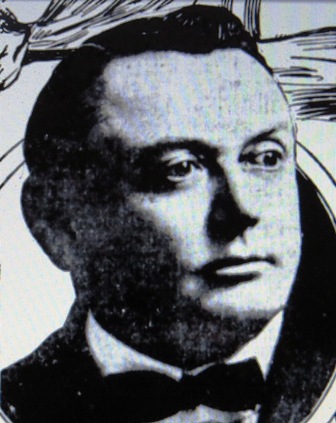
The black-haired John McCloskey

The black-haired John McCloskey

In 1934, The Milwaukee Journal called McCloskey, “one grizzled veteran who frowned on blond athletes.”

The article quoted E. Lee Keyser, a long-time minor league executive, who said when McCloskey managed Butte, “One of (McCloskey’s) players was an Indian outfielder whose hair was black,” the player struck out in a critical situation. According to Keyser, when the unnamed player returned to the clubhouse later, McCloskey grabbed his hair and said: “I just want to know if you’re wearing a wig. You hit like a blond.”

McCloskey managed in the minor leagues until he was 70-years-old, he died eight years later in 1940.

“Father of Sunday Ball”

22 Jan

After becoming president of the Waco Tigers in the Texas League, Henry Fabian allowed himself to be arrested in order to challenge a law that was costing Texas League owners money: The blue law that didn’t allow them to play games on Sunday.

The state statute forbade “Sunday amusements” that charged admission.  Texas League teams had lost money in each previous incarnation of the league and the inability to schedule games on Sunday was a contributing factor.

Whether challenging the law was part of Fabian’s plan from the beginning is unknown, but by June his Tigers had played three Sunday home games, and three times Fabian was arrested for violating the statute, posting $60 bond on each occasion.

After being found guilty at the local level Fabian challenged the statute in Texas’ Court of Criminal appeals, arguing that the law was passed before baseball became a professional sport and did not apply to the game.  The court ruled in Fabian’s favor, and while local ordinances still prevented Sunday games in Dallas, Sunday baseball became the norm in the Texas League. In his obituary, 35 years later, The Dallas Morning News’ headline called Fabian “Father of Sunday Ball.”

Fabian sold the Waco club to local businessmen in 1906 and took a job with a sporting goods company, but it was his interest in ballpark design and grounds keeping that would become his vocation.

Fabian participated in the layout and design of several local ballparks in Texas from 1888-1910, and was credited with creating the first “ Turtle-back diamond” at Oak Cliff Park, the Dallas Hams’ home field in 1888.  The pitched design and elevated pitcher’s mound allowed for quick drainage.

By 1910 Fabian had designed diamonds in Dallas, Waco, Galveston, New Orleans and Atlanta, when he was hired as head groundskeeper for the Saint Louis Browns.  He stayed with the Browns for three seasons until his old friend John McGraw hired him to be the groundskeeper for the New York Giants

By 1915 The Sporting Life said:

“Visiting ballplayers declare that the diamond Henry Fabian has built up at the Polo Grounds is the best in the country.”

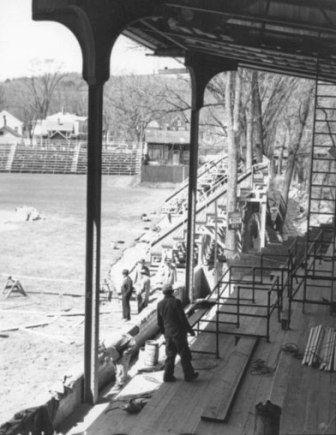
Fabian was considered the premier groundskeeper in baseball for the next 25 years and in 1939 he was put in charge of the Works Progress Administration’s (WPA) project to prepare Doubleday Field in Cooperstown for baseball’s centennial celebration.

Doubleday Field renovation, 1939

Doubleday Field renovation, 1939

Fabian died the following year on February 25, six years to the day after the death of his friend John McGraw.

Henry Fabian

21 Jan

Like John Bradley and George Kittle, Henry Fabian was a member of the 1888 Dallas Hams, champions of the Texas League and the Texas Southern League.  Unlike those two, when someone fired a shot at him he missed.

Fabian was born in New Orleans, in 1864 or 1866, depending on the source.  He began his career in 1886, catching and playing first base for both of his hometown teams in the four-team Gulf League: the Robert E. Lee’s and the team that became the New Orleans Pelicans.

Fabian had his fingers broken by a foul tip before the beginning of the season.  A 1913 article by former Major Leaguer turned sportswriter Sam Crane told the story:

“It was such a serious injury that there was no possibility of his playing again that season and rather than release him his manager (Thomas Brennan) asked him to become groundskeeper at the same salary he was getting as a player.”

That experience would stay with him.

By November of 1887 he had recovered enough to play in games against the Chicago White Stockings and Saint Louis Browns when their post-season barnstorming tour stopped in New Orleans.

In 1888 Fabian came to Texas as a member of the Galveston Giants, but was with Dallas by June. While statistics are spotty for his career, and non-existent for 1888, The Dallas Morning News said of him:

“Though not a brilliant player, Henry has always been a hardworking courageous one.”

Fabian continued playing until 1903, spending his entire career in Texas and Louisiana with the exception of 1891 when he played for the Cedar Rapids Canaries in the Illinois-Iowa League where he played with John McGraw, who became one of his closest friends.

Fabian was the subject of two strange stories.  In a July 1892 a headline in The Dallas Morning News said:

“Henry Fabian Shot At.  A Case in Which a Base Ball Man Dodged a Bullet.”

The story said a local carpenter named Parker had fired a shot at Fabian.  Fabian told a reporter for the paper that “an article appeared in The Kansas City Sun about which he wanted an explanation from Parker.”  The article said “Mr. Fabian’s description of the article The News is not privileged to report at this stage of the proceedings.”

There was never another reference in any Dallas paper to the incident or about what the Kansas City story might have been.

Henry Fabian, circa 1930

Henry Fabian, circa 1930

In 1904 an Associated Press article appeared in several newspapers under the headline “Joy Restores Her Sight:”

“Sight has been miraculously restored to the stone-blind eyes of an aged mother by the voice of her son who returned unheralded after an absence of 18 years.  The woman is Mrs. Sophie Fabian of New Orleans and the son is Henry.”

The rest of the story did not completely live up to the headline or lede; Mrs. Fabian was told her sight might come back and the story conceded “the recovery was not complete,” but nonetheless, the paper’s treated it as some kind of miracle

Fabian returned to baseball in 1905 as part owner and president of the Waco Tigers in the Texas League, and while there he was the catalyst for changing a Texas law that helped make Texas League baseball profitable.

That, and Fabian’s other claims to fame, tomorrow.

John Bradley

18 Jan

Two members of the 1888 Dallas Hams were shot and killed in Texas.

One, George Kittle, I wrote about in September.

John Bradley was the other one.

Charles M. “John” “Brad” Bradley (wrongly listed with the middle initial “H” on Baseball Reference) left Oil City, Pennsylvania where he was born in June of 1864, to go west and play baseball.  An article in The Louisville Courier Journal said he was born to wealth and left Pennsylvania because of his father’s disapproval of baseball:

“(Bradley) was surrounded with every luxury.  He acquired a collegiate education and all the ornamental accomplishments of modern times.  He was possessed of a charming tenor voice; was a brilliant pianist and an expert linguist.  He was passionately fond of the national game…An early disagreement with his father, the result of his penchant for baseball, led to an estrangement, and, troubles never coming singly, he was rejected by a young lady of Oil City, PA, to whom he was devoted.”

After playing in Corning, New York in 1885 Bradley went to Kansas.  Various sources place him with the Topeka Capitals in the Western League and/or a team in Abilene in 1886 though neither can be verified.  Bradley then played with the Emporia Reds in the Western League in 1887.

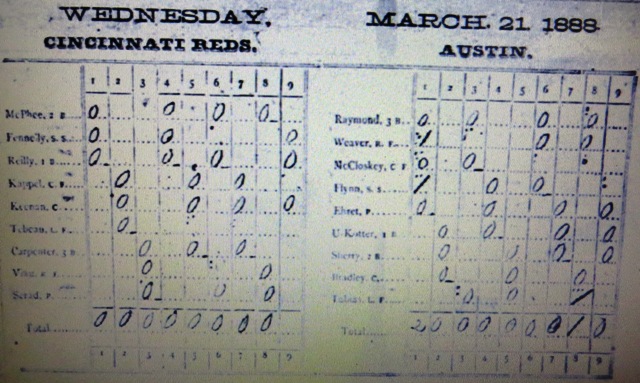
He signed with the Austin Senators in the newly formed Texas League in 1888.  In March, Bradley caught for Austin in two exhibition games with the Cincinnati Red Stockings of the American Association—the Statesmen lost the first game 2-0, but won the second 3-0.

Box score of 1888 Austin -Cincinnati game won by Austin 3-0.

Box score of 1888 Austin-Cincinnati game won by Austin 3-0.

Bradley was Austin’s starting catcher until the dissolution of the Texas League in July.  When the reformed Texas Southern League commenced play later that month, Bradley was with Dallas where he shared catching duties with Kittle.

Bradley hit .158 as Dallas coasted to a championship.

The 1888 off season was an eventful one.

Bradley was offered a contract for 1889 with the St. Joseph Clay Eaters in the Western Association.

He also started seeing Dolly Love, “A woman of bad repute,” as The Dallas Morning News said; problem was Love was also involved with a livery driver named Tom Angus.

At the same time Bradley got in trouble with the law in December of 1888.  The Austin Weekly Statesman said:

“(Bradley) shot a man named Billups in a (Dallas) bar room, because Billups attacked him with an empty beer keg because he refused to pay for drinks.”

Bradley was charged with “assault with intent to kill” and was scheduled to appear in front of a Dallas Judge at the end of January.  He was also arrested twice in early January for altercations with Love at the brothel she operated.

Throughout the chaos Angus and Bradley were trading threats over Dolly Love.

The rivalry came to a head on January 16.  Shortly after 10:30 a.m., Bradley and a friend exited Swope & Mangold’s Saloon at the corner of Main and Austin to return to his room at the Grand Windsor Hotel across the street.  The Austin Weekly Statesman said Bradley was:

“Shot down like a dog by Tom Angus, a hack driver, who followed him and fired in his back.”

The Headline in The Dallas Morning News said:

“The Killing of Charles Bradley the Baseball Catcher, all about a Fallen Woman.”

Bradley was shot through the back and began to run as Angus fired two additional shots; after running about 120 feet, Bradley fell dead in the street.  Angus was immediately arrested and ordered held for trial.

A letter from five representatives of the Texas/Texas Southern League and addressed “To the Baseball Profession of the Union” was published in newspapers around the country soliciting funds “In order that able counsel may be obtained to conduct the prosecution,” the letter concluded:

“John Bradley played with Austin and Dallas in 1888, and had recently signed with St. Joe for the season of 1889. He was a gentleman, an excellent ballplayer and altogether an honor to our profession.  To ball players this case suggests not only a duty but a privilege, and we trust that a suitable response will be made.  Yours fraternally,

J. J. McCloskey, manager Austin team, I888.

Charles Levis, manager Dallas team 1888

Doug Crothers, manager Dallas team, 1889.

Kid Peeples, short stop Dallas team 1888.

Billy Joyce, third base Ft. Worth and New Orleans, 1888.”

It is unknown how much money was raised.

Dolly Love left Dallas for Fort Worth to escape the publicity.  Tom Angus spent more than a year in jail awaiting trial during which time he got married.  Dick Johnson, a friend of Angus’, who was at the scene of the shooting, was charged as an accessory, but was acquitted in a separate trial.

When the trial began in April of 1890 The Dallas Weekly Times-Herald headline called it:

“The Most Sensational Case that Has Been up for Years.”

Several witnesses, including a Dallas police officer testified that Bradley had also made threats against Angus in the weeks leading up to the killing, and that he often carried a gun.  Although Bradley wasn’t carrying a gun on the morning he was shot, and was shot in the back, the defense claimed that Angus had acted in self-defense.  Angus was found guilty, but sentenced to only five years in prison.

The sentence was upheld on appeal, the decision said:

“The accused should congratulate himself upon the mildness of the sentence.”

Angus was released from prison in the spring of 1895; in December he was arrested for shooting a man over a dispute about a horse.

Bradley was buried in Dallas.

The 1888 Texas Southern League

17 Jan

The Texas Southern League was in existence for half of one season; the reason for its creation was that the Dallas Hams were just too good a team in 1888.

In the winter of 1887 the Texas League was formed with six teams: the Dallas Hams, Austin Senators, Fort Worth Panthers, Galveston Giants, Houston Babies and San Antonio Missionaries.  Representatives from the Memphis Grays and New Orleans Pelicans in the Southern League, which was struggling to replace teams that had folded, also attended the meeting and lobbied for the league to be expanded to eight teams, but the six Texas-based teams voted not to include them;   New Orleans and Memphis joined the 4-team (down from 7) incarnation of the Southern League, which also included the Birmingham Maroons and Charleston Sea Gulls.

Charlie Levis, who had played Major League ball in The Union Association and American Association in 1884 and ’85 was named manager and played 1st base for Dallas.  Levis, a St. Louis native, brought in several Missourians including some who had spent time in the Major Leagues and built a strong team.

The Sporting News said Levis:

“Signed a team of professionals for Dallas that would do credit to almost any league in the country…They are all splendid fielders and batsmen and fair base runners.”

The team was so strong according to The Dallas Morning News that:

“So good was the Dallas team that club after club dropped out after repeated drubbings at its hands.  Dallas won so many consecutive victories that the other cities lost their appetite for baseball and withdrew.”

By late June, Dallas led the league with a winning percentage above .800; Austin and Fort Worth had dropped out and all the remaining teams were losing money with players often going several weeks between paydays.  At the same time, the Southern League was collapsing.  In early July, a deal was struck to create the five-team Texas Southern League with New Orleans joining Dallas, Galveston, Houston and San Antonio.

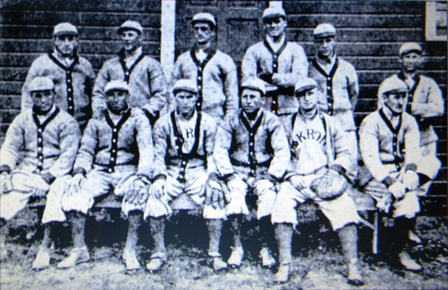
The 1888 Dallas Hams--Identifiable players: Front right Bill Goodenough, front left, Pat Whitaker, seated left, Ducky Hemp, standing left Charlie Levis, standing right John Fogerty,

The 1888 Dallas Hams–Identifiable players:
Front right Bill Goodenough, front left Ducky Hemp, seated left Pat Whitaker, standing left Charlie Levis, standing right John Fogarty,

While New Orleans provided some much-needed competition for Dallas the Texas Southern League half-season was not much different from the Texas League half-season.  Dallas finished with a winning percentage of .826, New Orleans finished second followed by San Antonio, Galveston and Houston.  The Morning News said on the final day of the season:

“The league is dead, and the Dallas club carries off the glory, waves high the pennant, and stands the champion club not only of the league but of all the South.”

The following season Austin and Fort Worth rejoined and the Waco Babies replaced the San Antonio Missionaries to again form a six-team Texas league; New Orleans returned to the Southern League, and the Texas Southern League was finished.

The story of one member of the 1888 Dallas Hams tomorrow.

Lost Team Photos

19 Nov

Another photo I’ve never seen published before, the 1908 Akron Champs, Ohio-Pennsylvania League Pennant Winners.

Top left to right:

Dick Breen—a minor leaguer for 12 seasons, his career overlapped with another career minor leaguer named Dick Breen—this Breen’s career came to an end in 1917, when while playing for the Reading Pretzels in the New York State League he got in a fight with Wilkes-Barre Barons  manager Jack “Red” Calhoun.  Both men were suspended indefinitely; Breen was released several days later, neither ever appeared in organized ball after that season.

Bill Speas—longtime minor league player and manager, Speas hit.284 in 22 seasons and won three Mississippi Valley League pennants as a player/manager with the Cedar Rapids Bunnies and Dubuque Dubs.

John Brackenridge—appeared in seven games for the Philadelphia Phillies in 1904, Brackenridge pitched in the Pacific Coast League from 1909-1913.

Fred “Buff” Ehman—a 6’ 4” (some sources list him an inch shorter) right-handed pitcher, the enigmatic Ehman was 81-36 for Akron from 1906-08, but according to The Akron Beacon Journal, was known for disappearing for days at a time and “sulking.” He had multiple trials with Major League clubs; according The Mansfield (OH) Daily Shield he never stuck with a team because of “his refusal to exert himself.”  Through 11 minor league seasons he won 214 games.

Wilbur Good—spent parts of 11 seasons in the Major Leagues: Joe Tinker said of him, “He is one of the fastest runners in the National League and still one of the poorest base runners.”

Edward Murphy—a light hitting catcher, Murphy played five seasons in the Ohio-Pennsylvania League.

Bottom left to right:

Bill Kommer—there is no listing for Kommer on any minor league data base.  He was left-handed pitcher who played for many amateur and semi-pro teams in Ohio during the first decade of the 20th Century;  he was released by Akron in July, there is no record of his statistics for the ’08 season.

William Hille—“Silent Bill” was a shortstop who played until 1917 primarily in the Texas and South Atlantic League.

Jim Callahan—his Major League career consisted of one game with the 1902 New York Giants; played three seasons for Akron (1906-08), was reported to have played in the Western League in 1909, but no records exist.

Matt BroderickThe Reading Eagle called him “one of the best shortstops who ever played on a minor league field,” Broderick played two games in the Major Leagues with Brooklyn in 1903—played minor league and amateur baseball for the remainder of the decade while working for Carpenter Steel Works in Reading, PA.

George Texter—one of the first players to sign with the Federal League in 1913, Texter played for the Indianapolis Hoosiers/New Jersey Pepper during the Fed’s two seasons as a Major League (1913-14).  Managed teams throughout the 1920s in the Ohio-Pennsylvania League (no longer recognized by the National Association, the OPL was nonetheless a strong semi-pro/industrial league during that period).

Cecil Armstrong—a dominant right-handed pitcher, first with the Youngstown Ohio Works team in 1905 during his three seasons with Akron (64-33 from 1906-08), Armstrong spent 1909 and 1910 with New Bedford Whalers in the New England League. Armstrong retired to Akron after the 1910 season.

Filling in the Blanks–Yeager

14 Nov

Baseball Reference lists “Yeager” appearing in three games 1884 Reading Actives in the Eastern League.

Edward Yeager was born in Reading, Pennsylvania on July 26, 1859.  He played on several local amateur teams including the Keystones of Reading.   In 1884 Yeager signed a contract with the Houston Nationals in the Texas League.  According to the Reading Eagle, who called Yeager “a star third baseman and hard hitter,” he returned home near the end of the season and joined the Actives.

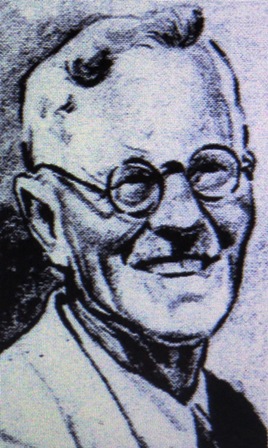
Edward Yeager, circa 1884

Yeager appears to have returned to amateur baseball in 1885.  At the same time he joined the fire department and became active in local politics.  Yeager served three terms in the Reading city council and was the Democratic candidate for mayor in 1899, losing by 58 votes.

Yeager ran again in 1902 and was elected Reading’s 24th mayor, serving until 1905 (at the time Reading mayors were limited to one, three-year term).  He attempted to run again in 1908, but was defeated.  Yeager served as city treasurer after his tenure as mayor.

Yeager, 1898

He passed away in Reading April 30, 1933.