Tag Archives: Walter Johnson

“Fans Inclined to be Fair find it Difficult to side with Wickware”

7 Oct

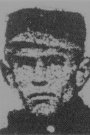
Frank Wickware is best remembered for defeating Walter Johnson and a team of minor league players 1 to 1 in Schenectady, New York in October of 1913.  He was pitching for the Mohawk Giants, and the game was very nearly cancelled after the pitcher and his teammates initially refused to take the field, claiming they were owed six weeks of back pay.
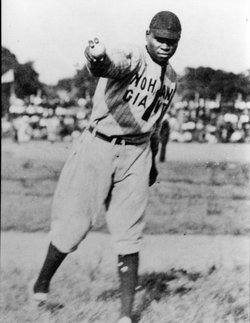
Frank Wickware

Frank Wickware

The New York Times said the crowd of 6,000 nearly rioted, the police were called to control the crowd and more than an hour after the game was scheduled to begin “the financial difficulty was settled and the game started.”

As a result of the “strike,” and the late start, the game was called after only five innings.

The incident in Schenectady wasn’t the first time in 1913 that Wickware took center stage in a controversy over money—the first time it contributed to the cutting short a much anticipated series of games.

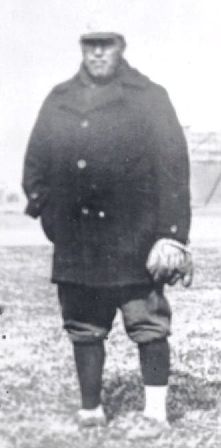
On July 17 the Rube Foster’s Chicago American Giants were to begin a five-game series with the Lincoln Giants in New York.
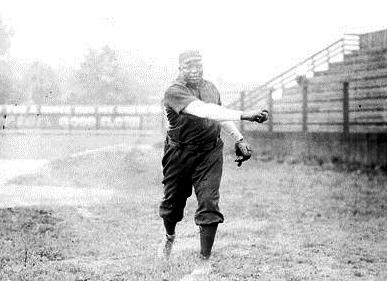
Rube Foster

Rube Foster

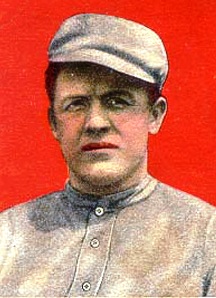
Roderick “Jess” McMahon, the owner of the Lincoln Giants, went to Schenectady before the series and signed Wickware, who he intended to start in the first game.

The New York Age said:

“Thursday afternoon before the game…McMahon spied Wickware all togged up in and American Giant suit.  He inquired of the pitcher why he was not in a Lincoln Giant uniform.  Wickware promptly told him that he was going to pitch for the American Giants.

“McMahon protested to Rube Foster against Wickware playing on the American Giants in view of the fact that he had given him money (allegedly $100), but the manager of the American Giants insisted that Wickware do the pitching for his team.  The two managers argued for over an hour, when the game was called off.”

The series was resumed the following day without Wickware.  The Lincoln Giants were ahead in the series 2 games to 1 before the game scheduled for July 22.  McMahon recruited Charles Earle of the Brooklyn Royal Giants to play left field in place Robert “Judy” Gans who was ill.  Foster objected to the substitution and refused to play the game despite there being “A large crowd.”

The Age said Wickware and both teams were doing damage to the future of black baseball:

“Fans inclined to be fair find it difficult to side with Wickware or regard him as a hero.  To accept money from one manager and then want to play for another is a piece of reasoning which does not favorably impress those who believe that one should keep his word at all times.  Just such conduct of Wickware’s will do much to injure the progress of baseball among colored clubs.”

“The sooner the managers of the colored teams get together and agree upon a working basis for their mutual protection the better.  Manager McMahon seems to have developed a habit of borrowing players from other clubs which should not be permitted. “

Roderick ":Jess" McMahon

Roderick “:Jess” McMahon

Wickware would remain one of the dominant pitchers in black baseball into the 1920s.  He continued to jump when teams when a better offer came—he played for four clubs in 1914, jumping a contract each time.  In 1925 Wickware was in a bar on 135th Street in New York with Lincoln Giants teammates Oliver Marcelle and Dave Brown.  After an altercation in the bar, a man named Benjamin Adair was shot and killed in front of the bar.

One report in The Freeman said witnesses claimed Adair was with the three players when a fifth man ran from building “shouted ‘I got you,’ and fired point-blank at Adair,” The New York Amsterdam News said “four men were quarreling on the sidewalk, when one drew an automatic.”

In either case, Brown disappeared and was assumed to me the shooter.  Wickware and Marcelle were never charged; there has been much mythology about Brown and speculation about the date and place of his death, but no definitive evidence has been presented.

McMahon and his brother Ed sold their controlling interest in the Lincoln Giants in 1914 and owned the Lincoln Stars from 1914-1917.  The McMahon’s were also boxing and wrestling promoters—which continues to be the family business.
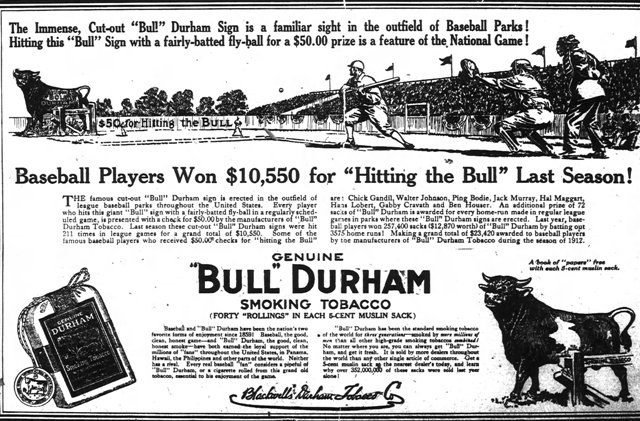
Lost Advertisements–“Baseball Players won $10,550 for ‘Hitting the Bull’ Last Season”

19 Jul

bd1913


A 1913 advertisement for Bull Durham Smoking Tobacco.

“The Immense Cut-out ‘Bull’ Durham Sign is a familiar sight in the outfield of Baseball Parks!

“Hitting this ‘Bull’ Sign with a fairly-batted fly-ball for a $50.00 prize is a feature of the National Game!”

In 1912 the Bull Durham signs were hit 211 times, among the players who collected $50 that season were: Chick Gandil, Walter Johnson, Ping Bodie, Red Murray, Harl Maggert, Hans Lobert, Gavvy Cravath and Ben Houser.

Bull Durham also gave “72 sacks of ‘Bull’ Durham,” for every home run hit in a ballpark with one of their signs.

“Last year, baseball players won 257,400 sacks ($12,870 worth) of ‘Bull’ Durham by batting out 3575 home runs!”

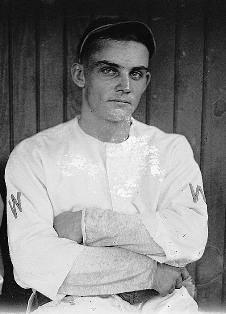
Chick Gandil hit the Bull Durham sign in 1912

Chick Gandil hit the Bull Durham sign in 1912

Baseball’s “Growing Evil”

24 Jun

By 1913 newspaper articles under the byline of a famous player were common in newspapers across the country, and most of the game’s biggest stars were represented.

Most fans of that era assumed the players did their own writing until an expose appeared in The Washington Herald in March of 1913.  Sports Editor William Peet wrote:

“The dear old public fell for this stuff and swallowed hook, bait and sinker.  An article under the signature of Christy Mathewson led three-fourths of the fans to believe that the great pitcher himself wrote it.”

According to Peet, players were paid between $250 and $1000 for each story “and not one of them wrote a single word,” but it was still a good investment:

“The newspapers themselves regarded these feature articles as good investments, for the reason that the stories were syndicated to 25 or more outside publications and the revenues derived not only paid the amount guaranteed the baseball player for the use of his name, but left a handsome profit.”

Peet exposed the writers behind the articles “written” by the game’s biggest stars:

Christy Mathewson and Jeff Tesreau/John Wheeler, The New York Herald

Walter Johnson/Ralph MacMillan, The Boston Journal/The Boston Herald

John McGraw/Walter Turnbull, The New York Evening Sun

John “Chief” Meyers/Jim McBeth, The New York American

Richard “Rube” Marquard/Bill Farnsworth, The Atlanta Georgian/Hearst Newspapers

Denton “Cy” Young/Sam Carrick, The Boston Post

Tris Speaker/Tim Murnane, The Boston Globe

“Smokey” Joe Wood/Jim O’Leary, The Boston Globe

Ty Cobb/Roger Tidden, The New York World

Hughie Jennings/George “Stoney” McLinn, The Philadelphia Press

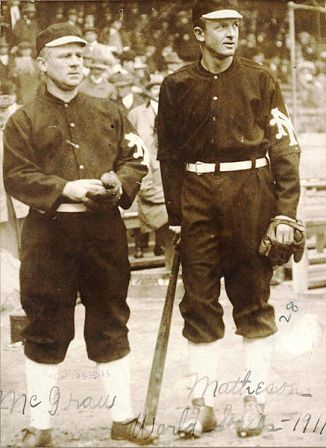
John McGraw and Christy Mathewson

John McGraw and Christy Mathewson

Peet called the practice dishonest, and said it had gone too far, and in New York and Boston the practice   had “become a mania.”  Peet singled out an article “written” by John McGraw criticizing “Chief” Myers that caused an “explosion,” and said the articles featuring “Rube” Marquard’s byline, and written by Farnsworth got Marquard “in bad with his teammates, for Farnsworth spared no one is his scathing criticisms.”

Pittsburgh Pirate manager Fred Clarke disagreed with the practice, telling Peet:

“I do not think it is any ball player’s place to butt into the newspaper end of the game…I think it is foolish for any player, especially those who take part in the world’s Series, to write about the games.”

As a result of Peet’s revelations the American League club owners condemned the practice of players’ names appearing on articles they did not write, but came just short of officially banning the practice. In September, the Baseball Writers Association petitioned the National Commission to end the “growing evil” of players authoring or appearing to author articles during the upcoming World Series.

The commission agreed, and American League President Ban Johnson informed Philadelphia Athletics manager Connie Mack on the eve of the World Series that star players Eddie Collins and Frank Baker “have been instructed not to write baseball stories or give the impression they are writing them.  If they ignore this request, a way of punishing them would be found. “

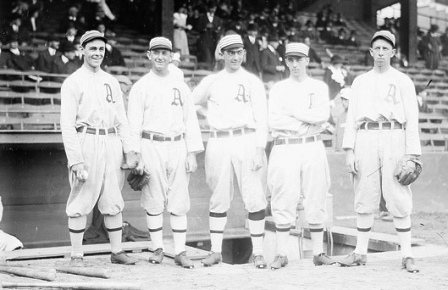
Frank Baker, center, Eddie Collins, far right,

Frank Baker, center, Eddie Collins, far right,

Johnson even threatened “Collins and Baker would not be permitted to take part in the World Series,” if they wrote articles or permitted their names to be attached to articles.

At one point Johnson and National Commission Chairman August Hermann said they would consider calling off the series if players refused to comply.  Dave Fultz, the former player, practicing attorney, and president of the Fraternity of Baseball Players, said members of the commission could be personally liable for damages if the series was cancelled.  Johnson and Herman’s threat to cancel the series as a whole was put to rest.

Mack argued that the players had contracts with newspapers and that Johnson had said earlier that players who were “capable” of writing their own articles would be permitted to do so, but as he prepared his team to play the New York Giants, he prepared for the worst, telling The Associated Press:

“(I)f the commission decides the players must not write under any conditions and players decide not to abide by the ruling, I will be prepared to put a team on the field,” The AP speculated that utility infielder John “Doc” Lavan  would play second base  and outfielder Rube Oldring would be moved to third base, with Amos Strunk taking Oldring’s place in the outfield.

Mack’s adjustments weren’t required.  Collins was allowed to write for The Philadelphia Record because his deal with the paper predated the commission’s ruling, and Baker did not write articles.  Together they led the Athletics to a 4-1 Series win, hitting .421 and .450.

Ghost written articles, and articles actually written by players never disappeared, but the practice became much less popular after the revelations and battles of 1913.

“The Speed of Rusie”

30 May

Hall of Famer Amos Rusie “The Hoosier Thunderbolt,” was famous for his fastball; it’s been estimated that he threw in the high 90s.  In only nine full seasons he led National League pitchers in strikeouts five times.

Amos Rusie

Amos Rusie

Sports writer William A. Phelon contended that Rusie was the fastest pitcher he had seen, and in 1913 he told a story by James Tilford Jones who played for the Louisville Colonels in 1897, and was still a fairly well-known minor league player.

The likely apocryphal story (Jones only had one at bat as a pinch hitter that season, and did not strike out)  appeared in The Cincinnati Times Star, and according to Phelon, Jones said:

“ Don’t tell me that Walter Johnson, or any other pitcher of the present time, is faster than Rusie, or even that any man has the speed that Rusie used to throw…That man was unique and individual –there was never one like him before his time, and none since.  I don’t think there ever will be.

“My first experience with Rusie happened a long, long time ago, when he was in full swing and I was playing with Louisville, then a member of the big circuit.  I was warming the bench that particular afternoon, and wasn’t specially noticing the work of the other side, when our manager (Fred Clarke) beckoned me.  ‘Joensey’ said he, ‘you go up and bat for the pitcher.  Two on, two down—we just gotta have this game.  Go up there and lay the bat against the leather.’

“’All right sir’ I assented.  I’ll pickle one outside the lot if he puts it over.’  And up I strode, with a fat bat in my hands.  I saw a very large, red-faced man standing out there on the pitching line and I saw him raise his right arm.  I was wondering why on earth he didn’t throw it, when heard something go POW, just like that, behind me.  I looked around.  It was the thud of the ball ramming into the big mitt, and the umpire said, ‘One strike.’

“I watched the big man keenly, and again he raised his arm while I set myself to annihilate the ball.  An instant later I saw a ball going by me, and swung at it.  It was the ball being returned by the catcher, and I thought it was coming up instead of going away.

“By this time I was furious, also desperately determined.  So I set myself almost upon the plate, with the bat jutting out, and watched the big man very closely.  Then something crashed into my bat, ripped it from my hands, and drove it round against the back of my neck—and I knew no more.

“Two or three days later, the situation was exactly the same—Rusie pitching, our pitcher up, and dire need of a pinch hitter.  Again the manager beckoned me. ‘Go up and hit him, Jonesey’ growled he.

“I marched up to the plate, but went up empty-handed— didn’t even pick up my bat—and calmly stood there in the batter’s box, with nothing but my bare hands.  ‘Hey you,’ yelled the manager, ‘where’s your bat.’

“’Don’t need it,’ I shouted back.  ‘I can’t see them anyway, and it is a whole lot safer with nothing in my hands than be up here with a chunk of timber that he might drive clear through my head!’

“Oh, yes, yes.  Rusie had some speed when he wanted to use it, and I never remember seeing him any time when he wasn’t inclined to use it, either.”

Jones only appeared in two games during the 1897 season; in his first game he pitched 6 2/3 innings in relief in a 36-7 loss to the Chicago Colts, giving up 22 runs, 14 earned—the Colts’ 36 runs are still the Major League record.

Jimmy Jones

Jimmy Jones

Jones became a full-time outfielder in 1900 and returned to the National league with the New York Giants in 1901; he appeared in 88 games for the 1901-02 Giants, hitting .209 and .237.

He returned to the minor leagues and continued playing until 1914, and finished his career managing the Maysville (KY) Burley Cubs in the Ohio State League in 1916.  He served as Laurel County Clerk for twenty years, and died in London, Kentucky in 1953.

Rusie retired with a 245-174 record, striking out 1,934 and walking 1.704.  He died in 1942 and was elected to the Hall of Fame by the Veterans Committee in 1977.

More “Chief” Johnson

30 Aug

Last week I told you about George “Chief” Johnson’s release from the Chicago White Sox in the spring of 1913, allegedly because of his affiliation with the Winnebago (Ho-Chunk) Native-American Tribe.

Cincinnati Reds owner August Garry Herrmann and manager Joe Tinker were apparently more concerned with a good arm than the so-called “Winnebago ban,” and signed Johnson.

George “Chief” Johnson

Through the first month of the season, Johnson was the only effective Reds pitcher, winning three games (including two shutouts) for a team with a record of 5-16.

The New York Times took notice in an article, the racist tone of which was typical of the era:

“Big Chief Johnson of the Winnebagos [sic] is copper-colored and fat. At bat he displays as much activity as the wooden Redmen who hold forth at the doors of countless cigar stands. But on the mound this latest Indian to edge his way into the select circles of major leaguedom can deal out ciphers with as much success as the more illustrious Johnson of Washington.”

Johnson ended the season 14-16, with a 3.00 ERA for a team that finished 25 games under .500.

In 1914, the Federal League came calling.  Otto Knabe, Manager of the Baltimore Terrapins sent a telegram to Johnson asking for his terms.  According to Knabe, Johnson replied with a telegram sent collect saying “Will sign for $10,000 bonus and reasonable salary.” Knabe telegrammed Johnson collect “Asked for your terms, not Walter Johnson’s”

Otto Knabe

Johnson signed the following month with the Federal League Kansas City Packers for a more modest $3000 advance and $5000 salary; the only problem was that Johnson had already signed a contract with the Reds for 1914.

Johnson’s 1914 season was highlighted by a series of injunctions and court rulings that kept him sidelined for much of the season while organized baseball battled the upstart Federal League.  (The saga of the Federal League has been rehashed in numerous books and blogs, no need to reinvent the wheel here—I recommend this book)

Johnson played for Kansas City in 1914 and 1915 posting records of 9-10 and 17-17.  Throughout his tenure in Kansas City Johnson had numerous run-ins with the law over his drinking and was cited for desertion and non-support of his wife. Additionally, his weight ballooned to well over two hundred pounds.

Johnson’s major league career was over after 1915, but he pitched three more seasons in the Pacific Coast League.  Pitching for the Vernon Tigers near the end of the 1916 season Johnson was so out of shape that it was reported in the Los Angeles Times that the Portland Beavers chased him from a game in the third inning by having several hitters in a row lay down bunts that the overweight pitcher was unable to field.

Johnson reportedly returned in better shape in 1917 and was 25-23 pitching for Vernon and the San Francisco Seals.  Johnson returned  in 1918, posting a 2-6 record, and was joined in San Francisco for a short time by his brother John who appeared in one game for the Seals.

After his release by San Francisco Johnson barnstormed with a variety of teams throughout the Midwest and West and sold “snake-oil” in a traveling tent show.  On June 11, 1922, Johnson was in Des Moines, Iowa with his tent show when he was killed in a dispute over money during either a dice or poker game (news accounts varied).  Johnson’s killer, an African-American gambler named Ed Gillespie, was originally charged with first-degree murder, but the charges were reduced to manslaughter based on eye-witness accounts that claimed Johnson was “drunk and belligerent.”  He was buried at the Winnebago Cemetery in Winnebago, Nebraska.

A postscript.

A few days after Johnson’s death a small item appeared in Iowa newspapers; it was about a druggist in Des Moines who had agreed to put a display in his store window to promote Johnson’s tent show. The story said:

“Anyone anxious to own a nice horned rattlesnake may have one by taking the one left in his show window by the late Mr. Johnson.”