Tag Archives: Western Association

“Dunnie’s” Narrow Escape

28 Jul

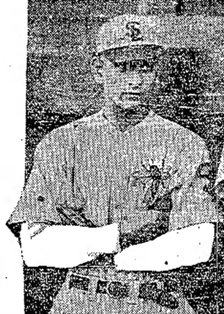
Samuel Morrison “Dunnie” Dungan returned home to Southern California in 1889 after graduating from Eastern Michigan University– the Michigan State Normal School– and joined the F.N. Hamilton’s a powerful San Diego-based semi-pro team that included 39-year-old Cal McVey, a member of Harry Wright’s Cincinnati and Boston Red Stockings teams from  1869 through 1875 (with a detour to Baltimore in 1873).

In the spring of 1890 the Oakland Colonels, champions of the California League in 1889 recruited Dungan to catch for them during a series of exhibition games in Los Angeles.  The Oakland squad did not impress Southern California critics.  The San Diego Union said:

“It is drawing it mild to say that it was the rottenest game that been played on the ground.  If it was not a fake, than the Oaklands cannot play ball.  Do they suppose up about San Francisco and Oakland that they can bring down to Southern California a lot of boys and show the Southerners how to play ball?”

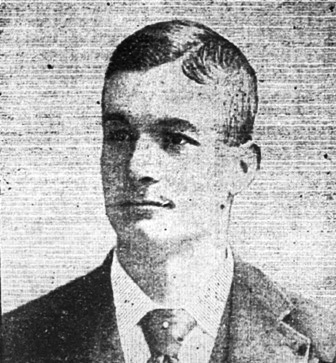
Samuel Dungan
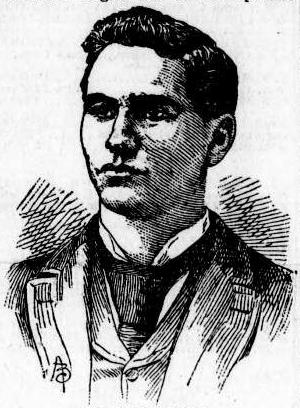
Samuel Dungan

The Union said the Hamiltons, as well as two other San Diego teams, the Schiller & Murthas and the Llewellyns “can beat the Oakland team out of sight.”

The paper said only one player stood out:

“Dungan, the San Diego catcher, who caught for the Oaklands both days, was about the only redeeming feature of that club…And he does not pretend to be a professional.”

As a result of his play during the exhibitions, Dungan was signed by the Colonels;  he still caught occasionally but was now primarily an outfielder.  Team owner Colonel Thomas P. Robinson was unable to restrain his enthusiasm when Dungan was signed, telling The Oakland Tribune:

“I believe Dungan is the greatest batter we’ve ever had here—better than (Lou) Hardie or (Vince) Dailey, the latter of whom I rank as the best of the old men.”

Fred Carroll, a California native who played with the Pittsburgh Burghers in the Players League in 1890, called Dungan “the only scientific batter on this coast.”

Statistics are incomplete for the 1890 California League season, but both The Tribune and The San Francisco Chronicle reported that Dungan was the league’s batting champion.  The Los Angeles Herald said he hit .332.  The Colonels finished third in the four-team league.  The Tribune said it was “probable that Dungan will go East.”

He was first rumored to be heading to be heading to the Washington Statesmen in the American Association but ended up signing with the Western Association’s Milwaukee Brewers.

It was Dungan’s departure from the West Coast in the spring of 1891 that led to the biggest headlines of his career.

The San Francisco Chronicle told the story:

“Sam Dungan, the ballplayer who was with Oakland last season and who led the California League in batting, is being pursued by an irate wife who says she will follow him to the end of the earth if necessary to again clasp him in her arms.  It seems that last year among the many conquests Dungan made in Oakland was Miss Mamie Bodgard.  She became wild over him, and at last was introduced to him.  After the season Dungan came south to his home in Santa Ana, but communication between himself and Miss Bodgard kept up.  She sent him many dainty perfumed notes.  Finally the marriage of the couple was announced and it created no great surprise.

“Now comes the thrilling part of this story.  Two hours after the marriage had taken place (in Los Angeles) Dungan left his bride and journeyed to Santa Ana, where he had an interview with his parents, who are well and favorably known and rank among the leading families.  Sam is a college graduate and was the idol of his parents.  Mrs. Dungan also journeyed to Santa Ana.  She did not go to the home of the Dungan’s, but went to the Richelieu Hotel.  She is a most pronounced brunette, rather petite, and is reported to have a temper.  The couple had parted, and the news of the separation soon became noised around.  Mrs. Dungan consulted a lawyer to have her ‘hubby’ restrained from leaving Santa Ana, but the heavy hitter eluded his young wife and started for Milwaukee, giving his bride the slip at Orange, she being on the same train with him that far.”

The jilted bride told a reporter for The Los Angeles Herald that she was “a grass widow,” but vowed to pursue Dungan to Milwaukee.  Mrs. Dungan’s trip to Milwaukee was unsuccessful.

A year later The Herald reported that a court in Santa Ana had awarded Mrs. Dungan $25 a month  “and she is very elated in consequence.”  She was said to have gone to Milwaukee twice the previous year and had taken to reading “Sammy’s love letters on the street corners,” of Santa Ana:

“Mrs. Dungan is an excellent dresser and is an exceptionally handsome woman.  She doubtless could be induced to kiss and make up, but the parents of her husband stand in the way of a reconciliation.  The Dungan’s are anxious to have Sam get a divorce, but he  can’t very well, and Mrs. Dungan says: ‘Never in a thousand years.'”

A divorce was finally granted in 1893.  Sam Dungan remarried in 1900.

Dungan went on to play parts of five seasons in the major leagues, mostly with the Chicago Colts and had a .301 career batting average.  He was an excellent minor league hitter, putting up several excellent seasons—including averages of .447, .424 and .372 in 1894, ’95, ’97 with the Detroit Creams and Detroit Tigers in the Western League. He also hit a league-leading .337 in 1900 for the Kansas City Blues in the inaugural season of the American League.

Dungan returned home to Santa Ana after retiring at the close of the 1905 season and participated in many old-timers games in Southern California.  The Santa Ana Register reported on his heroics during a 1924 fundraising game for former player Ed Householder who was dying of stomach cancer—Dungan joined Sam Crawford, Gavvy Cravath, Fred Snodgrass and other West Coast baseball legends for the game in Los Angeles:

“Yesterday, Dungan, now a prosperous Santa Ana resident and rancher, proved that years have not dimmed the remarkable eye nor time deprived the power from his arms and shoulders that enabled him, year after year, to outhit the other big league players of his day.

“Dungan rapped out a two-bagger with two men on the cushions in the tenth inning.  This blow broke up the game.  Previously Dungan had smashed out three other bingles.  Thus, Dungan of Santa Ana, the oldest man on the field in point of years, was the heaviest hitter just as he used to be years ago.”

Dungan died in Santa Ana in 1939.
Brief Bios

7 Apr

Finley Yardley

Identified as “Findley” on Baseball Reference, Finley A. Yardley was born in Ben Arnold, Texas on March 21, 1895.

“Fin” Yardley was a good hitter, but his intelligence was questioned more than once during his career.

After a spring trial with the St. Louis Browns in 1917, he was released to the Little Rock Travelers in the Southern Association for 57 games, but according to The Arkansas Gazette, “Forgetting is what chased him out” and he was sent to the Spokane Indians in the Northwestern League.

Yardley hit well in Spokane (.339 in 115 at bats), but despite his success The Gazette noted that:

“His think tank still slips now and then.  Recently he hit a drive good for three bases but forgot to touch first.”

Fin Yardley was no rocket scientist—his son John Finley Yardley was.

John Yardley was an aeronautical engineer whose team from McDonnell Aircraft Corporation designed the Friendship 7 capsule in which John Glenn orbited the Earth in 1962—Glenn called him “one of the real pioneers of the space program.”  Yardley was also involved with the Gemini, Skylab and Space Shuttle Programs.

After his playing career, Finley Yardley settled in St. Louis where he worked as a sales manager at a car dealership.  He died in Tucson, Arizona on March 1, 1963.

Charles Gurtz

Charles Joseph Gurtz was born in DePauw, Indiana in 1890.  He served in the United States Army, where he was a member of the 22nd Infantry and played for the unit’s baseball team in the El Paso, Texas city league.  He then played in a number of leagues throughout the Southwest not recognized by the National Agreement, including stops with teams in the “copper circuit;” loosely connected teams and leagues in mining towns in New Mexico and Arizona

Gurtz was let out of his contract in Silver City, New Mexico in order to join the Bloomington Bloomers in the Three-I League in 1914.  He hit .333, finishing second to Howard Wakefield for the league batting title.

Shortly after the 1914 season ended, Gurtz broke his leg during a semi-pro game in Odell, Illinois and returned home to Indiana.

In February of 1915, The Associated Press reported that he was “suffering from mental trouble, due to excessive religious zeal (and) has been declared insane. “  He was committed to Indiana’s state hospital at Madison, where “Physician’s say that he should respond to treatment and become normal again if his mind can be kept off religion.”

A month later Gurtz was released from the state hospital, The Associated Press said the hospital’s “superintendent expressed the opinion that Gurtz would be able to play ball.”

Gurtz played, but not well.

He hit just .193 for Bloomington in 1915.  The following year he was released by Bloomington just before the season began, but was signed by the Oklahoma City Senators in the Western Association in May.  He split the 1916 season between the Senators and the Muskogee Mets in the same league, hitting just .210.  (Baseball Reference identifies the player with Oklahoma City and Muskogee in 1916 as “William Gurtz,” but contemporary references in The Oklahoma City Times confirm that it was Charles Gurtz)

Gurtz returned to his native Indiana after the 1916 season and died on November 9, 1989, three weeks short of his 100th birthday.

Jimmy Duchalsky

James Louis “Jimmy” “the Duke” Duchalsky was discovered in Hawaii between the 1922 and ’23 seasons when Herb Hunter’s touring big leaguers visited the island during their barnstorming trip which also included stops in Japan, Korea, China and the Philippines.

The International News Service, which called the 5’ 9” 150 lb. Duchalsky the “hardest hitting pitcher in Hawaiian baseball circles,” said he caught the eye of New York Yankee pitcher “Bullet” Joe Bush.  Bush “was so impressed with the youngster’s work in a game he pitched against the big leaguers that he recommended him highly to Duffy Lewis manager of the Salt Lake City Bees in the Pacific Coast League).”

Joe Bush, front, second from right

Joe Bush, front, second from right  photographed during the tour.

Bush said the only thing he lacked was “a change of pace and that can be developed under the instruction of a good coach and manager.”

Duchalsky was 24-years-old (the Bees claimed he was just 21), but not as polished as Bush thought and struggled through 15 appearances, most in relief, for Salt Lake.  He posted a 1-3 record and 7.59 ERA in 51 innings—he did have 8 hits in 20 at bats, with one home run.   In May, he and teammate Tony Lazzeri were sent to the Peoria Tractors in the Three-I League; Duchalsky was 13-8 in 28 appearances.

The following season Duchalsky rejoined the Bees but pitched just one-third of an inning, allowing two runs and two hits in an 18-17 loss to the Oakland Oaks on April 10.  He was released later that week and returned to the Three-I League, this time as a member of the Decatur Commodores; he was 11-9 with a 4.13 ERA for the last-place (58-78) Commodores.

Jimmy Duchalsky 1923

Jimmy Duchalsky 1923

At the end of October he returned to Honolulu to play winter ball.

On December 7, 1924 Duchalsky was involved in an altercation with a cab driver. The Decatur Review said:

“Jim Duchalsky, known to all Three Eye League baseball fans as “The Duke,” has pitched his last game of ball… (he was) shot to death in his native city last evening after a street argument…It will be hard to convince Decatur baseball fans who have come in contact with Jim that he was the aggressor in any brawl that might have taken place for he was the most quiet player both on and off the field to ever appear here… Despite his quiet manners and the fact that he was not a mixer, many fans in both Decatur and Peoria will mourn his loss.  Duchalsky was admired by fans in every city where he played for his sportsmanlike conduct on the ball field and in all his games pitched at Staley Field was never seen disputing an umpire’s decision, even on balls and strikes.  He pitched his game and left the arguments out of his assortment.”

The Associated Press said, “The encounter was believed to have started in jealousy over a woman.”  The cab driver, John Emmeluth, claimed self-defense, but several witnesses said he approached and shot the pitcher with no warning.  He was sentenced to 20 to 25 years in prison.  Duchalsky was buried in Honolulu.

“Foster you are Released”

17 Mar

Elmer Ellsworth Foster’s career as a pitcher ended on August 26, 1884.  He had been out for three weeks with “an injury to the tendon in his right arm,” when he took the mound for the St. Paul Apostles in a Northwestern League game against the Milwaukee Brewers.  The 22-year-old was 17-19 with 1.18 ERA when he took the mound at St. Paul’s West Seventh Street Grounds.

The St. Paul Daily Globe said:

“When the popular favorite took his position in the box in the last half of the first inning the audience received him with an ovation of cheers, to which he responded by raising his cap.  A moment later he pitched the first ball, a sharp crack was heard distinctly all over the ground and the sphere went spinning ten feet to the right of the batter.  Foster turned pale, but stood in his position until the players in the vicinity reached him.”

He had “snapped the bone of the right arm just above the elbow,” and after Foster left the field a collection was taken up among the fans “A few minutes later it was announced that $172 had been collected.”

He made it to the major leagues two years later as an outfielder with the New York Metropolitans in the American Association, and played parts of five seasons in the American Association and National League.  A consistent .300 hitter in the minors, Foster hit just .187 in 386 big league at bats.

According to The Sporting Life, his manager with the New York Giants in 1888 and ‘89, Jim Mutrie considered him “one of the best fielders in the country, and the only reason New York ever let him go was because he didn’t show up well with the stick in fast company.”

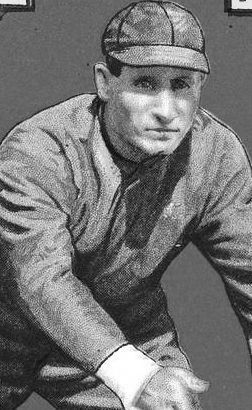
Elmer Foster

Elmer Foster

Sportswriter Hugh Fullerton said he excelled at other things as well:

“The rowdy of the rowdies was Elmer Foster.  Handsome, well bred, clean cut and with it all, well educated and something of an actor.  Foster was in baseball for the fun of it.”

From the time Fullerton joined The Chicago Tribune in 1897 until he left Chicago for New York in 1919 Bill Lange was probably the only 19th Century player he wrote about more often Foster.

Foster’s  best season was 1890 (.248 in 105 at bats and 5 home runs) with Cap Anson’s second place Chicago Colts after being acquired in late August.

Foster started the season with his hometown Minneapolis Millers in the Western Association (he hit .388 in his first twelve games), but fell out of favor with Manager Sam Morton after he and a teammate named Henry O’Day were arrested and fined in Milwaukee for public intoxication in May.

Foster was benched, but the team refused to release him, and by mid-July he was ready to take the Millers to court.  The St. Paul Daily Globe said:

“(Foster) threatens to bring suit against the management to compel its members to give him his release.  His claim will be that they are unjustly preventing him from earning a livelihood.  There is a possibility that the threat may be only a bluff, but should such a trial be put on, it will be of much interest in Western baseball circles, as it will be the first of its kind in this section.”

The Millers finally chose to release Foster rather than fight a lawsuit.  Foster was rumored to be headed to several different teams, but finally signed with the Colts on August 27.

After his strong September in 1890 Foster began the ’91 season as the Colts center fielder, but it didn’t last.

Fullerton said Foster sealed his fate with Anson during the opening series:

“We were going to Pittsburgh, and just before we arrived in town on the unearthly jump from Chicago to Pittsburgh, via Cleveland, Anson came along and sat facing us.

“’Foster,’ He said ‘The next time you take a drink, or anyone on the club takes a drink with you, I’ll release you.’

“’All right, Cap,’ said Foster, cheerfully.

“We arrived in Pittsburgh, and while Anson was registering the club at the desk Foster said: ‘Let’s go have a cocktail.’

“’Better be careful, Elmer, the old man is sore,’ I remarked.

“But we went.  The mixologist had just strained the cocktails into the glasses when Foster, looking into the mirror, spied Anson in the doorway.  He turned and, bowing low, said sweetly “Captain anson, will you join us for a drink?’

“’No,’ thundered Anson.  “Foster you are released.

“And now that I am released, Captain Anson,’ said Foster, ‘will you join us in a drink?”

Unlike many of Fullerton’s story, the basic facts (if not the part where he included himself in the story) are confirmed by contemporaneous accounts.  The Chicago Tribune said on April 26 after the Colts four-game series with the Pirates:

“Elmer Foster is not with the club and he has probably played his last game with it.  He and (Pat) Luby last night at Pittsburgh were drinking and Anson fined each $25 and ordered them to go to bed.  They paid no attention to the order and the fine was increased to $50.  This morning when the team was ready to go to Cincinnati Anson gave foster a ticket to Chicago and sent him home.”

Luby was not sent home and lost to the Reds 1 to 0 the following day.  He was fined several times for drinking during the 1891 season, and after a promising 20-9 rookie season in 1890 he slipped to 8-11, and followed it up with an 11-16 season in 1892 before Chicago let him go.

Foster was suspended without pay and finally released on May 11.  He was immediately signed by the Kansas City Blues.

Foster played well in Kansas City, hitting .300 in 70 games for the second place Blues, but was released in August.  The Kansas City Star said:

“One of the sensations of today is the unconditional release of Elmer Foster whose behavior on the present trip has been disgraceful”

The paper said Manager Jim Manning was forced to make the move, not just because of Foster’s drinking, but because he “has been largely instrumental in leading other members of the team astray.”

His replacement, Joseph Katz, acquired from the Grand Rapids Shamrocks in the Northwestern league hit just .225 in the final 25 games.

In December of 1891 The Minneapolis Times said:

“Elmer Foster, the ballplayer, yesterday secured $25,000 through the will of his dead mother, and today announced his permanent retirement from the diamond. “

With the exception of one game in 1895 (he went 1 for 2) with the Millers, Foster was true to his word and quit baseball at the age of 29.

Foster retired to Minneapolis where he operated a piano and organ store with his brother, did some acting and occasionally said he was considering running for the Minneapolis City Council or the Minnesota State Legislature, although there is no record of his ever officially filing to run for office.  He also worked as a scout for the Pittsburgh, and signed Ralph Capron out of the University of Minnesota for the Pirates.

After Fullerton moved to New York and stopped writing about Foster the “The rowdy of the rowdies” faded into comfortable obscurity in Minnesota.  He died in 1946 at age 84.

Some of Fullerton’s less reliable stories about Foster on Wednesday.

Davy Force

28 Oct

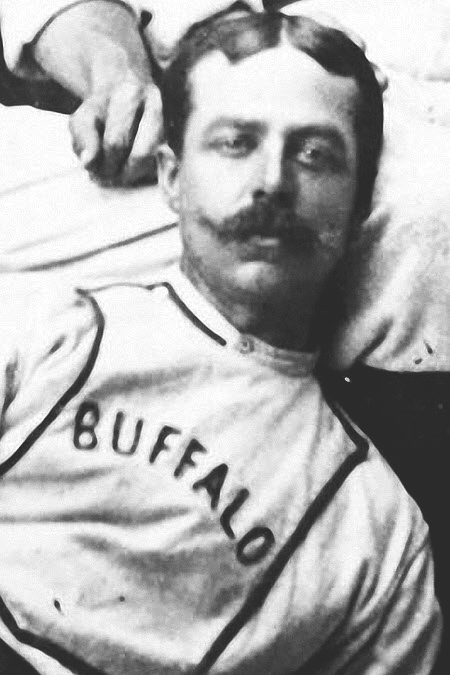
David W. “Davy” Force was a popular figure in 19th Century baseball.  Francis Richter, founder and editor of The Sporting Life said the five-foot four-inch Force was, along with George Wright ”the two greatest shortstops of the early days of baseball.”  Nick Young, National League president, told Ren Mulford Jr. of The Cincinnati Enquirer that Force was second only to Wright as the greatest.

Davy Force

Davy Force

Force played in the National Association and National League from 1871 to 1886, and finished his professional career in the Western Association with the Sioux City Corn Huskers.

He remained popular, and well-known enough that multiple newspapers reported in 1890 that the former player “sided with the Brotherhood,” and supported the Players League; he even made news that year for growing a beard:  “Force has raised a crop of whiskers as long as himself. “

So when it was reported on Christmas Eve of 1896 that Force had shot and killed a man—a former ballplayer no less–in a San Francisco bar and then fled, the news was reported in papers across the country.

The Louisville Courier Journal:

Ball Player Kills Another

The Cincinnati Enquirer:

Old Cincinnati Ball Player Kills a Man in Frisco

The Salt Lake City Tribune:

Baseball Player Shoots Another Without Warning

The Chicago Tribune:

Police now on Lookout for Force

The Baltimore Sun:

‘Davy’ Force Wanted for Killing a Man

Towns where Force had been a popular player were quick to distance themselves.  The Sioux City Journal said that while fans “took a sort of paternal and patronizing interest” in Force when he played in Sioux City “the Golden Gate murder is quite another story…If he has been leading a wild, reckless life, possibly discouragements and vicissitudes have made a different man of him.”

The victim, Joseph Manning, was described as “an ex-ballplayer,” and in various articles was conflated with former big leaguers Jim Manning and Tim Manning.

Once it was determined Manning was not Jim or Tim, no one seemed to know anything about him.

Seven days after the murder, Abraham Mills, former National League president, issued a statement:

“I have known Davy Force almost continuously since I engaged him in 1867 to play in the Olympic Base Ball Club of Washington.  For the last seven years he has been in the employ of the company for which I am an officer, (The Otis Elevator Company) and is a steady, hard-working man, and I fully believe his statement that he never knew a Joseph Manning, and that he has never had any serious difficulty with or made any assault of any kind upon any ballplayer, either during or since his professional career.”

Mills’ statement was printed in only a fraction of the newspapers that reported the shooting.

The accusations faded, and by the time Force died in 1918 there was no mention of the case of mistaken identity in the ballplayer’s obituary.

Who exactly Joseph Manning was, and whether he was actually a professional baseball player, remains a mystery; as does the identity of the “Davy Force” who killed him in San Francisco.

“Fear of the Black List has Stopped Many a Crooked Player from Jumping”

9 Sep

For a brief period in the mid1890s, George Jouett Meekin was considered among the top pitchers in the game; he might never have had the opportunity, but for what The Sporting Life called “The disastrous effects of Chairman Young’s somersault.”

Jouett Meekin

Jouett Meekin

 John Montgomery Ward, Meekin’s manager with the New York Giants, said he was, along with Amos Rusie, Tim Keefe, John Clarkson and Kid Nichols, the “most marvelous pitchers as ever lived.”

Charles “Duke” Farrell, who caught Meekin and Rusie with the Giants, said:

“Sometime, it seemed to me that (Meekin) was actually faster…Rusie’s speed struck the glove with a bruising deadening, heavy shock, and Meekin’s fastest gave a sharp, sudden sting.”

But in 1891 Meekin was a 24-year-old pitcher in his third season with the St. Paul Apostles in the Western Association. The New Albany, Indiana native became a well-known amateur player across the Ohio River in Louisville before signing his first professional contract with the Apostles in 1889.  His sub .500 winning percentage was not enough to keep the American Association’s eighth place Louisville Colonels, from inducing Meekin to jump his contract with St. Paul.

In June Meekin jumped; at the same time third baseman Harry Raymond jumped to Colonels from the Western League’s Lincoln Rustlers.

The National Board of Control, created after the 1890 season as part of the “peace agreement” between the National League and The American Association after the collapse of the Players League, to arbitrate contract disputes, acted quickly.  Board Chairman (and National League President) Nick Young announced that Meekin and Raymond would be “forever ineligible to play with or against a National Agreement club.”  The statement, signed by Young, also said:

“This order or any other that may hereafter be made for the same cause, will never be modified or revoked during the existence of the present board, whose term of office will not expire for five years.”

The move was applauded by the press and no less a figure than “the father of baseball,” Henry Chadwick, who called Raymond and Meekin part of a “venal cabal” of jumping players.

Despite the promise that the order would “never be modified or revoked,” Young did just that.  Within weeks of issuing the order, both players were reinstated.

The backlash was swift.

The Cleveland Plain Dealer called the reversal “nauseating.”  The Cincinnati Times-Star said it was “one of the greatest mistakes ever made.”  The Milwaukee Evening Wisconsin said Young and the board chose to “toss the National Agreement into the fire.”

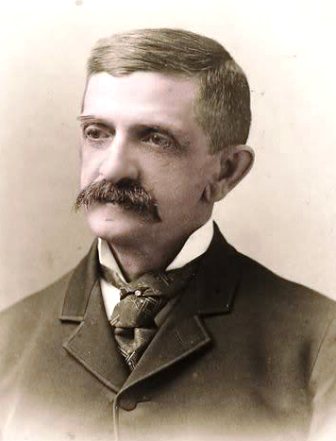
nickyoungpix

Nick Young

James Edward Sullivan, founder of the Amateur Athletic Union (AAU) said the reinstatement of the “arch-culprits” Meekin and Raymond “was the worst in the history.”  He predicted dire consequences as a result:

“Heretofore the fear of the black list has stopped many a crooked player from jumping or doing dishonest work.  But from now on it will be different.  A precedent has been formed.”

Raymond jumped back to Lincoln, taking Colonels’ pitcher Phillip “Red” Ehret with him to the Rustlers.  Meekin remained with Louisville and moved to the National League with the Colonels the following season.

Meekin had a 10-year big league career as a result of Young’s reversal.

From 1891-93, Meekin was 29-51 with Louisville and the Washington Senators and was traded to the Giants (along with Duke Farrell) before the 1894 season.  He was 33-9, and fellow Indiana native Amos Rusie was 36-13, for the 2nd place Giants.  Meekin had two complete game victories in the Giants four game sweep of the first-place Baltimore Orioles in the Temple Cup series (Rusie won the other two games).

The New York Evening Journal called Meekin “Old Reliable,” and said, “He can push ‘em up to the plate in any old style, and is factor with the stick.”  The pitcher hit .276 with 29 RBI in 183 at bats in 1894 (including hitting 3 triples in a game on July 4) and was a career .243 hitter.

Meekin won 102 more games (including 26, and 20 win seasons in 1896 and ’97), but as O. P. Caylor said in The New York Herald he suffered from “a lack of control.”  Meekin walked 1056 batters and struck out only 901 in more than 2600 innings, he also hit 89 batters; in 1898, he broke Hughie Jennings nose with a pitch.

After posting a 16-18 record for the seventh place Giants in 1898, Meekin, along with Rusie, and second baseman William “Kid” Gleason, were blamed by New York owner Andrew Freeman for the team’s disappointing finish.  Freeman told reporters:

“Meekin, Rusie and Gleason will be either sold or traded.  We do not want them.  I’m going to break up cliques in the team even if I have to get rid of every man.  There must be harmony.  Without it we can’t win games.  We have too many men who are simply playing for their salaries and do not seem to care whether they win or not.”

Rusie had injured his arm late in the season and sat out the next two years.  Meekin and Gleason, despite Freedman’s promise, returned to the Giants for the 1899 season.  The team finished in tenth place, and Meekin struggled with a 5-11 record.

He was sold to the Boston Beaneaters in August for a reported $5000, although it was commonly assumed that the Giants received much less, or simply “loaned” Meekin to Boston for the stretch run; a charge made by Brooklyn Superbas manager Ned Hanlon.  Although Hanlon’s charges have become “fact” in countless books and articles over the years, several newspapers, including The Pittsburgh Press refuted Hanlon’s story:

“All that talk and fuss about Freedman giving Jouett Meekin to Boston in order to help that team win the pennant and thus get even with Brooklyn is nonsense.  The truth of the matter is that Freedman thought Meekin’s days as a pitcher were over, and he offered him to the Pittsburgh club, but President (William) Kerr thought the same way and did not take him.  At the time Boston’s pitching corps was in bad shape and manager (Frank) Selee took a chance on the big fellow.  There was no underhand dealing in the matter at all.”

Meekin was 7-6 with a 2.83 ERA for Boston, but the team finished second to Brooklyn.  He was released by Boston before the 1900 season and pitched just two games with the Pittsburgh Pirates before being released again in July.  He finished the season with the Grand Rapids Furniture Makers in the Western Association and spent 1902 in the Southern Association with the Memphis Egyptians.

Meekin returned home to New Albany, Indiana, where, in 1910, according to The Trenton True American “his earnings from baseball are well invested in real estate.”

Meekin slipped into relative obscurity by the time he died in 1944.

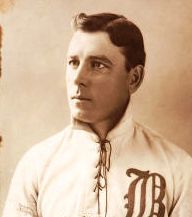
The original picture that appeared with this post–now below–was misidentified as Jouett Meekin in this blog and by The Louisville courier-Journal in 1897.  According to Mark Fimoff co-chair SABR Pictorial History Committee, the picture was actually Lave Cross.  

Lave Cross--picture earlier misidentified as Jouett Meekin.

Lave Cross–picture earlier misidentified as Jouett Meekin.

“The Disappearing Oakland Infielder”

7 Aug

James Ernest “Jimmy” Frick began his career with the Iola Gasbags in the Missouri Valley League in 1904, hitting .331 in 106 games.  While Frick began the 1905 season with the Oklahoma City Mets in the Western Association, a “C” level league, press reports said he could have played at a higher level and The Sporting Life said St. Louis Cardinals, Hall of Famer pitcher Charles “Kid” Nichols “cannot understand why Jimmy Frick of Oklahoma City persists in hiding out it the bushes when he can make good in fast company.”

Frick was hitting above .300 in July when he was sold to the Seattle Siwashes in the Pacific Coast League; he hit .252 in 18 games until August 18 when The Associated Press said Frick “disappeared mysteriously.”

Four days later The Seattle Star said Frick who “was very popular” with local fans had jumped the Siwashes and rejoined Oklahoma City having been promised “$1000 and a chance to manage the team next year.”

Whether the reported deal was actually promised to Frick is unknown.  While he returned to Oklahoma City he never joined the Mets and finished the season with the Wichita Jobbers.

At the end of the 1905 season multiple teams laid claim to him.  The Associated Press said:

“The case of J. Frick who was claimed by Indianapolis, Wichita, Seattle and Oklahoma City was referred to Secretary (John) Farrell (of the National Association).”

In February of 1906 Frick was awarded to Wichita then immediately traded to the Toronto Maple Leafs in the Eastern League.  He spent the next five and a half years in the Eastern League with Toronto, the Baltimore Orioles and the Newark Indians.

On July 16, 1910, while with Baltimore, Frick was hit in the head with a pitch.  In August The Sporting Life said he had not yet returned to the lineup:

 “(Frick) is in a bad way in this city, as the result of being hit on the head by a pitched ball during the last home series of the Birds. Although the accident happened at least three weeks ago, Frick’s head is still in bad condition, his face is swollen and dizziness seizes him on the slightest provocation. It is doubtful if Frick will play again this season.”

He did return at the tail end of the season, but only appeared in a few games.  In 1911 he was sold to Newark, and after hitting just .200 in 28 games he was sold to the Troy Trojans in the New York State League.

Jimmy Frick

Jimmy Frick

Before the 1912 season, Harry Wolverton, third baseman and manager of the Oakland Oaks in the Pacific Coast League, was named manager of the New York Highlanders in the American League.  Oakland hired Bayard “Bud” Sharpe to manage the team; one of his first moves was to purchase Frick from Troy to fill the void Wolverton left at third.

By March 7 The Associated Press said Sharpe was “somewhat exercised about infielder Frick.”  The new third baseman had arrived in Oakland by train several days earlier, but had not arrived at the Oaks training camp in Livermore, California and had not been heard from him.  Sharpe showed up the following day, but it was reported he had spent several days in an Oakland hospital—it was not reported why he was hospitalized.

Frick began the season as the Oaks starting third baseman, but after hurting his foot in April, August “Gus” Hetling filled in and Frick never returned to the regular lineup.

On September 17, with Oakland in a battle for the pennant with the Vernon Tigers, the team was in Los Angeles when Frick, according to The Associated Press left his room at the Hotel Rosslyn and “dropped from sight.”

The Los Angeles Examiner said the Oakland team and the Los Angeles Police Department had looked for Frick for more than a week and found no sign of the infielder.  The Associated Press said “all of Frick’s haunts have been searched,” and that the disappearance “may hurt Oakland in their fight for the pennant, as he is considered the best utility infielder on the team.”

Herb McFarlin, Secretary of the Oaks, said:

“Frick has always been a steady player, not inclined to drink or run around.  He always has been absolutely dependable.”

On October 4 The Associated Press said “the disappearing Oakland infielder” had been found by his wife:

“He had been ill in a Los Angeles Hospital, assuming an alias so that he would not be bothered.”

As with his spring disappearance there was no mention as to why Frick was in the hospital.

On October 5 he was with the Oaks in Portland for a game with the Beavers, he did not play, but was “out on the coaching line rooting for his team.”

Frick was with the team on October 27 when they took both games of a double-header in Los Angeles; Vernon won both games of a doubleheader from Portland, and Oakland took the pennant with a winning percentage of .591 to Vernon’s .587.

Frick saw little action in the final weeks of the season, his replacement Hetling hit .297 and was awarded a Chalmers Automobile as the league’s most valuable player.

Gus Hetling, Frick's replacement at third

Gus Hetling, Frick’s replacement at third

Frick and his wife went to Portland at the end of the season, and in late November planned to leave for Oklahoma City where they owned a farm.  On November 20 Mrs. Frick went to pick up tickets for the trip, when she returned home, she found Jimmy Frick dead.  He committed suicide by drinking carbolic acid. (Baseball Reference incorrectly lists his date of death as November 18),

The Portland Oregonian said Frick had been “ill and despondent,” and said he was suffering from “brain fever.”  (Brain fever is an antiquated and vague term used for inflammation of the brain).

None of the stories about Frick’s suicide and “brain fever” mentioned the severe injury he had received when he was hit in the head in 1910, so  it’s impossible to determine whether it contributed to the erratic behavior that year, hospital stays, or death of the disappearing Oakland infielder.”

“Begged the Crowd for God’s Sake not to Kill Him”

21 May

Edward Siegfried Hengel (often misspelled Hengle during his career) was a well-known umpire and manager in the 1880s.

Born in 1855, Hengel managed the Union Association franchise that began the season in Chicago, and relocated to Pittsburgh in August, 1884.  His career is occasionally confused with Emery “Moxie” Hengel (also often misspelled Hengle) who played second base for 1884 Chicago/Pittsburgh club, and had a long minor league career.  (The two were born two years apart in Chicago, but there is no indication they were related).

Emery "Moxie" Hengel

Emery “Moxie” Hengel

In 1886 Ed Hengel was an umpire in the Southern Association.  On August 5 he was working a game between Savannah and the Charleston Seagulls.  The Macon (GA) Telegraph said, in the sixth inning:

“”At this point of the game it became apparent to the audience, as well as to the players of the local team, that Hengle (sic), the umpire, had sold the game to Savannah; but notwithstanding his adverse decisions, the locals kept the Savannah team down to one run till the end of the ninth inning.  During the latter half of this inning (Hengel) gave the visitor three runs, letting them score in the following manner:  (John “Tug”) Arundel was at the bat. There were two out.  He hit a grounder to (Henry “Heinie”) Kappel who stopped it and threw it to first.  Arundel had stopped running and left the line when (first baseman Jim) Powell   failed to catch the ball”

Arundel then came back onto the field and ran to first, Hengel declared Arundel safe and a  run scored; the next hitter, Joe Miller, drove in two more runs, to win the game for Charleston, 4 to 3

The Telegraph said:

“As soon as the crowd caught on to the steal the grand stand and bleaching boards emptied their male contents on the ground, and for five minutes (the umpire) was in danger of getting very badly hurt, if not killed, by the infuriated crowd.”

The management of the Charleston team helped keep the fans at bay until police arrived:

“It were (sic) best for (Hengel) to get transferred immediately as another disgraceful piece of umpiring will cost him some inconvenience.  The people of Charleston will not stand another robbery.

“(Hengel) was scared nearly to death; he was as white as a sheet, and it is said begged the crowd, for God’s sake, not to kill him.  He did not deny having sold the game when charged with it by a director of the baseball club after he was safe.”

Hengel did not work another game in Charleston that season.

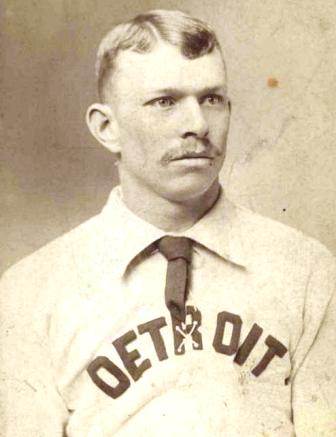
In October of 1887 The Aurora (IL) Daily Express credited Hengel with signing “(Charlie) Hoover crack-backstop of the Western League” for the Chicago White Stockings—within weeks Hoover’s long series of troubles would begin.

HOOVER_LG

Charlie Hoover

Hengel continued as an umpire, including stints in the Tri-State and Pacific Northwest Leagues,  and minor league manager for the next decade.  While managing the Hamilton (OH) club in the Tri-State League, Hengel saved a young girl from drowning, and “her grateful parents presented him a pair of diamond sleeve buttons.”

Hengel disappears from the newspapers after 1892;  he died in Great Britain in 1927; presumably not at the hands of angry Charleston fans.

Note:  Henry “Heinie” Kappel does not appear on surviving rosters for the 1886 Charleston Seagulls, but contemporaneous accounts in The Sporting Life and other newspapers confirm he was with the team.

Charlie Hoover–Infinite Baseball Card Set

21 Mar

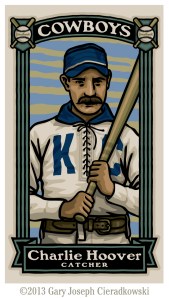
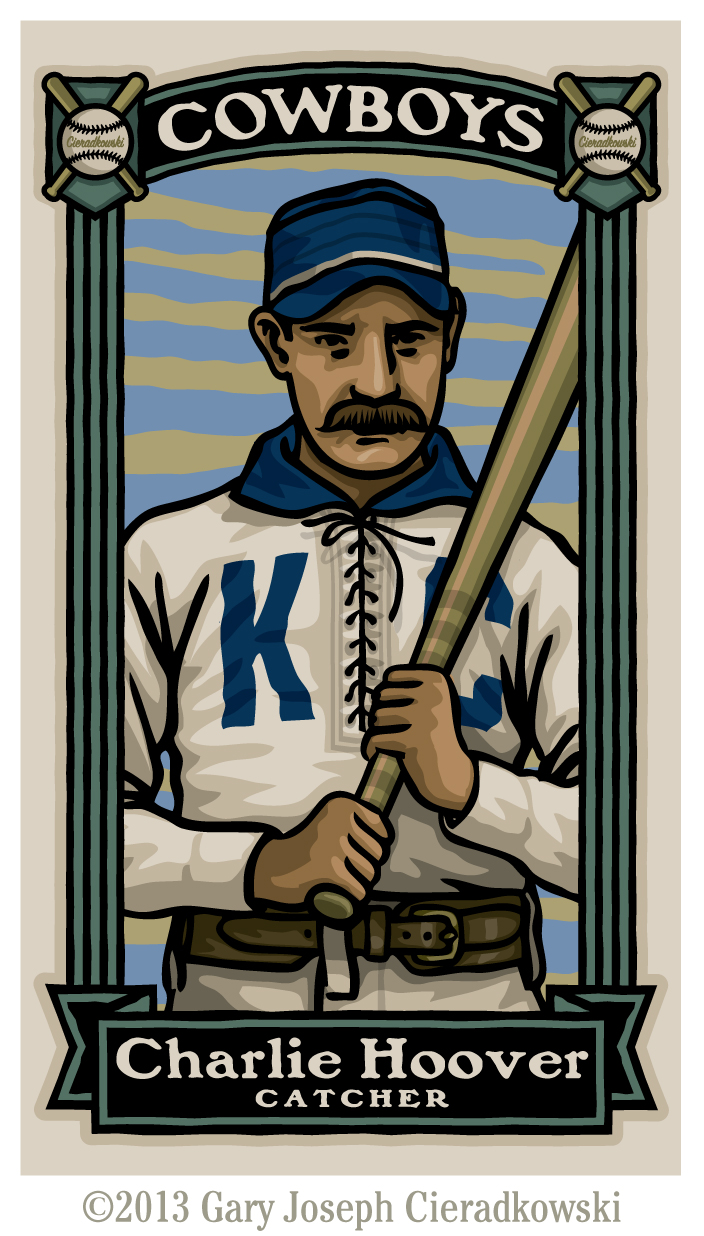
Gary Cieradkowski is an exceptionally talented artist from Covington, Kentucky.  Since 2010 he has produced the great Infinite Baseball Card Set Blog–with excellent stories and his incredible art work.  Gary contacted me recently about collaborating on a piece.  I chose Charlie Hoover.  Hoover was a talented, troubled 19th Century catcher who faded into obscurity and remains one of a handful of Major League players for which there is no information on the place or date of his death.  Read the piece here on Gary’s blog.

This is the card Gary created:

HOOVER_LG

“An Umpire Nearly Lynched”

11 Mar

The above headline appeared on an Associated Press story in August of 1890.  Former Major Leaguer Jimmy Manning, then managing the Kansas City Blues in the Western Association had interceded to quell a riot at the end of a game with the Denver Grizzlies in Kansas City:

“Two questionable decisions by umpire Jovin (Sic) in the ninth inning, when Kansas City was about to tie the score, angered the crowd to such an extent that they swarmed into field, hooting and jeering the umpire.  Two young boys got hold of a rope, and in fun proposed to lynch him.  This added to the excitement, and it looked for a time as if the umpire would be mobbed.  Jimmy Manning climbed up to the top of the fence and addressed the mob.  He said the umpire had decided rightly and advised that no violence be attempted.  This quieted the mob to a degree.  In the meantime the players of both clubs formed a hollow square around the umpire and conducted him to the clubhouse.”

Jimmy Manning

Jimmy Manning

“Jovin” was actually Fred Jevne, a 26-year-old minor league veteran who had become an umpire just a month earlier.  After joining the Spokane franchise in the Pacific Northwest League in April, Jevne was suspended in May for punching an umpire.

In July The Spokane Falls Daily Chronicle said Jevne and teammate Tom Turner “quit the nine because they were excessively fined and ill-treated.”  According to the paper the two players showed up at the July, 1 game “in an intoxicated condition and acted like ruffians in the grand stand.” Turner was eventually reinstated and finished the season in Spokane, Jevne did not.

Since 1885 Jevne had played for a variety of teams in several leagues, including the Southern, International, and California.  When he was signed by Spokane to play center field and serve as captain, The Daily Chronicle said:

“Jevne is rather short.  He is a good batsman and a good player generally.  The San Francisco papers, when he played there, alternately praised him and berated him, but all agree that he was a good player.”

Jevne made one more attempt at playing, joining the Evansville Hoosiers in the Northwestern League in 1891.  He then returned to the Western Association as an umpire.

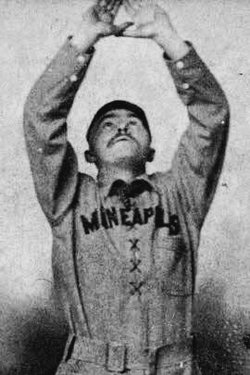
Fred Jevne

Fred Jevne with the Minneapolis Millers, 1889

In December of 1894 Jevne was named to the National League umpiring staff, where his work received mixed reviews.  In June The Baltimore Sun called him “As good an umpire as there is in the business.” In August, after a he worked a game between the Boston Beaneaters and Chicago Colts, The Boston Globe said “Umpire Jevne did poor work, both sides suffering from his yellow decisions.”  The Pittsburgh Press called Jevne’s performance in a September game between the Pittsburgh Pirates and Philadelphia Athletics “By far the worst exhibition of umpiring given this season.”

Jevne was not offered a position in the National League for 1896, and went to work in the Southern Association, where he seems to have a continued his fighting ways.  In July, The Birmingham Age-Herald said Jevne had missed the previous day’s game between the Montgomery Senators and Columbus River Snipes:

“Jevne, the regular umpire, arrived in town last night, but this morning loaded himself up with the spirit of hilarity, got into a fight with a citizen and when the hour for playing arrived was in the hands of the police, and failing to make bond was unavoidably absent from the field.”

Despite his troubles, or because of them, Jevne was asked to join the Interstate League at the end of the 1896 season because, according to The Sporting Life, umpires were losing control of games:

 “(Interstate League President Charles) Powers to-night wired for Fred Jevne the ex-National League umpire, who is so handy with his fists, to report for duty.”

Jevne was not popular with players or the press down south, and said his time in the Southern Association was difficult:

“It was no snap umpiring down South.  Fines didn’t go—were never paid—and so I used to remove men from the game.  Sometimes I would have to take out about half of a team before they would behave, and then the papers would roast me good and plenty the next morning…I had a scrap with a player named (Al) Gifford (Atlanta Crackers shortstop), and punched him in a car going from the grounds.  The local paper came out the next morning and urged the chartering of a special car for the umpire. So that he could be alone in his dignity, and another paragraph hinted that a cigar sign or dummy could be put in the special car for the umpire to punch”

Jevne appears to have returned to the Southern Association for parts of the 1897 and ’98 seasons.  He spent at least part of 1899 and 1900 in his hometown, Chicago, where he worked as an umpire in some college games.  In 1901 Jevne became a Western League umpire and that year met with a violent and mysterious end.

Initial newspaper reports said Jevne had fallen from a third story window in Denver’s Hotel Victor on August 2; he lingered for two days before dying. His body was returned to Chicago and he was buried at Graceland Cemetery.

However, several months after his death, Jevne’s brother Lloyd, a well-known three cushion billiard champion, told The Associated Press he was certain he had been murdered, and that before dying Jevne had said he was pushed:

“I saw Fred’s body after it was shipped back to Chicago, where the burial took place, and the most prominent feature of his injuries was the bruise on his nose.  Doctors I saw believe that he was struck across the face with some blunt object… When he was about to die it is not probable he would have told a falsehood.  He would not have said at that time that he had been pushed out the window.”

Lloyd Jevne

Lloyd Jevne

Whether Fred Jevne fell or was pushed from that hotel window has never been positively determined.

Salaries–1897

15 Nov

After Amos Rusie ended his year-long holdout, the issue of salaries was, as it has been throughout the history of the game, hotly debated—some thought ballplayers were grossly overpaid during a period when the average annual salary in the United States was just under $675.

Amos Rusie

The Fort Wayne Gazette published the following in an effort to address “much questioning as to the salaries paid young players at the present time.”

According to The Gazette National League players averaged $175 to $250 a month “all the way up to $5000 for veterans.”

Other league salaries:

Eastern League: $100-$150 for young players $200-$250 for stars

Western League: $75-$150, up to $300 for stars

Atlantic League: $75-$250

Western Association: $65-$115

Southern League: $75-$100

New England League: $75-$125

Interstate League: $65-$150

The Gazette came down on the side of the players:

“It is customary to speak of the high salaries and easy lives of National League players but the kickers seldom realize that the man who now supports his little family in comfort on $300 a month—probably had to slave two years for perhaps $75 a month, $450 a year…and a probable loss of salary whenever the little league he played with disbanded in arrears.”