Tag Archives: Western League

Actually, it Probably Wasn’t the Superstition

5 Dec

As with George Treadway, a story can get repeated throughout the decades while a large, key portion is lost in the process; such is the case with Billy Earle.

His career ended because of the superstitions of other players who thought he was “creepy,” as David Nemec described him in his excellent book “The Beer and Whiskey League.” In “The New Bill James Historical Abstract,” James credulously quotes the assertion from sportscaster Bill Stern‘s 1949 book “Favorite Baseball Stories” that Earle was:

“(F)orced out of baseball, because of nothing more than superstition, the belief that he was a hypnotist with the power of ‘the evil eye.’”

For awhile even Earle tried to use it as an excuse.

But actually, it was probably the morphine.

William Moffat Earle was at times a great player, but more often impetuous and prone to jumping contracts.

He earned his nickname “The Little Globetrotter” after being part of the 1888 world tour organized by Albert Spalding. Earle said of the trip:

“We played everywhere from the catacombs of Rome to Cheops of Egypt, under the shadow of the pyramids and out through India and the Islands of Ceylon.”
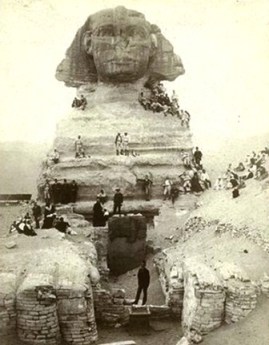
Billy Earle and the other members of the world tour

Billy Earle and the other members of the world tour at the Great Sphinx of Giza

After returning from the tour Earle joined the Cincinnati Red Stockings in the American Association. He bounced back and forth from Major League to minor league teams for the next six years. During that time, there were a number of humorous references to Earle’s interest in hypnotism, but none claimed it was an impediment to his career; however, in 1897, upon being released after one game with the Columbus Senators of the Western League the legend began.

In September of 1897, an article appeared in The Baltimore Sun under the headline, “A Haunted Ballplayer:”

“(Earle) cannot get a position on any ball team in the country, not even the small minor league teams.”

Earle told a sad story of teammates avoiding him and fearing the “hoodoo.” He even blamed his being released by Pittsburgh after the 1893 season on it, ignoring the fact that he was only signed because of injuries to the three other Pirate catchers, Connie Mack, Joe Sugden and Doggie Miller—and emergency catcher Jake Stenzel.

That 1897 story became the story of Billy Earle.

It also said:

“He is, moreover, a pleasant, intelligent, strictly temperate man.”

The first two might very well have been true. The last was not.

The rest of the story about Billy Earle has been lost, forgotten, or just ignored.

In August of 1898, The Cincinnati Enquirer told the real story of why Billy Earle had been out of baseball. The “strictly temperate” Earle was addicted to morphine.

His friend John McGraw helped get him treatment in a Baltimore hospital; his former Cincinnati teammates took up a collection to buy Earle a ticket to Philadelphia to stay with his parents after treatment.

He kicked the habit, and then for three seasons managed and played for an independent team in Richmond, Indiana; he also coached teams in Havana, Cuba during the winters of 1900 and 1902-1904. And he returned to professional baseball; hardly the profile of a blacklisted man.

Earle signed as a player/manager with the 1903 Vicksburg Hill Billies in the Cotton States League. He continued his playing career through 1906, and either managed or worked as an umpire in Midwest-based leagues through 1911.
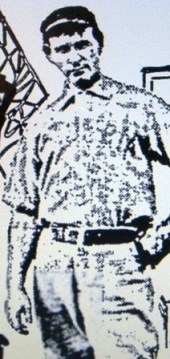
Billy Earle, player/manager Columbia Gamecocks 1905.

Billy Earle, player/manager Columbia Gamecocks 1905.

Billy Earle died in Omaha, Nebraska in 1946.

Were there some players in the superstitious world of 19th Century baseball who were uncomfortable playing with or against Earle? Probably. If he had hit .320 and not had a drug problem would he have had a 10-year or more major league career regardless of superstitions? Probably.
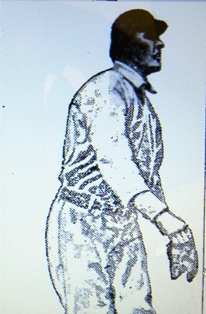
“The Man who Ate Himself out of the American League”

20 Nov

Frank Frederick Schneiberg was born in Milwaukee in 1882 (Baseball Reference lists his year of birth as 1880, but all available documents say 1882).

He began playing baseball for amateur teams in the Milwaukee city league, and after playing for the Pabst Brewery team in 1903 signed with the Springfield Hustlers in the Three-I League.  No records survive, but according to The Milwaukee Journal Schneiberg “won 19 out of 21 starts.”  He played with the Freeport Pretzels in the Wisconsin State League in 1905 and according to the Journal “won 12 straight.”

Frank Schneiberg

He won 22 games the following season with the La Crosse Pinks, which earned him a shot with the Detroit Tigers.

It didn’t go well.

Schneiberg was released to the Milwaukee Brewers before the beginning of the season.

The Associated Press said:

“He has the earmarks of a great pitcher…speed, curves, control and a pretty good collection of baseball brains…but Schneiberg was lazy…He wasn’t eager to pitch.”

The story quoted Tigers manager Hugh Jennings:

“He knows how (to pitch) but he won’t exert himself, I don’t want anybody who will not hustle.”

The Toledo News-Bee blamed his release on something else:

“He is known all over the country as the man who ate himself out of the American League.”

It is unknown whether either or both versions of his time with the Tigers is accurate, in either case, Detroit did try to claim that Schneiberg was still their property later that season when he was pitching well for the Brewers.  The claim was denied and he remained in Milwaukee.

Schneiberg pitched for the Brewers for three seasons compiling a 40-48 record.

While a fan favorite in Milwaukee, Schneiberg appears not to have been popular in at least one other American Association city.  The Toledo News-Bee accused him of being a head hunter in 1908:

“Schneiberg has the reputation of threatening to ‘bean’ batters.”

The following season The News-Bee claimed the Brewers were trying to trade the pitcher and said the team was:

“(V)ery anxious to trade the German, who does not work with any spirit, but the player is not highly regarded around the circuit.”

Regardless of the opinion in Toledo, The Brooklyn Superbas thought highly enough of Schneiberg to draft him from the Brewers at the end of the 1909 season.

He appeared in his only Major League game. On June 8, 1910, with Brooklyn trailing the Cincinnati Reds 4-0, Schneiberg relieved Nap Rucker in the top of seventh inning.  He walked four, gave up five hits and allowed 7 runs (Baseball Reference shows Schneiberg giving up eight runs, with seven earned—the box score from the game shows 7 total).

Schneiberg was lifted for a pinch-hitter in the bottom of the seventh.  Within days, he was traded to the Des Moines Boosters in the Western League.

He retired after the 1910 season, but in February of 1913 signed with the Memphis Chickasaws of the Southern Association.  He appeared in two games and was released, and in June signed with the Springfield Watchmakers in the Three-I League.  It’s unclear whether he appeared in any games with Springfield.

Frank Schneiberg 1932

Schneiberg retired to Milwaukee after the 1913 season, he became an asbestos worker and an official in the Asbestos Workers Union.  He passed away in Milwaukee in 1948.

Lost Team Photos

19 Nov

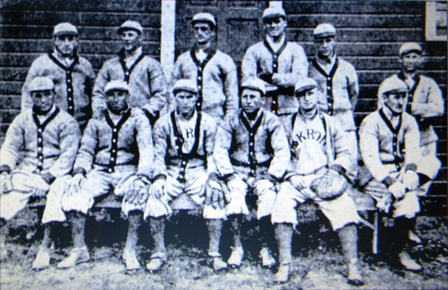
Another photo I’ve never seen published before, the 1908 Akron Champs, Ohio-Pennsylvania League Pennant Winners.

Top left to right:

Dick Breen—a minor leaguer for 12 seasons, his career overlapped with another career minor leaguer named Dick Breen—this Breen’s career came to an end in 1917, when while playing for the Reading Pretzels in the New York State League he got in a fight with Wilkes-Barre Barons  manager Jack “Red” Calhoun.  Both men were suspended indefinitely; Breen was released several days later, neither ever appeared in organized ball after that season.

Bill Speas—longtime minor league player and manager, Speas hit.284 in 22 seasons and won three Mississippi Valley League pennants as a player/manager with the Cedar Rapids Bunnies and Dubuque Dubs.

John Brackenridge—appeared in seven games for the Philadelphia Phillies in 1904, Brackenridge pitched in the Pacific Coast League from 1909-1913.

Fred “Buff” Ehman—a 6’ 4” (some sources list him an inch shorter) right-handed pitcher, the enigmatic Ehman was 81-36 for Akron from 1906-08, but according to The Akron Beacon Journal, was known for disappearing for days at a time and “sulking.” He had multiple trials with Major League clubs; according The Mansfield (OH) Daily Shield he never stuck with a team because of “his refusal to exert himself.”  Through 11 minor league seasons he won 214 games.

Wilbur Good—spent parts of 11 seasons in the Major Leagues: Joe Tinker said of him, “He is one of the fastest runners in the National League and still one of the poorest base runners.”

Edward Murphy—a light hitting catcher, Murphy played five seasons in the Ohio-Pennsylvania League.

Bottom left to right:

Bill Kommer—there is no listing for Kommer on any minor league data base.  He was left-handed pitcher who played for many amateur and semi-pro teams in Ohio during the first decade of the 20th Century;  he was released by Akron in July, there is no record of his statistics for the ’08 season.

William Hille—“Silent Bill” was a shortstop who played until 1917 primarily in the Texas and South Atlantic League.

Jim Callahan—his Major League career consisted of one game with the 1902 New York Giants; played three seasons for Akron (1906-08), was reported to have played in the Western League in 1909, but no records exist.

Matt BroderickThe Reading Eagle called him “one of the best shortstops who ever played on a minor league field,” Broderick played two games in the Major Leagues with Brooklyn in 1903—played minor league and amateur baseball for the remainder of the decade while working for Carpenter Steel Works in Reading, PA.

George Texter—one of the first players to sign with the Federal League in 1913, Texter played for the Indianapolis Hoosiers/New Jersey Pepper during the Fed’s two seasons as a Major League (1913-14).  Managed teams throughout the 1920s in the Ohio-Pennsylvania League (no longer recognized by the National Association, the OPL was nonetheless a strong semi-pro/industrial league during that period).

Cecil Armstrong—a dominant right-handed pitcher, first with the Youngstown Ohio Works team in 1905 during his three seasons with Akron (64-33 from 1906-08), Armstrong spent 1909 and 1910 with New Bedford Whalers in the New England League. Armstrong retired to Akron after the 1910 season.

Salaries–1897

15 Nov

After Amos Rusie ended his year-long holdout, the issue of salaries was, as it has been throughout the history of the game, hotly debated—some thought ballplayers were grossly overpaid during a period when the average annual salary in the United States was just under $675.

Amos Rusie

The Fort Wayne Gazette published the following in an effort to address “much questioning as to the salaries paid young players at the present time.”

According to The Gazette National League players averaged $175 to $250 a month “all the way up to $5000 for veterans.”

Other league salaries:

Eastern League: $100-$150 for young players $200-$250 for stars

Western League: $75-$150, up to $300 for stars

Atlantic League: $75-$250

Western Association: $65-$115

Southern League: $75-$100

New England League: $75-$125

Interstate League: $65-$150

The Gazette came down on the side of the players:

“It is customary to speak of the high salaries and easy lives of National League players but the kickers seldom realize that the man who now supports his little family in comfort on $300 a month—probably had to slave two years for perhaps $75 a month, $450 a year…and a probable loss of salary whenever the little league he played with disbanded in arrears.”

Joe Gunson’s Mitt

6 Nov

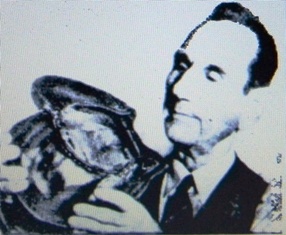
The photo above was taken in 1939.  Former Major League catcher Joe Gunson was donating the mitt he created in May of 1888 to the Baseball Hall of Fame.  Gunson caught for the Kansas City Blues in the Western League and made the mitt after a foul tip split his finger.  He told the Associated Press:

“We had a doubleheader scheduled the next day and Charlie Reynolds, who shared the catching with me, had sustained a similar injury…I got the idea to fashion some kind of glove to protect my hand.”

According to the United Press:

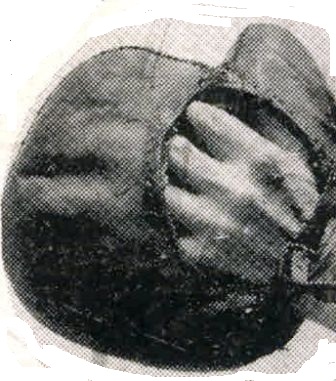
“(Gunson) improvised the mitt from a piece of leather, the belt from a Norfolk jacket, a bit of wire, sheepskin padding, and a buckskin covering.”

When Gunson died three years later the Associated Press and United Press called him the originator of the catcher’s mitt.

Over the years, other newspaper articles credited Albert John “Doc” Bushong with developing the catcher’s mitt.  In 1915, The New York Times said:

“(Bushong) wore the largest glove he could find, an added pads until it looked like a pillow…Out of bushings idea grew the idea of the mitt.”

Bushong’s glove was also mentioned in The Brooklyn Eagle in October of 1887, seven months before Gunson said he made his.

Bushong died in 1908, Gunson lived until 1942—longevity gave him a decided advantage in the number of times he was given credit for the mitt in newspaper articles during the first half of the 20th Century.

Currently, baseball historians remain split over which catcher should get the credit.

The Gunson Mitt

The debate may never be resolved. The most likely answer is that catchers in the 19th Century, who like Gunson, according to The Sporting Life, “has hands which for knots and gnarls rival the famous battered-up paws of Silver Flint,” might well have independently and nearly simultaneously developed equipment to protect their livelihood.

A Really Bad Idea

19 Oct

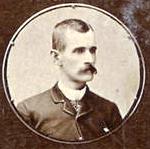
James Aristotle Hart (his middle name is incorrectly listed as Abner on Baseball Reference) was an influential figure in shaping baseball’s rules.

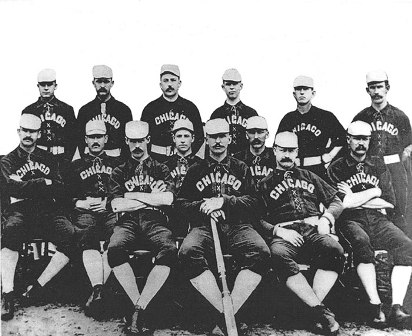
Hart managed the Louisville Colonels in 1885 and ’86.  He then purchased the Milwaukee franchise in the Western League, and helped A.G. Spalding organize the first baseball teams to go on world tours.  He returned to the National League to manage the Boston Beaneaters in 1889.

James Hart, 1886

In 1890 he went to England and Scotland to help launch a professional baseball league, and upon his return he became secretary of the Chicago Colts and served as an intermediary in the 1890 fight between the National League the nascent Players League.  He became president of the Chicago club the following year, succeeding Spalding, and served in that capacity until 1905.

The New York Times said:

“Many rules now deemed indispensable were championed by Hart.  The foul strike rule, one of the most important, was his final effort in the rule making.  He was largely responsible for…defining the coachers’ box, changing the pitchers’ box and substituting the slab, altering the shape of the home plate, requiring the catcher to play close up to the plate all the time, abolishing the foul tip and covering the players’ bench.”

One rule that Hart considered seriously enough to release to the press “with earnest request for publication and comment,” would have completely changed the game as we know it.

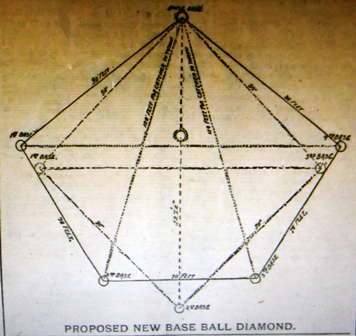
The idea, proposed by a man from Rollo, Missouri named Cliff Spencer and submitted to Hart, called for a redesign of the baseball diamond.

The Sporting Life said of the design:

“The proposed new diamond is a startling innovation, but the more it is studied the more favorably it impresses.”

The new diamond would increase the number of bases from three to four and while the distance between the bases would remain 90 feet:

“(T)he new base lines would throw first and fourth bases about ten feet further out than the present base lines. Thus making a very much larger area for fair balls.”

After several more paragraphs espousing the virtues of the new design, The Sporting Life concluded:

“No decided disadvantages are apparent in this proposed new diamond except that it may operate to the extreme in batting, base running and run-scoring.  (The) objection, could however be easily overcome by deadening the ball somewhat more should the batting become too heavy.”

The article concluded:

“The proposed new diamond, if adopted, would be a radical innovation.  But it maybe that a radical remedy is requisite to restore the base ball patient to entire health and vigor. It is generally conceded that some changes in the game are urgently needed in order to make it more attractive, to lift it out of the rut of pitcher-domination.”

Diagram of the proposed new diamond laid over traditional diamond–home plate is at the top.

Even the glowing review of the proposed plan in The Sporting Life stopped short of absolutely endorsing the idea:  “It is not intended here to advocate, either reservedly or unreservedly, the adoption of this radical innovation,” because it was conceded that there were much less radical measures that could be adopted to increase run production.

Within a week The Sporting Life, and every other newspaper who had published a story about the new diamond concept, had concluded that the idea would never be adopted.

Hart, a long time advocate of increasing run production, was not known to have ever again commented on the new diamond.

Ollie Pecord

26 Sep

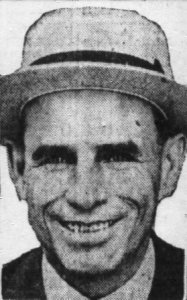
Oliver T. Pecord had a brief minor league career during the last decade of the 19th century, but for a brief time was known around the world for his pivotal role in another sport.

Born April 5, 1869, in Troy, NY, Pecord began his career in 1890 with the Flint Flyers in the Michigan League.  Pecord is credited with a .371 career average, but the available statistics appear incomplete.   For example, several newspaper accounts put Pecord with the Columbus Reds of the Western League in 1892, but there are no surviving statistics for 1892 for Pecord with any ballclub.

pecord

Ollie Pecord

After playing in the Southern Association, Western League and Eastern Iowa League (where he is credited with a .660 average, 31 for 47 in 14 games with Rock Island in 1895) Pecord left professional baseball to focus on boxing.

Pecord was a popular fighter, and while mentioned often for bouts in and around his home in Toledo, he appears to have been a journeyman and unknown outside of Ohio.  In 1900, Pecord turned his attention to work as an umpire for local semi-pro baseball leagues, managing fighters, and serving as a boxing referee.

Pecord went from a local sports figure to being known nationally when, in 1919, he was named as referee of the July 4 fight in Toledo between challenger Jack Dempsey and champion Jess Willard.

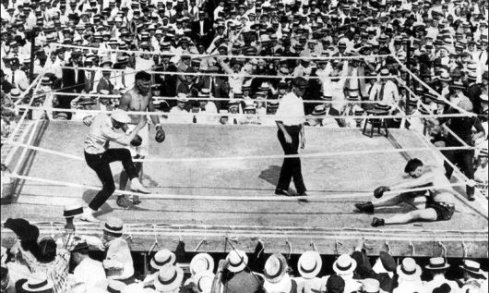
Pecord was at the center of the fight’s two controversies.  The ringside bell had malfunctioned and replaced by a whistle which Pecord, nor anyone else in the crowd, could hear.  Willard, knocked down for the seventh time in that round, was counted out by Pecord who raised Dempsey’s arm, and Dempsey left the ring.  But the round had actually ended at the count of seven; Pecord informed Dempsey’s manager Jack Kearns that the fight was not over and his fighter needed to return to the ring.

Pecord in the ring with Dempsey and Willard

Pecord in the ring with Dempsey and Willard

Willard was unable to answer the bell for the fourth round and Dempsey was declared the winner, but because Willard’s corner did not throw in the towel until after the fourth round had begun, it fell to Pecord to rule exactly when, and how the fight ended.  Two days later Pecord ruled the fight ended by a knockout in the third round.

This was not an insignificant decision because of the huge amount of money wagered on the bout—as an example, it was reported by the Associated Press that a man in Chicago who ran pari-mutual machines and a book on the fight, made $82,500 on the fight; $25,000 more than he would have made if Pecord ruled the fight over in the fourth round.

After the controversy around the fight died down, Pecord returned to relative obscurity nationally, but remained a popular figure in Toledo and served as a fight referee until the mid-thirties when illness forced his retirement.

Pecord died in Toledo on July 1, 1941.  The Toledo Blade called him “(T)he most prominent figure in sports Toledo has ever produced.”

June Cass

17 Sep

World War I cost Daniel June Cass his shot to play in the Major Leagues.

Born in Scotland, South Dakota June 25, 1894, Cass hit .336 in 28 games for the Des Moines Boosters in the Western League in 1916. After hitting .284 the following season with Des Moines Cass was purchased by the Washington Senator.

Cass joined the Senators in Augusta, Georgia for Spring Training and according to the Associated Press was set to make the Clark Griffith’s team, but for his draft status:

“Based on the fact that he is in class 1 of the draft and his number in the order of liability is so low, being in the first 400, that there is no assurance he would be able to remain with the Griffmen more than a month or two…if retained the Washington club would have to pay $3000 for Cass under the agreement with Des Moines, and the pilot (Griffith) figures it would be poor business policy.”

Although the article went on to say Cass would probably not be able to displace any of the starters, his speed alone would have benefitted Washington’s aging outfield.  (No stolen base records survive for his Western League tenure, but Cass was always mentioned as one of the best base stealers in the league in contemporaneous newspaper accounts)

Cass was returned to Des Moines and hit .327 in 24 games before reporting to Great Lakes Naval Training Station in Illinois on June 6.  Cass served the remainder of the year.

Cass returned to Des Moines for 1919 season, and got off to a good start hitting .308 and leading the league in stolen bases through 80 games.  It was also reported by the Associated Press that the Senators again had an interest in purchasing Cass.

In late July 0f 1919 Cass developed a case on tonsillitis, developed quinsy and died on July 28.

“Chief” Johnson and the “Winnebago Ban”

23 Aug

George Howard “Chief” Johnson was born on the Nebraska Winnebago (Ho-Chunk) Reservation to an Irish father and a mother who was likely only half Native American, yet like almost all players of his era with any tribal blood, he was branded “Chief.”

Johnson began his pro career at age 23 in 1909 with Sioux City and Lincoln in the Western League, after having played for several seasons with Guy Green’s barnstorming Nebraska Indians team.

Chief Johnson

Chief Johnson

Johnson constantly battled weight and alcohol issues; “The Chief is not noted for the care he takes of himself,” is how The Milwaukee Sentinel put it—but after a 23-10 record for the Saint Joseph Drummers in 1912, he was purchased by the Chicago White Sox.

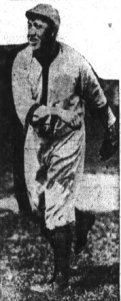
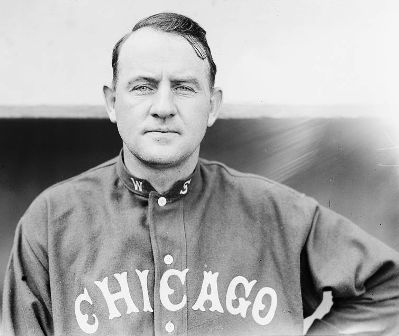
Johnson appeared destined to make the Sox pitching staff according to The Chicago Tribune and Chicago Examiner, but was released before Opening Day by the Sox and signed with the Cincinnati Reds.  His release by Sox Manager Jimmy “Nixey” Callahan was explained the next season in several newspapers, including The Milwaukee Journal:

“The Chief…had shown ability and class; he had behaved well, but when Callahan learned that he was a Winnebago he decided to turn him away.”

The story, a tour de force of early 20th-century bigotry, went on to say:

“For many years the Winnebago tribe has been under a blacklist by all circuses, Wild West shows and film companies.  There are plenty of Winnebagoes, very conveniently located; they are fine-looking people, and, as a rule educated, so they would be the finest material for show purposes.  Nevertheless, the reputation of the tribe for love of firewater has been such that managers shun their reservation, and they can’t get work in the professions which yield big wages to the Sioux, Pawnees and Chippewa’s.”

White Sox Manager Jimmy “Nixey” Callahan

I’ll include another chapter in George Johnson’s short and eventful life next week.