Archive | December, 2012

“Nature Boy” Williams

31 Dec

natureboy

By the time James “Nature Boy” Williams joined the Indianapolis Clowns in 1955 the team had become a full-time barnstorming attraction, having dropped out of the Negro American League which itself was in its death throes.

Later that season The Washington Afro-American said:

 “Williams already has become the fans’ number one idol.  His side-splitting antics and peculiar catches around first base have won rave notices.”

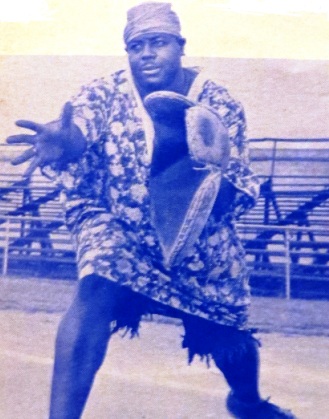
The 6’ 2” 220 pound Williams spent more than a decade with the clowns and was known for batting barefoot, playing with the large glove–as pictured–and dancing at first base with umpires.

Jet Magazine reported in 1964:

“Williams played the entire 1963 season with his right eye completely blind due to an off-season accident and without even his teammates knowing his condition.”

natureboywilliams

The Clowns played their last full season of tour dates in 1988, the team officially disbanded after playing a few games in 1989.

Williams died in Maryland in 1980 at the age of 50.

“Bugs” and Trains

28 Dec

Arthur “Bugs” Raymond was one of the most talented pitchers to end his career with a sub .500 (45-57) record.  Known more for his drinking problems and erratic behavior, Raymond was dead by 30.

John McGraw, the only manager who even for a short time, managed to get the best out Raymond, told sportswriter Grantland Rice that he had the best motion he’d ever seen and “Even half sober Raymond would have been one of the greatest.”

Rube Waddell, whose eccentricities were the standard by which all players of his era were judged, weighed in about Raymond, saying about Bugs something he could have said about himself:

“It’s a shame that fellow doesn’t take care of himself.  He would be a wonder if he would just keep in condition and pay strict attention to business.”

Bugs Raymond

Bugs Raymond

While Waddell was fascinated with fire and on many occasions assisted fire fighters (although there is no evidence supporting the long-held myth that Waddell left the mound during a game to follow a fire wagon), Raymond was enamored of trains.

According to the Hall of Fame sportswriter Hugh Fullerton III Raymond loved trains:

“The moment he enters a sleeping car he begins to take possession of the train and it isn’t long until he’s captured it.  Usually he begins by borrowing a blue coat with brass buttons and a uniform cap from some trainman or porter who admires baseball players, and arrayed in these he saunters through the train trying to collect fares, issuing orders and generally enjoying himself.”

Fullerton wrote about a 1907 road trip:

“(R)ushing through the darkness in two sections.   The St. Louis Cardinals were traveling in the rear car of the first section and the other section was following five minutes behind.  Suddenly there was a jarring of the brakes, the shrilling of air, the jar of sudden stoppage, and the second section jolted to a sudden standstill shaking sleepers out of their berths and awaking everybody.”

According to Fullerton the sudden stoppage and near accident of the following train was explained in the report issued several days later by the railroad:

“Raymond, who was looking for amusement, had stationed himself on the rear platform of the first section and amused himself touching off the red flare which is carried for use as a warning s and danger signals…the second section saw the warning and stopped.”

Hugh Fullerton

Hugh Fullerton


Anger Management

27 Dec

Thomas Timothy “Tim” Flood just couldn’t control himself.

Flood was a solid infielder and somewhat erratic hitter.  As a 17-year-old he hit .364 with the New Orleans Pelicans in the Southern Association in 1894 but hit .266 in his minor league career and .233 as a Major Leaguer.

He had a late season 10-game trial with his hometown St. Louis Perfectos in the National League in 1899.  He was given his next shot in the National league in 1902 when he was signed by Ned Hanlon’s Brooklyn Superbas to fill the void left at second when veteran Tom Daly jumped his contract to join the Chicago White Sox.

Flood was an upgrade in the field, and while a weaker hitter than Daly, he quickly became a favorite of Hanlon who named him Brooklyn’s captain for the 1903 season.
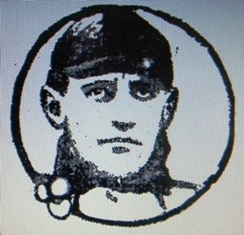
Tim Flood

Tim Flood

1903 was not a good season for the new captain; he continued to struggle at the plate and dealt with a knee injury that limited him to 84 games.  He was also suspended for two games in July for a physical altercation in Cincinnati with umpire James “Bug” Holiday.  Holiday, a former Major Leaguer had a stormy half season as a National league umpire and resigned several days after tangling with Flood.

Flood was released by Brooklyn in March of 1904 and joined the Los Angeles Angels in the Pacific Coast League.

He was a very popular player in Los Angeles and captained the Angeles in 1904 and part of 1905 until he assaulted Ira “Slats” Davis, another former Major Leaguer turned umpire during a game in June of 1905. Eugene Bart, president of the league suspended flood indefinitely.

Newspapers reported that Flood said he would “never fight another arbitrator whether he is in the right or wrong.”

In 1906, he signed with the Altoona Mountaineers in the “outlaw” Tri-State League, where he appears to have kept his pledge and had an incident-free season.

In 1907, he joined  the Toronto Maple Leafs in the Eastern League and managed to play 29 games before he was in trouble again.  Flood assaulted an umpire named John Conway during a game in Toronto; the attack included a kick to the umpire’s chest.

Flood was arrested.

He was charged with assault and ordered to appear in front of a magistrate. Friends told Flood the hearing would be a formality and that he should plead guilty and receive a small fine.

No one told Magistrate George Taylor Denison who said, “This sort of thing must be discouraged,” and sentenced Flood to “Fifteen days in jail with hard labor.” At the same time Patrick Powers, president of the Eastern League, banished Flood from the league.

Toronto fans were outraged and immediately began circulating petitions which “included the names of several clergymen” and were presented by team officials to Minister of Justice Allen Bristol Aylesworth in hopes of getting Flood pardoned.

Opinions of the punishment varied.  Several newspapers carried the following poem which lamented Flood’s fate for “Sassing” an umpire:

“’Holy Moses!’  In Toronto

There is news to make you pale

Sass the umpire if you want to—

That is, want to go to jail!

There is woe among the batters,

As around the field they scud;

And their pride is torn to tatters

By the fate of poor Tim Flood

Fifteen days in jail for Timmy

Soon the parks will close so tight

That you couldn’t with a jimmy

Let in one small streak of light.”

Others, including two former players, said Flood got what he deserved and implied that his behavior was not limited to the three well-publicized incidents.

Charles “Count” Campau, a former Major Leaguer and umpire, who had been a teammate of Flood’s in New Orleans said:

“I am sorry to see anyone go to jail, but, for the good of baseball. I am glad to see Tim Flood out of it for good. Rowdies of the Flood type are a disgrace to any sport or business, and especially baseball. He was always mixed up in just this way and was chased out of California, where b« was playing, for the same kind of tricks. Umpire baiting was always his long suit, and, from what I can understand, his attack on Umpire Owens [sic] was a most cowardly one: Flood is a good ballplayer, but his hasty temper, his meanness has put him out of the game forever, and incidentally Into Jail.”
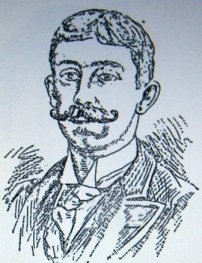
Charles "Count" Campau

Charles “Count” Campau

Tim Murnane, Major Leaguer turned baseball writer said:

“Tim Flood has a new record, and will now be in a position to go back to his trade and give up the game he was unfitted for.  The courts all over the country should follow the example of the Canadian judge, who sent a ballplayer to lock-up for assaulting an umpire.  It wouldn’t take many decisions of this kind to drive the bad men out of the sport.  Imagine a player taking a running jump at a man and hitting him in the breast with his spiked shoes!”
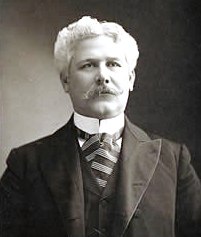
Tim Murnane

Tim Murnane

After serving 10 days, Minister of Justice Aylesworth ordered Flood released.  The player, in various reports, claimed he lost between 10 and 16 pounds during his incarceration, citing the poor quality of the food.

President Powers rejected pleas from the Toronto management to reinstate Flood and permanently banned him from the Eastern League; however, contrary to Campau’s and Murnane’s wishes, Flood was out of baseball for less than a month.

Flood was signed before the end of July by the Saint Paul Saints in the American Association and vowed, as he had before, that he was a changed man.

It appears 10 days in jail might have made a difference.  Flood was named manager of the Saints in 1908 and continued to play and manage in the minor leagues for five more seasons, apparently without incident.

In 1914, The Sporting Life reported, with no irony, that Flood was hired as an umpire in the Northern League.

Flood died in St’ Louis in 1929.

A Thousand Words—Home for Christmas

25 Dec

japantour

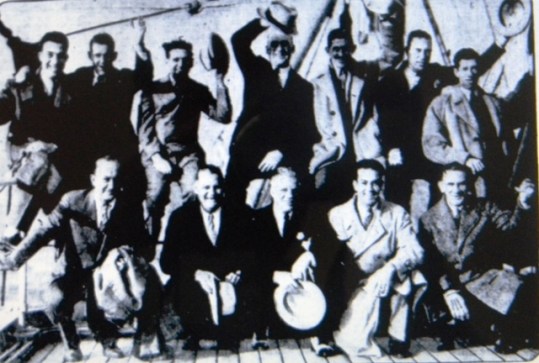
Members of the 1931 Tour of Japan delegation of Major League stars arrive in San Francisco two days before Christmas.  They were greeted on arrival by Ty Cobb:

Back Row: Al Simmons, Larry French, Muddy Ruel, Ralph Shinners, Mickey Cochrane, Lefty O’Doul, Lefty Grove.

Front Row: Ty Cobb, Leonard Knowles (New York Giants trainer), Herb Hunter (former minor league player who organized this and several earlier tours of Japan), Bruce Cunningham and Rabbit Maranville.

A Thousand Words–Harpo Marx

24 Dec

harpo

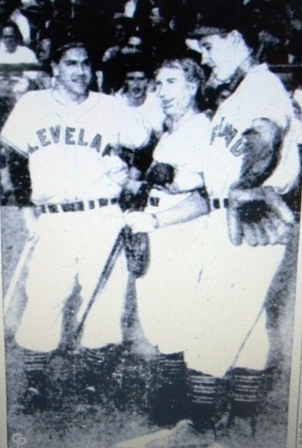
Harpo Marx with manager Lou Boudreau and pitcher Bob Feller at the Cleveland Indians’ training camp at Randolph Park (now Hi Corbett Field) in Tuscon, Arizona, March 1947.

Zimmer and The Players Protective Association

21 Dec

Charles “Chief” Zimmer made one more important contribution to the game as founding member and first president of the Baseball Players Protective Association.

When the organization was formed in June of 1900 Zimmer said:

“The players realize that the sport needs a stirring up, and will cooperate with the club owners in the good work.”

In retrospect it was an admirable, but naive statement.

Nearly 100 players attended the first meeting and elected Zimmer.  Hughie Jennings was elected secretary and William Clarke treasurer.  The attorney for the Association was former Major Leaguer Harry TaylorClark Griffith was later name vice president.

In December the association presented their five point plan to the owners:

  1. “Club owners (would) mot have the right to ‘reserve’ players at a salary less than that provided for the ensuing year, nor for more than three years.”

  2. “Not to buy, sell, assign, trade lend, accept, select or claim service of any player for any period in any way without his written consent.”

  3. “Club owners to pay physicians’ fees for injuries received in actual play.”

  4. “No player to be suspended without pay more than three times a season or two weeks at a time.”

  5. “The appointment of a committee of arbitration, one member to be chosen by the owners, one by the players, and a third (agreed upon to mediate disputes)”

The demands were met with silence.  The Baltimore Morning Herald said:

“Club owners will hardy accede to the requests—no communication yet established with the new organization.”

Part of the reason the association was largely unsuccessful was because early on it was made known they would do nothing to leverage their demands.  Harry Taylor told The New York Times:

“Well, this is a conservative organization.  There is nothing revolutionary about it, and we don’t propose to keep men from playing ball.”

While some short-term gains were made as a result of the creation of the American League as a Major League in 1901, allowing players to jump contracts for terms from AL clubs, the association was all but broken after the American and National League’s made peace in 1903.

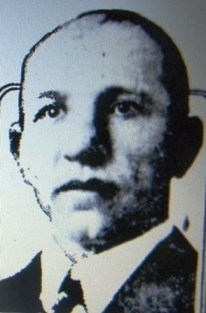
Charles "Chief" Zimmer

Charles “Chief” Zimmer

It would be more than 50 years before players again seriously considered taking collective action, but Zimmer’s organization provided one of the early, small steps to challenging the reserve clause.

Zimmer Rules

20 Dec

After Charles “Chief” Zimmer’s single, difficult season managing the Philadelphia Phillies he briefly became a National League umpire.

Reports said the adjustment from player and manager to umpire were difficult at first.  According to a brief story that appeared in several newspapers on the eve of Opening Day:

“Chief Zimmer umpired the Pittsburgh-Little Rock game last week, but he could not resist coaching the players, for he forgot himself once in the third inning and yelled ‘Look out!’ to (Tommy) Leach when Little Rock was trying to catch him off first.”

But by May he seemed to have eased into his new position, telling reporters:

“I hesitated about taking up the work, knowing that the life of an umpire is supposed to be filled with anything but joy.  However, I can honestly say that I am more than pleased with the experience thus far.  I have had no trouble at all, and players and spectators have accorded me the best treatment.  I don’t think I’d give up my present work to go back to catching.”

In September The Pittsburgh Press said there was “No doubt (Zimmer) will be reappointed,” as a National League umpire in 1905, but by January it was announced that he had not been retained.

Zimmer entertained offers to play for the Toledo Mud Hens of the American Association and the Rochester Bronchos of the Eastern League, but instead took a position as an Eastern League umpire.

He returned as a player/manager the following season with the Little Rock Travelers in the Southern Association.

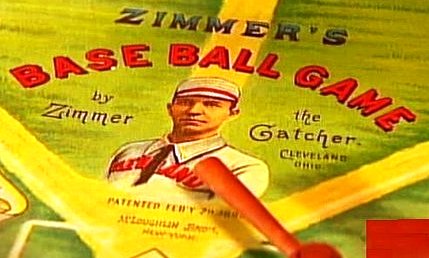
Through it all Zimmer was one of baseball’s earliest and best self-promoters.  In addition to endorsing Zimmer’s Baseball Game and his cigars, produced in what The Sporting Life said was “an extensive cigar factory in Cleveland.”  Zimmer always talked to reporters and always gave them something to write about, including his ideas for rule changes.

Zimmer's Baseball Game

Zimmer’s Baseball Game

In 1905 The Pittsburgh Press said “’Chief’ Zimmer has a scheme which he thinks would increase batting without abolishing the foul strike rule.” (The “scheme” was not Zimmer’s idea; it had been advocated by some for more than two decades, including “Cap” Anson and Zimmer’s former boss, Cleveland part owner Davis Hawley).  The plan would:

“Increase the territory of the fielders without increasing the length of the base lines…new foul lines (would be) drawn from the home plate to the fences.  At the point where they would pass first and third bases the lines would be six feet distant from the bases, gradually increasing the distance from the present foul lines as they neared the fences.”

Later he can out in favor of abolishing the foul strike rule when the issue was briefly discussed in the aftermath of the relatively low-scoring 1905 World Series.

In 1909 Zimmer suggested another rule; this one would essentially eliminate intentional walks by allowing any man on base to advance one base after a walk.  Zimmer said:

“It’s not right for a pitcher to take away Lajoie’s chance of hitting by walking him when there are men on bases.  I saw Larry passed four times in two games last fall.  He was paid to hit with the men on bases…Pitchers would have to put the ball over and the good batters would get a chance to do what they are paid for.”

Luckily like most of the other odd rule changes suggested during baseball’s first several decades, Zimmer’s “schemes” received little traction as both would have radically altered the game.  But Zimmer’s rules did succeed in accomplishing what they were most likely intended to do: they kept Zimmer’s name in the paper long after his career was over.

A final post on Zimmer and, perhaps, his greatest contribution tomorrow.

Chief and Cy

19 Dec

Charles “Chief” Zimmer caught Denton True “Cy” Young’s first Major League game; an 8-1 victory for the Cleveland Spiders over Cap Anson’s Chicago Colts.

Years later, Davis Hawley, a Cleveland banker and hotel magnate who also owned a minority share of the Spiders and served as the team’s secretary, related a story about Young’s debut:

“The night of Young’s first National League game, he complained to me that although he had let Anson’s team down with a few hits, he had not had his usual speed.”

Hawley who had watched him pitch in the Tri-State League asked why he felt that way.

“Well, down in Canton the catchers could not hold me I was so fast, but this man Zimmer didn’t have any trouble at all, so I guess I didn’t have much speed.”

Zimmer would go on to catch 247 of Young’s starts through 1898, including 19 shutouts; second in both categories to Lou Criger, who played with Young in Cleveland, St. Louis and Boston.

Zimmer would catch Young a few more times after 1898.

In 1921 the 54-year-old Young pitched two shutout innings, with the 60-year-old Zimmer catching, in a game between Cleveland Major League legends and amateur stars staged as part of Cleveland’s 135th anniversary celebration.  In addition to Young and Zimmer, Nap Lajoie, Earl Moore, Bill Bradley, Charlie Hickman, Nig Cuppy and Elmer Flick were among the participants.

Earl Moore, Cy Young, Bill Bradley, Charlie Hickman, Nap Lajoie and Chief Zimmer at the 1923 game.

Earl Moore, Cy Young, Bill Bradley, Charlie Hickman, Nap Lajoie and Chief Zimmer at the 1923 game.

The game was such a success that for the next four years it became an annual event at League Park (called Dunn Field during the 1920s); Young pitched the first two innings of each game with Zimmer catching. The event benefited the Cleveland Amateur Baseball Association medical fund.

Young always shared credit for his success with his catchers.  In the 1945 book “My Greatest Day in Baseball As told to John P. Carmichael and Other Noted Sportswriters,” he said:

“Every great pitcher usually has a great catcher, like Mathewson had Roger Bresnahan and Miner Brown had Johnny Kling. Well, in my time I had two. First, there was Chief Zimmer, when I was with Cleveland in the National League, and then there was Lou Criger, who caught me at Boston and handled my perfect game.”

A little more “Chief” tomorrow.

Elton Chamberlain

17 Dec

Elton Chamberlain (for the last thirty years always referred to by the nickname “Icebox,” but that name was not in common use for him contemporaneously; although he was called Iceberg fairly often.) was primarily known for two things: A righthander, he pitched ambidextrously in at least one game, and on May 30, 1894 he gave up four home runs and a single to Bobby “Link” Lowe—17 total bases, a record which stood for 60 years.

He was also embroiled in one of the early controversies over gambling while playing for the Cincinnati Reds in 1893 when he was accused by his manager, Charles Comiskey, of throwing the first game of a July 4 doubleheader against the Philadelphia Phillies.

The Cincinnati Enquirer said:

“Pitcher Elton Chamberlain of the Cincinnatis is accused of throwing the game to the Philadelphias yesterday morning. He is charged with being in league with Joe Brill, a local gambler.”

The story said Comiskey, notified of the allegation:

“(D)ecided to investigate (and) after a consultation with a club official, put Chamberlain in for three innings to watch him. Chamberlain’s pitching was very bad and be was taken out of the game in the third inning.”

Chamberlain’s teammates Jim Canavan and Silver King quickly came to his defense. King said he thought he would be the starting pitcher, not Chamberlain, until just before the game started; therefore Brill and Chamberlain could not have conspired.

Chamberlain said of the story:

“It was cruel and cowardly to try to ruin a man like that.”

The Sporting Life ripped The Enquirer and Comiskey:

“This is not the first time The Enquirer has accused ball players of dishonesty, and once it got into and lost a libel suit with Tony Mullane for accusing him of crookedness. Comiskey in his time has also made similar charges and Insinuations against guiltless players.”

The New York Herald said “The whole affair was so silly,” and seemed to have Comiskey in mind with this statement:

“The club official who suspends a player on the charge of dishonesty should be made to prove his charges or himself be forever barred from further connection with any club.”

The Herald also recommended that steps be taken to officially clear Chamberlain and punish those who accused him:

“The National Board should at once take up pitcher Chamberlain’s case and investigate it beyond the limit of doubt and when they reach the facts, whatever the facts; someone should be made to suffer.”

Cincinnati’s management, Comiskey included, quickly repudiated the charges that appeared in The Enquirer, although from all indications they were directly responsible for the charges being reported in the first place.

Elton Chamberlain

Elton Chamberlain

The headlines of July faded by August; there was no official investigation and no one was “made to suffer.”

Charles Comiskey

Charles Comiskey

Chamberlain finished the season with a 16-12 record and his 3.73 ERA led the Reds’ pitching staff. The following year was his last full season in the Major Leagues.

In 1895 he played for the Warren (PA) franchise in the Iron and Oil League. The team won the pennant behind the pitching of Chamberlain and another former Major Leaguer, Tom Vickery.

They also had a 21-year-old shortstop named Honus Wagner.

No statistics survive for that season, but forty years later Wagner, writing for The Pittsburgh Press, said Chamberlain “Seldom lost a ballgame for us,” and that Chamberlain and Vickery “gave out plenty of their knowledge to us youngsters.”

Chamberlain bounced around minor and semi-pro leagues after one last Major League trial with the Cleveland Spiders in 1896. In 1898 he accepted, then rejected, an offer to serve as a National League umpire. After turning down the umpire job Chamberlain, a Buffalo native, said he would become a professional boxer and challenged a local middleweight named Jack Baty to a fight that would include a $500 side bet. Baty’s fight record indicates the bout did not take place.

Chamberlain attempted to resume his baseball career with the Buffalo Bisons in the Western League in 1899—by July he was released and The Sporting Life reported that Chamberlain, a rabid horse player “is once more following the races.”

Chamberlain Died in Baltimore in 1929.

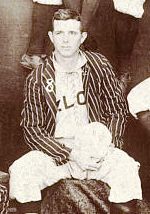
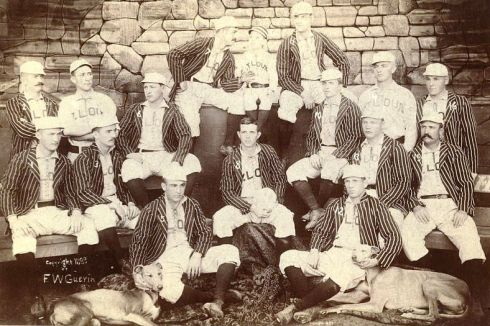
Chamberlain and Comiskey as teammates with the St. Louis Browns.  Chamberlain is 5, Comiskey 8.

Chamberlain and Comiskey were also teammates with the St. Louis Browns. Chamberlain is 5, Comiskey 8.

A Thousand Words–“The Wonderful Country”

13 Dec

satch

Leroy “Satchel” Paige talks baseball with local children in Mexico on the set of the 1960 movie “The Wonderful Country.”  Robert Mitchum and Julie London starred; Paige played Cavalry Sgt. Tobe Sutton.

It was Paige’s only real acting role (He made a cameo appearance as himself ten years earlier in “The Kid from Cleveland“),  and it’s a pretty good film.

Satchel Paige as Sgt. Sutton

Satchel Paige as Sgt. Sutton