Archive | May, 2014

Lost Advertisements–“Lajoie Endorses Heptol Splits”

9 May

lajoieheptol

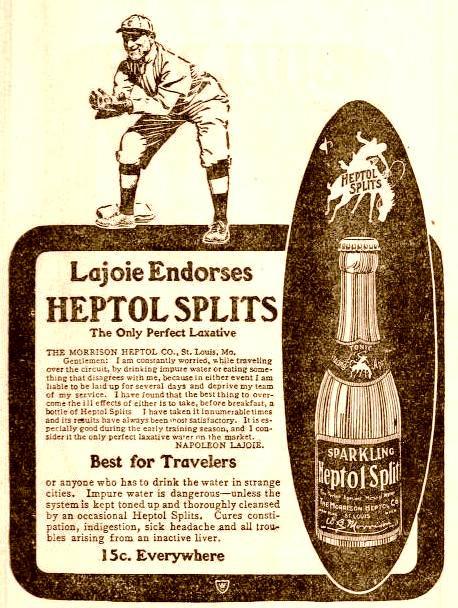
Cleveland Naps second baseman Napoleon Lajoie appeared in as many advertisements as any of his contemporaries during his career, including one for a “sparkling laxative.” This is a 1906 advertisement for Heptol Splits “The only perfect Laxative.”

“Gentlemen:  I am constantly worried, while traveling over the circuit, by drinking impure water or eating something that disagrees with me, because in either event I am liable to be laid up for several days and deprive my team of my service.  I have found that the best thing to overcome the ill effects of either, is to take, before breakfast, a bottle of Heptol Splits.  I have taken it innumerable times and its results have always been most satisfactory.  It is especially good during the early training season, and I consider it the only perfect laxative water on the market.”

The image of the cowboy on the bronco used for Heptol Splits’ logo was created by artist Charles Marion Russell.

Lajoie’s endorsement does not appear to have done much good for the brand which appears to have disappeared from drug store shelves within a couple of years.

A version of the advertisement appeared in the inaugural, 1906 edition of Napoleon Lajoie’s Official Base Ball Guide— an attempt  to compete with the Spalding and Reach Guides.

The 1906 Lajoie Guide

The 1906 Lajoie Guide


The Cleveland Press said upon the publication of the 1906 guide:

“”Lajoie’s Guide is especially interesting because it is the first work of this kind that has ever been attempted by a ball player while still in active service on the diamond…Lajoie is the champion batsman of the world and a great authority on the national game.  His book should find a ready sale.”

When Lajoie’s Guide ceased publication after the 1908 edition The Press said:

“After two years as editor of the American League Publishing Company, getting out the Lajoie Guide, he declares the others are too strong for competition, and only farm life for him in the winter months from now on.”

Miah Murray

7 May

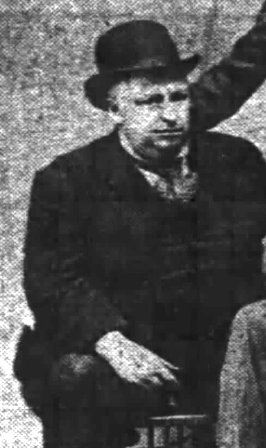
Jeremiah “Miah” Murray appeared in only 34 major league games, with four teams between 1884 and 1891.  In 31 games a catcher, he made 29 errors and was charged with 28 passed balls.

During that short career, he also became the subject of two stories which highlighted his shortcomings behind the plate.  Both stories appeared after the fact, so are subject to the usual caveats of 19th-century baseball stories.

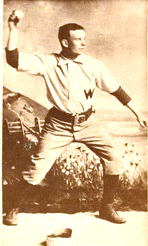
Jeremiah "Miah" Murray

Jeremiah “Miah” Murray

In 1894 The New York Sun wrote about the most embarrassing episode Murray’s career—said to have taken place during his rookie season, 1884:

“(Murray) tells about a game he once caught in at Buffalo when he was a member of the Providence team.  There were three men on bases and he threw to (Jerry) Denny to catch a man napping, but the ball never got there.  It hit Jim O’Rourke, who was the batsman, on the side of the head and bounded into the grandstand, three men scoring and winning the game for Buffalo.  Jim staggered and cried out with pain, but the crowd simply cried with glee, O’Rourke’s hurt being entirely lost sight of in the enthusiasm.”

Murray’s manager during that 1884 season was Frank Bancroft who led Providence to the National League championship and a three games to zero victory over the New York Metropolitans of the American Association earning for the first time the title “World Champions” from The Sporting Life.

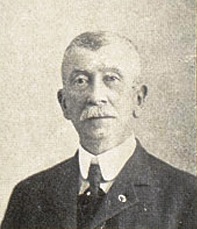
Frank Bancroft

Frank Bancroft

Bancroft compiled a 375-333 record over parts of nine seasons as a big league manager, before becoming an executive with the Cincinnati Reds.

It was while serving as the Reds’ Business Manager that Bancroft related another story about Murray’s brief time with Bancroft’s championship team.  The story first appeared in The New York  American in 1915:

“’Take it from me,’ said Frank Bancroft, while some of the fans were discussing famous bonehead plays, ‘the old timers pulled some bones that had all you youngsters blocked off the map.  Best I recollect, right now, was sprung by Miah Murray when he was catching for me…With a runner on first Miah steamed back to the stand a made a magnificent catch of a foul fly.  The crowd broke into roars of applause; Murray, leaning against the stand, took off his cap and bowed right and left—and the runner, sizing up the situation, lit out from first, kept right on going, and came all the way around while Miah kept bowing and the rest of the team were screeching and raving, all in vain.”

Murray later became a National League and college umpire; he was also a prominent boxing promoter and matchmaker in Boston where he operated the Lincoln Athletic Club of Chelsea, and later the Armory Athletic Club.  He died in Boston in 1922 at age 57.

Bancroft retired as business manager of the Reds in January of 1921; he died two months later at age 74.

Tragic Exits 2

5 May

Charles Rapp

Charles “Adonis” Rapp was a left-handed pitcher (he also played first base and outfield) who began his career with the Austin Senators in the Texas League in 1898.  For the next several years he played for a variety of Midwest based clubs (Fort Wayne, Saginaw, Grand Rapids) in the Interstate and Michigan State Leagues.

Contemporary newspaper reports say he was also a member of the South Bend Greens in the Central League, but he is not listed on any surviving rosters; he was also said to have been “tried out by Milwaukee, when that city was in the old Western League (1903).”

Rapp’s trail goes cold after the 1903 season until 1909.  Rapp was living in his hometown of South Bend, Indiana.  The Indianapolis News reported on May 17:

“Charles Rapp, former ball player, and well known throughout the city, killed his mother late Saturday and then committed suicide.  The weapons used were a hammer, a dull paring knife and a small pair of shears.  It is said that Rapp had a tendency towards insanity, that the tendency had been marked during the last few days and that he undoubtedly deranged when he attacked his mother.

“Rapp did not die until several hours after the double crime had been committed and after he had been removed from the Rapp home to the St. Joseph County Jail.  Before death came, and in reply to a query about the crime, Rapp said: ‘I tried to get the whole family.’

“The last person to see Mrs. Rapp alive and the first one to discover the body of the woman and the dying son was Charlotte Benz.  Mrs. Benz had spent the day at the Rapp home and left the house late in the afternoon…On her return she stopped at the Rapp place, entering by the rear door…and then suddenly a sickening sight met her gaze.  Lying in a pool of blood at one side of the sitting-room were Rapp and the body of the mother.  The heads were close together and as Mrs. Benz entered the young man cried out: ‘Get out of here, Lottie, get out of here.’  It was evidently his intention to kill the Benz woman, but Rapp was unable to move from loss of blood.”

The Associated Press said of the incident:

 “Until Rapp fell a victim to the liquor habit he was one of the most popular young men in the city.”

Henry Long

Henry Long was born in Chicago in 1870 or 1871 (cemetery and death records disagree), he was the younger brother of  Herman who had a 16-year big league career.
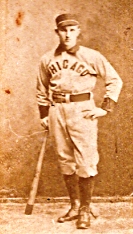
Herman Long

Herman Long

Little is known about Henry’s early life, or when exactly he began playing professional baseball.  Based on newspaper reports he appears to be the “Long” who played with the Battle Creek Adventists in the Michigan State League in 1895.

Before the 1896 season he was signed by the Lewiston team in the New England League.  The Lewiston Daily Sun said:

“Manager (Michael) Garrity has signed pitcher Henry Long of Chicago, a brother of Herman Long of the Bostons, and is said to be a good pitcher, a hard hitter and a good all-around man.”

Long didn’t last in Lewiston, he was 0-2 in just three games before he was released.  Long then appeared in one game for the Shamokin Actives in the Pennsylvania State League, and then joined the Hagerstown Lions in the Cumberland Valley League.

The right-handed pitcher started seven games for the Lions and was 4-3 with a 1.29 ERA.

On July 10 he missed the team’s train for a game in Hanover, Maryland.  The Philadelphia Times said he attempted to hop a freight train and fell; his right arm was crushed under the wheels.  His arm was amputated “but Long sank rapidly and died in the hospital” in Hagerstown.  While contemporary news reports said the body was to be shipped back to Chicago, where it would be “received by his brother Herman,” he was instead buried in Maryland

Matt Barry

In 1900 The Sporting Life said Matthew “Matt” Barry had been “the first player from Rhode Island to receive money for playing ball.”

Information on where he played is sketchy—he was the Rhode Islands in the New England League in 1877 and Springfield (MA) of the International Association in 1878–but beyond that, there are few references to where he played during his career.

The Providence News-Democrat called Barry, who was born in Providence in 1850, a “well-known ballplayer and one of the best-known members of the sporting fraternity in the state.”

Barry eventually returned to his hometown, Providence where he operated the Empire Saloon, on Empire Street.

After the turn of the century, Barry suffered a series of financial setbacks.   On August 30, 1907 The News Democrat said:

 “(Barry) attempted suicide by inhaling illuminating gas in his room in the Essex house, at 23 Burrill Street.”

Barry was discovered by the owner of the house:

 “The room was locked, but the door was forced, and then Barry was seen unconscious on the bed with gas streaming from an open unlighted jet…as Barry’s usual custom was to sleep with all the windows open , the fact that they were closed , indicated that he had prepared to take his life.”

He was taken to Rhode Island, where he died on September 2.

Barry’s friends disputed the story that he had taken his own life, claiming his “financial embarrassments” had been overstated and that he “was in better condition financially than he had been for years.”  His friends instead said Barry, who “had been troubled with insomnia” and took morphine to sleep, turning off the lights “at that time the morphine would begin to get in its work,” had accidentally turned on the gas when he meant to turn off the light “which was on the same chandelier.”

The cause of death was never officially determined.

“Why don’t you make Latham keep still?”

2 May

After winning the first three games of the 1894 season, the Cincinnati Reds dropped six of their next seven.  The Cincinnati Enquirer’s Harry Weldon said most of the players weren’t “fighters.”

“To be a ‘fighter’ in the sense that this term is applied in baseball does not necessarily mean that you must be a leg breaker, a rib crusher or indulge in billingsgate or profanity to your opponent.  It simply means that your mind must be on the game every minute and every second while it is in progress.  It means that you must watch every movement and point and be alert for any opening, however small.

“The Reds are as gentlemanly a team as there is in the league, and it is to their credit that they are so; but there is such a thing as carrying the matter too far.  There is an old adage about ‘fighting the devil with fire’ that some of our local players would do well to follow.  This advice is apparent.  There are times when ‘Excuse me please,’ and ‘I beg your pardon,’ won’t do.  The men to whom they are addressed don’t know what that sort of language means.  In other words, when you are in Rome do as Romans do.”

Weldon said some players were critical of the behavior of Reds third baseman Arlie Latham.  Latham was a Weldon favorite; the two had been friends since Weldon served as secretary for St. Browns President Chris Von der Ahe while Latham played there:

Arlie Latham

Arlie Latham

“There are a few growlers and soreheads who find fault with Latham for talking too much.  I cannot sympathize with such criticism.  Latham does not coach because he likes it or to be ‘funny’ and ‘work the grand stand,’ as many of his detractors would have people believe it.  I once heard one of the soreheads say to Captain (Charlie) Comiskey: ‘Why don’t you make Latham keep still?’

“’Do you want me to put him out of the game?’ replied the Reds’ captain.

“’No, I only want you to make him stop talking.’

“’Well, if I did that, he might as well be out of the game, for he would lose his interest.’

“Every word of this is true.  Latham is too much interested to keep still.  Hardly a ball is pitched in the game by the Reds’ pitchers that Latham from third base doesn’t have something to say.  Scarcely a movement is made at the bat, on the bases or the coaching lines that Latham doesn’t deliver some wordy instructions.

“He is in the game from start to finish.  He couldn’t be funny ‘to order’ to save his life.  The ludicrous and witty sallies he makes from the coaching lines just bubble out of him.  He doesn’t ‘day dream’ or ‘build air castles’ while a play is in progress as some players do.

“His mind is right on the business on hand.  He is a fighter all over.  There are others on the Cincinnati team who would do well to follow his example.  The Pittsburghs and Clevelands are examples of what fighters can do.  Every member of those teams was in the game all the way through when they were here.  Not a play occurred that they were not on their feet hustling and shouting.  The Reds should fall in beside (Latham) from now on and back him up with spirit and noise.

“Nothing pleases a crowd of local enthusiasts more than a scrappy game.  If you have got to go down, boys, do it with all your banners flying.  Fight it to the last-ditch, and then if you are whipped you’ll know how it occurred.”

Harry Weldon

Harry Weldon

The Reds never started fighting in 1894, and finished in tenth place with a 55-75 record; it was Comiskey’s final season as a major league manager, and his least successful.  The following year he purchased the Sioux City franchise in the Western league, and moved the team to St. Paul.

Latham, who hit .313 in 1894, had his final productive season the following year, hitting .313 for an improved Reds club (66-64) managed by William “Buck” Ewing.

Weldon was sports editor of The Enquirer until he suffered a stroke in February of 1900 at age 45, he died two years later.  Ren Mulford Jr., who succeeded Weldon as editor said:

“No more forceful writer on sports topics ever played upon the keys of a typewriter.”