Archive | January, 2015

Boston’s Horseshoe

9 Jan

Boston Beaneaters Manager John Morrill told The Washington Star in 1886:

“Yes, sir, it’s a fact, that professional ball-tossers are as a rule very superstitious.  It is nothing more than natural though, and is not as much due to the ignorance of the men as is sometimes supposed.  You see, so much chance enters into every game of ball that the boys who play game after game gradually become impressed with the belief that they can read in advance certain signs or omens which will have more or less effect upon their individual play, if not upon the result of the game.”

John Morrill
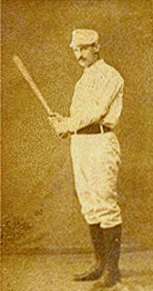
John Morrill

Morrill said that “on the whole” he thought his player’s superstitions were “a very good thing,” as long as “bad signs do not outnumber the good one.”  Morrill felt players were more inclined to look for good signs, which would encourage them to play “with more confidence.”

Morrill was also a supporter of mascots:

“Mascots are good things to encourage the boys.”

Morrill even attributed his greatest success as a manager to the power of superstition.  He took over the reins of the fourth place Beaneaters in July of 1883, and the team won 33 of their last 44 games and won the National league pennant.

“When we were way behind in the race for the championship, one of the members of our nine saw a horseshoe in front of the hotel in Detroit.  He stepped into the street and picked it up.  On it was the mark ‘O Winn.’  It was only the name of the Detroit blacksmith who had made the shoe, but as we won the game that day, the members of the nine began to regard the shoe as a good-luck sign, and the first thing we knew we were winning games right and left, and ended the season in the lead.  Our players attributed out success to the horseshoe, and so did Mr. O. Winn, who never fails to call upon us when we are in Detroit.”

More than 40 years later, William Braucher, columnist for the Newspaper Enterprise Association, resurrected the story of the horseshoe—although he embellished some of the details of Boston’s winning season.

He said the player who had found the horseshoe was outfielder Paul Radford. According to Braucher, “Radford’s father had it gilded and framed and it was presented to the Boston National League club.”
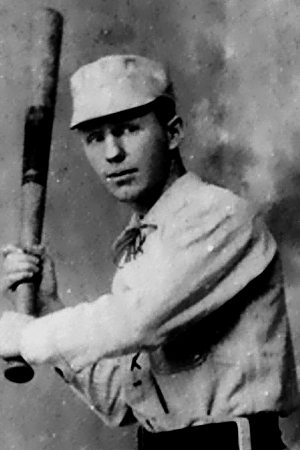
Paul Radford--found the horseshoe

Paul Radford–found the horseshoe

The horseshoe hung at the South End Grounds until the ballpark was destroyed by fire on May 15, 1894

Baucher said Red Sox owner James Aloysius Robert “Bob” Quinn, whose club had been a perennial doormat since he took ownership in 1923, was so desperate for a winner that he was trying to locate the missing horseshoe.

“Bob Quinn would like to know what happened to that horseshoe.  The president of the Red Sox even went so far as to put an ad in the Boston papers the other day offering a reward for the shoe stamped with the name of ‘O. Winn.’  Bob is trying every possible means to give Boston a winning ballclub.  And if a horseshoe will help he wants it.”

Bob Quinn
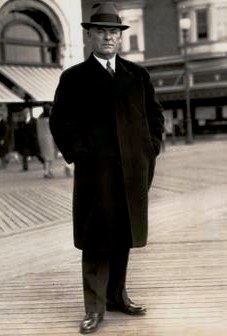
Bob Quinn

Quinn never found the horseshoe, and never had a  winning Red Sox team.
“If we had a Veritable Ty Cobb among us, and no one Cared to See him, what would it Matter?”

7 Jan

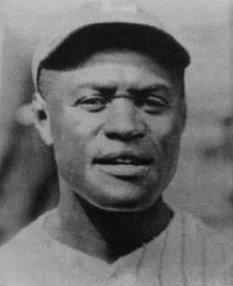
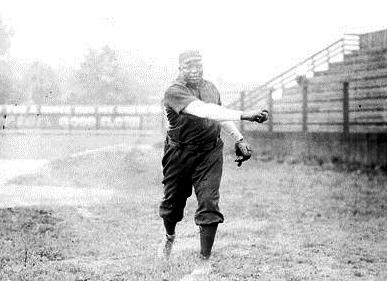
At the beginning of the 1914 baseball season, Andrew Bishop “Rube” Foster believed baseball’s color line was on the verge of being broken.

Rube Foster

Rube Foster

He talked about it with The Seattle Post-Intelligencer while touring the West Coast with the Chicago American Giants:

“Before another baseball season rolls around colored ball players, a score of whom are equal in ability to the brightest stars in the big league teams, will be holding down jobs in organized baseball…They’re taking in Cubans now, you notice and they’ll let us in soon.”

Billy Lewis, a writer for The Indianapolis Freeman did not share Foster’s optimism:

“It goes without saying it emphatically, that Foster’s opinion sounds mighty good to the ‘poor down-trodden’ colored players who have to do so much ‘tall’ figuring in order to make ends meet.  But the plain fact of the matter is that Rube has drawn on his imagination for the better part of his opinion.  For as much as I hope and as colored players and people hope for better days for the colored players there’s nothing to warrant what he had to say. Foster is having the time of his life, riding about in special cars out west, and naturally enough with the distinguished consideration paid him and his bunch of players, he feels to give out something worthwhile.

“Rube Foster nor the rest of us should expect to see any change in the baseball situation until there’s a general change…fact is, that our people are not breaking into the big leagues, and there’s no talk of them breaking into the big leagues, and there is not the slightest indication that they are needed.  This sounds rather severe, yet it is the truth, and that’s what we need even if we should not want it.  It may not make us free as it is so often insisted on.”

[…]

“As severe as the foregoing appears it has nothing to do with the playing ability of colored baseball men.  Expert sport writers long ago conceded that there were colored baseball players who played the game equal to the ‘high browed’ white players who drew their $3,000 plus per annum. It’s an old story why these competent men are not registered in the great leagues.  Really there is less opportunity for Negroes to play with the big leagues in the last few years than formerly. “

Lewis said Foster was wrong to claim that the acceptance of light-skinned Cuban players was positive sign:

“It is generally known that the Negroes stand last in the list of acceptability, hence it is rather poor diplomacy to speak of the preference shown for the Cubans.  It is right, all right.  Nevertheless, Cubans, Indians, Filipinos and Japanese have the right-of-way so to speak.  Of course they are not wholly persona grata, but they are not in the class with the colored players, who are absolutely without friends at court.”

Additionally, Lewis said fans were not ready for integration:

“If the management were inclined to take on the good ones among the colored players, they could not do so with impunity.  The box office is more often the dictator of terms than we think.  If we had a veritable Ty Cobb among us, and no one cared to see him, what would it matter?

“Foster is positive that he has the greatest player in the world in (John Henry) Lloyd.”

Foster had said of the shortstop:

“If you don’t believe it, wait until he gets into the big league—then watch the (Jack) Barrys, the (Honus) Wagners and the (Joe) Tinkers sweat to keep their jobs.”

Lewis said:

“It’s a fine boost for Lloyd, coming as it does from the famous Rube himself, yet we all know that if Lloyd was twice himself he would be no good unless it were the general sentiment that a man was a man.”

John Henry lloyd

John Henry Lloyd

Lewis felt Foster was deluded by the large percentage of white fans who watched him play when the American Giants barnstormed on the West Coast:

“The far west at this time seems ideal in the matter of patronizing games where colored and white teams are engaged.  But in spite of this there is no disposition in that seemingly fair country, to put colored men on the greater teams.  So it is not less than an iridescent dream.”

Lewis told his readers he did not disagree with what Foster desired, but said the great pitcher was basing his optimism on the of the wrong people:

“Much of the foregoing doubtless appears as an argument against mixed clubs.  It is not that way.  The object is to show up the true situation, the further object being to make the most of it. We will not be able to make the most of it as long as we fail to have the proper conception of things.  There are white managers who would gladly take on Negro players if it meant something by way of advancing their clubs.  But as said before it is the box office that dictates…the man on the bleachers and the man in the grand stand are together, and the manager must come by them…What have these to say about colored players entering the big league?  That’s the question.”

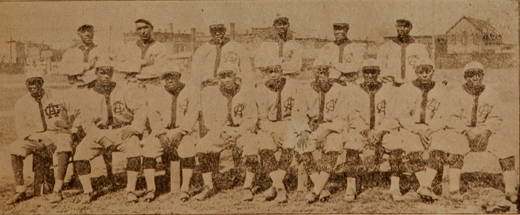
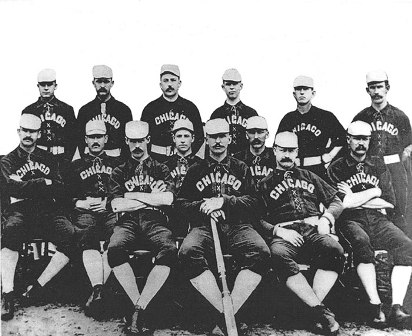
1915amgiants

The 1915 Chicago American Giants–Rube Foster is standing third from left, John Henry Lloyd is standing fifth from left. A year after Foster’s prediction, white baseball wasn’t calling.


“Boys of ’76”

5 Jan

On February, 2, 1925, The National League magnates “paused in (their) schedule deliberations” to honor the league’s past, and kick-off the diamond Jubilee celebration.

Thomas Stevens Rice, of The Brooklyn Eagle said:

“In the very same rooms in which it was organized on Feb. 2, 1876, the National League of Professional Baseball Clubs met again yesterday.  These rooms are in what is now called the Broadway Central Hotel, then called the Grand Central Hotel.”

The Associated Press said:

“In the same room in which Morgan G. Bulkeley, of Hartford, Conn., was elected the first president of the National League, the baseball men, paid tribute to the character and courage of those pioneers a half century ago.”

Dozens of dignitaries were on hand, including, John McGraw, Christy Mathewson, John Montgomery Ward, and Governor John Tener

But, the stars that day were six of the surviving players who appeared during the league’s inaugural season:

George Washington Bradley, 72, who won 45 games for the St. Louis Brown Stockings; John “Jack” Manning, 71, who hit .264 and won 18 games as an outfielder and pitcher for the Boston Red Stockings; Alonzo “Lon” Knight, 71, an outfielder and pitcher for the Philadelphia Athletics in 1876 and hit .250 and won 10 games, and three members of the Hartford Dark Blues, Tommy Bond, 68, a 31-game winner; Tom York, 74, who played leftfield and hit .259, and John “Jack” Burdock, 72, an infielder who hit. 259. Also present was the only surviving umpire from the 1876 season–Calvin J. Stambaugh.

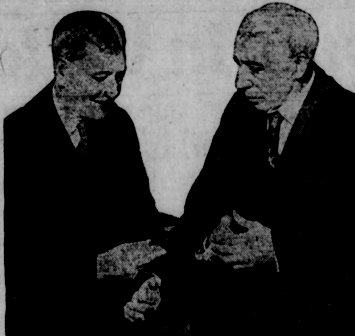
Calvin Stambaugh, right, the last surviving umpire from 1876 and Frank Wilson, a national League umpire from 1923 until his death in 1928.

Calvin Stambaugh, right, the last surviving umpire from 1876 and Frank Wilson, a national League umpire from 1923 until his death in 1928.

Other surviving 1876 players, including George Wright and and Al Reach cited “advancing age” for their inability to attend.

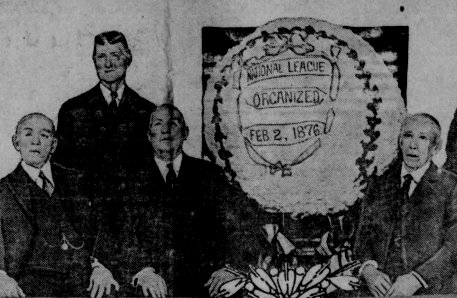
feb21925pix

Seated from left: York, Bradley, and Manning. Standing: Bond.

 Bozeman Bulger of The New York World said, in relating a conversation between too of the attendees, the event was notable for another reason as well:

“(S)everal of us younger men, moving over closer, discovered a contradiction of a tradition long cherished, that old-timers never could admit any improvement in the game or in the quality of the players.

“‘Have you seen this young fellow, Babe Ruth?’ Bradley asked of Manning.

“‘Yes, indeed,’ admitted Mr. Manning, ‘and don’t let anybody tell you that we ever had a man who could hit a ball as hard as that boy.  I doubt if there will ever be another one.'”

Bulger said the “Boys of ’76” also talked about how they “fought crookedness when a salary of $1,800 a year was considered big pay for a star.”  Bradley, who after baseball became a Philadelphia police officer, said:

“‘Oh, we had crooked fellows following us around back in ’76.  They pretended to make heroes out of us and would hang around the hotels.’

“‘One day Mr. (Chicago White Stockings President, William) Hulbert, a very learned man, advised me to keep away from these men.  He explained how they could ruin a boy and lead others into temptation . I was often approached, but thanks to that wise counsel, I kept myself straight, and I thank God for it today.  It’s worth a lot to me to look you younger men in the eye and feel that in turning the game over to you, we gave you something that was honorable.  It’s up to the players to keep it honorable.”

Tom York summed up his feelings about the game in 1876:

“‘Say, do you remember how proud we used to be after winning a game, when we walked home still wearing our uniform and carrying a bat–and the kids following us?  Ball players–all except Babe Ruth–miss that nowadays.”


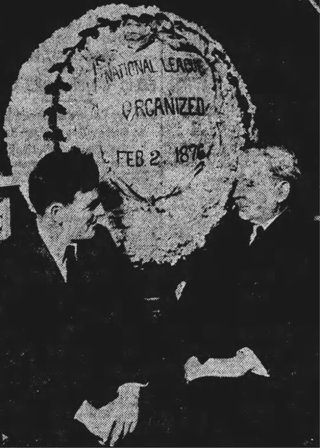
bondmanning

Bond and Manning talk pitching at the Golden Jubilee kickoff event in 1925.


McGraw’s “Rubber”

2 Jan

In 1903 and ’04 the Boston Beaneaters finished sixth, and seventh, while the New York Giants followed a second place finish in 1903 by winning the pennant in ’04.

Jacob Charles “Jake” Morse of The Boston Herald said he it wasn’t just talent that made the Giants more successful:

“It is astonishing that so little attention is paid to the care of baseball players during the training season and the playing campaign, especially the former.  It is in the spring that arms need the most careful cultivation and a first-class expert is almost indispensable.

“A first-class ‘rubber’ ought to be taken by every club that goes South, and if this were done sore arms and muscles would be reduced to a minimum.

“Here in Boston neither club has what is called a trainer or a ‘rubber.’ The New York National League club has had the services of the well-known ‘rubber’ Gus Guerrero, for several seasons, and he has given satisfaction.”

Before coming to the Giants as the team “Rubber,” Guerrero had made a name for himself as a competitive walker and runner.  The San Francisco Call said of him:

“Back in the late (eighteen) seventies Guerrero was the one best bet when it came to a foot race, whether for one or for 500 miles, six-day match, or even if the proposition called for a jaunt from the Pacific to the Atlantic coast.  Anything went with Guerrero; he ran for 48 hours, making 300 miles flat in that time, and once in 1884 he trundled a wheelbarrow from San Francisco to New York City.”

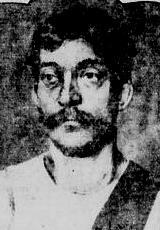
Gus Guerrero

Gus Guerrero

Guerrero, often billed as “The Mexican,” and “The best athlete Mexico ever produced,” was actually born in Northern California.  He became an athletic trainer in New York in the 1890s and began working for the Giants in 1900.

John McGraw inherited Guerrero when he came to New York in 1902, and swore by his “Rubber.”

The Associated Press said, in 1904 when McGraw, trying to rehabilitate his injured knee, took Guerrero on the spring training trip south:

“Last year (McGraw) depended on local massage men to rub and bandage the bad knee, but they did not understand the job.  Guerrero, a professional, has been spending several hours per day solely on McGraw’s weak muscles and has succeeded in hardening them so that the joint is fairly protected and does not spring at a critical moment.”

The New York Press said of Guerrero:

“(He) wears a baseball shirt labeled ‘New York’ all the time.  McGraw says he believes Gus sleeps in it. As the men come in he looks them over, particularly the pitchers.  If a box man complains of a stiff arm the trainer attends to it as carefully as a physician looks after the throat of an operatic prima donna.  He makes the player strip, steams him, puts him on a slab, massages him, and then rubs in a liniment of his own concoction which he declares would take the stiffness out of a telephone pole.  It is equal parts of witch hazel and alcohol to a quart; with half a teaspoon of oil of wintergreen and a dash of something else that Guerrero says is his secret.”

While McGraw seemed impressed with Guerrero, it appears some of his players were not.

When the team was training in Birmingham, Alabama during the spring of 1904, The New York Globe’s Allen Sangree, who was traveling with the Giants, wrote about an exchange between Guerrero and Christy Mathewson:

“Mathewson, in particular, was feeling grouchy yesterday.  ‘How’s your arm?’ asked Gus Guerrero, the rubber, as he put the finishing touches on him…’Arm alright,’ said Matty, ‘but I don’t feel good.’

“’Well, what’s the matter?’ pursued the rubber.

“’Nothing, didn’t I tell you!’ yelled the big fellow, in exasperated tones.  ‘Just nothing, only I don’t feel good; and don’t bother me either.’”

Just after Jake Morse wrote about the advantage McGraw’s “Rubber” had given the Giants, it was announced that he would no longer be the team’s trainer.

The New York Herald said:

“Gus and the players could not get along well, so he resigned.”

McGraw, who remained “a strong believer in massage treatment for pitcher’s arms before and after the game,” and replaced Guerrero with Harry Tuthill—Tuthill had trained several fighters, including William “Young Corbett II” Rothwell, and “Mysterious” Billy Smith.   Tuthill was with New York until 1908 when he joined the Detroit Tigers.

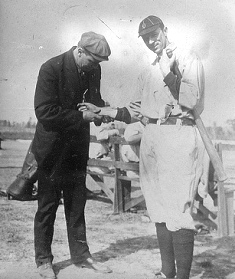
Harry Tuthill, with Tigers pitcher Del Gainer

Harry Tuthill, with Tigers pitcher Del Gainer

Guerrero never worked for another major league club. He continued to participate in races, and eventually returned to California where he died in 1914.