Archive | October, 2015

“Here was the King of all the Tramps I’d ever seen”

7 Oct

In 1947, Grantland Rice of The New York Herald-Tribune told a story about how he came to know one of the most colorful pitchers of the first decade of the 20th Century:

“Baseball, above all other games, has known more than its share in the way of masterpieces of eccentricity.  Many of these I happen to know.”

Grantland Rice
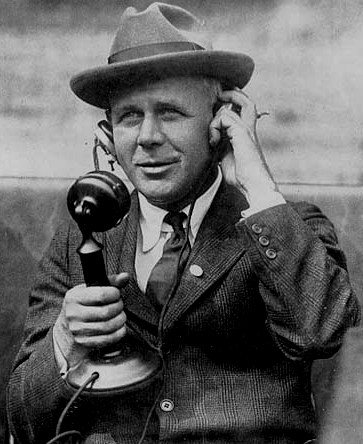
Grantland Rice

Rice went on to list some of his favorites—Rube Waddell, Crazy Schmit, Dizzy Dean—“Also, Flint Rhem, Babe Herman, Bobo Newsom, Germany Schaefer, Shoeless Joe Jackson, Arlie Latham—nits, wits, and half-wits—but all great ballplayers.”  But, said Rice, “one of the leaders in this colorful field” had been all but forgotten:

“His name was (Arthur) Bugs Raymond, the pitcher John McGraw always insisted had the finest pitching motion he ever saw, including Walter Johnson.”

[…]

“I remember Bugs because I happened to have a small part in his pitching career.  I was working in Atlanta (for The Journal) when I happened to read a story that came out of Shreveport (Louisiana), about a young pitcher named Raymond who had made and won the following bet:

“That he could eat a whole turkey, drink two bottles of scotch—and win a doubleheader.  He did it.  I didn’t believe it at the time, but I believed it later.  I recommended to either (Atlanta Crackers owner) Abner Powell or (manager) Billy Smith (44 years is a long time) that Raymond looked like a good buy.  Good copy is always scarce.  Raymond sounded like good copy.”

Bugs Raymond
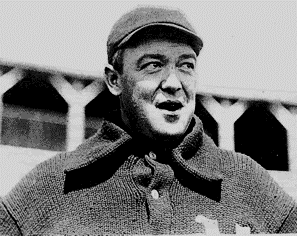
Bugs Raymond

Rice’s story about the bet is likely apocryphal, there is no mention of it in contemporary newspapers in Shreveport, or in Jackson, Mississippi where Raymond played in the Cotton States League before coming to Atlanta–he also names the wrong manager–Smith came to Atlanta the following season.  While Raymond probably didn’t make the bet Rice claimed, he did, on at least one occasion win both ends of a doubleheader, and he was wildly popular in Mississippi.  After he was sold to Atlanta in July of 1905, The Jackson News said:

“The regret over Raymond’s departure was not one-sided.  The big fellow was all broken up over the transaction.”

The paper said that although Raymond would make $200 a month in Atlanta and have a chance to return to the major leagues, leaving Jackson was difficult for him:

“During his engagement with the Jackson team he has made a host of friends and was undoubtedly the most popular player who ever donned a home uniform.  The plain fact is Raymond almost owned the town.  Nothing was too good for him and he always made a hatful of money on the big games, a shower of silver and greenbacks being the inevitable result of a victory in a doubleheader.”

Rice’s story about Raymond also took another real event and embellished it–either by design or through the fog of forty years.

After finishing the 1905 season with a 10-6 record for the Crackers, Raymond was picked by new Manager Billy Smith to start for Atlanta in an exhibition against the Boston Americans on March 26, 1906.

In Rice’s colorful version, he gave the incorrect date for the exhibition and wrongly claimed that he met Raymond face-to-face for the first time on the morning of the game:

“By some odd chance, before starting a mile-and-a-half walk to the ballpark, I happened to be taking a drink at some wayside bar in preparation for the trip.  A heavy hand fell on my shoulder and, as I looked around, there was an unkempt-looking fellow, around 200 pounds who wore no necktie and hadn’t shaved in at least two days.  Here was the king of all the tramps I’d ever seen.

“’How about buying me a drink, fellow?’ was his opening remark.  I bought him a drink.  Then I had to buy him another drink.

“’How do we get out to this ballpark?’ he asked.

“’We walk,’ I said, ‘if you are going with me.’ Then a sudden morbid thought hit me.  ‘Isn’t your name Raymond?’ I asked.

“’Yes,” he said ‘Bugs Raymond.’

“I figured then what my recommendation to the Atlanta team was worth.  Something less than two cents.

“’Do you happen to know,’ I suggested, ‘that you are pitching today against the Boston Americans?’

“’I never heard of ‘em,’ Bugs said.  ‘Where’s Boston?’

“On the walk to the ballpark that afternoon Bugs spent most of the trek throwing rocks at pigeons, telegraph poles and any target in sight.  People I had known in Atlanta gave me an odd look after taking a brief glance at my unshaven, rough and rowdy looking companion.”

Once at the ballpark, Rice said:

“Raymond started the game by insulting Jimmy Collins…and every star of the Boston team.  He would walk from the pitcher’s box up towards the plate and let them know, in forcible and smoking language, what he thought they were.”

In Rice’s version, the cocky, seemingly drunk Raymond shuts Boston out 3-0 on three hits.  He got those details wrong as well, and Raymond’s performance was just as incredible without the embellishments.
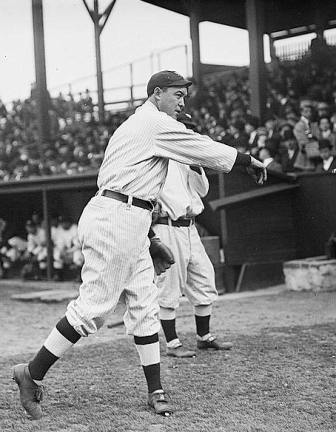
Bugs Raymond

Bugs Raymond

The Atlanta Constitution said on the day after the game:

“No better than bush leaguers looked the Boston Americans…yesterday afternoon at Piedmont Park, when ‘Bugs’ Raymond came near to scoring a no-hit game against the bean-eating crew, who escaped a shut-out through two errors made by (Morris “Mike”) Jacobs in the eighth inning.

“Score—Atlanta 4, Boston 2.

“’Bugs’ was there with the goods.  Boston hitter after hitter stepped up to the plate, pounded the pan, looked fierce for awhile, and then went the easy out route.

“’Bugs’ was in his glory.  It was in the eighth inning before a single hit or run was scored off his delivery

Both Boston hits were ground balls Atlanta shortstop Frank “Whitey” Morse beaten out by  Collins and Myron ”Moose” Grimshaw:

“As inning after inning went by, the Boston sporting writers along with the team began to think of the possibility of defeat, and, about the seventh inning, when it looked strangely like a shutout game, they pulled out their books of excuses and began to look for the proper one to use in Tuesday morning’s newspapers.

“The one finally agreed upon at a conference of all four writers read like this:

“’The eyes of the Boston players were dimmed by the flying moisture from the spit-ball delivery of one ‘Bugs’ Raymond, who let himself out at full steam, while our pitchers were waiting for the opening of the coming season.  It does a major league club good to be beaten every now and then, anyway.”

The Box Score
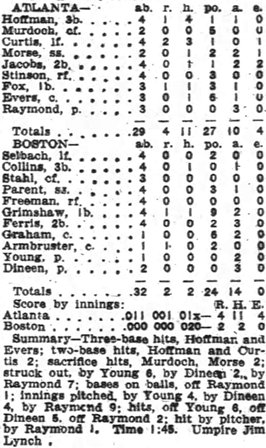
                 The Box Score

Given Raymond’s alcoholism, there might be some truth Rice’s embellishments although there is no evidence for most of his version.

The performance against Boston was quickly forgotten as Raymond just as quickly wore out his welcome with Manager Billy Smith.  On May 6 he was suspended indefinitely because, as The Constitution put it “(Raymond) looks with delight in wine when it is red.”  On May 31, Atlanta sold Raymond to the Savannah Indians in the South Atlantic leagues. An 18-8 mark there, followed by a 35-11 season with the Charleston Sea Gulls in the same league in 1907, earned Raymond his return to the big leagues with the St. Louis Cardinals.

By 1912, the pitcher, about whom Rice claimed John McGraw said “Even half sober Raymond would have been one of the greatest,” was dead.
Collins’ “Ten Commandments”

5 Oct

The Philadelphia Inquirer said in February of 1916, Eddie Collins of the Chicago White Sox, had broken “into the ‘Gospel League,’ after  the second baseman gave a temperance speech in front of “500 persons” at the Epworth Methodist Church in Palmyra, New Jersey church.

collins2

Eddie Collins

Despite Collins telling his audience he wasn’t  “contemplating a pulpit career,” the paper said they “(A)pplauded like World Series fans when he handed ‘booze’ some wallops that would have done credit to Billy Sunday.”

Collins’ talk focused on the evils of alcohol:

“I come to bring a message to your young people, from a baseball player’s viewpoint, of the necessity of clean living and I will be glad if anything I say will help any of you fight the battle of life…Temperate living in necessary for success in any field of action.”

He also praised his former manager from the pulpit:

“Life is a whole lot like playing baseball under Connie Mack’s orders.  Mack is the greatest baseball general the world has ever known and any man who has ever played on the old Athletics honors respects and loves the boss.”

Sunday said he approved of Collins taking to pulpit and providing a “boost” for baseball:

“The way to make the great game respectable is for every player to be respectable himself.”

The Inquirer told readers the following day that the Columbia University graduate had little in common with the evangelist who often mangled the language:

“The statement that Eddie Collins is emulating Billy Sunday is entirely erroneous…Eddie had a perfect record at the bat and fielded cleanly with the King’s English.”

Billy Sunday, evangelist

Billy Sunday, evangelist

Within a week, The Philadelphia Press said:

“Eddie Collins’ dip into evangelism has had a home-run effect among church people throughout the country, and he now is swamped with invitations to address church congregations, bible classes, and Sunday school meeting.

“The requests have swept in upon him at his home in Lansdowne (Pennsylvania) in such a deluge that he said today he had reached the point where he would have to give up base ball if he were to meet all the engagements asked.”

Collins told a reporter:

“I am gratified to learn that my little talk of last Sunday and my rules of life amounted to something but I don’t rank as an evangelist and can’t follow that calling.”

Instead of leaving the diamond for the pulpit, Collins printed and had distributed to churches, several thousand copies of part of the talk, what he called “The Ten Rules of Life.”

Some reporters, including William Peet of The Washington Herald, referred to the list as “Collins’ Ten Commandments:”

First: Safeguard your honor

Second: Don’t overeat

Third: Be a good loser

Fourth: Smile

Fifth: Keep good hours

Sixth: Have courage to do right

Seventh: Don’t think you know it all

Eighth: Be prompt

Ninth: Don’t drink alcoholic drinks

Tenth: Think clean thoughts.

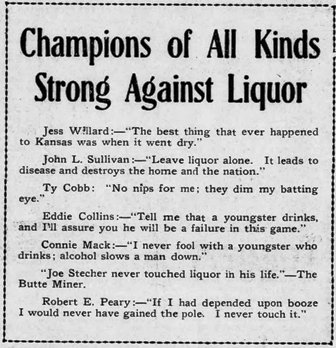
Collins’ statements about alcohol were used by various temperance organizations seeking prohibition.  Ads like the one below with quotes from Collins, Ty Cobb, and Connie Mack, and Admiral Robert Peary, as well as boxers Jess Willard, John L. Sullivan, and Joe Stecher appeared in newspapers and handbills distributed throughout the country.

temperance

Lost Advertisements–PM Whiskey, “Rube Waddell, The One-Man Ball Team”

2 Oct

waddellad

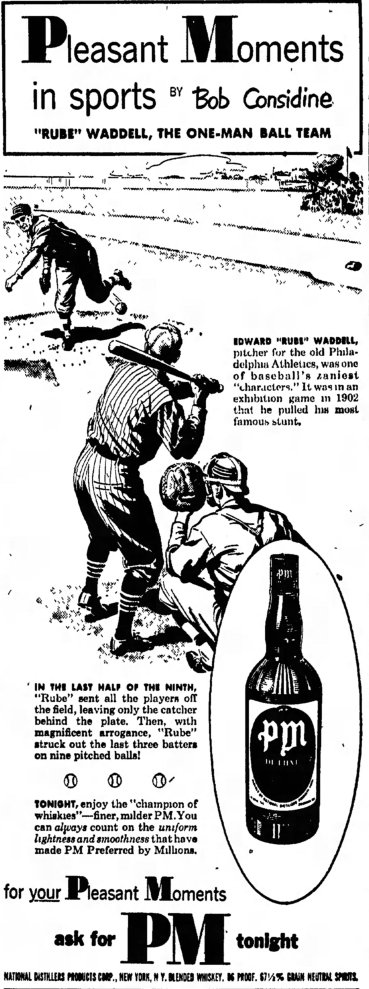
A 1951 advertisement for PM De Luxe Blended Whiskey–part of a series of ads featuring “Pleasant Moments in Sports,” stories from Bob Considine, co-author with Babe Ruth of the “The Babe Ruth Story.”

This one features an oft-told Rube Waddell legend:

“Edward ‘Rube’ Waddell, pitcher for the old Philadelphia Athletics, was one of baseball’s zaniest ‘characters.’  It was in an exhibition game in 1902 that he pulled his most famous stunt.

“In the last half of the ninth, ‘Rube’ sent all his players off the field, leaving only the catcher behind the plate. Then with magnificent arrogance, ‘Rube’ struck out the last three batters on  nine pitched balls.”

As with all Waddell stories, there was some truth and a good deal of embellishment in Considine’s account.  While the contemporary coverage of the game differs on some aspects of the performance, they all agree that Waddell pitched to just one batter after members of the team left the field in the ninth inning.

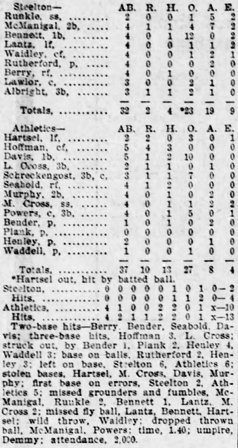
The game in question was played in 1903 at Steelton, Pennsylvania against that town’s YMCA team. The Athletics won easily, 10 to 2, and Waddell pitched the eighth and ninth innings for Philadelphia.

The Philadelphia Inquirer said:

“Waddell was the entertaining feature of the match, and in the last inning called in all the infielders after two men were out.”

The Harrisburg Daily Independent, which provided more in-depth coverage of the game, said:

“Rube Waddell was in all his glory at Steelton yesterday and his funny antics before and during the game were well worth the price of admission.”

The paper said before the game Waddell entertained the fans chasing “flies in the hills until he was perspiring,” and spent part of the early innings taking a “nap in his private carriage which carried him from (Harrisburg) to Steelton.”

rube

Waddell

As for his time on the mound, the paper said Waddell struck out the first two batters he faced in the eighth, then after getting two strikes on the third batter, named “Irish” McManigal:

“(W)hen he pitched the third ball (he) remarked, ‘Take your seat.’ ‘Irish,’ however, surprised the Rube and rapped out a pretty single to center field.”

Waddell gave up another hit in the eighth and the YMCA scored a run.

“The next inning Rutherford hit to Waddell and the Rube did a cake walk to first base to catch Rutherford.  Berry then hit to Monte Cross, but he threw wild to first and Berry reached third base.  Then the Reuben settled down and struck Lawlor out.”

The Daily Independent said Waddell did not call in the fielders, but instead, on their own:

“The Athletic players behind Waddell left the field and with a man on third base he and (Ossee) Schreck (Schrecongost) were left to put out the side.

“The Rube did not know his teammates had deserted him and when told to look around by Schreck he discovered the fact.  Then to make more complete the comedy Schreckengost [sic] sat down and the Rube struck out Albright while the crowd howled with merriment.”

The Harrisburg Telegraph provided a third set of contemporaneous “facts:”

“In the last inning when two men were out all the Athletics left the field except Waddell, Powers and L. Cross.”

The paper likely misidentified Schrecongost as Michael “Doc” Powers–Schrecongost had replaced him behind the plate in the eighth, and Lave Cross had already left the game–so the player who stayed on the field might have been shortstop Monte Cross.  The Telegraph also added another detail missing in the other reports:

“(Waddell) gave the batter three balls and the crowd was wild, but their last hope faded rapidly away as Rube put three fine ones over the plate and the striker was out.”

The Box Score

The Box Score

Considine likely cribbed his version from Harry Grayson, the sports editor of The Newspaper Enterprise Association syndicate.  Grayson told the three-batters-nine-pitches story several times throughout the forties, and that legend stuck.