Archive | December, 2015

Cuban X-Giants In Washington D.C., 1901

7 Dec

xgiants

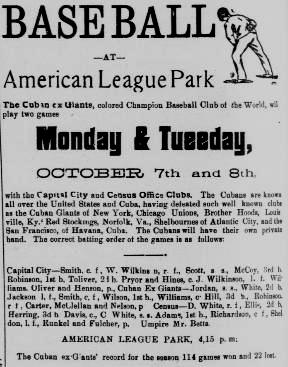
A 1901 advertisement for the Cuban X-Giants, managed by Soloman “Sol” White, in Washington D.C.  The team played the Capital City–described by The Washington Times as “a contingent of colored ball players of this city,” and the team representing the United States Census Bureau at American League Park.
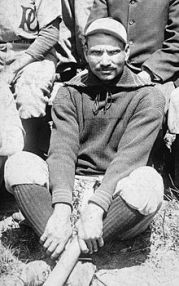
Sol White

Sol White


According to the ad:

“The Cubans are known all over the United States and Cuba, having defeated such well-known clubs as the Cuban Giants of New York, Chicago Unions, Brother Hoods, Louisville, KY. Red Stockings, Norfolk, VA., Shelbournes of Atlantic City, and the San Francisco, of Havana Cuba.  The Cubans will have their own private band.”

The previous week, the X-Giants played an 11-inning tie with the Philadelphia Athletics at Columbia Park–although the Athletics three biggest stars, Napoleon Lajoie, Harry Davis and Lave Cross did not participate, The Philadelphia Inquirer said, “Both teams put up a splendid article of ball and the game resulted in one of the best that has been played on the grounds this season.”

The Philadelphia Times was even more enthusiastic:

“The game itself was beyond all doubt one of the greatest ever witnessed upon the local diamond.”

The 11-inning tie against the Athletics
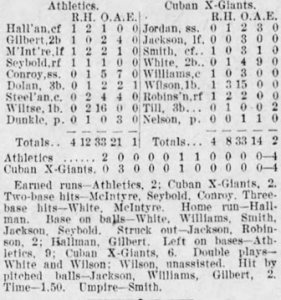
The 11-inning tie against the Athletics

The ad said the club had won 114 games and lost just 22 in 1901, and described them as the “Colored Champion Baseball Club of the World.”  In both 1900 and 1901 the X-Giants and the Cuban Giants each claimed to be “Colored Champion.”

In addition to Sol White, the roster included, Robert Jordan, Ray Wilson, Clarence Williams, John Nelson, Danny McClellan, Will Jackson, Johnny Hill, Robert “Ginney” Robinson, and Charles “Kid” Carter.

The X-Giants won both of the advertised games.  The victory over the Capital City club was of such little note that no newspaper mentioned the score.  The Washington Colored American simply said the X-Giants “Played stars and circles around the Capital Cities.”

They also beat the Census Department 8 to 0.  The Washington Times said:

“The visitors had things their own way throughout the game, and at no time were they in danger of being defeated.  They had a twirler (McClellan) in the box that knew the fine points of the game.  He struck out nine of the localities and allowed but two of them to get the slightest semblance of a safe hit off his cannon ball delivery.”

Danny McClellan
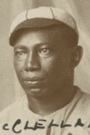
Danny McClellan

The X-Giants beat one more local team, the Eastern Athletic Club, on October 9, and left the nation’s capital 117-22.


Lost Pictures–The Best Eyes in Baseball

4 Dec

eyeszimmerman

eyesdaubert

eysspeaker

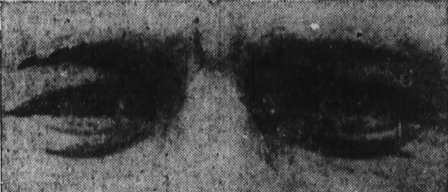
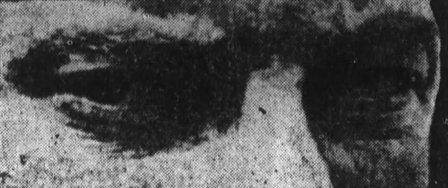
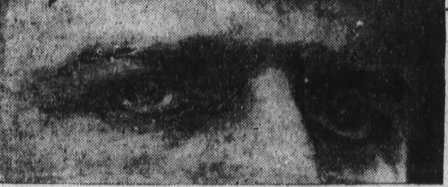
Above, three sets of eyes, 1916.

Harold “Speed” Johnson of The Chicago Herald said:

“It’s the eye and not the wallop that counts in the national Pastime.  Some eyes are more durable than others.  Larry Lajoie possesses such a pair; so does Hans Wagner, Terry Turner, Tris Speaker, Jake Daubert, Frank Schulte, Larry Doyle, Heine Zimmerman, Tyrus Cobb, Joe Jackson and Bill Hinchman.”

Johnson informed his readers that “Most of these birds refrain from reading during the offseason, thereby sparing their eyes.”

As for the three sets pictured above, Jonson said:

“Heine Zimmerman is another notable example of the batter who possesses the keen optics.  He eccentric third sacker of the Chicago Cubs, when at peace with the world, is one the greatest natural sluggers of all time.  His eyes never have troubled him but his temperament frequently has caused him to slump, swinging frantically at any old pitch.  Right now Heinie is seeing in exceptionally good form as witness his average of .336 for 48 combats.”

[…]

“There is nothing wrong with Jake Daubert’s glims as a slant at the latest averages will indicate…His heavy cannonading has been a principal factor in the upward climb of the Robins…For a pair of eyes that have been in use as long as Jake’s in the big set they’re holding out famously.”

[…]

 “Nine seasons of big league milling haven’ dulled the lamps of Tristram Speaker who right now is going better than he did in his banner years with the Boston Red Sox.  Not only is the big Texan rattling fences  at Dunn Field, Cleveland, where for seven years he averaged .381 on visits with the Bostonese, but he is keeping up his terrific pace abroad.”

Zimmerman’s temperament caught up with him again.  He wore out his welcome in Chicago in August of 1916, was traded to the New York Giants and finished the season with a .286 average.

Daubert’s eyes held out.  He hit .316 and led Brooklyn to the National League pennant.

Speaker kept hitting at Dunn Field and everywhere else, finishing the season with a major league-leading .386 average.

“Loved Baseball More than He Feared Death”

2 Dec

Robert William “Bob” Osgood was told by doctors that he couldn’t play high school baseball because of a heart ailment.  He was also told he wouldn’t live long.

According to The Associated Press, he begged his parents for a chance to play and “(T)he youth’s parents thought it better that Bob’s playing be supervised and permission was granted.”  By his senior year in 1946, was named to several Massachusetts All-State teams.

After graduation, Osgood signed with the Chicago Cubs.  His older brother Charles was then playing in the Cubs organization after appearing in one game as a pitcher for the Brooklyn Dodgers in 1944 as a 17-year-old.

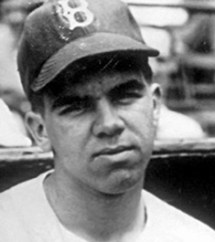
Charles Osgood

Charles Osgood


Bob hit .280 in 25 at-bats split between the Cubs’ North Carolina and Appalachian League teams.

No official records exist for Bob Osgood after that, but he was a member of the Visalia Cubs in 1947.

He was assigned to the Springfield Cubs in the New England League in 1948 but missed most of spring training when he was hospitalized with the flu.  On May 7, 1948, Bob Osgood became a member of the Marion Cubs in the Ohio-Indiana League; he was sent to Marion from Springfield after the club’s manager/catcher Lew “Zeke” Bekeza broke a bone in his hand.

Osgood appeared in two games behind the plate; he hit .500 with five singles in ten at-bats.

On May 11, 1948, Osgood was sitting on the bench with teammates during a rain delay in Richmond, Indiana.  The Marion Star said:

“Osgood, a catcher who played his first game for the Cubs last Sunday, collapsed and died in the Cubs’ dugout…The heart attack came as the Cubs team took shelter from a rain storm…At 8:03 p.m. after more than an hour of artificial respiration (two doctors) declared the boy dead.”

His manager, Bezeka told the paper “Osgood had not looked well in his few days with the Cubs and had a blue coloring to his face.”

A postscript:

 According to Jack Durant of The Associated Press,  former Reds and Dodgers catcher Clyde Sukeforth, a Dodger scout,  was in the stands and “Seeing the commotion around the bench, rushed out the stands to the dugout,” upon arriving “He knelt beside the boy who loved baseball more than he feared death and when he looked into the stilled features, well he knew who it was—Bobby Osgood, his own nephew.”

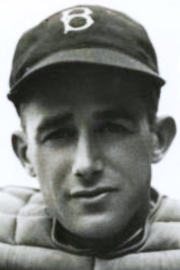
Clyde Sukeforth

A shorter version of this post appeared on August 17, 2012.