Archive | 2015

“A Travesty on the National Pastime”

12 Aug

The Brooklyn Eagle called it “(A) travesty on the National Pastime.”  The Associated Press said it was “A comedy in Brooklyn.”

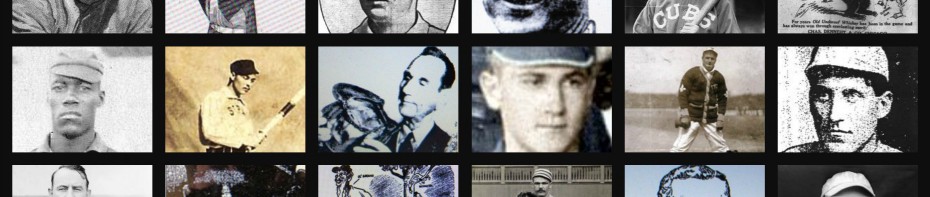
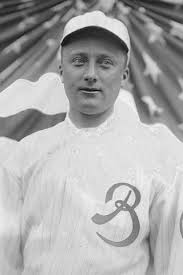
1915 home opener between the Federal League’s Brooklyn Tip-Tops and the Buffalo Blues.

The 1915 Federal League opener between the Brooklyn Tip-Tops and Buffalo Blues resulted in 13 to 9 Brooklyn victory,  slogged on for three hours and ten minutes, and Brooklyn Manager Lee Magee was ejected from his first game as a manager in the first inning.

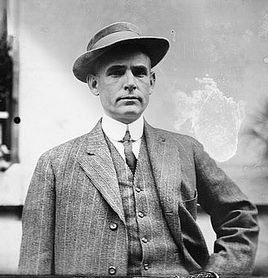
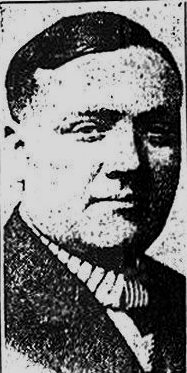
Lee Magee

Lee Magee

None of those things were the cause of the headlines.

The Washington Times said:

 “Of all the offenses committed against the fair name of baseball none has loomed up so ludicrously as the prize ‘bone’ play perpetrated in the opening game.”

In the seventh inning, catcher Grover Land pinch hit for pitcher Bill Upham.  Land singled and was then removed for pinch runner Dave Howard.

The Eagle said, in the following inning:

“Land donned the windpad and mitt in the eighth and proceeded to catch the balance of the game in place of (Mike) Simon, whose sore arm caused his retirement.

“Land’s return to the game after having once been replaced was a distinct violation of the rules, but Acting Manager (Jim) Delahanty wotted not of such things, Umpire Jimmy Johnstone gave it not a thought and Leader (Larry) Schlafly of Buffalo ignored it entirely, either from lack of observation or with a view of future action in the way of a protest.  The re-advent of Land caused a mix-up in the scoring, which turned the press box into a bedlam of protest, but there was no redress.  Later, the humor of the situation dawned on the scribes and they gurgled with glee at the monumental piece of stupidity perpetrated by the home management.”

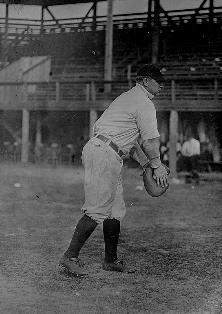
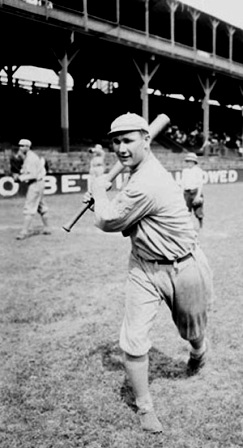
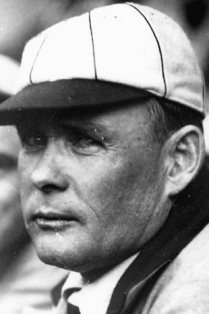
Grover Land

Grover Land

The following day, Schlafly filed a formal protest with Federal League President James Gilmore, and told The Buffalo News he was aware of the mistake and “Knew as soon as Land went in to catch the Brookfeds could not win the ball game.”

The Eagle later apologized to Delahanty for claiming he was responsible for the “bone play:”

“An injustice was done Jimmy Delahanty when it was stated that he was acting manager of the Brookfeds when Grover Land did the in again, out again, and in again stunt…The truth must be told.  Lee Magee was on the bench at the time, despite the fact that he had long before been chased off the field.  The Boy Manager had slipped into a long ulster, and, as he thought, disguised himself so the umps would not recognize him.  Then he slipped behind the water cooler and directed things.”

The paper concluded that Magee pulled the “bone” and chided him for allowing his players to take the blame.

Magee was fined $50 and suspended for two games for returning to the bench after the ejection.  The protest was rejected and the game remained in the record books as a 13 to 9 Brooklyn victory.

The Blues were 13-28 in June when Schlafly was fired.  Magee was replaced as manager by Brooklyn with a 53-64 record in August.  The teams finished sixth and seventh during the league’s second and final season.

Grantland Rice’s “All-Time All-Star Round up”

10 Aug

In December of 1917, thirty-eight-year-old sportswriter Grantland Rice of The New York Tribune enlisted in the army–he spent fourteen months in Europe.  Before he left he laid out the case, over two weeks, for an all-time all-star team in the pages of the paper:

“As we expect to be held to a restricted output very shortly, due to the exigencies and demands of the artillery game, this seemed to be a fairly fitting period to unfold the results.”
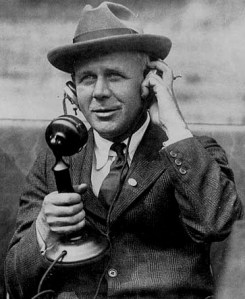
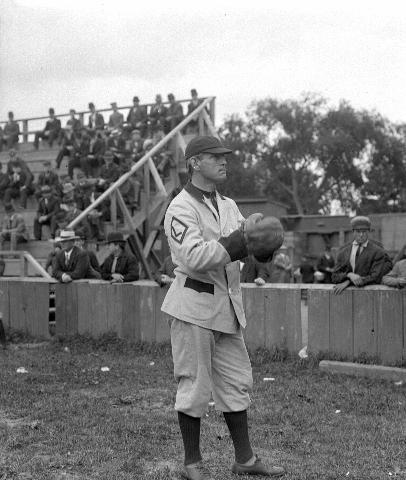
Grantland Rice

Grantland Rice

Rice said the selections were “not solely from our own limited observation, extending over a period of some eighteen or twenty years,” but included input from players, managers and sportswriters, including  “such veterans” as Frank Bancroft and Clark Griffith, and baseball writers Joe Vila of The New York Sun, Bill Hanna of The New York Herald and Sam Crane, the former major league infielder turned sportswriter of The New York Journal.

Rice said only one of the nine selections “(S)eems to rest in doubt.  The others were almost unanimously backed.”

The selections:

Pitcher:  Christy Mathewson

A. G. Spalding, John (Montgomery) Ward, Larry Corcoran, Charley Radbourn, John Clarkson, (Thomas) Toad Ramsey, Tim Keefe, Bill Hoffer, Amos Rusie, (Mordecai) Miner Brown, Addie Joss, Ed Walsh–the array is almost endless.

“In the matter of physical stamina, Cy Young has outclassed the field.  Cy won more games than almost any others ever pitched.

“(But) For all the pitching mixtures and ingredients, stamina, steadiness, brilliancy, brains, control, speed, curves, coolness, courage, is generally agreed that no man has ever yet surpassed Christy Mathewson…there has never been another who had more brains or as fine control.”


[…]

“It might be argued that Radbourn or (Walter) Johnson or (Grover Cleveland) Alexander was a greater pitcher than Mathewson.

But we’ll string with Matty against the field.”

Radbourn was the second choice.  Bancroft said:

“Radbourn was more like Mathewson than any pitcher I ever saw.  I mean by that, that like Matty, he depended largely upon brains and courage and control, like Matty he had fine speed and the rest of it.  Radbourn was a great pitcher, the best of the old school beyond any doubt.”

Catcher:  William “Buck” Ewing

“Here we come to a long array—Frank (Silver) Flint, Charley Bennett, (Charles “Chief”) Zimmer, (James “Deacon”) McGuire, (Wilbert) Robinson, (Marty) Bergen(Johnny) Kling, (Roger) Bresnahan and various others.

“But the bulk of the votes went to Buck Ewing.”
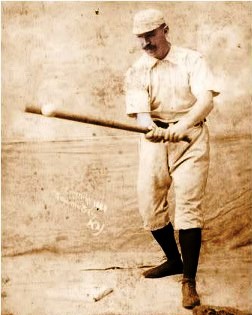
Buck Ewing

Buck Ewing

[…]

“Wherein did Ewing excel?

“He was a great mechanical catcher.  He had a wonderful arm and no man was surer of the bat…he had a keen brain, uncanny judgment, and those who worked with him say that he had no rival at diagnosing the  weakness of opposing batsman, or at handling his pitchers with rare skill.”

Kling was the second choice:

“Kling was fairly close…a fine thrower, hard hitter, and brilliant strategist…But as brilliant as Kling was over a span of years, we found no one who placed him over the immortal Buck.”

1B Fred Tenney

First Base was the one position with “the greatest difference of opinion,” among Rice and the others:

“From Charlie Comiskey to George Sisler is a long gap—and in that gap it seems that no one man has ever risen to undisputed heights… There are logical arguments to be offered that Hal Chase or Frank Chance should displace Fred Tenney at first.

But in the way of batting and fielding records Tenney wins….Of the present array, George Sisler is the one who has the best chance of replacing Tenney.”

2B Eddie Collins

 “There was no great argument about second base.

“The vote was almost unanimous.

“From the days of Ross Barnes, a great hitter and a good second baseman on through 1917, the game has known many stars.  But for all-around ability the game has known but one Eddie Collins.”

Rice said the competition was between Collins, Napoleon Lajoie and Johnny Evers:

“Of these Lajoie was the greatest hitter and most graceful workman.

“Of these Evers was the greatest fighter and the more eternally mentally alert.

“But for batting and base running, fielding skill, speed and the entire combination, Collins was voted on top.”

 SS Honus Wagner

“Here, with possibly one exception, is the easiest pick of the lot.  The game has been replete with star shortstops with George Wright in 1875 to (Walter “Rabbit”) Maranville, (George “Buck”) Weaver…There were (Jack) Glasscock and (John Montgomery) Ward, (Hardy) Richards0n, (Hugh) Jennings, (Herman)Long, (Joe) Tinker and (Jack) Barry.

“But there has been only one Hans Wagner.”
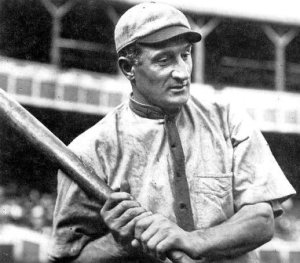
Honus Wagner

Honus Wagner

Jennings and Long were rated second and third,  “But, with the entire list  considered there is no question but that Wagner stands at the top.”

3B Jimmy Collins

Rice said:

“From the days of (Ned) Williamson(Jerry) Denny, and (Ezra) Sutton, over thirty years ago, great third basemen have only appeared at widely separated intervals.

“There have been fewer great third basemen in baseball than at any other position, for there have been periods when five or six years would pass without an undoubted star.”

The final decision came down to “John McGraw vs. Jimmy Collins.”  McGraw was “a great hitter, a fine bunter and a star base runner,” while “Collins was a marvel and a marvel over a long stretch…he was good enough to carve out a .330 or a .340 clip (and) when it came to infield play at third he certainly had no superior…So taking his combined fielding and batting ability against that of McGraw and Collins wins the place.  McGraw was a trifle his superior on the attack. But as a fielder there was no great comparison, Collins leading by a number of strides.”


OF Ty Cobb

“The supply here is overwhelming…Yet the remarkable part is that when we offered our selection to a jury of old players, managers and veteran scribes there was hardly a dissenting vote.”

[…]

“Number one answers itself.  A man who can lead the league nine years in succession at bat.

“A man who can lead his league at bat in ten out of eleven seasons.

“A man who can run up the record for base hits and runs scored in a year—also runs driven in.

“Well, the name Ty Cobb answers the rest of it.”

OF Tris Speaker

 “The man who gives Cobb the hardest battle is Tris Speaker.  Veteran observers like Clark Griffith all say that Speaker is the greatest defensive outfielder baseball has ever exploited…Speaker can cover more ground before a ball is pitched than any man.  And if he guesses incorrectly, which he seldom does, he can go a mile to retrieve his error in judgment…And to this impressive defensive strength must be added the fact he is a powerful hitter, not only a normal .350 man, but one who can tear the hide off the ball for extra bases.”
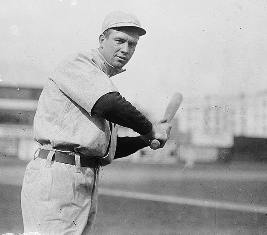
Tris Speaker "hardest hit"

Tris Speaker 

OF “Wee Willie” Keeler

Mike Kelly and Joe KelleyJimmy Sheckard and Fred Clarke—the slugging (Ed) Delehanty—the rare Bill LangeBilly Hamilton.

“The remaining list is a great one, but how can Wee Willie Keeler be put aside?

“Ask Joe Kelley, or John McGraw, or others who played with Keeler and who remember his work.

“Keeler was one of the most scientific batsmen that ever chopped a timely single over third or first…And Keeler was also a great defensive outfielder, a fine ground coverer—a great thrower—a star in every department of play.

“Mike Kelly was a marvel, more of an all-around sensation, but those who watched the work of both figure Keeler on top.”

Rice said of the nine selections:

“The above is the verdict arrived at after discussions with managers, players and writers who have seen a big section of the long parade, and who are therefore able to compare the stars of today with the best men of forgotten years.

“Out of the thousands of fine players who have made up the roll call of the game since 1870 it would seem impossible to pick nine men and award them the olive wreath.  In several instances the margin among three or four is slight.

“But as far a s deductions, observations, records and opinions go, the cast named isn’t very far away from an all-time all-star round up, picked for ability, stamina, brains, aggressiveness and team value.

“If it doesn’t stick, just what name from above could you drop?”

Lost Advertisements–Lajoie for Nuxated Iron

7 Aug

lajoienuxated


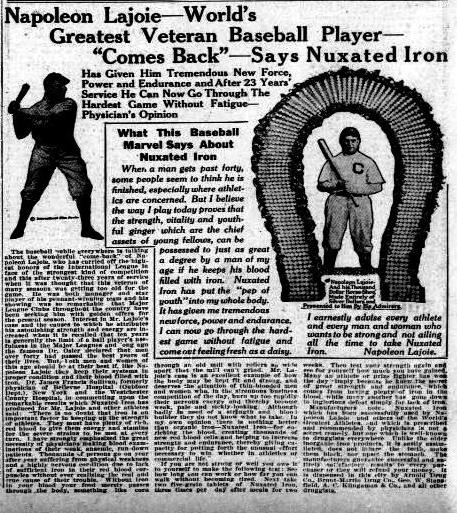
Not to be outdone by Ty Cobb, Harry Hooper and Joe Jackson who also endorsed the new “miracle drug” from DAE Health Laboratories in Detroit in 1916, Napoleon Lajoie took his turn in an advertisement for Nuxated Iron.

Napoleon Lajoie–World’s Greatest Veteran Baseball Player–‘Comes Back’ says Nuxated Iron Has Given him Tremendous New Force, Power and Endurance After 23 Years’ Service He Can Now Go Through The Hardest Game Without Fatigue–Physicians’s Opinion

Lajoie’s testimonial for the product said:

“When a man gets past forty, some people seem to think he is finished, especially where athletics are concerned.  But I believe the way I play today proves that the strength, vitality and youthful ginger which are the chief assets of young fellows, can be possessed to just as a great a degree by a man of my age if he keeps his body full of iron.  Nuxated Iron has put the ‘pep of youth’ into my whole body.”

Most doctors disagreed with Lajoie’s assessment.

The Journal of the American Medical Association took notice of the Nuxated Iron ad campaign and in October of 1916 had this to say about the “miracle drug:”

“Newspapers whose advertising ethics are still in the formative stage have, for some months past, been singing—at so much a song—the praised of “Nuxated Iron.”  The public has been that this nostrum is what makes Ty Cobb, “the greatest baseball batter of all time,” a “winner” and is what helped Jess Willard “to whip Frank Moran” besides being the “untold secret” of Willard’s “great triumph over Jack Johnson.”

All that DAE would say about the ingredients were:

“Formula—The valuable blood, nerve force and tissue building properties of this preparation are due to organic iron in the form of ferrum peptonate in combination with nux vomica (strychnine) phosphoglycerate and other valuable ingredients.

But alas, The AMA Journal was not impressed with the claims made by Nuxated Iron’s endorsements:

“The Journal felt that it owed it to the public to find out just how much iron and nux vomica there were in ‘Nuxated Iron.’  Packages of the nostrum…were subjected to analysis.”

What the analysis found was that the formula that made Ty Cobb a “winner,” offered no health benefits:

“There is only one-twenty-fifth of a grain of iron in each ‘Nuxated Iron’ tablet, while the amount of nux vomica…is practically negligible…In a dollar bottle of ‘Nuxated Iron’ the purchaser gets, according to our analysis, less than 2 ½ grams of iron; in 100 Blaud’s Pills, which can be purchased at any drug store for from 50 to 75 cents, there are 48 grains of iron.”

To sum up their analysis The Journal called the claims made by Nuxated Iron “the sheerest advertising buncombe.”

Cobb was said to have earned as much as $1000 for his endorsement, there is no record of what Lajoie was paid.

Nuxated Iron remained on the market until at least 1921; although by then they had sought a higher power to endorse the product.

Portions of this post appeared in one about the Cobb advertisement for Nuxated Iron, published February 15, 2013.


Griff’s Invention

5 Aug

Bob “Buster” Bescher arrived in Cincinnati a right-handed hitter.  In 1909, he led the National League with 54 stolen bases but hit just .240.

Bescher

Bescher

Bescher’s manager, Clark Griffith would compare him to Ty Cobb in an interview with Harry Salsinger of The Detroit News:

“If Bescher could hit he would probably set a pace for base-stealing that would never be equaled…Bescher gets away like Cobb, and his success lies mostly in getting away.  He is running in his first few steps.  He has a great pair of limbs and is in stride at the jump.  He is lightning fast.”

The Cincinnati Enquirer said:

“Bescher is a big, strong fellow, naturally left-handed, who was, unfortunately, coached to bat right-handed when he was a kid.”

Griffith set out to change that before the 1910 season.  In January, The Enquirer said:

“A device for batting practice was shipped to Bob Bescher at his home in London (Ohio) by Manager Griffith yesterday.  The arrangement was constructed according to Griff’s order, and it was designed to give Buster practice in batting left-handed before he goes South with the club six weeks or so hence.”

Clark Griffith

Clark Griffith

The paper described Griffith’s invention:

“The device consists of a ball of regulation size, but fitted with an extra cover, to which stout rubber cords are attached, one on each side.  One of the cords is to be fastened to the floor and the other to the ceiling, allowing the ball to swing loosely at about the height of the batter’s waist.  When the ball is struck with a bat, the flexible cord allows it to swing several yards and it returns with great force, coming back at about the speed of a pitched ball.  Then it is time for Buster to get busy with the club and soak it out again.”

A diagram of Griffith's invention.

A diagram of Griffith’s invention.

The Enquirer said Griffith hoped Bescher would add “30 or 40 points” to his average batting left-handed.

“He is the best base runner in the National League…Griff has sent him instructions to hit only left-handed with the new machine, and he hopes that Bob will be a regular Ty Cobb when he reports in March.”

Bescher batted almost exclusively left-handed during spring training in Hot Springs, Arkansas and became a switch-hitter that season, and seems to have benefitted from Griffith’s invention—but never became a “regular Ty Cobb.”

He improved his average to .250 in 1910 and again led the league with 70 stolen bases.  The next two seasons he hit .275 and a career-high .281, leading the league with 81 and 67 steals.

Bescher

Bescher

In 1913, Bescher slowed, hitting just .258 and stealing 38 bases.  He bounced from the New York Giants to the St. Louis Cardinals and Cleveland Indians over the next five seasons, never hitting better than .270 or stealing more than 39 bases.  He played minor league ball through the 1925 season.

“Slow Man’s Steal”

3 Aug

The New York Evening Journal said:

“The newest wrinkle in the baseball season of 1911 is a discovery by (John) Chief Meyers.”

Chief Meyers

Chief Meyers

The New York Giants’ catcher called is the “Slow man’s steal.”

“On two occasions now the Indian has pulled this play, and the National League is laughing because he worked it successfully on (Bill) Bergen and (George) Peaches Graham, two of the best catchers in the league.

“Some time ago the Chief realized that it would be impossible for him to trust his speed, which he has not, in stealing a base so he decided to work it with his head.”

Meyers, the paper said, knew that as a slow runner he could induce catchers to throw to first base if he took a long lead off.

“Having figured this out, the Chief gets on the bag and gradually eases himself down the line until he sees the catcher is watching him.  He then takes another step towards second base and the catcher naturally shoots the ball to first.  Instead of making an effort to get back to the base the Indian starts for second the minute he sees the catcher draw back his arm.  Both times that he has worked it the first baseman has been caught making a touch for the runner sliding back to first, only to look up and see him sliding into second. “

The Evening Journal called it “(O)ne of the greatest mirth-provoking plays on the diamond,” and said when Meyers worked the play on Graham and Boston Rustlers first baseman Fred Tenney, (T)he stands broke into howls of laughter.”

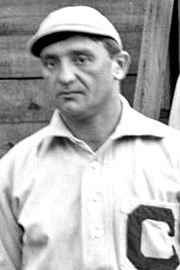
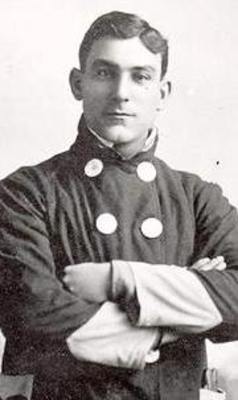
Fred Tenney

Fred Tenney

Meyers said:

“I call it the slow man’s steal because a fast man couldn’t do it.  The catcher would expect him to run to second and a good throw would head him off.  Besides, the pitcher would hold a fast man up at first and not allow him to take the lead.”

Meyers stole five more bases the rest of 1911, there is no record of how many of those incorporated the “Slow man’s steal.”

Lost Advertisements–“Fast Games–League Stuff”

31 Jul

blackpels

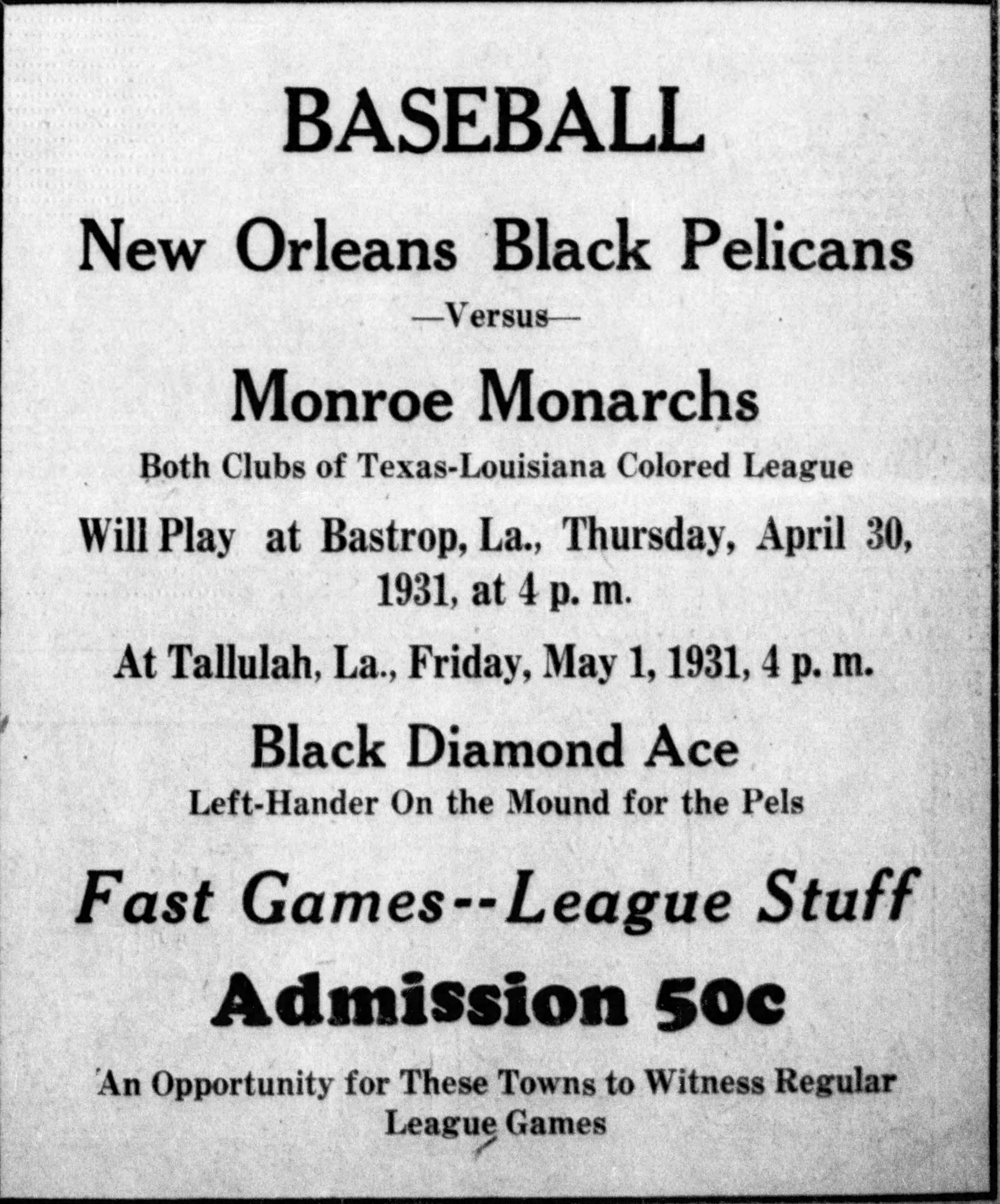
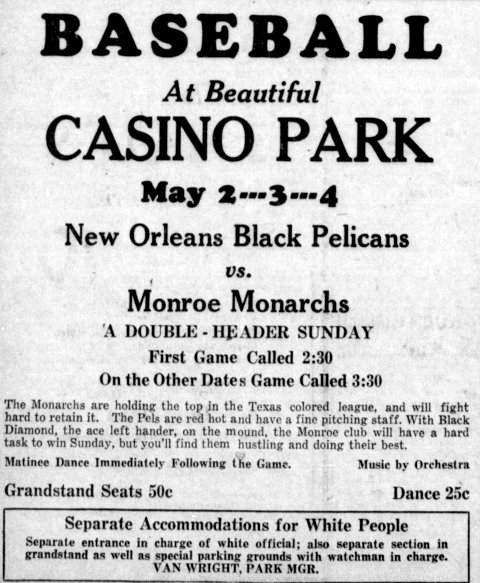
blackpels2Above are two advertisements for a six-game, three town series between The New Orleans Black Pelicans and the Monroe Monarchs in 1931  Both teams were members of the Louisiana-Texas Colored League.

After single games in Bastrop and Tallulah, the clubs played four games, including a Sunday doubleheader at Monroe’s Casino Park.  The ad for the two games in the smaller towns promised “Fast Games–League Stuff,” and “An opportunity for these towns to witness regular league games.”

Both advertisements said that “Black Diamond” would be on the mound for the Pelicans.

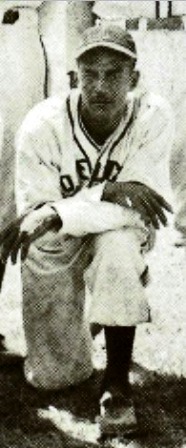
Pitcher Robert Pipkin was so popular in his native state in the early 1930s that he was more often referred to by the nickname “Black Diamond” than his actual name–which was just as often misspelled Pipkins or Pipken or Pipkens.  The Chicago Defender said the left-hander was six-feet tall and weighed 180 pounds.

Black Diamond

Black Diamond

Typical of Negro League players of the era, Pipkin played for at least a dozen professional and semi-pro teams from 1928-1942.  With the exception one season with the Cleveland Cubs (1931), he spent his entire career in the south.  In addition to the Pelicans, he played for the Birmingham Black Barons, the Houston Black Buffaloes and local New Orleans clubs like the Flinkote Giants and the Dr. Nut Algiers Giants.

While he had a somewhat mythic reputation in Louisiana, even in the white press–The Monroe Morning World called him “One of the greatest Negro hurlers in the entire country”–he was generally unknown in the North.

The note at the bottom of the advertisement for the three games in Monroe is a reflection of the times in Louisiana:

“Separate Accommodations for White People

“Separate entrance in charge of white official; also separate section in grandstand as well as special parking grounds with watchman in charge.”


“A Boy he Lived and a Boy he Died”

29 Jul

When Rube Waddell died on April 1, 1914, he was eulogized by sportswriters across the country.  Perhaps no one captured the essence of baseball’s most eccentric personality than William George “Billy” Murphy, sports editor of The St. Louis Star, who called the departed pitcher “The Peter Pan of the National Game.”

The other left-handed Rube

Waddell

Murphy said:

“A boy he lived and a boy he died.  He knew naught of the great problems of sociology or philosophy, but lived in the realm of love, adventure, romance, gallantry, and grace.

“The tales that are told of him, if written, would be classics in the folklore of childhood.  He was but a little child himself.

“A man of baseball genius, of an ardent temperament, reckless of physical laws and self-indulgent, he paid the penalty.”

Murphy

Murphy

The story of Waddell’s catching pneumonia while helping to stack sandbags to save the town of Hickman, Kentucky, which contributed to his contracting tuberculosis, the cause of his death, has been told often.  But Murphy told another story about Waddell’s stay in Hickman—at the home of Joe Cantillon, his manager with the Minneapolis Millers.

 “Memory of Rube Waddell will live forever in the heart of Joe Cantillon…’Rube’s big heartedness has never been exaggerated,’ said Joe.  ‘In fact, his generosity never has been fully told.  Year before last down at Hickman the Rube was with me at Christmas time.  A storekeeper called me up Christmas Eve and told me the Rube was inviting everybody who passed the store to step in and get fitted for a pair of gloves.  The merchant thought the Rube had gone daffy and wanted to know if he should stop him.  I told him ‘no,’ to let Rube have his fun, and if he couldn’t pay for it I would.  He gave away forty pair.

“Rube was lonesome and the Christmas spirit was upon him and he couldn’t do anything else that would have brought him more pleasure.”

JoeCantillon

Cantillon

Murphy said Waddell, for “all his buffoonery, was brave and would go the limit to help a woman or child.”

 “Waddell was the greatest of all the southpaws and his name will live forever in the history of America’s national game.

“There was not a selfish bone in his body and he did much good.  He was indeed a little boy who never grew up.  He made many happy and lived his life as he saw it.

“May his rest be as sweet as was his life.”

“Baseball is full of Authenticated instances of Woman’s Influence over it”

27 Jul

In 1905, The Washington Evening Star said:

“The unwritten history of baseball is full of authenticated instances of woman’s influence over it…Not infrequently a sweetheart’s or a wife’s objections to the game cause a star to forsake the diamond for work for which he is not fitted in the least degree, and at which he makes only a living at best.

Bill Lange is a case in point.  Up to (1899) he was one of the best ground coverers in the profession, and as a batsman had a high average.  From the day of his wedding, his wife kept at him to leave the game, urging him to take the step on the grounds of personal safety.  Bill reasoned with her and told her time and again that he knew of no other job for which he could make $4,500 in six months.  But Mrs. Lange was obdurate, and so, when his last season closed Bill ruefully announced to his manager that the diamond would never know him again.  And it has not, though he has annually been tempted by numerous flattering offers. ‘I have given my word to my wife,’ he says simply, ‘and so long as she feels as she does about the game I shall not take up the bat.’”


Bill Lange

Bill Lange

Lange never played another professional game

The Evening Star said that occasionally a wife would change her mind, and allow her husband to play professional ball; George “Del” Howard was one such player.

Howard—under his middle name Elmer—was a member of the Mattoon, Illinois team in the Indiana-Illinois League in 1899.

“Howard took as his wife the daughter of a prominent citizen of a central western town.  They had scarcely settled down after their honeymoon when Mrs. Howard began pleading with her husband to give up the game, naming as a reason that she had a strong dislike for it.  She was so insistent that finally Howard reluctantly severed connections with the game, and secured employment selling agricultural implements.

“But he did not give up all hope of returning to the diamond.  During the months that he was engaged in telling farmers of the merits of his particular make of wheat drills and mowers he spent his spare time endeavoring to get his wife interested in baseball. At first it was hard and slow work, and had to be accomplished diplomatically, but little by little he progressed to the point where Mrs. Howard would accompany him to games.  Then Howard explained every play made, told her about the players, introduced them to her, and made her acquainted with the woman folk of the players who were in the grandstand.

“At the end of four tedious years his work of education bore fruit.  Mrs. Howard came to him one day, confessed that she had changed her mind about baseball, declared that she would rather have him on the diamond than an agent for farm implements, and further caused him great joy by appending that he couldn’t get their quickly enough to suit her.“

After a five-year absence from baseball, Howard signed with the Omaha Rangers in the Western League in 1904.  He hit .316 in 144 games (finishing second to William “Bunk” Congalton of the Colorado Springs Millionaires for the batting title) and was purchased by the Philadelphia Phillies.

Del Howard

Del Howard

Traded to Pittsburgh for three players, the 27-year-old Howard made his major league debut for the Pirates on April 15, 1905, in Cincinnati with his wife Jessie in the stands.

Howard’s rookie season was his best; he hit .292 in 123 games with the Pirates.  He played in the major leagues for five seasons and was a member of the 1907 and ’08 World Series Champion Chicago Cubs.

Howard played and managed in the minor leagues through 1922. His wife Jesse died in California in 1933.  He died on his 79th birthday on December 24, 1956.

“Negro Baseball is Here to Stay”

24 Jul

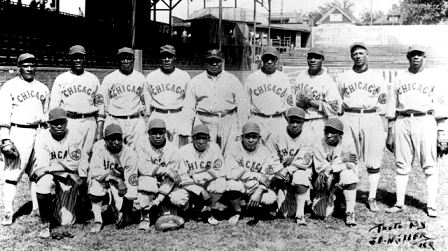
At the close of the first Negro National League season in 1920, The Kansas City Sun declared “Negro baseball is here to stay.”

The paper made several observations about the state of the league and its future and picked the league’s first all-star team.  Beginning with a bit of bragging, the paper said that in spite of the Chicago American Giants winning the pennant, “Kansas City proved to be the best Negro baseball city.”

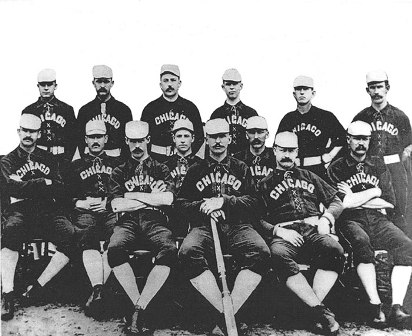
The Chicago American Giants

The Chicago American Giants

As evidence of Kansas City’s dominance, The Sun said:

“One hundred thousand White and Negro fans attended the Monarch games at Association Park the past season without the least bit of friction…(and) played to more local fans than the Kansas City Blues (of the American Association)…Negro teams used to play for a keg of beer, but now they play for $5,000 gates.”

The league as a whole, according to the paper, drew “more than 700,000 fans.”

but, it was not all a glowing review, The Sun did acknowledge one of the league’s biggest difficulties in the inaugural season, “(They) did not discover any real Negro umpires the past season;” inconsistent umpiring would remain an issue in subsequent years.

Perhaps most importantly, The Sun said the current season “Made baseball a safe investment,” and “Made baseball contracts legal.”

The final point was overly optimistic, as contract jumping and player raids were a serious detriment to the league throughout its 11-year run.

The Sun also picked the league’s first all-star team:

Pitchers:  Charles“Bullet” Rogan, Monarchs, Bill Drake, St. Louis Giants

Bullet Rogan

Bullet Rogan

Catchers:  George “Tubby” Dixon, Chicago American Giants and John Beckwith, Chicago Giants

First Base: Ben Taylor, Indianapolis ABC’s

Second Base: Bingo DeMoss, Chicago American Giants

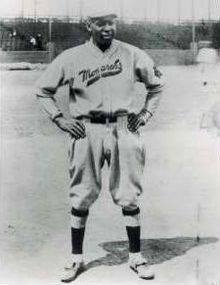
Third Base: Bartolo Portuondo, Kansas City Monarchs

Portuondo

Bartolo Portuondo, all-star third baseman

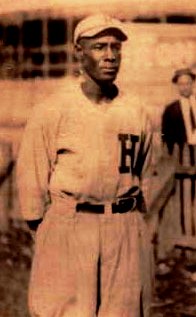
Outfield: Jimmie Lyons, Detroit Stars, Cristobal Torriente, Chicago American Giants, and Hurley McNair, Kansas City Monarchs

Utility:  John Donaldson and Tank Carr, Kansas City Monarchs.

“A Lajoie Bunt”

22 Jul

Francis “Red” Donahue was a teammate of Napoleon Lajoie in Philadelphia and Cleveland.  During a road trip in New York with the Indians in 1904 he told a story to Elmer Ellsworth Bates of The Cleveland News:

“I never come to New York without recalling the first time (Fred) Dutch Hartman of the old New York team ever saw Lajoie in a game.  Hartman had just began playing third base for the Giants and he had to be coached all the time by his teammates.

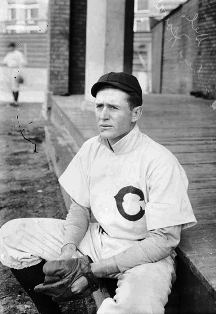
Fred "Dutch" Hartman

Fred “Dutch” Hartman

“The Phillies came over here and when Larry came to bat Hartman appealed to his fellow players for instructions.

“‘Play in for this fellow,’ was the tip.  ‘He’s liable to bunt.’

“Hartman went in about 30 feet and pushing his cap back on his head waited for the bunt.  The pitcher swung up a nice one and Larry smashed it.  The ball went away at awful speed.  It brushed the top of Hartman’s head, struck squarely in the middle of his cap and carried that piece of headgear with it clear out against the left field fence.  The other 17 players roared, but Hartman couldn’t see the joke.

Napoleon Lajoie

Napoleon Lajoie

“‘I thought you said he would bunt,’ said he.

”That was a Lajoie bunt’ said (Giants center fielder George) Van Haltren.  Wait and see him hit one with no cap to interfere with the ball.”