Archive | 2015

“It smacks of Old-fashioned Common Sense”

26 Jun

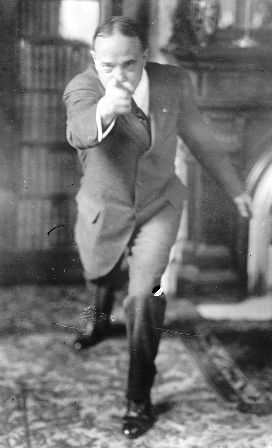
For more than a century, major league baseball has looked for ways to increase hitting.  Or, as Bozeman Bulger of The New York World put it in 1917

“Overhauling the rules of baseball to make it harder for the pitcher and more of a joy ride for the boys who wield the ash has always been a favorite winter pastime.”

Burger said former pitcher and current National League President John Tener was “(C)onvinced that the public wants more hitting.”

John Tener

John Tener

Tener and others shared their ideas for rule changes with Bulger on the eve of the meeting of the rules committee.

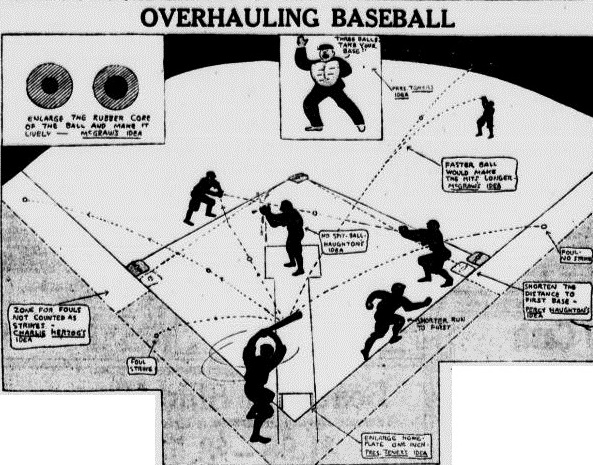
“Tener proposes making the home plate larger and at the same time allowing a batter to take his base on three balls instead of four.”

[…]

“Then comes Charlie (Buck) Herzog (of the New York Giants) with a suggestion, perhaps the most interesting of all.  It is the outpost of a real imagination that is comprehensive. Before announcing his plan, Herzog calls attention to the injustice of calling strikes on very hard hit line drives that fall foul by inches.  To all intents and purposes, those are real scientific hits, and the fact that luck causes them to fall foul should not act upon the batter as a penalty.  In other words, he is being severely punished for really doing scientific work. Herzog suggests, therefore, that a zone be described along those two foul lines between third and the fence and between first and the ground limits.  This zone should be at least ten feet in width, and any ball hit therein is not to be called a foul.  At the same time, it is not to be called a safe hit.  In other words, the batter loses his hit by bad luck, but it relieves him of an unjust penalty.”

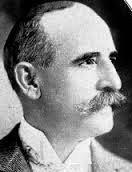
Buck Herzog

Buck Herzog

Incredibly, Bulger completely endorsed Herzog’s proposed rules change and claimed, “Every ballplayer in America” would agree, because “It smacks of old-fashioned common sense.”

Another rule change was proposed by Percy Duncan Haughton.  Haughton, a long-time college football coach (Cornell and Harvard), and Harvard baseball coach in 1915 (he also played both sports at Harvard) had become a part-owner of the Boston Braves in 1916.  Bulger said:

“Mr. Haughton’s scheme has not been taken very seriously by those who were studying these problems while he was still a football player, but there is a real satisfaction in finding a new magnate so much interested in the sport.  The President of the Braves proposes that the distance from third to home and from home to first be lessened by several inches.  It might help the batter a little, but an extreme change like that would be pecking at the one fundamental of the game that has stood all tests.”

The most practical suggestion came from Giants Manager John McGraw, who proposed that no rules be changed, but advocated a more lively ball.

Bulger, however, was sure some rules would change:

“(T)he powers that be appear to be intent upon really turning out a new model.”

The New York World's rendering of the proposed changes.

The New York World’s rendering of the proposed changes.

When the meetings at the Waldorf Astoria in New York ended two weeks later, Jack Veiock of the Hearst Newspapers International News Service said:

“(I)t was confidently expected that the members of the rules committee would get together and make a few alterations in the baseball code as it stands today.

“But the rules committee did nothing of the kind  The wise old heads who are in control of baseball are satisfied with the rules.”


“If you say that Man was not out, you are a Liar”

24 Jun

At the height of Billy Sunday’s popularity as America’s most influential evangelist, his “gentlemanliness,” and ability, on the baseball field became more legend than fact.

Billy Sunday, evangelist

Billy Sunday, evangelist

John Brinsley Sheridan of The St. Louis Post-Dispatch attempted to dispel some of the legends in 1917:

“Sunday tells young men now ‘to play the game’ uprightly.  This is how Sunday played it in 1885:

“The Browns and Chicago were playing for the world’s championship before 10,000 persons, who paid from 25 to 75 cents to see the game…The Browns kicked on the decisions of Umpire (David F. “Dave”) Sullivan and refused to play unless he retired from the game.  They could not do that sort of thing on the lots nowadays.  When Sullivan retired, (Cap) Anson and (Charles) Comiskey, the leaders of the teams, agreed that William Medart, a pulley manufacturer of St. Louis, should umpire.  Medart was a spectator at the games.  He put on a mask and a protector and proceeded to umpire. “

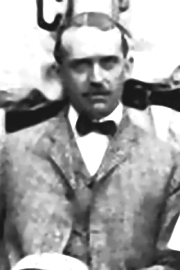
William Medart

William Medart

In the ninth inning of game four, with Chicago trailing 3 to 2, White Stockings pitcher Jim McCormick reached first on an error by Comiskey.  A contemporary account in The Chicago Tribune said:

“(McCormick) was standing with one foot on the bag when Comiskey made a motion to throw the ball.  He never moved, but by force of habit Comiskey touched him and laughed.  The umpire, who was not appealed to at all, electrified the spectators and players by calling McCormick out.”

Sheridan said, “This is how a baseball reporter of the day (from The Post-Dispatch) described what happened next:

“Sunday, fists clenched, eyes blazing, ran at Medart and cried, ‘Robber, robber.  That man is not out.’  Medart advanced to meet Sunday with firm step and beetling brow and aid, ‘If you say that man was not out you are a liar.’  ‘Who says that I am liar?’ Cried Sunday. ‘I do,’ said Medart, assuming a posture of defense.  ‘I’ll make you pay for that,’ cried Sunday, advancing on Medart.  ‘You can collect now,’ replied Medart, boldly.”

McCormick also attempted to attack Medart, but Mike “King” Kelly “(S)topped McCormick and then forced Sunday to sit down.”

But the future evangelist could not be calmed down:

“Sunday’s eyes were blazing and his teeth were set.  When he sat down he continued to abuse Medart, who said, “Shut up your mouth, there Sunday, or I’ll put you off the field.’ Sunday shut up his mouth, but continued to glare at Medart.”

Medart, before his death in 1913, described the scene to Sheridan:

“Billy was a cocky guy in those days and was not disposed to back down for any man.  Rather fancied himself.  I was somewhat of an athlete, gymnast and boxer.  I fancied myself, too.  I am sure that Sunday and I would have collided had it not been for Mike Kelly.

“Sunday was livid with rage.  I was mad myself.  I did not seek the job of umpiring.  I only took it to ensure the progress of the game.  I was there as a mere spectator.  Probably I was the only responsible man in the stand that was known to the managers of both teams, and, therefore, acceptable to them.  I did the best I could, but I have no doubt my work was bad.  I had not umpired ten games in my life.  I was just an amateur with a taste for ball games(Medart had umpired National League games in 1876-77 and worked at least one more St. Louis game in 1887).”

Sheridan said the man responsible for keeping Sunday and Medart from coming to blows, was also the first, and a somewhat unlikely, supporter when Sunday was “saved.”.

“Most of the baseball players of the day were men who lived lightly.  Among the gayest and lightest of the lot was Mike Kelly, the famous $10,000 beauty, by many said to have been the greatest of all baseball players.  Kelly had been reared in the Roman Catholic faith, but the “king” of the ballplayers was not overburdened with religion.  Ballplayers all speak well of Kelly.  He is their idol.  He was wild and wooly, he lived life and died at 35 [sic, 36], but he was sweet to all men.  Most of the ballplayers of Sunday’s day were wont to ridicule him for his conversion at first.  All but Kelly, the wildest of the wild.”

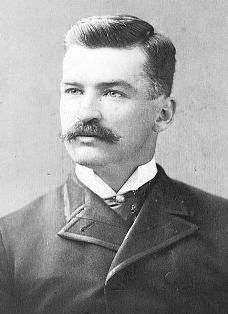
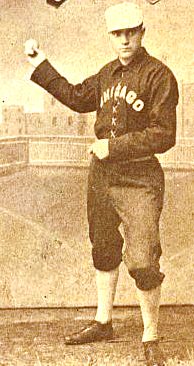
Mike "King" Kelly

Mike “King” Kelly

According to Sunday:

“Kelly was the first man to meet me after the news of the conversion became public.  He shook me by the hand and said, ‘Bill, I am not much on religion myself, but I am strong for a man who honestly believes.

“After that, the boys all were for me.  Whatever Kelly said was law with them.”

As for Sunday’s ability as a player, Sheridan said:

“Many people say Sunday is a great evangelist.  He was not a great baseball player.  One of his many biographers says that Sunday always tried to hit the baseball where it would hurt his opponents most and help his friends most.  The fact of the matter is that Sunday was lucky to hit the ball at all…(I)t is certain that, not at any time, was Sunday’s bat feared by opposing pitchers or players.

Billy Sunday

Billy Sunday

“Nor was the evangelist-to-be a great fielder or runner.  He was very fast on his feet.  That helped him a lot (and) in fact was his best asset as a ballplayer…He could outrun such men as Curt Welch and Dickey Johnston 3 yards to 2 yards, but Welch and Johnston could outfield Sunday, for they got quicker starts on batted balls than Sunday.  When it came to baserunning much slower men could beat Sunday because they knew when to run and how to get a good start on the pitcher.  Sunday never learned these little niceties of baseball.  As a matter of fact, hey are not really learned.  They are like Sunday’s gift for preaching, something given a man, his genius.”

“Probably the ‘Boniest’ Bonehead Play Ever”

22 Jun

While some of the details changed in subsequent tellings, this story stayed substantially the same from when it was first presented in a column by sports writer William A. in 1913, until the final published version in 1957 in The New Orleans Times-Picayune.  One version called it, “Probably the ‘boniest’ bonehead play ever”

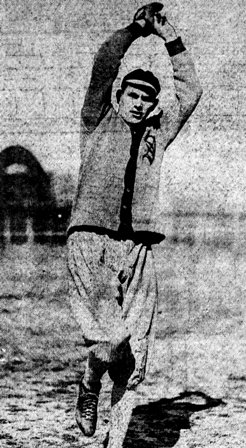
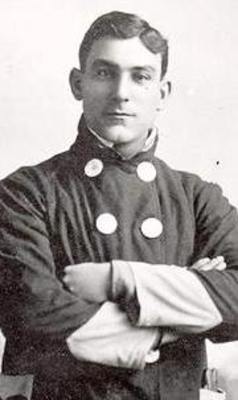
The story was told by and told about lefty Evan “Rube” Evans.  Born on April 28, 1890, in Sebring, Ohio, Evans was a career minor league pitcher who, when the story first appeared, seemed to be headed to the big leagues. 

Rube Evans

Rube Evans

The tall–he was reported by various sources as anywhere from 6′ 2″ to 6′ 4″–began his professional career with the Dallas Giants in the Texas League in 1910; he was 15-12 for the pennant winners, but The Dallas Morning News said he didn’t “take baseball seriously” until the following year, when he was 18-16 for the Giants:

“Before that, it seemed, the big, husky flinger looked at playing baseball something in the light of a joke.  Last season, though he came back into the game with a different viewpoint. He seemed to realize that ball playing was a man-sized business.”

After his 1911 performance, Evans’ contract was purchased by the New York Giants, and he joined the team for spring training in Marlin, Texas in 1912.  The Morning News said if he maintained his new found focus “and works as hard as he knows how to work he ought to stick.”

Evans quickly impressed the Giants with a pitch “takes a most freakish break,” according to The Washington Times:

“Rube Evans, the Giants left-handed recruit pitcher from Dallas, surprised bot Manager (John) McGraw and Coach Robby (Wilbert Robinson) by showing them a curve that is entirely new to the big league…The ball is delivered in exactly the same manner as the spitball, but he does not moisten it.”

The paper did not elaborate on how Evans’ “dry spitter” was different from versions reported on during previous seasons–including the one thrown by Christy Mathewson of the Giants–but according to The New York World, “McGraw says he will try and teach it to Rube Marquard.”

Despite his “dry spitter,” Evans failed to make the team and was returned to Dallas where he posted a 22-12 record for the Giants.

In 1913, he joined the New Orleans Pelicans in the Southern Association but appeared to be headed to the Cleveland Naps before he threw a pitch in the regular season for the Pelicans.  In March, Evans shut down the Detroit Tigers 3 to 1 on five hits and followed that up with a four-hitter (and 3 to 1 victory) against the Naps.

The Cleveland Press said, “(Naps Manager Joe) Birmingham plans to cut down his squad considerably.  It is said recruits (Hugh) Peddy, (Pete) Shields and (Ward) McDowell will be left here in trade for one good pitcher, probably Southpaw Rube Evans.”

With Evans apparently on the verge of joining the Naps, the story of his “bonehead” play was told by Phelon, then repeated widely:

“(Evans) has one curious habit—a trait which has aroused much wonder on the part of every manager under whom the southpaw has been toiling.  When given an order by his manager or captain, Mr. Evans always stops, cocks his ears, and demands a repetition of the directions.  Naturally he is first taken for a simp, or bonehead, but when further acquaintance with him shows that he is a gentleman of intelligence and high mentality, the field leaders are muchly puzzled.

“’I always want my orders repeated,’ quoth Mr. Evans, ‘so that I will never again make such an error.”

(The 1913 version of the story, which quotes Evans,  places the incident in McKeesport, Pennsylvania, some later versions say it happened in 1913 with the Pelicans, still others say it was in Portland, Oregon; however, the original publication predates Evans’ time on the West Coast which did not begin until May of 1914).

Evans said he had pitched into the ninth inning when the opposing team put a runner on third with one out, when his manager told him if the other team attempted a squeeze play to “bean him.”  Evans said:

“’I knew no more what a squeeze play was than the man in the moon, but my orders rang in my ears as I started winding up.  Just as a swung up my arm, the fellow on third tore for the plate…I took careful aim at the oncoming runner, and pickled him with a fine shot to the back of the cranium.  Three seconds later the crowd was coming towards me with roars of fury, and I got over the back fence just in time.

“’Well how was I to know that I should have hit the batter and not the runner?  Ever since I have insisted on duplicate orders, so that I would know just what to do.’”

His acquisition by Cleveland never materialized and he had a disappointing 12-15 record in 1913, in a season split between New Orleans and the Birmingham Barons.

It is also in question whether Phelon’s characterization of Evans as a “gentleman of intelligence and high mentality,” was entirely accurate given his inability to stick with clubs who were impressed with physical abilities.  After his second chance to pitch in the majors didn’t materialize, the remainder his of career was marked by long stretches of mediocrity, charges of bad behavior and comparisons to another left-handed “Rube.”

In August of 1913, he was suspended for the remainder of the season by the Birmingham Barons for, according to The Birmingham Post-Herald, “Failure to keep in condition.”  The Sporting Life’s Chandler Richter called him “Erratic,” The Oakland Tribune said he was”Eccentric,” a wire service retelling of the “beanball” story from 1915 said he “earned a nationwide reputation as a ‘squirrel,” another called him “the real eccentric,” when compared to Rube Waddell.

The other left-handed Rube

The other left-handed Rube

His two-year tenure with the Portland Beavers in the Pacific Coast League (PCL) began when he wore out his welcome in New Orleans in May of 1914 and was sold to the Beavers.  It was particularly rocky.  The Spokane Daily Chronicle said Evans and Beavers manager Walter “Judge” McCredie “got along like a pair of strange bulldogs.” He was suspended at least once, again for the euphemistic “failure to be in proper condition,” and gave up a game-winning home run to Jack Ness of the Oakland Oaks when he accidently threw a pitch over the plate while attempting to intentionally walk Ness.  At the close of the 1915 season, Portland let him go for what The Portland Oregonian called “His inability to take care of himself.” Of his 9-22 record the paper said:

“Rube ran into gobs of adversity.”

After leaving Portland, Evans played parts of three seasons for the Salt Lake City Bees in the PCL–in 1917 he was 21-9, but when McCredie was named manager of the Bees in 1918, Evans time with the team was nearly over.  Before the season, The Oregonian said, “Evans did not take kindly to the idea of having to take orders” from his former manager and was threatening to jump the club.  He finally did jump in June after appearing in 14 games and posting a 3-8 record.

Evans went to Portland and finished the 1918 season in the semi-pro Shipyards League, The Oregon Daily Journal said upon his arrival:

“Rube Evans was through at Salt Lake and McCredie was probably saved the trouble of wearying his hand by writing out Rube’s release, when Rube left.”

In 1919, he played for the Rupert franchise in the semi-pro Southern Idaho League; while successful, his reliance on the emery ball for his success didn’t make him friends.  The Twin Falls Times said:

“When Rube Evans lugged the emery ball into the S.I.L. he failed to do anything beneficial to the league.  Rube will win a few more games for the Rupert club, but he has lowered the standard of sport in the league.”

Evans had one more season in professional baseball, posting a 10-7 record with the Regina Senators in the Western Canada League in 1920.  In an August 15 doubleheader against the Edmonton Eskimos Evans was ejected for arguing with the umpire while facing the second batter of the first game; he came back to lead the Senators to 5 to 3 victory in the second game, giving up two runs in 7 2/3 innings, and hitting a three-run home run in the sixth.

Rube Evans

Rube Evans

After the 1920 season, he returned to Ohio and spent the next decade playing semi-pro baseball there and in Western Pennsylvania.  His last headlines came in 1924 when he pitched six innings for the Sharon (PA) Elks team in an exhibition game against the New York Yankees.  The Elks lost 10-8, Babe Ruth went 2-4 with a double for the Yankees.

Evans’ playing days ended in Akron, Ohio.  He pitched for and managed the Goodyear Tire and Rubber Company team, and stayed on with the company as a rubber worker.  He died on January 30, 1950.

A clue to some of Evans’  erratic behavior is contained in his death certificate.  The pitcher spent the last three and a half years of his life in Ohio’s Cambridge State Hospital; his cause of death was listed as “General Paresis,’ brought on by syphilis.

A shorter version of this post appeared on June 3, 2013

Lost Pictures–Roger Bresnahan and Toy

19 Jun

bresnahanandtoy


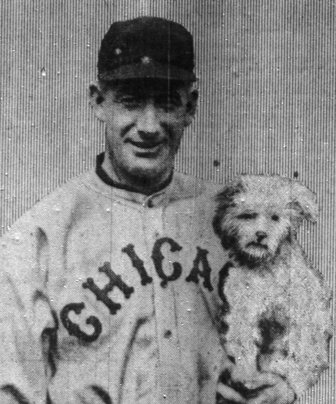
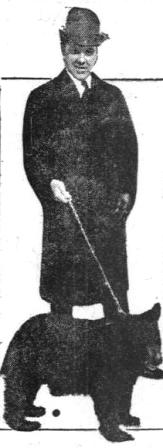
The Chicago Cubs were 14 games over .500 and in second place, just two a half games behind the New York Giants on July 25, 1914.  The team lost 14 of their next 17 and wound up in fourth place.  (the Giants finished second to the Boston Braves).  At the end of the season, first-year Manager Hank O’Day was let go by the Cubs and returned to umpiring.  Catcher Roger Bresnahan was named as O’Day’s replacement.

Later in the off-season, there was another drama taking place off the field.  It involved Clara Maduro:

In December, The Chicago Daily News said:

“Because the female of the species is more deadly than the male, Clara Maduro, the brown bear mascot of the Cubs, must die.  The wee cub, which fans saw drinking milk from a bottle or eating ice cream cones at the West Side park last summer, has grown to giant proportions, and while of a pleasant disposition is inclined to break loose at times. Hence, Clara will be executed New Year’s Day.”

A month earlier, The Chicago Tribune reported:

“‘There’s a woman being strangled at Wood and Taylor Streets,’ was the message received by Desk Sergeant Comstock of the Warren Avenue station last night.  ‘Send a lot of policemen.’

“The patrol wagon with a number of detectives was sent to the location, which proved to be on the west side of the National League ballpark.

“A loud howling was heard from the inside, and upon investigation it was found the bear mascot of the Cub team, which had been locked in a cage in the team’s quarters had broken its chains and was roaming about.”

After an outpouring of outrage and concern from Chicagoans, The Daily News reported that Clara Maduro “has been saved through the protest that followed the announcement.”  The bear was initially placed with a local saloon owner named Joe Biggio; later reports said the bear went to the Lincoln Park Zoo.

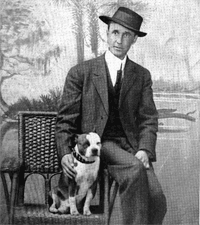
With Clara out, it was determined that a bear cub mascot was not the best idea for 1915.  So in March, the team introduced their new mascot, Toy.

The Tribune said:

“‘Toy,’ the 1915 Cub mascot is a canine of high degree and more likely to become a permanent fixture than the baby bear which grew so big and developed such a crabbed disposition that he [sic] had to be discarded last fall.  ‘Toy’ used to be the mascot and assistant caddie of a feminine golf expert who was a visitor at Tampa during the Cubs stay there and who became such an ardent baseball fan that she bestowed her pet on the team when the Cubs departed for the north.”

The Cubs started the season strong and led the National League until mid-July, but the team faltered badly and ended the season in fourth place with a 71-82 record.

Toy did not “become a permanent fixture;” when Charles Weeghman bought the team after the 1915 season he replaced both Bresnahan and Toy.

Weeghman did not learn from the past and introduced the Cubs new mascot in November.  A bear cub whose mother was killed during a Wisconsin hunting trip, was presented to the team by the hunter, either a state senator named Albert J. Olson or Cubs stockholder J. Ogden Armour–newspapers reported both, but the bear’s name, Joa, would suggest the latter.

It is unknown what became of Toy.

Weeghman introduces Toy's replacement

Weeghman introduces Toy’s replacement


Things I Learned on the Way to Looking up other Things #15

17 Jun

Fullerton’s Prediction

Seven years before he watched the events of the 1919 World Series unfold from the press box, Hugh Fullerton warned readers of The Chicago Record-Herald:

“Baseball as a great national sport is in greater peril today than ever before.  Not until the present week did I realize this fact.  The gamblers, bookmakers and handbook men, who ruined horse racing…and who made fighting a noisome scandal, have attached themselves to baseball this year as never before”

Hugh Fullerton

Hugh Fullerton

“The King of them all for Superstitiousness”

In 1916, Napoleon Lajoie, then a member of the Philadelphia Athletics, told The Cleveland Press:

“I have known many a ballplayer who collected hairpins, held his breath if he saw a circus horse, but Bill Armour was the king of them all for superstitiousness.

Bill Armour

Bill Armour

“If you put a ladder in front of the door to his room Bill would have jumped out of the window sooner than have come under that ladder.  I think he would have stayed in there and starved to death rather than let the ‘jinx’ take him overboard because he went under a step-ladder.   Me?  No, I am not superstitious, it’s all nonsense.

“Going to fetch me a black cat?  Don’t bring it up here; we have enough bad luck as it is without any black cat hanging around the clubhouse.”

Napoleon Lajoie

Napoleon Lajoie

Black cat or not, Lajoie was correct about the Athletics “bad luck.”  The team finished in eighth place with a 36-117 record.  The forty-one-year-old Lajoie hit just .246; 92 points below his career average.  He retired at the end of the season.

“Any old Manager can run a Team of real Baseball Players”

Bill Dinneen pitched in the major leagues for 12 seasons, and a month after his playing career ended he began his 28-year tenure as an American League umpire

Bill Dinneen

Bill Dinneen

In 1910, he told Joseph Samuel “Joe” Jackson, sports editor of The Washington Post, how major league clubs should allocate money:

“’If I were a club owner, I would invest $15,000 in a scout and $5,00 in a manger  And old manager can run a team of real baseball players  But the best leader in the world can’t make bad material good  Every major league team needs a thoroughbred judge of raw material more than a teacher of baseball tricks’’’

Jackson said Dinneen’s observation confirmed what he thought while watching the Philadelphia Athletics beat the Chicago Cubs four games to one in that year’s World Series

“His remarks come merely to emphasize what the world’s series showed—that a club that is hitting the ball over the lot, and giving its pitchers support, will set at naught all schemes to beat it by carefully thought out plans that might be applicable if the other fellows would stop making so many base hits”

John Milton Dabney

15 Jun

Born in November of 1867 in Richmond, Virginia, the son of former slaves, John Milton Dabney spent his childhood working for his father who became a successful restaurant owner and caterer in Richmond after the Civil War.

In 1885, Dabney went to work at the Argyle Hotel in Babylon, Long Island.  He joined the hotel’s baseball team (ostensibly composed of the hotel’s service workers, but some of the best amateur players on the East Coast were recruited for the team by head waiter Frank P. Thompson, as Dabney likely was), intended to provide entertainment for the summer tourists.

The Argyle Hotel Athletics fared well against the strongest amateur teams in the area and caught the eye of a white promoter, John F Lang.   Under Lang’s management, the team began touring that summer as the first professional African-American baseball team, the Cuban Giants.  The following year, Lang sold the team to Walter Cook.

John Milton Dabney

Initially a left fielder, Dabney also pitched and played first base for the Cuban Giants in 1885-86 and for the Cuban X-Giants in the 1890s.

Dabney went to work for the United States Postal Service and played baseball in Richmond for decades–he also played football for the Richmond Athletic Club and worked as a boxing referee.  According to the Baltimore Afro-American, “No amateur team in Richmond was complete unless Milton Dabney played first base.”

In 1897, Dabney  captained the Eclipse, a team based in Richmond, The Richmond Planet said:

“Dabney, who will play first base is perhaps one of the most celebrated colored players in the United States  He has played on clubs all over the country, notably with the Cuban Giants  He knows the game from A to Z and can be depended on at all times”

While Milton Dabney was a pioneer of black baseball, his older brother Wendell Phillips Dabney was a pioneer in another field.  An author, composer, and publisher of The Enterprise, and later The Union,  Cincinnati-based black newspapers, The Chicago Defender called him “The dean of Negro journalists.” he was one of the most prominent African-American newspaper publishers and political activists of the first half of the 20th century.

Wendell Phillips Dabney

Wendell Phillips Dabney

Dabney eventually went to live in Newark, New Jersey, where his son owned a funeral home, he died in a nursing home there in November of 1967, four days short of his 100th birthday.  Until his death, he was oldest surviving retired postal carrier in the country, and the last surviving member of black baseball’s first professional team.

Lost Advertisements–The Big Train for Coca-Cola

12 Jun

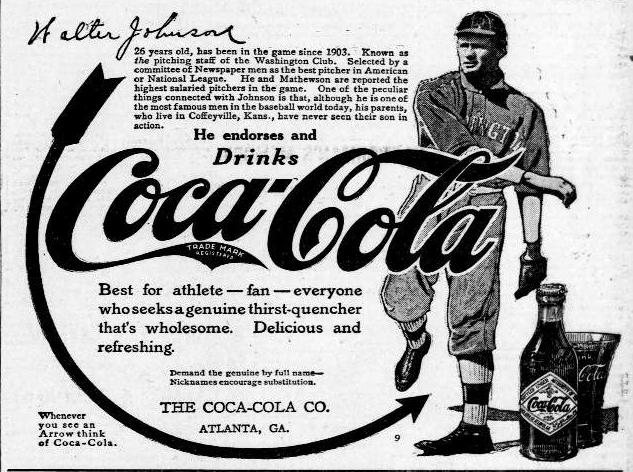
bigtrainA 1915 advertisement for Coca-Cola featuring Walter Johnson.

“26 years old (Johnson was 27 when the ad appeared, but fact-checking was a bit loose in ads of the era)  has been in the game since 1903, Selected by a committee of newspaper men as the best pitcher in American or National League.  He and Mathewson are reported the highest salaried pitchers in the game.  One of the peculiar things connected with Johnson is that, although he is one of the most famous men in the world today, his parents, who live in Coffeyville, Kans. have never seen their son in action.”


“Their Joy was Unrestricted”

10 Jun

After Charles “Cy” Swain lost his leg in an accident after the 1914 season, he attempted to stay active in baseball by forming a team called the Independents with another former player, Tommy Sheehan.

Cy Swain

Cy Swain

Swain managed the team which was comprised of minor and major leaguers who spent the off-season on the West Coast.

In the early spring of 1916, the team played their most unusual game.  The San Francisco Chronicle described the scene:

“For the first time in the history of the State Prison across the bay in Marin County, the convict baseballers were yesterday permitted to play against an outside team…The attendance? Good!  Something like 2300 men and women prisoners, even including the fellows from solitary confinement, took their seats to watch the game, and their joy was unrestricted.”

Swain’s Independents were playing the Midgets, the baseball team at San Quentin.

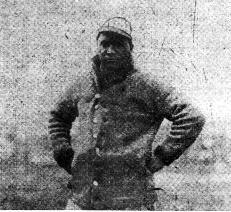
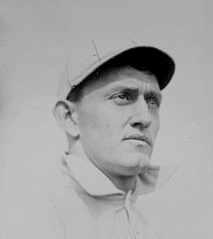
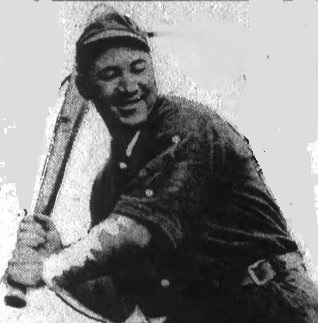
The paper said Swain received “an ovation that lasted for five minutes,” and that the prisoners cheered loudly for Ping Bodie, Spider Baum, and Biff Schaller.

Ping Bodie

Ping Bodie

“They know a good play or a bad one, just as you do from your comfy seat at Recreation Park, and they did their rooting accordingly.”

Because of prison rules, the game recap was slightly different than usual:

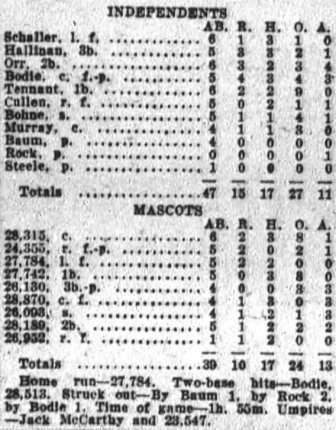
“Names are barred when it comes to San Quentin inmates, but it is worthy of note that No. 27784 came through with a home run, while third sacker 26130 pulled a fielding stunt that would land him with the Coasters if he were a free agent.

“Warden (James A.) Johnson, however, has his players fully signed, and he is protected with a reserve clause that is far more binding than the foundation of organized baseball. “

Jack McCarthy, a former American League and Pacific Coast League umpire, worked the game with “No. 23547,” and “to their credit be it said, the double system worked perfectly.”

The game was a slugfest, won the Independents 15 to 10—Bodie, Schaller and Ed Hallanan had three hits each.

The Box Score

The Box Score

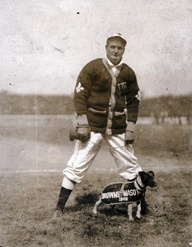
Swain’s independents returned to the prison again the following year, beating the Mascots 9 to 6.  After the success of those games, baseball against outside teams became a regular feature at San Quentin.

Cy Swain

8 Jun

Charles R. “Moose” “Cy” Swain was for a short time, one of the best-known players on the West Coast and his brief time as the West’s home run king is all but forgotten.

Born in Palo Alto, California, Swain made his professional debut with San Jose franchise in the California State League in 1904.  Years later, Mike Steffani, San Jose manager, told The San Jose Evening News that his “discovery” of Swain was an accident.

Steffani was in need of a shortstop, and Swain’s brother Ira, who played at Stanford University,  was recommended to him by pitcher Win Cutter.  Cy, who accompanied his brother to San Jose, played first while Steffani worked out Ira at short.  Steffani said he told Cutter:

“I think young Cy is the best player.  I like the way he handles the ground balls.  He acts like (Charles) Truck Eagan to me.”

Cy Swain was signed.  Ira was sent home.

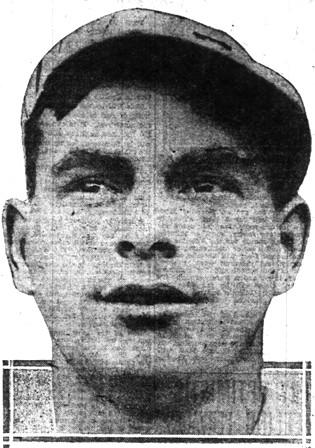
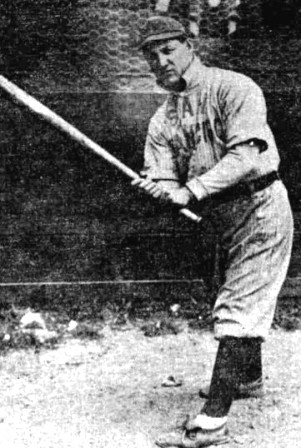
Charles "Cy" Swain

Charles “Cy” Swain

Swain was called “a hard hitter,” who struck out often.  He also apparently enjoyed a drink.  After hitting a disappointing .239 for the Spokane Indians in The Northwestern League in 1907, Swain was traded to the Butte Miners.

In announcing the news, The Spokane Press said, “Charley isn’t exactly a temperance man.”   The paper said that when the Spokane owner sent him a contract with a temperance clause, Swain wired back, “Send me two of those; I may break one.”

Swain, who also struggled with weight issues, went from Butte to the Tacoma Tigers, then the Vancouver Beavers.

In July of 1910, he was leading the league with a .298 batting average when the Washington Senators offered $1800 for his contract.  The Vancouver Daily World said the offer was turned down.  The club’s owner/manager/shortstop Bob Brown told the paper:

“That pennant looks awfully good to me, and until I have it clinched I intend to hold the team intact.  There have been numerous other clubs after Charlie’s services, but they will all have to wait until the season is over.”

Swain slumped badly the rest of the year and finished with a .250 average (and a league-leading 11 home runs). The Beavers finished second, six and a half games behind the Spokane Indians.

Despite Swain’s sluggish finish and questions about his weight—The Seattle Star said he was “carrying 220 pounds”– Washington purchased his contract at the end of the season.  Just before he reported to the team in Atlanta in February of 1911, The Washington Herald said:

“There is a reason why this man Swain should not be overlooked when the time comes for the final selection of the Nationals.  It was Cliff Blankenship who was sent scouting for Walter Johnson five years ago and who signed him…and Blankenship is sponsor for Swain.”

Cliff Blankenship

Cliff Blankenship

Swain responded to a letter from William Peet, The Herald’s baseball writer, about his weight:

“I note what you say about certain of my friends on the Western papers claiming I have taken on so much weight that I am handicapped thereby.  Just write them a personal letter and bet them all you’ve got that I haven’t taken on more than five pounds since I quit playing last fall…I will join the Washington club in shape and try my best to make good.”

Early reports from Atlanta in the Washington papers, The Post, The Times, and The Herald sounded promising:

“For a big fellow Swain is a wonder when it comes to covering ground in the outfield.”

“Though a six-footer, weighing 200 pounds, he runs like a sprinter.”

“He hits hard…his most distinguishing trait (is) a willingness to work and an inexhaustible fund of good humor.”

Swain was hitting .273 in spring games when he became sick (either a cold or the flu, depending on the source) and did not appear in a game, or practice with the team for a week.
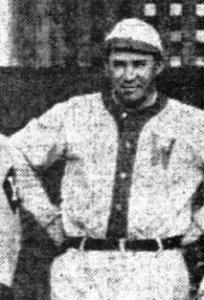
Swain in Atlanta with the Senators

Swain in Atlanta with the Senators

On April 6 The Herald said:

“Swain and Manager Jim (McAleer) had a long talk this morning in the clubhouse and when the Vancouver husky emerged his face was wreathed in smiles.

“’It’s all right, boys,’ he said.  ‘I will probably go back to the Pacific Coast.  Had a nice chat with the boss and told him that if he decided he couldn’t use me to ship me (West) and he promised to do so.”

Swain was returned to Vancouver, where he hit. 309 and helped lead the Beavers to the Northwestern League pennant.  After hitting .286 for the last place Sacramento Sacts in the Pacific Coast league in 1912, Swain was sold to the Victoria Bees in Northwestern League in May of 1913, setting the stage for his record-breaking season.

On August 1, The Oakland Tribune said:

“(Swain) is electrifying the natives in the Northwestern League.  Playing for Victoria, up to last Sunday, Cy had connected with 17 home runs and was hitting .329.”

He hit 17 more by September 18.  Swain’s 34 home runs broke the previous West Coast high—Ping Bodie hit 30 for the San Francisco Seals in 1910 (Art Bues had the previous league record with 27 in 1910)—and his .329 average was a career high.

He benefitted from the small dimensions of the league’s parks; The (Portland) Oregonian said fourteen of his 34 home runs cleared Victoria’s 270 foot center field fence and 11 more came at Seattle where the left and right field fences were just 237 feet from home plate.

After another solid season in the Northwestern League in 1914–.310 with 12 homeruns—Swain was traded to the Minneapolis Millers in the American Association for Fred “Newt” Hunter on November 24.

While most of the newspapers in Northwestern League cities shared the view of The Spokane Chronicle, that “The exchange will effect a promotion for Swain as he will play in a class AA league, which has been his ambition.”  The Seattle Star, however, despite the numbers he put up, raised some doubts about Swain:

“It is not likely that Seattle will be disappointed in the trade…Swain did not deliver last season like the fans had hoped and expected.  He was the joke of the league in the pinches.”
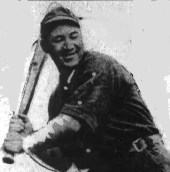
Swain

Swain

Just three days after the trade, Swain was working his off-season job for the Pacific Telephone and Telegraph Company in San Francisco, when he fell from the back of a company truck which ran over his right leg.  On December 4, the leg was amputated.

The San Francisco Chronicle said:

“He was counting on making good with Minneapolis with the view of someday stepping into the big league, the dream of every ballplayer.  What Swain will do now with one limb lost has not been decided, for the unfortunate player is overwhelmed with grief at the sudden termination of his diamond career.”

Benefit games were held in San Francisco and Tacoma, drawing 4000 and 7000 fans; the games raised more than $4000 for Swain.

He used the money to open a cigar store in San Francisco with another former player, Tommy Sheehan.  The two also organized a team, managed by Swain, called the Independents.  The team was comprised of West Coast professionals—including Ping Bodie, Spider Baum, and Biff Schaller–and played during the winter and early spring.  One of their games in the spring of 1916 was the first game ever played by an outside team on the grounds of San Quentin Prison.  Swain’s team won 15 to 10.

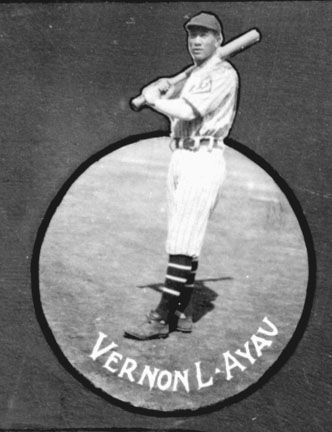
In November of 1916, Swain and Sheehan organized team made up of major leaguers and West Coast players to travel to Hawaii for a series of games.  The team played local and military teams, as well as the All-Chinese team which included Vernon Ayau, the first Chinese player to have appeared in a professional game.

Ayau, played against Swain's team in Hawaii

Ayau, played against Swain’s team in Hawaii

News of the games in Hawaii was sketchy; based on various reports the team played between eight and 12 games on the trip; all sources agree the only game they lost was against a US Army Infantry team.

Swain continued to manage the Independents in 1917 and ’18.  He and Sheehan also sold the cigar store and opened the Maryland Bowling Alleys in Oakland with Cliff Blankenship, the former catcher who recommended Swain to the Washington Senators in 1910.

Early in the fall of 1918, Swain’s brother, Ira, who accompanied to the tryout in San Jose in 1904, contracted the Spanish Flu and died on October 21.  On November 5, The Oakland Tribune said:

“Charlie Swain, one of the most popular ball players in the history of the game in the West, died here last night, a victim of Spanish Influenza.  Two weeks ago today Charlie’s brother Ira fell victim to the malady.”

Swain was 36-years-old.  The Tribune said:

“Good-bye, Charlie, we’re going to miss that happy smile.”

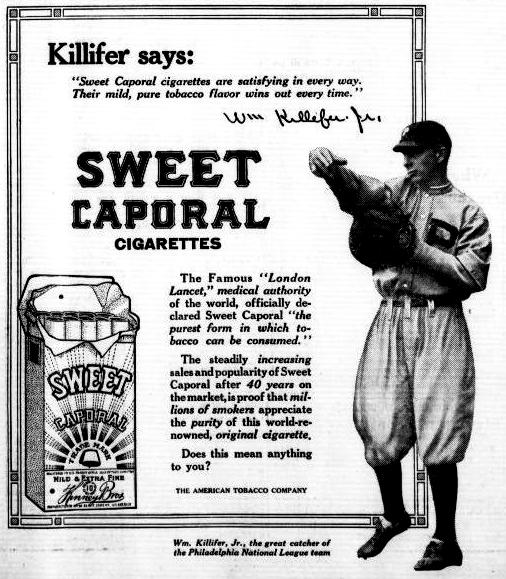
Lost Advertisements: Bill Killifer [sic] for Sweet Caporal Cigarettes

5 Jun

killifersweetcaporal

A 1914 advertisement for Sweet Caporal Cigarettes.  While spelling Killefer‘s name wrong, the ad calls him “(T)he great catcher of the Philadelphia National League Team.”

Killefer says:

“Sweet Caporal cigarettes are satisfying in every way.  Their mild, pure tobacco flavor wins out every time.”

In 1918, Killefer was traded to the Chicago Cubs, along with Grover Cleveland Alexander.  After the Cubs won the National League pennant, The Chicago Daily News reported that Killefer would be getting a bonus beyond his World Series share:

“A bet of a ten-cent cigar against $1000, made as the result of a joke while the Cubs were training at Pasadena, California, last spring has been won by Bill Killefer, it was revealed today.  The loser, William Wrigley, one of the club’s stockholders, wagered the $1000 that the team would not win the National League pennant.  Killefer, who accepted it in jest, had forgotten about the bet until he was reminded of it by Wrigley.”