Archive | October, 2018

“I’ve Selected them in the Order as Their Greatness Appeals to me”

31 Oct

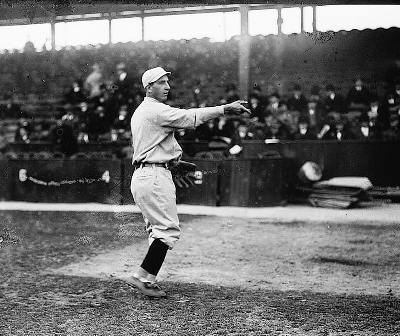
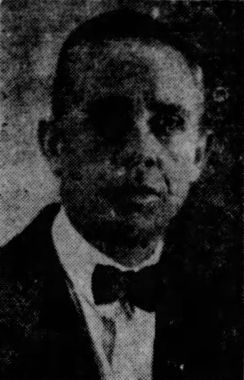
Dizzy Dismukes probably wrote more about the players he saw during and after his career than any other Negro League player.  The Pittsburgh Courier regularly published his observations in 1930.  Like this one:

“Strolled into a barber shop (in St. Louis) a few days ago and arguments were rife as to the best pitcher of all times.”
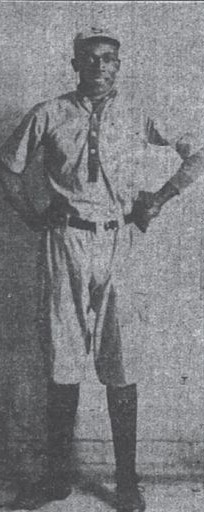
diz

Dismukes

Dismukes said that each participant in the discussion “based his argument on one particular game” they had witnessed.  He told the group he would share his top nine “I had seen during my 21 years” in the pages of the paper:

“I’ve seen some might fine work done by some pitchers whose names won’t be included in the list because of the short duration of their performances.  For instance, there was  Bill Lindsay, who died early in his career (at age 23 in 1914), Pat Dougherty, who had as much zip on a fast ball as any pitcher who ever through a pellet, he imbibed too much of intoxicants, and numerous others.”

Dismukes said “consistency of performance for a reasonable number of seasons” was his criteria.  Unfortunately, Dismukes chose not to go into the detail he did when selecting outfielders, or The Courier did not give him the space, so the pitcher list lacks a lot of the insights of the previous one, but listed them in order:

“Here goes:

  1. Rube Foster

  2. Cyclone Joe Williams

  3. John Donaldson

  4. Steel Arm John Taylor

  5. Bullet Rogan

  6. Dick Redding

  7. Frank Wickware

  8. String Bean Williams

  9. Walter Bell”

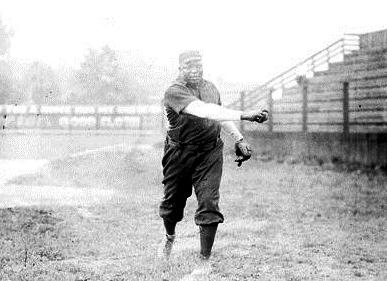
RubeFoster

Rube Foster

Of the list, he said:

“I’ve selected them in the order as their greatness appeals to me.  There will be very little opposition to the placing of the first names two, although some may prefer juggling numbers 3, 4, 5, and 6.

“Some might argue as to the effect the lively ball would have had on their performances.   In the list above are two notable examples:  In the list above are two notable examples: ‘Cyclone’ Williams and Rogan.  How many times during a season were they shelled off the hill?”

Next, he rated catchers.  Josh Gibson, then 18, had not yet begun his first season with the Homestead Grays, and was not on Dismukes’ radar:

“The crop of young catchers breaking into the game in the past ten years have been so poor that I can only find three, namely: Frank Duncan, of the Kansas City Monarchs, Raleigh (Biz) Mackey of Hilldale, and Larry Brown of the Memphis Red Sox showing enough skill to qualify.”

His first choice:

“Topping the list is none other than Bruce Petway, whom I claim to be the greatest catcher I ever saw.  His best days were spent during the base-running craze.  There were not as many fast me afoot playing baseball then as now but there were more base runners.  One could possibly count all the thefts against Petway during a season on one hand and then have a few fingers left.”
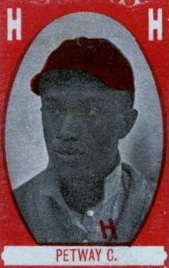
 

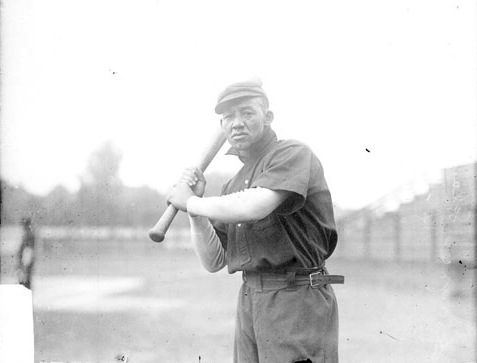
petway

Dismukes said some people thought Petway was a poor catcher because he dropped a lot of balls, but he claimed:

“Petway would intentionally drop balls to encourage base runners to start, as very few had the nerve.”

Dismukes said Petway was a great base runner and “an uncanny judge” of foul pop ups.

Second was George “Chappie” Johnson:

“With Chappie behind the plat, a pitcher did not have to have much on the ball…(and he) was the greatest conversationalist in baseball…Chappie had the opposing batters dumbfounded with a never-ceasing flow of ‘lingo’ crossing the batter up by telling him exactly what the pitcher was about to deliver then standing far to one side of the plate telling the pitcher to ‘get this one over.’ The pitcher then shot one across the plate and he gracefully reached in with one hand to receive a strike.  He excelled in receiving with one hand.  Many young catchers have ruined a career trying to emulate Chappie.”

The third pick was Pearl “Specs” Webster:

“He could do everything expected of a great catcher.  In competition he proved the fastest runner in colored baseball and in bunting and getting to first base as well as circling the bases he was a wonder.  He truly was one of baseball’s greatest catchers.  Specs died overseas in the service of the USA.”
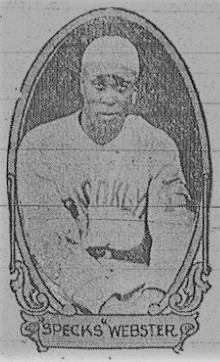
specks

Next was “a scrawny kid from Kansas City,” Frank Duncan:

“He gets the call for No. 4 position.  A great receiver, thrower, fast on bases, and a dangerous hitter.”

Dismukes’ next choices:

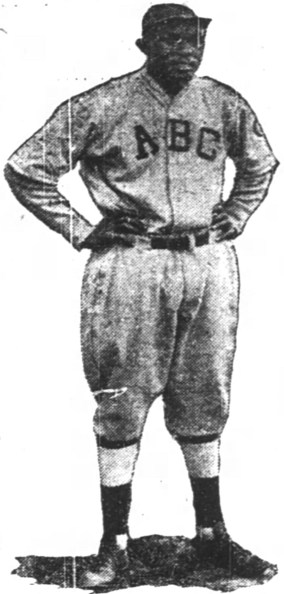
“Pete Booker, another of the old school, gets post No. 5, while Russell Powell, reporting to the Indianapolis ABC’s as an infielder and converted into a catcher, is choice No. 6.  He was one of the few catchers who seldom made false moves back of the plate.  When he threw at a base runner there was always a chance of getting him.  He excelled in trapping runners off third base with snap throws.”

His seventh choice:

“Wm. McMurray, who could look at batter’s feet and come near telling what batter could or could not hit, gets the lucky No. 7 position…whenever you put Mac in a game you always had a well-caught game.”

His final two choices were Biz Mackey and Larry Brown:

“(Mackey) a super hitter, and one who comes near as any recent catcher in having a throwing arm resembling that owned by the one and only Petway, in No. 8 in line, while ninth, last but not least is Larry Brown, who shows unusual skill in handling of pitchers.  (Dolf) Luque, formerly of the Cincinnati Reds and now with Brooklyn of the National League, praises Brown as being the best receiver he ever pitched to.”
“About the Best Outfielder he had Ever Lamped”

29 Oct

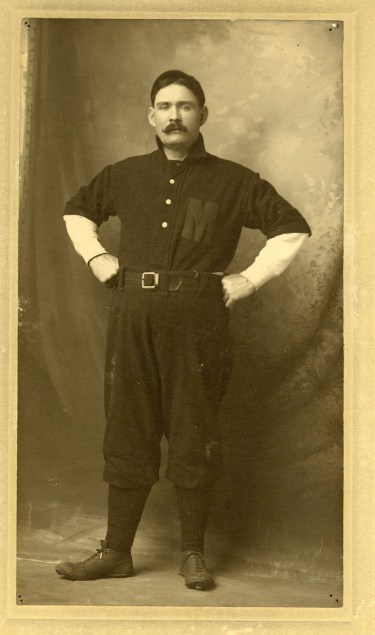
In 1930, Dizzy Dismukes provided his list of the greatest outfielders he had seen during his 20 years as a Negro League pitcher, to The Pittsburgh Courier, as part of a series of ‘releases’ he wrote for the paper:

“From 1909 to 1915 I had seen a great array of outfield talent, including such stars as Pete Hill, Frank Duncan, Jap Payne, Spotwood Poles, Jimmy Lyons, (Robert ‘Judy’) Gans, C. B. Earl [sic Earle]…and a host of others.”

dismukes.jpg

Dismukes

Dismukes said none of them measured up to the man who “I have little doubt that the choice of ranking him as no. 1 will be unanimous,” among The Courier’s readers:

“Ranking as the best outfielder of all time is Oscar Charleston, who reported to C. I. Taylor for a tryout in the spring of 1915 as a pitcher”

Dismukes said Charleston played some games in the outfield for Taylor and:

“His uncanny judgement of fly balls, his prowess with the bat, and daring on the bases in games he played soon convinced C. I. that he had about the best outfielder he had ever lamped.”

oscar.jpg

Charleston

Dismukes said:

“In the days of the bunt—that is the swing bunt—he excelled, and then, as the home run craze began to creep into the game, he kept pace with the leaders by amassing as many as any other.”

In the field, Dismukes said:

“Opposing players complained that four men played the outfield for the (Indianapolis) ABC’s. Charleston, playing close in behind second base, snared line drives which ordinarily were hits, and then when some batter would drive one to the far corners of the lot for what seemed like a sure hit, Charleston would bob up from somewhere to make a catch just before the ball had a chance to hit the ground.  I for one have never seen his equal.”

Dismukes chose Pete Hill for number 2 all time:

“A close student of the game in every sense, he played the batter when playing outfield; was a great hitter in a pinch, whether it was a single, double, triple, or home run that was needed.”

The third best outfielder, according to Dismukes, was Jimmy Lyons:

“He too, like Charleston, broke in as a pitcher, but the late Dick Wallace, then manager of St. Louis (1911) realized his value as an outfielder.  Lyons was the most daring of all batters I ever saw; was fast and used his speed to every advantage.  He was considered about the freshest kid to break into baseball during those days.  Safe bunting was his specialty.  Talkative, he could upset an infield by telling them what he was going to do and get away with it…In that respect I class him as greater than Charleston or Hill.  Drop the ball and he would run—and how.”

Dismukes said “that seemingly slow moving Frank Duncan” was number four:

“There was a natural hitter.  A great judge of pitched balls and uncanny at getting to first base by being hit by a pitched ball.  Frank’s position was left field.  Hit one right on the foul line and he was there to receive it; hit one over the shortstop’s head, he was there; hit one up against the fence, he was there; why, how, everybody who has seen him play still wonders.”

Dismukes said “that nervous type” Spotwood Poles was fifth:

“(He) was the fastest man I ever saw in getting to first base.  With all his speed however, he was an ordinary base runner, seemingly awkward, but a good fly chaser and one of the game’s greatest lead off men.  And, truly, he was a great hitter.”

Next was Andrew “Jap” Payne:

“Payne in the time of need could do more acrobatic stunts to help a pitcher out of a tight situation, than all the outfielders put together.  Almost any ball Jap could get within three to five feet of before hitting the ground he caught, as he usually took a dive for them.”

payne

Payne

Dismukes’ next choice was Poles’ Lincoln Giants teammate Robert “Judy” Gans, who had become an umpire:

“(Gans’) whom his teammates dubbed ‘telegram’ because he told everything he knew, must be given credit for being one of the game’s greatest fielders.  He started as a pitcher, but found his real greatness would be shown in the outfield.”

In the eighth spot:

“I had heard a lot of a lad out east by the name of (Herbert ‘Rap’) Dixon, and it was my good fortune to see him last fall in about seven games and I quickly concluded he was just about all I had heard of him.  Eastern critics have been ranking him with Charleston.  He is a great fly chaser, a hard and timely hitter, and few outfielders have possessed throwing arms the equal of his.  To exclude his name from my list would be an injustice.”

And, “Last but not least” Dismukes said:

“James Bell, affectionately called by his teammates ‘Cool Papa’…I would like to see a contest with ‘Cool Papa’ as a participant (against the 1916 version of) Jimmy Lyons.”


“He had us Instilled with the Nervous Spirit of Race Horses”

26 Oct

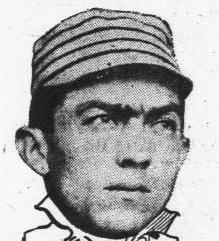
Upon returning to New York after defeating the Detroit Tigers in the 1907 World Series, Frank Schulte spoke to The Syracuse Post-Standard, and said manager Frank Chance was primarily responsible for the win:

“The unanimous opinion among the team regarding Frank Chance is that he is the best baseball manager doing business today…It shows from the beginning his clear head in building up his club to the perfectly oiled machine that the critics agree it is at present. The full credit for the success of the Cubs must be given to Frank Chance.  The burden has been upon his shoulders and he has carried it as no other man could.”

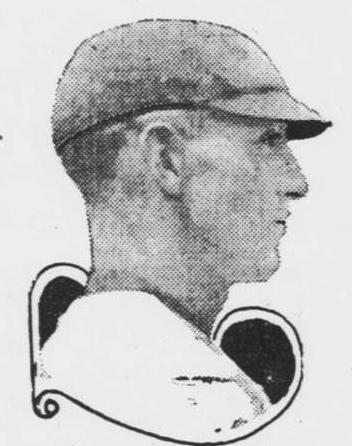
schultepix

Schulte

Schulte said Chance was constantly aware that the 1906 club had let down after winning 116 games in the regular season and lost the World Series to the Chicago White Sox four games to 2:

“He was firmly convinced that our defeat in the post season series of 1906 was due, at least partially, to our perceptible letdown after we had the pennant clinched.  That there was such a letdown was widely recognized, and we felt the effects of it after we ran against the Sox.  I do not say that we could have beaten the Sox last year, for they had a fine team, but I do claim that we could have nearer it if everybody had been on his toes, as he should have been…This year Chance was fully alive to the emergency. From the beginning to the end of the season he had us instilled with the nervous spirit of race horses…When the National League pennant was clinched was there any let down? There was wide comment about the difference in this respect between 1907 and the previous year.”

Schulte said Chance never stopped riding the team after they clinched the pennant:

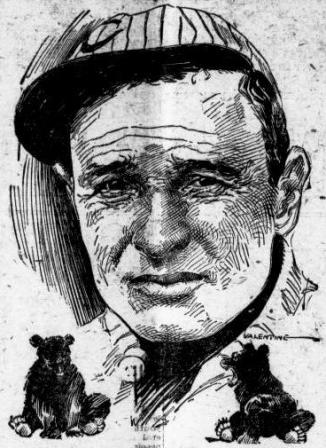
chance

Chance

“(H)e kept hot after us…He called attention repeatedly to the splendid fight being made in the American League; he reminded us of the issue the year before.  He kept close after every man, seeing to it that each player was at his best and living in a way to keep so.

“He insisted upon the observance of strict training rules, he coached every man for every conceivable weakness in his play that would be apt to make trouble in the post season series.  When he turned his team loose for the final showdown every man was fit for the game of his life, and the records show just what kind of baseball was in the Chicago crowd for that series.  The fans sat up and took notice.”

Schulte said the “quite a little knocking” done of the Tigers, who dropped four straight to the Cubs after a first game tie, was unfair:

“The Detroit Tigers of 1907 formed a splendid team, and whoever would pretend to deny it is ignorant of the rudiments of baseball.  Let people say what they will, the fact is this: The Cubs did not breathe  wholly freely until that last game had been won, for we realized at all times that we had a formidable foe to contend with.  We realized too, that luck favored us in generous proportion.”

Chance, Schulte and the Cubs repeated in 1908, beating the Tigers four games to one in that series.


“I bet I’ll add a hundred points to my batting average”

24 Oct

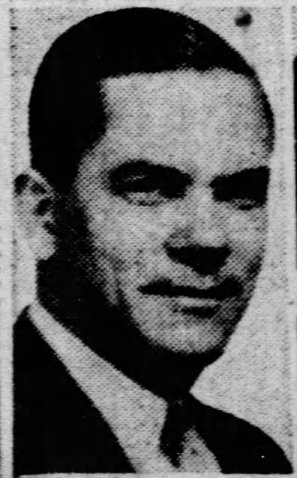
Walter “Christy” Walsh was Babe Ruth’s agent and also operated the Christy Walsh Syndicate which employed several well known sportswriters, including Damon Runyon, Bozeman Bulger, and Ford Frick, to ghost write articles for Ruth and other players.

christywalsh.jpg

Christy Walsh

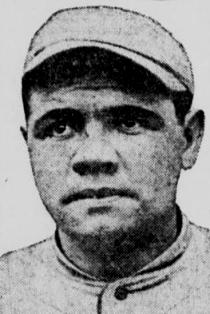
In 1927, an article under Ruth’s byline appeared in several newspapers during the summer of 1927, as Ruth was in the process of hitting 60 home runs:

“Here’s a tip to hitters.

“Take it from one who knows.  There’s no percentage in going up there to the platter and swinging from your heels trying to park the ball over the fence.

“Home run hitting is fine and it gives you a real kick when you smack one, but 99 out of a hundred hitters ruin themselves when they try too hard.”

Ruth, or the Ruth surrogate, compared it to “pressing in golf.”

ruth

Babe Ruth

And he said:

“The real hitter is the chap who steps up there with a short swing and plenty of wrist, and meets the ball.”

Don’t emulate him, he said:

“When you’re trying to improve your hitting take your tip from chaps like Eddie Collins, Joey Sewell, or Ty Cobb.  These fellows have real hitting form.”

Ruth said:

“I get paid for making home runs and hitting balls a long way.  So I have to stay up there swinging.  But if I didn’t, I’d change my form tomorrow.  I’d go up there flat footed like Eddie and Joey and I’d take a short swing instead of a long one.

“I wouldn’t make so many home runs but I bet I’ll add a hundred points to my batting average for the season.”

He concluded the lesson:

“Home runs are pretty things to watch and now and then they win ball games, but the real hitter is the chap who can step up there and get his two singles every game.  He’s the one to take as your example.”

Things I Learned on the way to Looking up Other Things–Quote Edition 2

22 Oct

More random quotes and observations that follow no theme or thread:

Cap Anson told The Chicago Daily News in 1904:

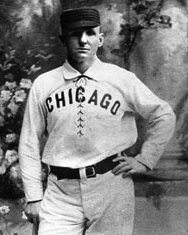
“I consider (Charles) Radbourn and John Clarkson the greatest pitchers I ever saw.  Buck Ewing was just about the best catcher that ever wore a mask.  He could catch, throw, bat and run and had a good head.”

cap1

Cap Anson

After Frank Baker hit home runs off Christy Mathewson and Rube Marquard in the 1911 World Series, he told The Philadelphia American:

“There seems to be much speculation as to what sort of balls were thrown me when I made my home runs…Well, I hit them and I know what they were.  Matty threw me an inshoot, but what would have been an outshoot to a right handed batter, while the Rube threw a fast one between my shoulder and waist.

“Connie Mack told me when I went to the bat that I would not get a fast one, and he was right  I set myself and looked them over against Mathewson and when he tossed me that curve and I saw her starting to break, I busted her, that’s all.”

baker2

Frank Baker

Thirty-four year old Bill Bernhard told The Cleveland News about seeing 38-year-old Cy Young in Hot Springs, Arkansas in spring of 1905:

“There is no use talking, there is only one Cy Young.  When the rest of us pitchers report in the spring, we act as if those alleged deceiving arms of ours were made of glass and humor them accordingly.  But not so with old Cy.  The very first day that Cy reached Hot Springs, a week or so ago, he cut loose as if he had been pitching all winter.  Great Scott, but he had speed to burn and the next day and the next it was just the same. And curve them? Well, you ought to have seen the old boy.”

cyyoung

Cy Young

In 1915, The Chicago Daily News noted that Charles Comiskey “isn’t given to boosting players very often,” but that Catcher Ray Schalk was an exception:

“Schalk shows more life than any other player I have ever seen.  He is level headed and his thinking and natural ability stamp him as one of the greatest catchers in the world today, and he can claim equal distinction with the great and only Buck Ewing, considered in his day the peer of all backstops.

schalk

Ray Schalk

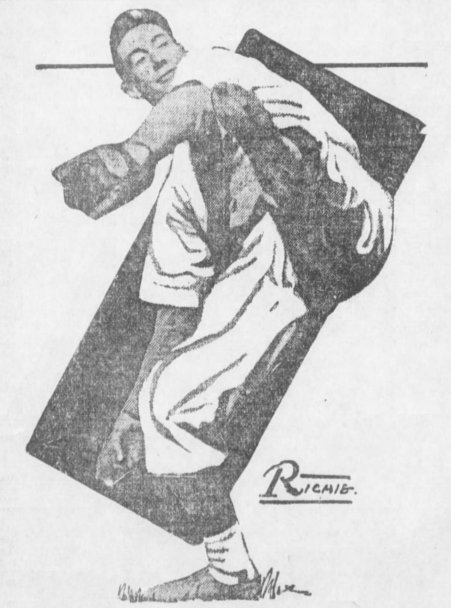
Dave Landreth was a baseball promoter from Bristol, Pennsylvania who had a brief foray into professional baseball when he served as director of the Baltimore Terrapins in the Federal League.  He told a story to The Bristol Courier about Lew Richie—Richie was born in nearby Ambler, Pennsylvania, and pitched for Landreth in semi-pro leagues before making is pro debut in 1906 at age 22:

“Landreth hired Richie to pitch the morning game of a holiday twin bill for the county championship, and after winning and fanning 18 men, all for five dollars, Richie came back in the afternoon and insisted on hurling that game , too, for nothing.

“Somebody ‘kidded’  him about winning the morning game on a fluke, and Lew wanted to show them—and he did, winning that game as well.”

richie.jpg

Lew Richie

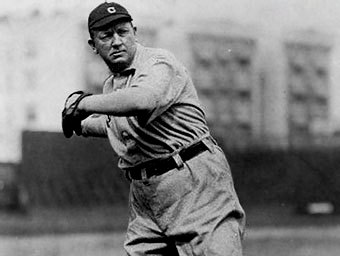
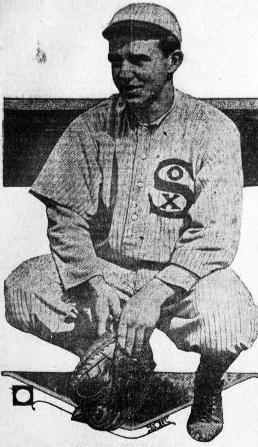
Tim Donahue had a reputation for being tough during his eight seasons in the major leagues.  The catcher told The Chicago Evening Post he had only encountered one man who made him back him down:

“I was never put down and out but once.  It was when I was playing semi-professional ball too, and was quite a young lad.  There was a big fellow named Sullivan on the other side and I tried to block him at the plate.  He swung on my jaw and I thought a load of bricks had dropped on my head.  I finally came to, but I didn’t block Sullivan any more.  That’s the only time I would ever clear out.”

“Baseball is a lot Faster now”

18 Oct

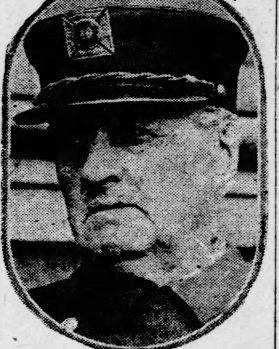
Bill Gleason was the shortstop for three of the four straight American Association champion St. Louis Browns team—he was with the 1885-1887 teams—and, apparently, very superstitious.  After his baseball career ended in 1891, the St. Louis native returned home and became a fire fighter.

Unlike many of his contemporaries, he didn’t spend his later years complaining about how the game wasn’t as good as when he played.

In 1926, the captain of the city’s Engine Company Number 38, sat in the Sportsman’s Park press box for game three of the World Series, and spoke to a reporter from The Post-Dispatch:

gleason26

Bill Gleason Fire Captain

“’It’s a fast team, a fast team,’ Gleason repeated again and again as the Cardinals infield worked.  ‘And baseball is a lot faster now than it was when we played it back in the old days.’”

And Gleason was aware of how most of his contemporaries felt:

“’I’m not one of these old codgers who’d tell you there are no times like the old times.  These boys out there are faster than we were, I think, and the game’s gone a long way ahead.  And I wouldn’t like to say we had any players quite up to the big fellow out there,’ waving a hand toward ‘Babe’ Ruth who was emerging from the Yankee dugout.”

Gleason noted that while his three Browns teams “were champions of the world,” he said they were not as great as the current Cardinals:

“’This man (Jesse) Haines who pitched today is a wonder.  He had everything, speed, curves, and absolute control (Haines shut the Yankees out on five hits in a game delayed by rain for 30 minutes during the fourth inning)…Sometimes it seems to me that we don’t have the pitching now that we used to, but Haines certainly furnished it for us today.  He puts me in mind of old Tim Keefe of the New York team.  He was a great pitcher in my day.”

But Gleason was even more impressed with the Cardinals infield:

“’Then there’s that double play combination.  (Tommy) Thevenow to (Rogers) Hornsby to (Jim) Bottomley.  Thevenow is lightening fast, Hornsby’s play is as smooth as silk, and Bottomley is just a beauty.”

gleason88.jpg

Gleason, 1886

Gleason said Hornsby’s play at second reminded him of his Browns teammate Yank Robinson:

“’(He) handled himself a lot like Hornsby.  You didn’t realize how fast he was moving. He worked so easily.’”

Gleason said the Cardinals had better hitting than his Browns and said of outfielder Billy Southworth:

“’He’s like Curt Welch, the center fielder of the Browns.  Goes back on a fly ball and gets set for it just like old Curt did.  And (catcher Bob) O’Farrell is a lot like Doc Bushong of the Browns—steady and dependable.’”

Gleason also talked about how the 1926 incarnation of Sportsman’s Park differed from the first version which hosted the 1886 world’s championship against the Chicago White Stockings:

“’In those days,’ he said, ‘the grounds were laid out so that we batted from Grand Avenue, and what is now home plate was then left field. “

Gleason said the following season, when the Browns again played the White Stockings in a post series, that the decision to make the series a “winner take all” for the gate money was Albert G. Spalding’s idea:

“’(Browns owner) Chris von der Ahe (wanted to) split the gate.  (Spalding) said he would play only on the basis of winner take all and we played on that agreement.  The Browns won the series four games to two.  We won the last three games here, and I think it’s likely the Cardinals will do the same thing.”

His prognostication was off—the Cardinals dropped the next two games to the Yankees, but did come back to win the final two to take the World Series in seven games.

Gleason remained with the St. Louis fire department until his death at age 73 in 1932—there was general confusion about Gleason’s age at the time of his death, The Post-Dispatch said “Records vary to his age but he was about 70,” The St. Louis Star and Times and The Associated Press said he was 66.

The Post-Dispatch said he was recovering from an infection he got from stepping on a nail at a fire, when “he insisted on going down to the corner drug store.  On the way home he collapsed from the heat and never left his bed again.”

“A Catcher is the Most Important man on a Team”

16 Oct

Lou Criger was very confident when he joined the St. Louis Browns in 1909.  He spoke to S. Carlisle Martin, the cartoonist for The St. Louis Post-Dispatch, who occasionally interviewed notables and published the story with a series of drawings:

“A catcher is the most important man on a team…a poor catcher can spoil the good work of any pitcher and a live, brainy catcher can make an ordinary pitcher look good…Another point:  The catcher has the whole game in front of him.  Besides tipping the pitcher off on the different batters as they come up—signaling for a high or low one, one close in and one away out, the catcher must keep one eye on the runner all the time.  And there’s where many a game is lost, letting the runners go wild.”

criger2.jpg

Criger as drawn by Martin

Then, Criger decided to take on Ty Cobb and the Detroit Tigers:

“Why they tell you that Ty Cobb is a great base runner.  Maybe he is, but I never had any trouble with him.  Why he only got away with me twice in the two years that I have been playing against him>  Most of his good base running I call bone-headed work.  And one of those two times he tried the delayed steal, that is, starting when he thought I was going to return the ball to the pitcher, and then I had him by 20 feet, but the second baseman was away from the bag and waited for him, and Cobb slid away round and stuck his foot on the bag.

“No, I’ve got his ‘goat’ and I’ve got the rest of the Tiger bunch, too.  Cobb tried to block me last summer and I went after him and have been after him ever since.  I used to say to him: ‘Look out, Ty, this fellow is as wild as hawk and he’s liable to crack you on the head.’  And then I’d signal for one right at his head.  Bing!  Down he’d drop and when he’d get up the fight was all out of him, he couldn’t hit a stationary balloon.

“You know you can kid a batter until he won’t know where he’s at.  I pestered (the Tigers) so much that they came around and begged me to let up.  They said we had nothing to gain and they might lose the pennant.

“You see, (Boston) made the Tigers look like 30 cents last fall in Detroit when we beat ‘em three straight ( Detroit went from being in second place, a half game out to third and two and a half back after losing a three-game series to the Red Sox September 21-23, 1908) (Hughey) Jennings wouldn’t even get off the bench.”

criger1

Criger said he had ‘Ty Cobb’s Goat”

Criger was just as cocky concerning the Browns prospects for 1909; he said it was likely his final season and he could go out a winner:

“If we got an even break in the luck and our best players are not injured, they’ll have to go some to beat us out…and I feel that we will hang in on Jennings’ bunch.”

Criger’s handicapping was off.  The Tigers went 98-54 to win the pennant—including beating the Browns18 out of 21 games—Cobb hit .351 against the Browns and stole bases. The Browns finished 61-89 in seventh place.  Criger hit just .170 in 74 games and was traded to the New York Highlanders after the 1909 season.

Things I Learned on the way to Looking up Other Things–Quote Edition

12 Oct

When you spend hours pouring over microfilm and web based newspaper archives you find something every day that is interesting but not enough for a standalone post—these are random quotes and observations that follow no theme or thread, I just think they should not be lost to the mists of time.

Cy Young was asked by The Cleveland News in 1909 if there would ever be a successful ambidextrous pitcher in the major leagues:

“Elton Chamberlain, who was with Cleveland in the early 90s, essayed to perform this feat occasionally, but about all he had with his left arm was a small amount of speed and a straight ball. The way pitchers have to work nowadays a man who can use one rm and use it effectively is quite a man as pitching goes.”

chamb

Elton Chamberlain

In 1909, Time Murnane noted in The Boston Globe that Billy Sunday, as an evangelist was earning more than 10 times what the “highest-paid men” in baseball were making. Of Sunday’s ability he said:

“No doubt Mr. Sunday is a very good evangelist, much better it is hoped than he ever was as a ballplayer. Mr. Sunday was a fast runner. That marked his limit as a baseball star. He could not hit or field or throw well enough to make it worthwhile talking about.”

billysunday2

Billy Sunday, evangelist

In 1946, Grantland Rice of The New York Herald Tribune asked Connie Mack during a discussion of Bob Feller which pitcher he felt had the “greatest combination of speed and curves,” of all time:

“He hesitated less than two seconds. ‘Rube Waddell,’ he said. ‘The Rube was about as fast as Feller, not quite as fast as (Walter) Johnson. But the Rube had one of the deepest, fastest-breaking curves I’ve ever seen. Johnson’s curve ball was unimportant. Feller isn’t as fast as Johnson but he has a far better curve ball.’”

Mack did, however, concede:

“’Feller and Johnson were far more dependable than the Rube who now and then was off fishing or tending bar when I needed him badly.’”

rube

Rube

In 1916, in his nationally syndicated American League umpire Billy Evans asked Napoleon Lajoie about the best pitchers he faced:

“I never faced a wiser twirler than Chief Bender…he made a study of the art. If a batter had a weakness, the Chief soon discovered it, and from that time he made life miserable for that particular batsman. His almost uncanny control made it possible for him to put into execution the knowledge he would gain of the batter’s weakness. I know of a certain big league player, and he was a good one, who would request that he be taken out of the game any time Bender worked…Best of all, he had the heart of an oak and in a pinch always seemed to do his best work.”

chiefbender

Chief Bender

In 1907, the Washington Senators hired Pongo Joe Cantillon to manage the team, Ted Sullivan, “the man who discovered Comiskey,” was never shy about taking credit for an idea, and told The Washington Star:

“As I was instrumental in enticing Cantillon to come to Washington I know the salary that was offered, and I saw the contract. It was nearly twice the salary of a United States Senator, and there is not a bench manager today in the eastern country that is getting one-half the salary of Cantillon. The Washington management has corrected all the errors of the past in getting a baseball pilot who knows all the bends and shallows in the baseball river.”

pongo

Pongo Joe

Despite the money, and Cantillon’s knowledge of the “bends and shallows,” the Senators finished 8th twice and 7th once during Cantillon’s three seasons in Washington, he had a 158-297 record during his only stint as a big league manager.

Home Field Advantage

10 Oct

William Lape had a brief minor league career; in 1911 he spent his first season in pro baseball playing in the Southwest Texas League, a “D”  league with clubs in Bay City, Beeville, Brownsville, Corpus Christi, Laredo, and Victoria—Lape split the season between Victoria and Brownsville.

Texas was a bit of a culture shock for Lape, who was born in Irvin, Pennsylvania on June 11, 1888, and raised in Ohio.

When he returned to Ohio in the fall—the league, formed in 1910, folded after the 1911 season—Lape explained to The Dayton Herald that all of the umpires in Texas were “homers,” and why:

“They have to be or some of the ranchers who tote six-shooters around with them all the time would take a crack at them.  It comes a little hard to the northern players when they first go down there because they are looking for an even break on the road.  They soon get over that idea, however.  Every close play goes to the home team.

“The ranchers line up along the bleacher fence when the game gets close and every once in awhile some of them will waive their gun at the umpire just as a warning as to what might follow if he handed the home team the worst of it.  I’ve seen several games stopped for 15 or 20 minutes while the ranchers swarmed on the diamond and argued with the umpire”

lape.jpg

William Lape

The league, which played two-half seasons, with a championship series at the end, was in such poor financial straights at the close of the second half that first half champions Bay City declined to participate in a playoff.

Lape said during the 1910 playoff series between Brownsville and Victoria:

 “(T)here was a riot at every game.  Men fought each other in the grand stand and women cried and wrung their hands like an awful calamity was being enacted. I understand quite a few Texans are carrying lead around in their systems yet as a result of that series.”

While Lape said he enjoyed playing in Texas and that it could be lucrative, “I got $16 once for pulling off a steal of second and third that put us in the way of scoring the winning run,” he spent the rest of his career playing with professional and semi-pro clubs in Michigan and Ohio.

He died in Miami, Florida, July 28, 1973.

“O’Brien…Felt Like Dropping Dead”

8 Oct

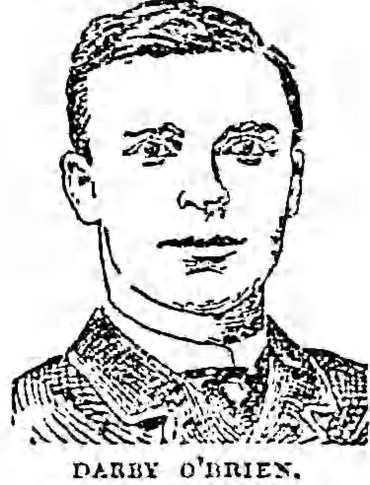
Darby O’Brien was a rookie and Charley Jones was near the end of his 12-year career  when the two were teammates with the New York Metropolitans in 1887; his friendship with Jones gone sideways made O’Brien a brief sensation on the police blotter.

darby.jpg

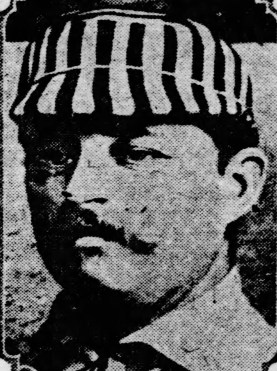
O’Brien was playing for the Brooklyn Bridegrooms the following season when, on July 21 he was arrested along with teammate Jack Burdock were arrested when leaving Brooklyn’s Washington Park after a game.

The troubled Burdock, who battled alcoholism, was arrested for assault for attempting to kiss a 17-year-old stationary store employee the previous year, while, as The New York Sun said he “was under the influence of liquor,”  Burdock was acquitted later that year when the victim failed to appear to testify against him.

burdock

Jack Burdock

Burdock being in trouble was not news, but said The Sun:

“(O’Brien) is one of the steadiest men in the ball business and, consequently felt like dropping dead when (New York Detective)  McGrath told him he was wanted for larceny.”

O’Brien’s alleged crime?  The Brooklyn Eagle said:

“The charge against O’Brien is made by Mrs. Louisa Jones, wife of Charles W. Jones, formerly left fielder of the Kansas City nine, and is that he stole her dog.”

charleyjonespix

Charley Jones

According to Mrs. Jones, O’Brien had given her the dog, “a small pug,” to take care of after the 1887 season and subsequently “presented the dog to her.”  Mrs. Jones said O’Brien later returned to the Staten Island hotel where the Jones’ lived and stole the dog.  The New York World said he “snatched the dog out of her lap,” at the hotel and ran to a train to escape.

After O’Brien was released on “the promise of (Brooklyn owner Charlie) Byrne” that O’Brien would appear in court on July 23, he spoke to a reporter from The Eagle:

“Mrs. Jones story is untrue.  I did not give her the dog nor did I snatch it from her lap, as was reported in a morning paper.  I was stopping at the Nautilus Hotel when she and Jones came there to live.  I got the dog from (catcher Bill) Holbert.  She was a beauty and is Beauty by name.  Mr. Holbert raised her from a pup and I was too fond of her to part with her.  Mrs. Jones admired her very much.  I declined to give her Beauty, but did promise her one the next litter.  That was only to keep her quiet.  She annoyed me very much.  She got square, however, for when I was preparing to go West (after the 1887 season) she and Jones bolted and took the dog with them.  I got Beauty back.”

O’Brien failed to say how he “got Beauty back.”  The Eagle said Holbert backed up his statement.

The World described the scene when O’Brien returned to face the charges:

“Justice Massey, of Brooklyn, was a half hour tardy in his arrival at the courtroom this morning and he found the chamber packed full of people  .

“There were baseball players, baseball enthusiasts and patrons of the national game.  There were a couple of hundred of the youth of the City of Churches, and there as many of the pretty girls for which Brooklyn is famous.”

Both O’Brien and Burdock were in court that morning, but the paper said:

“Darby received most attention, for he is one of the Brooklyn boys who doesn’t pose as a bridegroom.”

In addition to Byrne and Holbert, the New York papers said O’Brien’s Brooklyn teammates Al Mays and Bill McClellan were there for support.

The case was continued and the potential baseball/dog trial of the century was scheduled for September 5, 1888, but ended with a whimper.  The Evening World said:

“Not only is the Brooklyn baseball team in third place in the Association today, but it’s members are at last all out of court.

“Darby O’Brien’s dog case came before Justice Massey this morning and the popular left fielder was promptly on hand to show that he didn’t steal Mrs. Jones’ canine.  He was spared the pains, however, for a note came from the Staten Island complainant in which she declared that she would not press the complaint

“Darby was therefore discharged.”

Unfortunately, the dog did not make it to the trial, O’Brien told The Eagle that in July “(Beauty) had a fit on Sixth Avenue and died.”

O’Brien played with Brooklyn through 1892, became ill with tuberculosis and died in his hometown of Peoria, Illinois in 1893, he was 29.

dob (1).jpg

O’Brien

When word reached Byrne that O’Brien had died, he told The Eagle:

“Darby was a typical, humorous, quick witted young Irishman, handsome and clever.  He was like a good sailor.  He had a sweetheart in every city the team visited.  He was generous to a fault.  His purse was open to everyone and he never called for an accounting.  He was, without exception, in the full sense of the word, the most popular ballplayer in the country—not for his phenomenal ability or his brilliant work, but for his happy go lucky manner.”