Archive | October, 2018

Lost Advertisements: Rip Collins for Mail Pouch Tobacco

5 Oct

ripmailpouch

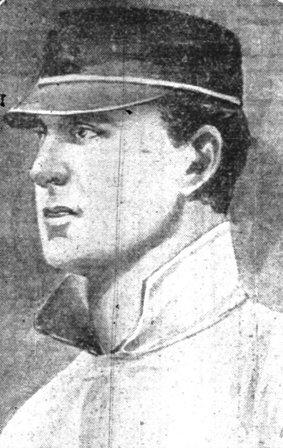
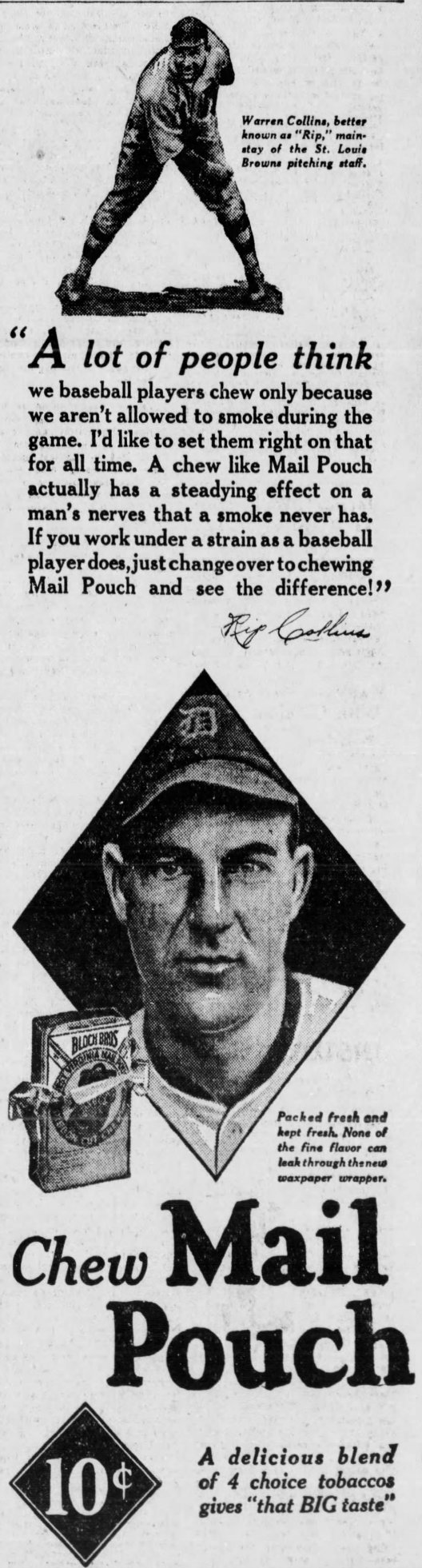
A 1930 Mail Pouch Tobacco ad featuring Harry Warren ‘Rip’ Collins of the st. Louis Browns.

“A Chew like Mail Pouch actually has a steadying effect on a man’s nerves.”

Collins’ nerves were good for a 108-82 record over 11 major league seasons and for a career as a Texas Ranger.

In November 1926, “Baseball Magazine” declared his career a bit of a disappointment–but for a reason– Collins was simply “Born a hundred years too late.”

The magazine said:

“Collins came to the big leagues an unbranded maverick, wild as a Brahma steer from his own beloved Texas cattle land. Nature, with a lush prodigally, had endowed him with athletic skill of the highest order.  Six feet one he stood with muscles like tempered steel, 205 pounds of raw, crude strength.  He had blinding speed, more sheer stuff, perhaps, than any pitcher has shown since Walter Johnson came out of the mountains of Idaho to create one of the great pitching records in history.”

The magazine said while:

“He might have been a marvelous hurler.  He has been merely good.”

The reason he never reached his potential:

“Rip has been guided through life, for good or ill, by the untamed spirit of the wilderness.  He chafed under irksome restraint.  He hated big cities, crowds, the luxuries of an old and possibly decadent civilization.  He abominated the petty jealousies and the bickerings and the small politics on a big league ball club.”

Collins said:

“When I have finished the baseball season, I can’t be cooped up any longer.  I take my rattle trap Ford and go down to the wild country of the Rio Grande where you can go days with out seeing anybody.  I’m homesick for the call of the coyote.”

Collins said he was better suited “for the pioneer days” than the baseball diamond.

He said he joined the Texas Rangers because he was turned down by the United States Army when he first attempted to enlist, because of two bad knees–one injured during the a football game with the Haskell Indian School when he was at Texas A &M, and the other he hurt playing basketball. The Ranger accepted him he said, caring only that he could ride a horse and shoot.

Of his time with the Rangers, and how it differed from the army in which he later served:

“In the Regular Army a soldier’ll say to the corporal, ‘shall I shoot?’ The corporal will ask the captain and the captain will wire the War Department for instructions  The Rangers don’t believe in asking unnecessary questions.”

The magazine said Collins’ “people were strongly opposed to the professional game.” And he said they still were not completely accepting:

“Even now, they look at it with a little suspicion, though they always get the papers and look up the box scores.”

Collins, who told “Baseball Magazine” he learned how to pitch “throwing rocks at jack rabbits,” admitted he didn’t have a great commitment to the game:

“Baseball to me, has been only a simple way to make a living.  I like the game, but I’d rather pitch in the Texas League where I could go fishing the next day, than to be a star in the majors.”

In the end, Collins said he was “condemned, at present” to a life staying in “swell hotels” instead the life he desired.

Collins remained “condemned” in the major leagues through the 1931 season–he reappeared in the Texas League for 10 games in 1933.
“It was Hard for me to get Used to Some of the Boneheads”

4 Oct

Most baseball writers and dozens of baseball figures caught the twenty greatest “fever” during 1911 and 1912.

After Frank Baker hit .375 with two home runs and five RBIs, leading the Philadelphia Athletics to their 1911 World Series victory over the New York Giants, Grantland Rice opined in The New York Mail:

baker2

Frank Baker

“The twenty greatest ballplayers, picked exclusively for this column by John McGraw and the Giants—John Franklin Baker.”

The Washington Times said Germany Schaefer was asked to put his twenty greatest list together shortly after the end of his best season in 1911:

“Write ‘em out and send ‘em to me,’ the newspaperman suggested.

“Germany did.  The list read as follows: ‘Germany Schaefer, Germany Schaefer, Germany Schaefer, Germany Schaefer, Germany Schaefer, Germany Schaefer, Germany Schaefer, Germany Schaefer, Germany Schaefer, Germany Schaefer, Germany Schaefer, Germany Schaefer, Germany Schaefer, Germany Schaefer, Germany Schaefer, Germany Schaefer, Germany Schaefer, Germany Schaefer, Germany Schaefer, and Germany Schaefer.’”

Germany Schaefer

Schaefer

The Philadelphia Record asked Connie Mack for his twenty greatest list, Mack refused but told the paper “if his life depended on any game of ball,” he would start Chief Bender:

“Do you know, Bender has never yet failed me in a crisis?  Whenever there is a game that the fortunes of our club hinge on I’ve sent in the Chief and he has delivered every time.”

Billy Hamilton, who made a couple of the lists that circulated during 1911 and 1912, told The Boston Globe he was upset no one had named his former teammate Marty Bergen:

“Why, I can’t see how you can possibly leave him out…He and Buck Ewing were in a class by themselves among the men I have seen behind the bat.  I have never seen anything like that snap throw of Martin’s, with the ball always on the runner.”

Wild Bill Donovan then put Bergen on the list he chose for The Detroit News:

  • Ed Walsh
  • Jim Hughes
  • Christy Mathewson
  • Duke Farrell
  • Marty Bergen
  • Hal Chase
  • Fred Tenney
  • Napoleon Lajoie
  • Eddie Collins
  • Jimmy Collins
  • John McGraw
  • Hughie Jennings
  • Herman Long
  • Ty Cobb
  • Bill Lange
  • Ed Delahanty
  • Willie Keeler
  •  Fielder Jones
  • Fred Clarke
  • Bobby Wallace

Donovan told the paper of Ed Walsh:

“If Walsh were worked about once in four days, instead of being asked to go in three times a week as often is the case now, I believe that he would be unbeatable.”

edwalsh

Ed Walsh

In lauding Farrell, his teammate in Brooklyn, Donovan took a swipe at many of the catchers he worked with during his career:

“The big Duke was a wonderfully heady man, and the only catcher who ever lived on whom it was impossible to work the hit and run game.  Any time Duke called for a waste ball, you could bet your next paycheck that the runner was going to go down.  After pitching to man of his intelligence it was hard for me to get used to some of the boneheads that I encountered later.”

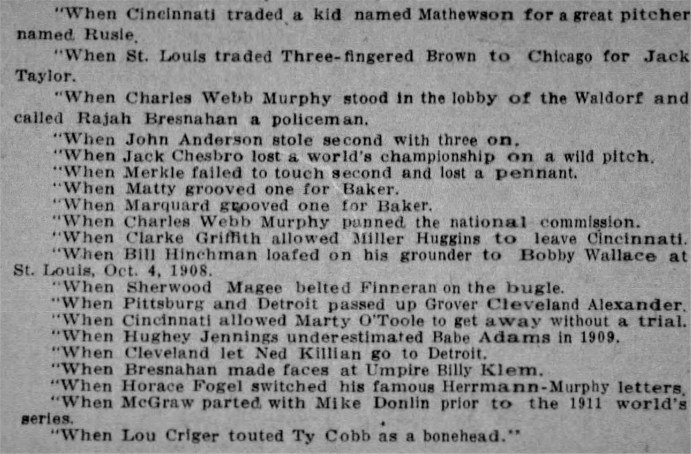
One more list—attributed to several papers and sportswriters at the time—appeared first in The Pittsburgh Gazette-Times, and chronicled the “Twenty greatest blunders in baseball:”

20blunders

As the craze was dying down, The Chicago Tribune said Ted Sullivan, the man who I credited with discovering Charles Comiskey—and Comiskey’s favorite scout, would put together “a list of the twenty greatest baseball actuaries of all time were he not a bit doubtful about the other nineteen.”

“The Twenty Greatest Fever”

2 Oct

In November of 1911, an interviewer asked industrialist Andrew Carnegie to name the 20 greatest men of all time.  Within days, Carnegie’s list was parsed and picked apart, and led to what The Chicago Daily News called “The twenty greatest fever.”

Lists of the twenty greatest everything appeared in papers across the country for the next year.  Of course, the question was put to many baseball figures and led to a number of interesting lists and quotes.

One of the first to weigh in was Chicago White Sox owner Charles Comiskey, in The Daily News:

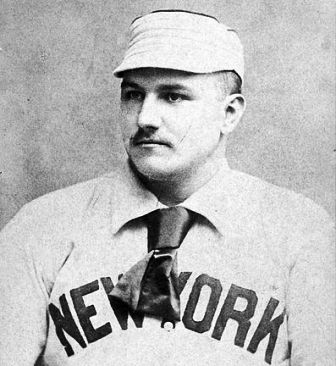
  • Buck Ewing
  • King Kelly
  • Cap Anson
  • Charlie Ferguson
  • Fred Pfeffer
  • Eddie Collins
  • Honus Wagner
  • Jack Glasscock
  • Harry Lord
  • Ty Cobb
  • Fred Clarke
  • Willie Keeler
  • Tom McCarthy
  • Napoleon Lajoie
  • Charles Radbourn
  • Bobby Caruthers
  • Christy Mathewson
  •  Clark Griffith
  • Ed Walsh
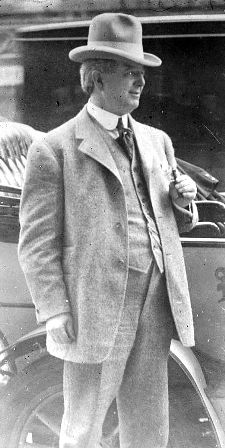
comiskeypix

Charles Comiskey

Comiskey said Eddie Collins, who would acquire for $50,000 three years later, was the best current player:

“He’s got it on all the others in the game today.  I don’t know that a good lawyer went to waste, but do know that a mighty good ballplayer was found when Eddie decided to give up the technicalities of Blackstone for the intricacies of baseball.   There isn’t much use saying anything about Connie Mack’s star, everybody knows he is a wonder as well as I do.”

Cy Young was asked by The Cleveland News to name his 20 greatest:

“I guess we’d have to make a place for old Amos Rusie, ‘Kid’ Nichols should be placed on the list too, ‘Kid’ forgot more baseball than 90 percent of us ever knew.  And there was Bill Hutchinson, just about one of the greatest that ever lived.  You can’t overlook Walter Johnson, and, by all means Ed Walsh must be there.  The same applies to Mathewson.  Then comes my old side partner, Bill Dinneen.  Bill never was given half enough credit.”

amosrusie

Amos Rusie

Young rounded out the battery:

“I’d pick old Lou Criger first of all the catchers.  George Gibson of the Pittsburgh team, to my way of thinking, stands with the leaders.  Give the third place to Oscar Stanage of Detroit, and I feel safe in saying that I have chosen a really great catcher.”

Young said:

“Doping out the infields is comparatively easy.  Without hesitation I would name Hal Chase, Eddie Collins, Nap Lajoie, Hans Wagner, Bobby Wallace, Jimmy Collins, Herman Long, and Charlie Wagner.”

Young said of his infield choices:

“You can’t get away from Bobby Wallace for a general all round gentlemanly player, he has never had a superior at shortstop unless that man was Honus Wagner.  Maybe Johnny Evers is entitles to consideration, but I never say him play.”

As for his outfielders, Young said:

“Ty Cobb’s equal never lived, according to my way of thinking, and I doubt if we will ever have his superior.  Say what they will about Cobb, but one who is true to himself must acknowledge his right to rank above all other players.

“I chose Cobb, Fred Clarke of Pittsburgh, Tris Speaker of Boston and Bill Lange for the outfield, and regret that the limitations prevent me from choosing Jim McAleer.  McAleer was the best fielder I have ever seen.  I say that with all due respect to Cobb and other competitors.

“Tris Speaker is a marvel, and only because of his playing at the same time as Cobb is he deprived of the honor of being the greatest outfielder…Many fans of today probably don’t remember Bill Lange.  Take my word for it, he was a marvel.  He could field, bat, and run bases with wonderful skill.  No man ever had the fade-away slide better than Lange.”

The reporter from The News noticed that Young had, “chosen his twenty greatest players without mentioning his own great deeds,” and asked Young whether her felt he belonged on the list.  Young said:

“Oh, I’ve heard a whole lot of stuff about myself as a player, but I was but ordinary when compared to the men I name as the greatest in the game.”

cy

Cy Young

When Ty Cobb presented his list of the 20 greatest current American League players to The Detroit News, the paper noted his “Very becoming modesty” in leaving himself off of his list.  Cobb’s picks were:

  • Ed Walsh
  • Bill Donovan
  • Walter Johnson
  • Jack Coombs
  • Vean Gregg
  • George Mullin
  • Billy Sullivan
  • Oscar Stanage
  • Ira Thomas
  • Hal Chase
  • Napoleon Lajoie
  • Eddie Collins
  • Jack Berry
  • Owen Bush
  • Frank Baker
  • Harry Lord
  • Sam Crawford
  • Clyde Milan
  • Joe Jackson
  • Tris Speaker
cobb

Ty Cobb

Cobb included Bobby Wallace, Russ Ford, and Heinie Wagner as honorable mentions.

More of the lists and quotes from “The twenty greatest fever,” on Thursday